




Abstract
Critical examinations of the sport for development (SfD) field have highlighted concerns related to an emphasis on individual-level solutions and outcomes and the reinforcement of current neoliberal power structures. As such, the purpose of this paper is to investigate how SfD organisations use their annual reports to frame social problems, define the causes of those problems, the role of sport in crafting solutions to development problems, and make moral judgements related to their work in the SfD sector. Using framing theory as a framework, a qualitative content analysis of the annual reports from 2019 to 2021 of five prominent SfD organisations was conducted. The researchers used an open coding methodology to develop a codebook based on the four functions of framing: defining problems, identifying causes, determining solutions, and making moral judgements. The analysis revealed a lack of consistent salience of social problems except for the COVID-19 pandemic. The causes for these problems were largely ignored within the annual report documents; instead, organisations focused on the solutions they were working to implement. Solutions were framed primarily through the expansion or continuance of their active programming, bolstering the claim that their active SfD efforts are working.
Keywords
Introduction
In the last 30 years, recognition of the so-called power of sport to achieve social development goals has grown considerably, and literature as well as programmes in the field of sport for development (SfD) has likewise significantly expanded (Moustakas and Bauer, 2023; Svensson and Woods, 2017). Partially, this is due to the increasing belief that sport can be an effective, low-cost tool to promote several development goals, including within areas such as employability, social cohesion or education (Dudfield and Dingwall-Smith, 2015; Parry, 2012; Petry, 2023). Concurrently with this growth, academics have levied numerous criticisms towards the field, especially as it concerns the overly strong focus on individual-level outcomes and the potential risk that SfD programmes merely reproduce or reinforce current neoliberal or capitalistic power structures. In an earlier, seminal critique of the field, Hartmann and Kwauk (2011) noted how sport is used in a top-down manner to recalibrate marginalised youth in line with the values and knowledge ‘of those who have benefited from social hierarchy and market-based competition’ (p. 292). Other authors (Henhawk, 2022; Mwaanga and Adeosun, 2020) have likewise highlighted how the values of neocolonialism or neoliberalism often permeate the design and implementation of SfD or sport-based programmes.
Given these growing critiques, research has arisen looking at organisational communications within SfD (e.g. Kang and Svensson, 2023; Sandvik and Seippel, 2023), with a specific focus on how the organisations frame the ideals of SfD and how, if at all, they respond to criticisms levied against the field. This emerging research, which complements previous work analysing the discursive stance taken in sport or SfD policies (e.g. Hayhurst, 2009), highlights how SfD communications tend to reproduce neoliberal values and hegemonic power relations. In the following, we aim to extend this emerging sphere of research, and we look specifically at how major SfD NGOs frame social problems and the role of sport in creating solutions within their annual reporting documents. Thus, though treading on admittedly developed territory, this paper contributes to advancing knowledge in several ways. Namely, we provide an analysis of reports from some of the biggest global SFD NGOs while also employing a communication-focused theory, allowing us to offer both a comprehensive review and a new theoretical lens.
Moving forward, our paper progresses in four broad steps. First, we will present framing theory as our chosen framework for this paper. Second, we will delve into extant research around communication and discourse within SfD. Third, we will detail our methods and illustrate our findings. Finally, we will critically discuss the implications of our findings and propose avenues for future research.
Framing theory
Goffman's (1974) framing theory was selected as the conceptual framework for this study. This framework is suitable for the current research examining how major SfD organisations frame their work to their publics because as the theory suggests, social frameworks supply information to aid in how the audience interprets concepts. Frames emphasise pieces of information making them more memorable, noticeable, or salient to the consumer (Entman, 1993). Salience related to framing is how an author makes a piece of information more noticeable to their audience. The increase in salience is important because when information is more noticeable, there is a greater likelihood that the audience will receive and process the information (Entman, 1993). Frames serve additional functions as they define problems, identify the causes that are creating the problems, suggest solutions and justify treatments of the problems, and make greater moral judgements about the solutions (Entman, 1993). In short, framing theory and the functions of framing provide a robust framework for our current study to answer our core questions about how SfD organisations present problems and the role of sport in crafting solutions.
Framing theory has been utilised in public relations research to understand how organisations shape the meaning of their central issues as well as the defining issues for important stakeholders (Hallahan, 1999). Although typically framing theory is attributed to media and public relations organisations, because of internet technology, sport organisations, including SfD organisations, have growing opportunities to share their own message and information with the public without relying on the media (see, e.g., Pedersen, 2015). As such, scholars have expanded framing research to include how sport organisations produce their own media to influence stakeholder perceptions (e.g. Hambrick and Svensson, 2015; Kang and Svensson, 2023; Sandvik and Seippel, 2023). In addition, scholars have investigated non-profit organisations and found that information related to critical societal issues, the causes of those issues, the desired outcomes, and the interventions used to achieve those outcomes, are all highlighted frames adopted by organisations in their communication (Garrow and Hasenfeld, 2014). Analysing frames can be a useful tool to explain how organisations (e.g. SfD organisations in the current study) create meaning and how meanings can be later spread and potentially institutionalised (Purdy et al., 2019).
This framing analysis is guided by a critical lens and contributes to the growing body of literature that criticises the so-called power of sport in solving complex social issues and instead highlights how programmes focus on individual-level outcomes while also, at times, reinforcing existing capitalistic or colonialist power structures (e.g. Coalter, 2010; Darnell, 2007; Hartmann and Kwauk, 2011). Furthermore, this research builds upon the work of Kang and Svensson (2023) who investigated how SfD organisations frame sport and development through their organisational communication on their websites. They found that organisations continue to perpetuate an idealistic view of sport as well as a hegemonic view of development, although some organisations did portray a more critically grounded view of sport as well as an emphasis on a bottom-up and collaborative form of development (Kang and Svensson, 2023). This research extends the examination of organisational communication by SfD organisations to understand how they define problems, diagnose causes, propose solutions, and make moral judgements related to their SfD practices.
Literature review
As hinted above, an increasing body of literature has looked explicitly at how policy and programming in SFD are communicated, or framed, by various stakeholders, and the influence this has on organisations and communities. The stakeholders at the centre of many of these studies are situated in the Global North, as Northern organisations and governments play a disproportionate role in funding programmes and establishing standards in the field (Mwansa and Kiuppis, 2021). After all, if we are to accept that these often Northern-driven SfD programmes carry a risk of reproducing detrimental power relations, then communications are a critical facet of that reproduction as they allow actors to frame issues or, in the case of policies, set the agenda. Indeed, though our analytical lens originates from the field of communications, sociologists such as Foucault (2000) or Lukes (2021) have long recognised how the production and dissemination of knowledge or information play a central role in sustaining existing power structures.
Looking at organisational communications from a set of local or regional SfD NGOs from across the globe, Kang and Svensson (2023) highlight how many organisations still retain an idealistic or neoliberal view of sport and implement programming in a hegemonic, top-down fashion. For instance, they identified various examples of organisations using disempowering language or displaying hegemonic attitudes, whereby the organisations are somehow uniquely capacitated to instil skills or values upon so-called disadvantaged or marginalised groups. A similar focus on skill development and individual change can also be found in the work of the FC Barca Foundation (Webb, 2022). Elsewhere, Sandvik and Seippel (2023) considered more specifically how environmental issues were framed by sport organisations, and generally found that most organisations briefly recognised environmental issues but did not provide specific diagnoses or identify a clear responsibility for the sport sector. Similar concerns appear within research on mass media related to SfD. Harrison and Boehmer (2020) highlighted how SfD-related news employed predominantly episodic frames and failed ‘to connect isolated events to the broader picture’ (p. 18). Beyond these more recent studies, other studies looking at organisational communications in SfD have, up to now, predominantly focused on how organisations use (social) media to enhance stakeholder outreach and partnership (Hambrick and Svensson, 2015; Svensson et al., 2015).
In a related stream of research, scholars have also considered how language is deployed within policies related to sport and SfD, arguing that policy documents often tend to work to uphold the status quo and reproduce existing power relations. Through these approaches, these authors have worked to further evidence the often neoliberal or neocolonial tendencies criticised within SFD (cf. Henhawk, 2022; Joly and Le Yondre, 2021; Svoboda and Šafaříková, 2021). Scholars, in particular, have employed various discourse analytic techniques and, through these, have unearthed many of the neoliberal or hegemonic assumptions underpinning national and international sport policy (Açıkgöz et al., 2019; Hayhurst, 2009; Moustakas, 2023). Two key findings emanate from this literature. One, policy often reproduces notions that sport is a positive, powerful force for change that can help upskill and empower individuals. Second, policy often positions already marginalised groups as responsible for their own empowerment, thus shifting both responsibility (and, by extension, blame) for social development to individuals while largely dismissing systemic factors. For instance, in an analysis of Turkish sport for social inclusion policies, scholars noted how those policies often reflected neoliberal and neoconservative narratives while often seeking to direct marginalised youth towards precarious or low-paid employment (Açıkgöz et al., 2019). In turn, these communications and policies trickle down to the implementation level, cementing ideological beliefs around the universal benefits of sport and further imposing Northern ways of doing within programmes or evaluation (Njelesani et al., 2015; O'Byrne et al., 2024).
Put together, these studies from both communications and policy perspectives paint a picture of a field that still frequently positions sport, and SfD organisations, as a unique enabler of development while also squarely placing the onus for development on (marginalised) individuals. As noted above, in the following, our goal is to expand on this work and highlight how major SfD organisations frame problems, causes, solutions, and judgements within their annual reporting.
Methods
Design and data collection
A qualitative content analysis was employed to examine the frames constructed in the public-facing organisational communication of SfD organisations, namely, here in the form of annual reports. We used a purposive sample of five SfD organisations’ annual reports from 2019, 2020, and 2021. Annual reports are an effective source of data as they provide a comprehensive understanding of the organisation's annual goals, objectives, and performance. In addition, no other single document that provides this detailed information is publicly available to all stakeholders (Dixon and Coy, 2007). Previous research on non-profit organisations, including SfD organisations, has utilised data collected from annual reports to analyse the framing or nature of organisational communication (Flack and Ryan, 2003; Kang and Svensson, 2023; Sandvik and Seippel, 2023), and our study expands on this by looking explicitly at the five largest global SfD organisations. The SfD organisations, Right to Play, Common Goal, Laureus, Beyond Sport, and Peace and Sport, were selected as the organisations for analysis because of their status as leaders in the SfD field, their considerable financial volume, and their role directly supporting local SfD initiatives across the globe (Darnell, 2007; Darnell et al., 2019; Whitley et al., 2019). Indeed, based on their latest annual reports, these organisations alone combine for over US$100m in yearly financial volume, much of which is then redistributed to hundreds of local projects and organisations.
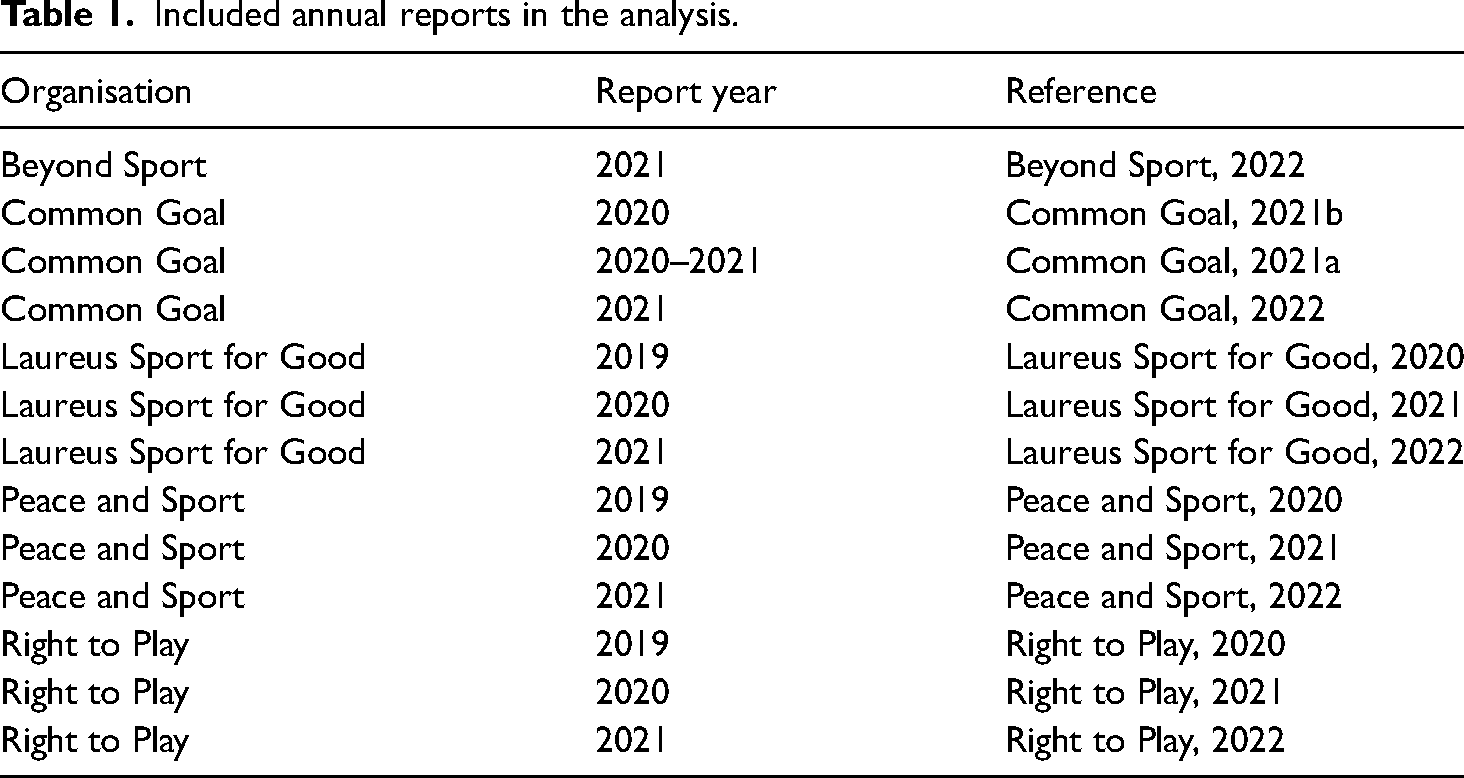
For our sample, we employed the most recent available data, as well as selected a period that covered before and after the start of the global COVID-19 pandemic. This was done to ensure that pre and post-COVID periods were covered, as well as to capture any shifts over time. We obtained annual reports through an online search of publicly available annual reports published by the five targeted NGOs. When we were unable to locate reports online, we contacted the NGOs directly to request the documents. However, one organisation only had the 2021 annual report available leaving a sample of 13 annual reports from the five organisations. A full list of included documents is presented in Table 1.
Included annual reports in the analysis.
Data analysis
Krippendorff (2019) describes content analysis as a tool that enables researchers to investigate unstructured data to reveal information about specific phenomena. For our analysis specifically, we use a form of directed content analysis (see Hsieh and Shannon, 2005) that deductively expands on the functions of framing defined by Entman (1993). We used MaxQDA to support and organise our analysis, and we proceeded in three general steps.
First, each author independently familiarised themselves with the data, reading the annual reports and taking extensive notes. This process allowed us to generate preliminary reflections while also developing specific initial codes connected to the functions of framing, namely, defining problems, identifying causes, determining solutions, and making moral judgements. As such, these codes reflected a variety of related topics, including information related to social issues the organisations are trying to address, the work they do like improving education, and perceptions of the larger power of sport to create outcomes.
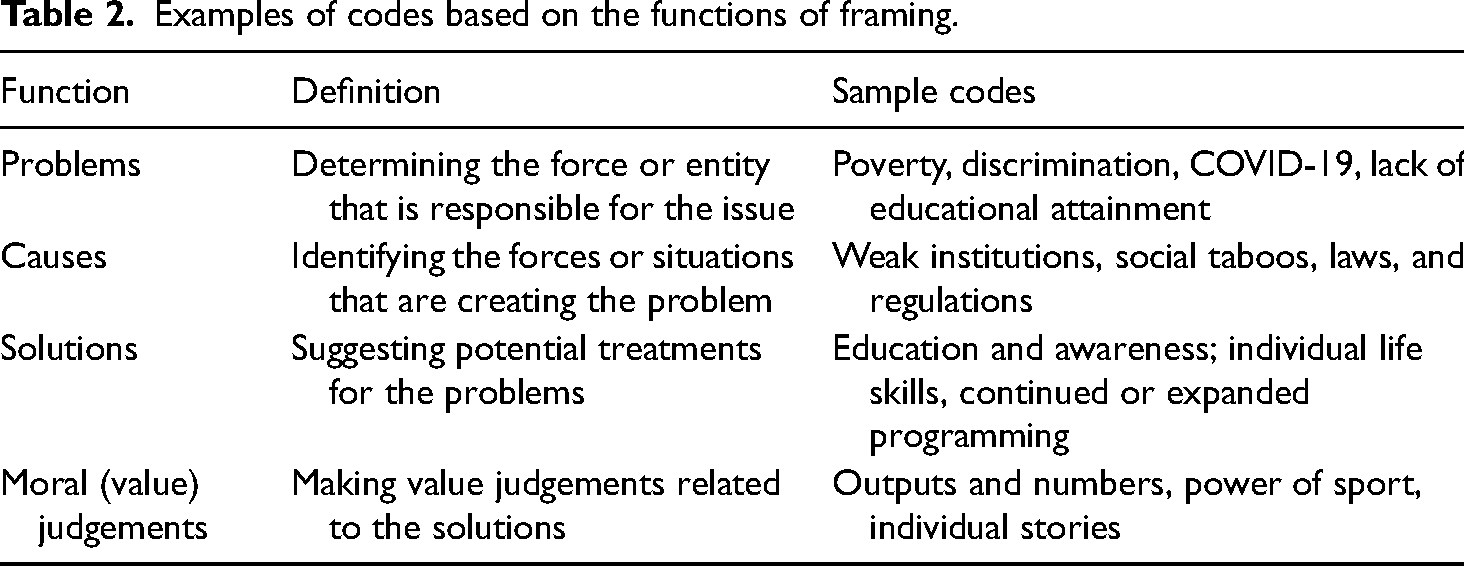
Second, each author initially coded one annual report. Afterwards, we compared our coding, discussed the need for additional codes, and refined our codebook. Following the piloting phase, each author coded half of the annual reports, and throughout, memos and notes were taken to refine the codes and track analytic reflections (Merriam and Tisdell, 2016). In addition, in the case of any uncertainties or questions, the authors regularly met and exchanged throughout the coding process. Examples of codes for each function are found in Table 2.
Examples of codes based on the functions of framing.
Finally, we moved from coding to developing themes, or patterns in the data that connected various codes together (Bryman, 2012; Hsieh and Shannon, 2005). To move from coding to our final themes, we reviewed codes and associated excerpts, used in-built visualisation tools within MaxQDA (e.g. code maps, code relations) to support reflection, and engaged in a process of iterative, collaborative theme development. In the end, a number of sub-themes were identified within the framing functions, and these are presented in the following section.
Findings
Following the coding, 11 sub-themes within the four functions of framing were identified. The functions of defining problems were separated into three sub-themes including COVID-19, societal problems, and specific local issues. The function of identifying causes was not separated into sub-themes and is therefore reported alongside the framing of problems. The function of determining solutions was divided into four sub-themes, including improving education and skill development, forming partnerships, and increasing, and continuing SfD programmes. The final function of making moral judgements can be broken down into four subcategories including quantitative outputs, the power of sport, individual stories of success, and the suggestion that solution is predominantly individual leading to individual behaviours and skills overcoming systemic challenges.
Problems and causes
Analysis of the annual reports of SfD organisations revealed a lack of consistent salience in types of development problems. When problems were identified, they were either highlighted as more general issues that the organisations wanted to address or as specific issues that were important to an individual story. One notable exception was the problems related to the COVID-19 pandemic, which was a persistent theme across all organisations.
Every organisation mentioned that COVID-19 was creating unprecedented challenges for SfD organisations around the world. Along with the challenges facing all people, organisations emphasised that COVID-19 negatively impacted vulnerable populations at higher rates including children as ‘COVID-19 rolled back years of progress on the advancement of children's rights’ (Right to Play, 2022: 3) Some organisations also presented the COVID-19 pandemic not only as a salient problem but as an opportunity to highlight their own resilience or resourcefulness in the face of the crisis: ‘With the pandemic exacerbating the challenges faced by the young people we serve, the partners we support and the sector we are so proud to be part of, 2020 was a year of harder work than ever’ (Laureus Sport for Good, 2021: 5). Similarly, the pandemic was also framed as an opportunity to think more creatively about SfD programming. Peace and Sport (2021) emphasised that the pandemic provided extra motivation and as a result, their staff ‘redoubled its efforts to develop innovative peace-through-sport programs’ (p. 5).
In addition to COVID-19, there was significant salience of large-scale problems that need to be addressed on a global scale. Many of the problems that were featured in these reports were mirrored in the United Nations’ Sustainable Development Goals, including reducing poverty, encouraging educational attainment, eliminating gender inequality, and promoting peaceful societies. The frequency of words within the reports is demonstrated in Figure 1, with words including COVID-19, health, education, gender, and inclusion amongst the 75 most common words when common words like a, the, and to were eliminated (see Figure 1 for the word frequency with larger words appearing more often within the analysed reports).
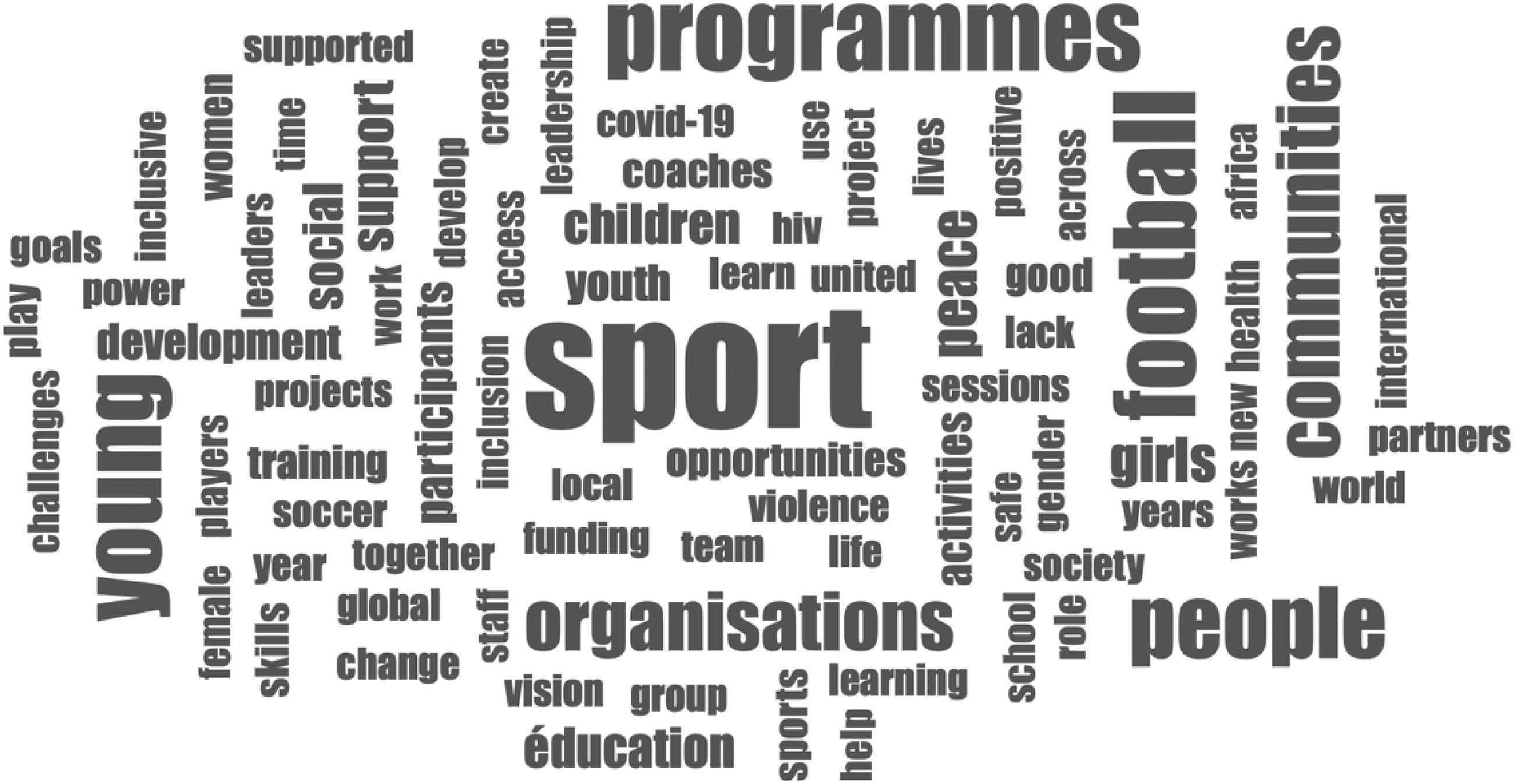
Word frequencies derived from annual reports.
However, there was no consistent salience of these issues across all the organisations. For example, although multiple organisations acknowledged that ‘gender inequity and discrimination are deeply entrenched and widely tolerated throughout the world’ (Common Goal, 2021a: 6) and gender inequity is particularly relevant related to sport participation as ‘historically sports have been a male-dominated space’ (Laureus Sport for Good, 2020: 19), the problem of gender inequity was not emphasised equally within the sample. Organisations also recognised problems surrounding the promotion of peaceful societies, such as Common Goal (2022) which indicated that ‘conflict, insecurity, weak institutions and limited access to justice remain threats to sustainable development’ (p. 33). Many of these problems were framed as large-scale issues threatening development on a worldwide level, yet other problems were less salient and only discussed in the context of one individual or supported project.
For example, environmental concerns like climate change were only mentioned by Laureus (2021) in relation to their Green Challenge. Although Laureus (2021) acknowledged that more needs to be done to combat climate change and improve sustainability practices, it was not a salient issue within the sample and was not mentioned by any of the other examined organisations. In addition, problems related to discrimination of people with physical or intellectual disabilities as well as the challenges faced by refugees were presented in the documents but were mentioned infrequently and only in relation to individual stories of partner organisations or single participants. These specific problems were often framed in the context of other more salient problems. For example, related to the lack of services for people with disabilities, Laureus (2020) wrote that for ‘children with disabilities, many miss out on basic education and other physical and therapeutic interventions to help them learn, develop and grow’ (p. 16). Therefore, the problems related to disabilities were also related to problems associated with health and education. Although several problems were indicated in the annual reports of SfD organisations, there was not consistent attention given to each issue and varied from organisation to organisation as well as year to year, reflecting likely shifts in community, funder, and policy priorities.
Unlike problems that were heavily featured, albeit with different salience, within the examined SfD organisations’ annual reports, the causes of these problems were largely ignored. Throughout the sample, there were only a few mentions of causes such as cultural taboos or lack of knowledge that may lead to problems in areas like health, gender (in)equity, and education. Allusions to taboos including ‘stigma towards mental health’ (Laureus Sport for Good, 2022: 17) and the lack of health education including a ‘lack of access to reliable information and health services’ (Common Goal, 2021a: 19) were present in the reports so there was some acknowledgement about may be causing developmental challenges, but it was not a prominent theme. There was even less salience given to the notion that these problems may be caused by systemic issues or weak institutions. For example, Common Goal (2022) did mention how the challenge of ‘structural and systemic discrimination’ limits access to sport for marginalised communities (p. 9). Overall, this was not common in the sample as the focus was often on the proposed solutions rather than the root causes.
Solutions
Although the causes of problems were not clearly illustrated within the reports, much of the information was focused on the solutions to these development challenges. The analysis revealed that SfD organisations highlighted the expansion or continuation of their active programming as a solution for social, political, and economic problems. Beyond Sport (2022) set the goal to increase ‘our support of the global network’ and ‘sharpen their programs’ to create a more lasting impact on sport for development projects worldwide (p. 4). Likewise, further bolstering the claim that the work they are doing itself is a solution to development challenges, Common Goal (2021a, 2021b) emphasised that it was important that ‘organisations are strengthened to continue to serve their communities’ (p. 36).
The second identified sub-theme that was present throughout the reports was that collaborative work between SfD organisations and external partners is key to solving problems. Within the context of these reports, these partners can be broadly understood in two categories, either as local NGOs implementing activities in their communities or various corporate and governmental funders financing those activities. Though far too long to list, these funders include major international corporations such as Frito Lays, national governments such as Canada, as well as other foundations. The acknowledgement of the group effort is illustrated not only by the corporate logos and comprehensive descriptions of all the partner organisations provided in all of the reports but also explicitly highlighted that the work conducted would not have been possible without ‘our partners who made it possible to extend the reach of this international mobilization’ (Peace and Sport, 2021: 28). SfD organisations suggested that partnerships were considered key in creating meaningful solutions to development challenges as ‘working in partnership – as teammates – we can together help communities get through these challenges and emerge stronger than ever’ (Laureus Sport for Good, 2020: 5). In short, SfD organisations’ partners are repeatedly presented as key stakeholders in the delivery and support of activities.
Within the provided activities, education and the development of life skills were highlighted as the most salient solutions to the targeted development challenges. Education included improving larger scale awareness about the SfD sector and identifying ‘where the sector can do more, focusing efforts on bringing together expert minds in new ways and providing to help strengthen community sport organizations’ (Beyond Sport, 2022: 4). Education also included the role of sport in individual educational attainment as organisations pointed out the connection between sport and improving ‘learning outcomes by fostering academic performance and achievement, leadership abilities, and concentration and focus capabilities’ (Laureus Sport for Good, 2020: 24). This sub-theme also included the development of individual skills and educational attainment as a means to solve problems. Common Goal (2022) uses ‘street football to enable young people to develop skills and abilities they need to develop positive life perspectives and find their place in society’ (p. 12). Elsewhere, there were examples from Right to Play (2021) that emphasised how its programming is ‘giving millions of children a chance to develop a lifelong love of learning, and the holistic skills they need to succeed’ (p. 15).
Moral (value) judgements
As with solutions, there was particular salience related to the value judgements related to their SfD work. The annual reports dedicated significant space to outputs and numbers which suggested that quantitative data are a main sign of success or impact. Quantitative outputs that were emphasised throughout all the reports included the number of programmes supported through grants, the number of children reached by particular programmes, and the number of countries where programmes are implemented. Funding was also mentioned in quantitative terms as Beyond Sport (2022) highlighted providing ‘a record $1.8 million in funding 45 projects and organisations around the world’ (p. 4). The documents further included outputs like assessment data from specific supported programmes. For example, Right to Play (2021) illustrated the success of a skill development programme for refugees in Thailand through pre- and post-test data, stating that ‘the number of children and youth who say they appreciate their value and the value of others increased from 9% to 84% as a result of their participation in the Achieving Change Together program’ (p. 16).
In addition to the outputs and numbers, the annual reports made explicit references to the concept that sport has the power to impact change. There was a significant reference to the broad-reaching capability of sport programming that proves ‘that sport has the power to change the world’ (Laureus Sport for Good, 2020: 4). Along with such sweeping claims, in some instances, the organisations framed the power of sport and play as a means to solving specific problems like adversity or conflict, as Right to Play (2021) helped ‘children to rise above adversity using the power of play’ (p. 5) and Peace and Sport (2020) suggested that ‘sustainable peace can be significantly advanced through the powerful catalyst of sport’ (p. 45).
The idea that sport has inherent power received significant salience as did the inclusion of individual stories of upliftment that were presented as emblematic of the NGO's work. The annual reports from all the organisations were filled with colourful images and testimonials from individuals including participants, coaches, and administrators who reported being positively affected by SfD programming supported by these organisations. For example, Right to Play (2020) shared the story of Zaida from Mozambique, who was going to be forced into marriage at 14, but ‘the skills and confidence she gained in Right To Play programs helped her convince her parents to let her stay in school’ (p. 3).
This idea leads to the additional sub-theme that the annual reports framed solutions as developmental challenges that can be solved if individual people were more educated or had adequate training in particular (life) skills such as leadership and communication. For example, the reports often argued that individual skills learned through SfD programmes could be used to directly combat large-scale developmental programmes such as conflict or gender inequality. One illustrative example of this comes via the following quote: ‘The mother of a girl in the program told us how her daughter used the confidence and quick-thinking skills she learned to stand up to a group of attackers who threatened her after school and escape a very dangerous situation’ (Right to Play, 2020: 5). This framing was not only present within Right to Play's reports as there were examples from other organisations about individuals growing up within disadvantaged communities with limited access to financial resources and no access to sport. These development challenges then led to negative behaviour before being introduced to a sporting programme, but after gaining access, participants became model youth within their communities: ‘He quickly developed a passion for rope skipping, building confidence, gaining focus and becoming a better citizen through the sport’ (Laureus Sport for Good, 2020: 17). This framing was not just limited to individual cases but also broad ideas that teaching life skills to children ‘is a key objective in order to minimise risk factors associated with crime, violence and drug use’ (Laureus Sport for Good, 2020: 28).
Discussion
Our findings illustrate how SfD organisations frame problems in the field, as well as the kind of solutions and moral judgements associated with these problems. Beyond the rather consistent presence of COVID-19 in the problem category, there appears to be rather inconsistent attention to various development problems across our sample, except for educational attainment and gender equity, which seem to be the most salient. This variation could be due to several factors, including the use of different examples across the problem areas each year, shifting community or organisational priorities, or how focus areas are defined by funders. What is most striking, however, is the almost utter lack of discussion of causes, which draws a close parallel to the results found by Sandvik and Seippel (2023). Though a wide variety of problems were identified, including many far-reaching social problems such as poverty reduction, peace promotion, and, to a lesser extent, environmental protection, the causes of these problems were hardly, if ever, explicitly mentioned. Although framed as a problem, the COVID-19 pandemic provided organisations with an apolitical cause and scapegoat for numerous problems which were exacerbated by the pandemic. COVID-19 also provided a means to highlight wins by the organisations amidst a global shutdown. At best, reports loosely pointed to concepts such as stigma, taboo, or lack of information to explain the identified problems. Though Common Goal referenced structural issues related to racism, within the reports, there was no broader acknowledgement of the role systemic factors, such as government policies or social structures, could play in the problems discussed. A kinder, more pragmatic analysis could suggest that a discussion of (systemic) causes is perhaps burdensome, as it makes it harder to measure the outcomes of solutions and that the goal of these reports is to demonstrate achievements, so it is not overly surprising there is less salience on the causes. A more critical view would however suggest that causes are ignored as any discussion of causes would reflect negatively on the many corporate and governmental funders of these organisations. For instance, it is likely difficult to talk about causes of climate change such as overconsumption and fossil fuel-dominated mobility while also being funded by partners such as Mercedes-Benz and Nike, and listing numerous motorsport athletes as ambassadors, as is the case with Laureus. Some more critical voices have even suggested that this is largely the point of such sponsorships and partnerships, namely, that these allow elites to shape, control, and legitimise the agenda of the SfD field in their favour (Moustakas, 2024).
Regardless, it is evidently much simpler for organisations, and attractive for funders, to highlight programmes promoting individual-level outcomes as the main solutions to these otherwise complex social problems. Most organisations highlight the need for more or continued programming as a key solution, taking it as a given that the work they are doing is definitively working. This assumption is further translated to the overt focus on quantitative outputs within the reports, whereby most reports place the most salience on numbers highlighting how many people or regions they have reached, or how much money was spent. Yet again, if these numbers are to be considered markers of value or success, then that can only be the case when the default assumption is that the programmes are already effective. Ultimately, however, these numbers are not framed in terms of quality of service or participant outcomes but are largely output-focused.
Within this, there is another key, underlying moral, or value, judgement being made. Namely, that individual skills are the essential ingredient to address the targeted social problems. In light of the otherwise near-complete absence of causes, we would argue that this creates an implicit judgement that individuals are not only primarily responsible for development but, as other authors have argued, are also de facto to blame for social ills (e.g. Nixon, 2019). In fact, in the limited cases where causes are discussed, explanations such as stigma or lack of information appear to be well-suited to individual interventions aiming to raise awareness or develop skills. This moral judgement is made almost explicit through Right to Play's slogan to “Rise Above”, which reflects the organisation's goal to help children ‘rise above these challenges and find their way back to hope’ (Right to Play, 2024). Thus, it is not for organisations to work to address the root causes of social challenges, but rather incumbent upon young people to address challenges and act as ‘multipliers’, as evidenced through examples around overcoming obstacles such as fending off assault in the reports. Though we suspect that the organisations might argue against our conclusion, suggesting that with their limited reach and resources, they can better help participants to ‘beat the odds’ as opposed to ‘changing the odds’ (cf. Seccombe, 2002), we would push back against this for two reasons. Firstly, the organisations regularly extoll their significant partners and collaboration, including highlighting how they have been able to develop policies or integrate their curriculum within national education ministries. Thus, these organisations clearly have access to levers of power and decision-making and could therefore work towards improving the overall conditions of participants in their broader communities, even if they themselves cannot enact any kind of broad policy changes. Secondly, even if you accept the premise that these organisations should solely focus on supporting participants to ‘beat the odds’, doing this becomes exponentially harder when participants are not afforded a greater awareness of their context or socio-political situation. In other words, if participants are to beat the odds, it seems to us they should first know the odds.
Though not an explicit goal at the outset of our analysis, our findings allow us to situate these organisations through the lens of Giulianotti's (2011) typology of global civil society organisations in SfD. From this, we would argue that the selected organisations mostly align somewhere between a technical and dialogical model of SfD. From a more dialogical perspective, we see that the selected organisations target specific social groups, work with a train-the-trainer (i.e. multiplier) approach, and often promote modified experiential sport methodologies. From a more technical perspective, however, we note clear hierarchical relations between funders and local NGOs, as well as a prevalence of positivist measurement forms, which is readily documented by the overwhelming reliance on outputs and numbers to document impact.
In short, the selected organisations give salience to highly complex social problems while obscuring or ignoring their causes, and instead put forward solutions and judgements around the necessity, and efficacy, of individual-level interventions.
Limitations and Future Research Direction
Though our study provides interesting insight into how global SfD organisations frame problems, causes, solutions, and judgements within their annual reporting, there are nonetheless some limitations to be mindful of, especially as they concern the sample and mode of analysis. Of note, we could not fully capture one of our targeted organisations – Beyond Sport – as only one report was available despite direct requests to the organisation. More broadly, one could also dispute our selection of organisations as being representative of the largest global SfD NGOs. Either way, future work could benefit from looking at communications from other NGOs (e.g. Women Win) or with major foundations associated with traditional sport organisations (e.g. UEFA Foundation, World Netball Foundation). As with any other English-language research, especially in a field as globally active as SfD, it must also be considered a limitation that we did not engage with materials from important SfD organisations predominantly working in other languages such as French or Spanish (e.g. Futbol Mas). Especially in the Spanish-speaking world, which has been significantly influenced by more critical concepts such as World Systems Theory or Critical Pedagogy, it would be interesting to contrast the extent to which organisations there engage with problems and their (systemic) causes. Finally, another potentially connected and relevant stream of research concerns how major development agencies, such as USAID, GIZ, or others, frame their policies or communications related to SfD. Indeed, over and above the five NGOs investigated here, such international development agencies are likely the biggest financial supporters of global SfD projects (see, e.g. Bauer, 2022; Darnell et al., 2019) and could provide further insight into the assumptions embedded in, and imposed on, SfD work globally.
Another limitation of our work comes from the more directed, deductive approach of our analysis. Through this, we can only explain how reports were framed, not why they were framed in a certain way. Future research would do well to investigate how SfD organisations decide what to communicate, as well as employ further critical (discursive) approaches to such analyses. Such research could, amongst other things, illuminate how individuals perceive problems and their causes, and illuminate why causes are in turn so poorly described within reports. Likewise, though we present some critical perspectives on the overall framing of these reports, how these communications are perceived by programme participants or affiliated organisations would likewise be a valuable lens for future research, as there remains an ever-present need to better centre the perspectives of participants and communities in SFD research (cf. Chong et al., 2022).
Conclusion
The SfD field is rooted in the idea that sport has a unique power to inspire change and achieve social and developmental goals. However, scholars have expressed concerns that the practice of SfD is too focused on individual-level outcomes and reinforces hegemonic power structures (e.g. Hartmann and Kwauk, 2011) The current study builds upon the critical research in the SfD field to examine how leading SfD organisations are framing their organisational communication and emphasising individual outcomes as solutions for complex social problems. Frames are valuable tools within mediated and organisational communication that emphasise pieces of information making them more memorable and salient to their audiences (Entman, 1993). Examining the frames promoted by leading SfD organisations can provide key insights into how they are reproducing the hegemonic power dynamics.
Our analysis discovered key themes across the four functions of framing, defining problems, identifying causes, determining solutions, and making moral judgements. The key takeaway from this study is that the organisational communication of SfD organisations reinforced the idealised notion that sport has this unique power to solve large-scale developmental issues. While defining problems and suggesting solutions was evident within their annual reporting documents, there was a lack of salience in identifying the causes of these problems. This could suggest that organisations may understand the challenges of the complex social problems including poverty, gender inequality, and displacement of people, but are unwilling to acknowledge the root causes. Therefore, instead of highlighting systemic causes, they focused on individual-level solutions and further idealised the power of sport in creating change. This is problematic as the examined organisations are leaders in the field that likely represent the greatest financial volume and influence in the support of local SfD initiatives across the globe (Darnell et al., 2019; Whitley et al., 2019). As such, their messaging will influence how we continue to think about and how we approach SfD work, leading to a persistent emphasis on individual-level outcomes rather than systemic causes of global development problems.
Footnotes
Declaration of conflicting interests
The authors declared no potential conflicts of interest with respect to the research, authorship, and/or publication of this article.
Funding
The authors received no financial support for the research, authorship, and/or publication of this article.
