



Abstract
Narratives of progress have circulated around women's sport in recent times, as reflected in the growing numbers of women sports participants, increased media visibility and movements towards pay parity for professional sportswomen. As part of a wider project exploring children's sporting identities, 147 children were asked via focus groups (21) about their views on the perceived progress of women in sport, with the data analysed to see how these ideas might be underpinned by feminist perspectives. Using reflexive thematic analysis, the constructed themes comprised of (1) pay equity, (2) media visibility, (3) girl fandom and (4) a continuum of boys’ views. Overall, children are overwhelmingly positive about the progress of women in sport. Feminist frameworks presented in discussions on equity of pay and resources as linked to liberal feminism, to media visibility typically associated with popular feminism. However, while the viewpoints of the children appeared to support the progressive narrative around women in sport, many of the frameworks that underpinned children's views may not ultimately challenge gender inequality in sport. The significance of this research relates to the potential for future generations to recognise and embrace gender equity in sport.
Introduction
Narratives of progress have circulated around women's sport in recent times, reflected in the growing numbers of women sports participants, increased media visibility and movements towards equal pay for professional sportswomen (Willson et al., 2018). Despite these improvements and decades of effort around gender equity in sport, questions have been raised about this discourse of progress (McLachlan, 2019) which has been described as slow and uneven, leaving generations of girls and women behind (de Soysa and Zipp, 2019). There is a wealth of studies to support these claims, illustrated by the lack of gender equality around the concussion discourse (Hardwicke et al., 2024), the gendered systems for girls involved in hockey (Adams and Leavitt, 2018), the lack of structural change in horseracing (Williams and Hall, 2020), while soccer for girls and women in England has been shown to take place against the backdrop of inferiority (Pielichaty, 2020). This paper collects the views of a general population of school children regarding the progress of women in sport. Speaking to the next generation can provide a barometer around these progress narratives and give an indication as to children's contemporary attitudes towards women in sport.
Feminist frameworks are an important part of the evolution and progress of women in sport, whereby they can encourage movement forwards around equity, and visibility and acknowledge the importance of diversity and inclusion. In writing about girls and sport for development, Zipp et al. (2019) suggest that feminist practice should be central to the design of sport. In my writing about the place of women in sport and sports media I have employed various forms of critical feminism, neoliberal feminism, postfeminist and popular feminism, to highlight the plight and inequalities associated with women athletes, coaches and sports media professionals, e.g. Kitching et al. (2017), Kitching et al. (2022), Sheehan and Kitching (2024). Combined with my interest in child/youth sport, these perspectives have encouraged me to explore children's views on the topic. What is of interest in this paper is how children construct or reproduce their ideas around women in sport and how those ideas might be underpinned by feminist discourses or perspectives. Locating feminist frameworks in the views of children could help to imagine a gender inclusive model of sport for future generations.
Literature review
With very little research evidence on children's views of women in sport, some studies provide detail around gender/equality/equity frameworks that exist around children's sporting lives. Sport both within and outside of school tends to reproduce gendered hierarchies and power relationships for children in surfing (Schmitt et al., 2024) and playground football (Kostas, 2022), while some girls find traditionally male sports difficult to navigate (Bevan et al., 2021). Children are surrounded by traditional discourses of sport, particularly via their coaches who can position girls as different or deficient (Goorevich and LaVoi, 2024) or use discourses of difference (Hamer and Giles, 2024). Musto (2014) writes about how 8–10-year-old girls and boys in a youth swimming team discussed gender in their free time and found that girls and boys interacted in ways that affirmed essentialist and categorical but non-hierarchical meanings of gender. Similarly, boys in this later stage of middle childhood have been found to consistently compare and contrast the sports and physical activities that boys and men do with those of girls and women (Drummond, 2016). Young female equestrian participants (aged 10–17) challenge the idea of equestrianism as a sport where men and women compete on equal terms (Thompson et al., 2024). Larsson (2021) writes about how young people voice their experiences of injustice in sport and acknowledges that talking about perceived injustice can be problematic in a sporting context. In a study that most resembles this research, Sambol et al. (2024) explored children's (aged 4–17) views of women coaches. In speaking with males (n = 55) and females (n = 20), they found that exposure to women coaches reduces negative attitudes in children but does not significantly affect the underlying influence of deep-seated, implicit biases and stereotypes amongst children. This evidence paints a mixed picture in terms of children's gendered experiences in sport, but none of these studies account for children's broad-based views on women in sport.
In the midst of the growing popularity of feminism, there has been some, though scant evidence exploring adult attitudes towards women in sport. Pope et al. (2022) write about male followers of football and found proof of a change in attitude towards women in sport, with men performing overtly/covertly misogynistic masculinities, but also progressive masculinities, with a small number of men performing the latter two simultaneously. The findings showed signs of a backlash against the advancement of gender equity in football. Also in relation to women's football, Giachino et al. (2024) explored younger generations’ views on women's football, and found that they are favourable, but that there is still an element of disapproval around women's football. In terms of Australian women's football (AFLW), Glazbrook and Webb (2024) found evidence of gendered attitudes towards women athletes, with traditional gender role ideals shaping negative attitudes. Importantly, each of these three studies used survey methods to gather views of adults. Along with shedding light on children's viewpoints on women in sport, the qualitative approach used in this study may provide deeper, descriptive insight and nuances that may not be captured in quantitative studies.
Feminist frameworks for women in sport
Rather than delineating versions and waves of competing feminisms, there have been calls for discussion on the intersections and overlaps between different strands of feminism (Caudwell, 2011). On the representation of women in sports media, Thorpe et al. (2017) conclude by suggesting that synthesising feminist perspectives is beneficial to understanding how women athletes are situated within global neoliberalism. Wood and Litherland (2018) use a critical feminist framework to write about the encounter between neoliberalism and feminism via a WWE documentary. They argue that this combination of capitalism and feminism may open opportunities for new forms of representation for women in sport. In my previous work with others, I used a synthesis of feminist frameworks in writing about one professional athlete activist (Kitching et al. 2022). For the purposes of this study, an amalgam of feminist perspectives is used to highlight the feminist potential in children's viewpoints around progress for women in sport.
With discourses of gender equity and fairness central to this study, earlier strands of first and second-wave feminism are important and still hold significance in the male dominated field of sport. Many of the questions raised by early liberal feminists remain pertinent to contemporary sports practice (Scraton and Flintoff, 2013), particularly around access, opportunity, pay and conditions. Cooky and McDonald (2005) write about the narratives that girl athletes produce around their sport experiences; they found that all girl participants challenged gender discrimination, thereby subscribing to elements of liberal feminism. Second-wave critical feminism outlooks are also important in outlining the structural inequalities that exist for women athletes; bell hooks wrote about the need to resist not only gender discrimination, but also racism, classism and other forms of oppression (hooks, 2000). Lusted and Fielding-Lloyd (2017) use a critical feminist position to argue that the liberal ‘absorption’ approach to gender equality does little to challenge the structural arrangements with male interests prioritised and protected. Using both liberal and critical feminism in this research will maintain a focus on gender equity and institutionalised and deep-seated conditions for women in sport, but also support intersectionality and recognition of other forms of oppression. The work of Birrell (2000) and Scraton and Flintoff (2013) is important in this regard.
Contemporary perspectives on feminism, for example, neoliberal feminism, have much to offer in terms of giving voice to power, control and politics, telling us more about who may be included or excluded. Banet-Weiser writes about ‘popular feminism’ as part of the economy of visibility, something which took hold following the #metoo movement (see Banet-Weiser and Portwood-Stacer (2017)). Popular feminism refers to conditions whereby individuals and organisations have their feminism seen, liked, retweeted shared, and accessible to the public. Through popular feminism, there is recognition of the growing number and prominence of women, and thus this tenet of feminism flourishes in popular culture and media, where it is closely linked to the neoliberal principles of individualism (McClearen, 2018), self-entrepreneurialism and economic success. Banet-Weiser suggests that similar to liberal feminism, simply bringing women to the table can become the solution for all gender problems; however, the mere presence of women does not necessarily challenge structures (Banet-Weiser et al., 2020). In this way, popular feminism and the growing number and visibility of women may not be enough to address and remove barriers that prevent true gender equity (Banet-Weiser, 2018). The use of popular feminism in this paper can highlight instances where children refer to the mediatisation, marketisation and visibility of women in sport. A trend that has grown alongside popular feminism is popular misogyny (Banet-Weiser, 2018), as a response to popular expressions of feminism. Mostly cultivated in online circles, popular misogyny is often characterised by a cohort of males who are not happy with women's increased visibility and presence in sport. Given the connection between the recent popularity of feminism and the theme of this paper around progress for women in sport, searching for aspects of misogyny will be an important aspect of the data analysis.
The key interest in this paper is the way in which children construct or reproduce their ideas around the progress narrative for women in sport, and how these ideas might be underpinned by feminist perspectives. The intention is not to cover every tenet of feminism, but rather, to highlight the types of feminism that might be visible in children's viewpoints. Combining first and second-wave frameworks of liberal and critical feminism alongside the more contemporary popular feminism will support a theoretical discussion around the varying degrees of support (or otherwise) for the perceived progress of women in sport amongst this cohort of schoolchildren.
Materials and methods
This study took place in the context of a wider research project on children's leisure and sporting identities. The project aimed to explore the place of sport/leisure in children's lives, covering themes such as children's hobbies, sport participation/experiences, sport event attendance, fandom and engagement with sports media. There have been several outputs as part of this project, around children's fandom (Kitching, in press), parental influence on the children's leisure time, and children's embodied experiences of sport (Kitching, 2024), indicating strong boy/girl differences in their orientations towards the physical, social and emotional nature of sport. While these works add to an understanding of children's sporting identities, this study tells us more about the equality/diversity/inclusion frameworks that might underpin children's engagement in sport and sports media.
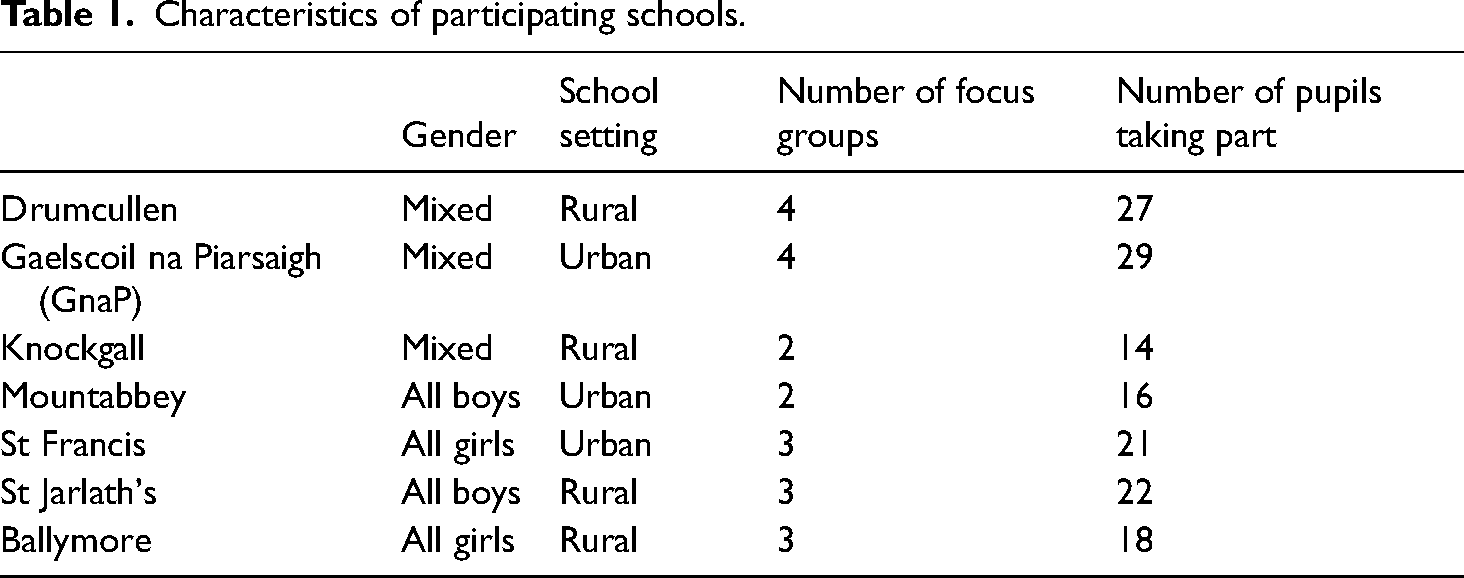
As documented in the above outputs, in late 2023, twenty-one groups took place with primary school children (n = 147; 77 boys; 70 girls) aged 10, 11 and 12 from seven primary schools in Ireland. Fifteen primary schools in the Republic of Ireland (ROI) were invited to nominate an upper primary school class group for the research project. In inviting these schools, consideration was given to gender, language of instruction, whether the school was designated with DEIS (Delivering Equality of Opportunity In Schools) status and if so, what DEIS band. Seven schools consented to take part in the research and nominated a class group (see Table 1) and a date was agreed for the author to attend and hold focus groups with the pupils. In advance of the school visit, an online information sheet and ‘opt-out’ form were circulated by the class teacher to the pupils’ parents; three parents/children opted out at this point. On the days of the focus groups, children were again given the opportunity to opt-out, and of all twenty-one focus groups, one child chose to return to class. Ethical approval was granted from the University Research Ethics Committee. In line with the wider research project, the topics of questioning were based around the children's engagement in sport and sports media, with specific questions for this study around the children's views around the progress of women in sport, whether they agreed that there has been progress, how it has manifested and what their own views are on women in sport; progress in this regard was spoken about in general terms. During the focus groups whiteboards/markers were used to support children in stimulating their discussion (Morgan et al., 2002).
Characteristics of participating schools.
Immediately following the focus group interviews, the schools and children were given pseudonyms, and the audio files were transcribed and reviewed for accuracy. Reflexive thematic analysis (RTA) was used to analyse the data, thereby encouraging thoughtful and reflective engagement with the data and the analysis (Braun and Clarke, 2021). This involved several analysis steps, starting during and immediately following the interviews, when notes were taken around elements that may have been hidden in the audio file including looks, non-verbal interactions or silences. These notes were particularly important in revealing the gendered discourses at play; a previous paper related to this dataset outlines how girls in mixed schools were less forthcoming regarding their opinions in relation to their embodied experiences of sport, and this contrasted with boys who were more exuberant, whatever the setting (Kitching, 2024). In contrast, for this topic, girls in mixed schools (even those who might have had little interest in sport) were quite forthright and happy to contribute. In this way, both the school setting and topic influenced the engagement of girls and boys, thereby indicating the importance of note-taking in the data analysis. It must also be acknowledged that having a woman (me) conduct the focus groups may have swayed the children's opinions and what they were willing to contribute. For example, when some boys, such as Cody [Knockgall 2] gave his views about women in sport, he directed them at me, saying ‘I think it's nice because you’re finally getting a chance to play a lot more…you’re finally getting recognised’. It is possible that Cody's opinion may have changed depending on the interviewer.
The next analysis stage involved a process of familiarisation, prior to coding. All the comments that children made about women athletes were coded and patterns around their views started to develop. These patterns were reviewed to assess whether the focus group data could be properly explained. In taking these steps, I acknowledge that the results that were generated are not separate from my own biases and experiences (Braun and Clarke, 2019). For example, while I consider myself a feminist, the search for feminist accounts in the children's conversations did not preclude finding aspects of anti-feminism, or discourses of popular misogyny in the data. Further, given my experiences as a white Irish woman, I was careful to search for the voices of children who were ethnically and/or racially divergent. The constructed themes are listed in the next section.
Results
In the initial data analysis phases, there were indications of children's views around equity for women in sport, with many boys and girls advocating for increased fairness. Some children outlined their discontent as to how women professional athletes have been treated. Debalah [St Francis 2] was forthright in her opinion: Let's say, yeah, I'm a girl, but I really love football. I want to be professional, but I also want to earn the same amount of money that the boys do, and you can't. That's not fair. Why is it like that though?
Some children spoke about how men and women should be treated the same way in sport. Linda [Gaelscoil 2] said: I think it is good. Like women deserve to be treated as good as men are treated… We're…we're as tough as them….
Some children spoke about the lack of fairness in terms of how women athletes and teams are resourced: The women's team are sometimes better in certain sports, but in general they're all equal… I feel like the men's team are getting way more equipment. [Katelynn, Gaelscoil 4] I think when I see people, the men having good managers and the women getting kind of okay managers, I just have a really bad feeling because it's not really fair. They're not getting paid equally. And it's just very upsetting. [Ríona, Gaelscoil 4]
These examples, all from girls in two different school contexts, outline the feminist potential within the data. The quotes are also reflective of three of the four themes that were constructed from the data analysis, which will be elaborated on in the ensuing sections: (1) pay equality, (2) media visibility, (3) girl fandom and (4) a continuum of boys’ views.
Pay equality
In line with the evidence of girls advocating for fairness as above, many children spoke about the need for women athletes – particularly professional soccer players – to be adequately reimbursed for their work. A discussion on pay ensued in Gaelscoil na Piarsaigh, focus group 4: I mean you should get paid if you play professionally. So, you should get the same amount as the men's team. So, the women and men should have the equal thing because it's only fair. [Katelynn, Gaelscoil 4]
Zainab [Gaelscoil 4] suggested: ‘I think they should all be paid equally because more people focus on the boys like Ronaldo’. Some boys in the same focus group agreed with these views: In the soccer, the men get paid way more… it's just unfair. The women, the women's USA team is the best women's team in the world… Yeah. And they played the men's team in a friendly and they battered them. So, they should be just paid equal [sic] or the women be paid more. [Liam, Gaelscoil 4] The American men's team, they're actually shockingly good, and they get paid 10 times more than the women. They're the best team in the world…I think the girls and boys should be [sic] the same rights. That's it. [Luca, Gaelscoil 4]
Some children believed that women athletes [in Ireland] were better than their male counterparts and should be duly rewarded. Related to another study from the wider project (Kitching, in press), the Republic of Ireland (ROI) women's soccer team was a point of discussion in the group and so the children regularly compared the ROI men's and women's soccer teams. Colm [St Jarlath's 3] said ‘they’re better than the men in soccer’, as did Sage [Drumcullen 3]. In one conversation, three children [Gaelscoil 2] discussed both teams. Lena [Gaelscoil 2] said ‘the women are like a little better than the men's soccer team’ and Luke said, ‘I agree, I think they’re way better than the men's team’. Zaira said, ‘the men are doing awful, they lost against Greece’. In the same school and the same topic, but a different focus group [Gaelscoil 4], Luca said ‘the women are way better than the men’, and Liam said: Ireland is a very small country, but the women are better in soccer and they’re better in boxing…I think they should have equal pay.
This conversation around equal pay became relevant in many of the focus groups. Abigail [Drumcullen 3] said ‘I think that they should be paid the same just because they’re a different gender it doesn’t matter’. Aaron in the same focus group said, ‘I think women should be paid more’. Josh who admitted he was a fan of ROI player Katie McCabe said, ‘I think the girls should be paid more, they’re better than the men's [team]’. In all, pay equality was a key element of children's discussions around progress for women in sport. Other than Liam mentioning that the women's US soccer team should be paid more than the men's equivalent, there was never any mention of equity.
Narratives of equality and fairness were key aspects of the children's views around the progress of women in sport. These analogies led towards comparisons between men's and women's sport/teams around pay and resourcing and these typically occurred in every focus group. Further, while the children were not questioned about rugby in the focus groups, both boys and girls mentioned rugby as a comparative example in four of the seven schools, where women's participation in rugby was spoken about somewhat disparagingly, aligning with recent research (Clargo and Skey, 2024; Petrie et al., 2024). Superficially, these comparisons seek out injustices in terms of performance, equal pay and overall fairness, but more significantly frame women's sport in relation to men's sport. Comparing women's sport and men's sport can reinforce male heroism and the superiority of male athletes and identify men's sport as the norm against which women's sport should be judged (Poniatowski and Hardin, 2012). Further, binary oppositions (which are almost unavoidable in sport) can create stable categories that can sometimes become oppressive and enable discrimination. The children's views appear to reinforce comparisons between women's and men's sport, which can sometimes hamper efforts for equity and progress.
The equality argument referred to above could be associated with liberal feminism frameworks, which advocate for equal access and opportunity and parity in pay and conditions for women. As mentioned earlier, these frameworks have a place in calling out discrimination and structural or institutional inequalities, such as wage, resource or access issues, which were mentioned by the children. However, liberal feminist frameworks sometimes lack nuance, intersectionality and recognition of global inequalities. For example, the children tended to focus on women as performance athletes, and absent from the discussions were women athletes with disabilities, those from non-white backgrounds, athletes as mothers, or just the wider concerns around girls and women as general participants in sport. In writing about sports coaching, Norman (2021) suggests that seeing gender equality through an equal opportunities lens results in narrow conceptualisations of gender issues and does not enable coaches to address equity in their environments (Norman, 2016). There is also evidence to suggest that liberal feminist approaches to gender equity in sports clubs and organisations have faced resistance (Lusted and Fielding-Lloyd, 2017; Patil and Doherty, 2023; Spaaij et al., 2020). Thus, the discourse around pay equality was narrow in only showing concern for elite level or professional level women in sport and failed to recognise intersectionality or the consideration of the wider realm of girl/women athletes and their participation in sport. In terms of feminist potential in the children's outlooks then, the focus on equal pay might demonstrate the limited nature of children's views around the progress of women in sport.
Media visibility
This was the most popular theme constructed from the data gathered, and the one that provided the most consensus amongst both girls and boys. Children were strong advocates for women's visibility in the sports media. Alison [Ballymore 1] said ‘it's just all men's sport on the TV, you wouldn’t see anything to do with the women's’. Adam [Gaelscoil 3] said: I could name about fifty men athletes, but I probably couldn’t give you three women athletes. But it's just very sexist, because men are on the TV more. I think it's very stupid.
Cooper [Mountabbey 1] suggested that there weren’t many women's sport events on TV, ‘especially with big sports do you know like [sic]…Gaelic [football] it's all kind of men's’. In the same focus group Casey suggested: For me I think it should be even enough…because how come men get to be on TV all the time playing matches. And ladies don’t?
Media visibility became a topic of conversation in Drumcullen [2], with Christian saying, ‘I think it should be advertised more’. Benji said, ‘the women's soccer wasn’t talked about as much as the men's’. Milly said: When it's the men's stuff, it's like everything is talked about it, but it's not that it's not normal, it's just not as crazy.
It also became topical in the Gaelscoil [3]; Andrea said ‘I think women should be more popular. People only really notice the men's sport. Oran said, ‘they should grow women's sport more because you see men athletes and they make so much more [money] than women’. Similarly, Elodie said ‘I think women's sport needs to be appreciated the same as men's sport because more people care about the men's sport than they do the women's’. Fiachra said, ‘I think women should be more popular’. While increased media visibility was important for most of the children in Gaelscoil [3], Keith had a more nuanced view: There's [sic] still women matches on, so there's soccer matches on for women, but you just watch the boys match. But if you want to go watch a women’s match, it's on the TV as well…the women's soccer is always on the tv, we’re just watching the men's ones all the time. So you can't complain about that.
Similarly, Zahil [Mountabbey 1] had a more pragmatic view on broadcaster choices: They broadcast what people are going to watch…It's because more people have interest in men…What's the point of broadcasting something that you're not going to make money off? It's basically gambling.
Thus, while the overwhelming view suggested that there needed to be increased media visibility for women in sport, some boys were less convinced. This point will be returned to in the fourth theme, a continuum of boys’ views.
Media visibility of women athletes was an important theme constructed from the data. These aspects are characteristic of popular feminism, which as earlier discussed is linked to media visibility and affective embrace with an aim to capitalise on the popularity of feminist discourse, but without critiquing or problematising patriarchy. The shift towards popular feminism and media and public support for women in sport appears to be a progressive movement. However popular feminism is limited in its scope, as it fails to critique the boundaries, structures and patriarchy that cause exclusion or inequalities for women. In other words, it is easier to argue for enhanced visibility than it is for equal pay, and to argue for increased payment than structural changes in how women in sport are treated; these aspects of neoliberal feminism are less threatening and more palatable than feminisms that advocate for structural change or systemic inequality (Cooky and Antunovic, 2020). Positive developments such as participation increases often hides deep-seated gender inequalities, for example, structural factors such as opportunities, conditions and pay (Sherwood et al., 2018). Thus, while the increase in popularity and awareness of women athletes amongst these children is welcome, it is possible that the beliefs that these children hold about women in sport may not manifest as a call to action to challenge systemic issues as they grow towards adulthood. Further, as earlier mentioned, the absence of discussions around non-white women athletes is problematic in terms of recognising the salience of ethnicity, diversity and difference within the field of women in sport. In this way, it appears that discourses surrounding women and men in sport are homogenised by the children and separated from other identity constructs.
Girl fandom
Several children expressed an interest as fans of women's sport, particularly the ROI women's soccer team. While many boys shared their knowledge on the team, evidence of strong fan engagement came from a small number of girls. Lena [Gaelscoil 2] lauded the progress that has been made with the team saying: I'm very happy about like [sic] the women's soccer and all that, cos [sic] it feels like about, I don't know, seven years ago soccer was like [sic]…soccer's for boys.
Maeve (St Francis 1) said she went to one of the team's recent matches at the Aviva (ROI national soccer stadium) with her soccer club, as did Cait [pilot focus group], both of their first experiences in following the team and crucial to the process of becoming a fan (Pfister et al., 2018). Cliodhna (Ballymore 1) watched their European Nations League matches on television. ROI and Arsenal player Katie McCabe was a key idol for many of these girls; Gráinne [Knockgall 2], who chose Katie McCabe as her favourite athlete, said ‘I’ve always kind of supported Arsenal’. Elodie [Gaelscoil 3] said ‘she plays for Arsenal, she's one of the best on the Irish team’ and Aoife responded, ‘she's the captain’. Sadie [Knockgall 2] said ‘she scored a goal from the corner’. While these examples might demonstrate strong feminist potential, there was another side of girl fandom that was less affirming, around women's sport events and the related anticipation and profile. Here, girls often compared women's sport with men's sport, and it was a source of disappointment for some, with Sadie [Knockgall 2] and Cliodhna, Kim and Lisa [Ballymore 2] lamenting the lack of atmosphere and excitement at women's sport events when compared with men's sport, while Lexi [Ballymore 1] said ‘it makes you angry’. While this evidence might be one of the first research accounts of girl fans of sport in the literature, the picture of frustration painted by this cohort indicates the distance yet to be travelled in terms of the popularity of following women's sport.
A continuum of boys’ views
With a few exceptions outlined in this section (Luke [Gaelscoil 2] and Cody [Knockgall 2]) all the data presented here is derived from boys who attended allboys’ primary schools. As mentioned in the methods section, boys in all school settings were generous with their opinions no matter the study topic, though it is possible that as a woman speaking about women in sport, I may have influenced what boys said or left unsaid. Boys offered a wide spectrum of opinions on women in sport and showed up as fans of the ROI women's football team as evidenced elsewhere. Several boys had progressive views, such as Niall {St Jarlath's 2], who suggested that women's sport was: Kind of underrated compared to men's…. I know a lot of people talk about Serena Williams is probably one of the best of all time, but I think they’re a bit underrated.
Luke [Gaelscoil 2] said women's sport has ‘improved over the years’, and alluded to FIFA games saying, ‘they’ve added women into the game…and I have, I have a team like that…most of my team is women’. Colm [St Jarlath's 1] said ‘most of the sports I watch, I watch women's ones as well’. Pedro [St Jarlath's 3] mentioned the mother of one of his classmates, who Peter [St Jarlath's 3] described as ‘one of the best footballers in the country – she would probably be better than most boys’. Cody [Knockgall 2] was a strong advocate for women athletes, particularly in soccer: Women's soccer matches. I feel like they’re one of the best matches [sic] out there because they’re so good, but they’re not recognised enough.
With a few exceptions, the boys in St Jarlath's were complementary about women athletes. Referring to the traditional Irish sport of Gaelic football, Pauric [1] said: I’d rather watch a ladies’ football match than a men's football match. They play way better Gaelic football than the men…. it's just faster…the men are just passing around but the women, they’re always moving, going fast up and down the field.
A discussion ensued in St Jarlath's [3] around women athletes. Similar to Pauric above, Pedro said he preferred to watch women's sport, not because of the speed or style of play mentioned by Pauric, but because of their moral superiority when compared with boys, as indicated by (Allison, 2021) in relation to women's sport: I prefer to watch a girls’ match over a boy's match…Because boys play off the ball…If someone hit me, I'd try and hit them a shoulder back or something on the ball though. But girls wouldn't they just get on with the match? I prefer it because my sister Ciara, she played a lot of hurling and football, and I love watching her….
Also referring to Gaelic sports, Karl [St Jarlath's 3] retorted with a similar viewpoint: Because girls are like, it's just good because they're really physical and there's no fighting. If you hit someone a good shoulder, I've done it plenty of times before obviously because they're coming in and they come back and hit you across the legs or something or give you a dirty dig and then you'd be like, “ah, ref!”. And then the ref would just play on. But for the girls’ match, they're very physical but they're fair. That's why I like it.
Another boy in the group responded by saying ‘girls have a way [sic] calmer temper than boys’. Here, we can see how the discussion moved towards key differences between girls and boys in sport. In a different focus group but in the same school, Jabari [St Jarlath's 1] gave his opinion on women and men in sport: It depends because some people will say that the women's sport is more physical, and some people say that the men's sport is more physical because you know how in soccer most people dive a lot and then there's the people who have videos of women's players getting flattened and getting right back up again. And then they say that the women's game is much better, but at the same time in the men's game they're scoring goals from much farther away. It's just because biologically men are stronger so they can do stuff like that.
While Jabari makes an initial attempt to find some nuance in his argument, his point moves towards gender essentialism, and belief in the biological rather than cultural differences between boys and girls. Different to the rest of the children, as mentioned earlier, Keith [Gaelscoil 3] and Zahil [Mountabbey 1] were less convinced about the need for increased media visibility for women athletes. Further, some misogynistic comments were also returned in both all boys’ schools. Robert [St Jarlths 2] made a negative comment about women playing sport, which was immediately responded to by Niall (mentioned earlier) and others: Robert: That the men in soccer probably would be more competitive because the men tackle each other, but the girls probably want to keep their knees clean… And it is just better to watch men…I think it's better to watch men…. Because men probably like tackle more. Niall: Sure Katie McCabe almost broke someone's arm in the last match.
A similar comment was made during a focus group in the other all-boys’ school [Mountabbey 2], which was again responded to and opposed by some. For context, the whole conversation is included here [Mountabbey 2]: Mahmud: I think they [women] shouldn't play…So many of them, yeah, they don't have the same strength Unknown: they deserve the respect. They're still humans. Johnny: They should get respect. Ryder: The men get loads of money, and the girls are doing the best they can and they're not getting as much money. David: The best women might be as good as the best men…the Arsenal women are just class. Jason: I think they should be getting small bit more money. They're not as good, but that's the best they can be. So I think they should be getting more money…. They're still trying. It's not like people still think the women should be working in the house all day and then the men getting money…The men are able to do so much more than women, but they're both trying their hardest out.
This discussion perhaps is indicative of the spectrum of views that boys had on women in sport, with some willing to defend misogynistic commentary, others lauding the best women players, while gender essentialism is also evident. One further element of the continuum of boys’ views related to an example indicating the flexible or overt/covert views from boys on women's sport. As outlined in earlier data, Luke [Gaelscoil 2] had been vocal about the positive growth of women in sport, stating that he has a women's team on his FIFA game profile. However, at one point, referring to Spain winning the 2023 Women's World Cup (WWC) he said ‘I have a dark joke, but I’m not gonna say it’. This could have been related to the case of sexual assault by the head of the Spain Football Federation on one of the players during the WWC medal ceremony. Regardless of the content of his joke, his contribution perhaps indicates how some boys may not have fully revealed their honest opinions on the topic of women in sport.
Many boys in this dataset were positive about the progression of women in sport, and the boys show great knowledge and interest via their own channels of interest in male sport, soccer and sports gaming. However, it would be wrong to assume that all children have this viewpoint. The comments from Robert and Mahmud indicate that not all boys are happy with the progress of women in sport. While these comments were misogynistic, given that the boys’ comments were challenged in each focus group it could not be claimed that popular misogyny was prevalent in the discussions. It was telling that both comments came from focus groups in all-boy settings, as did Jabari's comment which could be associated with gender essentialist outlooks and the binary oppositional accounts mentioned earlier, with the former widely regarded as a barrier to gender equity in sport (LaVoi and Goorevich, 2024). Luke's comment on the other hand, showed a level of restraint that might come from attending a mixed-gender school setting. We can see from the Pope et al. (2022) study on men football followers and their views on women in sport how Luke might simultaneously hold both covert misogynistic and progressive masculinities. Thus, boys’ views on women in sport have demonstrated a continuum of beliefs about women and men, including both misogynistic and progressive views.
Conclusion
Superficially, the data indicates that narratives of progress for women in sport have been reproduced in this cohort of children, who, aside from a few exceptions, are overwhelmingly positive about women athletes and teams. The theme constructed around girl fandom is an indication of the increased awareness and significance of women in sport for young girls, something which has not been found heretofore in a general population of girls, at least to this author's knowledge. Further, the small number of girl superfans, as evidenced by their attendance at matches, and their knowledge and interest in the ROI women's team illustrates the scale of growth in the popularity of women athletes. Simultaneously, these enthusiastic girl supporters also expressed frustration at the wider lack of interest in women's sport events, perhaps providing a sense of their feminist ideals. This, along with the boy advocates defending the interests of women athletes, is perhaps the most positive feminist tale arising from this research.
While a range of feminist narratives are visible in children's views, many of these perspectives scratch the surface in terms of challenging patriarchy and structural or institutional issues for women in sport. In the way that McLachlan (2019) suggests that discourses of progress could constrain the possibilities for gender equity in sport, positive developments such as arguments for equal pay and increased visibility often fail to challenge institutions and structures that caused these conditions in the first place, while comparative discussions around event attendances, moral codes and biological differences serve only to position men's sport as superior to women's sport. In research with young female sports performers in the UK, Devonport et al. (2019) found that sport does not always provide a way to challenge and resist dominant discourses. While the children quoted in this paper provide hope for the future of women in sport, many of the frameworks underpinning their viewpoints will not challenge entrenched gender inequality in sport.
In terms of a way forward, a good starting point might be encouraging children and young people to critically reflect on their own sports engagement; Larsson (2021) suggests that there is room in youth sport to create opportunities for children and young people to voice concerns about gender equality. As mentioned in another paper on this project (Kitching, 2024), listening to children's voices around their participation in sport could create space for critical inquiry and provide opportunities to create more inclusive spaces in sport. There is also a job of work to be done by sports feminists in communicating the underlying patriarchy that is consistently upheld in sport; creative approaches to presenting research could help in this regard, for example, Hogan et al. (2022).
Footnotes
Declaration of conflicting interests
The author declared no potential conflicts of interest with respect to the research, authorship, and/or publication of this article.
Funding
The author received no financial support for the research, authorship, and/or publication of this article.
