



Abstract
Many (inter)national governments and sports organisations are implementing standardised Safe Sport policies and guidelines. However, the Western-born, rights-based norm that underlies Safe Sport can collide with pre-existing geo-sociocultural norms of local contexts. Drawing from a case study of South Korea's elite sport pathway where tightened regulations on abuse challenge the long-lasting relational hierarchy based on Confucianism, this paper examines how athletes and coaches manoeuvre within the fast-changing social order shaped by the new safeguarding policies and practices. Analysing data from semi-structured interviews with 48 participants around two Elite Sports Schools, the paper shows that the rights-based norm integral to Safe Sport is sifted through the Confucian hierarchy, generating two main shifts respectively in coaches’ roles (from caring disciplinarians to professional service providers) and senior athletes’ (from potential abusers to benevolent superiors). That is, individual actors re-script their relational template by negotiating between the familiar and new relational ethics. From this, the paper suggests that Safe Sport is not a straightforward process of modernising less advanced practices up to a certain standard; it requires understanding how individuals make sense of the process in their own socio-cultural contexts.
Introduction
Safe Sport policies and practices have been rapidly developing around the world, aiming to protect athletes/children from all forms of abuse and violence (Moustakas and Petry, 2023). In particular, the International Olympic Committee (IOC) has taken the lead in the global movement for safeguarding athletes by, for instance, adopting the Consensus Statements on sexual harassment in 2007 (Ljungqvist et al., 2007) and abuse (non-accidental violence) in 2016 (Mountjoy et al., 2016). Moreover, the IOC (2017, 2018) has put forward safeguarding guidelines and toolkits to set minimum standards and encourage International Federations and National Olympic Committees to develop and implement effective policies in their jurisdictions. Most of these initiatives to date could be termed a ‘standardising’ process through which key concepts and principles are clarified, common understandings are shared, and best practices are disseminated for wider application.
However, these safeguarding measures and practices are spreading and settling in at differing rates across the globe. This is inevitable because every national or regional context is unique and different, and this socio-cultural diversity often weighs against swift and consistent policy changes (Kisakye et al., 2023; Wilson and Rhind, 2022). In essence, the established standards of Safe Sport have been predominantly informed by the notion of human rights (Rhind et al., 2013), constructed from concept clusters around what it means to be a human, rooted in ‘the culture of the Western industrial democracies’ (Rosemont, 2016: 36). However, there are many other societies with their own traditional views of human beings and relations, which may ‘hold opposed views and are therefore slower to change’ (Wilson and Rhind, 2022: 15). This calls for a much more culturally sensitive, socially conscious approach to achieving Safe Sport more globally (Rhind et al., 2017). Indeed, for the new Safe Sport policies and practices to be implemented in local and national contexts, there needs to be a ‘contextualising’ phase through which to enable diverse local sport development settings to take in the safeguarding principle, work out details and negotiate with pre-existing socio-cultural arrangements (Tuakli-Wosornu and Kirby, 2022; Zurc et al., 2014).
Although research on athlete safeguarding has studied various socio-cultural factors (e.g., Jacobs et al., 2017; Solstad and Strandbu, 2019), such as gender, race, sport-specific norms (i.e., the Sport Ethic) (Hughes and Coakley, 1991) and their intersections – especially in Western contexts (Kisakye et al., 2023; Rhind and Mori, 2020), there remains a lack of attention to geo-cultural norms that may mediate most of the other sociocultural factors. In this regard, this article focuses on a geo-cultural norm that operates in a ‘contextualising’ process of Safe Sport: East Asian relational hierarchy based on Confucianism. Confucian norms carry a particular notion of humans, namely, ‘role-bearing persons’, as opposed to the Western conception of ‘rights-bearing individuals’ (Rosemont, 2016). This unique value system can serve as a filter through which the new safeguarding measures are translated and screened out, while simultaneously, it can also be challenged by Safe Sport policies and practices.
Informed by both Rosemont's (2016) comparison between rights-bearing individuals and role-bearing persons and Ogura's (2017) observation of the Confucian relational template in South Korea (hereafter, Korea), this paper investigates how role-bearing athletes and coaches in Korea navigate through the new codes of practice brought by the rights-based safeguarding measures. Analysing data from 48 semi-structured interviews with student–athletes, parents, coaches and teachers in two Elite Sports Schools, this paper argues that the rights-based, western-born relational norm of Safe Sport is diluted with Confucian hierarchy in Korean society and localised into particular practices in coach–athlete and senior–junior athlete relationships: contractual relations and gentler hierarchy. The next section reviews the overarching theoretical framework of this paper.
Rights-bearing individuals versus role-bearing persons
The current Safe Sport movement is mainly underpinned by the concept of rights. Key literature has adopted ‘rights-based’ or ‘human-rights’ approaches with one of its origins from children's rights approaches (e.g., Kisakye et al., 2023; Rhind et al., 2013; Yilmaz et al., 2020). Likewise, safeguarding policy documents of international sports organisations, such as the IOC's Consensus Statement (Mountjoy et al., 2016), make clear reference to several conventions on human rights, such as the United Nations Declaration of Human Rights, the United Nations Convention on the Rights of the Child (UNCRC) (UNICEF, n.d.), etc. These conventions have also fed into national sports governing bodies’ development of safeguarding policies (Eliasson, 2017). The notion of athletes’ rights, enshrined in sport-specific declarations, such as the World Players Association's (2017) Universal Declaration of Players Rights, has also been influenced by ‘human rights legislation’ (Kidd and Donnelly, 2000). Defining sport participants (e.g., athletes and children) as ‘right holders’ and relevant responsible parties (e.g., sport organisations and coaches) as ‘duty bearers’, rights-based approaches to abuse issues in sport have the effect of rendering the safeguarding movement more self-evident and making it easier to challenge all potentially harmful practices as violating the basic principles of international treaties.
However, as Rosemont (2016: 48) highlights, ‘rights’ is a concept developed from the Western Enlightenment view of what it is to be a human being, as alluded to by its accompanying concepts, including ‘duty, rationality, autonomy, choice, self, and freedom’. Hence, the rights-based approach in Safe Sport inherently projects a particular type of human beings (e.g., rights-bearing, freely choosing and rational). Though any society can accept the basic standards of human rights (and Safe Sport) in principle (e.g., by signing treaties or incorporating its principles in their policy development), their application in practice might cause challenges, due not only to the different views of what it means to be a human being but also to their long-established relational ethics based on these views. One of the distinct views is Confucianism: an ancient Chinese philosophical and belief system that emphasises social harmony, respect for authority and fulfilment of roles within relationships (Zhang et al., 2005).
Rosemont (2016), an American Confucian philosopher, made clear distinctions between ‘role-bearing persons’ in early Confucian writings and ‘rights-bearing individuals’ in contemporary Western thinking. This parallel illuminates potential challenges that Safe Sport can bring to a modern society where rights-based civic values and role-based relational norms coexist in formal and informal areas of social life, including sport. Two distinctions deserve attention here.
First, in the Western conceptualisation, humans are deemed unconditional ‘rights-bearers’ based on the assumption that ‘people have certain rights solely in virtue of being human’ (Rosemont, 2016: 34). Conversely, the Confucian tradition emphasises the ‘qualities of human beings’ and ‘the kinds of persons who exemplify (or do not exemplify) these qualities’ (51–52). In other words, we are not complete human beings until we achieve those qualities. In this traditional conception, accordingly, the Western notion of rights is not taken for granted. Hence, while children in the UNCRC are deemed ‘full human beings’ (Freeman, 1996: 37), the Confucian tradition would see them as ‘human becomings’ (Rosemont, 2016).
Second, the two systems hold different assumptions about the nature of being human. While contemporary Western thinking regards individuals as autonomous, freely choosing selves (e.g., Adams and Kavanagh, 2020), Rosemont (2016: 52) asserts that the early Confucian perspective does not view humans in isolation, but humans are ‘the totality of roles … in relation to specific others’. These roles are not what they ‘play or perform’ as posited in Western sociology (e.g., Goffman, 1959; Mead, 1934), but inherent in who they are; they become the roles they ‘live in consonance with others’ (Rosemont, 2016: 53). Therefore, the two contrasting views would see what an appropriate coach-athlete relationship should be like differently. Rights-bearing individuals would perhaps contend that boundary-setting is key (Tuakli-Wosornu and Kirby, 2022) to respecting the autonomous, freely choosing individuals, whereas role-bearing persons would maintain that boundaries are set already by the interconnected roles (quite closely) and what matters is whether one would achieve the qualities the roles require.
As such, differing conceptions of what it is to be a human being may influence how we establish relationships in sporting contexts. Although the Western principle of human rights is not automatically put into practice even in Western sporting contexts due to, for example, sport-specific norms (Hughes and Coakley, 1991) and power relations (Nite and Nauright, 2020), the realisation of the human rights principle behind the Safe Sport measures in non-Western sporting cultures might have additional challenges because of the different perspectives on human beings and relations, such as role-based relational norms in East Asia. The next section delves deeper into the role-bearing persons’ relationship by drawing upon Ogura's (2017) analysis of the Korean relational schema, and how the power imbalance embedded within the relational template has played a part in reproducing physical punishment and abuse in the nation.
Confucian relational hierarchy in South Korea
Korea is one of the countries where Confucianism constitutes fundamental socio-cultural norms and raises role-bearing persons (Kim, 2009). Though the nation has developed a liberal democracy, the Confucian value system is embedded in most of the society's cultural customs and practices, serving as ethical, moral codes of conduct (Yang, 2009). Confucian values manifest in various forms: collectivism, tight social roles, vertical relations and some other traditional conservatism (Zhang et al., 2005). Even though some traditional virtues, such as prudence and unquestioning obedience to parents, have been fading away within the globalised and neo-liberal economic environment, relational hierarchy appears to be prevailing and is still being practised daily, across all aspects of life in the country.
Relational hierarchy is most obviously reflected in the Korean language. Depending on whom one speaks to, Koreans use one of the ‘three main forms of speech (high, middle and low forms)’ and more than 10 different pronouns are available to address ‘you’ (Song and Meek, 1998). Ogura (2017), a Japanese philosopher, offered an insightful observation of hierarchical relationships in Korea. Figure 1 shows one's hierarchical relationships with others, with oneself (‘I’) at the centre. According to Ogura (2017), Koreans can only be on equal terms with those whom they can call ‘neo’ (you) in Korean, and the most important criterion of ‘neo’ is being the same age, such as classmates from school. People use non-honorific language for ‘you’.
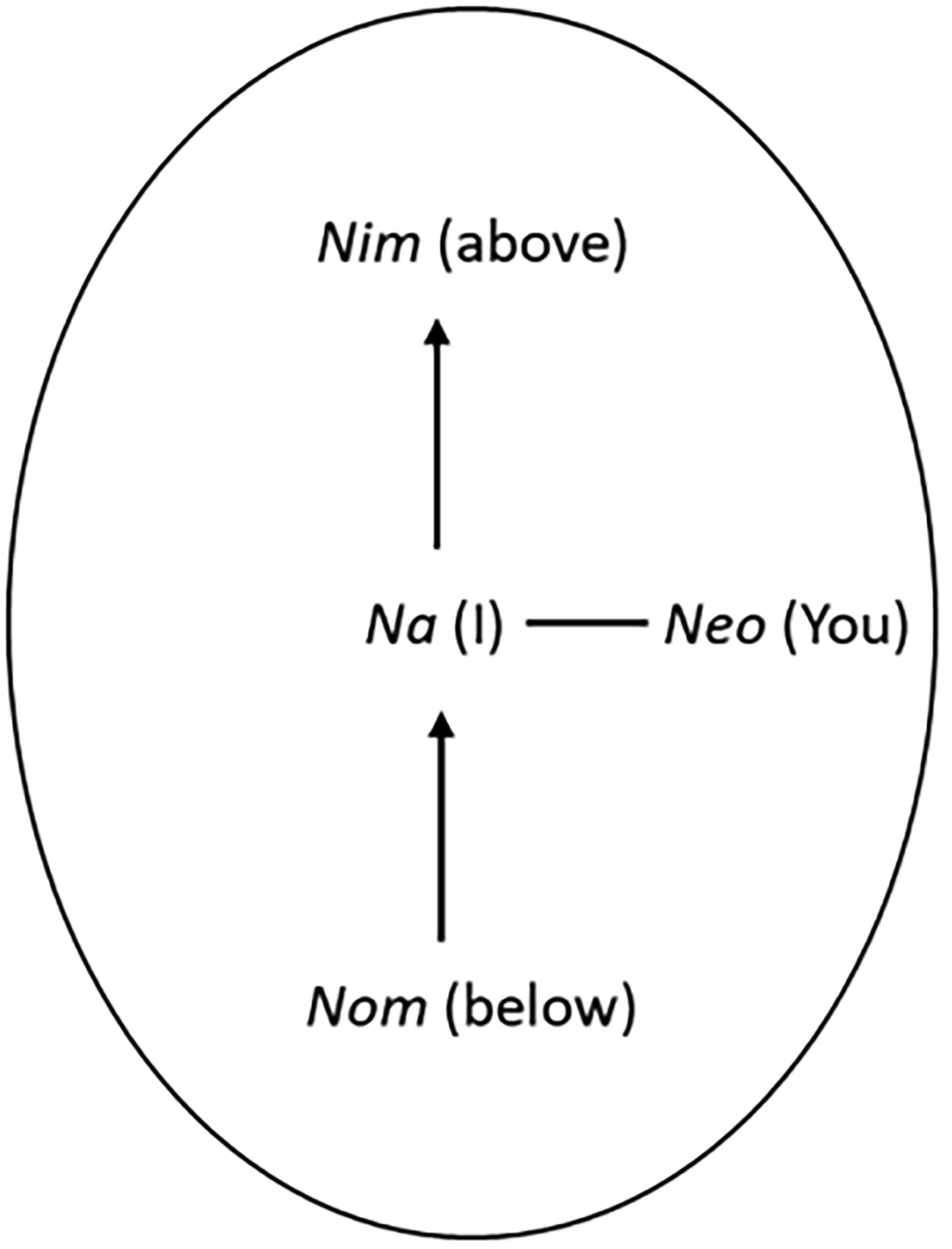
Koreans’ relational hierarchy in daily life.
Apart from the ‘neo’ category, there are people who are above or below oneself, which can be termed ‘nim’ and ‘nom’ in Korean respectively. People above one (nim) are mostly one's elder or superior, including kings, teachers, parents, older siblings, presidents, heads, senior colleagues and their spouses, etc. (Ogura, 2017). For example, a teacher is addressed by pupils as ‘seonseng (=teacher)-nim’. Sports coaches are also called seonseng (=teacher)-nim as they ‘teach’ sports, or ‘coach-nim’, a loanword compound, more specifically. Ogura (2017: 40) stresses that those who are addressed as nim are assumed to have higher moral values than oneself. In other words, although teachers do not necessarily have higher moral values than students, they are called nim with the expectation for them to do so in the Confucian value system.
On the contrary, nom is defined as those who are below in a hierarchical order, or are morally inferior, compared to oneself (Ogura, 2017). Therefore, non-honorific language is used for them. Ogura (2017) distinguishes between ‘nom of love’ and ‘nom of hatred’. Despite both implying incomplete human beings, ‘nom of love’ indicates those who have the potential to develop their moral values, including children, disciples or junior members (i.e., human becomings), whereas ‘nom of hatred’ involves those who have no potential to be developed to become consummate human beings.
Physical punishment in Korea can be explained by this notion of ‘nom of love’ given that the practice has long been justified as a tool of discipline for those below oneself, to foster them to be a more complete being (Hahm and Guterman, 2001). For instance, parents’ corporal punishment used to be common (see Go, 1992), which was mainly attributed to the seemingly contradictory Confucian logic of the whip (cane) of love (Yang, 2009): ‘Because I love you, I must whip you when you don’t behave’ (Hahm and Guterman, 2001: 176). This authority of parent nims was also extended to schoolteacher nims as seen with parents offering ‘sticks’ to teachers for disciplining their children ‘noms’, news reports of which were last found in 2009 (Myung, 2009). However, this distinction of physical ‘punishment’ (towards noms of love) from physical ‘abuse’ runs the danger of condoning physical violence committed in the name of discipline (Yang, 2009). Indeed, physical punishment for educational purposes can easily escalate to excessive violence (Kim, 2007). 1
While this practice of walking the ‘whip of love’ tightrope constitutes an authoritarian or disciplinary side of the nims’ interactions with noms of love, the other side is paternalistic benevolence and care (Huang et al., 2023). 2 Song and Meek (1998) illustrate this harmonious aspect of the Korean nim-nom relationship and relative role expectations by highlighting ‘morality and benevolence on the part of superiors, and obedience and loyalty on the part of inferiors’ (4). As this double-sided disciplinarian-caring interaction is based on power imbalance, however, any threat to the authority of nims can switch the benevolent side over to the authoritarian one (Huang et al., 2023), laying bare the fundamental power asymmetry behind the harmonious façade.
Interactional hierarchy in Korean sporting society surely embodies the K-relational template, especially given the fact that elite sports pathways were/are provided via school (Kim et al., 2020). An athlete ‘I’ have a coach-nim above me, while a coach ‘I’ have an athlete as nom. In a similar way, a junior athlete ‘I’ have a senior athlete as a ‘seonbae-nim’, while a senior athlete ‘I’ have a junior athlete as a ‘hubae-nom’. Although there are sport-specific justifications for physical punishment (e.g., improving mental toughness, concentration, team spirit and tightening discipline for communal living, etc.) (Kim, 2007; Kim et al., 2020) and broader ‘militarized masculinity culture’ influenced by militarism that the nation inherited from Japanese colonial rule and authoritarian military regimes (Hahm, 1997; Tikhonov, 2009), a key underlying mechanism that lies across these differing times and spaces appears to be the hierarchical relational template under investigation in this paper.
Taken together, our review presents three dominant interactional modes of nims (coaches and senior athletes) in their relationships with noms (athletes and junior athletes): benevolent carers, strict disciplinarians and potential abusers. These modes constitute a guiding framework with which we observe whether the main modes of interaction change under the influence of new Safe Sport measures that completely ban all forms of physical violence. It can be assumed that physical violence (be it punishment or abuse) per se might reduce significantly. However, questions remain as to whether the Safe Sport policies and practices crack the very relational template of nim and nom and how the nim-nom relations change accordingly.
Context and methods
Korea's safeguarding measures have been gradually intensified since the 2000s with constant abuse scandals in sport (Kim and Dawson, 2022, 2023). The most recent wave of reforms was sparked by two cases in triathlon and short-track speed skating in 2018 and 2020 respectively (see BBC, 2020; The Guardian, 2019), which led to the establishment of a sport-specialised Safe Sport body, Korea Sport Ethics Centre (KSEC) in 2020. These initiatives consulted allegedly ‘advanced’ safeguarding policies in Western countries, such as Canada, the UK and the US for their policy development and for keeping pace with so-called global standards (Korea Institute of Sport Science, 2020).
Though these campaigns have not directly targeted Confucianism relational norms, their emphasis on individual rights and pursuit of breaking down the rigid hierarchy in sport culture brought about measures that can potentially dent the very relational norms in the country. For example, stricter sanctions against physical punishment in sport and more accessible reporting channels appear to have reduced the power asymmetry between coaches and athletes as well as between senior and junior athletes, challenging the traditional authority of nim.
To capture how individuals manoeuvre in the new era of Safe Sport, a purposive sampling strategy was employed (Tracy, 2020) by selecting two Elite Sports Schools in Korea as the main sites for data collection. This is because the majority of school-age athletes train in their school teams and compete for their schools in Korea (Kim et al., 2020). More particularly, Elite Sports Schools are one of the key elements of the country's elite sport development programme. Being state-funded, the schools provide free education, coaching, facilities and high-price sport equipment for the middle (aged 13–15) and high school students (aged 16–18) on the elite pathway. Of 15 Elite Sports Schools across the country, two schools were chosen taking into consideration their different sizes and sports on offer (one located in one of the largest metropolitan areas; the other in the South facing a drastic decline in youth population) in case Safe Sport policies may be experienced differently. Elite Sports Schools serve as an optimal space for observing how Safe Sport policies and practices are applied and experienced for their dual nature, as (a) a main pathway for nurturing high-performance athletes competing internationally (performance-driven) and (b) state-run institutions subject to the national policies and curricula, which means that they are obligated to comply with the government's new Safe Sport regulations.
Following the attainment of ethical approval from the authors’ institutions, participants were recruited through several approaches (Tracy, 2020). First, ‘direct contact’ was made by leveraging one author's 11-year experience of secondary school teaching to ensure access to Elite Sports Schools. Once ‘gatekeepers’ (teachers) were secured, they introduced potential interviewees (student–athletes, parents, coaches or teacher–managers). Recruitment further expanded via a ‘snowballing’ method to listen to more diverse voices, particularly independent of the schools’ potential influences. Participants were reassured that their identities would be kept confidential. From the two Elite Sports Schools, we secured a total of 47 participants (25 from School A and 22 from School B), while we additionally included one inspector of a Regional Office of Education which oversees one of the schools (see Table 1 for the list of interviewees).
List of participants.
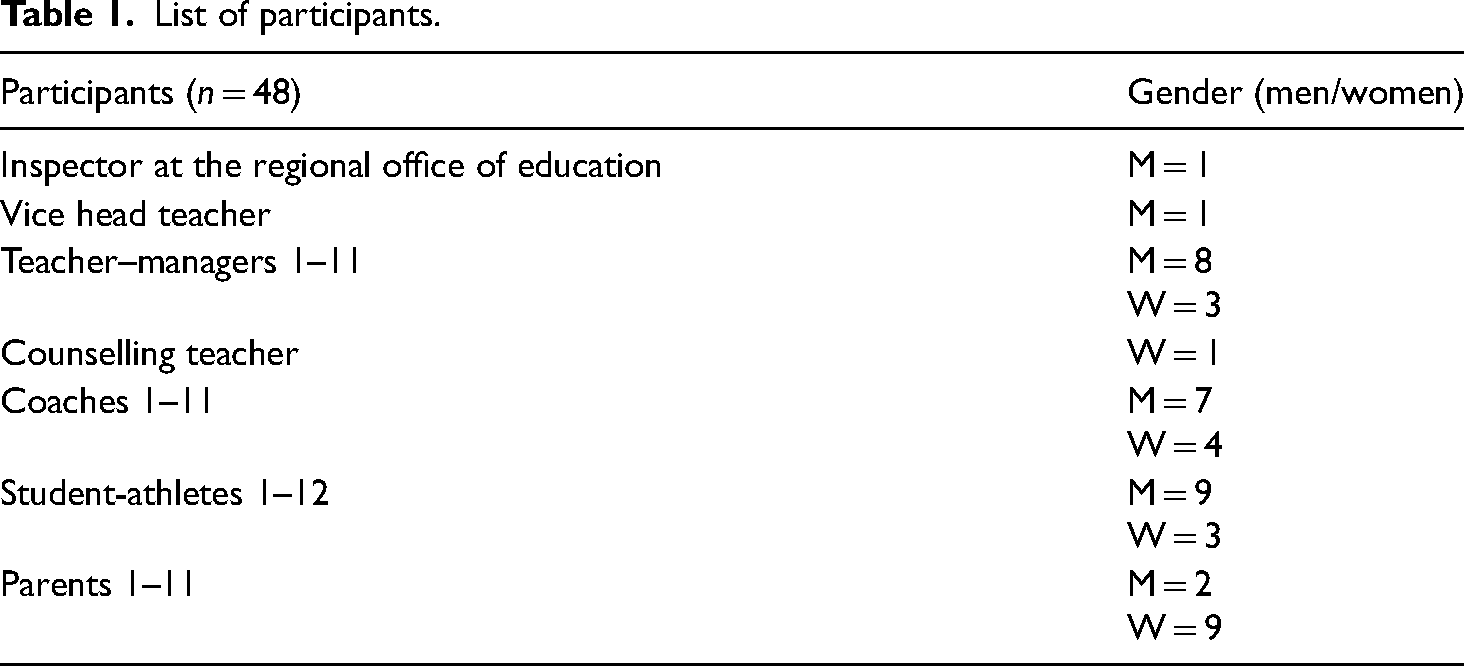
All student–athletes were in their final year of the high school course (18 years old). We deliberately sought this cohort because: (a) they had experienced Safe Sport-related changes 3 throughout their high-school years; (b) they were relatively free to speak about negative experiences as soon-to-be school-leavers; and (c) the research topic can be sensitive to athletes under 18. We also recruited parents of athletes to capture their perspectives as an important stakeholder group in the elite pathway programme (Holt et al., 2008). Although we did not intend to match parent and child interviewees, the nature of snowballing led us to have eight parent-child pairs amongst the 11 parents.
Interview questions explored the following themes: key changes in the current practices and atmosphere at the frontline after the strengthened Safe Sport regulations; the impact of the Safe Sport initiatives on their work and relationships; and athletes’ daily lives and interactions with others in sports settings, etc. Each interview, conducted once, varied in duration from 30 to 130 min. The scheduling of interviews was carefully managed in consideration of the individual participants’ preferences and availability. Most interviews were performed face-to-face at locations chosen by the participants, while telephone (n = 10) interviews were also utilised for the convenience of participants (mostly with parents). All interviews were audio-recorded and subsequently subject to being auto-transcribed verbatim through a digital platform (Naver Clover). The transcriptions then underwent rigorous checks and corrections by two research assistants and the authors. Following the analysis, selected excerpts and quotes were translated into English by the authors.
A theory-informed thematic analysis was conducted with reiterative inductive and deductive processes (Alvesson and Sköldberg, 2018; Braun and Clarke, 2019). Collected data were manually processed via an inductive thematic analysis. Interviewees’ experiences and opinions were first divided into two time periods (before and after the recent Safe Sport wave around 2020), to identify and contrast changes. With this dividing point in time, interview data was reviewed a second time to capture (a) the relational hierarchy template taken for granted or purposively indicated within interviewees’ comments, and (b) alternative ways of organising relationships mentioned by interviewees. These two distinct interactional norms were interpreted via Rosemont's (2016) notions of ‘rights’ and ‘roles’, and their relevant concept clusters, as well as three dominant interactional modes of nims developed from our review of Ogura's (2017) observation of K-relational norms.
It should be noted that the analytical framework, consisting of Rosemont's (2016) and Ogura's (2017) insights, served as a tool to interpret individuals’ thoughts and actions as a site of conflicts and negotiations between the traditional relational template and the new relational ethics of Safe Sport. Thus, the analytical focus was not only on identifying rights and role-bearing attitudes per se, but more on how the two different views create tensions and result in cultural shifts in the empirical setting. This process generated several themes which were finally mapped onto the changes in two key relationships between (a) coaches and athletes and (b) senior and junior athletes, according to which the following sections are organised. In our data, role-bearing and rights-bearing minds not only spread out across a wider spectrum but co-exist even in one participant's practices, which may reflect the messy reality of a gradual transition in the Korean sporting sector. That said, there appears to be a general trend, moving away from the strong traditional role template to flexible, and rights-informed attitudes, due to being exposed not only to various policies and procedures from Safe Sport education to punishment but perhaps to broader sociocultural changes in Korean society.
Coach–athlete relationship: Coaches from caring disciplinarians to professional service providers
It is unsurprising that the coach–athlete relationship in Korea epitomised the traditional hierarchical template. The relational template prescribed the roles of coaches and athletes, which automatically guaranteed coaches’ authority as nim over nom (athletes) – that is, the reproduction of role-bearing persons. As discussed earlier, the nim-nom relationship can be seen as double-sided because it is both disciplinary and caring, as captured in the concept of ‘a whip of love’ (Hahm and Guterman, 2001). Traditionally, sports coaches also bore this role in their relationship with athletes (Kim, 2007).
Most coach participants over 40 say that coaches, including themselves, used to administer physical punishment or at least ‘maintain tight discipline’ (Coach 6). Coach 1 noted: ‘I learnt that way, so I taught athletes that way, to be honest. That was the norm. Everyone took it for granted, so did I, to the extent that I couldn’t imagine coaching without that [physical punishment]’. Such authoritarian practices, however, would be perceived as caring for athletes, akin to taibatsu in Japan, another Confucian society (Tucker, 2013; Zhang et al., 2005), which can be considered ‘an expression of the level of commitment and care’ (McDonald and Kawai, 2017: 202). That is, corporal punishment in Korea was justified as coaches’ performing of the relational template towards their nom of love, though many instances might have included cases of abusive violence.
The other side of the coaches’ relational template was a warm caring role of nim, such as feeding and clothing athletes from underprivileged backgrounds. Despite successful model cases (Park, 2012), such private support ran the risk of congealing into a sense of ownership over the athletes as seen in cases where coaches take it as betrayal when their athletes leave for other teams or coaches (Teacher–Managers 1 and 3). As such, these father-figure models, be they disciplinarians or carers, often came with a lack of professionalism with no clear private boundaries by today's standards (Teacher–Manager 1).
Though safeguarding regulations have been stepped up since the mid-2000s (Lee et al., 2022), actual changes in the school sports setting were most directly influenced by the complete ban on corporal punishment by the Primary and Secondary Education Act in 2011, and more recently, the Ministry of Education's 2021 announcement to punish coaches’ verbal abuse with dismissal (Park, 2021). Additionally, many of the Human Rights in Sport campaigns and policy measures (e.g., reporting mechanisms, education programmes, etc.) at national and regional levels have sensitised coaches and athletes to all forms of abuse. This has closed the era of disciplinarians, giving way to a new era.
The total ban on physical and verbal abuse and the strengthened disciplinary actions have undermined the authority of coaches. Disarmed coaches seem to have been perplexed at the loss of their major coaching tool, not knowing how to take control of their athletes. As the Vice Head Teacher highlights, ‘Without this [method], what have coaches got at hand to push their athletes to the limit?’ Coaches are now, therefore, pressured to re-equip themselves with new knowledge and skills. Our participants have tried hard to employ new coaching techniques to replace the authoritarian approach with, for instance, science-based and/or athlete-centred coaching. Teacher–manager 10 said regular attendance of (international) coach education programmes had been a useful source of information as well as inspiration for developing a scientific coaching curriculum. Coach 3 told us that her governing body (gymnastics) emphasises the importance of gaining athletes’ ‘consent’ for any inevitable ‘touch’ per every training session.
According to Teacher–Managers 1 and 5, such renovations in coaching practice entail a shift towards a new paradigm with a kind of ‘service mindset’ (Teacher–Manager 1), which includes horizontal communication skills for athletes’ and parents’ satisfaction. Korea's educational bureaucracy also propels such a transition with the Regional Offices of Education offering various in-service education programmes for coaches employed at school. The School Inspector recognised the challenging situation coaches were placed in, but also showed a firm belief in the new direction his Office of Education was heading: [In coach education sessions] I get this question from coaches: ‘What should I do when athletes don’t listen to me, and I can’t stand it?’ Then, I answer: ‘Hold it in. You know that physical punishment is not the answer. You need to work much harder. You should develop teaching and learning and [coaching] programmes that help children to feel interested and improve their performance … You need to make plans by age or youth development stage; you need to refer to many books; and you need to collaborate with your colleagues to get good ideas. In doing so, you should make your athletes follow you. You raise your authority and expertise by yourself’.
The reconstruction of coaching without physical punishment, especially for those who used to rely heavily on the method, is a kind of modernising of the former, culturally taken-for-granted vertical relationship into a horizontal one based on professionalism and expertise. Their role as a coach no longer automatically makes them nim above athletes; rather, they are now required to develop certain professional capacities to build up their authority as coach and re-establish their relationship with rights-bearing athletes of new generations. That is, the traditional roles inherited from the Confucian relational template have now been deconstructed to a great extent.
The potential for an alternative relational norm is found in our coach participants’ reflective voices. Coach 7 said: ‘I believed that [tight discipline] worked because that made athletes react quickly and focus [on training] … I came to realise later that … that was focus on me [not to be told off], not on their own training’. Similarly, looking back on her past practices from today's perspective, a coach-turned Teacher–Manager 9 remarked: I believed I was caring for my athletes … which made me sometimes go over the line. Actually, I didn’t need to tell them off because they wouldn’t be able to reach the performance level [that I wanted]. I could have just made them happy every moment during training. I regret I went the extra mile doing evening and personal training sessions to improve their performance. Do you think they were happy? I’m sure they were just being dragged around.
The reflection above can be considered a sign of departure from the disciplinarian role-bearing coach, given that she no longer believes she should be a nim who decides what is best for athletes. However, this can also be seen as a withdrawal from the caring role – the other side of the Confucian nim – as indicated in her regret over the additional training sessions she used to offer. Indeed, coaches’ realisation of the new rights-based relational norm made many of them retreat to defensive, contractual relationships with young athletes because the growing emphasis on athletes’ rights and increased sensitivity to coaches’ potentially abusive practices have strained their relationships. Many participants (Coaches 1, 4, 5, 6, 8 and 9; Teacher–Managers 3, 5, 6, 7 and 10; and Parents 1, 2, 4, 9) mentioned that frequent accusations and dismissals of coaches had demotivated coaches, as highlighted by Coach 8's comment: ‘I see that eventually it's coaches who quit [if there is trouble]. Why should I get to that point [by putting in extra effort]?’ Student–Athlete 5 in a combat sport shared his view on the change in coaches’ approach: To be honest, coach nims don’t get themselves involved in sparring these days. They just stand outside and give feedback. It's a reverse effect. This [sport] is what you can learn by bodychecking each other. There is no other way. For a technique like …, you have to learn every little thing, including where to look. You can’t get these things by just listening to explanations.
As a risk-averse reaction, similar to ‘no touch’ responses in the UK sporting setting (see Gleaves and Lang, 2017; Piper et al., 2012), our coach participants tell us that many have decided to only work-to-contract, retorting, ‘what about coaches’ rights?’ (Coach 1). Moreover, coaches’ employment conditions have become quite secure recently in most regions of the country due to both organised union activities of coaches and the government's increased awareness that conditional contracts on athlete performance can cause abusive training (Jung and Choi, 2021). Hence, coaches no longer find any reason to risk their jobs by overexerting themselves to enhance athletes’ performance, not to mention challenging young athletes’ delinquent behaviours. This change in their role can be seen as both their losing authority and their release from the responsibility their previous role-bearing position had imposed on them. In short, the coach–athlete relationship seems to be shifting from one guided by the traditional relational template to a dry, contractual relationship.
Senior–junior relationship: Senior athletes from potential abusers to benevolent superiors
Our student–athlete interviewees state that their relationships with senior/junior athletes now have become more positive. The young participants highlighted that there used to be different duties and benefits assigned to students by their class year (age) in the Elite Sports School setting where communal living is a default, such as the first-year students cleaning the rooms and being forbidden to use a lift (Student–Athlete 9). Bullying was part of communal life, while senior athletes took for granted forcing errands, such as massage, waking them up in the morning and forging swords in fencing (Student–Athletes 1 and 9, Parent 9 and Teacher–Manager 5), echoing the stratified status amongst Japanese athletes: ‘Third years are gods, second years are humans, and first years are slaves’ (Kumate and Falcous, 2015: 46). In short, there used to be more explicit, abusive uses of power.
However, a series of school violence scandals have tightened up the educational bureaucracy's regulations on any form of violence at school. Moreover, as what is termed ‘school violence–Me Too disclosure’ accused a number of famous athletes of having bullied their peers when they were at school, punishment for student–athletes’ school violence has been further strengthened in recent years (e.g., banning representing Korea internationally) (Park, 2021). These changes seem to have contributed to bringing a new culture into the relationship among young athletes.
Many of our athlete interviewees describe their relationships with seniors and juniors as like ‘real brothers’ (Student–Athlete 8), ‘a relationship like friends’ (Student–Athlete 3), ‘teasing each other’ or ‘friends using honorifics’ (Student–Athlete 7) and ‘comforting each other in times of difficulty’ (Student–Athlete 12), signalling a considerable change towards a more horizontal relationship. Coaches often warn athletes about the irreversible consequences of student–athletes’ involvement in school violence, as seen in Coach 2's remark: ‘I tell my athletes not to cause even a minor trouble … saying, ‘Be careful of your behaviours, as your athletic career might end here [if you violate the regulations]’.
The changes in athlete–athlete interaction appear to lead some athletes to feel that power relations have been rather reversed. One student–athlete commented that when his juniors tease him, he ‘feels offended, and thinks if [he] lacks something to be their senior’ (Student–Athlete 11). Similarly, Parent 4 observed that senior students had now become underdogs if they were in trouble with younger athletes: When a junior acts rudely to his senior, and then they fight, and both are to blame from my perspective … but that's [considered] the senior's fault. [If the junior says] ‘I don’t want to be with him as I was hit’, the senior is put into a weaker position than juniors.
Such greater liability placed on senior athletes shows that disciplinary regulation itself is built on the assumptions of relational hierarchy: that is, ‘seniors must be perpetrators’ or ‘seniors as people above juniors should be more responsible for any troubles in the group’. Therefore, although the rights-based safeguarding measure seemingly places junior athletes on equal terms with senior athletes, the way in which school violence is handled may not treat student–athletes as equal individuals with equal rights either. In particular, senior athletes are still expected to act as vertical role-bearers in the Confucius relational template, the role of moral and benevolent superiors.
Even young athletes cannot completely free themselves from the relational template. Indeed, many still feel that there needs to be some order although it is unclear whether this is a knee-jerk reaction to the sudden levelling of vertical relations or because young athletes are also moderate embodiments of the Confucian hierarchy. Student–Athlete 9 complains that ‘younger athletes are more and more lacking in some basic manners, such as coming to help their seniors if seniors are doing something’. Perhaps they can be at best nice and generous nims who are still above juniors, not peers on fully equal terms. Student–Athlete 2 highlights that there is ‘a line not to cross [between seniors and juniors]’ and that is why he believes ‘[disciplining juniors] is necessary to some extent’. He goes on to argue: The juniors have no idea of who is above and below them because these days it's like just being friends. They’ve got no boundaries [to keep] … [When I was a junior], I thought this [disciplining] should be eliminated, but as I’ve got juniors now and experience them, I now think we need it.
The athlete participants’ opinions show how the hierarchical social norms form a powerful ideology – as everyone grows old and becomes nim to many people at some point, people want to keep the hierarchical order to some degree. Indeed, the majority of young athletes interviewed do not completely disapprove of the relational hierarchy. Rather than dismantling the hierarchy altogether, they seem to prefer to formulate a ‘good’ above-below relationship.
Another vestige of such a traditional relational template is found in how coaches govern athletes’ daily interactions. For instance, a teacher–manager distinguishes between seniors’ and juniors’ roles, which seems to be practising a Confucian tenet: ‘things and persons should fall into proper places and order’ (Zhang et al., 2005: 109): I’ve got this principle. There's no physical punishment [between athletes], but some rules, like, ‘Hey first-years, you bring some water here. When you guys are in the third year, I’ll tell your juniors to do the same thing’. And to the third-year students, ‘Hey, you see the first years get you water, so you should buy them ice creams or snacks, alright?’. (Teacher–Manager 10)
The interviewee's interpretation of the new order above clearly steers away from violence and physical abuse that can arise between young athletes. However, it is still following the Confucian relational hierarchy. His efforts are mostly about creating a harmonious climate in his team, but in a very Confucian way. As a result, the maximum output of such efforts might be warm, paternalistic care which is not much different from the positive manifestations of the Confucian relational hierarchy (Tzeng and Lee, 2021).
All in all, the senior–junior relationship appears to be transitioning from a rigid hierarchy to a gentler form of hierarchy. Although the interviewed senior athletes are trying to create a more horizontal relationship, they do not seem to want their generosity to end up in a fully equal relationship. Most hope to maintain a certain degree of order and discipline. Instead of discarding the Confucian hierarchy, they try to obtain the qualities of a good senior member, nim, within the hierarchy. What young athletes problematise seems to be a bad, authoritarian hierarchy, not hierarchy per se.
Discussion and conclusion
This paper has examined to what extent new Safe Sport policies challenged or filtered through the existing relational hierarchy by focusing on two Elite Sports Schools where coaches and athletes are managing to adapt to the relational order set by new Safe Sport policies. On the one hand, new Safe Sport measures appear to have modernised the coach–athlete relationships with new knowledge, regulations and practices. Outright physical violence is fading away, to be replaced with coaches’ professional capabilities, and coaches increasingly feel the need to set professional boundaries with student–athletes. On the other hand, deep in the informal relationships between athletes, relational hierarchy remains firm. What is being pursued amongst young athletes is not setting new boundaries between de facto equal individuals, but becoming kinder, moral, role-bearing nim and nom within the inherited Confucian relational norm. In that sense, it seems fair to suggest that the Confucian hierarchy in Korean sport selectively sifts through the rights-based, western-born relational norm of Safe Sport and develop localised practices in the elite pathway context: (a) more contractual relations between coaches and student–athletes beyond the traditional relational template; and (b) gentle, harmonious relations between senior and junior athletes within the traditional template.
If we compare the two relationships, the Confucian hierarchy between senior and junior athletes remains firmer than the one between coaches and athletes. This is perhaps due to the different nature of the two relationships. The coach–athlete one is based on the legal employment contract of coaches, whereas athletes, mostly minors during school years, mingle with each other in more informal relationships, which makes it difficult to regulate their interaction other than with exhortation (e.g., education) unless they violate formal regulations. The strictness of coaches’ legal employment contracts has largely suppressed the cultural relational norm, while there is no alternative form of relationship to replace the traditional relational template in the senior–junior relationship. In the absence of any replacement, the existing relational template seems to be evolving into a more acceptable form of hierarchical relations.
These two Confucianism-mediated developments beg the question: are the Safe Sport initiatives in Korea failing? Regarding the coach–athlete relationship becoming more contractual, some may feel disappointment as it was basically derived from coaches’ anxiety about potential accusations of abuse. However, in the long run, the resultant ‘no-passion’ approach may create more autonomous coaching environments where athletes set their own limits and become self-regulating – that is, rights-bearing individuals. Moreover, a new concept of care could emerge or be imported from overseas, such as duty of care (Kavanagh et al., 2021), from a rights-based perspective, in place of Confucian paternal care, although it runs the danger of losing the positive aspects of tight-knit role-based relations.
Student–athletes’ seemingly ‘normalised’ adherence to the hierarchy may look short of the ideal of what Safe Sport initiatives are trying to achieve. However, just because some aspects of the relational hierarchy have weakened does not necessarily transform all the Confucian ‘role-bearing persons’ into ‘rights-bearing individuals’ overnight (Rosemont, 2016). This is not only because the hierarchical template has been wired into every person, but also because most main social spheres of this society still maintain the relational template (e.g., department head-staff, PhD supervisor-student relationships, etc.) (Kim and Hamilton-Hart, 2022; Kim and Kim, 2020). Therefore, unless the sport sector can be a spearhead to bring down the ‘Confucian hierarchy’ in Korea, which seems very unlikely, constructing a ‘harmonious hierarchical relationship’ with people above and beyond might be the best-negotiated strategy at which our student–athlete participants have arrived.
The findings show that coaches and athletes negotiate between the familiar Confucian relational template and the new relational ethics, trying to find a way that does not go against either of them. Indeed, they did not simply comply with the new regulations: coaches showed pushback by withdrawing from active engagement with athletes, while athletes tried to adhere to the Confucian relational logic. They re-script their relational template, referring to both old and new ones to seek what is deemed appropriate by their relational templates at hand (March and Olsen, 1984).
This points us to potential approaches that Safe Sport research can consider. As seen in the findings, even if new Safe Sport policies and practices provide another model template for actors to take and apply, the template is after all interpreted and translated by the actors in a particular situation (cf., Scott, 2015). Therefore, in order to inform the culturally diverse global sports’ development of safeguarding practices, we should probably pay as much attention to the specific processes of individuals’ making sense of the cultural shift as to developing standardised practices for everyone (Zurc et al., 2014). As Kisakye et al. (2023) highlight, ‘applying a strategy developed in the Global North to contexts within the Global South may have little effect if cultural nuances are not an a priori consideration’ (10). In this paper, we have offered one way to take into account cultural nuances: given that individual actors are the bearers of some relational template derived from certain sociocultural norms, it is worth understanding the template and how it aligns with the norms of Safe Sport.
This is not to say in any sense that unique cultural elements can be used as an excuse to delay implementing safeguarding measures to protect athletes – a reduction to ultimate ‘relativist positions that avoid universalizing notions of the likes of human rights’ (Kumate and Falcous, 2015: 53). Rather, we suggest that unique cultural elements be put under academic investigation to find out how they serve as potential hindrances to safer sport so that this knowledge can be used in a particular locality to work out strategies to negotiate with pre-existing socio-cultural arrangements. In this regard, future research should be mindful that Safe Sport is not a straightforward process of modernising or improving some less advanced practices up to a certain standard; rather, it is working with the residuals of the sociocultural history embedded in the present contexts (Goodin, 1996). Developing effective, workable Safe Sport policies requires a nuanced understanding of the present sociocultural contexts.
Finally, it should be noted that this study did not employ any particular gender perspective, and thus, the presented views on the shifting culture generally mirror experiences shared in common amongst our interview participants regardless of their gender. That said, it is a limitation of this study that some of the data may appear to reflect mainly male perspectives. This seemingly male-centred standpoint in places, however, is a reflection of the male-dominated sector (where males are in the majority) and society (where males tend to be in positions of power). In this respect, future research should focus particularly on women's and girls’ experiences in Confucian cultures which are likely to be under-represented due to the patriarchal social structure and norms (Kim and Kim, 2020). Such gender-specific approaches could enable researchers to identify particular gender norms that are potentially entrenched in the Confucian relational hierarchy as additional geo-cultural barriers to creating safer sporting environments. Also, contemporary reinterpretations of Confucian philosophy from gender equality (Mun, 2015) and human rights (Kim, 2015; Li, 2020) perspectives could be another way to reconcile the potentially conflicting values of rights-based safe sport measures and hierarchical relational norms in Korea and other East Asian countries more broadly.
Footnotes
Declaration of conflicting interests
The authors declared no potential conflicts of interest with respect to the research, authorship, and/or publication of this article.
Funding
The authors disclosed receipt of the following financial support for the research, authorship, and/or publication of this article: This work was supported by the International Olympic Committee, Olympic Studies Centre (Advanced Olympic Research Grant Programme 2021/22).
