



Abstract
This article draws from several months of ethnographic research on gender, embodiment and violence, offering insight into situated (and contradictory) definitions of violence in mixed martial arts (MMA). Analysing interview data, violence is defined conceptually by members of one MMA club in the UK through specific frameworks, in which MMA fighting is regarded as ‘controlled’ violence. MMA skills are expected to be embodied relative to those definitions through bracketing processes, with regulating emotions, the significance of context and power dynamics between individuals fighting being key in categorising distance to ‘real’ violence. Analysing field notes and my own felt difficulties as a participant–observer, however, the navigation of women's bodies in mixed-gender sparring interrupts these categorising features of frame. Despite the acknowledgment of intersubjective and reflexive work to embody physically violent skills appropriately, men distance themselves from women in training. The contributions of the article identify how women's gendered bodies – as performative, normative and regulatory – interrupt the everyday orderliness of ‘control’ and expectations of who ‘does’ violence more broadly. The consequences of these gendered expectations are noted, with indications as to what other forms of violence might be ongoing in this highly gendered space.
Introduction
Societal distinctions and perceptions of violence have long been of academic interest. The role which violent actions play in wider society and their supposed benefits can be perceived and categorised in a more legitimised sense, for example, police and military use of force. However, the role of sport as a moral holiday (Collins, 2008: 243) and civilising action (Elias and Dunning, 1986) classifies ‘sport’ as another legitimised violent form. In this sense, then, illegitimate violence can be understood as contextual to violation and/or force (e.g. excessive police or military force, violence against the powerless, outside of the rules of the sport (Terry and Jackson, 1985)). Yet, there are difficulties of distinction when we consider violence in the context of martial arts and combat sport (MACS): that is, sport with a mimetic intention to cause harm.
The ambiguities and contradictions surrounding ‘violence’ in these spaces call for contextual sensitivity to behaviour and emotions and the ritually legitimised violence situated in action (e.g. Matthews and Channon, 2016). Over the last 20 years, MMA has become a topical example for considering these contextual issues, especially given previous Ultimate Fighting Championship (UFC) advertisements of MMA ‘as real as it gets’ to an actual street fight (see Downey, 2007, 2014). Some suggest that risk or edgework might be more of an appropriate concept to explore than ‘violence’ (see Channon, 2020). Still, the passion for distinction is arguably heightened. Despite significant organisational changes with the unified rules (as listed on the UFC website), MMA can still be regarded as a sport that stretches the limits of what forms of violence are legitimised or framed (Goffman, 1974) as sporting practice.
Combining various combat sports and martial arts traditions into one sporting category, MMA fighting can include body locks, chokes and striking of the body, including knee and elbow strikes, as well as losing consciousness. MMA, therefore, lends itself as a unique case to explore violence alongside matters of embodiment. What complicates definitions of violence/s further, however, are the gendered bodies through which action is enacted, in this instance, the embodiment and use of MMA skills. Therefore, this article contributes a gendered lens towards (il)legitimate violence and embodiment, bringing focus to observational and felt data in MMA where the interactional frame of ‘training’ is fragmented in observable ways. This frame ‘work’ (Goffman, 1974) is in accordance with the ‘rules’ of violence as situated by participants and the rules of gendered expectations of who ‘does’ violence. Drawing firstly from Goffman's (1974) frame analysis, and then Crossley's work on embodiment, the article provides participant definitions of violence – that is, ‘controlled violence’. The article then outlines a critical re-viewing of this ‘control’ in practice, where my body and the bodies of other women in training fragment the fighting frame and legitimacy.
Frame and gendered embodiment
Goffman's seminal work on interaction (e.g. Goffman, 1959) demonstrates that mundane social situations are ritualised and accomplished encounters, with rules and analysis around ‘frames’ telling of how situations of action or ‘strips of interaction’ are mutually understood and conceptually achieved. To understand situations and situational conventions – to know ‘what is it that's going on here’ (Goffman, 1974: 134) – ‘frames’ or ‘frameworks’ are relied upon. The interpretation of schemata into a particular frame of interaction is influenced by ‘keys’ or ‘keying’ (45), with materials, spatial arrangements and timings as just a few examples of keying used to direct the ‘audience’ in ‘bracketing’ frames of activity. Keys thus bring a sense of definitional clarity to action, but can also have radically different statuses as parts of the real world. This includes how we understand we are watching a play-fight rather than a ‘real’ fight (see 45–6) or how we come to know that sparring is not MMA fighting, and MMA fighting is not a brawl.
Experiencing and observing these moments ethnographically are focused on this article, but bracketing moments are equally tied to felt experiences of bodies. Crossley's phenomenological discussions of embodiment can be considered here, where the reliance upon the body (and other bodies) is a pre-requisite to developing skill and normative context of sporting practice. Given that skills and bodily knowledge are also reflexive (Crossley, 2005), tracing the observable transformation of the body (see Crossley, 2004, 2006) and how this may impact situational frameworks are of interest.
Yet, in the sporting context where beliefs of men's natural superiority are so prevalent, women are indeed ‘trouble’ (Butler, 1990), presenting numerous problems in bracketing, frame and intersubjective practice. The feminist phenomenology of Iris Young (2005) is valuable here, too, to consider how women's and men's embodied experiences are differently treated and valued. This article therefore analytically observes the interactional routines and intersubjective happenings through which ‘controlled’ violence is made relevant. However, it also presents a gendered dynamic, reviewing how ‘control’ is felt, embodied and gendered within the ethnographic space of Fight or Flight MMA club.
A gendered review of control partly influenced the methodological aims of the research, given that at the time of data collection (2018), there was limited research on women in MMA as practitioners or researchers. Where research participants are only men, arguably a false and generalised understanding of embodiment (and violence) is brought alongside it. Consequently, my body became an important tool to both explore and interrupt expectations of embodiment that I had previously read in the literature. I explore these decisions and processes below.
Methods
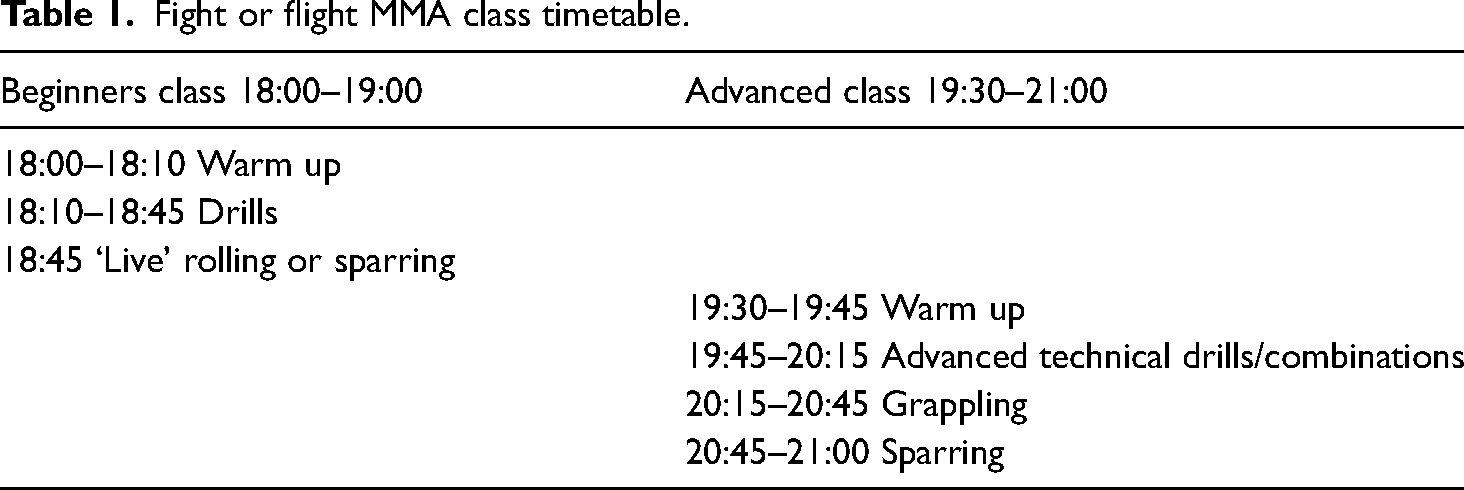
Fight or Flight MMA (pseudonym) was a well-known club in the UK MMA circuit, having moved across locations and gyms since its inception some 10 years prior. Despite being situated on the outskirts of a developing city centre, the club often played host to visiting fighters of ranging professional statuses. Certainly, the club's popularity is partly the reason for my interest in the space. The club's training schedule was spread over 3 days a week, with two MMA classes on each of those days: a beginner's class and an advanced class (see Table 1). After gaining institutional approval from Swansea University's School of Social Science ethics board, 42 h was observed (May–September 2018), with approximately 20 h spent participating across beginner and advanced MMA classes. Four participants in the club were approached and agreed to a semi-structured interview.
Fight or flight MMA class timetable.
Typical of many MACS clubs in the literature (e.g. Abramson and Modzelewski, 2010; Green, 2016; Spencer, 2012), the demographics of Fight or Flight MMA were highly gendered. Participants were primarily men, with only three women regularly attending the classes, including myself. Club members were primarily white British and working class aged between 17 and 46. Each MMA class had an average number of 24, and all attending the club were given information sheets with a consent form to read and sign. Details of research questions and articles of similar interest were also offered to participants to understand the aims and how data would be explored academically. As a semi-public space, some individuals came and went within the observation period. Nonetheless, this article follows those noted as primary members of Fight or Flight MMA, those who played a central role in interviews and field notes.
This article follows Steve (head coach), Phil (a seasoned fighter with over 15 fights in various competition forms), Sarah (with training experience for around 2 years), Lily (having only a week or so of experience in MMA at the time of my arrival, but previous experience of Taekwondo) and Rhys (member of the club for 2 years, but fought in Karate from a very young age). Phil, Rhys, Sarah and Lily agreed to one semi-structured interview each: three face-to-face with one via Zoom, ranging from 50 to 90 min. Semi-structured interviews appreciated their stories, history and their interpretations of violence – accounts of action not always observable. For reasons identified in a previous publication (John, 2023), I did not ask Steve to be interviewed in this format. Interviews ‘in the field’ did take place with Steve, although the organized interviews are the focus of this article.
Interviews were transcribed and analysed through mapping (Clarke, 2003), with preliminary themes developed from prior personal and research experience and the literature. Despite the importance of narrative, however, what people say and do can vary given that talk and action are highly situational. Interviews alone may ‘remove the “social” from social action’ (Jerolmack and Khan, 2014: 200), decontextualising interactions. Demonstrating the observed, situated knowledge-in-action through an ethnographic lens was, therefore, of equal importance.
Participant observation and flexible researcher role
There were various ways to ethnographically experience and explore the analytical interests of ‘the everyday’ in Fight or Flight MMA. The ‘everyday’ involved physical training and skill embodiment, and I wanted to feel those moments: the hitting, thinking, moving. The use of flexible researcher roles is well documented, with the body as a tool of inquiry and useful in ‘intensely physical’ (Stephens and Delamont, 2006: 328) settings (e.g. Channon, 2013; Green, 2011). Having 5 years of MMA training before the research this article draws from, I utilised my bodily capital to participate given that I was interested in ‘performing the phenomenon’ (Wacquant, 2014: 1) and the sensorial phenomena of being there (Sparkes, 2009; Sparkes and Smith, 2012).
In this flexible role, I actively participated in the MMA classes: face-to-face and body-on-body with participants. My competencies as an insider-of-sorts as an ex-MMA practitioner allowed me to engage with MMA's physicality in various ways. I was less skilled in ground-based martial arts, though somewhat advanced in stand-up striking, pad work and stand-up sparring (enough not to feel like a complete and utter novice anyway). In previous research (John, 2016), this flexible role was invaluable, given that I was the only woman in those clubs.
With the potential to be the only woman in Fight or Flight MMA, my flexible role was of continued importance to see and feel gendered interactional experiences. Male researchers undertaking a similar role have had the privilege ‘to see and not to be seen, to represent while escaping representation’ (Ellingston, 2017; Haraway, 1988: 581). This article, instead, shows the different experiences of visibility. My role, body and words no doubt impacted phenomena and its analysis. My body did cause impact, as previous publication (John, 2023) and the latter half of this article demonstrate. Firstly, however, Fight or Flight MMA's situated understandings of ‘violence’ are given analytic attention.
Findings: defining violence in MMA
In my time, researching and participating in MMA debates around ‘violence’ in the sport were always present. Leading into the initial research on the subject (John, 2016), there was consistent chatter from participants about MMA's representation, with the same anxieties present in fieldwork in Fight or Flight MMA (2018). Notably, ‘outsider’ perceptions of the sport were raised unprovoked, and entering Fight or Flight MMA, I was met with ‘MMA's not really violent you know’, or ‘It's no different to boxing’. These immediate explanations may have also been a classed and gendered reaction to me in that space, given that I was a woman completing a doctorate (indeed, both ‘outsiders’ in the particularities of the MMA club). Still, the contextual nature of ‘violence’ in sports was evident in these conversations, with participants raising interesting points around the complexity of violence as a phenomenon during our interviews: Would you say MMA is violent? [Long pause] It depends at what level, but ultimately yes … I think it comes to the different levels. There's a controlled violence in a sense. Yeah. So yeah, I think it is violence but in a controlled manner … at the end of the day sports is sports, and there are rules, and if you adhere to the rules an’ you're in control of yourself then that's just sportsmanship … People have grown up watching boxing an’ things like that, it's just an ideology, it's sort of normalised in an extent in society … Whereas cage fighting's quite new … ‘cause obviously it's in a controlled environment, and it doesn't escalate beyond that. If they're controlled, and they adhere to the rules, they're sportsmanlike, then go for it.
The overall emphasis appeared to be ‘controlled’, repeated several times in reference to ‘rules’, ‘environment’, and to the individual (‘they're sportsmanlike’). There are complications around categorising MMA as violent, given that the goal of fighting is to cause some form of intentional harm. The ‘different levels’ of violence are also open to interpretation, given that ‘levels’ could relate to the different classes and layers of skill embodiment or the ‘normalised’ violence across sporting contexts. For Lily, rules provide a framework of how to do violence ‘properly’ within the formal codes of sporting practice with indicators of what could be considered as ‘bad violence’ within those rules or as ‘part of the show’ (Andreasson and Johansson, 2019: 1192–1195; see also Stenius, 2011).
There is a point of differentiation ‘in control of yourself’, with ‘control’ arguably relating to a fighter's emotions, with fighting (and training) often involved with layers of emotional management (e.g. Spencer, 2012; Vaccaro and Swauger, 2015). That is, fighters should be able to control their breathing, stay calm, react and attack sufficiently in training or fighting scenarios. Yet, control is also relative to rules of behaviour within the fighting context, with the importance of sportsmanship and fighting character highlighted. Lily does not interpret MMA as inherently different from other sports; therefore, given these rules and guidelines, ‘sports is sports, and there are rules’. Phil raised similar points: Uh, violence [laughs], I think the general public would see violence as a physical act, or an aggressive act towards someone else … So violence isn't necessarily throwing a punch. It can be someone throwing abuse, someone being loud, being pushy, loud, and aggressive. But I don't think many people actually understand what violence is … working the door, like I throw people out and I've had people say, ‘You were far too aggressive’, but they've never had a violent confrontation in their life. They don't understand what violence is … Like me and Tom, tearing chunks out of each other – that's violence. But the entire time me an’ him will be havin’ a conversation saying, ‘Can you hit me harder?' … That's violence, but they won't understand that because they don't get the mentality behind it. So, I think violence depends on your level of experience. A guy who's had no violent confrontation in their life won't understand how I enjoy competing, how I enjoy – not breaking people's arms – but putting people in positions they shouldn't be able to be put in just because I find it enjoyable. They wouldn't understand the concept.
Like Lily, Phil discusses physical as well as emotional violence (e.g. ‘throwing abuse’), but quickly extends to limited understandings ‘they’ (the general public?) have of the topic. Phil might be referring to people who have never had an MMA fight or to those who have never seen fighting or experienced abuse or violence while working on the door. Indeed ‘they’ are different from fighters like himself, with physical violence in MMA highly different ‘from a spectator point of view’ (Wacquant, 1995: 486). Phil's judgment of appropriate behaviour (evident in critiques of ‘the general public’) echoes a level of superiority – his experience and mentality are more valuable. These perceptions are not unique to Phil. As the article explores, ‘they’ (being ‘others’ and ‘outsiders’) also have a specific gendered dynamic embedded across coaching and practitioner perspectives.
Beyond perceptions of value, the necessity of physical impact in training (‘hit me harder’) is noted here, given its essential role in skill embodiment. Linking to Lily's response, if the perspective of controlled violence is relevant, then to be emotional is arguably engaged in out-of-frame behaviour (Goffman, 1974). Phil could be managing distance from emotions (thus a violent identity) in his interruption of ‘not breaking people's arms’. Perhaps he was going to say ‘breaking people's arms’, but thought that might be too far: a boundary breaker. Instead, Phil enjoys ‘putting people in positions they shouldn't be able to be put in’, bringing forward ‘beauty in practice’ (see Turelli et al., 2021: 2) instead of the outcomes of injury.
Phil's acknowledgment of varied forms of violence can relate to the purpose or ‘mentality’ behind the action. For example, the potential distinctions would consider non-emotional aspects of training, such as ‘havin’ a conversation’ about punching harder in training. For Phil, the ‘general public’ simply does not understand intentions of physical violence – perhaps, Phil does not even think ‘they’ would know what a ‘really’ violent scenario would look like, given ‘they wouldn't understand the concept’. Phil's disagreement that he is ‘far too aggressive’ at work could be a method of impression management, demonstrating the relativity and subjective definitions of violence (‘violence depends on your level of experience’). It might be the case that, as both fighter and doorman, Phil has become accustomed to a certain level of violence that he finds acceptable and enjoyable. Nonetheless, these accustomed levels have consequences for those remaining ‘outside’ of the norm, whether men who are beginners in MMA, or women: both lacking ‘insider’ skill and masculinity. The classification of these groups as having an inability to even ‘understand’ is observed in Fight or Flight MMA, where embodying ‘controlled’ violence is disrupted and for some (indeed ‘the others’) infantilized in practice. I outline some of the observations of embodiment in practice before reviewing in a specific gendered lens of action.
Embodying ‘controlled’ violence
Responses show an understanding of MMA as a form of ‘controlled violence’, with definitions of ‘control’ relating to rules and expectations of the sporting context and goals that orient the action. To be a fighter is to be part of an enterprise of controlled violence through physical skill. In this enterprise, that is, Fight or Flight MMA, club members were varied in skill set and experience, but all had to become accustomed to performing ‘controlled violence’ in specific movements and progressions:
Both classes usually began with a warm-up, stand-up-based fighting technique (e.g. boxing, Muay Thai), followed by ground-based martial arts like Brazilian jiu-jitsu or wrestling. The timetable represents temporal elements of this progression, with routines across classes increasing in technical expectations and power (e.g. how hard someone might punch or kick or how much resistance to use when performing techniques). To become accustomed (that is, to embody) to ‘controlled’ violence, there was work and hours of it, with a routinised training process involved in ‘drills’ and ‘sparring’. Drills are techniques and reflexive interactions repeated over time; not thought-provoking necessarily, but simple and ongoing:
Steve uses the space of the dojo and tells everyone to circle around him. He calls someone to demonstrate the arm-bar, breaking down the details of the movement. It takes some moments for the coach to discuss the technique, looking around the room to see a sea of nods or silent faces. ‘If you can't see what I'm doing, move so you can see’. He repeats the arm-bar, but now on the right arm. ‘Alright, have a mess around with that’. We separate into our pairs, finding a repetition of movements or rhythm to get as many reps as possible. He calls back out to the class, ‘Okay, just get that movement done before we move on to the next’. Fieldnotes 27/06/2018.
Coach walks around the room. His face is blank, just watching. He interrupts, shouting over the music. ‘Guys, with your fucking ears on! You're reading your guy. Don't be lazy with the pads, hold the pads appropriately. Do the same shit. Make it automatic’. Fieldnotes 30/07/2018.
There was a pattern to a technical demonstration in a specific instructional way: Steve calls for attention, demonstrates the technique on a body, and the club repeats the actions in their pairs. Techniques are also sequential (Crossley, 2004: 44), where additional demonstrations advance the technique in some way, then repetition again. In both progressions, there is significant work by Steve and the ordering of the training context. The aim is to gradually build a technique into one fluid motion through additional layers of movement, the key point being repetition. These repetitions involved a ‘regular rhythm’ to ‘repeat until you get it right’. Despite the apparent simplicity of the ‘same shit’, these are essential to progression, alongside repetitive components to ‘Make it automatic’.
Each time Steve displayed techniques, there was direction to view him and listen (‘move so you can see’/‘with your fucking ears on’). Club members watch, all while being instructed through a specific gaze with nods, imitation and mirroring gestures (see Crossley, 2007: 59). In other MACS research, the actual moments of ‘becoming parrot’ did ‘not involve thought, but the performance of an act over and over again’ (Spencer, 2012: 90–91) – essential to building muscular memory for pre-reflexive action (Graham, 2013; Wacquant, 2004: 60). In a fight, fighters ‘have no time to think or plan’ (Crossley, 2004: 45) and to ‘drill’ techniques to a capability of automatic response produces bodies ‘capable of efficient and pre-reflexive action’ (Hogeveen, 2013: 85) needed to compete.
Despite the importance of these demonstrations, it intrigued me that Steve rarely called upon women in the class to demonstrate techniques to others. On the occasions that he did, women were only called upon for pad work or stand-up based movements. I initially thought this was a coincidence, given the lack of women in the club in a general sense. Thinking about the larger patterns of gendered behaviour, as the article discusses later, arguably this was no coincidence at all.
Even so, expectations of skill progression were shared across the class – layering movements from hitting pads onto bodies in our pairs through sparring. Sparring enables ‘free-form’ fighting movements and exchanges with an acceptable increase in force and power based on the purpose of the drill, the progression of the class and the instructions given by the coach (although, the ‘freeness’ to move and exchange is not always experienced equally). Replicating fighting ‘rounds’, sparring was timed from 1 to 3 min, positioned as a more challenging interaction, but still without the intention to hurt one another (see also de Garis, 2000: 95). Steve played a key role in situation regulation, as most coaches do (e.g. Wacquant, 2004: 85), with sparring etiquette repeated from ‘Go around, be nice’, particularly with newer members and reminders to control intensity (‘New faces? Destroy ‘em haha. Nah. Start slow’). Setting the pace (‘Partner work. Slow the fuck down!’), encouraging safety (‘Okay guys, this is a nasty little technique. Be nice on this!’) and the use of power (‘Don't be a cunt and send ‘em through the air’). Each had their role in the separation of potentially dangerous emotions, such as frustration or anger, with potential to negatively impact training, but equally, the meaning of action taking place.
While sparring, we see the key difference between embodied ability: bodies do something to techniques that we as members are expected to perform: they fight back. Steve's call for us not to ‘be lazy’ reflects the recognition of the difference between striking on pads and striking on the body, reminding us by shouting across the dojo regarding hand placement (‘Keep those hands up!’) and footing (‘On the balls of your feet!’) and demonstrating the importance of other simple yet taken-for-granted movements. To be ‘automatic’ is more complicated than one might think, particularly with the incorporation and layering of techniques (‘Power, plus the acceleration, plus the hip’). Members are also encouraged to feel these differences, stressing the importance of a corporeal intersubjectivity that is recognisable (Crossley, 1996). This ‘feeling’ also requires a level of vulnerability in an open exchange:
Steve is demonstrating an arm bar. ‘Sit on your own heels. Don't fall back. It's not a bicep curl. Pinch it with your back muscles. Isolate. Make it vulnerable’. Fieldnotes 29/08/2018.
Here, ‘it’ is most likely specific to the arm subjected to the arm bar. However, interestingly, the direction to ‘Make it vulnerable’ could have been directed to either the person putting on the arm bar or the person receiving it. In the first interpretation, there is an idea of forcing something to become vulnerable through the technical competencies of isolating the arm away from the body and using the leverage of our muscles and angles to draw it away from our grappling partner. Or Steve could be telling us that our bodies need to be vulnerable for our partners to put on techniques properly, telling the person experiencing the arm bar to ‘let it’ be vulnerable in a specific way.
The contrast of ‘make it vulnerable’ to other demands, which seem to be about control, is interesting given that vulnerability (and control) are almost contradictory aspects of fighting. The contrast is also highly gendered, given that these bodies are incompetent (thus feminised) and still learning. There is something about the dehumanisation of violence in relation to this, like when Steve referred to the body as ‘it’ rather than ‘yourself’, ‘him’, or ‘her’. To be nice is to have a relationship with a body, to care about the body in front of you, and of course, the feminisation of care: to be feminised is problematic in this space.
Painful practice and emotional regulation
Members relied on each other's bodies through sensory experiences: a carnal transformation between the body and mind in embodying the broader schema of MMA fighting and becoming pre-reflexive (see Crossley, 2004: 38). The body as corporeal is equally evident; through intersubjective interaction, club members are ‘expected to perform any technique in accordance with its norm’ (Crossley, 2004: 60), with norms relevant to ‘control’. These intersubjective interactions were mediated through pain, with verbal and directed exchanges through each other's bodies guiding each other through movements. The ‘coming to know’ was evident across observation, where there were numerous calls of ‘It's not working’ or ‘Something's not quite right'.
Lily and Sarah are on the floor, trying to put on a foot lock. Lily is trying, though Sarah is yet to tap out. Sarah sits up, with a confused look on her face. ‘Can you feel anything yet?’ ‘I can feel something, but not enough to like, tap out’. ‘What about now?’ Fieldnotes, 07/08/2018.
In asking whether Lily could ‘feel anything’, arguably that ‘thing’ is representative of pain or discomfort. Pain was a useful tool and indicator of when a technique was done correctly, a way the body ‘feeds back’ (‘What about now?’), as a collective enterprise that ‘recodes the body’ (Green, 2011: 381) through which members locate correct techniques. Amongst the communication of pain through and with body placement, fighters must be capable of not only performing painful skills, but also accepting of it, conditioning the body to take pain to ‘reduce their own susceptibility’ (Downey, 2007: 217; see also Wainwright and Turner, 2003): If you do something like this, you're gonna experience some form of pain. An’ if you wanna compete, you wanna fight, if you go into that fight not knowing what a calf crusher feels like, and the guy gets you with a calf crusher, you’re gonna tap straight away, ‘cause you're not used to it. You've gotta build up that tolerance; otherwise, you're gonna tap at the first submission move. I don't think you can compete without experiencing it … Say if I put you in an arm-bar an’ I didn't know what I was doin’ an’ how it feels, I'm more likely to snap your arm than if I would know what it feels like, an’ I know the pressure … your body can accommodate, and it's a lot more than what people think.
Bodies are instruments of development and advancement, socialised through pain, but for Rhys, the limits of the body can also be tested ‘more than what people think’. Like Spencer's ‘body callusing’ (Spencer, 2012: 86), the body builds tolerance over time which, for Rhys, is a crucial process for both the fighter's safety and their opponent: ‘necessary to master the art of control’ (Turelli et al., 2021: 2). The detachment of emotions as a training convention also marks the difference in intention: There's always been injuries … it's not so much they've gone too hard, they've overestimated what the person could do … like when Tom cracked my rib, he tried to not be so brutal. But by doing that, he fucked it up and made the injury happen … So that's why when you have a group of guys who train together regular, they know how far they can push it. Like if Tom tags me with a really hard right hand an’ he sees he's wobbled me, that's fine. He knows enough to, not back off, but let me get my wits about me, am I alright. Then reset, and we'll go again … I don't think we've ever had to break up anyone from going like too far, like actually getting pissed an’ goin’ for it.
Phil draws away from injury not because of having ‘gone too hard’, but rather because of the skill level when sparring (‘they've overestimated’). Knowing ‘how far to take’ someone is highly specific to trust and the importance of intersubjective knowledge. The realisation that someone could be ‘actually pissed’ indicates the difference in action, with loss of control and retaliation. Emotion and being ‘pissed’ can therefore break frame in training and fighting contexts; a form of flooding out (Goffman, 1974: 359) and a distinction where ‘understood limits’ (Goffman, 1974: 345) of ‘controlled’ definitions are established. Staying calm is also highly gendered in that getting angry is about emotional excess and territory of the ‘feminine’ (Vaccaro et al., 2011) and infantalised.
Given the framework tension, interactional moments, such as resetting to ‘go again’ and ‘make markers of perspective clear’ (Goffman, 1974: 255), re-establish control as situational governance (Goffman, 1974: 347). Controlling emotions is equally important in the fighting context (Spencer, 2012: 123–125; Vaccaro and Swauger, 2015: 75); like Collins’ work on ‘forward panic’ (Collins, 2008: 121), emotions in sparring may lead to a fighter not thinking, wasting energy or may interrupt rhythm and techniques. Yet, despite these layered observations and conversations with members of Fight or Flight MMA, there is a paradox. Women's bodies unsettled many of these assumptions and expectations: ‘control’ and situational management become fragmented.
Mixed-gender training: breaking the frame of control
The instances above have a specific gendered pattern: men are paired with men. Rhys and Phil talk of their experiences with men. Discussions of ‘control’ in these instances therefore stem from a lens of bodily neutrality. It became rather apparent early on in observing Fight or Flight MMA, however, that women's bodies quickly complicate the frame of action. Men in the club would avoid pairing with us in training, pretend to have an injury or use these opportunities to go to the toilet. Furthermore, rather than generally encouraging mixed-gender sparring, gendered bodies were a key organisational and segregating feature. Lilly tells me about her experiences: I don't think the guys like being paired with the girls. A few reasons: (a) Awkward touching, and (b) I feel like they don't think we can handle as much … I always feel like they're doing things more gently and stuff and it's like, no, just come on, seriously … the only way I'm gonna learn is if it's done properly …
As Rhys previously mentioned, pain and performing techniques properly are a major point of preparation for fighting. Embodiment is arguably restricted for Lily when men perform ‘more gently’, putting Lily (and other women) at a significant and dangerous disadvantage. When training is not ‘done properly’, the lived-bodily experiences of women (Weaving, 2015; Young, 2005) are limited. Lily does not explain what she means by ‘awkward’, but from the literature, my experiences and other observations, awkwardness develops, especially with grappling-based techniques. When women's bodies confront men in training, techniques are not able to just be techniques through just a body; they are embodied through a dangerous body to touch (a gendered and a sexual/ised body).
Rubbing, grabbing and hitting: techniques become something that is not neutral. There is a perceived weakness to women training (‘they don't think we can handle as much’), and this is perhaps a chivalrous (albeit chauvinist) way to ‘protect’ women. If we also consider the idea of a fair fight (and controlled violence) in terms of a sporting honour code (Collins, 2008: 229), hitting women is not honourable or socially acceptable. Nor are these instances which men appear to enjoy (see Matthews and Channon, 2016: 762). Although I do not analyse specifics of ‘space’ here, women in the club seem to be women merely ‘positioned in space’ (Young, 2005: 39) – with the privilege of spatial movements (and bodily engagement) granted to men's bodies. Lily and Sarah noticed these separations also, and being paired with the ‘new guys’: … it does kind of piss me off because they put the woman with the new guys … it's like I struggle with the new guys because, I mean, I can hold the pads for them no problem, but they can't hold the pads for me … when someone holds the pads badly I end up injuring myself … Wednesday, for example … he [coach] was like “I'll take you on the pads” … and it kind of made me think like okay, I can kind of understand why you're taking an 11-year-old, compared to someone that's nearly thirty and he can't hold the pads for them, but I'm capable of doing that … it's a bit of a kick in the teeth, and it is a bit frustrating, and I find it belittling … If I can hold pads for coach, then I can hold for most in that class, but I think it's more to do with perception than ability, you know?
There is an annoyance and embarrassment (‘it does kind of piss me off’/‘I find it belittling’), not only being paired with them consistently, but also (as above) being paired with an 11-year-old. Sarah is limiting her abilities and risking injury (‘they can't hold the pads for me’), despite proving herself capable of holding pads for Steve. Steve may be holding her back, perceiving her as a weaker person (given that she is a woman) (‘more to do with perception than ability’). Still, as Rhys mentions earlier, everyone needs to ‘build up that tolerance’. Yet, women, when paired with the ‘new guys’, are never able to fulfil these demands. The occasion of putting the ‘new guys’ with women is more interesting in this respect, where ‘new guys’ are basically ‘women’ due to lacking skills.
A crossover exists here to Phil's response on page 9, where there is a division between those perceived to not ‘get the concept’. There is an inferiorization of women and their bodies that read as simply unable in a lack of touch and physicality from training partners and the dismissal of women's desires for violent embodiment. Maternal roles and emotional labour to look after ‘the new guys’ are also given. The classification of men who are beginners as equally inferior and infantilized: both assumed to be of less skill and of less worth (see Turelli et al., 2022).
Sexualising narratives also materialised around touching women. A memorable encounter was a grappling scenario with Sean, not a ‘primary’ participant, but a participant, nonetheless. New to the MMA club and friends with Lily, he generally sparred in ‘the women's area’. In one instance, Sean ‘tapped out’ on my bottom and simultaneously laughed in panic. Quickly moving away from my body he asked, ‘Did I just slap you on the arse?’ There was a look of horror alongside a hint of humour on his face, with Sean's immediate response to tapping my bottom telling of his anxieties. I was not just a ‘sparring partner’, but a ‘woman’ foremost.
There was another occasion with Sean where, when watching Lily and I grapple, he said ‘All I see is making out’. It was interesting that jokes about sexualising women's bodies were easily made, but to train with us was too awkward or difficult. Heteronormative presumptions around the sexual/ised awkwardness of bodies are arguably embedded here. Normalised understanding of sex/gender/sexuality is operating in a way that presents discomfort through sporting practice. Would Sean have reacted the same if it were a man's bottom, for example?
Weaving's research on women in the UFC (drawing on Young, 2005) discusses the changing possibilities of embodiment of women's lived-in-experiences in MMA; from body-object to the body-subject (2014: 130–131). The findings in this chapter so far demonstrate, however, these changes are rather reversed.
‘Do you mind jumping in?’
Anxieties of mixed-gender training were so substantial that Steve frequently called upon my positionality as researcher–participant to alleviate them. On numerous occasions where I intended only to observe, Steve approached me while writing field notes, questioning my intentions (‘We're one short if you wanna join in?’) or asking me to participate (‘Would you mind stepping into the second class?’). On other occasions, more direct requests were raised, with sparring gender dynamics being one of the ‘felt difficulties’ I experienced in a visceral sense: ‘Do you mind jumping in for this one, ‘cause I think he's [Mike] feeling a bit awkward’’. I turn to look at the floor and see Lily grappling with Mike. With no warm-up, no bobble [hair tie], and no intention of joining in … I join in. Sarah arrives. Coach looked relieved … We go in a three. Field notes 23/07/2018.
Mike's timidity in approaching Lily's body was apparent, appearing unsure of where to place his hands and how to press his groin into her body. Despite putting myself at risk of injury due to not warming up, the adjustments were made for Mike (a ‘new guy’), who was ‘feeling a little awkward’ (or perceived this way by Steve), assumed by the coach because of gendered body parts. Equally, this applies to gender norms: that women are weak and vulnerable. Despite ‘rules’ of control discussed previously, women's bodies bring about a different set of rules. Women are perceived as weak, something to be protected. Ironically, these ‘rules’ leave women secluded and limited in their embodiment and enjoyment. If the body is somewhat dehumanised to overcome the barriers of violence within social interactions (Collins, 2004, 2008), women's gendered bodies re-humanise the action.
I also felt like I could not deny Steve's request as another ‘felt’ difficulty. As noted in previous publications, there was a sense of vulnerability in both my researcher and ‘MMA practitioner’ role in a complex and toxic space. In a unique environment where physical impact, pain and injury are everyday occurrences, wider constitutions of violence are also highly situated. There was a lack of appreciation for a spectrum of violence that could (and did) exist within the space: a highly gendered and unregulated space. Such features can easily lead to an unequal balance in power surrounding coaching behaviours and coach–athlete relationships. Still, despite a sense of annoyance at unwanted participation, there was a sense of complicity. Neither I, Sarah nor Lily did anything to challenge our frustrations. No one did. Women's bodies (and my own) became politicised, perhaps with assumptions of men ‘doing’ violence to women (in a physical sense) arguably triggering this. This heteronormative and restricted perception of violence and who typically does violence in both a criminalised and sporting context are relevant here – especially when the wider landscape of MMA is often tied to hyper-masculine practice (Bowman, 2020).
Discussion
Drawing from Goffman's (1974) frame analysis and Crossley's (e.g. 2005, 2006) work on embodiment, the article explored violence in the case of MMA, namely, how violent action was framed and embodied. Fight or Flight MMA club members recognised various types of violence that exist – considering not just physical violence but emotional forms of violence too (e.g. ‘throwing abuse’). Action was situated as violent when there is ‘no sense in it’ (Phil), with rules specific to the sporting context having an important role in the purpose of action and expected behaviours of ‘control’. This confirms previous discussions on MMA and MACS, such as Spencer (2012) and Abramson and Modzelewski (2010), where ‘violence’ is distanced in various ways (Channon and Matthews, 2018).
In Fight or Flight MMA, bodies had to learn to become accustomed and attuned to the experiences of giving and receiving pain, preparing not only for the demands of training but also the requirements of producing a fighting body (see also Downey, 2007). Pain was necessary for knowing when to ‘push’ the body’, but in these painful exchanges, there is a potential to breach the frame of ‘control’. This was managed by Steve in his direction to others, and the orientation of MMA skills outlined appropriate practices and techniques expected within training. Despite instances of potential injury, emotional disconnection was essential in interaction management. The situatedness of ‘control’ relative to emotions was also raised in interviews, where becoming angry was a highly frowned upon and infantilised reaction.
Contributing to the experiences of MMA embodiment and the growing discipline of the sociology of sport, data demonstrate how action is occasioned and displayed in the viewing of interactive practices, where boundaries of ‘controlled violence’ are worked through intersubjectively. This ‘control’ was enacted and rarefied in forms of action as reasonable in the MMA space, with modifiers or breaching of interactional brackets consisting of emotional ‘flooding out’. Such flooding out includes showing anger or losing control within the training context, but even elements of aggressiveness are mediated in recognition of the body's necessity to perform over time. The rules of violence are observed, with participants ‘working out’ the importance (and fragility) of definitions of action in strips of interaction.
Who gets to do ‘controlled’ violence is highly regulatory, and assumptions of which bodies can fight and get to enjoy violent skills are challenged. The article contributes to a gendered lens on MACS embodiment, offering insight into how definitions of violence are interrupted by gender in mixed-gender training. Despite definitions of ‘control’ in interview data, situational definitions are troubled, where the boundaries of mimetic violent events were broken and re-keyed in touch. MMA training was no longer a controlled and ritualized violence, but instead, began to mirror realities of ‘real violence’ in fear of hurting women, whether that be interpersonal or potentially sexual. Women's bodies, therefore, complicate ‘controlled’ violence both theoretically and in an intersubjective capacity.
Arguably a recognisable issue of the article is the publication of data from some 5 years prior. There were difficulties in analysing and writing up the research during the COVID pandemic, particularly as it took longer than anticipated to format the ‘story’ I wish to tell. The gendered aspects of this article correspond are also part of this ‘story’. During writing and analysis, I needed to come to terms with the various difficulties of the fieldwork experience. Time was needed to make sense of these moments; to re-visit the space analytically while managing reflexivity to document the analysis inseparable from the experience as researcher–participant (see John, 2023). To be in a physical state of ‘control’ does not mean that there are no desires to enact other forms of violence. Equally, the accepted boundaries of violence, which construct the sense of legitimacy (or not) are shifted based on those who hold positions of power – like Steve and senior members of the club. This article, therefore, lays the foundations of a complex ethnographic account of embodiment, gender and violence: all of which add to the blurring of boundaries surrounding il/legitimate violences experienced not only in sport, but in everyday life.
Footnotes
Acknowledgements
I would like to thank the two anonymous reviewers for this article. Your comments and recommendations were thought-provoking and invaluable to the progression of this work. Thank you also to George Jennings and Victoria Silverwood for being critical friends when the time was needed.
Declaration of conflicting interests
The author declared no potential conflicts of interest with respect to the research, authorship, and/or publication of this article.
Funding
The author disclosed receipt of the following financial support for the research, authorship, and/or publication of this article: This work was supported by the Economic and Social Research Council (ESRC) (grant number ES/J500197/1).
