




Abstract
This paper analyses Western media narratives of the jurisdictional contest between LIV Golf, a novel upstart professional golf tour, and the long-established PGA Tour, generally understood to be the pinnacle of men's professional golf. In doing so, the paper seeks to answer two research questions: How do dominant incumbent sporting professions utilise the court of public opinion to defend their territory from encroachment by new rivals? What are the potential implications of such professions’ failure to successfully do so? Viewed through the lens of Abbott’s concept of ‘bump-chains’, this paper shines critical light on how the long-established and dominant PGA Tour and its partisan (but not full contingent of) members initially sought to defend their territory against encroachment by a new entrant to the profession of competitive golf, before capitulating and proposing a ‘merger’ with LIV Golf in June 2023, which as of July 2024, has still not materialised, nor the finer details even made public. Utilising a critical qualitative analysis of popular Western-centric news media sources, the paper argues that the PGA Tour adopted a three-fold set of defensive rhetorical manoeuvres to seek to de-professionalise LIV Golf and discredit it in the court of public opinion as a convincing rival to the incumbent profession. It concludes that the PGA Tour's rhetorical defence attempts and thus its position as a dominant superordinate were untenable in the face of the new entrant's reach and power. In doing so, the paper adds theoretical depth to our understanding of bump-chain attacks within the sporting arena, and also acts to highlight sporting jurisdictions’ vulnerabilities to encroachment by previously unconsidered entities. These findings bring implications for governing bodies and institutions in the sporting arena concerning the strength of their jurisdictional positions, extending beyond professional boundaries.
Introduction
Debates in the sociology of the professions can be traced back to the work of founding theorists like Marx, Weber and Durkheim, but maintain a place in discussion of the sociology of sport (Malcolm, 2014; Malcolm et al., 2014). Through such lenses, the professions are viewed as bodies who control entry to their membership (Muzio and Ackroyd, 2005), the conduct of their members (Evetts, 2013), and the rewards to which they are entitled, in return for lucrative incomes, power and status (Freidson, 2001). Professionals are also understood to work within well-defined jurisdictions (Noordegraaf, 2020) and to employ specific symbols and practices to reinforce the boundaries of their professional jurisdiction (Kronblad and Jensen, 2023). In mono-professional workforces where one professional group enjoys near-unchallenged dominance over a workplace, collective professional identities become particularly strong (Muzio et al., 2013) and the material and social aspects of professional life become institutionalised as symbols of that profession (Kronblad and Jensen, 2023). Thus, professionals enjoy elevated, protected status and significant symbolic capital as powerful, skilled practitioners who are at the top of their game.
The purpose of this paper is to examine the rhetorical reactions of one such previously dominant profession to a novel upstart seeking to encroach on its territory and thus threatening the incumbent profession's perceived power, status and position with bump-chain activity (Abbott, 1988). In doing so, we review the contours of the emergence of LIV Golf, a recently founded professional golf league, as it sought to encroach into the territory formerly comfortably held by the PGA and European Tours.
The PGA Tour is the organiser of professional golf tournaments in the North American region. It operates the flagship series of annual golf tournaments in America (the PGA Tour) and four other ‘tours’ which are established by age (the PGA Tour Champions, for players aged 50 and over), by status (The Korn Ferry Tour, for players seeking to qualify to play on the PGA Tour) and by region (the PGA Tour Canada and PGA Tour Latin America). The PGA Tour consistently markets itself as the leading global professional golf tour (Davis et al., 2023). Its tournaments typically take place over four days (Thursday–Sunday) with one 18-hole round of golf being played by each player per day, and the player completing 72 holes in the fewest shots is declared the tournament winner. The 2024 PGA Tour season consists of 39 such events. Each tournament of the PGA Tour has prize funds of millions of dollars, typically around $10 m (Knight, 2022). The PGA European Tour, known as the DP World Tour for sponsorship reasons, is a similar entity which operates its tournament schedule across Europe and Africa. It is generally considered to be a rival to the PGA Tour (players can have playing rights on both tours but cannot play two tournaments at the same time), but its prestige has been severely diluted due to the best European and world players electing to play on the PGA Tour if they secure playing rights on it (Shipnuck, 2023). Furthermore, the prize money available on the European Tour is approximately one-quarter of the PGA Tour's (Huggan, 2022). It is thus seen as a ‘stepping stone’ to the zenith of professional golf, the PGA Tour (Tremlett, 2019).
Launched to public fanfare in October 2021, LIV Golf has been a provocative and buzz-generating entity in the world of competitive professional golf (Jephson, 2023). Funded by the $660billion Saudi Public Investment Fund and chaired by Yasir Al-Rumayyan, it seeks to provide an alternative competition to those taking place on the long-established and restrictive reserve of the PGA and DP World Tours and to ‘modernize and supercharge the wonderful sport of golf’ (LIV, 2023). This modernisation entails a shake-up of many of the facets of traditional (PGA) competitive golf: tournaments only last three days (54 holes), and there is a team-based element of competition alongside the more established individual Strokeplay competition. Key to the attractiveness of LIV Golf for its players is the eye-wateringly large sums of prize money available: $25million per tournament (Jerram, 2023). Another key difference is the ‘signing bonuses’ that top LIV Golfers secured when agreeing to forego their playing rights on the PGA and European Tours in order to join LIV Golf. Prior to the 2023 season on the PGA and European Tours, there was no guaranteed income for Tour members beyond the prize money available to all competitors. Swift moves to implement a ‘minimum earnings programme’ were made as part of a rushed response to the growing numbers of key PGA/ European Tour golfers moving to LIV Golf (PGA Tour, 2022).
The strategy behind Saudi Arabia's funding and investment in LIV Golf is to both diversify its economy away from a reliance on natural resources, the sale of which contributes to roughly 87% of the state's annual budget (see Al Naimi, 2022) and, despite some growing Arab nationalism, aims to strengthen its geo-political status in the region. Thus, the LIV Golf investment is part of a massive shift of resources into sport, including the English Premier League (cf. the takeover of Newcastle United), the Saudi pro league (football), World Wrestling Entertainment and Formula 1. Saudi Arabia is currently looking to invest in the Indian Premier League Cricket and cycling and is the sole bidder for the 2034 FIFA World Cup (see Ettinger, 2023). As Ettinger suggests, this investment is ‘…about major economic and geopolitical transformations in one of the world's most consequential states’ (Ettinger, 2023: 531).
In examining this contemporary (and as of July 2024, ongoing) jurisdictional competition, the paper utilises Abbott's (1988) concept of ‘bump chains’ as a mechanism used by new entrants to encroach on jurisdictions that were previously exclusively controlled and/or owned by one professional body. The paper examines the efforts of LIV Golf to ‘bump’ the PGA and DP World Tours from their position and subsequently, through an analysis of relevant Western news and other popular media sources, explores the defensive manoeuvres deployed by the PGA Tour, its key members and stakeholders in response to this sustained encroachment by a novel arriviste competitor. The utilisation of ‘bump-chains’ to the jurisdictional contest in professional golf sheds contemporary light on the processes of bump-chain activity in sport, and in turn brings practical implications for institutions that govern, manage and act as amplifiers for professional sport.
The paper proceeds as follows: first, the professions are theorised through Abbott's (1988) structural conceptualisation of jurisdictional control and ‘bump-chain’ attacks, before a systematic analysis of previous examples of ‘bump-chains’ in competitive professional sport. The paper then reviews the rhetorical defences implemented by the PGA Tour and its key stakeholders to seek to retain the Tour's status as the summit of achievement and professionalism for competitive golf. Finally, an analysis of the jurisdictional contests’ abrupt ending and a consideration of the implications of the proposed merger for the broader sports world and beyond is put forward.
Professions, incumbents and jurisdictional contests
Andrew Abbott's seminal work The System of Professions (1988) provides a thorough grounding in professionalism as a structural mode of organising and protecting specialised work. Here, he summarises the contributions of early scholars of the professions, who ‘agreed that a profession was an occupational group with some special skill’ (Abbott, 1998: 7). These skills are uniformly acknowledged as requiring extensive ongoing training and the professions are also acknowledged as being ‘more or less exclusive’. The concept of ‘more-or-less exclusivity’ is referred to by Abbott (1988) as jurisdiction. Jurisdiction, he argues, embodies both social and cultural control. Cultural control surrounds the carrying out of specialised tasks ‘and is legitimised by formal knowledge [and skill] that is rooted in fundamental values’ (Abbott, 1988: 86). Social control ‘arises in active claims put forth in the public, legal and workplace arenas’. The key element of Abbott's outlining of jurisdictional control is that it is exclusive. In other words, whilst new rival professions can create their own ‘schools, journals and ethics codes’, they cannot occupy a jurisdiction without either finding it vacant (due to an incumbent profession moving elsewhere in terms of the tasks they practice) or fighting for it. In theory therefore no intellectual or practitioner space exists where new professions can seek to enter a space where full jurisdictional control already exists (Kent and Manca, 2014).
It is this exclusivity (and with it, exclusion) which gives rise to Abbott's conceptualising of jurisdictional contests. He is aware that within the arenas of professional jurisdiction, professionals as individual practitioners can maintain tenancy of multiple jurisdictions and it is professions (as governing bodies) which seek to protect their jurisdictional territory from other professions. Individuals who move jurisdictions do so because there is a vacancy, and as such, ‘vacancies have the causal initiative, rather than individuals’ (Abbott, 1988: 88). In other words, if an alternative profession looks attractive enough to a practicing professional, they can move their professional practice to a new jurisdiction, or practice there in addition to their former territory(/ies).
Vacancies within entire professions can arise by brute force, where a profession seeks to attempt to dislodge or even remove a current incumbent by direct attack (Jephson, 2023). It is this process which Abbott (1988: 88) calls a bump-chain. Bump-chains are argued to begin with new groups entering the playing field for the first time, or by old groups seeking new turf (ibid.). The outcome of a bump-chain jurisdictional contest, Abbott argues, ‘is determined largely by the internal structure of the fighting professions’ (1988: 90) – in particular, the solidarity of its member professionals – as well as where the contest takes place; in full view of the public arena, or behind closed doors and out of the view of practicing professionals.
The public arena is acknowledged by Abbott (1988) as being a key amphitheatre in which jurisdictional contests are fought. As such, they generally take place in view of their consumers. The assessment criteria of the public arena, Abbott states, are ‘efficacy and legitimacy’ (1998: 90). That is to say, new entrants to a profession are judged by the public on their effectiveness (potential or actual) and also the public's perceptions of what are appropriate behaviours (Suchman, 1995). It is this legitimacy which can be a significant feature of incumbent professions’ defences when being attacked, in order to elicit public questioning of the acceptability of their new rival (Nite et al., 2024). Abbott makes particular note of bump-chain attacks where jurisdictional competitions take place, featuring a group created for the very purpose of seizing control of an existing profession. He argues that ‘this occurs only when dominant individuals or organizations direct the process’ (1988: 96). The ascendancy and financial/political reach of LIV Golf's founders will be discussed in detail in the next section of this paper.
But what of bump chains and how they end? Abbott (1988: 111) argues that in most cases bump chains are not long and usually end with either amalgamation or division. Amalgamation is where rival professional groups form single units. This is argued by Abbott (1988: 105) to ‘often terminate a chain beginning with a threat from subordinates or outsiders’, but can often fail due to one group, the subordinate, lacking the power to coerce the incumbent superordinate. This is not always the case due to financial sway, as has been acknowledged. The public arena and its yardsticks of efficacy and legitimacy hold powerful authority over jurisdictional contests. The other general outcome of jurisdictional contests is division, whereby a formal ‘split’ in jurisdiction takes place and individual professionals lose their interchangeability to practice across both the new and incumbent areas of work. Whilst not a common outcome, Abbott (1988: 106) states that such specialisation ‘occurs through differentiation in an exogenous social structure shaping the profession’, which resonates starkly with the creation and rise of LIV Golf, as will be discussed in the next section of this paper. The chief cause for division is argued to be ‘strong outsiders … performing the same tasks as the professional specialists’ (ibid), and division is argued to furthermore be a strategy for upwardly mobile groups seeking to set themselves above their current peers in terms of status (and in LIV Golf's case, income) rather than task.
Abbott's conclusion (1988: 112) is succinct: ‘the effects of a given initiating event usually work themselves out in a single general task area, through the rearrangement of jurisdictions, the strengthening of some, the weakening of others’. It must be noted, however, that structural theories of the professions such as Abbott's (1988) are generally borne out of the ‘classic’ professions, in particular, that of medicine, which formed the basis of Abbott's theorising and other research into bump-chain attacks experienced by the psychiatry profession (Kent and Manca, 2014). As such, the realities of bump-chain attacks and the efforts by incumbent professions are complex, temporally specific, and rare (if not unique). Thus they require empirical evidence to put them to the test. Furthermore, bump-chain attacks would benefit from a more wide-reaching investigation than those limited to the fields of law, accounting and medicine, which have been the typical fields of analysis for the sociology of the professions. In light of this, we contend Abbott's theory bears remarkable resemblance and applicability to the initiating event and subsequent rise of LIV Golf as a rival to the incumbent PGA Tour. It is thus to a review of previous bump-chains in professional sport, before an examination of the organisation of LIV Golf and the main players in its creation, that this paper now turns.
Bump-chains in professional sport
Jurisdictional contests have occurred in professional sport previously. Two notable examples are in Australian cricket in the 1970s and in European association football, most recently in 2021. Cricket has long been understood as a professional sport, but one that from its inception as a game with ‘amateur ideals’, and was ‘long regarded by its conservative administrators as a national symbol and a community enterprise rather than (an entertainment) industry’ (Sandiford, 1985: 270). It was subject to a ‘brute-force bump’ in 1977 through the creation by Australian media mogul Kerry Packer of a breakaway cricket league known as World Series Cricket (WSC), which aimed to revolutionise the sport by introducing innovations such as coloured clothing, floodlights and a white ball, primarily televised on Packer's own television stations (Lee, 2013). While it ultimately concluded with Packer and WSC declaring a ‘truce’ (both rhetorically and legally) with the Australian Cricket Board, fundamental changes had been made to the formation and structure of professional cricket. It was commercialised to a massive extent, moving it far away from the ‘gentlemanly’ game with amateur ideals (Parry and Malcolm, 2004). The effects of this jurisdictional contest on professional cricket thus created disturbances which had an indelible impact on the development of the profession. The traditional formats and appearances of cricket, cricketers and their remuneration packages were significantly altered and continue to be advanced to this day in the form of the Indian Premier League, which is one of the most commercially lucrative broadcast sports in history (Gupta, 2011; The Economist, 2023).
Association football (soccer) is no stranger to ‘breakaway’ attempts. As far back as 1888, the creation of a formal ‘Football League’ in England was met with derision from the press (Burnton, 2021). In the more recent past (1960), discussions in broadsheet British newspapers wrote about a ‘crying need to create an upper cadre, forming a super-league of no more than 16 clubs who can perform and grow wiser in some newly-established European League’ (Burnton, 2021). In 1985, secret discussions were held by ten English teams to form a new competition, which teams from around Europe also expressed a desire to join (Sutcliffe, 2022). Clandestine meetings took place to further organise the league, its structure and rules, until the plans were leaked to the Football League secretary who subsequently released a press statement on the new league contradicting the interests of English football (Chester, 2022). All teams subsequently reversed their decisions to break away from the Football League. Other examples abound: in the 1990s, when AC Milan (a renowned Italian soccer team) failed to qualify for European competition by virtue of their finishing position in the Italian domestic league, the team's owner, Silvio Berlusconi, proposed the richest European clubs break away and form their own league (Giulianotti and Finn, 1999). This threat was taken seriously by European football's governing bodies, to the extent that entry criteria to the top tiers of European Football were extended to clubs who finished second in their domestic leagues, amongst other criteria (Giulianotti and Finn, 1999). Thus, whilst previous attempts at creating a breakaway league in football have overwhelmingly failed, they have succeeded in creating shockwaves, tension and ultimately selfishly-driven change from the clubs’ perspectives.
The most recent attempt at a breakaway was the ‘European Super League' (ESL) proposed competition involving the biggest and most well-known clubs in Europe, including six from the English Premier League, three from Spain and three from Italy. The competition strived to rival, or potentially even replace, the venerated UEFA Champions league; itself commonly understood to be the apex of European club football (Brannagan et al., 2022). In the official announcement on 18 April 2021, the league stated its intent to create ‘excitement and drama never before seen in football’ (The Super League, 2021). However, the ESL in its proposed form lasted only a matter of days. By the evening of 20 April 2021, two days after the star-studded announcement of the ESL's creation and following intense public turmoil (UEFA, 2021), five of the six English teams withdrew, followed swiftly by the sixth and final English team, alongside AC Milan, Internazionale Milan and Atletico Madrid (Ingle et al., 2021). This left the proposed ESL in tatters, and in a very public state of collapse. Academic scrutiny of the failure of the ESL to cement its position in the jurisdiction of elite European football competition is limited but burgeoning (see Welsh, 2022 and Ginesta and Viñas, 2023) and highlights the key roles played by governing bodies, public figures and supporter groups in aggressively discrediting the proposals for a new league. It also notes the need for an overhaul in the ways football is viewed in terms of ownership structure and governance (Ruberti, 2023). This highlights the legacy of even short-lived bump-chain attacks on incumbent professions and their guardian governing bodies, that a swift and brutal quashing of a neophyte contender can still prompt existential questions about the modus operandi of the incumbent, its values, and the extent to which its current operations are worthy of overhaul. Having established the legacy and consequences of previous ‘bump-chains’ in professional sport, this paper now turns to an examination of the actors within the jurisdictional contest between LIV Golf and the PGA Tour.
Professional golf is itself no stranger to breakaway attempts. The first rebellion by PGA Tour professionals took place in 1967, when a breakaway group of 100 players formed ‘American Professional Golfers’ principally because of frustrations at the PGA's executive committee and their unchecked power. The ensuing jurisdictional contest was played out very much in the public arena, with the de facto leader of the breakaway APG, Jack Nicklaus, ‘throwing haymakers in the press’ (Shipnuck, 2023). The other arena in which jurisdictional contests take place, that of law, proved to be another stumbling block for the PGA, as their seeking of restraining orders against breakaway players was neutered by the judiciary. Upon realising the likelihood of outright victory was never within their grasp, the PGA and their officials ‘quietly began seeking a truce’ (Shipnuck, 2023: 12). The ensuing truce, generally understood to be a victory for the breakaway players, resulted in what is now known as the PGA Tour. In 1994, Australian professional golfer Greg Norman proposed the ‘World Tour’ to PGA professionals who he was hosting at his offseason tournament, the ‘Shark Shootout’ (Shipnuck, 2023). Bankrolled by Australian media mogul Rupert Murdoch and consisting of eight tournaments, the ‘World Tour’ sought to be a vastly more lucrative circuit than the PGA Tour, with fewer tournaments than the PGA's lengthy schedule. It would exist alongside the PGA's schedule and as such, ‘while Norman assured his colleagues that he was trying to forge a compromise with the [PGA] Tour … he also said cryptically that at some point the players might have to pick a side’ (Shipnuck, 2023: 2). Norman's efforts to create and attract player interest in an alternative, non-US-focused World Tour were ‘over in the blink of an eye’ (ibid): when, upon learning of his proposed Tour, senior, venerated members of the PGA Tour walked out of the initial proposal meeting that was hosted by Norman, leaving his reputation in tatters, and paving the way for his intimate involvement in the rise of LIV Golf almost thirty years later.
In the more recent past, another breakaway professional golf league was proposed but never materialised. Initiated in 2018 and funded by the British-based World Golf Group, it sought to offer 18 tournaments per year, with a purse of $20 million each; a vast increase on the PGA Tour's prize money, whose premier tournament at the time offered a comparatively paltry $11million (Both, 2018). Formally known as the Premier Golf League (PGL), the league sought initially to merge with the PGA's European Tour and relied heavily on capital investment from Saudi Arabia's PIF to make the merger proposal attractive. The PGL offer was seized upon by the Commissioner of the PGA Tour, Jay Monahan, and his counter-offer to the European Tour resulted in the announcement of a ‘strategic alliance’ in November 2021 (PGA Tour, 2022) to strengthen the established PGA and European Tours’ resolve against any upstart new competitors. The PGA Tour commissioner's tactics left the competitor PGL ‘dead in the water’ (Shipnuck, 2023: 52), but his subsequent unwillingness to meet with key Saudi investors was heralded as the key event in the creation of LIV Golf. This came with the backing of the $660 billion Saudi Public Investment Fund and combined with a blueprint for a novel, attractive form of golf that was created by the PGL, the groundwork for LIV Golf was complete, and the first tranche of signings of professional players was announced at the end of May 2022 (Shipnuck, 2023).
In a remarkable and unanticipated turn of events, on 6 June 2023, the overt cessation of all hostile litigation between the PIF and the PGA and European Tours was announced, heralded by a television interview featuring the PGA's Commissioner, Jay Monahan, and the Governor of the PIF, Yasir Al-Rumayyan. Touted by the popular press as a ‘merger’, the deal was more of a framework agreement, which itself was subject to months of granular negotiations, which as of July 2024 have still not been finalised. The most recent contours to the series of events are the announcement in January 2024 of a multi-billion dollar investment in the PGA Tour from a US-based investment group – the Strategic Sports Group (Beall, 2024b) – and the subsequent April 2024 announcement of lucrative equity payments in the PGA Tour for valued members who have thus far resisted offers to join the rival LIV Golf circuit (Beall, 2024a).
We consider the intrusion of LIV Golf onto the PGA's formerly comfortable domination of competitive professional golf as a brute-force ‘bump-chain’ attack. It bears all the hallmarks of Abbot's (1988) framing of a jurisdictional contest: a new profession being created by a dominant individual or organisation, seemingly solely for the purpose of encroaching onto the territory controlled (almost) exclusively by a current incumbent: the PGA and DP World Tours. Furthermore, the jurisdictional contest is (as of July 2024) still being played out in the courts of public opinion on sport and its associated loudspeaker, the Western media. To date, there continue to be headline-generating defections of high-profile PGA and DP World Tour players to LIV Golf (Leighfield, 2024). When this is combined with an admission from PGA Tour board members that ‘if LIV takes five players a year for five years, they can gut us’ (Murray, 2023b), alongside the PGA Tour agreeing to private equity investment from American investors in January 2024, the contours of the PGA/LIV Golf rivalry seem not only increasingly complex, but also that they are undergoing a crescendo. Recent thought-provoking academic scrutiny has shone a light on the legitimacy work undertaken by the PGA Tour and its advocates in the form of public messaging (Nite et al., 2024). This follows other work (Ginesta and Viñas, 2023) in using popular print media as a means of analysing the contours of the 2021 jurisdictional contest in European football. Public messaging through popular media sources thus represents an established and fruitful means of addressing the two research questions which this paper seeks to address:
How do dominant incumbent sporting professions seek to utilise the court of public opinion to defend their territory from encroachment by new rivals? What are the potential implications of such professions’ failure to successfully do so?
Methodology
This paper utilises qualitative media analysis with a focus on discourse tracking (Altheide and Schneider, 2013), which was deemed appropriate because it permits a rich thematic and interpretive approach, whilst appreciating the temporal contours of a series of events (ibid). 1 As central aspects of popular sporting culture, news media form a vital part of any serious analysis of Western culture (Altheide and Schneider, 2013). The discourse tracking method involves looking for key themes, words and events within news media and following them over time in order to see how specific elements of discourse (in this example, articles containing the keyword ‘LIV/LIV Golf’ were selected) emerge as powerful symbols which guide individuals in their quest for establishing meaning (Altheide, 2013). With this in mind, golf and news publications were selected for a discourse tracking exercise conducted between the periods of October 2021 and August 2023. Selected publications were BBC News, The Guardian, and Golf Digest, as they represent mainstream UK and US-based sporting/golfing news outlets and all offered consistent reporting on the LIV-PGA debate. In a manner similar to other research making use of media articles in understanding the LIV-PGA drama (Nite et al., 2024), we focused on popular mainstream and industry-specific media sources due to their agenda-setting capacity and their ability to influence attitudes on the issue at hand in a desired direction (Tewksbury and Scheufele, 2019). Alongside these traditional media sources, the Netflix series ‘Full Swing’ was considered a valuable source of Western-origin, PGA-led rhetoric, and so featured in the dataset considered for this paper. Whilst these sources have a Western-centric focus, and in particular the television series ‘Full Swing’ is easily pigeon-holed as propaganda (the PGA had full editing rights for the show), it is precisely these reasons that offer distinct value as a source of combative and self-protective rhetoric within the jurisdictional competition between the PGA Tour and LIV Golf. While there are of course significant limitations to the accuracy of detail in such data, it was the court of public opinion (in the Western world and as informed by Western media), which was a key focus of our analysis of bump-chain activity and response. Therefore, these publications (limitations acknowledged) were the most appropriate sources of data to help us understand our research questions. To note, we are aware that we are applying Western-centric concepts to a non-Western state (see Stuenkel, 2017), in so far as they emanated from Western media and academia through Western journalists and academics.
A total of 100 typographic, video and audio articles were considered across the four sources. These articles were selected on the basis of their currency as well as their reporting on official announcements. After selection, articles were subsequently stored, reviewed and subjected to theoretical thematic analysis (Braun and Clarke, 2013); a methodology used previously in studies of representations of golf in the media (Bowes and Kitching, 2021). Firstly ‘descriptive’ codes (Saldaña, 2013) were identified, which summarised passages of qualitative data and formed ‘bread and butter’ categories from a wide variety of data forms for further analysis (Turner, 1994), and subsequently ‘pattern’ codes (Miles et al., 2014), which are appropriate for the development of major themes from collected data, as well as the formation of theoretical constructs and processes. Both first-cycle ‘descriptive’ codes and second-cycle ‘pattern’ codes consisted of codes that were drawn up at the outset of the research, as well as ones which were modified in light of emerging issues and events. The grouping of pattern codes produced narratives related to three overriding themes, which combine to form a typology with which to understand the defensive manoeuvres by the Tour. An example of how these themes were developed is presented below, using the theme ‘Competitiveness, Money & Skill’ (Figure 1):
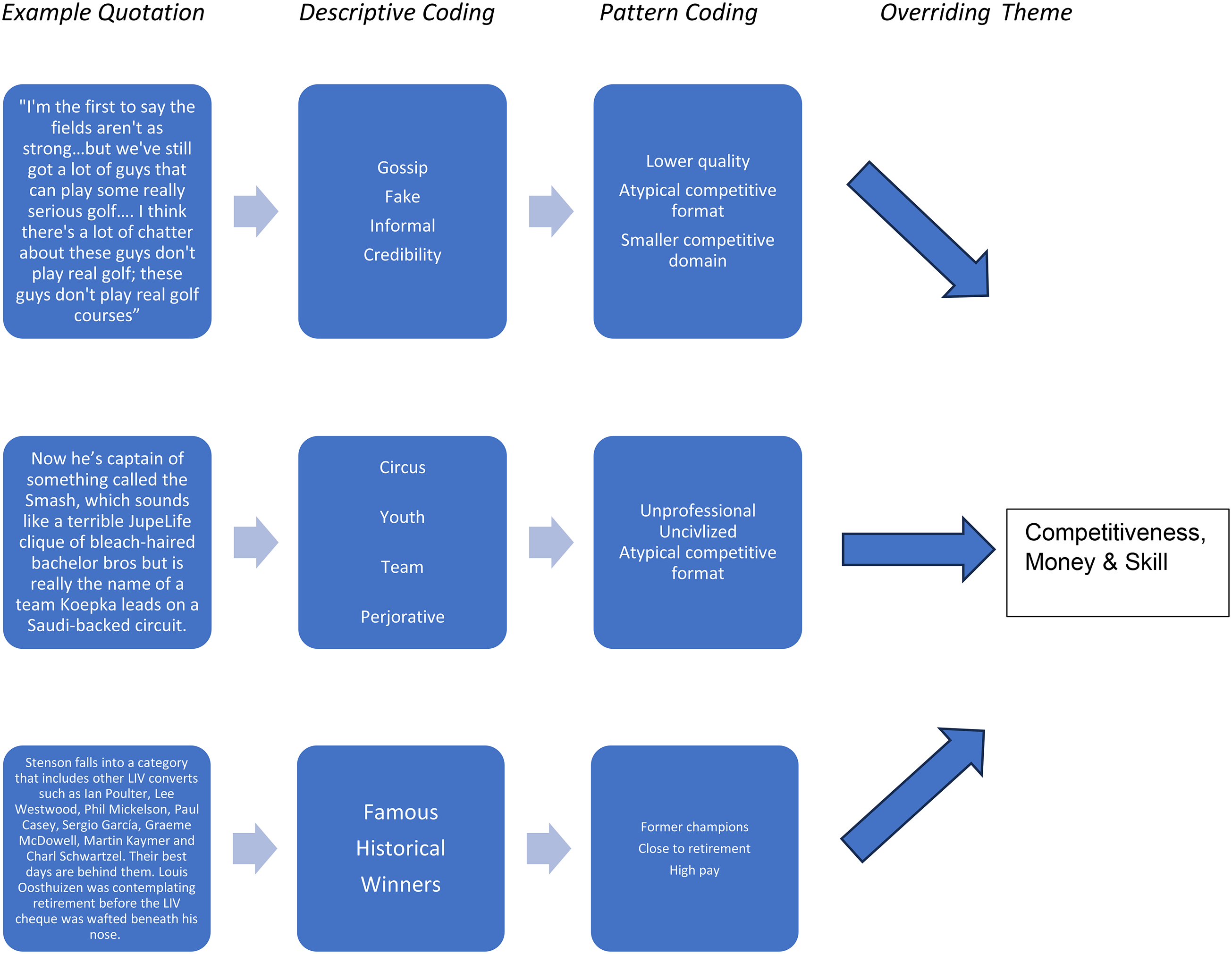
Example coding patterns and thematic generation.
The second pattern of codes produced the theme of ‘Disloyalty and Legacy’, pertaining to, inter alia, the sense of betrayal felt at disturbing the status quo. The third and final theme was labelled ‘Morality’, relating to sportswashing, integrity and ethics. Taken together, these three themes help to build a picture of sporting jurisdictional behaviour in bump-chain activity. This threefold typology is discussed following a reflection on the limitations of our methodology.
Limitations
This process of developing codes relied on the subjective interpretations of the researchers, leading to the risk of personal investigator bias. The researchers are all British academics based in United Kingdom institutions and as such, care was taken to limit bias stemming from the authors’ cultural understanding of the topic, especially given the cultural roots of the institutions under investigation. That said, despite our commitment to methodological rigour and critical analysis of the motivations and meanings behind the data we use, our subjective understandings of these data are inevitably influenced by our cultural habitus (see Bourdieu, 1977). We thus acknowledge there are clear limitations in the undertaking by Western academics of an analysis of solely Western media reporting on a non-Western-origin event: as acknowledged by Bowes and Kitching (2019: 17), limitations of conducting analyses of media surround the impossibility of knowing ‘the intentions or the editorial decisions made in selecting content for posting by the golf organisations, the market-informed strategies in place, the coordination of posts and press releases by outside social media managers or agents’. This is particularly the case when considering PGA Tour-created media sources such as the Full Swing documentary series (of which a third series will be released in 2025; Carpenter, 2024). Nonetheless, we contend that this one-sided analysis still possesses value and utility within the field of the sociology of sport, as it advances a more nuanced understanding of media representations of non-Western bump-chain initiators in professional sporting jurisdiction. In doing so, it shines a critical light on the short-sightedness of much Western reporting on a provocative phenomenon and in line with other analyses of sporting news media, seeks to stimulate further engagement with media discourses, both Western and non-Western, in understanding differing ideologies and identities (Shin et al., 2022).
The rise of LIV golf: defensive manoeuvres deployed in the court of public opinion by the PGA tour
This section of the paper is dedicated to a scrutiny of the efforts by the PGA and DP World Tours to discredit and subordinate LIV Golf through moral and status-based considerations. Whereas the defensive contrivances deployed to combat the ESL were three-fold, that is, pressure and vitriol was meted out by governing bodies, prominent public figures and fans (Brannagan et al., 2022), in the case of LIV Golf, meaningful fan protests were absent. Thus, the two main sources of defensive devices of governing bodies and public figures were considered, before a rationalisation of the lack of fervent fan-based objections to LIV Golf. An unambiguous defensive campaign, spearheaded by the Commissioner of the PGA Tour and supported by the Western news and golfing press, was initiated from the very first LIV Golf event on 9 June 2022 (Roberts, 2022) until the proposed merger announcement in June 2023. The emergent themes of the campaign were threefold: disloyalty and legacy; competitiveness, money and skill; and morality. Taken together, they form our understanding of bump-chain activity and resistance in the case of men's professional golf.
Disloyalty and legacy
In an open letter to PGA Tour players on 9 June 2022, following the first official LIV Golf tournament in London, Commissioner, Jay Monahan, thanked Tour members for their ‘trust, patience and loyalty’ (PGA Tour, 2022), immediately invoking normative values of the ideal-typical professional as trustworthy, discrete and dependable. The letter (PGA Tour, 2022) adopts a vitriolic stance in portraying those Tour players who have defected to LIV Golf as betraying all the values of professional golf, invoking the ‘spirit of golfers past’ to intensify the contempt towards which LIV Golf should be directed: …This week, the RBC Canadian Open is a shining example of what you have created with the PGA Tour: a star-studded field, a committed sponsor, sold-out hospitality offerings, record crowds and a global broadcast distribution. These elements are part of the TOUR's DNA, built by the likes of Jack and Arnie, furthered by Tiger and others – whose legacies are inextricably linked, with each other and with the PGA TOUR. This collective legacy can’t be bought or sold.
Themes of betrayal are thus palpable in the PGA Tour's rhetorical efforts to secure loyalty from remaining members. As can be seen from the excerpt, elements of occupational prestige such as competition, sponsors and crowds are also utilised as a way of elevating PGA Tour events compared to their LIV Golf counterparts. Additionally, themes of betrayal are clear. In a Guardian article from October 2022, ideas of solidarity, pride given in service and honour of members are distinctly notable in the stances adopted by Rory McIlroy, a vocal defender of the TOUR's ideology (Murray, 2022): I think it is the first time in my life that I have felt betrayal, in a way. It's an unfamiliar feeling to me. You build bonds with these people through Ryder Cups and other things. Them knowing that what they are about to do is going to jeopardise them from being a part of that ever again.
Furthermore, upon his signing with LIV Golf, Cameron Smith, the 2022 Open Champion was described as golf's ‘latest villain’ (Fontaine, 2022) and that he is risking his ‘future and legacy to tee up against lesser players on poorer courses on golf's version of a gap year’. In the PGA Tour-produced Netflix series ‘Full Swing’, which documented the contours of eight players in the 2021–2022 PGA Tour season, the rise of LIV Golf maintained a continuous undercurrent and was the target of many status and legacy-based attacks from players and organisational figures. In an episode focusing on Ian Poulter, a prominent and vocal member of LIV Golf, his inability to crown his golfing career by playing any future roles in Ryder Cups (a prestigious biennial Europe vs USA golf competition) calls into question LIV Golf's ability to bestow historical standing on its members: …I think Ian Poulter … he's given up everything … [he's] not going to be a Ryder Cup captain, he's not going to get the goodwill of the game, he's not going to get the goodwill of the sponsors … it all goes away. (Full Swing, 2023a)
What we see here is the exercise of discretion by the PGA's bureaucrats to affect the legacy of previously vaunted PGA Tour members, in effect a ‘pseudo-cancelling’ of their prior achievements in favour of a refocussing of attention on their decisions to leave the TOUR. LIV Golf players were thus portrayed as losing claims to special status and esteem, as the ‘vocation’ of LIV Golf rather than PGA Tour golf; whilst it affords its members significant financial reward (explored below), it removes any ability to claim social esteem in the golfing world.
Competitiveness, money and skill
Having established the invocation of professional betrayal and the abandonment of legacy as ordnances deployed by the established jurisdiction-holder to discredit their new rival, the second theme in the PGA Tour's defensive discourses was one surrounding competition, money and skill. From both governing bodies and public figures, rhetoric surrounded the LIV Golf offering as being of a lower quality, and of being almost exclusively motivated by money. The TOUR's commissioner was vocal about the power of money to entice players to LIV Golf: The PGA Tour, an American institution, can’t compete with a foreign monarchy that is spending billions of dollars in an attempt to buy the game of golf. We welcome good, healthy competition. The LIV Saudi golf league is not that. It's an irrational threat; one not concerned with the return on investment or true growth of the game. (Berhow, 2022)
Being labelled in some media outlets as a ‘crass money grab’ (Panja and Das, 2023) highlights how LIV Golf was subjected to attacks on its credibility. A professional exercise discretion in turning down work that they deem of insufficient quality to be worth undertaking because they are motivated by more than money (Freidson, 2001). LIV Golf defectors were thus portrayed as betraying those archetypal professional ideal, that money should not be the sole driver of the development of competitive professional golf. It is not only the sums of money that are challenging the traditions of competitive professional golf: the format of LIV Golf competition is distinctly different from traditional competition, in that competitions are shorter (54 holes and three days, as opposed to 72 holes and four days), and involve a team element of 12 teams of 4 players (Davis et al., 2023). Furthermore, LIV Golf events do not feature the traditional mid-competition ‘cut’ that was a feature on the vast majority of PGA Tour events, where only the top-65 players are guaranteed a slice of the prize money. Thus, LIV Golf competitions were not ‘real’ professional golf, as they are not a true test of a professional's skill and mettle over what were understood to be the established parameters of authentic professional competition. In a Golf Digest article, golfers who left the PGA Tour for LIV Golf in 2022 and 2023 are alleged to have ‘faced criticism that the format of LIV events caused them to form some competitive rust’ (Priest, 2023), and that the only way they can truly demonstrate their elite skill is to show a competitive standard of golf at the Major championships where they can play due to world ranking or past champion status. As honestly outlined by a prominent LIV golfer (and 2022 Open Champion), Cameron Smith, in a BBC Sport article: I'm the first to say the fields aren't as strong … but we've still got a lot of guys that can play some really serious golf…. I think there's a lot of chatter about these guys don't play real golf; these guys don't play real golf courses. (BBC Sport, 2023a)
Further rhetoric surrounding a perceived lack of skill in LIV Golf competition was shared by Matt Fitzpatrick, 2022 US Open Champion, in a Full Swing interview, where he stated: ‘I want to play against the best players, and that, for me, is on the PGA Tour, so that's where I want to be’ (Full Swing, 2023b). This was compounded by his allegation of the LIV Golf offering, which he turned down, as being ‘a bit of a half-hearted proposal’ (ibid): illustrating the LIV Golf offering as lacking the values of a profession when compared to the TOUR. Thus, governing body and player-led rhetoric is shown as seeking to portray LIV Golf as less competitive, less skilled, poorly organised, less ‘traditional’, and less worthy of public admiration, even as almost vulgar (Murray, 2023a) in terms of the Saudi-backed prize money for all participants, which those competing work less hard to secure.
Morality
A major point of contention that both the governing bodies and the sporting press on behalf of the established incumbent (the PGA Tour) drew with LIV Golf was not solely on the basis of its disruptiveness in terms of format, entry criteria and prize money – but also due to its birthplace and the source of its instigation that was a cause célèbre. LIV Golf is financially backed by the Saudi Arabian Public Investment Fund and as such, has been the target of accusations of ‘sportswashing’ by the business and sporting press (Lauletta, 2022). The concept, ‘sportswashing’ serves, for most commentators and scholars, as a simple and short-hand way of criticising non-democratic regimes for using investment in sport (usually Western), sports clubs and sports events to detract from illiberal practices in their home countries, thus attempting to improve their nation's global reputation (Schad, 2022; Skey, 2023). It is increasingly critiqued for being used by commentators (and in this case, organisational leaders) as a means of making ‘quick comments rather than a deeper understanding’ of the complex issues at play between state-funded investors and the teams, leagues and competitions, which are the recipients of investment (Jorgensen, 2022). Saudi Arabia has invested some £5bn in sports since 2021 (BBC Sport, 2023b). At the time of writing Saudi Arabia is the sole bidder for the 2034 FIFA World Cup and has been selected to host the 2029 Asian Games (ibid.). This is significant because such involvement of non-traditional sporting nations in the global world of elite sport is likely to lead to fundamental changes in the way sport is financed, governed and how and where it takes place.
In the case of the PGA Tour vs LIV Golf, issues of morality extending beyond the morals of betrayal are clearly apparent. In a rich quote from Jay Monahan, the PGA Tour Commissioner, in episode three of Full Swing, morality is emphatically referenced: on the PGA TOUR, our members compete for the opportunity to add their names to history books, and yes, significant financial benefits … without having to wrestle with any sort of moral ambiguity. (Full Swing, 2023a)
By stating this, Monahan takes a direct swipe at LIV Golf by critiquing its moral standpoint. He thus sets the PGA Tour, and those who play on it, apart as a distinct ‘moral community’. This is furthered in the initial letter sent by Monahan to all PGA Tour players in the lead-up to the inaugural LIV Golf event in London in June 2022: …you are the PGA TOUR, and this moment is about what we stand for: the PGA TOUR membership as a whole. It's about lifting up those who choose to not only benefit from the TOUR, but who also play an integral role in building it. I know you are with us, and vice versa. Our partners are with us, too. The fact that your former tour colleagues can’t say the same should be telling. (PGA Tour, 2022)
The villainising of LIV Golf players highlights the treatment of defectors at the start of the LIV-PGA Tour conflict. LIV players were portrayed as abandoning a sense of community, in which they play(ed) a crucial role. The charged language used by Monahan (and indeed, a significant portion of Western news media portraying players as ‘defecting’ to LIV Golf), highlights the Gulf as being portrayed as a protagonist in conflict and as being shot through with reductive, Orientalist attitudes and language (Koch, 2020). These portrayals, and the stance taken by the PGA Tour and its governors, are somewhat troubling, particularly in light of the PGA Tour's rhetorical about-turn from initially being vehemently hostile towards LIV Golf, to welcoming it with open arms in the proposed merger. This will be explored further in the concluding section of the paper. The concept of ‘sportswashing’ needs to be problematised, given that it is clear that in many ‘sportswashing’ arrangements it is not just the investor who benefits and it is clear that nothing is actually ‘washed’. Equally, the fact that the PGA and DP World Tours both sanctioned the release of players to take part in the lucrative ‘Saudi International’ events in January 2021 and 2022 (Wright, 2022), suggests that they may, unwittingly, have contributed to the idea of LIV Golf in the first place. Having scrutinised the defensive instruments utilised by the PGA Tour in seeking to set the consumers of golf against LIV Golf, this paper now turns to a contemplation of why the PGA Tour was unsuccessful in its defensive of bump-chain activity.
Discussion: what next for elite competitive professional golf?
We set out to undertake a critical scrutiny of brute-force ‘bump-chain’ activity on the formerly exclusively held territory of elite professional golf. In doing so, we have established a three-pronged understanding of the defensive mechanisms deployed by the TOUR and amplified via Western media to seek to discredit and subordinate LIV Golf as a credible option for both elite competitive golfers and the viewing public. While this research initially aimed to predict the ending of the bump-chain, Abbott's (1988) assertion that bump-chains typically do not last very long proved especially true in this case, with the cessation of all pending litigation between the PGA Tour, the DP World Tour and LIV Golf announced on 6 June 2023. It thus appears as though the concerted and successful attempts at ‘jurisdictional subordination’ have been unsuccessfully exercised by the established incumbents: the PGA and DP World Tours. Given the passionate rhetorical defences articulated by the PGA and their supporters, the second research question that this paper seeks to answer is now addressed: what are the potential implications of a profession’s failure to successfully defend itself against a neophyte contender to its jurisdictional territory?
In the months preceding the merger announcement, the PGA and DP World Tours made starkly isomorphic changes to mirror the novel golf competitions hosted by LIV Golf. In an approach similar to the ESL accelerating scrutiny of the current competitive arrangements of elite-level European club football (Brannagan et al., 2022; Ruberti, 2023), prominent PGA Tour members have publicly acknowledged the catalytic effect that LIV Golf had on the PGA Tour's operations, with Max Homa, a PGA Tour disciple, stating: It does seem like the emergence of LIV forced us as players and the executives of the PGA Tour to just look at their product. I don’t think we would be here this soon without LIV, but I would hope at some point we would have looked at this and said, hey, there might be a better way to do it. (Murray, 2023b)
The defensive rhetorical devices deployed by the PGA and DP World Tours were ineffective in the face of untapped amounts of purposeful investment capital. Whilst archetypal professionalism focuses on ideals of status, pride given in service and the ability to turn down ‘undesirable’ work, contemporary understandings of professionalism understand the impact of managerialism on traditional modes of organising and regulating work (Evetts, 2013). The bureaucratic management model of the PGA Tour, led by its commissioner, Jay Monahan, exemplifies the imposition of control ‘from above’ which removes discretion from professionals’ daily work tasks. In the face of an inability to have input into the commissioner's decisions, combined with TOUR board members’ fears that ‘if LIV takes five players a year for five years, they can gut us’ (Murray, 2023c), the decision to merge with LIV Golf was made both promptly and without the consultation or clear support of the members integral to its continued existence.
Rhetoric from players was distinct and highly unsettled in the wake of the announcement of the merger. Accusations of hypocrisy have been levelled with ferocity at PGA Tour leadership by players and advocacy groups alike: Mr Monahan talked last summer about knowing people who lost loved ones on 9/11, then wondered aloud on national television whether LIV Golfers ever had to apologize for being a member of the PGA Tour. They do now – as does he. PGA Tour leaders should be ashamed of their hypocrisy and greed. Our entire 9/11 community has been betrayed by Commissioner Monahan and the PGA as it appears their concern for our loved ones was merely window-dressing in their quest for money – it was never to honor the great game of golf. (9/11 Families United, 2023)
I accept those criticisms but circumstances do change and I think looking at the big picture got us to this point. It probably didn't seem this way to them but as I looked to those players that have been loyal to the PGA Tour, I'm confident they made the right decision. They have helped re-architect the future of the PGA Tour, they have moved us to a more competitive model. We have significantly invested in our business in 2023 and we're going to do so in 2024.
Defensive rhetorical imagery thus continues to be richly portrayed in these quotes, as well as the ongoing rhetoric surrounding the proposed merger which, as of July 2024, has still not been finalised nor have the finer details been made publicly available. Nonetheless, the ongoing rhetoric highlights how the seeming attitude-reversal from PGA Tour leadership means that they are now subject to rhetorical attacks on their professionalism, but that they continue to evoke rhetorical entreaties to professionalism in the players who remained loyal to the TOUR during the bump-chain attack and amidst its fallout. As it stands, whilst the jurisdictional battle in the courts of law appears to be over (for now), the battle over professionalism in the court of golfing public opinion appears to be entering a new, post-merger phase.
Conclusion
This paper shines new light on contemporary and ongoing structural changes in the formerly stable and monopoly-controlled arena of men's professional golf by applying sociological frames of reference (Abbott, 1988). In doing this, a more nuanced understanding is developed of the processes involved in bump-chain activity in professional sports and how sporting professions seek, and in this case fail, to defend their jurisdictional territories. This understanding has particular relevance to sports which are institutionalised as having successfully exercised closure regimes and who thus may be vulnerable to encroachment from powerful sources of capital, such as in tennis (Roeloffs, 2023). These findings necessitate future research into the attempted fracturing of sporting leagues and how sociological theory, in addition to bump-chain analysis, can help us to further understand them. Qualitative analysis from key stakeholders such as professional golfers (Lim et al., 2023) would serve to shine valuable insights into those with strategic decision-making power in both the incumbent and encroaching organisations in the golfing arena. Additionally, more wide-ranging research from the consumers of sport would illuminate valuable views on the concept of contemporary (post-merger) professional golf. In the case of golf, diverse perspectives such as those from fans, grass-roots level institutions and aspiring players, which this study did not address, would bring value to future research on ongoing jurisdictional changes in the sport. Additional critical perspectives on ‘sportswashing’ are also necessary given the relative infancy of the terminology and its vast potential to be inappropriately levelled. If we move beyond the simple, and in our view wrong, definition of the term as ‘investment in sport = attempt to burnish a state's image or shift public perception away from established viewpoints’, we can move to an understanding of it as a bidirectional process that can benefit both parties: by offering resources to sport organisations on the one hand, and embedding previously uninvolved nations in the sports industry on the other, leading to their becoming ‘normalised’ in international business in the long-term (Grix et al., 2023). Indeed, we agree with and amplify arguments that ‘the concept of sportswashing, circulated widely by doxosophists, is potentially problematic in describing and understanding Gulf investments in, and ownership of, sports teams, competitions and events’ (Crossley and Woolf, 2024: 318). In short, the sociopolitical and socioeconomic drivers of investment in sport are far more complex than the term permits and explorations of these in future research are clearly warranted. Such research might focus upon similar analyses of public opinion gathered from Middle Eastern or Arab media sources.
Through analysing the processes of bump-chain encroachment on professional territory and institutional responses, the findings herein have practical relevance for those institutions and actors playing a governing role in professional sport. For golf, there are implications for future governance in terms of recovery from the turbulence surrounding the bump-chain activity, both in terms of the attack and the jurisdictional restructuring and the resistance attempts, which have sought to discredit significant actors and institutions in the sport. For sporting fans, there are likely broader sociological implications of such corporate conflicts, which may affect their social cohesion and their enjoyment of sporting entertainment. This warrants further research, as does the impact on player identities. For the wider sporting world, this analysis brings implications for governing bodies that may in the future face bump-chain encroachment. Against significant financial might the tactics of disloyalty, legacy, competitiveness, skill and morality ultimately failed to resist the bump-chain attack and look set to leave lasting scars on the sport of golf. Similar bump-chain encroachments in other sports are likely, due to the distribution of global capital and the political, social and economic rewards for increasing participation in sport. Therefore the lessons from this analysis are of value to other sporting jurisdictions.
Footnotes
Acknowledgements
We would like to thank the three anonymous reviewers of this paper as well as the IRSS editorial team: their comments and recommendations were thought-provoking, constructive and valuable. The lead author wishes to express gratitude to attendees at the ISSA World Congress in 2023 for their feedback and encouragement when this paper was first presented.
Declaration of conflicting interests
The authors declared no potential conflicts of interest with respect to the research, authorship, and/or publication of this article.
Funding
The authors received no financial support for the research, authorship, and/or publication of this article.
