



Abstract
Scholarship on sports following represents a burgeoning field of inquiry in the sociology of sport, yet sport following's connections to, or ability to facilitate, social capital remains underexplored. Drawing on a contemporary nationwide survey of the United States and employing the foundational theories of social capital by which we operationalize statistical analyses using regression modeling, this study investigates the nuanced contributions of sports following to various dimensions of social capital. Our analysis reveals complex relationships of sports following to social network size, community engagement, neighborhood trust, and social network variety, highlighting sports following as a significant predictor for all our operationalized social capital measures, although negatively so for neighborhood trust. Exploring the interplay between sports following, individual characteristics, and socio-political affiliations, results underscore the powerful predictive capacity of sports following even controlling for other characteristics, highlighting strong potentiality for building social capital, although along some dimensions more than others. These findings spotlight the domain of sports following as fertile ground for further investigation into its capacity to serve as a unique facilitator of social capital on the increasingly divided American socio-cultural landscape.
Introduction
In recent decades, the connection between social relationships and the benefits, or social capital, accruing from them has garnered considerable attention. More sparsely, studies of sports have also highlighted the multifaceted role sports play in fostering community bonds, enhancing individual well-being, and shaping societal structures. This paper aims to contribute to augmenting and expanding the existing research into how sports following may contribute to building and manifesting social capital, or the beneficial resources accumulated by social connection. The theory of social capital, primarily advanced by scholars such as Pierre Bourdieu (e.g. 1984, 1986) and later expanded upon by others like Robert Putnam (e.g. 1993, 2000), provides a foundational framework for understanding the value embedded within social interactions and networks of social connections. These interactions and connections, spanning both personal and professional realms, have been shown to yield substantial benefits, including improved career trajectories for individuals with expansive and diversified networks (Erickson, 1996; Granovetter, 1985, 1995), thus facilitating and reflecting elements of social stratification. The application of social capital also impacts upon societal implications for how communities engage with and through sports, and how sports may help different people and communities come together, or alternatively stratify them. Within all conceptualizations of the personal or social externalities of social capital, all have at their core potential benefit to the individual, group, or broader society gleaned from social interactions or feelings of connection with others.
These existing theories highlight the dual potential of social capital concepts as both a marker of social inequality (e.g. Bourdieu, 1984, 1986) and a potential vehicle for societal cohesion and democratization (e.g. Putnam, 1993, 2000). Despite these complex dynamics, the role of sport as a cultural and social catalyst remains powerful, with various studies indicating that engagement in sporting activities can significantly influence social capital formation and expression (Gemar, 2021a; Sánchez-Santos et al., 2024; Widdop et al., 2016). However, even as spectator sports around the world, and within the United States, have risen in popularity and accessibility, they remain under-researched in studies of sport generally, but are specifically absent from social capital literature on sport. There is also a relative lack of research on social class and sport (Cunningham, 2023; Seippel, 2018), and social capital's role as a marker of inequality and its exclusionary potential are often less considered in many fields (e.g. Gemar, 2024a; McKinnon, 2017), including sport (Gemar, 2021a). In this study we consider multiple theories of social capital to assess the potential complexity of sport's role in building (or not) different elements of social capital.
This paper thus situates itself within the ongoing scholarship on social capital, aiming to contribute an innovative study of how sports, in this case sports following, may contribute to building social capital in the contemporary United States. By leveraging a unique and contemporary dataset that captures American sports following, and drawing upon established theories of social capital, I examine the relationships between sports following and various dimensions of social capital. Specifically, I explore the predictive value of sports following forming social network size, neighborhood trust, community engagement, and the diversity of social networks among American adults. In doing so, this paper builds upon the foundational work of Erickson (1996), Granovetter (1973), and Bourdieu (1986), while also engaging with more recent sports contributions to the field (e.g. Gemar, 2021a; Sánchez-Santos et al., 2024; Widdop et al., 2016). By examining sports following as an inherently social behavior, I aim to explore the relationship of sports following to social capital and contribute to the nascent and sparse understandings of this relationship within the existing literature.
Social capital (and sport)
The foundational concept of social capital centers on the potential benefits of social interactions, positing that these interactions, can yield tangible benefits (Widdop et al., 2016; Wollschleger, 2021), or a type of “capital” (Bourdieu, 1986). Research has shown that those with privileged backgrounds and distinguished occupations have broad and respected networks, which afford them access to desirable employment, enhance their career progression, and facilitate smoother promotional processes (Erickson, 1996; Granovetter, 1985, 1995; Savage et al., 2015). This concept aligns with Bourdieu's exploration (1984, 1986), highlighting social capital's role in both signifying and perpetuating broader social class distinctions and inequalities, generally (Gemar, 2024; Savage et al., 2015), and within sports participation (Gemar, 2021b). Bourdieu's interpretation of social capital points to its symbolic, reproductive, and exclusionary effects, which often overshadows the concept's potential for fostering equality or democratic outcomes (Putnam, 1993, 2000). Despite this, Bourdieu's formulation of social capital is considered less exhaustive than later theories (Gemar, 2024a), and it was utilized to bolster certain arguments (Ward, 2004), without being fully defined for empirical study (Pinxten and Lievens, 2014).
Bourdieu highlights the significance of institutionalized and other credentials that define symbolic status groups, where individuals’ network connections may be situated, defining social capital as the sum of actual or potential resources associated with having a stable network of relationships characterized by mutual familiarity and acknowledgment—essentially, belonging to a recognizable group (Bourdieu, 1986). This membership grants individuals the support of the collective's capital (Bourdieu, 1986), acting as a “credential” that legitimizes their claims to various forms of credit within the group, as well as potentially outside of it. Thus, a crucial element of these networks is the tangible or symbolic credential that confirms group membership. Such credentials allow one to be part of groups that may be distinguished by higher education levels, specific professions and occupations, or engagement in particular cultural and sporting activities (e.g. Bennet, 2009; Gemar, 2021a; Gemar and Vanzella Yang, 2022). Therefore, membership in groups, a form of social connection that also can include credentialed groups such as university graduates or certain occupations, provides both ingroup benefit and outgroup recognition from this connection.
Social capital thus also encompasses the potential for significant symbolic and practical benefits, emanating from networks that include familial, friendship, or acquaintance relationships which can significantly boost career paths (Field, 2017). Moreover, the generation and sustenance of social capital are often attributed to what could be considered more peripheral connections, illustrating what Granovetter prominently described as the “strength of weak ties” (Granovetter, 1973). This theory is further expanded by Savage et al. (2015), who suggest that the advantages enjoyed by individuals in high-status jobs derive not so much from direct ties to influential figures but rather from the broader network of casual acquaintances facilitated by their socioeconomic position.
The utility derived from an extensive network of weaker connections is fundamentally linked to their ability to engender a more diversified social network of connections. Granovetter (1973) maintained that the diversity promoted by such weak ties plays a crucial role in the accrual of valuable social capital, given that individuals linked by weaker ties are less prone to having overlapping traits, experiences, knowledge, and social ties, thus reducing redundancy. This argument is further solidified by Burt (1992), who introduces the notion of “structural holes” within social networks, positing that these gaps in less dense networks enable the formation of unique, and non-redundant connections (Portes, 1998), which in turn significantly enhance the breadth and effectiveness of an individual's social capital.
Erickson (1996) highlights the significant advantages of having a diverse social network in professional environments, emphasizing the value of encompassing a wide range of cultural preferences and practices. This diversity facilitates interactions across varied interest groups and backgrounds, a notion that resonates with Peterson's (1992) concept of the “cultural omnivore.” Cultural omnivores are individuals who engage with a variety of cultural expressions, irrespective of societal status—that is both highbrow and lowbrow forms of culture (Peterson and Kern, 1996). This is contrary to those who engage with only highbrow or lowbrow forms of culture, and thus less may engage with fewer people with differentiated taste or cultural behavior.
Such cultural omnivorousness, further examined in studies by Peterson and others (Chan and Goldthorpe, 2010; Gemar, 2019a, 2019b, 2023; Peterson and Kern, 1996), is linked to higher social standing, showcasing the benefits of interacting with a broad spectrum of cultural forms. Erickson (1996) elaborates on how engaging in diverse cultural experiences not only broadens one's cultural perspective, but also significantly expands and diversifies social connections and networks. This expansion enriches the social capital derived from these networks and underscores a reciprocal enhancement between cultural and social diversity. Through interactions with a diverse group of individuals, exposure to different cultural practices naturally occurs, and vice versa, illustrating that cultural diversity acts both as a result and a driver of varied social networks, creating reinforcing relationships that strengthen both dimensions (Erickson, 1996). Therefore, cultural diversity is both a driver of social capital and a reflection of the social stratification that facilitates the ability to engage in diverse cultural offerings. This is also how elements of cultural and social capital can both facilitate and reinforce each other.
This framework suggests that individuals with expansive and diverse social networks are better positioned to secure prestigious job opportunities, enjoy smoother career advancements, and access a wider array of professional opportunities (Erickson, 1996; Granovetter, 1973). Conversely, a lack of such networks may limit access to influential societal sectors, contributing to broader social inequalities (Smith, 2005). This kind of accumulation of social capital benefits illustrates Bourdieu's analysis of its complex nature, emphasizing its role in reinforcing social class distinctions and perpetuating inequalities across generations (Bourdieu, 1986; Gemar, 2024b). This aligns with further research suggesting the scarcity of social capital as a key factor in the ongoing creation and maintenance of class-based, gendered, and racial disparities within modern societies (Friedman et al., 2015; Reardon and Bischoff, 2011). Lutter's (2015) work, for instance, identifies a higher likelihood of career setbacks for women compared to men within networks that lack openness and diversity, pointing to the subtle biases that can pervade social capital in seemingly equitable environments.
However, while Bourdieu's work and the legacy of subsequent work by others (e.g. Savage et al., 2015) casts social capital in a light that underscores its role in fostering distinction and reinforcing inequalities because of its unequal accumulation, this contrasts with Putnam's (2000, 1993) more optimistic view of its capacity to democratize and positively transform societies. Putnam's research (1993, 2000) primarily emphasizes the potential societal benefits and the collective and individual advantages derived from social capital. Putnam highlights how personal social networks contribute significantly to societal welfare, largely due to civic engagement that emerges from a sense of community responsibility nurtured by these networks (Putnam, 2001). Especially pertinent to this paper's discussion, Putnam underscores the significance of common values and social ties that are cultivated in an active civic and social environment, stemming from trust in others, social bonds, and shared norms initially established within the community. Therefore, while Putnam and Bourdieu emphasize different potential outcomes of social capital formation within societies, both agree on social capital as the beneficial outcome of social connection, broadly conceived, whether for individuals, groups, or society more broadly.
A key factor contributing to the value of social capital within social network diversity is the ability to generate “bridging” social capital (Putnam, 2000). Bridging social capital involves forming connections between individuals or groups from varied social backgrounds, whether they differ socioeconomically, occupationally, culturally, or demographically, inherently making these connections diverse. The presence of cross-status ties within a network significantly enhances the amount of bridging social capital (Putnam, 2000). Such networks, known in social network theory as “heterophilous networks”—in contrast to “homophilous networks”—comprise individuals from diverse social backgrounds and facilitate the exchange of resources and knowledge across societal segments (Woolcock and Narayan, 2000), promote community and civic participation (Putnam, 2000), and encourage inclusivity, trust, and cooperation. Despite the challenges posed by societal prejudices, discrimination, and entrenched social inequalities, these diverse connections are critical for bridging the divides within society (Lin, 2001). For the purposes of this paper, sports may represent a unique location in contemporary American society where diverse, or other, social connections may be made.
Social capital, networks, and sport
Engagement with sports is an eminently social act (Widdop et al., 2016). Sports serve as a cultural element that predominantly emphasizes group orientation and belonging, and thus social connection and potentially positive effects of such connection. This concept extends to teams of athletes, fan groups, and broader solidarity communities within cities and nations (Gemar, 2021a). Misener and Mason (2006) highlight that sports events play a significant role in generating social capital for communities. Widdop et al. (2016) further argue that in Britain, sport stands as one of the most popular form of group activity, with sports organizations excelling in fostering and maintaining friendships and social network connections. Yet, it is noted that numerous participatory sports focus more on the individual, including those Bourdieu (1984) associates with higher social status, and thus in theory higher forms of many kinds of capital, not just social capital. These individual-centric sports are often viewed as less effective in cultivating social capital because of their more solitary engagement (Widdop et al., 2016). Nonetheless, Bourdieu's interpretation of symbolic group membership suggests that identifying as part of a group, such as “runners,” “golfers,” “tennis players,” or “cyclists,” can provide social capital by facilitating weak ties among individuals engaged in these activities, despite their typically individual nature (Gemar, 2021a). The value of such group affiliations is further amplified by institutionalization, for example, through membership in country clubs or other types of sports and non-sports clubs (Forsell et al., 2020), where members commonly share interests in specific activities. All of these specific dynamics also apply to sports spectatorship. While one can follow and consume spectator sports individually, it is often a group activity. For instance, certain pubs or stadium sections become known gathering spots for fan groups, and hosting viewing parties in homes or semi-private venues becomes a way to strengthen neighborhood or workplace connections. Therefore, sports may be a cultural site that resists the social disassociation found in other areas of social engagement and social capital literature (e.g. Putnam, 2000). This research therefore seeks to test if traditional elements of social capital are strongly related to sports engagement in the contemporary United States.
Indeed, among recent studies of social capital, networks, and sports engagement, Widdop et al. (2016) find that different sports participation profiles are influenced by different forms of social capital, but that social capital as neighborhood trust is an important predictor of sports participation across the spectrum of different physical activity profiles. They also find that the size of one's friend network is positively predictive of sports participation, especially more omnivorous sports profiles (Widdop et al., 2016). Gemar (2021a) finds the specific metric of social capital that most effectively predicted sports engagement, in their study, depends on these consumption profiles, with social network size emerging as a universally relevant predictor across profiles of sports engagements, while the diversity of social networks is particularly crucial for omnivorous sports participants (Gemar, 2021a). Additionally, Gemar (2021a) found that the prestige of one's social network plays a significant role in engaging with certain highbrow sports, thus potentially evidencing Bourdieu's arguments around symbolically circumscribed group membership, credentialization, and mutual recognition. Sánchez-Santos et al. (2024) likewise find that higher levels of direct sports participation and sports spectatorship are positively associated with more extensive social networks. Scholarly work has also found that sports participation is associated with sports volunteering (Dawson and Downward, 2013).
Therefore, while individuals might initially or occasionally engage in sports alone, they naturally find themselves interacting, communicating, and sharing these activities with family, friends, and acquaintances (Widdop et al., 2016). Consequently, the variety of one's social connections and the nature of these relationships play a crucial role in influencing sports consumption, while the composition of one's social circles and views of others can significantly shape their engagement with sports (Widdop et al., 2016). I therefore utilize as many different social capital metrics as I can, and that are commonly operationalized to capture social capital in the scholarly literature. Following operationalizations from previous studies, we assess social network size, social network variety, neighborhood trust, and community engagement. To assess how these dynamics relate to the following of spectator sports, I ask the following guiding research questions:
Data and methodology
In this research, we draw on a newly developed and highly relevant dataset that enables an in-depth and comprehensive examination of how various aspects of social capital relate to sports fandom within the modern United States context. This dataset originates from a national survey crafted by scholars, commissioned to the survey research firm Momentive/SurveyMonkey, and which was disseminated to a large online survey taking population in December of 2023. The survey methodology included an initial random selection from this population, complemented by an algorithm-driven stratification process during data collection to align with the latest demographic benchmarks for gender and age in the latest U.S. Census. This approach ensured a stratified random sampling technique was applied for the demographic representativeness of these variables. The demographics of the survey respondents, including age, gender, geographic region, and income, closely mirror the U.S. population, with a slight skew toward higher educational levels and a variation in racial representation—overrepresentation of White and Asian Americans, underrepresentation of Black and Latinx Americans, and accurate representation of Indigenous Americans. Despite these disparities, which are common in contemporary survey science of national populations (Spitzer, 2020), the sample's conformity to census data and its requisite size lends credibility to its validity and reliability for the analyses and findings presented in this research. The majority of participants completed the survey via mobile devices, resulting in a total of 2032 responses, all of which were utilized in the analysis of this paper. These data capture sports following for a broad range of professional sports leagues, both domestic and foreign, along with college athletics and large competitions such as the FIFA World Cup (both women's and men's) and Olympic Games (both summer and winter).
In addition to common demographic variables, the data also include questions that we rely upon for formulating social capital metrics. While the data used did not come from a solely social capital focused survey, and thus measures may not be as comprehensive as other conceptualizations of social capital measurement (e.g. Bullen and Onyx, 2001, 2005; Onyx and Bullen, 2001), the data include several previously well theorized, validated, and utilized survey questions by which we can efficaciously measure dynamics of social capital. Namely, for neighborhood trust we rely on a question that asks, “Is there any area within a mile of where you live where you would be afraid to walk alone at night?”, with answer choices of “yes” and “no.” This question mirrors questions of neighborhood trust on the highly regarded General Social Survey (GSS) in the United States (NORC, 2022), and reflects an established and validated survey methodology for capturing neighborhood and interpersonal trust in the social capital literature (e.g. Bullen and Onyx, 2001, 2005; Forsell et al., 2020; Onyx and Bullen, 2001). Bullen and Onyx (2005: 8) argue that “Trust entails a willingness to take risks in a social context based on a sense of confidence that others will respond as expected and will act in mutually supportive ways, or at least that others do not intend harm,” and argue that a survey question regarding the safety of walking in one's neighborhood is among the “best” questions for measuring trust in studies of social capital (Bullen and Onyx, 2005: 17). Therefore, the logic behind this metric is that those who are more trustful and less fearful of their neighbors are more likely to either have existing relationships with them or be more willing to make such connections, ultimately also leading to broader social connection and community engagement (Bullen and Onyx, 2001). Neighborhood trust is also a prominent metric in other studies of social capital and sport (Widdop et al., 2016) and one of the core elements that “define social capital” (Bullen and Onyx, 2005: 15).
We measure civic and community engagement by questions asking whether respondents “volunteer with a charitable organization” or “participate in organized civic or political activities” “on a regular basis.” Measures of civic or volunteer engagement are well theorized and empirically operationalized measures of social capital (e.g. Bullen and Onyx, 2001; Putnam, 2000). Indeed, Bullen and Onyx (2005: 15) argue that participation in the local community is another one of the core elements that “define social capital,” arguing that questions about volunteering and participation in organized groups and activities are among the “best” questions to capture this core element of social capital. This is because such engagement represents both a manifestation of social connection, and thus social capital (e.g. Putnam, 2000), and is a location where social capital can further accumulate because of its eminently social nature.
We measure social network size using the question that asks, “In the past 12 months, how many different friends and acquaintances have you socialized with at least once away from the workplace?” Inherent in this question is capturing more than passing interactions, but rather a stronger type of acquaintance, although not deep friendship. Indeed, as foundationally introduced by Granovetter (1973), and mirrored by some of Bourdieu's conceptualization of social capital (1986), it is arguably not deep friendships but rather “weaker” connections or those based on “credentialization” as part of a social group which produce the most useful capital from social connection. The size of one's social network may be a strong empirical measure of the amount of resources embedded in social connection that the respondent may be able to summon towards achieving certain ends, and thus may be considered an empirical representation of social capital. Network connections of friendship or acquaintance is a key component (Forsell et al., 2020) and core element (Bullen and Onyx, 2005) of social capital and the type of questions used in this study appear in validated measurement methodologies (Forsell et al., 2020) and are among the “best” questions to ask regarding social capital research (Bullen and Onyx, 2005: 15).
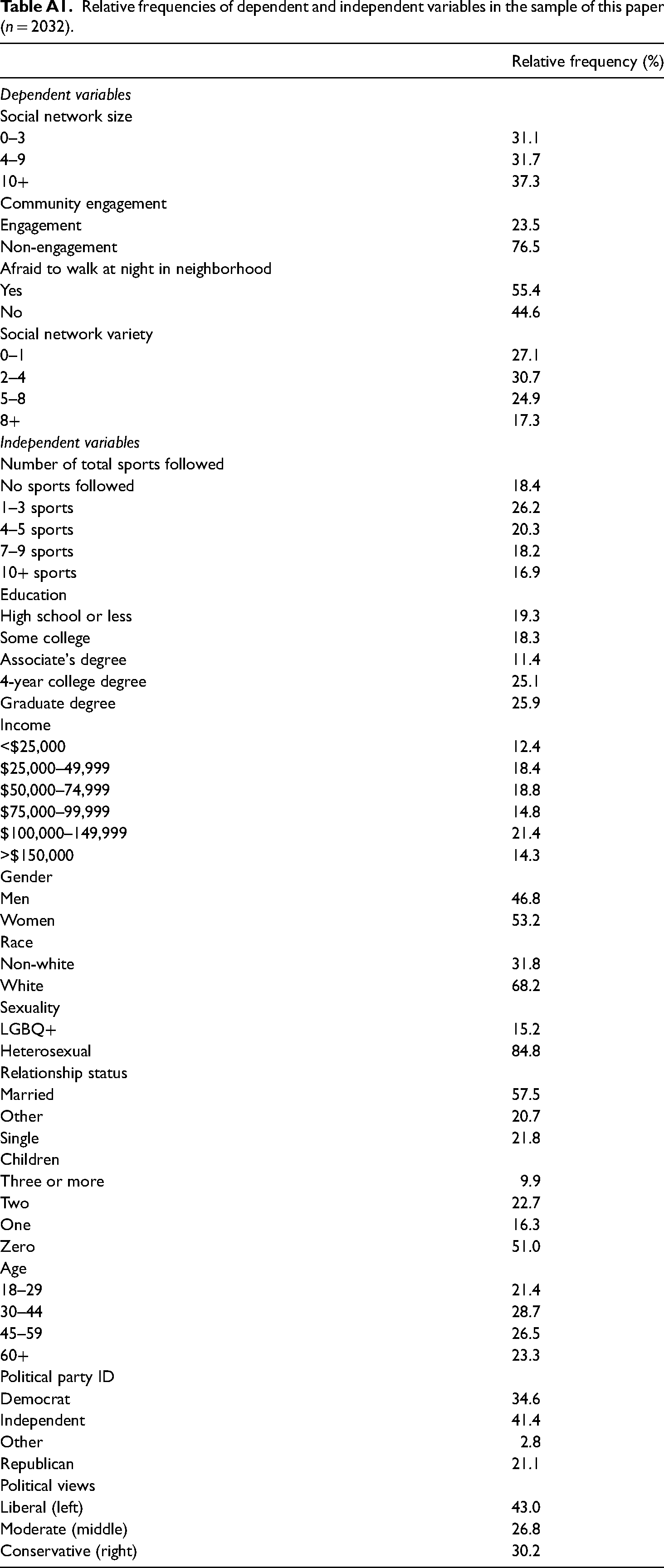
Finally, we set out to create a metric for social network variety using the number of people from different occupational categories that respondents report having “socialized with away from the workplace” in the past year. While for measures of neighborhood trust, community engagement, and social network size, we do not need to calculate any more complex metric, we must compute a variable to capture social network variety. Because a crucial element of social capital is the breadth of one's connections across different social statuses (Chetty et al., 2022), we suggest that this can be quantified through the occupational diversity within an individual's network, which reflects the spectrum of social standings or their homogeneity. Diverse connections signify “bridging” social capital—the connections between people from various social backgrounds (Woolcock and Sweetser, 2002)—and contrast with the more restrictive idea of network closure (Bourdieu, 1986). Bourdieu highlighted that credentials and group affiliations play crucial roles in defining network membership and accessible resources (Bourdieu, 1986; Gemar, 2024a), indicating that occupational diversity within a network is a key indicator of social capital potential. To do this we calculate how many people of different occupations respondents reported socializing with outside of work in the past 12 months. This again captures meaningful, while not necessarily close relationships within one's network by which the respondent could in theory derive some benefit. The relative frequencies in the sample for all four metrics of social capital appear in Appendix Table A1. This measure again falls into the core social capital component of social network connections (Bullen and Onyx, 2005; Forsell et al., 2020), while also capturing some elements of another core social capital component that is tolerance and acceptance of difference (Forsell et al., 2020).
It is important to note that with respect to the types of social “networks” that some of these measures capture, we are not capturing pure networks of connection per se. This is to say that given the national nature of the data used in this research, respondents do not know each other. Rather, we seek to understand which potential network connections each of these respondents might have within their own contexts by which they might accrue or manifest social capital. Therefore, while unable to capture in fine detail the inner-workings of a specific network or set of networks, the metrics used in this research are still able to measure or suggest elements of social capital, which is “a purported benefit of social networks by virtue of the social trust, network and reciprocity that may be produced, and reproduced, when individuals and groups work together” (Doherty and Misener, 2008: 114).
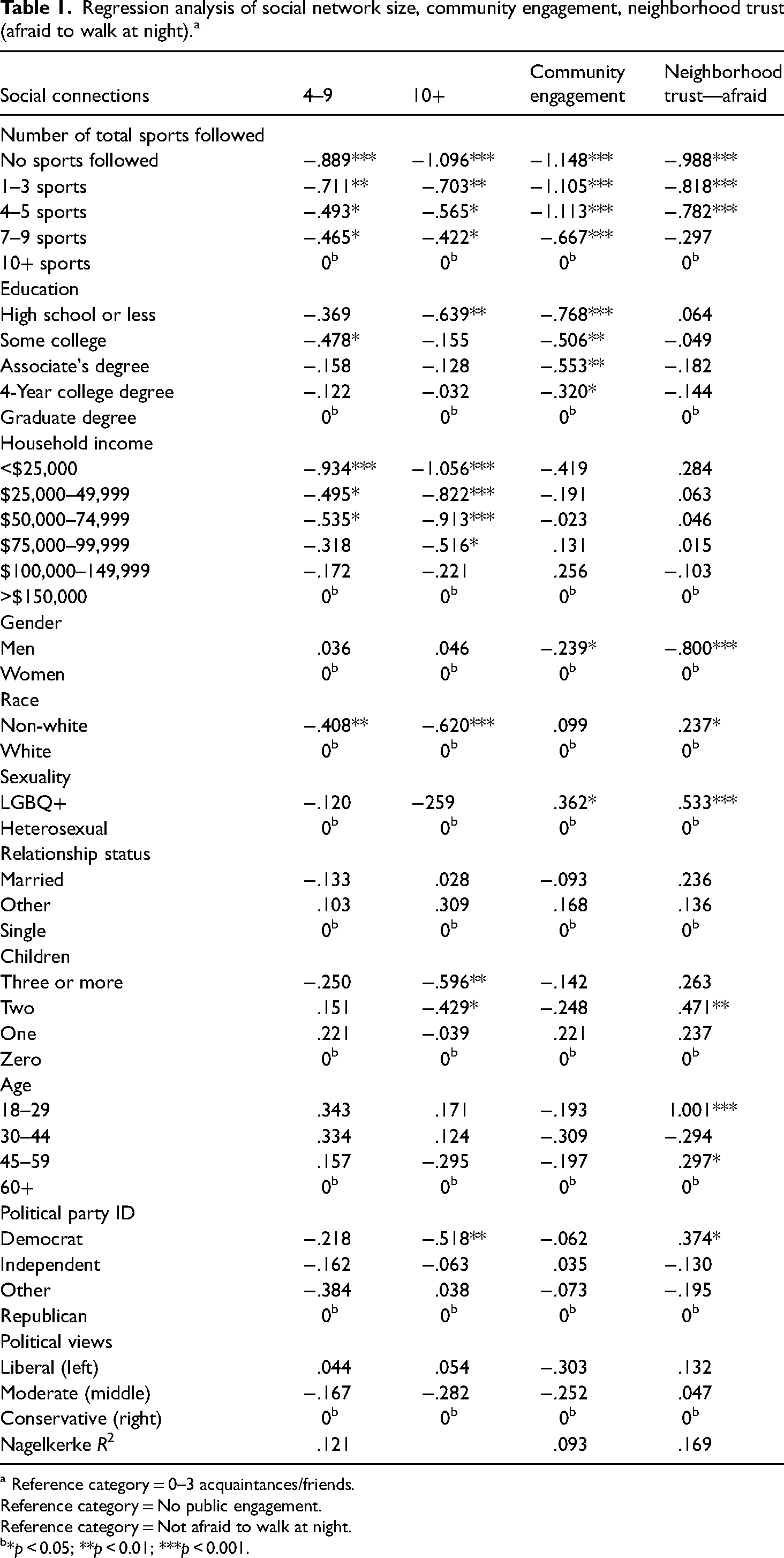
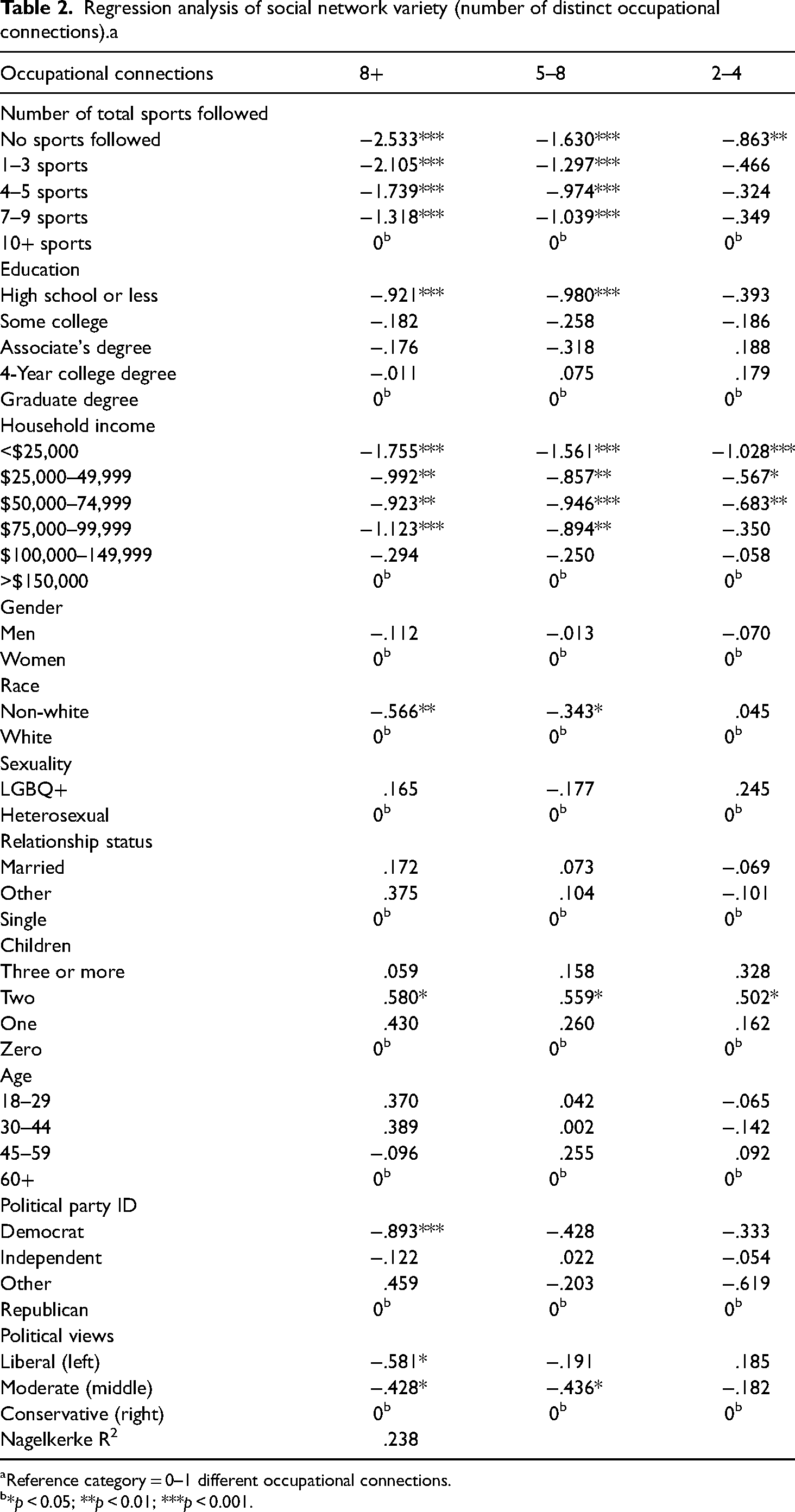
After defining and calculating the social capital variables, I then perform multinomial logistic regression analyses with the four social capital metrics as dependent variables to assess if sports following facilitates social capital. Using a range of independent variables that may theoretically be associated with one or more of the social capital metrics, this analysis yields numerous statistically significant results contributing to the understanding of these relationships. In these regression models, independent variables include the number of sports followed by the respondent, their formal educational attainment, household income, gender, race, sexuality, relationship status, the number of minor children in the home, age, political party identification, and political views on the political–ideological spectrum from “liberal” on the left to “conservative” on the right (as are the American colloquial characterizations of this spectrum). The relative frequencies for the categories of all these variables also appear in Appendix Table A1. The results of the four multinomial logistic regression analyses appear in Tables 1 and 2.
Regression analysis of social network size, community engagement, neighborhood trust (afraid to walk at night).a
Reference category = 0–3 acquaintances/friends.
Reference category = No public engagement.
Reference category = Not afraid to walk at night.
*p < 0.05; **p < 0.01; ***p < 0.001.
Regression analysis of social network variety (number of distinct occupational connections).a
Reference category = 0–1 different occupational connections.
*p < 0.05; **p < 0.01; ***p < 0.001.
Findings
Notably, Table 1 shows that the following of sports emerges as not just a significant factor, but arguably the most significant factor in predicting social capital for all metrics, with elevated sports following strongly predictive of social network size, community engagement, and increased neighborhood trust. For social network size, sports following is only rivaled by the similarly predictive power of (elevated) household income. Those who follow more sports and those who have elevated levels of income are most likely to have the largest social networks. Those with graduate degrees are also more likely to have the largest social networks than those with a high school degree or less. Those with elevated levels of education are also more likely than not to have higher community engagement, something not found for elevated levels of income. However, for neighborhood trust, neither income nor education levels show statistically significant predictive relationships for this social capital metric. Rather, along with results for gender, sexuality, and age, sports following is the least predictive of neighborhood trust, with those following more sports significantly less likely to be trustful of their neighborhood community than those following fewer sports. Therefore, while sports following is positively predictive of social capital metrics for network size and community engagement, it is negatively predictive of the social capital metric for neighborhood trust. After gradient effects for sports following across social capital metrics, then, findings also underscore a gradient effect across educational and income levels for some of these metrics, suggesting that higher socioeconomic status is also strongly associated with social capital, although to a lesser extent than sports following, and for some social capital metrics more than others.
While to a lesser extent than sports following or socioeconomic variables, demographic and political variables also exhibit some predictive power for these social capital metrics. Differences along the lines of gender, race, sexuality, age, children in the home, and political party display varying effects across social capital metrics. For instance, women and LGBQ+ respondents report more community engagement and less neighborhood trust in the form of more fear walking around their neighborhood at night, while young people also report much less neighborhood trust compared to the oldest age group. Nonwhite respondents and those with more children report smaller social networks and less neighborhood trust than white respondents and those without children. Finally, compared to Republicans, those who identify as Democrats for their political party identification are less likely to have large social networks and less likely to report neighborhood trust. Taken together, these findings highlight complex relationships for how sports following, individual characteristics, and societal affiliations intersect to shape the size of social networks, experiences of social engagement, and perceptions of community safety.
The next regression analysis, presented in Table 2, focuses on the social capital metric of social network variety, categorized into four distinct groups based on the number of different types of distinct occupational connections. The resulting log odds ratios reveal how the independent variables influence the diversity of one's social network. First, a higher number of sports strongly predicts more varied social networks. Indeed, the number of sports followed is the strongest predictor of having the most varied social networks, ahead of socioeconomic, demographic, and attitudinal variables. However, income shows as the second strongest predictor of more varied social networks, something that holds across all categories relative to the reference category of the least varied networks. The difference between attaining the highest levels of education is also significantly predictive of elevated social network variety relative to the lowest level of education.
While the amount of sports following and socioeconomic position are the strongest predictors of social network variety, other strong predictors include race and politics. White respondents are more likely to have more varied social networks, especially at the highest two levels of network diversity, than non-white respondents. Republicans are much more likely to have the most diverse social networks than Democrats, and those with more conservative political views are also generally more likely to have more diverse social networks than those with more moderate and liberal (left) political views. Finally, those with two children are more likely to have networks of elevated diversity compared to having the most narrow networks. Other variables do not show statistically significant results, suggesting variables such as age, gender, and sexuality have less influence on the occupational diversity of social networks.
Discussion and conclusion
While investigations of direct sports participation (e.g. Gemar, 2021a; Widdop et al., 2016), and to a lesser degree attendance at sporting events (e.g. Sánchez-Santos et al., 2024), appear in the scholarly literature of social capital and sport, the following of sport is nearly absent in this literature (Gemar, 2021a). Incorporating insights gleaned from prominent theoretical frameworks of social capital and contemporary empirical research of sport and social capital, this paper aims to contribute to understanding if and how sports following might contribute to social capital formation within the contemporary United States, and whether it does so differentially according to different understandings of social capital. We do this through exploring relationships between sports following and different established measures of social capital and connection. The significant associations identified from the results of the multiple analyses of this paper between sports following and various dimensions of social capital not only corroborate some recent findings, while challenging others and deepening our understanding of the role of sports in social capital formation. I do this by presenting novel results of sports following as a powerful mechanism for social connectivity and community engagement.
In answer to the first research question of this paper regarding any connection between sports following and social capital metrics, we find strong and compelling results. Confirming a significant predictive relationship between sports following and key metrics of social capital, this study underscores the powerful role of sports following in facilitating social connection and engagement across social capital metrics of social network size, community engagement, and social network variety of occupational connections. Echoing Bourdieu's (1986) concept of social capital as the aggregate of potential resources linked to a durable network of relationships, this analysis reveals that sports following significantly enhances social network size and community engagement. This aligns with the findings of Widdop et al. (2016), who highlight sport as a pivotal form of group activity that nurtures and maintains social connections, capable of transcending socioeconomic barriers to foster inclusive environments for social interaction.
Furthermore, the findings of this paper generally support and expand the work of Gemar (2021a) and Sánchez-Santos et al. (2024) that find an influence of sports spectatorship and participation in expanding social networks and connectivity, illustrating ways through which sports following contributes to the development of social capital, as theorized by Putnam's (2000) arguments on the formation of social networks and trust within communities. Indeed, sports following of common teams within communities may nurture both larger social networks and create commonalities of connection within the community, or even a version of the type of common values (i.e. support for the local or similar teams) that Putnam (e.g. 1993, 2000) and other scholars of social capital have generally attributed to religion, social clubs, or politics. Further, sports following may facilitate social connection across religious or political divisions, which in the case of the contemporary United States, are in certain respects at unprecedented levels (Heltzel and Laurin, 2020).
The second research question of this paper asked whether the relationships with sports following differed across the four social capital metrics used in this paper to operationalize social network size, community engagement, neighborhood trust, and social network diversity. While results show strong statistically significant relationships between sports following and all four metrics, the relationships between sports following and social capital do indeed vary across the different operationalized dimensions. While the predictive power of sports following is strong for social network size, community engagement, and social network variety, its impact on neighborhood trust presents a more complex picture. The findings here rather show a significant inverse relationship between sports following and neighborhood trust.
These findings suggest that increased sports engagement does not uniformly translate to enhanced localized trust or perceptions of safety and invites further inquiry into the diverse outcomes of sports engagement on social cohesion and community trust. These findings may illustrate a resonance with Putnam's (2000) exploration of “bridging” versus “bonding” social capital, where sports following may serve more effectively as a bridge across diverse social groups rather than strengthening existing close-knit community bonds, thereby offering a nuanced perspective on the varied outcomes of sports engagement on different aspects of social capital. However, it may also be the case that the data were unable to support an analysis using variables that might most efficaciously capture the reasons for this dynamic, or indeed any compounding or mitigating effects. A limitation of these analyses is the moderate or lower explanatory power for the regression models, especially those predicting social network size, community engagement, and neighborhood trust, even as these models consider a variety of independent variables that may facilitate the formation of social capital. This complexity thus highlights the need for further study and detailed understandings of sports’ impact on various dimensions of social capital, especially elements that may affect bridging or bonding types of social capital in potentially substantially different manners.
It is also notable that the impact of socioeconomic, demographic, and political variables on social capital metrics generally showed less influence on social capital than sports following. However, socioeconomic factors were generally the second most powerful predictor across most metrics, although demographic factors of age, gender, and sexuality were the second most important predictors for neighborhood trust. While differences in political party identification between Republicans and Democrats were statistically significant predictors of social network size and neighborhood trust, there may be other factors, such as geography or urbanity that account for these if they were available for this analysis, and it is notable that political ideology was not significant for network size, community engagement, or neighborhood trust. However, both political identification and political views were predictors of social network variety, potentially indicating more homophilous networks and some occupational sorting and network closure influenced by political identity or views. In sum, these results underscore the relationships between individual characteristics, societal affiliations, and sports engagement, but show the prominent importance of sports following, even controlling for these other factors.
In conclusion, by drawing upon the foundational theoretical work of Bourdieu and Putnam, reflecting on the contributions of recent empirical research, and leveraging statistical analyses of a new dataset, this study provides a comprehensive analysis that significantly contributes to the understanding of the role of sports following in the development of social capital. Confirming significant predictive relationships between sports following and various dimensions of social capital—namely social network size, community engagement, and social network variety—these findings introduce nuanced research on sport engagement's role in societal cohesion. However, an inverse relationship with neighborhood trust suggests a complex impact, underscoring the potential distinction between the role of sports following in forming bridging and bonding social capital. The study also reveals the relationships between sports following with social position, individual characteristics, and socio-political affiliations, suggesting sports following's potential to transcend traditional barriers, and ability to foster bridging social ties amidst contemporary societal polarization. Recognizing the study's limitations, I propose future research delve deeper into the mechanisms through which sports following enhances social capital, potentially considering elements of geography, urbanity, the evolving digital landscape, and further considering societal polarization. However, this research underscores sports following's unifying power as a tool for potential societal change, highlighting its potential to expand and bridge social networks, and foster community engagement, which can potentially contribute to bridging societal divides in the United States’ diverse and evolving social landscape.
Footnotes
Declaration of conflicting interests
The author declared no potential conflicts of interest with respect to the research, authorship, and/or publication of this article.
Funding
The author received no financial support for the research, authorship, and/or publication of this article.

Appendix
Relative frequencies of dependent and independent variables in the sample of this paper (n = 2032).
| Relative frequency (%) | |
|---|---|
| Dependent variables | |
| Social network size | |
| 0–3 | 31.1 |
| 4–9 | 31.7 |
| 10+ | 37.3 |
| Community engagement | |
| Engagement | 23.5 |
| Non-engagement | 76.5 |
| Afraid to walk at night in neighborhood | |
| Yes | 55.4 |
| No | 44.6 |
| Social network variety | |
| 0–1 | 27.1 |
| 2–4 | 30.7 |
| 5–8 | 24.9 |
| 8+ | 17.3 |
| Independent variables | |
| Number of total sports followed | |
| No sports followed | 18.4 |
| 1–3 sports | 26.2 |
| 4–5 sports | 20.3 |
| 7–9 sports | 18.2 |
| 10+ sports | 16.9 |
| Education | |
| High school or less | 19.3 |
| Some college | 18.3 |
| Associate's degree | 11.4 |
| 4-year college degree | 25.1 |
| Graduate degree | 25.9 |
| Income | |
| <$25,000 | 12.4 |
| $25,000–49,999 | 18.4 |
| $50,000–74,999 | 18.8 |
| $75,000–99,999 | 14.8 |
| $100,000–149,999 | 21.4 |
| >$150,000 | 14.3 |
| Gender | |
| Men | 46.8 |
| Women | 53.2 |
| Race | |
| Non-white | 31.8 |
| White | 68.2 |
| Sexuality | |
| LGBQ+ | 15.2 |
| Heterosexual | 84.8 |
| Relationship status | |
| Married | 57.5 |
| Other | 20.7 |
| Single | 21.8 |
| Children | |
| Three or more | 9.9 |
| Two | 22.7 |
| One | 16.3 |
| Zero | 51.0 |
| Age | |
| 18–29 | 21.4 |
| 30–44 | 28.7 |
| 45–59 | 26.5 |
| 60+ | 23.3 |
| Political party ID | |
| Democrat | 34.6 |
| Independent | 41.4 |
| Other | 2.8 |
| Republican | 21.1 |
| Political views | |
| Liberal (left) | 43.0 |
| Moderate (middle) | 26.8 |
| Conservative (right) | 30.2 |