




Abstract
This article examines the ways in which envisioned sport mega-event legacies are publicly framed, communicated and contested. By employing Bourdieusian field theory, the Birmingham 2022 Commonwealth Games (CWG) as a case, and drawing upon documentary and media analysis, this article questions how CWG 2022 legacies were framed in a pre-event context. The article makes two key arguments. First, dominant actors within the mega-event field framed a considerable part of their pre-event legacies in terms of intangible inclusivity legacies relating to the host city's local communities, workforce and volunteering practices. Second, alongside these framed legacies, counterclaims emerged from actors on a civil society level, illustrative of a wider scepticism toward mega-events’ effects in the present day. Whilst limited scholarship has examined CWG 2022 to date, this paper also advances scholarship on sport mega-events’ socio-political legacies whilst it, theoretically, unpacks Bourdieu's tools of ‘field’ and ‘doxa’ in a new context.
This article examines the ways in which post-event ‘legacies’ were framed before Birmingham (UK) staged the 2022 Commonwealth Games (CWG). The growing literature on sport mega-events has, for several decades, highlighted how each mega-event typically involves the pursuit of short- and long-term ‘legacies’. These legacies are emphasized by, most notably, local authorities, hosting committees, sport's governing bodies and other stakeholders in order to justify the large-scale economic investments involved in the bidding for, and staging of, sport mega-events (Horne, 2017; Roche, 2000). ‘Legacy’ has hence become a ‘watchword’ of mega-event staging, and ‘[m]ega-events have thereby come to be seen as catalysts for urban transformations, drawing on legacy as a tool for changing diverse elements of urban life, from mobility and policing to housing and leisure’ (Talbot, 2021: 21). As argued here, the CWG 2022 – staged between 28 July and 8 August 2022 – followed this trend, and involved, for example, legacy programmes for individuals and communities that, essentially, were intended to leave a lasting impact in the time-diffuse post-event context of the event.
Notwithstanding, as scholars have warned, ‘legacies’ – both in pre/post-event rhetoric and in the academic study of mega-event legacies – are highly contested and may also be divided according to, inter alia, hard/soft and tangible/intangible legacies (Horne, 2017). In addition, others emphasize how pre-event rhetoric and promises do not always – nor necessarily – correspond with what actually occurs after the events (Boykoff, 2016; Preuss, 2007). Whilst accepting this, and 18 months on from the event, this article's case study centres on the CWG 2022. Hence, our aim here is not to evaluate whether CWG 2022 produced its intended ‘legacies’, nor to define the event's ‘successes’ or ‘impact’ given that it may take years – even decades – before legacies actually play out and can be appropriately measured. Instead, we remain concerned with the ways in which ‘legacies’ are attached meanings, how they are framed and ultimately whom (or which stakeholders) possess the power to make claims regarding the anticipated legacies of CWG 2022. This remains a topic of high significance because it allows for understanding how socio-cultural legacies are publicly communicated, promoted and contested by various social, political and urban actors. It also speaks to the individuals and/or stakeholder organizations that are situated within a wider (social) field (Bourdieu, 1993), who possess distinct interests and worldviews vis-a-vis the staging of the CWG 2022 in Birmingham. By drawing upon Bourdieu's field theory and mega-event-related applications of Bourdieu, in combination with data from official documents and quotes cited in media articles, this article showcases how framed legacy claims before the CWG 2022 may only be fully understood if we analyze them as emerging from actors within a CWG field that appreciates both the local and global context which the editions of sport mega-events are staged within.
Event narratives are often packaged around ‘distinctive local histories and images’ through which legacy discourses are constructed (Vanwynsberghe et al., 2013: 2079). Indeed, with Birmingham home to people from 187 different nationalities (and one of the first ‘super-diverse’ cities in the UK), and wherein citizens from ethnic minority communities represent over 50% of its population, a central plank of the CWG 2022 legacy planning was to advance equality, inclusion, and diversity (EDI), leveraged through a diverse and sustaining volunteer workforce (Birmingham City Council, 2022). Research that has examined inclusive event workforce (and volunteer) growth is limited, but what there is highlights a dominant social inclusion discourse that tightly associates inclusion with employment. Taking the Vancouver 2010 Winter Olympic Games as context, Vanwynsberghe et al. (2013) demonstrated that the primary goal of neoliberal Games-related social inclusion policies centred on individual employability and the moulding of responsible productive workers via pre-employment and training initiatives, rather than using the event to address wider and engrained social inequities or adverse impacts of the Games. Not dissimilarly, Nichols and Ralston (2011) draw on the experiences of participants involved in a legacy volunteering programme established following the Manchester 2002 CWG to critique the employability-driven pre-volunteer programmes typically aimed at disadvantaged groups in the lead-up to mega-events. Thus, they contend that such dominant social inclusion discourses are intended to feed participants into the workforce to promote economic prosperity, yet such initiatives fail to consider the wider benefits of volunteering and have so far proven poor at tracking throughput beyond their associated programmes. Elsewhere, however, Kaplanidou et al. (2021) reported that the acquisition of human capital (hard and soft skills development) by members of the Athens 2004 Olympic Games Organising Committee was one intangible legacy outcome of the Games. Whilst the authors point out that the transferability of such acquired resource capabilities will be mediated according to the job types and market conditions that the individual encounters external to the event, they stipulated that such outcomes can be woven into bidding documents as prospective intangible outcomes (Kaplanidou et al., 2021). Against this backdrop, this paper engages with the following research questions (RQs):
What were the framed meanings of the ‘legacy’ ahead of the CWG 2022? What were CWG 2022's post-event ‘legacy’ aspirations in relation to workforce and volunteering? Which counterclaims contesting these legacy aspirations emerged, and from which social actors?
Beyond adding to the limited literature on CWG 2022, this article also makes two broader contributions. First, it extends debates on sports mega-event legacies and, specifically, the ways in which they are publicly communicated (Cornelissen et al., 2011; Preuss, 2007). Second, it extends sport-specific sociological applications of Bourdieu's field theory (Duignan, 2021) into the under-explored case of the CWG 2022.
Field, doxa, struggle and mega-events: A Bourdieusian framework
Several social theorists have highlighted the ways in which power relationships shape different structures and systems in modern societies (e.g., Foucault, 1977). This includes the work of Pierre Bourdieu. This article maintains that legacy claims and contestations are articulated in social fields – that is ‘distinct microcosms endowed with their own rules, regularities, and forms of authority’ (Wacquant, 1998: 221). Social spheres of life, like art, education, media, politics, religion, science and so on, all represent distinctly separate fields (Bourdieu, 1993). Each field is made up of a structured system of social positions hierarchically ordered by the distribution of the current and valorized forms of capital, or the stakes, which define that given field at that moment in time, therefore placing those with the greatest stocks of capital in the dominant upper echelons of the field in focus (Bourdieu, 1993). Each field therefore constitutes a system of objective positions wherein ‘the occupants of the dominated positions are constantly engaged in struggles of different forms’ (Bourdieu, 1985: 736). Struggles occur between agents (dominant and dominated/subordinate individuals, factions and entities) at different positions within a network of relations for the stakes (the resources and rewards) around which a field is organized and their position within it, as they vie against one another for influence and status (Bourdieu, 1985; Threadgold, 2020). Depending on their position within a field, then, social actors manoeuvre to either conserve, subvert or transform ‘the structure of relations of forces 1 that is constitutive of the field’ (Bourdieu, 2005: 30).
Whilst fields impose struggles on the actors within, the dominant, the subordinate, and the challengers share a tacit acceptance that the field of struggle and the stakes that are struggled over are worth pursuing, and Bourdieu referred to this underlying social structure and structuring force of fields as doxa (Bourdieu, 1990a, 2005; Swartz, 1997). Bourdieu (1977) wrote that ‘every established order tends to produce the naturalization of its own arbitrariness’, outlining a correspondence between objective social structures and internalization of one's position within those structures, meaning that a political order is not perceived as arbitrary but instead is beneath consciousness and appears as natural and self-evident, and so ‘goes without saying and therefore goes unquestioned’ (1977: 164–166; 1998). In this article's context, this notion of Bourdieusian thought is crucial since it speaks to how dominant (doxa) and competing viewpoints are articulated through language and institutions, and some (doxic) views are imposed as universal and come to define ‘what can be legitimately thought and said in a field’ (Bourdieu, 1977; Threadgold, 2020: 21).
Importantly, these analytical relations may be transferred over to the mega-event contexts, and relevant mega-events’ community of organizations (Thiel and Grabher, 2015). Via institutions and these communities of organizations, discourses as to what mega-events and their prospective legacies can and should be are instituted, given credence by the cadre of professional experts and technocrats who grasp the position takings as a misrecognized elite which legitimates their authority over the field (Bourdieu, 1977). As Duignan highlights, there is a naturalized (doxic) assumption that ‘mega-event-led processes and development are a force for good’, often masking the unequal developmental effects that the evidence-base consistently documents (2021: 708). For example, Duignan et al. (2023) highlight the deprioritization of local businesses during the delivery of the 2018 Gold Coast CWG in Australia, having been given greater salience in the bidding phases of the process.
Mega-events’ public visibility, particularly within the local area where they are to be staged ‘increases the risk that problems develop into serious reputational damages’ (Thiel and Grabher, 2015: 237). When the taken-for-granted assumptions are questioned the dominated groups have an interest in pushing back and exposing the arbitrariness of the doxa and defending its integrity (Bourdieu, 1977). For Bourdieu, behaviour is interest driven, and as Swartz (1997: 125) summarizes, ‘challengers and incumbents share a common interest in preserving the field itself, even if they are sharply divided in how it is to be controlled’ – in the case of mega-events, all groups desire the posited benefits from hosting them, encapsulating the stakes by which social actors struggle for. The dissensus stirred by opponents therefore serves to promote a consensus within the field (Bourdieu and Wacquant, 1992).
To move beyond the field as an abstract notion, Noble (2013) unpacks the concept further, expounding that it is structured around institutions, settings, occasions, and participants. In the context of a major sports event, prominent institutions may include, for example, The CWG Federation, incumbent national governments and local authorities, sporting bodies, businesses and sponsors, and community organizations and representative bodies; the setting can refer to sport stadia and the host city; the occasion as the event itself, and the participants may include organizers, significant political figures, as well as the athletes, coaches, performance support teams, and officials. Whilst fields can be described as relatively autonomous, many interrelate with others and, as such, sport mega-events not only relate to a ‘sport mega-event’ field, but also economic, security, political, and tourism fields as well as others (Duignan, 2021; Lee Ludvigsen, 2022). Bourdieu's field therefore allows scholars to capture, in different mega-event cases, who the dominant agents in the mega-event organization are, and how these agents possess the power to ‘determine norms capable of satisfying their own interests’ (De Oliveira, 2020: 180).
Whilst conventional assumptions present mega-events as mechanisms of change, that are said to ‘play a key social and economic development role for hosts who stage them’, Duignan argues that qualitative event impact and legacy evaluation can remain atheoretical (2021: 705). To help remedy this, Duignan brings together social scientific concepts, management, and organizational theory to more critically explore and understand such processes and mechanisms of change (2021). Following Duignan (2021), an event can be taken as a ‘short term intervention’ that ‘impacts and changes targeted geographical spaces, communities, and/or industries’, and which occurs within a defined timeframe (are not continuous), yet which spans over both ‘real’ time (the live staging) and ‘managed’ time (the pre and post hosting of the event; Duignan, 2021). Thus, field configuring events present arenas in which networks are constructed, exchanges occur, and event impacts and outcomes are shaped. Thus, the organization and hosting of mega-events bring together disparate field members forming complex and conflicting stakeholder networks comprised of both new and established institutions (Duignan, 2021). The impacts and outcomes generated therefore depend on the mix of institutions connected to the Games’ governance networks. Where missions, visions and purposes diverge between stakeholders and their agencies, then the power relations between actors become the ‘moderating variable’ and drive uneven development outcomes (Duignan, 2021).
Mega-events, promises and legacies
Having clarified the field of struggle encapsulating each sport mega-event, we now unpack the contested concept of ‘legacies’ – and the claims and rhetoric that follows – within these social fields. Given mega-events’ high significance socio-economically and politically, they have become subjected to a huge amount of inter-disciplinary research across sociology, political science and urban geography (Boykoff, 2016, Lee Ludvigsen, 2022; Müller, 2015). Yet, less attention has been dedicated to those mega-events that are considered somewhat smaller in scale than the Olympics and football World Cup. One of these events is the CWG, however, it should be highlighted that some scholars have drawn attention to the CWG's political aspects and symbolism, including the case of Glasgow's 2014 CWG (Black and Whigham, 2020; Whigham and Black, 2018).
This is not the place for an exhaustive account of the full mega-event subject area. However, one departure point surfacing from several decades of research into mega-events is the concepts of ‘legacy’ or ‘legacies’ (Cornelissen et al., 2011; Preuss, 2007). Namely, the term ‘legacy’ remains an inherently slippery term, with legacy promises often exaggerated in bid discourses to justify, for example, the enormous financial cost of mega-events (Boykoff and Fussey, 2014). As Grix et al. (2017) state, the concept of ‘legacy’ is therefore often both misquoted and misunderstood in both popular discourses and academic studies. Indeed, mega-events’ social history underscores how there often is a disconnect between the promised legacies and the post-event realities (Tomlinson, 2014). Partly for this reason, we must approach the ‘legacy’ concept critically. Yet it also becomes an important task for scholars to decipher how legacies are communicated by hosts, organizing committees, sport governing bodies and local authorities, because such communication speaks to how the relevant event's hosting visions and articulations are utilized as socio-political instruments. Indeed, following Cashman and Horne (2013) legacies must be understood as political notions which cannot be fully predicted in the years leading up to a mega-event. Yet, they argue that, as legacies have moved to the centre stage of mega-event hosting, ‘[t]here needs to be greater research to explore the best ways of approaching individual aspects of legacy management’ (p. 62).
For Preuss (2007: 211), and ‘[i]rrespective of the time of production and space, legacy is all planned and unplanned, positive and negative, tangible and intangible structures created for and by a sport event that remain longer than the event itself’. Importantly, these dichotomies: Intangible/tangible; planned/unplanned; positive/negative, remain important. Horne's (2015: 7) idea of selective legacies should also be mentioned here, as representing ‘the interests of those dominating powerful political and economic positions in society’, thus opening up for Bourdieu-inspired analyses.
Moreover, the element of time is crucial: legacies need to outlive the relevant event's days, and certain legacies take years (even decades) to materialize. This renders evaluations of mega-event's ‘impact’ or ‘success’ tricky because of the time it takes to empirically capture or measure this and given each mega-event's unique local and national characteristics (Knott et al., 2017). Furthermore, legacies exist across diverse domains. Legacies exist in the form of, inter alia, security, tourism, urban infrastructures, the local economy and inter-personal legacies such as ‘feel-good’ effects evoked from being at an event or experiencing liminal moments or festivity (Armstrong et al., 2016; Roche, 2000). However, the ways in which a sport mega-event is experienced and remembered intra- and post-event differ between the diverse social groups and local communities in relevant host cities (Armstrong et al., 2016; Giulianotti et al., 2015).
Upon proceeding, we remain principally concerned with intangible legacies, including those speaking to inclusion, workforce and diversity. Kokolakakis and Lera-López (2022) reported that ethnic minorities tend to engage less with sport mega-events hosted in their country of residence and suggested that, in part, this could be due to an associated Western image of the Olympic Games that may fail to accommodate for the cultural diversity of a host nation's minority ethnic communities. A cornerstone of the CWG 2022's Legacy Plan, however, was to embrace and champion diversity across the communities of the West Midlands and ensure local and representative volunteer recruitment at the Games. As Geoff Thompson – the deputy chair of the Games – highlighted in the lead up to the event, each Commonwealth nation would be represented within the citizenry of the city of Birmingham. The rhetoric surrounding the planning and delivery of CWG 2022 consistently emphasized a determination to increase and diversify volunteering both at and beyond the Games. As Rogerson et al. (2022) explain, diversifying volunteer recruitment may be undermined by a sense of isolation or a lack of a shared culture of formal volunteering. To strategically leverage what Horne (2017: 334) might term a ‘universal legacy’ – event outcomes that are ‘communal, collectivist, and inherently democratic, available to all by virtue of being made freely accessible’ – would require a Games to be able to instil and nurture a ‘volunteering ethos’ amongst latent and prospective citizens via its promotional recruitment material, and then the interactions and experiences that play out during the event and pre-event activities (Rogerson et al., 2022).
Research design and methods
Case study: Situating the CWG 2022
To contextualize our case, it is necessary to highlight how the modern CWGs are shaped by their historical roots. For Keech, the Commonwealth itself is today a ‘voluntary association of states which have experienced British rule or, latterly … who wish to work together … to further their individual and/or collective concerns’ (2018: 136–137). The foci of the CWGs have evolved to align more strongly with the purpose of the Commonwealth, ‘working towards shared goals of prosperity, democracy and peace’ and promoting human and political rights (The Commonwealth, 2023; Keech, 2018). Host cities are therefore presented as vehicles for urban regeneration, and social and economic development, with bidding cities now expected to submit comprehensive technical candidature files to the CWG Federation detailing how the managed event will be responsive to the needs of the host city – much akin to the requirements of the International Olympic Committee (Keech, 2018).
Concurrently, in the wider mega-event context of contested legacies and cities less attracted to mega-event hosting rights (Lauermann, 2022), the future and viability of the CWG has also been debated. Black (2007: 264) forewarned that, as a second-order event, the CWG held ‘an uncertain future in an increasingly crowded global events calendar’, in part, because competing nations are restricted to Commonwealth countries, and which is said to limit the external signalling potential of the CWG – that is the ability to use the event to articulate key ideological messages or narratives about the host to not only mobilize domestic public support for the Games, but, critically, that also appeal to international sport organizations and corporate sponsors. As Black (2007, 2008) discusses, as well as demonstrating event-hosting capability, to compel such internal and external audiences, prospective bidders must convey a politically symbolic, noble, and inspiring vision that signals, for instance, developmental ambition or that the country has ‘arrived’, graduating from a once developing country status. Further, Black (2007) states that both the CGF and the Commonwealth are a ‘relevance challenged’ due to the concomitant dissolution of the British empire and global rise in status of several Commonwealth states (e.g., India, Malaysia, South Africa). Coupling this with the fact that the CWG has only been held outside of the UK and the ‘traditional “White Dominions” of Canada, Australia, and New Zealand’ on three occasions, the framed narratives signalled by what is a limited pool of CWG host nations arguably grow increasingly distant from the original purpose of the Commonwealth and may therefore have less external appeal (p. 267). Looking ahead, the future of the CWG is precarious. In July 2023, the Australian state of Victoria stepped away from its CWG 2026 host city commitment due to high costs, demonstrating the event's wider issues in finding committed host cities (Yerushalmy, 2023) for its 2026 and 2030 editions. With no financial appetite for back-to-back Games, suggestions that Birmingham could step into the breach to host the CWG's 2026 edition have recently been quashed by the British government (Ingle, 2023). It might be speculated then that future host candidates – particularly those already equipped with the necessary event infrastructure – dispense with symbolic narratives that transcend the sporting spectacle, and to the further detriment to any external imaging potential, if, indeed, the CWG is to survive in its current format at all.
Concerning the CWG 2022, this event was staged between 28 July and 8 August 2022. The hosting rights for the event with an allocated budget of £778 million (Interim Evaluation Report, 2023), had been assigned to Birmingham, by the CWG Federation (CFG) in December 2017 after Durban, South Africa, had first secured the hosting rights in 2015, before losing the same rights in 2017. However, the CWG 2022 has, with some exceptions (De Ruyter et al., 2021), been subjected to less analysis than other, recent mega-events.
Document and media analysis
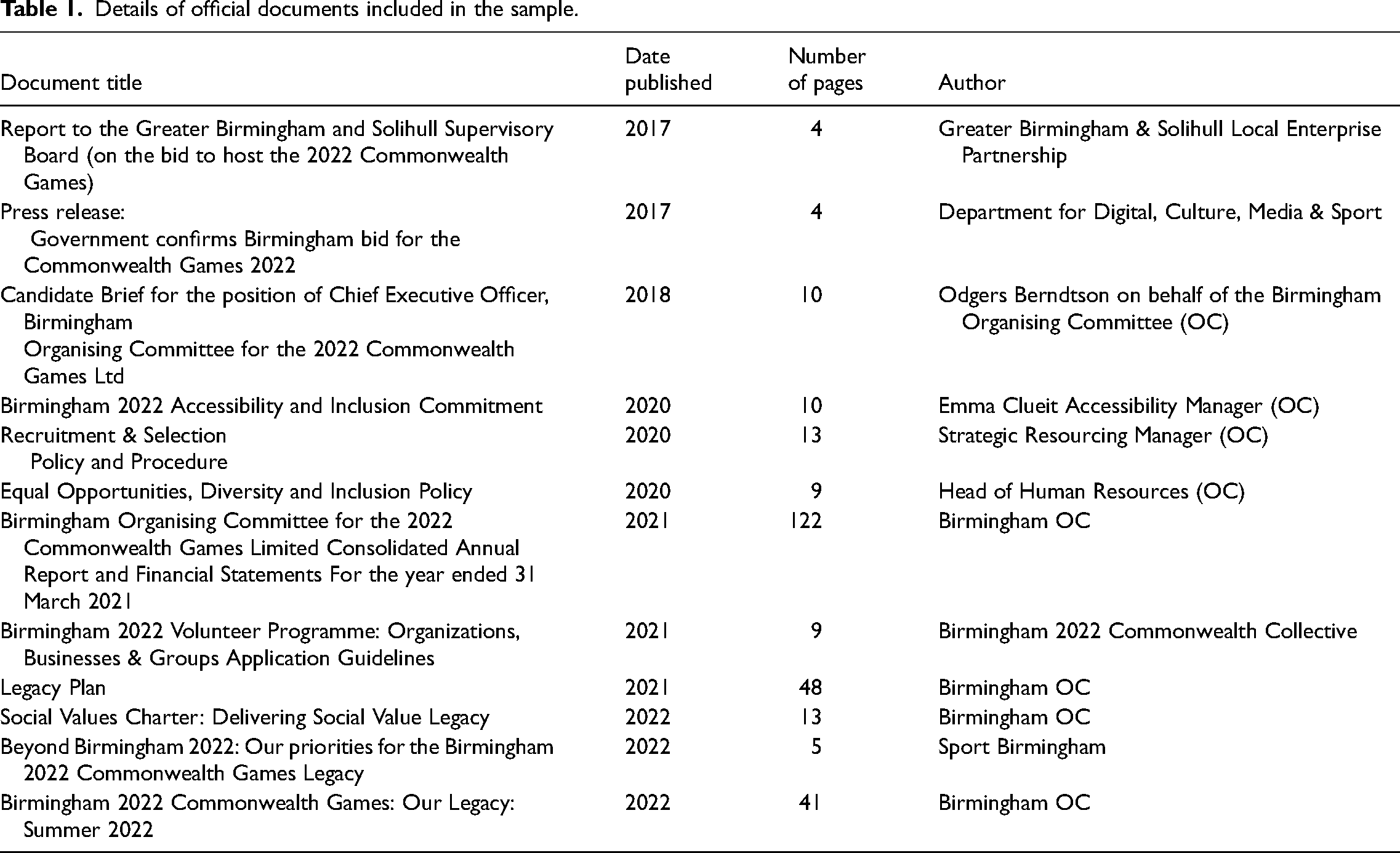
Following on from our ontological constructivist position, whereby we are concerned with the social construction of legacy discourses, this article's data are drawn from two qualitative data sources. First, documentary research involving analysis of publicly available documents related to CWG 2022 and pre-event reports. Second, we draw from purposively sampled media sources (specifically, the quotes/statements provided/quoted in those media articles) spanning the dates 21 December 2017 (when it was announced that the CWG would be held in Birmingham) and 9 August 2022 (the day after the event's closing date). In recent years, document analysis of mega-event-related documents and bid books has become an increasingly popular method allowing researchers to explore mega-events stakeholders’ visions and discourses (Beissel and Kohe, 2022; de Oliveira, 2020). For Bowen (2009), document analysis – the systematic reviewing and evaluation of documents (both print and online) – fits within the context of a case study. Here, the documents we are concerned with thus refer to official documents and communiqués produced and communicated by those organizations (jointly) responsible for directing and coordinating the planning and organization of the Games. The selection of these documents is justified because they can be considered as the formal and available discourses of the relevant organizations, as made available on their official channels (Lee Ludvigsen, 2024). Concurrently, it is important to be mindful of the fact that such documents seldom are ‘politically neutral’ because they are serving the interests of its publisher organization, the organization's members and its commercial partners (Beissel and Kohe, 2022). Our sampled documents are summarized in Table 1.
Details of official documents included in the sample.
Media items were drawn from the online newspaper and news-blog repository LexisNexis. Specifically, the data we sought were the direct quotations from statements and interviews of key social actors and organizations connected to CWG 2022 that were cited within such media articles, rather than, as Millward (2017) puts it, the ‘journalistic descriptions’ of the unfolding organization of the Games. Indeed, newspaper articles should be treated with caution, particularly in the case of editorials and opinion pieces, due to the position, purpose and potential bias of the journalist (Millward, 2017). Whilst, as Ličen et al. (2017) maintain, tabloid media can present trivial or sensationalist news reportage, we chose to include both broadsheet and local tabloid articles because journalists reporting for the latter are well situated to give a platform to social actors, organizations and communities directly implicated in the Games in Birmingham. In relation to the media articles, however, it should be re-emphasized that our analysis related to the quotes and statements that were cited within the media articles. This remains an important distinction because our units of analysis were quotes or statements from key players in the CWG 2022, rather than journalistic or tabloid descriptions (Millward, 2017).
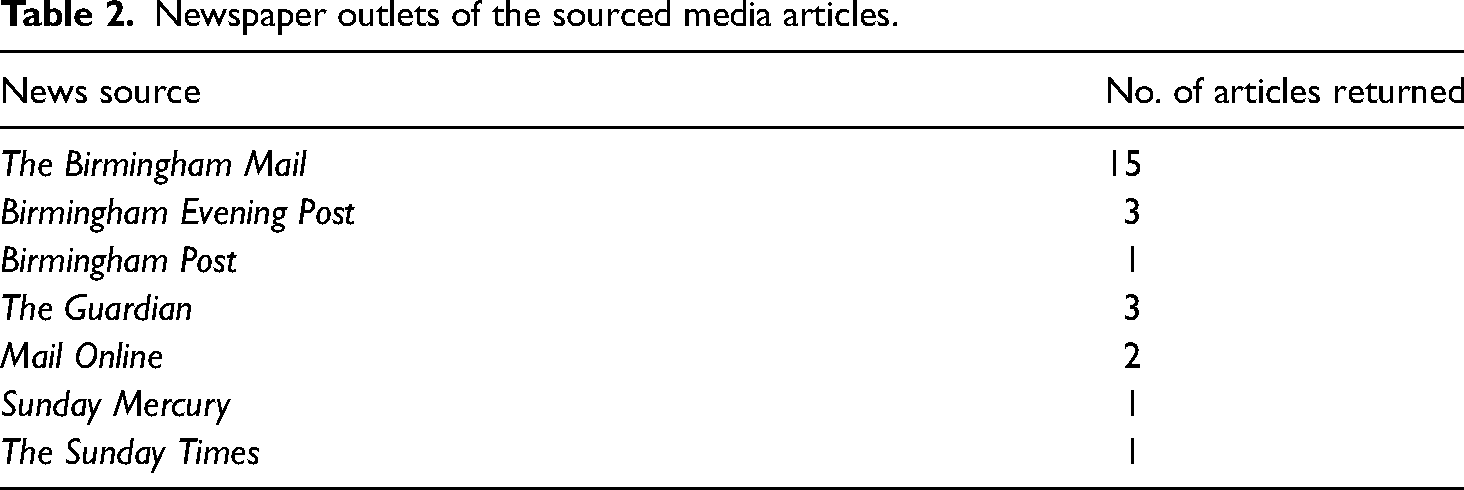
The scope of this repository search was narrowed to newspaper articles only that were published in English, and of UK publication location and geographic focus. Articles from both national broadsheet (e.g., The Guardian) and tabloid (e.g., The Daily Mail) news outlets were included, as were Birmingham-based tabloids (e.g., The Birmingham Mail). News stories containing the words ‘Birmingham commonwealth games 2022’, ‘race and ethnic diversity’, ‘legacy’, ‘legacies’, ‘community’, ‘volunteering’, ‘workforce’ and that were published within this timeframe were searched for and this yielded 355 articles. Additional online articles referred to within the originally sourced and relevant documents were snowballed into the pool of articles identified for analysis. After removing duplicates and discarding irrelevant articles that did not take as their central focus EDI legacy development in conjunction with the staging of the Birmingham 2022 CWG, and once the remaining sample had been verified across the research team, 26 were identified for analysis (see Table 2).
Newspaper outlets of the sourced media articles.
Data analysis
Concerning the process of data analysis, we followed the process of approaching documentary data as discourse subject to qualitative analysis with the aim of identifying dominant and repeated themes (Bowen, 2009). As such, official Games documents were reviewed and analysed initially by two members of the research team who highlighted, discussed and agreed on passages and segments of document text which spoke to social inclusivity, EDI, and legacy in combination, and as the Birmingham 2022 workforce and volunteering formed a central plank of legacy discourse surrounding the event, these dimensions formed core strands of this textual analysis. Following this, the research team reviewed the data highlighted from within official documents and together we undertook selective coding around the core inclusive legacy theme shaped around Games volunteering and workforce.
To analyse the media data, quotations illustrated within the articles were first grouped into types of social actors/stakeholders involved with and implicated by CWG 2022 before being assessed by two members of the research team to discern those statements made about social inclusivity, volunteers and workforce, rather than, for example, the quality or development of stadia or infrastructure. From there, the research team discussed and selectively coded the highlighted stakeholder statements that contested inclusive legacy discourses framed around volunteer and workforce development.
Inclusivity legacies and contestation
The analyzed documentary data demonstrated that the CWG 2022 continued the trend whereby sport mega-events – including its forerunner, CWG 2018 – are increasingly employed to discursively frame improvements to national and local accessibility and social inclusivity (see Powell, 2019). As this section argues, a significant amount of pre-event legacy discourse may be considered to be inclusivity legacies. Crucially, however, these attracted opposition and were criticized for failing to fully materialize.
The focus upon inclusivity came to the fore early in the preparation stage. Concerning recruitment, it was noted in a candidate brief prepared in 2018 by private company Odgers Berndtson on behalf the organizing committee, that: At full complement the OC [organising committee] leadership and organisation will be drawn from a diverse range of backgrounds, bringing a highly effective mix of skills and knowledge from the West Midlands region, sport and business worlds (p.3).
This remains important given the organizing committee's position in breathing life into, and framing legacies. Yet, beyond ensuring inclusivity in the organizing committee, it is also possible to see how inclusivity in other areas was continuously framed by diverse actors. This framing concurrently illustrates who ultimately made legacy claims before the CWG 2022, most notably the organizing committee, but also its partners including the government, local authorities and CWG England.
Throughout the preparation stages of CWG 2022, which were impacted by the coronavirus disease 2019 (COVID-19) pandemic, the emphasis on inclusivity legacies remained a central aspect of the event's pre-event legacy discourses. Importantly, as the CWG's own Legacy Plan from March 2021 stated, the event was approached as a generator of legacies related to inclusivity in the form of, inter alia, establishing ties between communities, providing employment and volunteering opportunities and, overall, the CWG was described as ‘a new era of equality and opportunity in Birmingham and across the West Midlands’ (2021: 5).
As the Legacy Plan maintained: The Games can be a wider catalyst and accelerate our aspirations around climate change and regeneration, to showcase this national centre of hospitality and advanced green manufacturing. We want these Games to be the most sustainable yet. We will champion better mental and physical health, strengthen connections between communities, and through volunteering and employment opportunities we will prosper (p.5).
One way in which this aspiration was worked towards involved the ‘Stronger Communities’ initiative which was established seeking to target interventions across the host city's diverse communities. Indeed, as the Our Legacy document from the summer of 2022 reflects on, one key aspect of the Games’ inclusivity vision related also to the involvement of local communities within the Games’ celebrations with the idea that this would boost long-term benefits: To support on the delivery of Commonwealth Games activities and support the wider work around equalities and cohesion in the city, a Community Stakeholder Panel has been created. The Panel is made up of residents from across the city's 10 constituencies and provides a forum for residents to actively engage and be involved on these projects … The Celebrating Communities fund was set up to allow each of the city's 69 wards to apply for funding encouraging people and communities to come together and celebrate the Games their own way. As well as helping people to feel involved and celebrate the occasion, the intention was to spark some longer-lasting initiatives (Our Legacy, 2022: 38, emphasis added).
As Talbot (2021: 29) notes, the ‘ways we talk about legacy’ often reflect the ways in which those legacies are constructed by host governments, local organizing committees and sport governing bodies – these are commonly regarded as the dominating or powerful players of the mega-event field. Thus, in the context of Bourdieu's (1989) concept of field, these actors typically dictate the articulation of legacies and seek to impose orthodox understandings of legacies as undoubtedly positive for all actors across the field. However, despite these ideas being set out publicly through documentary form before the Games had even started, it remains important to reiterate that these kinds of claims are contested.
Regularly, in social fields, ‘each [actor] responds and reacts to the actions of the others (or the effects of those actions), generating, in turn, situations, opportunities and provocations to which the others must respond’ (Crossley, 2002: 674). Indeed, the claims of other actors question the extent to which enhanced inclusivity became a by-product of the Games. In May 2022, Mac Alonge, the chief executive of diversity and inclusion consultancy, The Equal Group, commented that: ‘The Games has been positioned as this great thing for the region, for the economy. But people haven’t felt it, people have felt frustrated’ (quoted in The Guardian, 2022). Meanwhile, Birmingham Mail (25 May 2022) also reported how the organizers of the CWG 2022 had been ‘given the “red card” on diversity’ following a report put together by a group of activists and academics who claimed the organizers had ‘failed to fulfil a pledge to be a “Games for Everyone”’. As the Secretary of Birmingham Race Impact Group 2 (BRIG) was quoted, ‘The Report Card seriously challenges the diversity credentials sought and projected by B2022 in providing a series of recommendations to the CWG OC and its delivery partners’ (quoted by Birmingham Mail, 2022). Thus, already before the CWG had taken place, and through documentary discourses, we unsurprisingly see how this sport mega-event brought together a disparate field of complex but also conflicting webs of stakeholder networks (Duignan, 2021).
Returning to Bourdieu's (1989) field, we may see here how actors situated on different sides of the CWG's organization are involved in a struggle. Whilst this struggle is not characterized by unified or coherent movements who agree on all legacy-related matters, this struggle is inherently social because the actors – whilst holding different views – are still in indirect and direct interaction through these public discourses dealing with legacy claims (cf. Crossley, 2002). As De Oliveira (2020: 5) writes, ‘[a]t stake in this symbolic struggle is the imposition of a worldview that best conforms to their [segments of classes’] interests in modifying or maintaining their social position’. Inclusivity legacies are thus politically contested and, as evident in the next section, this struggle comes to the fore as a central contestation was over the extent to which the Games led to inclusivity through workforce development and volunteering.
Volunteering and workforce
One of the driving themes for generating this inclusive legacy was through volunteer and workforce development. As expressed in the Legacy Plan document published jointly by the Birmingham 2022 Organising Committee and partners in March 2021:
We will prioritize a significant number of places for local volunteers to ensure that our volunteers truly encompass and are representative of [the] region's people … We want to build the most inclusive, diverse, and representative volunteer workforce ever … As the Games for Everyone we would like our legacy on volunteering to mean that our volunteers are representative of Birmingham and the region (p.21).
To follow this, the Birmingham 2022 CWG Committee and partners produced the Our Legacy document which espouses that the development and experience gained through volunteering at the Games can beget further volunteering and lay the tracks into future employment for those involved, whilst selection and training processes would be guided by the core value of inclusion to facilitate a diversity of applicants’ entry into these Games-time roles: From the application process through to interview, selection, orientation, and uniform Birmingham 2022’s volunteering programme has had legacy, innovation and inclusion entwined in everything it has done … Gathering and deploying a large group of volunteers is also an excellent chance to accelerate employability and skills opportunities for local people. Games-time volunteering could create paths to additional training, career enhancing opportunities both in voluntary work and paid employment (Our Legacy, 2022, p.26)
Some examples of the inclusion-orientated recruitment practices set out by the Organising Committee were illustrated in its Consolidated Annual Report and Financial Statements for the year ended 31 March 2021: The Company's workforce EDI dashboard enables it to actively monitor representation within its recruitment processes and workforce make-up, in order to identify how it compares against the West Midlands population … If the Company identifies groups which are under-represented, it takes appropriate action to target these groups, to increase their participation in recruitment. The Company's Games time workforce also includes its volunteers. The Company will monitor volunteer applications and the workforce of suppliers, so that it can remain focused on the priority of developing a workforce reflective of the West Midlands and will take action where appropriate (p. 26)
However, it can be argued that volunteer and workforce jobs and roles are also problematically framed in application guidance, recruitment procedure documents, and even public statements. For example, on 2 July 2020, the Birmingham Mail quoted a statement made by the Chief Executive Officer for Birmingham 2022 claiming that ‘Our Executive Management Team (EMT) are best-in-class senior practitioners’. In a similar vein, in the workforce Recruitment and Selection Policy and Procedure document, stated that it was the organization's aim ‘to attract, recruit and retain the best local talent from Birmingham and the West Midlands’ (Strategic Resourcing Officer to the Birmingham 2022 Organising Committee, 2020: 4).
The use of language such as the ‘best-in-class’ and the ‘best talent’ is not without implication, as illustrated by research on access and mobility to and within the so-called elite occupations (e.g., finance, medicine, law), occupations wherein many minoritized ethnic groups (specifically, those of Black, Bangladeshi, and Pakistani people – and who are also likely to be from working class backgrounds) are under-represented in upper-echelon jobs (Friedman and Laurison, 2019). Bourdieu's concept of field homologies comes into play here: Defined as ‘a resemblance within a difference’, agents are said to be objectively placed in equivalent or at least similar social positions across a myriad of separate fields (Bourdieu and Wacquant, 1992: 106). The concept of homology amongst fields serves to reproduce the power relations whilst simultaneously preventing subordinates from one field gaining advantage in another and upsetting the balance of that social space. This presents at least two problems for developing a representative workforce. One is that persons from backgrounds traditionally under-represented in certain jobs or volunteering activities may self-eliminate from applying to such opportunities due to ‘an unconscious estimation of their objective probabilities of success’, viewing such openings as inaccessible and ‘not for us’ (Bourdieu, 1977: 445; Friedman and Laurison, 2019). The other problem is, and it is important to acknowledge an under-representation of racial-ethnic groups in sport (event) volunteering (Hayton and Blundell, 2021), here, that recruitment decisions may reflect homophily, or cultural symmetry whereby tacit judgements of a candidate's suitability and capability are based upon the perceptions of their cultural competency – embodied forms of cultural capital misrecognized by gatekeepers often from traditionally well-represented groups as ‘objective’ markers of merit – whilst others from traditionally under-represented backgrounds are evaluated as less suitable, regardless of their aptitude (Friedman and Laurison, 2019). On this second point, the notion of competence was emphatically deployed in the Games’ Recruitment & Selection Policy and Procedure document, with competency-based questioning justified as follows: Structured competency-based interview questions will be used, as they are one of the more valid and effective selection techniques, based on the assumption that past behaviour is the best predictor of future behaviour. Competency based questions allow candidates to demonstrate their work history, experience, knowledge, behaviours and motivation (Strategic Resourcing Officer to the Birmingham 2022 Organising Committee, 2020, p.8)
Not dissimilarly to the behaviours and motivation dimensions underpinning the ‘competency-based’ screening approach outlined above, general volunteer roles ‘are open to applicants who meet the criteria and demonstrate the passion and committed attitude required to be a Games volunteer’, as communicated in the Birmingham 2022 Volunteer Programme: Organisations, Businesses & Groups Application Guidelines (Birmingham 2022 Commonwealth Collective, 2021: 5). Criteria such as passion and a committed attitude constitute embodied volunteer dispositions not unlike a diligent work ethic described by Friedman and Laurison (2019), and one which is characterized by a sustained commitment to a particular role. There are two important facets to this point: one is that such behavioural codes are mirrored by others of similar background, experience and socialization so that, second, they are recognizable to one another, thus meaning that embodied volunteer dispositions of passion, a committed attitude/work ethic must be both tacitly discernible to gatekeepers and congruent with their image of cultural competency.
In addition, such messaging is somewhat divergent from that conveyed in the Birmingham 2022 Volunteer Programme: Organisations, Businesses & Groups Application Guidelines which notes that ‘Experience and qualifications are not necessary requirements, however, and Birmingham 2022 welcomes all applicants, especially first time Games volunteers’ (Birmingham 2022 Commonwealth Collective, 2021: 2). This statement chimes with comments made by Jagwant Johal (BRIG Secretary) as he posed the question: “are these [Birmingham's Black, Asian and minority] communities just going to end up being recruited to the volunteering programmes while the remunerated jobs go elsewhere" (quoted in the Birmingham Mail, 2021). Informed by the evidence from the Birmingham 2022 workforce data, Johal's comments speak to the unequal and seemingly stratified opportunities and rewards available to Black, Asian, and minority ethnic communities compared to White communities in managed and real Games time, but also those which are likely to track beyond the Games as part of region's employability ‘legacy’. Drawing on concepts associated with Bourdieu's notion of field, there was a collective understanding around the prospective legacies of the Games as framed by the dominant event actors, and that the benefits ensuing from the hosting of them were worth pursuing. However, in the years and months leading up to the event, other actors claimed that the rewards – important stakes that are in the interests of Birmingham's Black, Asian and minority ethnic communities – originally presented were not evenly distributed (e.g., workforce, employment and volunteering opportunities). Accordingly, this uneven distribution drove struggles imposed by the field between incumbent institutions responsible for organizing the Games and those challenging them to make good on their EDI promises.
Indeed, such legacy promises and the posited inclusiveness of such recruitment strategies to ensure a representative workforce came under significant public scrutiny, with the BRIG a prominent body in this and one spotlighted by the media. Initially, as pointed out by BRIG Secretary, Jagwant Johal, and when exposed, ‘The Birmingham CWG 2022 Board of Directors was overhauled in less than a month for not being fully representative of the city's diversity, following a community-led challenge’, with 19 out of 20 senior Board and Executive roles held by white people (quoted in the Birmingham Mail, 2021). Johal added that: ‘This was a tacit acknowledgement they had not quite got the optics right. After all, it was Birmingham's diversity that got the Games here in the first place’ (quoted in the Birmingham Mail, 2021). Drawing upon Birmingham 2022 CWGs’ own dataset, the BRIG claimed that the organization as a whole ‘fails to come close to reflecting the Black, Asian and other minority ethnic roots of over half the city’ (quoted in the Birmingham Mail, 2022). For context, in 2021, 18% of Games personnel were of an ethnically diverse background, with this rising to 20% in 2022, whereas 32% of the West Midlands workforce and 47% of the Birmingham workforce were of an ethnically diverse background across this period (Birmingham2022, 2023; Birmingham Race Impact Group, 2022).
Conclusion
This article examined the communicated, framed, and contested meanings of mega-event legacies. As such, it connects with, and contributes to the literature on sport mega-events and their legacies (Cashman and Horne, 2013; Cornelissen et al., 2011; Horne, 2017; Talbot, 2021; Toohey and Taylor, 2012). For decades, critical questions surrounding the concept of ‘legacy’ have followed most – if not all – sport mega-events (Horne, 2017). Concentrating on the CWG 2022 case, this article makes an important contribution to these legacy-oriented debates as it addressed, critically engaged with, and responded to three RQs speaking to (a) the framed meanings of legacy prior to the event, (b) the legacy aspirations vis-à-vis workforce and volunteering and (c) counterclaims emerging from social actors in the ‘mega-event field’.
In answering these questions, and borrowing theoretical insights from Bourdieusian theory, most notably doxa and field, this article revealed how, in relation to RQs 1 and 2, inclusivity legacies framed as positive for, and in terms of the host city's local communities, workforce and volunteering practices were communicated by organizing bodies and authorities. Then, in response to RQ3, we may see how these communicated legacies and legacy-related doxa (cf. Bourdieu, 1977) were rapidly paralleled by what can be understood as ‘community criticisms’ from actors situated within the civil society who emphasized the limited impact of the CWG (cf. Giulianotti et al., 2015). This remains important because it exemplifies how it is not solely tangible legacies (i.e., constructions, stadiums, urban interventions or redevelopments) that attract public scrutiny, but intangible legacies too. Given that ‘legacy’ compose one important site of political contestation before and after mega-events, the question of legacy framing opens up for scholarly readings of mega-events’ ‘distribution of power, struggles and who gains from the situation’ (Horne, 2017: 338). In a hitherto unexplored case study, this article reaffirms findings from earlier, sociological sport mega-event literature (De Oliveira, 2020; Giulianotti et al., 2015; Horne, 2017) highlighting that the existence (or suspected non-existence) of legacy is increasingly attracting public opposition in contemporary societies.
Theoretically, meanwhile, we have illustrated the inextricable relationship between doxa and struggle – in this case, within the sport mega-event field. The findings, therefore, reaffirm Bourdieu's concept of doxa in that the stakes and rewards that the Games present (and, in part, framed by the organizers) are accepted and bought into by the variety of stakeholders implicated by the event's hosting, with struggles between the incumbent organising parties and the wider community unfolding when promised outcomes are seen to more closely reflect rhetoric rather than the reality during the pre-event build-up. Second, Bourdieu outlined that whilst fields are autonomous and separate from one another, their structural and functional characteristics are isomorphic, meaning that those in either dominant or subordinate positions in one field will most likely occupy respective positions in another, and we get a sense that the framing of recruitment discourses and the practices they feed may stratify, filter, or even exclude prospective candidates to and from particular roles and workforce areas according to intersectional characteristics much akin to those occupational profiles reported in mainstream and elite industries (Bourdieu, 1990b; Bourdieu, 1993; Friedman and Laurison, 2019).
Lastly, we echo that ‘[f]uture sport mega-events and other forms of festival capitalism will continue to attract diverse forms of opposition, criticism, and complaint’ (Giulianotti et al., 2015: 115). As demonstrated, this included the CWG 2022, and whilst continued research subscribing to diverse methodologies is needed to empirically capture the more longitudinal developments and narratives of CWG 2022's legacies, our arguments still remain significant because sport mega-events such as the CWG are reflective of wider urban political tendencies (Lauermann, 2019) and our findings, albeit rooted in a single case-study, speak to how contemporary, neoliberal projects are publicly communicated by its organizers, promoters and advocates, but simultaneously contested by local communities in the twenty-first century.
Footnotes
Declaration of conflicting interests
The authors declared no potential conflicts of interest with respect to the research, authorship, and/or publication of this article.
Funding
The authors received no financial support for the research, authorship, and/or publication of this article.
