




Abstract
Professional sport is a central element of our daily entertainment that contributes to shaping us individually and bonding us collectively: it provides us with shared ‘historic’ moments. This article is interested in these moments, and how the field of sports generates them, by asking the following questions: (1) has the frequency of ‘historic moments’ changed over time, and (2) is the way we make sports history consistent throughout the years? We conducted a temporal analysis of newspaper and magazine articles (n = 1062) published in France (Le Monde, l’Équipe) and in the United States (USA Today, Sports Illustrated) during three time periods in the 21st century (2003, 2010, 2019). Our results show that: (1) as time passes, ‘historic’ moments occur more frequently; (2) sporting history is increasingly linked to social dimensions; and (3) statistical performances continue to mark history above all else. Although performance-based achievements are consistently celebrated, sporting history cannot be separated from our collective social existence, and the currents therein. We show that the act of making sports history is also bound to the normative, social, and cultural history of a society.
During the second week of February 2023, ‘sports history’ was made in several ways. On February 7th, with his near buzzer-beater shot against the Oklahoma City Thunder, Lebron James made basketball history by surpassing Kareem Abdul-Jabbar's record of 38,387 points (Beacham, 2023). Six days later, Patrick Mahomes of the Kansas City Chiefs and Jalen Hurts of the Philadelphia Eagles made American football history by breaking longstanding racial barriers in the world of sports: for the first time in the National Football League (NFL), two black quarterbacks started in the Superbowl (Sergent, 2023).
The term ‘making history’ is used often in the field of sports reporting; as in the examples above, it is typically used without being explicitly defined. It is therefore interesting to interrogate this ‘mot-valise’ (catch-all, literal: luggage-word, Castel, 1995), to understand its meaning sociologically in the world of sport. More broadly, sports exist in and reflect wider societal and social contexts: what happens in the sporting world and how it is reported upon is inherently linked to and influenced by the social world, given the intrinsic and complex relations between sport and society (Donnelly, 1995). Thus an examination of how the term ‘making history’ is used can also yield boarder reflections on the interplay with the wider social and cultural universe.
This research is therefore interested in the act of reporting on ‘making sports history’. It aligns with our previous research on catch-all terms, such as ‘hero’ (Roy et al., 2021), that are overused and become taken for granted, though the meanings attributed to them may shift over time and illustrate interesting wider social and cultural trends.
By analysing the evolution of media coverage related to ‘making sports history’ in France and in the United States during the 21st century, this article will show how ‘history-making’ sporting moments, and the responsible sports heroes deemed exceptional by media, are all bound to the normative, social, and cultural history of a society at a given time.
Context: What is sports history?
Sports history, classically defined as ‘a genre of empirical knowledge that is based upon the remains of the past’ (Day and Vamplew, 2015: 1717), is marked by data/social/cultural/political facts. Canadians have been taught that their country's sports history was marked in 1928 by Fanny Rosenfeld, Jane Bell, Ethel Smith, Myrtle Cook and Ethel Catherwood who earned two gold medals in the 4 × 100 m relay and in the high jump, making Canada the top competing country in women's track and field at the very first Olympics Games that allowed women's participation. Canadian sports history was also marked in 2010 when Sidney Crosby scored the game-winning goal against the U.S. hockey team and made Canada the most decorated country in Winter Olympics history with 14 gold medals (Giddens, 2017). From a North American standpoint, we might think of Jackie Robinson who in 1947 broke the racial barrier in Major League Baseball or Michael Jordan who will go down in history as one of the best basketball players of all time, with his six championship titles (Robbins, 2011). All in all, these moments mark sports history because athletes break performance records, or break social barriers and boundaries that limit certain social groups from participating fully in the culture of sport.
Nevertheless, a racialised athlete does not inevitably make history because of their ethnic and racial background. Michael Jordan has marked the history of basketball through his performance and impressive statistics. Often described as apolitical (Wright, 2016), he has ‘made history’ as any white athlete would have: based on his athletic achievements, without consideration for his social, cultural, or ethnic background. This is in sharp contrast to another event that left its mark on the Olympic Games: Tonnie Smith's and John Carlos’ black gloves and raised arms on the 200 m podium in Mexico City, in 1968. Here, sports history is political as athletes want to expose the racial discrimination experienced by the Afro-American community in the United States at a time of great social upheaval (Edwards, 2017). As we can deduce from the above-mentioned examples, sports history is marked by performance-based data, but also political events and social issues arising from the surrounding social and political world.
Conceptual frame: Sport heroes
Klapp (1948) recognised 75 years ago that heroes are a collective production of public interest. More recently, several authors (Kinsella et al., 2015; Klapp, 2017; Roy et al., 2021) argue that heroic figures are heroised figures, meaning that they are transformed into heroes by a process of heroisation. It has been argued that individuals are heroised not for their inherent attributes, but because of social ideals that are projected onto them and that they come to embody (Cooley, 1922; Franco et al., 2011; Franco and Zimbardo, 2006). In other words, the characteristics that are used to heroise an individual are selected because they represent broader social values and norms. Thus, the transformation of an individual into a hero is a social commentary (Klapp, 1954, 2017). We will therefore use the concept of ‘heroisation’ as an analytical lens to interpret the act of making sports history.
We argue that athletes can socially and culturally ‘make history’ because they hold a heroic status in contemporary Western societies (Laurin-Lamothe et al., 2015). Indeed, since the beginning of the 20th century, sports and athletes have been the subject of increased public and media attention, whereby sports stars achieve considerable public status, an ‘assimilation into the world of entertainment caus[ing] them to be treated as celebrities’ (Smart, 2007: 953).
Some authors counter that athletes are not heroes, but rather entertainment for the masses (Swierczewski, 1978) or that they are not altruistic and moral individuals but motivated by personal financial gain (Lasch, 1991). Others tie sports heroes to the personification of a brand, and their heroisation to an effective marketing response to consumer demand (Boorstin, 1963; Whannel, 2002). Like the aforementioned authors, we agree that these are undeniable trends. However, we also maintain that sports athletes can still be considered heroes for three reasons.
The first is that their personal practice of the sport is often interpreted as a manifestation of their moral character (Morgan, 2013; Wenner, 2013a). The second reason is that their actions have an impact off the field (Wieting, 2000), for example by fostering national and/or collective pride (Swierczewski, 1978; Van Hilvoorde et al., 2010; Weiss, 1969). The final reason athletes can undergo heroisation is that although previous authors have long argued that athletes embody social values and norms (Czarnowski, 1956; Weiss, 1969; Wenner, 1994), we would go one step further and hypothesise that today, they can even represent an excess of social norms (Moreau and Nahas, 2015).
Indeed, we argue that heroised sports athletes are an exaggerated representation of society, notably on a normative level, because they are perceived as individuals ‘par excès’ (Castel and Haroche, 2001) and represent an ideal for which to strive (Leonard, 1998). They can be seen to represent the myth of the democratic and meritocratic ideal (Ehrenberg, 1991), in the sense that the victor earns his or her achievement in the face of adversity but on an even playing field, like all the other players. They have even become the personification of our potential social success (Holt et al., 1996; Wenner, 1994) in a context where the visibility of elite athletes is ever-present, notably through their philanthropic efforts and presence on social media (Kunkel et al., 2022). So athletes make history and become heroes in a way that clearly and explicitly illustrates wider values related to meritocracy and social mobility.
The heroisation of athletes will also depend on the time period in which they emerge; the public appreciation of their contribution will depend on the wider social, economic, political, and ideological context (Lowe and Payne, 1974; Smart, 2007). Studying the heroisation of athletes can therefore be a useful and interesting approach to analyse a society's normative vocabulary, embodied by its sports heroes: there is nothing ‘objective’ about being a hero, as it emerges from the social world.
Some authors go further still and underline the importance of analysing implicit heroisation, such as the glorification and the social elevation of individuals despite them not being designated explicitly as ‘heroes’ (Kinsella et al., 2015; Roy et al., 2021). In this research, we are using this concept of implicit heroisation by analysing the act of making sports history – which we consider a type of heroising process – even though the athletes concerned might not be labelled explicitly as a ‘hero’. More specifically, we investigate what kind of athlete makes history, analyse how and why history is made, and explore what arguments were used to justify why a moment was ‘historic’.
Research objectives
As a mot-valise, the expression ‘making history’ is used and has sociological interest beyond the sphere of sport, but in this study, we limited ourselves to trying to understand what ‘making history’ means in sport. Consequently, this research conducts a temporal analysis of the ways in which sports history is made and reported upon. Two main questions have guided our study: (1) has the frequency of ‘historic’ moments changed over time? (2) are we making sports history in the same manner throughout time?
Methods
The data for this research was collected from two countries (USA and France) and from the archives of four newspapers: USA Today and Sports Illustrated (USA); Le Monde and l’Équipe (France).
French and American newspapers were chosen to widen our scope of sources and to allow us to determine if there were observable differences in the cultural elements and trends of two countries speaking different languages on different continents. France and the USA were selected because they have newspaper publications dedicated to covering multiple sports.
The choice of newspapers was based on two factors. The first was the nature of the sources used for the collection of data: we wanted both generalist newspapers (USA Today and Le Monde) and sports-dedicated news sources (Sports Illustrated and l’Équipe). This allowed for a comparative analysis exploring how ‘making history’ is presented to consumers by different types of news broadcasts.
The second factor justifying our choice of media was the newspapers’ reputability and their circulation figures. USA Today is the first national general-interest newspaper of the United States (Britannica, 2009) releasing its first publication on September 15th, 1982. It now reaches over seven million readers daily thanks to its print and online issues (USA Today, 2023). The second American news source used to collect data, Sports Illustrated, is the leading sports magazine in the United States, launched in 1954 (Britannica, 2023). Since 2020, Sports Illustrated publishes monthly in addition to special issues. It was reported to have a readership of over 92 million monthly in January 2022 (LoRé, 2022). Le Monde is a French general-interest newspaper publishing its first paper on December 18th, 1944. It quickly earned a reputation as a reliable national news source, making it the most widely read newspaper in France in 2022 (ACPM, 2023a; Gouvernement de la France, 1944). In April 2023, Le Monde reported over 115 million monthly online visits to their website LeMonde.fr, as well as a French print readership of over 476,000 (ACPM, 2023b). Finally, l’Équipe, formerly l’Auto-vélo, published its first report on October 16th, 1900. In 2022, the magazine had a monthly average of over 66,500 print readers, and over 148,800 online readers, making it the leading sports news source in France (ACPM, 2023a, 2023c).
Data extraction
To explore the evolution in how history is made, according to these generalist and sport-dedicated publications in France and the USA, the articles analysed in this research were selected from three different time periods: January 1st 2003 to December 31st 2003; January 1st 2010 to December 31st 2010, and; January 1st 2019 to December 31st 2019.
We selected the 21st century for all three time periods for two main reasons. The first is that sport has entered a new dimension since the 2000s, due to significant professionalisation and financialisation of the sector (Andreff, 2021). The second is the accelerated pace of media coverage and digitalisation in our daily lives since the 2000s (McGillivray, 2014). These factors were thought to unduly affect the comparability of ‘historic moments’ in sports going back more than two decades.
Our initial intention was to look at the years 2000, 2010 and 2020, beginning on January 1st and ending on December 31st. However, we subsequently had to alter the years used for data collection for several reasons. The first concerned the unavailability of l’Équipe's archives between 2000 and 2001. Given that l’Équipe's publications were only available as of December 19th, 2002, articles were collected for the year 2003 across all news sources to harmonise the data. Additionally, the year 2020 was not analysed because most of the sporting world experienced significant declines or event cancellations due to COVID-19. We therefore selected the year 2019 instead.
The databases used for collecting data were Eureka, Factiva and Google, according to the availability of archived data for each news source (Eureka and Factiva were prioritised to collect the data, followed by Google, when archives were not available in the prior two databases). The following keywords were used to collect the English data: making history, make history, made history, mark history, marked history, wrote history, write history, create history, created history. The search formulas applied enabled the keywords to be identified anywhere in the articles and allowed a three-word discrepancy between the verb and the noun ‘history’ to include differing sentence structures (e.g. allow inclusion for: ‘marked local sport history’). As for the collection via Google, which did not allow for a three-word discrepancy, we used the following search formula: intext:history. For the French news sources, we extracted articles based on the key words: marqu* histoire, écri* histoire, fait + histoire, crée + histoire. A three-word discrepancy between the verb and the noun ‘histoire’ was also similarly applied.
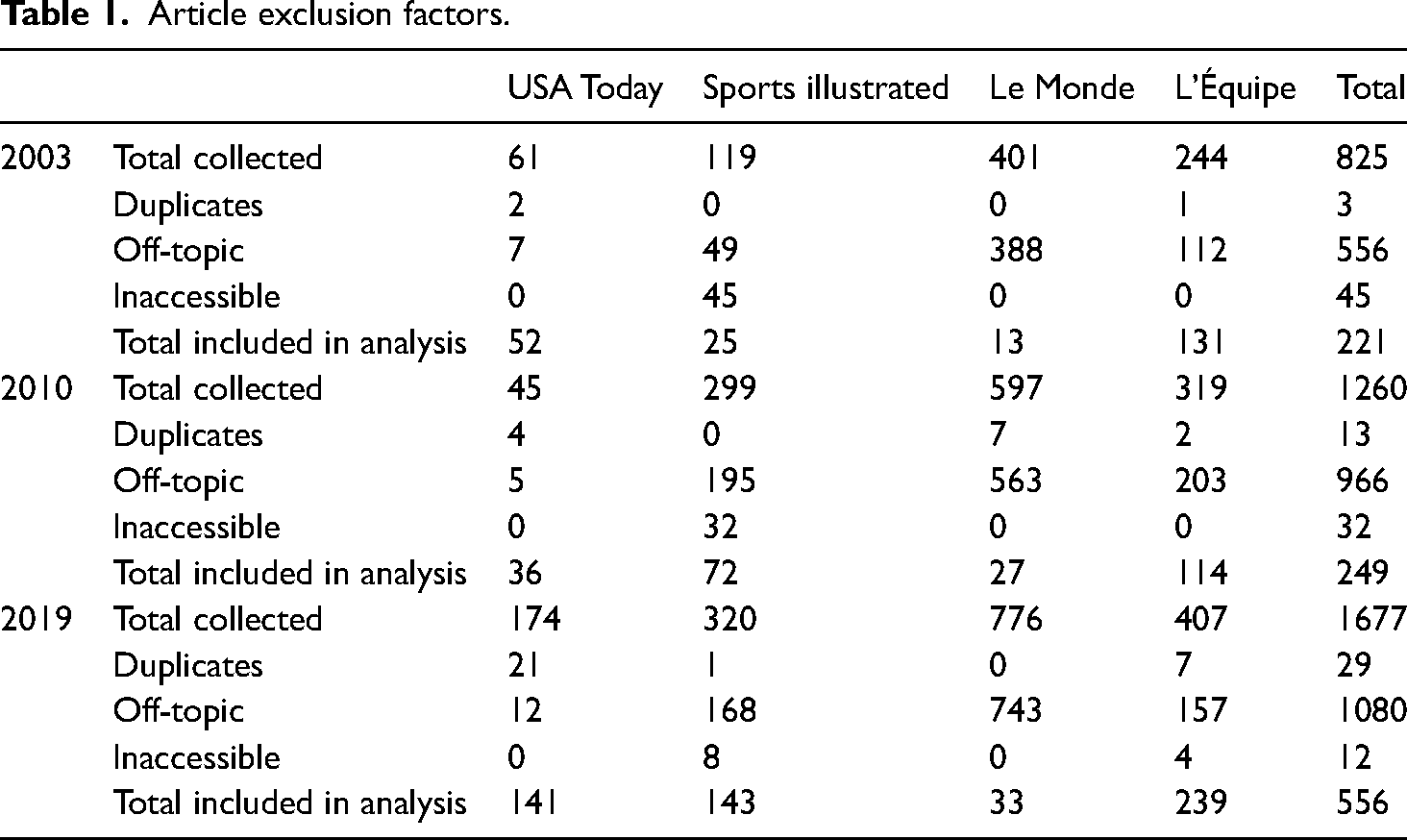
Sports Illustrated data was collected using Google. We collected 738 articles, 240 of which were included in our analysis following exclusion criteria (see next paragraph). USA Today data (print and online) was collected using the database Factiva; we retained 229 articles of the 280 initially extracted as per our exclusion criteria. L’Équipe publications (print and online) were collected using the database Eureka, yielding 970 articles of which 486 were excluded. Finally, the database Eureka was also used to collect data from Le Monde (print and online), producing 1774 articles, of which 73 were included for analysis.
Exclusions were applied for the following reasons: (a) the article was a duplicate (i.e. appeared online as well as in print); (b) the article was off-topic (i.e. not sports-related, e.g. some articles adopted an alternative use of the word ‘history’ such as in ‘team history timeline’ and (c) the article was inaccessible (the URL in the database was invalid or behind a paywall) (see Table 1).
Article exclusion factors.
Data analysis
Our qualitative data analysis was inspired by an inductive thematic analysis (Braun and Clark, 2006) to evaluate how ‘making history’ was reported in different time periods by the news sources selected. Collected data was analysed by the first author, beginning with a rough read-through of data collected in the first year of our sample (2003) to determine underlying themes and possible categories. Three categories were initially identified by the first author: ‘athletic performance(s)’, ‘social barrier(s)’ and ‘other’. These were discussed with the second author, not in a positivist logic of validation (such as with an inter-coder reliability approach), but to allow for exchanges and reflections, with the aim of building knowledge. The ‘critical friend’ method was favoured in our analysis because it can offer useful consideration of multiple interpretations of the data, each equally justifiable, and reflective of the differing expertise of the contributors (Smith and McGannon, 2018). Although inter-coder reliability (Lincoln and Guba, 1985) was considered, it has been known to raise issues relating to the consistency of data coding because what is considered a fair argument for one coder may not be for another (Smith and McGannon, 2018). The critical friend method thus enables dialogue and the ‘acknowledgement of multiple truths, perspectives and results in the research process’ (Smith and McGannon, 2018: 117).
Following this initial explorative categorisation, data for the years 2010 and 2019 was also coded according to these three categories. Discussions with the third author then led to the idea of further exploring the ‘other’ category, and dividing it into three: ‘trivia’, ‘personal background’ and ‘sports governance’. Our subsequent recoding thus allowed for a categorising of the data according to five overarching themes (‘athletic performance(s)’; ‘social barrier(s)’, ‘trivia’, ‘personal background’, and ‘sports governance’), while also tracking articles by date, news source, country of origin, nature of the news source (sports-focused or generalist), author, and the sport discussed in the article.
A statistical analysis of the categorised qualitative data then allowed for the visualisation of trends through the 21st century as well as between countries and cultures, accompanied by excerpts that aptly illustrate these identified trends. Let us note that the quantitative dimension of our results should not overshadow the fact that this analysis is, in essence, qualitative, as it was purposefully based on a subjective interpretation of themes emerging from the data body. This does not however diminish the illustrative power of this study and the trends it found in the data. Lastly, it should be noted that because an article may sometimes touch on several themes, a source may be counted several times across different categories.
Study limits
This study has certain limitations. First, contrary to most sociohistorical analyses, the data from one year was analyzed to represent each decade, instead of a stratified sample over the total period analysed (in this case from 2003 to 2019). Therefore, although we have insights on the subject studied, one would need to analyse articles published over the whole of these years to draw a more comprehensive portrait of the evolution. Additionally, as demonstrated by our inclusion and exclusion criteria, some articles were not accessible or were incomplete given that they required various subscriptions to different sites. This did not allow for the full analysis of all articles published in the years chosen in the scope of this study.
The second limitation is related to the phenomenon, noted since the print revolution at the end of the 19th century (Tomes, 2002), of eye-catching journalistic formulas (sensationalist headlines, clickbait), which have been and continue to be consistently used as a means to bolster readership, circulation and engagement (Lee, 2009; Wenner, 2013b). Moreover, the use of such strategies has been exacerbated in recent years, due to two factors: the mass digitalisation of sports media (Boyle, 2009) and shifts in revenue streams which are increasingly prioritising online engagement and ‘views’ over news source reputability (McChesney, 2013), and; the globalisation of media and marketing, where competition between media has increased (Wenner, 1998, 2015). In this context, it is likely that the term ‘making history’ has been and will continue to be used by journalists to increase the visibility and reach of their articles. One could consider that our study, objectively, is not truly looking at what constitutes ‘making history’, or acts that create true sports heroes, but is rather a study on the tactical use of this expression by journalists (Wenner, 2013b). Nevertheless, we hope to have limited this possible bias by reading and assessing articles in their entirety, beyond the catchy headline or phrase.
The third major limitation of our study is that although we used the ‘critical friend’ approach (Smith and McGannon, 2018), our data was, on the first pass, coded only by the first author, and thus our subsequent interpretations have been influenced by a singular point of view.
Finally, it is noteworthy that the selection of the four news sources brings a bias, limited to media coverage of elite sports. Our choices and analysis are limited to a study of history as it is marked by elite sports, rather than broader sporting cultures.
Results
Our initial inductive reading of the articles led us to develop five themes used by the media to argue that ‘history had been made’:
history was made by the nature of a statistical performance of an individual, team, or collective group of athletes (n = 836):A pioneer of women’s pole vaulting, she has written its history by winning every title: the first world indoor title in 1997, the first world outdoor championships in 1999 and again in 2001, and the 2000 Olympic Games. ([our translation], Jolly, 2003)With a 13-0 win over Thailand in their Women's World Cup opener on June 11, Team USA made soccer history. The defending champions have once again demonstrated their superiority in the game. ([our translation], Maad, 2019) history was made because a social barrier was broken, allowing social change within the sports world (n = 112):George Washington’s Kye Allums made history last weekend by becoming the first openly transgender player in NCAA hoops history to suit up in a game when the Colonials played a pair of games in a tournament in Minnesota. (Zirin, 2010)“I can't believe it! I can't believe I just wrote history tonight … I did it for all the girls, it's mind-blowing.” Britain's Fallon Sherrock spent Tuesday evening playing darts against Ted Evetts, […]. She became the first woman to win a match on the professional circuit, the PDC (Professional Darts Corporation). ([our translation], Lemouton, 2019) history was made by a change in sports governance, such as rules, regulations, and all the administrative ‘red tape’ in sport (n = 52):He had already made NFL history when the Rams acquired his rights by trading 11 players to the Dallas Texans. (Tuttle, 2010)Stefan Grand Prix makes history! SGP becomes the first team in F1 history to send equipment to Bahrain without having a registration for the 2010 season! ([our translation], L’Équipe, 2010) history was made by a fatuous fact or event, seemingly trivial to the performance of the sport itself (n = 42):A number of ‘cardboard signs’ have also marked the history of these duels. ([our translation], Duprés, 2010)For the first time, we wore the Yellow Jersey, with McGee, and Cooke took off the green jersey, these are events that will mark the team's history. ([our translation], Rumpus and Gatellier, 2003) and finally, history was made by an athlete, or a group of athletes based upon a personal or familial characteristic, personal experiences or relationships not contingent on sports (n = 20):Vermont's Duncan Brothers Make History as First Trio of Brothers to Play in NCAA Tournament Game. (Carroll, 2019)Like when Drew Brees of the Saints and Nick Foles of the Eagles, each from Austin Westlake, made history in January by becoming the first Super Bowl MVPs from the same high school to oppose each other in an NFL playoff game. (Lee, 2019)
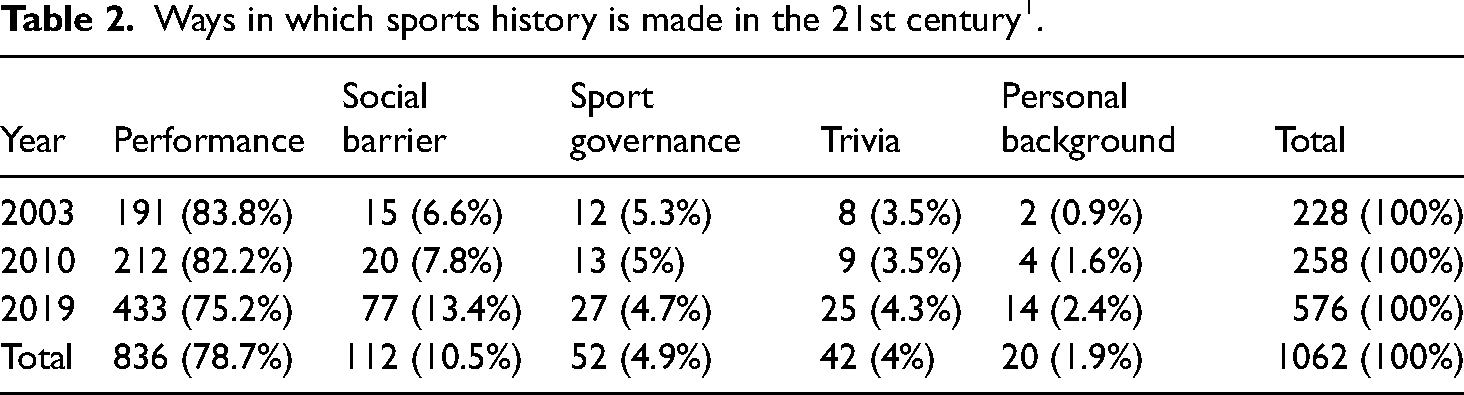
These five categories enabled our analysis of trends in the subject matter throughout the years included in our analysis (2003; 2010; 2019) (see Table 2).
Ways in which sports history is made in the 21st century 1 .
Sports history is made more frequently today
First, our analysis allowed us to note an important increase in the sheer number of articles about ‘making sports history’ through time, a number which more than doubled between 2003 (n = 228) and 2019 (n = 576). In addition, a clear shift in subjects covered can be observed, with an increasing number of articles associating ‘making sports history’ with the breaking of social barriers.
The rise of social considerations in sports history
The category specific to ‘breaking social barriers’ grows increasingly important within our collected articles over time, doubling in statistical importance across all four news sources between 2003 (6.6% of articles, n = 15) and 2019 (13.4% of articles, n = 77).
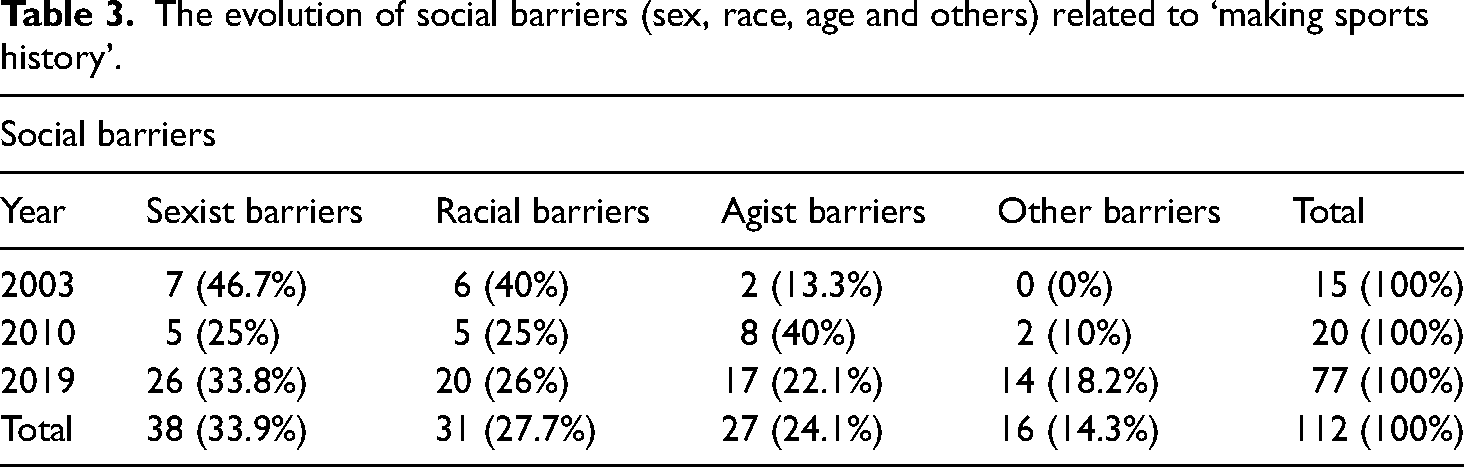
Within this category, we notice a qualitative evolution of the types of social barriers being broken. In 2003, barriers involved exclusively the subject matter of sex, race, and age: Teresa Phillips made college basketball history Thursday night, becoming the first woman to coach an NCAA Division I men's team. (Weir, 2003) Black quarterback made history, but that's not enough. […] Doug Williams, the first black quarterback to lead an NFL team to victory in a Super Bowl when the Washington Redskins beat the Oakland Raiders in 1988. (O’Connor, 2003) Last but not least, at least four exceptional champions want to take this opportunity to make sports history in their respective sports. As far as Ian Thorpe is concerned, it's already done. The 20-year-old Australian remains a magnet for superlatives. Since his breakthrough in 1998 (youngest ever world champion, 400 m), he has taken swimming into a new dimension. ([our translation], Josse, 2003)
In 2019, although the sex, race and age barriers are the most quantitatively important types of barriers discussed in these articles, this category evolves to include a larger array of subjects, namely physical ability, gender identity, ethnic origin, and sexual orientation: Deaf tennis player, South Korea's Duckhee Lee, wins match to make ATP Tour history. (Bumbaca, 2019) Trans wrestler Nyla Rose quietly makes history with AEW. […] Nyla Rose is the first transgender wrestler in a major American promotion. (Greene, 2019) Marciulionis made history when, in 1989, he became the first player from the former USSR to play in the NBA. ([our translation], Ohnona, 2019) Eight years earlier, Fashanu was the first professional footballer in history to come out. ([our translation], Brochen, 2019)
Between 2010 and 2019, the large increase in the number of articles citing ‘historic’ moments (from n = 258 to n = 576), coupled with the near doubling of the proportion of articles in relation to social barriers (see Table 2), has led to a very substantial increase in the sheer number of articles on making sports history related to women breaking sexist barriers, and racialised athletes breaking racial barriers (see Table 3): Toni Harris made history with her commitment [commitment] to Central Methodist University on Tuesday. (Caron, 2019). Michelle Cox is looking for more after making history as a coach in New Zealand's top men's league. (Clinton, 2019) Los Angeles Angels designated hitter Shohei Ohtani made history Thursday night by becoming the first Japanese-born player to hit for the cycle. (Gardner, 2019)
The evolution of social barriers (sex, race, age and others) related to ‘making sports history’.
Making sport history ‘traditionally’: Performance-based arguments
This increased attention given to social barriers has caused a corresponding decrease in the proportion of articles related to ‘making history’ due to performance (83.8% in 2003, 75.2% in 2019), although overall athletes’ performance consistently remains the most common argument, used in 78.7% of the articles over the years. Articles in this category presented a distinction between the two subcategories. The first subcategory relates to individual performance (whether it be an individual sport or an individual team member in a team sport, 53.1% of total articles over time): Allessandro Petacchi makes history with his Tour de France performances my fourth victory in the Tour de France puts me in the history books. ([our translation] Martinez, 2003)
The second subcategory relates to collective performance (whether it be a collective result from a team sport or a collectivity of athletes from individual sports, 26.4% of total articles over time): After easily dispatching the New Jersey Devils in the first round, the Flyers made history by overcoming the Boston Bruins’ 3-0 series lead to win the Eastern Conference semifinal before surging past the Montreal Canadiens and into the final. (Graves, 2010).
Table 4 presents the evolution of these subcategories by year according to the type of news source, generalist or sports-focused, and illustrates some interesting differences with regard to the frequency in which the subcategories are discussed by different news sources. Sports-focused news sources are twice as more likely to publish articles associating sports history with individual performance, whereas generalist news presents a much more even distribution.
Articles on ‘making sports history’ related to performance in the 21st century 2 .

Differences in making sports history among countries analysed
Given the multi-national nature of the sample, an analysis of the similarities and differences between French and American news sources is presented (see Table 5). This analysis allowed us to notice trends specific to the two most common categories (social barriers and performance).
International differences in making sports history.

While, for all sources, the act of making sports history is in most cases associated with athletic performance, French news sources were more likely to refer to athletic performance (82.5% of the time) compared to American ones (74.1%). Overall, social barriers were cited twice as much in American news sources (14.4%) as in French (7.4%). However, over time, the proportion of articles citing social barriers is growing for both countries, and the relative growth has been more important in France, from 4% to 9.8%, compared to the USA, from 11.5% to 17%. It is also interesting to note that the rate of growth in France made the greatest jump between 2003 (4%) and 2010 (6.2%) while in America it was in the more recent decade (9.8% in 2010 to 17% in 2019), even experiencing a relative dip in reporting between 2003 (11.5%) and 2010 (9.8%).
In short, sports history is being made more today than yesterday. In addition, the data has enabled us to determine the growing interest and importance given to the social dimension of sport, as reflected in the relative increase in articles mentioning social barriers, and the addition of more sub-categories of barriers, over time. Despite this increase in social considerations, statistical performance remains the most common way in which media sources identify sports history. Finally, differences were observed between the countries analysed as to the relevance of each category; while France consistently places slightly greater emphasis on performance, it is also experiencing the greatest overall rate of growth in the number of articles associating ‘historic’ sports moments with social barriers, despite the uptick in the USA since 2010.
Discussion
In general, it was interesting to note that while other studies have shown that heroes can go from being iconic to irredeemable (Roy et al., 2021; Roy and Moreau, submitted) and that the history of sports is also composed of many fallen heroes that have stained their respective disciplines (Wenner, 2013a), this research found that sports heroes are usually reported as making history ‘in a good way’. When history was marked at all negatively, it was performance-based and thus did not call into question their status as heroes nor the moral standards this identity upholds. In addition, these negative historical moments were never judged to be unredeemable or to have tainted the individual's character. For this reason, fallen sports heroes or negative stories (e.g. doping, violent behaviours, sex abuse) are seldom discussed from the angle of making history. Rather, these negative character-breaking narratives are framed as a scandal, a disgrace, an exceptional event, as something to fix but to forget in sports culture.
Moreover, one key finding of this study is the increasing of the reporting on the act of making sports history. Two factors can explain why sports history is made more often today than it was yesterday. Firstly, we note the increased quantification of professional sports through statistics; unlike in other fields (such as healthcare) in which statistics can act as a tool that bolsters professional practices (Erikson, 2012), in sports there is an added performative factor that changes the way in which we understand, and thus consume sports (Yarrow and Kranke, 2016). Though the production of quantitative data is not a new concept for describing, evaluating, and comparing games, data produced around a sporting event is becoming increasingly abundant and precise (Grow and Grow, 2017). For example, the Canadian Football League (CFL) just partnered with Pro Football Focus (PFF) who specialise in performance data. The PFF foresees being able to retrieve over 200 different data points for the teams by dissecting every game and every player's performance, data that the CFL has forecasted as being fundamental to the improvement of game and player quality (Canadian Football League, 2023). This phenomenon seems more pronounced in Canada and the United States than in France given that Europe didn’t begin to collect such data until many years after North America (Broda, 2013). However, the importance of data, particularly in French soccer, is growing rapidly, and there is no doubt that with the rise of artificial intelligence, data will play an increasingly important role over the coming years (Delfosse, n.d.). Quite simply, when more things are being analysed and tracked, there is more of a chance that a record will be broken, in a way that might have been previously unforeseen.
Secondly, the processing of information, notably sports-related media content, has both accelerated and multiplied (McGillivray, 2014). This considerable increase in athletes making history in the media begs the question: are these athletes really ‘heroes of the moment or [rather] heroes for the moment?’ (Smart, 2007: 955). Since the 19th century, sports and the media have profited from a mutually beneficial relationship, and as a result, the world of sports has gained status and significance in social spheres (Boyle, 2009; Helland, 2007).
Unrelated to the frequency of making history, a point that became evident through our analysis is the increased tendency of generalist newspapers to cover subjects such as collective performance and social barriers, compared to sports newspapers. Although their sport-specific counterparts are increasingly interested in quantifiable statistical data, often tied to individual athlete performances (Rowe, 2007), there seems to be a gradual and continued effort on behalf of generalist news sources to create sports stories that go beyond these numbers and talk to the collective achievement, perhaps catering to a broader audience. In their corner, sports-specific news sources are still devoted to perpetuating the individualism that is deeply rooted in sports culture, enabling ‘the transformation of notable athletes into nationally celebrated figures’ (Andrews and Jackson, 2001: 6) through stories that continue to capitalise on individuals and their performances.
Lastly, our data illustrates that history is not made today in the same way it was yesterday. While performance remains the most consistent way of marking history, we have seen the emergence of a new argument justifying the act of making sporting history, based on characteristics relating to identity and social status, thus directly echoing contemporary social movements (minority rights, intersectionality), which have grown in importance over the last 10 years. In this sense, our research parallels other studies that show the growing social importance of underdog heroes (Franco et al., 2011; Goethals and Allison, 2012; Roy et al., 2021), that is individuals belonging to marginalised groups who overcome systemic barriers or who speak truth to power. These people embody a fight against social inequality and towards recognition, acceptance, and inclusion (Zimbardo, 2009). Their heroisation is thus entrenched in the pursuit of a societal ideal based on social equality, illustrating the to-and-fro relationship between the social and sporting spheres (Moreau, 2008). The rise of a modern-day sports hero is thus deeply rooted ‘in the actions sporting figures engage in as citizens, in using their voices, their reputations, and their profiles to draw attention to discrimination and prejudice, inequalities and injustices in social and political life’ (Smart, 2007: 962).
Conclusion
Marking the history of sports cannot be done outside a particular social context. The links between sport and society are complex because while sporting history reflects a country's social and cultural history, sport can also be used as a form of resistance and social change (Donnelly, 1995). The disenfranchised heroes in sport are both the product of contemporary social change, and are active contributors to such change, for instance, by challenging prevailing social norms.
This research has shown the deeply rooted social nature of making sports history, and how it evolves with shifting social contexts. However, it remains an exploratory study and paves the way for other research avenues. The first is the production of systematic data on this subject, to show in a statistically significant way the evolution in numbers, but also in the manner of making history in the field of sport. Our analysis has highlighted five major categories which define the way history is made in sports. These categories could serve as the basis for a broader survey, even if, as we have seen, the social barrier category would merit a finer breakdown in view of its ever-growing importance. Through our analysis, we also noticed that U.S. media more frequently covers the subject of broken social barriers in sports than their French counterparts, though this is changing and at different paces in each country. Finally, future research could follow the trajectory of a specific sports hero who has left their mark on history in different ways, to analyse the complexity of heroisation and its overlap with other social dynamics. Notably, the research could study the trajectories of ‘fallen sport heroes’, such as cyclist Lance Armstrong, banned from the cycling world due to doping after winning the Tour de France seven times, or of Tommie Smith and John Carlos, who banned from all Olympic competition after they raised their black-gloved fists on the podium at the 1968 Olympic Games in Mexico to denounce the injustices experienced by the African-American community in the United States.
Footnotes
Acknowledgment
The authors thank Philippe Mineau for his professional editing services.
Declaration of conflicting interests
The author(s) declared no potential conflicts of interest with respect to the research, authorship, and/or publication of this article.
Funding
The author(s) received no financial support for the research, authorship, and/or publication of this article.
