



Abstract
Policy learning from other international contexts is an important strategy during the sports policymaking process for the government of Taiwan, and recent research has examined potential parallels between Taiwan and Scotland with regards to sports policy. Although the status of Taiwan and Scotland is not the same, interesting comparisons can be made given their shared status as ‘contested nations’ that are often in the shadow of their closest neighbours with whom there is an uneasy political relationship – respectively, China and England. As a consequence, sport is regarded in both countries as an important vehicle for establishing and promoting a distinctive identity, albeit with contrasting political and policy considerations. Drawing upon 15 semi-structured interviews with sports policymakers and politicians from both Taiwanese and Scottish contexts, this paper critically examines the similarities and contrasts with regards to the political considerations which shape and constrain the nature of sport policy in each context. This analysis will focus on the role of central government, local government, sport policy organisations, and sporting National Governing Bodies in both Taiwan and Scotland, with particular emphasis on the position of sport within the broader policy, political, ideological and constitutional considerations for policymakers in each context.
Introduction
Policy learning from other international contexts is an important strategy during the sports policymaking process for the government of Taiwan, and recent research has examined potential parallels between Taiwan and Scotland with regards to sports policy. Although the statuses of Taiwan and Scotland are not the same, interesting comparisons can be made given their shared status as ‘contested nations’ that are often in the shadow of their closest neighbours with whom there is an uneasy political relationship – respectively, China and England. As a consequence, sport is regarded in both countries as an important vehicle for establishing and promoting a distinctive identity, albeit with contrasting political and policy considerations.
In the context of Taiwan, the Taiwanese have successfully merged aspects of Japanese and American sporting cultures with their own cultural heritage in order to produce an amalgamation which retains traditional values while promoting a modern Taiwanese national identity. A noteworthy phenomenon is the integration of Japanese and American sports cultures with local cultural heritage. This blending process serves to preserve age-old traditions while also bolstering Taiwan's contemporary national identity. A prime illustration of this is Taiwan's renowned baseball culture, introduced by the Japanese colonial government in the early 20th century with the aim of modernising both the Han Chinese population and the indigenous communities of Taiwan (Chiu et al., 2014; Morris, 2011; Xie, 2003, 2012a, 2012b; Yu, 2007). In the post-World War II period under Kuomintang (KMT) rule, baseball was tolerated but largely regarded as a vestige of Japanese influence. However, the KMT strategically repurposed the sport as a vital propaganda tool to further its political ideology. Consequently, baseball transformed into not just a national sport but also a pivotal cultural institution, encompassing themes of globalisation, national identity and Taiwan's evolving social fabric (Hwang, 2015). Furthermore, Taiwanese people embraced various other American sports, including basketball, softball and volleyball. While basketball and volleyball were originally devised by American YMCA instructors in the 1890s, they were later adapted to fit the Taiwanese cultural context in the latter half of the 20th century (Gems, 2020). This fusion of Japanese and American sports cultures with local heritage not only diversifies the sporting landscape but also enriches Taiwan's cultural identity. This amalgamation plays a crucial role in preserving traditional values while showcasing the diversity and openness inherent in modern Taiwanese society.
On a broader international stage, the dominant focus has been placed on elite sports within sport policy considerations by sports policymakers and politicians (Chang, 2009; Huang and Tan, 2015). This is perhaps unsurprising given the contested nature of Taiwan's nationhood, with increasing tensions between Taiwan and China with regards to international recognition of Taiwan's independence as a nation or nation-state. Sport has therefore long been used as a geopolitical tool on the global stage, with Taiwan frequently pursuing opportunities for independent sporting representative teams within the domain of international sporting competitions such as the Olympic Games (Chiu et al., 2021). Hosting sporting mega-events in Taiwan and attending international sporting events therefore provide an opportunity to give the nation of Taiwan a tangible presence on a global scale, even though this presence has been disputed by China. In such international competitions, Taiwan has the opportunity to showcase its strength and influence in the sports arena through athletes’ outstanding performances, event organisation capabilities, and the participation of domestic sports organisations. This competition extends beyond the realm of sports and embodies political, cultural, and social influence on the international stage.
Given that one of the main objectives of the Beijing Games for the PRC leadership was to promote the cause of Chinese nationalism, the Chinese government has exerted pressure on Taiwan's participation in international sports events for a long time (Bairner and Hwang, 2011). For example, China has demanded that international organisations, such as the International Olympic Committee (IOC), recognise Taiwan as part of China. China often utilises its diplomatic influence to persuade certain countries or international organisations not to engage in formal diplomatic relations and international cooperation with Taiwan. Moreover, the choice of host countries for some international sports events and even the name Taiwan uses when participating in the Olympics can be influenced by the Chinese government (Chiu et al., 2021; Lee and Li, 2015).
Given these circumstances, and the growing interconnectedness of sport and politics in the Taiwanese context, it follows that there is an increasingly close relationship between politicians, legislators, and national sporting organisations in Taiwan (Tan et al., 2009). The close relationship between sports and politics is notably significant. Taiwanese politicians frequently engage in sporting events, particularly significant ones, as a means to strengthen their ties with constituents. This participation also serves as a platform to exhibit their leadership qualities and promote national unity. They often attend sports events, interact with athletes, and use these occasions to convey political messages. Moreover, the government and national sports organisations in Taiwan frequently utilise sports events to bolster the country's global image and competitiveness. International sports events play a crucial role in political diplomacy, as noted by researchers (Chiu et al., 2021; Yu and Mangan, 2008). Governments and political figures leverage these events to interact with representatives from other nations, fostering cultural exchanges. Concurrently, these events serve as avenues to showcase national values and culture.
Notably, international sports events like the Olympics offer countries opportunities to demonstrate their prowess and national identity. Governments allocate substantial resources to support athlete training and competitions, striving for outstanding achievements on the international sports stage (Zheng et al., 2023). This has resulted in relatively strong part-political affiliations between sport leaders and policymakers and the two leading political parties in contemporary Taiwan, the Democratic Progressive Party (DPP) and the Kuomintang (KMT). However, these strong ties between political parties and sporting organisations have equally resulted in areas of tension between government agencies and non-government organisations, particularly during periods of transition between DPP and KMT parliamentary and government control.
Switching attention to the Scottish context, a number of initial parallels and contrasts between Scotland and Taiwan can be identified. Firstly, sport has been argued to play an important role in the expression and maintenance of a distinctive Scottish national identity, given the lack of independent statehood for Scotland (Reid, 2018; Whigham et al., 2021). Similarly to Taiwan, Scotland possesses a number of independent sporting representative teams in international sport which can bring the nation to life; however, in contrast to Taiwan, these Scottish representative teams have been broadly accepted within the international sporting system and have thus not faced the formal challenges to their legitimacy as has been faced in the Taiwanese context. The political importance of sport in Scotland has similarly grown in recent years, and particularly so given that sport policy was one of the original ‘devolved’ policy areas within the remit of the Scottish Parliament following its re-establishment in 1999, with a dedicated Minister within the Scottish Government for a distinctive Scottish sport policy which can differ from that of the United Kingdom government.
However, in contrast to Taiwan, there is a greater distance between politicians and sports policy makers, which therefore means that the policymaking process in Scotland is more ‘piecemeal’ in nature (Chaney, 2015; Davies, 2019; Owe, 2012; Reilly et al., 2016). For example, whilst funding priorities for sport are dictated at a governmental level by the Scottish Government, this funding is subsequently distributed to ‘Sportscotland’ – a non-governmental organisation responsible for sport policy – which then organises sports participation initiatives alongside individual sporting national governing bodies. This comparatively hands-off approach to funding thus differs from the Taiwanese context, although there is a degree of accountability for Sportscotland in ensuring ‘value-for-money’ in the allocation of funding towards the sports policy goals of the Scottish Government dictated primarily by health concerns for specific target groups (e.g., young people, the elderly, those dealing with diabetes, obesity, mental health issues, dementia, and those in lower socio-economic classifications). Finally, the emphasis of sports policy in Scotland has shifted away from ‘sport’ in its purest sense towards a focus on physical activity and active lifestyles (such as active travel, workplace activity, and active domestic work), and increasingly so following the incorporation of sport and physical activity into the Scottish government's ministerial policy goals and responsibilities for the National Health Service, social care, and mental well-being (Scottish Government, 2023), thus differing the Taiwanese emphasis on elite sport policy goals.
Given these broader policy contexts, this article critically examines the similarities and contrasts with regards to the political considerations which shape and constrain the nature of sport policy in Taiwan and Scotland, drawing upon semi-structured interviews with sport policymakers and politicians from both the Taiwanese and Scottish contexts. This analysis will focus on the role of central government, local government, sport policy organisations, and sporting National Governing Bodies in both Taiwan and Scotland, with particular emphasis on the positioning of sport within the broader policy, political, ideological and constitutional considerations for policymakers in each context.
To this end, the purpose of this article is to share direct insights from senior decision-makers with regards to sport policy in each context in order to examine the nuanced ways in which ‘contested’ nationhood shapes the actions and strategic approaches adopted by policymakers in each nation. Specifically, it will be argued that sport policymakers in ‘contested nations’ such as Taiwan and Scotland need to remain mindful of the heightened implications of sport policy decisions during periods of political turmoil, thus endeavouring to provide a unique contribution to build upon past scholarship on sport policy. Given that sport policy decisions often possess inherent impacts on an international scale, whether related to participation in international sporting competitive structures or the hosting of international sporting events, proactive consideration of the potential unforeseen diplomatic consequences of sport policy developments is crucial where they might have politically sensitive practical consequences for their respective nations’ broader political goals.
Sport policy in Taiwan and Scotland
Sport policy in Taiwan
Taiwan's sports policy has gone through various stages of development since the government relocated to Taiwan in 1949. In its early years, the focus was on improving the physical fitness of the population. The National Sports Commission of the Ministry of Education was responsible for promoting sports policies, with a primary focus on sports training and health, emphasising the goal of improving national physical fitness for military preparedness (Tan et al., 2009). On 25 October 1971, the United Nations passed Resolution 2758, which cancelled the Republic of China's seat in the UN and replaced it with the People's Republic of China. Many countries subsequently broke diplomatic ties with Taiwan and aligned themselves with China, causing a significant impact on Taiwan's diplomacy.
The intervention of international political factors also affected Taiwan's participation in international sports affairs, and the development of sports in Taiwan only gradually received attention after the diplomatic impact in 1971 (Fang, 2020). In 1973, to strengthen sports diplomacy and focus on developing competitive sports, the Sports Administration of the Ministry of Education was established. This organisation began planning for school sports, social sports, international sports, and academic research on sports, in order to help Taiwan break free from its diplomatic isolation caused by losing its seat in the United Nations (Tan et al., 2009).
The sports policy shifted from a military-oriented focus to elite sports development, driven by the desire for international recognition and enhancing Taiwan's global profile, as well as promoting national pride and identity. The government actively cultivated talented athletes, developed relevant programmes, and trained talents for the military in the long-term, with the main goal of producing talented athletes rather than providing public welfare (Chang, 2009). Although there were policies related to developing mass sports during this period, mass sports were seen as a means of achieving better results in sports competitions (Huang and Tan, 2015). Sports were used as a tool for diplomacy and international relations, and Taiwan used it to promote its image and build relationships with other countries.
After the completion of the Ten Major Construction Projects in 1976, the economy of Taiwan gradually stabilised and the people's material living standards became more prosperous, leading to the development of consumer and leisure concepts, which helped promote the development of sports for all (Yang and Lin, 2014). Starting in 1978, the government began to focus on community-based sports for all and, on 1 August 1979, launched the ‘Active Promotion of National Sports Movement Plan’ to promote sports for all as a means of enhancing physical fitness, promoting balanced physical and mental development, and cultivating sporting talents.
Following the perceived failure at the 1988 Seoul Olympic Games, the government launched the National Sport Development Project in 1989 to strengthen its elite sports system. However, it was not particularly successful until the establishment of the Sports Affairs Council (SAC) in the late 1990s (Tan et al., 2009). In 1999, the first National Sports Conference was held, and the ‘White Paper on Sports in the Republic of China’ was published, which established a dual focus on elite sports and sports for all with the objective of raising Taiwan's profile globally.
Since then, Taiwan's sports policy has entered a period of transformation. The current sports development policy is based on the ‘Sports Policy White Paper’ issued by the Sports Administration in 2013, which sets three main focuses for 2013–2023: strengthening the cultivation of sports talents, developing the sports industry, and fostering a sports culture. Therefore, Taiwan's sports policy can be seen as linking geopolitical, nationalist, and socio-economic development dimensions. The development of sports policy not only focuses on sports itself but also continuously responds to social trends, needs, and challenges. One important factor that affects the development of sports in Taiwan is cross-strait relations, namely, the relationship between Taiwan and China.
Using major sporting events as a platform for exposure is another important element in the development of sports in Taiwan, and bidding for sporting events can serve as an example. Chu (2017) mentions that Taiwan's attitude towards China has had a significant impact on its bids for major sporting events in recent years. From 1988 to 2016, Taipei and Kaohsiung successfully secured bids for 13 major sporting events with the support or neutral attitude of China. Lee and Li (2015), when analysing Taiwan's successful bid to host the 2017 Summer Universiade, also emphasised the important role of the “acquiescence” of the Chinese government and relevant actors to Taiwan's demands.
On the other hand, there is an example where Taiwan was forced to abandon its bid to host a major sporting event due to strong opposition from China – the cancellation of the East Asian Youth Games which were originally scheduled to be held in Taichung in August 2019. The reason for the cancellation of this first event hosted in Taiwan by a sports organisation affiliated with the Olympics was the ‘Name Rectification Referendum for the 2020 Tokyo Olympics Taiwan’ launched in Taiwan (Chiu et al., 2021). Supporters of the referendum requested that the current ‘Chinese Taipei’ be changed to ‘Taiwan.’ These developments therefore emphasise that the hosting of and participation in major international sporting events remain important issues for Taiwanese sport policy, and one which possesses significant considerations for cross-strait relations between Taiwan and China.
Sport policy in Scotland
Following the re-establishment of the Scottish Parliament in 1999, Scottish politicians have had the opportunity to pursue distinct strategies to promote certain Scottish economic, social and political goals. As noted above, as a ‘devolved’ policy area, sports policy therefore holds the potential for devising a distinctive strategic approach for achieving broader political and societal goals aligned with the specific aims of the devolved Scottish Government, which may contrast from the goals of the UK-wide government situated in Westminster (Reid, 2018).
One such example has seen Scotland bidding to host a range of international sporting events as part of an economic development strategy, using the hosting of such events to enhance the tourism industry and as a catalyst for urban regeneration (Chaney, 2015; Christie and Gibb, 2015; Matheson, 2010; Mooney et al., 2015; Salisbury, 2017; Whigham et al., 2021). The policy emphasis on using sports events as a means towards achieving broader economic development goals is perhaps unsurprising given the increasing need for governmental support towards event hosting costs and the increasing political scrutiny of the economic returns on governmental investment and outlay.
Given this, governmental policies and initiatives related to sports policy have emphasised the importance of leveraging events to enhance Scotland's international image and /or tourism promotion as a central tenet of Scotland’s sports event hosting policy (Chaney, 2015; Clark and Kearns, 2016; Horne, 2017; Matheson, 2010; Owe, 2012; Rogerson, 2016; Whigham et al., 2021). For example, in his analysis of the legacy planning for the 2014 Commonwealth Games in Glasgow, Rogerson (2016) highlighted the attempts by its organisers to achieve legacy outcomes in numerous additional areas outside of sports participation, including education, transport, environment, employment, housing and cultural benefits for Glasgow and Scotland.
An additional core driver of sports policy in the Scottish context is prioritising community sports and physical activity participation, with an emphasis on tackling public health concerns linked to sedentary lifestyles through increasing sports and physical activity levels amongst the general public. Notwithstanding the repeated concerns highlighted by academics in relation to the efficacy of funding elite sport and event hosting policies discussed above (Clark and Kearns, 2015, 2016; Matheson, 2010; McCartney et al., 2012; Owe, 2012; Stewart and Rayner, 2016), the Scottish Government has continued to prioritise the emphasis on community sports and physical activity participation throughout its policy approach to sport at all levels (Davies, 2019; Reilly et al., 2016). Furthermore, Davies’ (2019) review of the benefits of sports participation in Scotland emphasised that increasing activity levels could also lead to potential improvements in other policy areas for the Scottish Government, including the economic contribution of the sports industry, social integration and inclusion, and the psychological and mental well-being of the Scottish population.
However, the evidence on the relative success of the Scottish Government's strategy in terms of achieving these goals has highlighted a mixed picture. For example, the Scottish Government's (2015) own analysis from the Scottish Health Survey on the impact of the 2014 Commonwealth Games on sports and physical activity participation demonstrated only minor positive impacts upon the aspirations of the Scottish population to increase participation, thus undermining the realisation of the planned legacy of the Games given the centrality of using the event to boost sports and physical activity participation to improve health outcomes in the Glaswegian and Scottish population (McCartney et al., 2010, 2012). Furthermore, evidence from other analyses of the success of broader Scottish sports policies in achieving the goals of boosting sports and physical activity has also highlighted the limited progress made in this regard (Reilly et al., 2016; Rowe, 2019).
Summary
As outlined above, sports policy has acted as an important facet of the expression of a distinctive identity and international recognition for both Taiwan and Scotland. Although each nation's degree of sovereignty differs in terms of the creation of sports policy and representation in diplomatic spheres, both nations have been able to develop policy aims in the domain of sports which articulate specific practical and ideological goals for the nation, both within and beyond the context of sports. Notwithstanding nuanced differences in terms of the historical emphasis on sports policy in each respective nation, with more focus on elite sports development in Taiwan in contrast to a greater emphasis on tackling issues regarding physical and mental health in Scotland, sports policy has offered leverage for each nation to pursue distinct policy aims which differ from their political counterparts in China and the rest of the UK, respectively.
Furthermore, international sporting events have become increasingly important to the achievement of social, economic, political and sporting aims for each nation, with both nations pursuing opportunities to host and participate in such events as independent entities. However, the international spotlight on such events has in turn resulted in a degree of contestation regarding the use of sporting events to achieve such policy goals, thus representing an area of analytical consideration for Taiwanese and Scottish sport policies. Thus, attention now turns to consideration of the experiences and perceptions of policymakers and politicians in each context with regards to these aspects of policymaking in the forthcoming analysis.
Methodology
The goal of the current research was to attempt to begin to address this using empirical data collected in two separate time periods spanning from 2014 to 2020. Data were generated through 15 semi-structured interviews with sports policymakers and politicians in Taiwan (9 interviewees) and Scotland (9 interviewees), through a combination of face-to-face and telephone interviews. These participants were identified on the basis of their potential utility for understanding the policy, political, ideological and constitutional considerations for sports policy in each context. To this end, a criterion-based purposive sampling strategy was adopted to delineate potential participants for interview. Participants were initially selected by identifying politicians from political parties in each context with parliamentary responsibilities in relation to sport policy, as well as representatives from national sporting organisations in each context.
The interviews ranged in length from 20 to 50 min, and the interview data were recorded and fully transcribed verbatim. Each respondent was offered the opportunity to be given a pseudonym to protect his or her anonymity; however, some participants were happy to give consent to de-anonymise their contributions, and this was granted for a number of participants in the Scottish context, and their names have been attributed to any quotes offered in the forthcoming discussion. Table 1 provides further details on the interview participants from each context.
List of interview participants by nation.
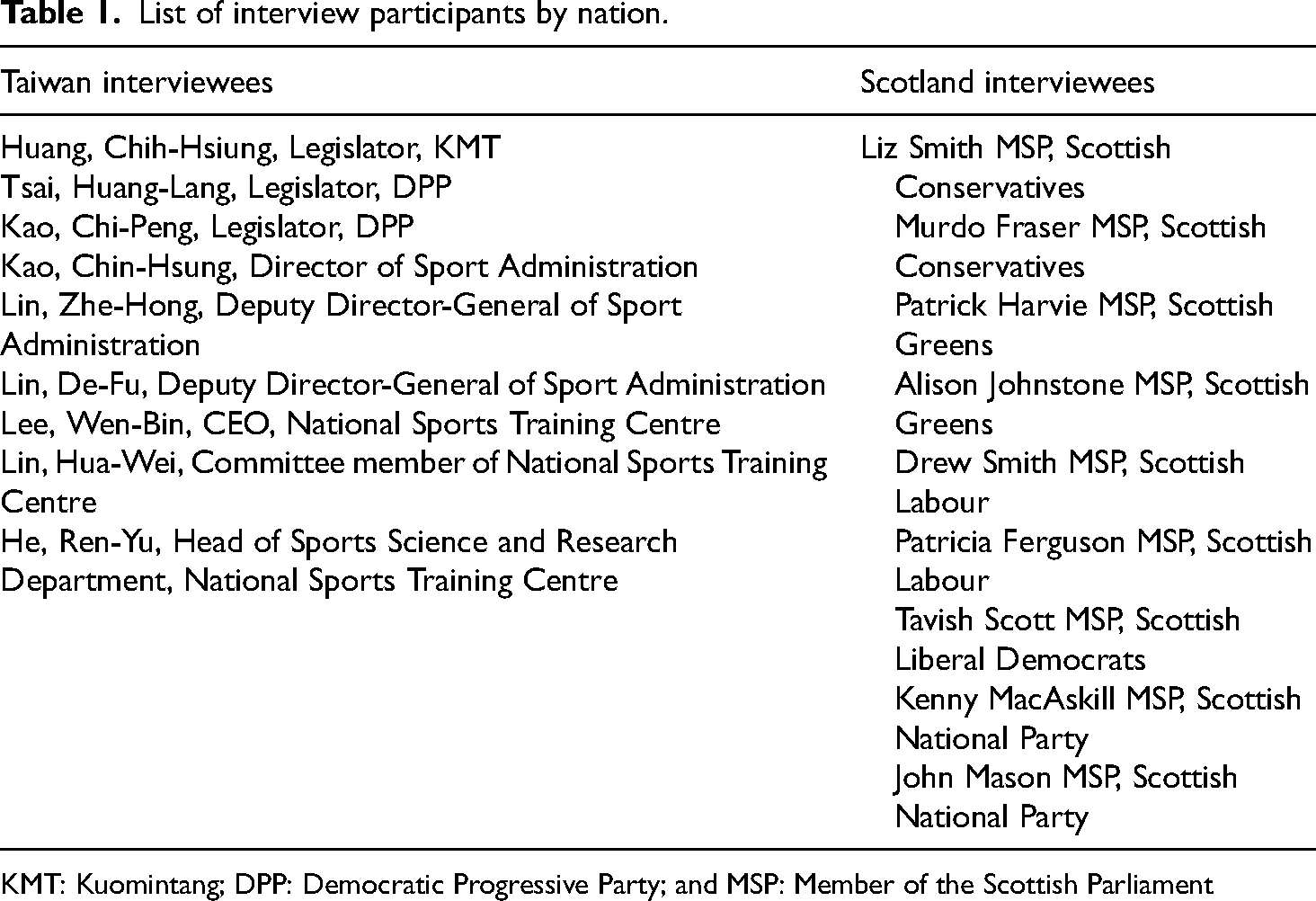
KMT: Kuomintang; DPP: Democratic Progressive Party; and MSP: Member of the Scottish Parliament
The interviews ranged between 18 and 50 min in duration and were transcribed verbatim at the initial stage of the data analysis process to preserve the data and retain the authentic features of the interviews (Wood and Kroger, 2000). The completed transcripts were uploaded and analysed using the NVivo software package. However, in the case of the primary data, NVivo software was only used to manually code the content of each data source, with an open coding system being used to identify key themes emerging from the interviews. Throughout the thematic analysis process, a particular emphasis was placed on the strategic thinking and ideological values which underpinned the production of sport policymaking in each context. To this end, the interviews were scrutinised with regard to the ‘values’, ‘goals’ and ‘means-goal’ positions of each political actor in line with the analytical framework of Fairclough and Fairclough's (2012) for ‘political discourse analysis’, with the interview data providing an opportunity to explicitly discuss the nuances of each interviewee's approach to sport as a general policy area in greater depth.
This study's alignment with the axiological position of critical discourse analysis, which permits and encourages the incursion of personal political values in the research process (Fairclough, 2003, 2015), thus requires a degree of consideration with regards to the trustworthiness of the current analysis. In order to overcome the potential risk of subjective biases of each researcher undermining the trustworthiness of the analysis, we made use of interrater reviews of the data analysis process in each geographic context in order to provide a balanced approach to data collection, analysis and presentation stages (Mauthner and Doucet, 2003). Remaining conscious of the arguments of Berling and Beuger (2013) concerning the importance of ‘practical reflexivity’ in political science, we therefore endeavoured to present the forthcoming findings with political neutrality to the best of our abilities, notwithstanding the inherent subjectivity of political and policy research noted by Berling and Beuger (ibid).
Discussion
The analysis of the interviews identified a number of areas of contention for sport policymaking which illustrated similarities and differences between the Taiwanese and Scottish contexts, which revolve around four specific themes:
Importance of sport as a policy area, Use of sport for specific national policy goals, Symbolism of sport in relation to national identity, Taiwan–China and Scotland–UK sports policy tensions.
The forthcoming discussion will therefore focus on the arguments and perceptions of the interviewees in relation to each of these themes, with an emphasis on coaxing out the comparative experiences of sport policymaking in these two similarly ‘contested nations.’
Importance of sports as a policy area
One key focus of the discussions within the interview process was the extent to which sports policy was prioritised within the broader political and ideological considerations of central governments in each nation. In this regard, a general consensus emerged that sports policy remains a relatively peripheral policy area in both contexts: I think the two main parties do not regard sports policy as a major government issue. In the field of sports, neither government regards it as a major government issue. But if we must compare, then the DPP perhaps slightly better than the Kuomintang (KMT)… but compared with other developing countries, our government is relatively unfamiliar with sports. (Tsai, Formal Legislator, Taiwan) I think probably in Scotland, and I presume in the other devolved administrations, it probably is a slightly bigger deal than it would be in the UK government terms. (Drew Smith MSP, Labour, Scotland)
However, there was a general agreement that sporting issues were growing in terms of the attention paid to them by politicians, with a growing profile on achieving broader political and ideological goals: I think sports pretty high up the pecking order because it's important for Scotland both economically… for all the reasons, economically, socially and culturally. We're a pretty sport-loving nation in that sense. So I think it is important. (Tavish Scott MSP, Liberal Democrats, Scotland) …there's few things that are more important, because I just think that it's got so much validity in terms of talking about health, and talking about mental health as well… certainly I think we took it very seriously because we felt that it linked in to every other portfolio… (Patricia Ferguson MSP, Labour, Scotland) Look at our budget. From the establishment of the Sports Administration in 2012, it's been 13 years. The budget at that time was 7 billion, and then it will grow to 9 billion because the 2017 Taipei Universiade held, so it grew to 9 billion… In Taiwan, people don't think that sports are a kind of right/power, but a welfare. The welfare is given by the government. For instance, now that the epidemic has come, the welfare will be temporarily suspended. They will not think that ‘it is my right’. People in foreign countries think ‘that is my right’…. (Kao, Formal Director-General of Sport Administration [central government], Taiwan)
Upon comparing between the two contexts, notwithstanding the aforementioned emphasis on the relatively marginalised, yet growing, status of sports policy, some significant differences emerged. For example, it was contended that Taiwanese politicians are beginning to prioritise sports policy more due to the opportunities it provides for the expression of a distinctive Taiwanese identity and the formulation of specific sports policies with regard to their political ‘other’ in China; however, it was argued that the Taiwanese public does not necessarily view sports provision as a civic ‘right’ per se. In contrast, Scotland's increased prioritisation of sports policy has been driven through its status as a ‘devolved’ policy area within the United Kingdom's devolved constitutional arrangements, given that this affords deviation in sports policy from the goals of the central United Kingdom government. Furthermore, the hosting of major events such as the Commonwealth Games in conjunction with other medium-profile international sporting events has been a key driver of sports policy in Scotland, not only boosts sports participation but also acts as a catalyst for economic development and enhances the international profile of the Scottish nation.
Use of sport for specific national policy goals
Another important consideration emphasised by the interviewees in each nation was the growing linkages between sports policy and broader political or ideological goals for each nation's government, both domestically and internationally. Once again, an analysis of the ways in which sports are linked to these broader political goals illustrated both shared practices and contrasting approaches within their use in Taiwan and Scotland.
Firstly, in terms of shared practices and approaches between the two nations, one area of consensus centred around the prioritisation of raising the respective nation's international profile as a key facet of sports policy, with an emphasis on the opportunities to use sport and sporting events to project images of the nation on the global stage: We competed with China for a long time. We can’t actually join a lot of international organisations because China stops us. Since we are a small country, it's important to use international mega events to raise our profile. (Lin, committee member of National Sports Training Centre, Taiwan) It [the 2014 Commonwealth Games] certainly showcased Scotland and Glasgow to the world in an incredibly positive light… not only a brilliant sporting experience, but a really warm and cultural experience too. So… I would imagine that in terms of tourism and stuff it can only be to the good. (Alison Johnstone MSP, Green, Scotland)
This shared emphasis on sport's potential to promote the profile of each nation is perhaps bolstered by the specific political context faced by each nation, whereby the contested status of nationhood and statehood possessed by Taiwan and Scotland results in a prioritisation of the promotion of a distinctive identity and international image. Given that sport facilitates an opportunity to achieve these goals in a comparatively non-confrontational manner in comparison with other policy areas, sports policy has offered an opportunity to leverage sporting competition and events to this end.
However, as mentioned previously, the specific emphasis of sports policy in relation to enhancing sporting excellence with regards to sports and physical activity participation was argued to differ in each nation. For example, in the Taiwanese contest, the interviewees argued that greater focus is placed on sporting success in order to emphasise the success of the Taiwan nation in relation to their geographical and political neighbours of China: Winning medals is the expectation of the people. It also influenced the development of sports, and the development of the industry. You can see that Tai Tzu Ying won, so the population of badminton has increased, the market has gradually become popular, and parents will take their children to learn badminton, or learning tennis as well as other kind of ball sport. (Lin, Committee member of National Sports Training Centre, Taiwan) The main axis of the Sport Administration is very simple - that is, healthy people, excellent sports and vigorous Taiwan. Then sport could be a very important field. Sport performance is related to national self-confidence, and now we are being suppressed in the world, so winning medals is very important. (Lin, Current Deputy Director-General of Sport Administration, Taiwan)
In contrast, in the Scottish sport policy context, a much greater emphasis was placed on the importance of deploying funding as a means to tackling physical inactivity and public health concerns, as well as other broader non-sporting goals such as economic regeneration: I’ll give credit to the Scottish Government for this… to try and encourage a genuine national sporting legacy and… genuinely trying to achieve a legacy where people are not just more active in sport but are physically active as a result of the Games, and that work has all went on for a good few years before the Games arrived. (Drew Smith MSP, Labour, Scotland) It's first of all a chance to regenerate the East End of Glasgow which probably statistically is the poorest area of the country. The infrastructure and investment is phenomenal in the area over the years. (Kenny MacAskill MSP, SNP, Scotland)
It can therefore be argued that a comparative analysis of sports policy strategies in each context followed the same broader logic regarding the potential for using sport to link to broader national political goals, with shared concerns about international image and profile enhancement through the sporting domain, whilst equally allowing for the scope for leveraging sport for specific governmental concerns in Taiwan (i.e., elite sporting success and gender inequality) and Scotland (i.e., public health and economic regeneration).
Symbolism of sports in relation to national identity
Given the aforementioned status of sport as a means of expressing a distinctive national identity in Taiwan and Scotland, it is unsurprising that another noteworthy theme within the interviewees’ responses relates to the importance of sport and its symbolism in relation to national identity. A number of interviewees emphasised the importance of sport in this regard, highlighting the heightened attention afforded to sporting matters in Taiwan and Scotland given their contested constitutional status: In Taiwan, Taiwanese people's political ideology is too strong. The issues like cross-strait problems, land identification, ‘fusion of races’, unification vs independence, provincial identification, immigrants, and so on. There are many, many confrontations. Probably only on sports fields, there's no ideology and no confrontation. This is the only one thing that can unite the country. (Tsai, Formal Legislator, Taiwan) I suppose the attitudes of the [political] parties are a wee bit different, especially to having a separate Scottish team… the Olympics are a much bigger thing that the Commonwealth Games.. effectively I've got no team at the Olympics so I don't so engaged because it is a British team. For me, the fact that it is a Scottish team, I am immediately more engaged and more interested. Now whether your average Labour politician would feel the same… to be fair, some of them would… (John Mason MSP, SNP, Scotland)
Interestingly, both of these interviewees drew distinctive parallels between the expression of sporting nationalism and political ideological considerations in relation to engagement with national identity, whether in relation to national unity or with regards to contrasting engagement with secessionist or unionist positions. However, a number of participants from across the political spectrum were equally keen to identify the complex symbolism of sporting nationalism and the intricacies of sports policy delivery, given that this often involved a strong degree of cross-border cooperation between their neighbouring nations: Many of the Scots Commonwealth Games team were based in England because the training facilities in England were better. So there was certainly no tension or animosity of any kind between the competitors from the Home Nations, and I think that kind of over-spilled a bit into the crowd reactions. (Murdo Fraser MSP, Conservatives, Scotland) I think it's important that we do compete as a home nation in Games like the Commonwealths… I think it's an important thing that it allows people to feel that we can have both of those. We can compete as Team GB at the Olympics but we can also have the benefit of competing as Scotland as well at different times… it agrees with my view on the constitution where you don’t have to make that choice, you can have both. (Drew Smith MSP, Labour, Scotland) We actually cooperated with the Chinese people a lot for elite sport development. We compete in the political issue at the government level, but we cooperate at the practical level with sport. (Lin, Deputy Director-General of Sport Administration, Taiwan)
In the Scottish context, interviewees illustrated the frequently-cited argument in past academic analyses regarding the dualistic symbolism of Scottish sport, which leads to complexities in relation to the expression of Scottish and/or British national identity for Scottish sports enthusiasts. On the one hand, sport has offered scope for the expression of a distinctive Scottish identity in events with independent Scottish representative teams, such as the Commonwealth Games, or in international team sports competitions in football, rugby, hockey, netball and cricket, amongst others; however, sports have equally provided a domain for the expression and development of a unitary British identity in major events such as the Olympic Games. Given this, it can be argued that the British government has adopted a relatively accommodating stance towards Scottish sport in terms of both policy and identity politics, although this is in part due to the realpolitik of Scotland's historic possession of independent sporting representative teams during the global spread of sports during the height of the British Empire's colonial era.
In contrast, the symbolism of sport in relation to national identity in the Taiwanese context is heavily influenced by rising political tensions with China. The tensions have in turn led to a greater emphasis on the expression of a distinctive Taiwanese identity and a sense of national unity through sports competition and international participation. However, in contrast to the more accommodating position of the British government, this approach has resulted in growing conflicts with the Chinese government who have frequently contested Taiwan's status in international sporting competition, given that this symbolically undermines the official Chinese ‘one country, two systems’ policy which refutes Taiwan's sovereignty as an independent nation or nation-state. This therefore illustrates that whilst both Scotland and Taiwan are equally contested in relation to their constitutional status, the position and stance of their respective political neighbours (or, to some, foes) manifest itself in contrasting attitudes towards the relationship between sport and national identity in each context.
Taiwan–China and Scotland–UK sports policy tensions
The final theme derived from the analysis of the interviewees’ responses focuses on aspects of sports policymaking which illustrate the tensions of enacting policy in the context of ‘contested nations’ such as Taiwan and Scotland. A number of interviewees emphasised that even in relatively low-profile policy areas such as sports could still become embroiled within broader geopolitical tensions between Taiwan and China or Scotland and the UK, respectively.
In the Taiwanese context, these disputes often centred around a couple of sources of tension. The first of these sources of tension related to the need for cross-border cooperation and approval in relation to sports policymaking on a ‘cross-Strait’ basis between Taiwan and China: In 2018, the scale (of sport exchange between Taiwan and China) suddenly dropped, and it suddenly cooled down, you know, because the government suddenly found out that these groups were going to the mainland, and they received all the expenses on the ground, so they came to Taiwan at their own expense. The government found that this is not equal, and the unequal communication has violated the cross-strait people's relations regulations, because the cross-strait people's relations regulations are the highest legal rank between Taiwan and mainland China – the relationship needs to be equal to both side. So when your movement has become a tool of his rule, when there is no equal treatment, the government will intervene.
(Kao, Formal Director-General of Sport Administration, Taiwan)
In particular, the need to maintain cordial relations between sporting organisations in Taiwan and China was emphasised as a key consideration, given the aforementioned prevalence of Taiwanese athletes to train and compete in China on a regular basis: For sports-related agreements between local governments and mainland China, they have to send them to the Sports Administration. Maybe this is something that is not authorised by the local government in the Cross-Strait People's Relations Regulations, or ready to sign a contract.
(Kao, Formal Director-General of Sport Administration, Taiwan) We actually cooperated with the Chinese people a lot for elite sport development. We compete in the political issue at the government level, but we cooperate at the practical level with sport. (Lin, Deputy Director-General of Sport Administration, Taiwan) The training of many sports in Taiwan actually relies on the training venues in mainland China, including where we trained in the past, or their good coaches came to Taiwan to assist… it is relying on mainland coaches to assist us… In the early days, before the pandemic, the track and field training venues were all moved to mainland China for training, not to mention the ice and snow events.
(Kao, Formal Director-General of Sport Administration, Taiwan)
Whilst the existence of cross-border cooperation was also a significant consideration for sports policymakers in the Scottish context, the tensions between the Scottish and UK governments were argued to manifest themselves in a different way. Firstly, one bone of contention between the respective governments with regards to sports was illustrated in responses regarding the funding and resulting economic benefits of hosting major international sporting events, such as the 2014 Commonwealth Games: Some of this is complicated by the current devolution settlement because we don’t get the money back in VAT to spend, or anything such as that. Y’know, post-independence it really takes off… We’re not able to invest on the basis of getting a return. We only get the allocated spend, so we put all that money in but we don’t get the benefit back. Y’know, the benefit of the tourist spend in Glasgow is going into George Osbourne's [former Chancellor of the British government] coffers, yet who's funding the infrastructure and investment?
(Kenny MacAskill MSP, SNP, Scotland) I think that because the media focus on politics is always about where there is division, and rightly so as that's where the debate is and you can have the most influence… but that's not to say that I don’t think there's huge debates in sport. There are huge issues of inequality and there are huge issues about public money being spent, so I would take the view that there should be a bit more debate about that.
(Drew Smith MSP, Labour, Scotland)
The comments from Smith illustrate that the devolved nature of sports in the Scottish context has failed to sufficiently raise the profile of the policy area, despite some positive developments evident in this regard; however, the importance of considering the funding priorities for sports policy argued by both interviewees reiterates that tensions still exist in this regard. Furthermore, the dualistic nature of relationship between sports and Scottish nationalism was also a point of tension flagged by interviewees from both sides of the constitutional debate, with both pro-independence and pro-union politicians noting that success in sports can be ‘spun’ either way in terms of its political capital and credit: …one of the very interesting aspects of the Commonwealth Games was how enthusiastically the audiences of the Commonwealth Games cheered not just the Scots athletes, but all the athletes from the home countries… which suggests that while people were very happy to go along and cheer on the Scottish team, there's no question that they were doing that in any kind of exclusive sense… Many of the Scots Commonwealth Games team were based in England because the training facilities in England were better.
(Murdo Fraser MSP, Conservatives, Scotland) You just have to look at the Olympic Games. I mean, the downside for Salmond and the ‘Yes’ [pro-independence] campaign was how successful the Scots were, particularly Chris Hoy in London. I mean everyone knew… who wanted to think about it… that Chris Hoy built his career by training in Manchester… And they only get that sports Lottery funding because they're being part of the elite programme across the UK. Certainly I saw a couple of SNP people having very uncomfortable times on telly or in hustings when you pointed out all of that wouldn't be available.
(Tavish Scott MSP, Liberal Democrats, Scotland)
These arguments thus illustrate that policymaking in both the Taiwanese and Scottish contexts is not made in an ideological or political vacuum and that a number of broader strategic considerations need to be at the forefront of the minds of policymakers. Whilst the domain of sports facilitates opportunities for underpinning attempts to bolster the expression of distinctive identities within the ‘contested nations’ of Taiwan and Scotland, there remains an inherent risk that any attempts to derive too much political capital through sports policies and initiatives could risk the ire of stoking tensions with their respective geopolitical neighbours.
Conclusions
Reflecting upon the contrasting sport policymaking contexts in the two ‘contested nations’ of Taiwan and Scotland outlined above, it is clear that whilst the specific geopolitical considerations of each nation have shaped the status of sport policy in contrasting manners, there remains a degree of shared experience in terms of the influence of their respective political ‘others’ (i.e., China and England).
For example, with regards to the shared arguments that sport takes on added importance as a policy area in ‘contested nations,’ policymakers and politicians in both contexts argued that the opportunities for the expressions of distinctive national identities and policy goals within the domain of sport was in contrast to other spheres of policymaking – such as foreign, economic, trade and/or defence policy – which were more constrained in this regard. Given the degrees of freedom afforded to Scotland by the legal status of the devolved Scottish Parliament with regards to sports policy, it appears that Scottish policymakers have placed a greater emphasis on sport policy to this end in recent years; however, their counterparts in the Taiwanese context have expressed a willingness to increasingly exploit these opportunities, understandably so in light of the growing geopolitical tensions between China and Taiwan.
Indeed, a comparative analysis of the sports policy strategies in each context demonstrates a shared belief in the possibility of leveraging sport to achieve broader national political goals in Taiwan and Scotland. Some of these policy goals are shared, such as the use of sport for international image and profile enhancement for these ‘contested nations,’ whereas other policy goals demonstrate divergence in line with the specific governmental concerns in Taiwan (i.e., elite sporting success and gender inequality) and Scotland (i.e., public health and economic regeneration). Furthermore, whilst policymakers in each context equally express agreement in the powerful symbolism of sport in relation to national identity given their specific constitutional status, the position and stance of their respective political neighbours manifest itself in contrasting attitudes towards the relationship between sport and national identity in each context. This is perhaps unsurprising given the contrasting strategic approaches of China and the UK with regards to the status of sporting representatives from Taiwan and Scotland – whether individuals or teams – in the domain of international sporting competition.
Finally, it becomes clear that, despite its relatively marginal status within the broader policy context, sport remains a contested policy area in each national context, and this demands a cognisance of the broader strategic considerations at the forefront of the minds of sport policymakers. Given the inherent risks associated with generating political capital for Taiwan and Scotland through sports policy and initiatives, and the potential subsequent political and legal tensions with their respective geopolitical neighbours, it is argued that sport policymaking in both contexts requires a diplomatic navigation of the temporal ideological or political situation.
Therefore, reflecting on the practical implications of these findings in an era of increasing tension in China-Taiwan relations, and a growing sense of constitutional deadlock for pro-independence political actors in the Scottish context, it can be concluded that sport policymakers will need to remain mindful of the heightened implications of sport policy decisions for ‘contested nations’ during these politically tumultuous times. Sport policy decisions often possess inherent impacts on an international scale, whether related to participation in international sporting competitive structures or the hosting of international sporting events, and thus require proactive consideration of the potential unforeseen diplomatic consequences of sport policy developments where they might have politically sensitive practical consequences for their respective nations’ broader political goals is essential.
Footnotes
Declaration of conflicting interests
The authors declared no potential conflicts of interest with respect to the research, authorship, and/or publication of this article.
Funding
The authors disclosed receipt of the following financial support for the research, authorship, and/or publication of this article: This work was supported by the Ministry of Science and Technology (Taiwan) and the Economic and Social Research Council (United Kingdom).
