




Abstract
The term sportswashing has been discussed and analysed within academic circles, as well as the mainstream media. However, the majority of existing research has focused on one-off event-based sportswashing strategies (such as autocratic states hosting major international sports events) rather than longer term investment-based strategies (such as state actors purchasing sports clubs and teams). Furthermore, little has been written about the impact of this latter strategy on the existing fanbase of the purchased team and on their relationship with sportswashing and the discourses surrounding it. This paper addresses this lacuna through analysis of a popular Manchester City online fan forum, which illustrates the manner in which this community of dedicated City fans have legitimated the actions of the club's ownership regime, the Abu Dhabi United Group – a private equity group operated by Abu Dhabi royalty and UAE politicians. The discursive strategies of the City fans are discussed, in addition to the wider significance of these strategies on the issue of sportswashing and its coverage by the media.
Introduction
In February 2023, English football club Manchester City (hereafter MCFC) were charged by the English Premier League with breaching financial fair play rules on more than a hundred occasions. In 2008, MCFC were bought by the Abu Dhabi United Group – a private equity group operated by Abu Dhabi royalty and UAE politicians. The Group has invested approximately £1.5 billion in that time (Garner-Purkis, 2021) and the club have won seven premier league titles, eight domestic cup trophies and the 2023 UEFA Champions League; achievements that would have been deemed impossible before the takeover. This has aroused criticism for not only financially distorting club football, but also as ‘one of football's most brazen attempts to “sportswash” a country's deeply tarnished image’. (Human Rights Watch, cited in Delaney, 2019). Indeed, these two issues – MCFC's financial might and their ownership's connections with a state that detrimentally affects the human rights of its citizens (Amnesty International, 2022) – are frequently intertwined in media coverage. The club's financial dealings had previously been sanctioned by European football governing body, UEFA, but those charges were overturned by the Court of Arbitration for Sport in July 2020 on the basis of a statute of limitations. While the Premier League charges were described in the media as an effort by the League to demonstrate that it could govern its own affairs without need of independent oversight (Delaney, 2023), MCFC fans were largely united in viewing it as ‘a witch hunt’ and ‘a conspiracy’ against their club in particular, apparently seeing little morally suspect in the actions of their ownership (Critchley, 2023). Whatever the result of the charges levelled by the Premier League against MCFC will be – investigations are ongoing at the time of writing – the events have served to demonstrate the extent to which fans remain fiercely loyal to the club under the Abu Dhabi United Group in the face of media criticism and official investigation.
Sportswashing is a tactic of morally questionable political regimes to distort attention from their ethical violations through leverage of emotional associations and media coverage that come with sport (Fruh et al., 2022). MCFC have been described as a successful sportswashing project ‘in extending its economic reach internationally and normalising the state's investment in football and strategic use of sport to brand Abu Dhabi and the UAE in a positive light’ (Chadwick et al., 2023: 10). However, little scholarly attention has focused on the experiences of the fans as regards their club's ownership by a company heavily related to a morally questionable regime – nor, indeed, has there been much research on the fans of any club owned by regimes similarly accused of sportswashing (with the notable exception of Jones et al., 2023). There is the risk that by overlooking fans, researchers ignore their agency in the sportswashing debate; as Skey argues ‘some of the current debates seem to assume that the hosting of an event or purchase of a sports club naturally leads to favourable reviews or attitudes’ (2022: 12). This paper aims to remedy this lacuna through exploration of the discourses circulating within a fan community on the issue of sportswashing. Without discounting the influence of established media, the rise of online fan communities has facilitated fans constructing, circulating and affirming their own narratives; fan communities are therefore significant actors – rather than merely passive targets – in the development of sportswashing. Through analysis of a popular MCFC online fan forum, we examine how the MCFC fans seek to legitimate the actions of an ownership regime that has been the subject of serious moral and legal criticisms. We employ Van Leeuwen's (2007) framework for legitimation in exploring how the club's ownership and its critics are perceived by fans. We highlight how MCFC fans not only employ a range of legitimation discursive tactics when discussing the ownership, but also an inversion of those tactics in de-legitimating critics of the club. Having accounted for these strategies, we then examine how MCFC's history and identity shapes the discourses circulating on the forum, and expound on their significance. Our study reveals how a football club's fans can be particularly significant contributors to, and actors within, sportswashing. Implications are discussed, with a particular focus on the significance of fans’ reactions to challenges to, or criticism of, the club's ownership.
Literature review
Sportswashing and soft power
Sport has long been a site for the propagation and contesting of soft power. Soft power ‘is more than just persuasion or the ability to move people by argument […] It is also the ability to entice and attract. In terms of resources, soft power resources are the assets that produce such attraction’ (Nye, 2008: 95). Sport possesses considerable attractive power, and, as a consequence, remains a key site for the shaping, championing and challenging of collective identities (Bairner, 2001). It is therefore a prominent vehicle for attempts to exercise soft power on an international stage. Indeed, prominent examples of such attempts litter the pages of twentieth-century history, such as Mussolini and Hitler parading the strength of their fascist regimes through hosting the 1934 FIFA World Cup and the 1936 Summer Olympics respectively, to South Africa emerging from the shadow of apartheid through hosting and winning the 1995 Rugby Union World Cup (see Boykoff, 2022; Steenveld and Strelitz, 1998).
Criticisms of soft power emanate, in part, from the distinction it draws between examples of ‘hard power’: a form of power that is more readily displayed in overt military action or international penalties and restrictions. Beyond attempts at fostering cultural diplomacy, the relation between soft and hard power has also seen examples of soft power function as a prelude to war. While the Nazi's invasion of Austria began 2 years after hosting the 1936 Olympic Games, more recently, Russia followed their hosting of the 2018 World Cup with an escalation of the Russo-Ukrainian war, 4 years later (Boykoff, 2022). We contest that such examples blur the distinction between examples of soft and hard power, and, as a result, draw attention to those examples where sport is used to actively deflect attention away from ongoing domestic and international troubles.
On this basis, recent developments have seen the emergence of the term ‘sportswashing’, in scholarship and the wider media, coined as a way of describing how powerful private and state actors leverage sport to distract from, or distort perception of, their unethical actions. The term first began to be widely circulated in 2015, prior to the European Games being hosted in Baku, Azerbaijan, (Boykoff, 2022), and, more recently, has been applied to events such as Qatar's hosting of the 2022 FIFA World Cup, the Saudi Arabia-financed LIV Golf Tour, and indeed, Abu Dhabi's ownership of MCFC. It is a strategy that has attracted criticism from several prominent human rights groups, who view it as a major cause for concern (see Amnesty International, 2020; Worden, 2022). Accordingly, the need to track and conceptualise these developments stems from a perception that ‘global sports have become increasingly entangled in political and economic orders that include seriously morally problematic elements’ (Fruh et al., 2022: 3). As a result, in contrast to exercises of soft power in sport, sportswashing is viewed in overwhelmingly negative terms (Jones et al., 2023). 1
We intend to go further here and assert that, while as Boykoff (2022) suggests, the concepts of soft power and sportswashing can overlap with one another, the latter moves beyond unhelpful dichotomies by taking account of a wider range of potential target audiences: primarily, those seeking to use sport to mask unfavourable actions and those seeking to criticise the application of sport to achieve this. This stands to undermine accounts of ‘soft disempowerment’, which serve only to emphasise the ongoing vacuity of conceptual understandings of power as something that a particular group can obtain, inflict, or even manage. 2 In the case of sport, this is frequently seen in assessments that prescribe a ‘did it work’ or ‘did it not work’ evaluation, ultimately, overlooking the contradictions in sport itself. Whether examples of soft power can be considered as successful or unsuccessful, analysis must move beyond the ‘representational force’ that it requires (Mattern, 2005); a force, which, despite the lack of military intervention, nonetheless prescribes it a level of hard power, thus blurring Nye's original ‘soft’ and ‘hard’ distinctions. Instead, while examples of soft power can readily be acknowledged as legitimate attempts by state governments to favourably frame and represent their nation and culture, for which sport has historically played a key role, what sportswashing exposes are the motivations behind sport's compliance to obfuscate or divert attention away from less favourable associations.
For this reason, Fruh et al. define sportswashing as the process by which ‘attention is routed away from the moral violation […] through sport’ (2022: 3). This distortion of attention is a complex process, in which the respectability of, and affection for, the sporting institution counteracts, though does not completely mask, the moral violations of the sportswashers. While sportswashing attracts scrutiny and criticism of such violations, its aim is that this negative attention will be ultimately outweighed by the positive associations accrued (Delaney, 2020). When considering the broad idea of what constitutes such success, it is key to think in terms of deflection rather than concealment. Sportswashing does not generally aim to completely mask the misdeeds or failings of the sportswashers in question, but complicates the conversation around these negative associations; as Skey observes ‘if Saudi Arabia is being discussed in relation to a well-run, high-profile golf or tennis tournament, then it isn’t only being associated with an appalling human rights record, an inequitable political system or resource exploitation’ (2022: 760).
There are two chief sportswashing methodologies: event-based and investment-based. The first of these, which has been the focus of the majority of research into this fledgling field, has been characterised by a rise in states with heavily criticised human rights records playing host to major international sporting events. Examples of this include Russia and Qatar hosting the 2018 and 2022 FIFA World Cups (Brannagan and Giulianotti, 2015; Meier et al., 2021). The second methodology is more recent – and under-researched; it is the tactic of autocratic state actors investing in Western sporting institutions through major sponsorship deals or even by attaining ownership status. In doing so, sportswashers not only aim to deflect from their negative reputation through positive associations, but also to leverage the tribal loyalty of sports fans. Authoritarian regimes have pursued sponsorship of major sport clubs for some time – and indeed, continue to do so – but recent years have seen an expansion of this tactic into purchasing a majority stake of these clubs. The significance of this evolution should not be overlooked, as Dr Kristen Coates Ulrichsen argues, ownership represents a marked increase into the interweaving of the sportswasher and the sportswashed: ‘Ownership is a much greater thing [than sponsorship and hosting]. You actually work your way into the social fabric a club has with its supporters’ (cited in Delaney, 2020). This chimes with Fruh et al.'s (2022) argument that sponsorship or ownership of a successful club may create a halo effect whereby supporters of the club come to associate that success with the regimes behind their sponsors/owners and begin to look favourably on them despite documented immoralities. However, as stated earlier, sponsorship/ownership (particularly the latter) of sport teams is under-examined as a sportswashing strategy when compared with the emerging literature on sportswashing through the hosting of major events; most notably, its impact on fans and how they reconcile their emotional link with their club and its status as a sportswashing entity.
Football fans
The significance of football fans with regard to sportswashing is all the more pertinent in a context in which increased attention is being paid to online abuse perpetrated by sports fans against athletes, journalists and other fans (see Kearns et al., 2023). Notably, several sport journalists have attested to instances of fans of a sportswashed club aggressively defending their ownership regimes via social media and other online platforms (Cohen, 2021). This is worthy of further exploration in light of the substantive research done on the mobilisation of football fans in the past, instances wherein fans view themselves as guardians of the club's identity against perceived commercial distortion by ownership regimes or other powerful financial stakeholders in the sport (Gerke, 2018; Numerato, 2015), as in many ways, this actively pro-ownership stance can be viewed as the flipside of the coin of previously documented fan activism.
The tribal nature of football fandom has been heavily documented (Dixon, 2014; Porat, 2010), and while scholars must be wary about reducing diverse and evolving fan cultures to a homogenous and wholly consistent set of values and habits, there are broadly defined qualities that distinguish football fans as a sub-culture and make them particularly relevant with regard to potential leverage by forces such as sportswashing regimes. Most notably, football fandoms are often characterised by a strong sense of ‘in-groupness’ which frequently manifests in antipathy – and even hostility – to perceived outsiders and/or threats to the group (Knijnik and Newson, 2020). Additionally, football fandoms are often self-policing spaces, wherein fans engage in ‘lateral surveillance of both themselves and others simultaneously to reaffirm their own conceptions of authenticity as well as those that are deemed fake’ (Dixon, 2014: 437). This sense of authenticity – and the status it confers – runs deep, as Porat writes ‘[the] most committed fan […] behaves as if he possesses the club and the game, and behaves accordingly’ (2010, 280). 3 This strong sense of what might be termed ‘spiritual ownership’ of the club has frequently been the source of conflict between fans and the official owners of their club, when these owners are perceived as acting in conflict with the traditions and best interests of the institution (Numerato, 2015; Turner, 2017). Such conflict is by no means inevitable however; notably Hodges and Brentin have cautioned against the tendency ‘to reify activist positionalities as consistently “against” the state, system or certain oppressive practices in a given historical moment’ (2018: 333), citing examples of activist fan groups aligning with club or state authorities.
Indeed, in certain contexts, the fans’ ownership of clubs has gone beyond ‘spiritual’, with their unique role in maintaining a club's identity being recognised with seats on the board. German football, for instance – with some exceptions – mandates that the majority of club shares are owned by its members. While largely unheard of in the upper reaches of the English football pyramid, several lower division and non-league clubs have come into the control of supporters trusts in the twenty-first century. Such examples further illustrate that fans embracing the ownership of their club by foreign state actors of a morally questionable regime should by no means be assumed to be an inevitable consequence of football's traditionally tribal loyalties.
Legitimation
Thus, a given fanbase's reaction to the takeover of their club by sportswashers depends on the success (or failure) of the new ownership regime in affirming their authenticity as part of the in-group. Legitimacy is defined by Suchman as ‘a generalized perception or assumption that the actions of an entity are desirable, proper, or appropriate within some socially constructed systems of norms, values, beliefs and definitions’ (1995: 574). Van Leeuwen (2007) conceives of four main categories of legitimation: authorisation, moral evaluation, rationalisation and mythopoesis; each of which contains its own sub-categories (see Table 1 for a more detailed breakdown of these categories). Van Leeuwen follows Berger and Luckmann (1992) in asserting that legitimation is fundamentally tied to context: ‘Legitimation is always the legitimation of the practices of specific institutional orders’ (92).
Van Leeuwen's categories of legitimation.
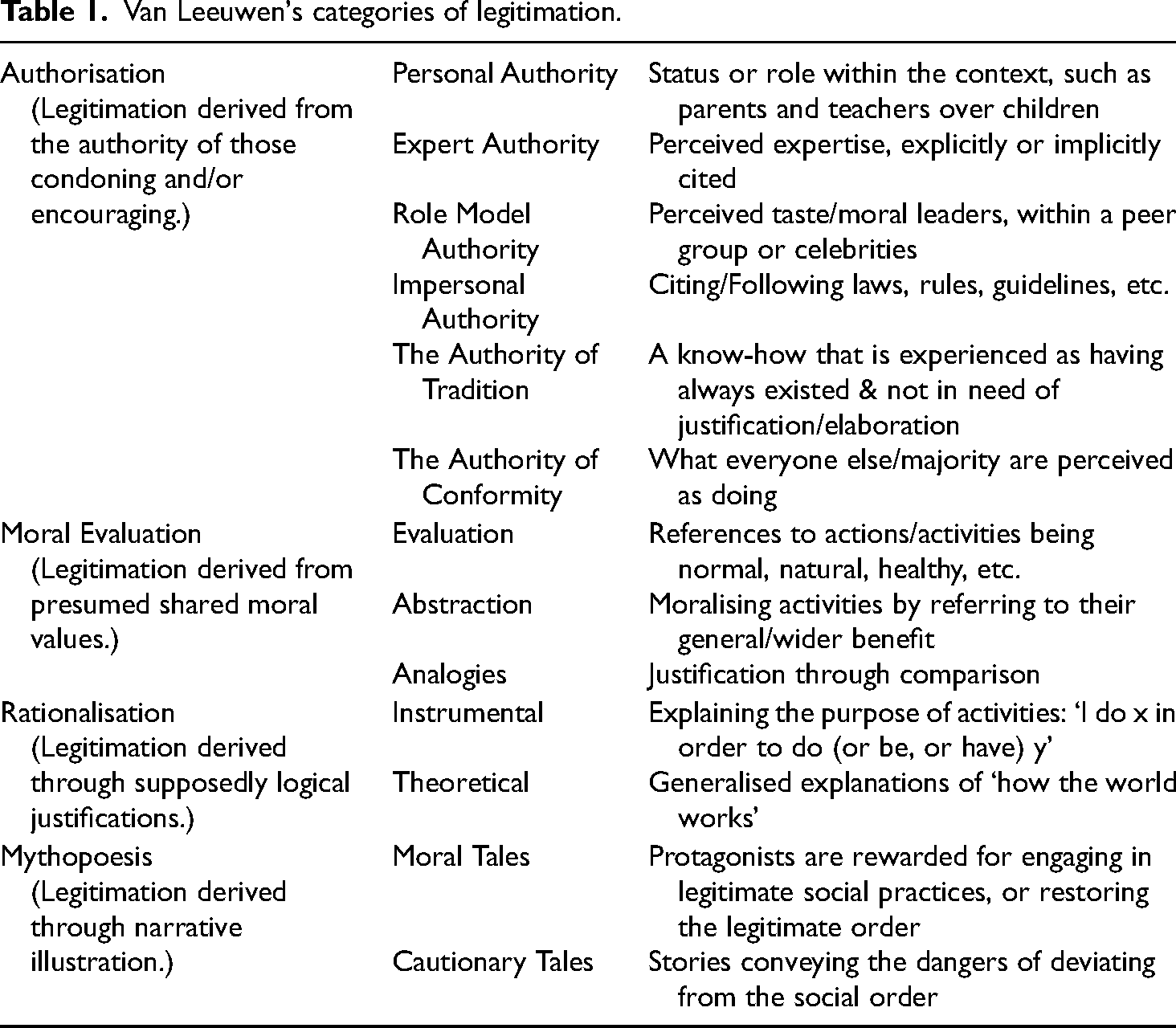
Van Leeuwen (2007) argues for legitimation as a linguistic process, wherein legitimacy is affirmed and continually reaffirmed through everyday discursive interactions. In the context of football fandom then, owners achieve legitimacy through convincing fans that they are appropriate and admirable stewards of the club's values to the extent that fans themselves reassert this legitimacy among communication with each other. Weber argues that legitimacy functioning ‘within a social group [is] dependent on the willingness of individuals with deviant wishes to give way to the majority’ (1947: 132). Thus, ownership need not command unilateral approval among fans, but rather achieve legitimacy within the most prominent channels of fan culture.
Despite such potent possibilities for analysing the relationship between football authorities and football fans, Van Leeuwen's work has rarely been applied to sport. The majority of research concerning legitimation and sport has focused on internal transformation of institutions (see Nite and Edwards, 2021; Washington and Patterson, 2011). Little of it concerns fans or the everyday discursive practices so crucial to successful sportswashing; in this respect, Van Leeuwen's framework provides a ready lens for such examinations. The relative lack of empirical research into fans’ reaction to sportswashing entities taking ownership of their club is in need of addressing. As sportswashing strategies escalate and entwine themselves in the fabric of sports cultures, there is the risk that they become normalised, regarded by media and fans as an acceptable and expected development.
Methodology
MCFC present an interesting case study in this regard for several reasons. Firstly, while discontent may well exist within MCFC fans over the club's ownership by the Abu Dhabi United Group, there has been no organised campaign of protest against them (Smith, 2021). It can therefore be inferred that the Abu Dhabi United Group have been largely successful in courting the tacit consent, and even wholehearted support, of the vast majority of MCFC fans. However, there remains the possibility that while dissent may not be expressed in public, it could be within the subcultural backstage of fan forums. Thus, while MCFC could be described as a successful example of sportswashing in so far the ownership group has extended its perception beyond human rights abuses with the club's fans, our analysis remained alive to the possibility of uncovering reticence concerning, or even resistance to, the ownership on the forum. Secondly, there have been a number of documented online attacks by their fans on journalists criticising – or even merely covering – the issue of sportswashing at the club (Cohen, 2021). Given the aforementioned lacuna regarding research into sportswashing through long-term ownership of sports institutions and the rise in online hate perpetuated by sports fans (see Kearns et al., 2023), it is worth examining the MCFC case study in order to illuminate the impact of such ownership arrangements on a club's fanbase and the methods by which that fanbase have come to terms with their club's status as a sportswashed entity. Thirdly, while the reaction of Newcastle United fans to their club's recent takeover by Saudi actors has been examined (see Jones et al., 2023), the takeover of MCFC occurred before the widespread circulation and understanding of ‘sportswashing’, their fans are therefore in an interesting position of having to reconcile the club's success with emerging and recurring questions on the morality of the ultimate owners.
To adequately explore these questions, and following receipt of institutional ethical approval, we focused on an analysis of three discussion threads from the discussion forum of a popular MCFC fansite. The forum has over 77,000 members and has been active for almost 20 years. As Kilvington et al. argue, the study of forum posts is distinct from analysis of other micro-blogging social media sites, forum users ‘are more likely to offer considered judgements […and] forum posts tend to be longer and more nuanced than those found on certain social media sites’ (Kilvington, Cable, et al., 2022; Kilvington, Hylton, et al., 2022: 850). Additionally, the focus on a MCFC forum facilitated us solely examining discussion of MCFC fans concerning their club; narrowing our focus beyond general football discussion on major social media platforms would have been a more difficult and less certain approach. Furthermore, given that the forum predates the takeover by the Abu Dhabi United Group and has no official affiliation with the club, it might be thought that it would be more likely to feature reticence concerning (or even resistance to) the club's ownership, and, therefore, any endorsement or support of the ownership by users would be all the more significant in the context of this forum.
It must be noted however, that users are anonymous. The forum analysed has no registration requirements and each user posts under a pseudonym. Therefore, it is not possible to claim representativeness of MCFC supporters in terms of gender, sex etc., (see Cleland, 2014; Weber et al., 2022). However, the relative anonymity of the participants addresses some of the ethical issues that online research in this space often poses. This research also doesn’t identify the name of the particular fan forum. Although cursory web searches fail to bring up any of the direct quotes used in this paper, it would be of course still possible to find the source of the quote with an intermediate level of search expertise. The main point to reiterate here is that the threads we used are public, not private. The topics of the three threads focused on were as follows:
MCFC's 2019 FA Cup final victory which completed an unprecedented English domestic trophy treble The announcement that the Court of Arbitration for Sport had overturned UEFA's sanctions on MCFC in July 2020 A thread discussing MCFC's announcement of record profits in 2022
Once the structure of each thread was understood, a proprietary script written in the Python programming language was deployed to open, download and save the data from each page of these three threads. Python has been employed in similar fashion in recent scholarly research on soccer and sports communication more generally (Cable et al., 2022; Kilvington et al., 2023; Kunkel et al., 2021; Wang and Lu, 2023). Once downloaded the data was collated into three distinct files and pre-processed to ensure a consistent structure and remove any extraneous data. Comments in these threads date from May 2019 to January 2023, comprising 12,507 comments in total. These three threads were chosen as they represent victories for the club in three different but overlapping fields: a competitive sporting victory (the cup final win over Watford and completion of a historic domestic treble), a legal/political victory (the Court of Arbitration for Sport overturning UEFA's sanctions on the club) and a financial/commercial victory (the announcement of record profits). Victories were focused on as they afford us the opportunity to assess how users reconciled their joy over the club's financial and footballing might with its much-criticised source. The manner in which the discourses surrounding each victory intertwine and bolster one another is – as will be outlined in further detail in the following section – significant.
The analysis of the threads adapted Van Leeuwen's (2007) framework for legitimation as a coding structure in which to account for both the ways in which forum users legitimise the status of MCFC and the motivations and actions of the club's hierarchy, and also how they rhetorically de-legitimate the club's critics and perceived ‘enemies’. While there are several frameworks for analysing legitimation, Van Leeuwen's was deemed the most appropriate for this research, as it is based in the analysis of language and therefore ideal for examining forum content. Additionally, it has previously been adapted to account for de-legitimation (see Kim, 2022; Yu, 2022) and therefore is an appropriately versatile framework for exploring not only how forum users discuss the in-group of MCFC (ownership, coaches, fans, etc.) but also the out-group of the club's critics (media, rival clubs, etc.) Furthermore, this framework – as will be expounded anon – accounts for both rational and emotional arguments, providing a scope that accounts for the variety of voices within the forum – and MCFC fans more widely.
Each post in the three threads outlined above was manually examined and coded according to Van Leeuwen's categories of legitimation (which, in this case, also encompassed inverted examples pertaining to de-legitimation, as outlined above). To take account of the diffuse nature of forum communication, coding categories were not mutually exclusive and, where applicable, some posts were coded with multiple categories. For the sake of clarity, however, the examples presented in the tables below include examples of posts illustrating one particular discursive category.
Findings
Legitimation
Forum users employ an interweaving variety of discursive tactics to absolve MCFC of any allegations of financial impropriety or moral violation, and present them as excelling within the accepted parameters of football administration. The actions of the club's hierarchy are often framed as neutral ‘common sense’ moves; employing what Van Leeuwen would describe as Instrumental Rationalisation, users depict MCFC hierarchy as following conventional and ethically sound business practices (Table 2, P2). Specifically, the motives of the Abu Dhabi United Group in purchasing the club are explained in a fashion that dismisses the possibility of sportswashing as a journalistic flight of fancy. Buying MCFC is discussed as a sound business decision that has borne out substantial profits for the ownership, with any other benefits or consequences of the arrangement viewed as incidental and of little concern to them: ‘HRH's non engagement merely supports the idea that the overall goal of the CFG project isn't/wasn't “sportswashing”. He's not wanting to associate himself in any way really, just make money’.
Examples of legitimation in MCFC fan forums.
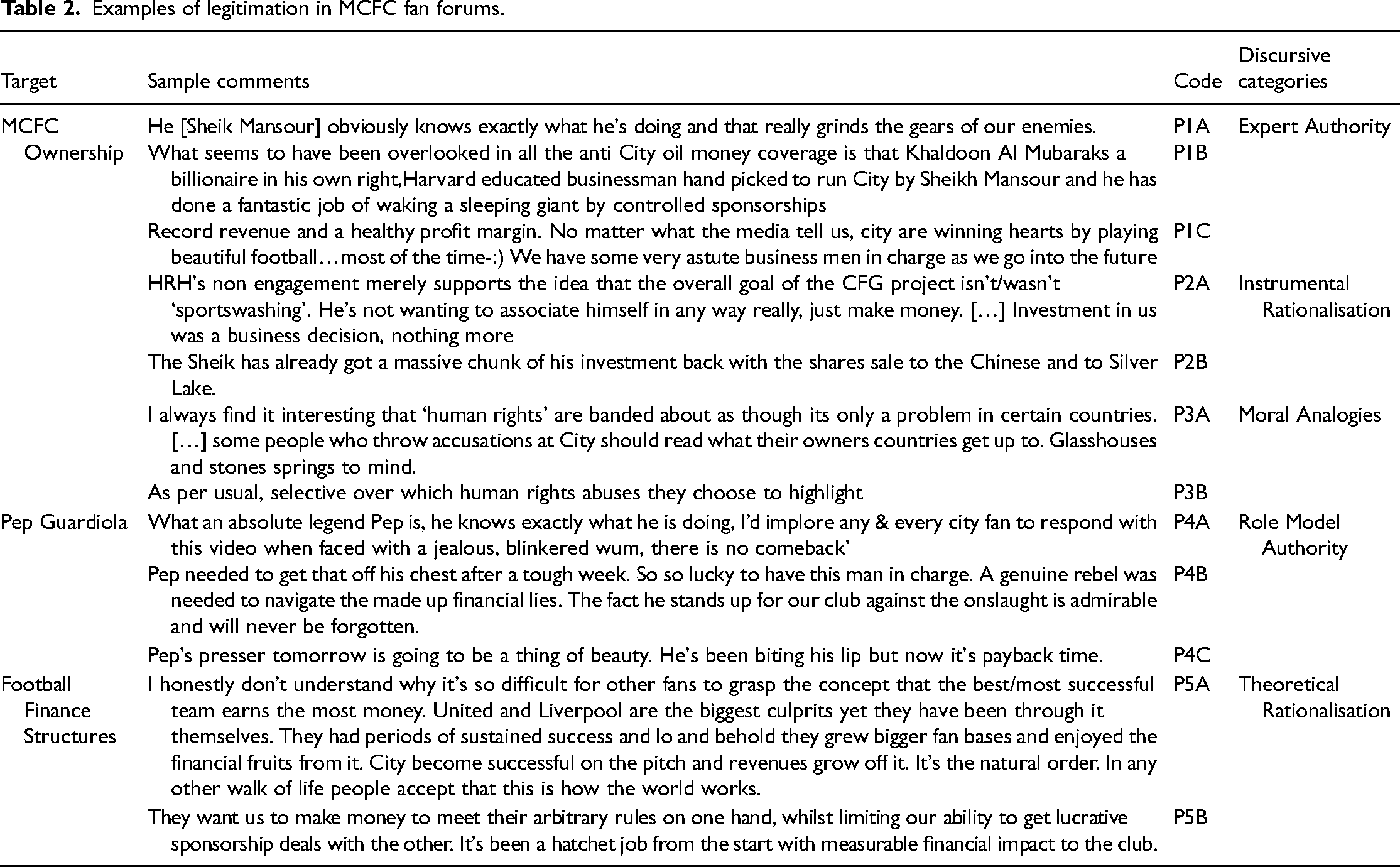
In a similar vein, Expert Authority is a discourse employed to champion the business acumen of the club's hierarchy (Table 2, P1). MCFC's economic advantages over its rivals – and subsequent on-field dominance – is framed as the result of the unique savviness of its administrators: ‘He [Sheik Mansour] obviously knows exactly what he's doing and that really grinds the gears of our enemies’. Such savviness is presented in some comments as cause for envy and resentment among MCFC's rival clubs, thus tacitly legitimising MCFC's success by presenting opposition to it as purely self-serving. This savviness is largely discussed in general terms with the phrase ‘best run club in the world’ recurring across several comments. Details are rarely provided, with MCFC's financial success (particularly in the profits thread) and on-field victories assumed to be implacable proof of objective administrative competence. In this, there is some overlap with the Authority of Tradition: the plaudit, ‘best run club in the world’ is understood in these discussions as an obvious and unquestionable truth, in need of no further elaboration. The club's vast wealth is tacitly framed as proof of, and reward for, its administrative and footballing excellence, rather than as an advantage which facilitates the achievement of this excellence.
The success and expertise of MCFC's hierarchy is based on the premise – implicit in some comments and explicitly discussed in others – of a meritocratic football economy, wherein the cream naturally rises to the top (Table 2, P5). Attempts to regulate this economy are presented as tampering with the natural state of affairs, assumed to be motivated by the greed and fear of the traditional powerbrokers of European football: ‘They [UEFA] want us to make money to meet their arbitrary rules on one hand, whilst limiting our ability to get lucrative sponsorship deals with the other’. Such discourse consists of an overlapping combination of Theoretical Rationalisation, Authority of Tradition and Moral Evaluation. Some users acknowledge negative aspects of the abiding financial structures of club football, wherein a small number of superclubs wield a distortive amount of economic and political power. However, in such comments, MCFC are discussed as a threat to this hegemony rather than a potential part of it. The human rights abuses associated with the UAE government and MCFC's ownership are raised and summarily dismissed through use of Moral Analogies; comparisons are drawn with other regimes – usually one involved in some capacity with rival clubs – and the supposed lack of criticism they face by fans and media observers for similar offences (Table 2, P3). Elsewhere, users tacitly concede a degree of perilous escalation to the distorting effects of money within the game, but depict this as initiated by MCFC's competitors who are now reaping what they have sown in being overtaken within the ruthless world of modern football, a Mythopoeic Cautionary Tale. Largely, even users who express discontent with football's economic climate view MCFC's role in it as at least passive and at most subversive.
In slight contrast to the cold but laudatory expertise that MCFC's ownership is celebrated for, the club's players and particularly their management are discussed in more emotive terms; in what Van Leeuwen would describe as Role Model Authority (Tables 2, P4). Head coach, Pep Guardiola is prominently depicted as displaying restraint and deft communication skills when faced with accusations of the club's alleged financial misconduct. MCFC's triumphs – on and off the pitch – are frequently read as moments of vindication for Guardiola against the club's accusers: ‘Pep needed to get that off his chest after a tough week. So so lucky to have this man in charge. A genuine rebel was needed to navigate the made up financial lies’.
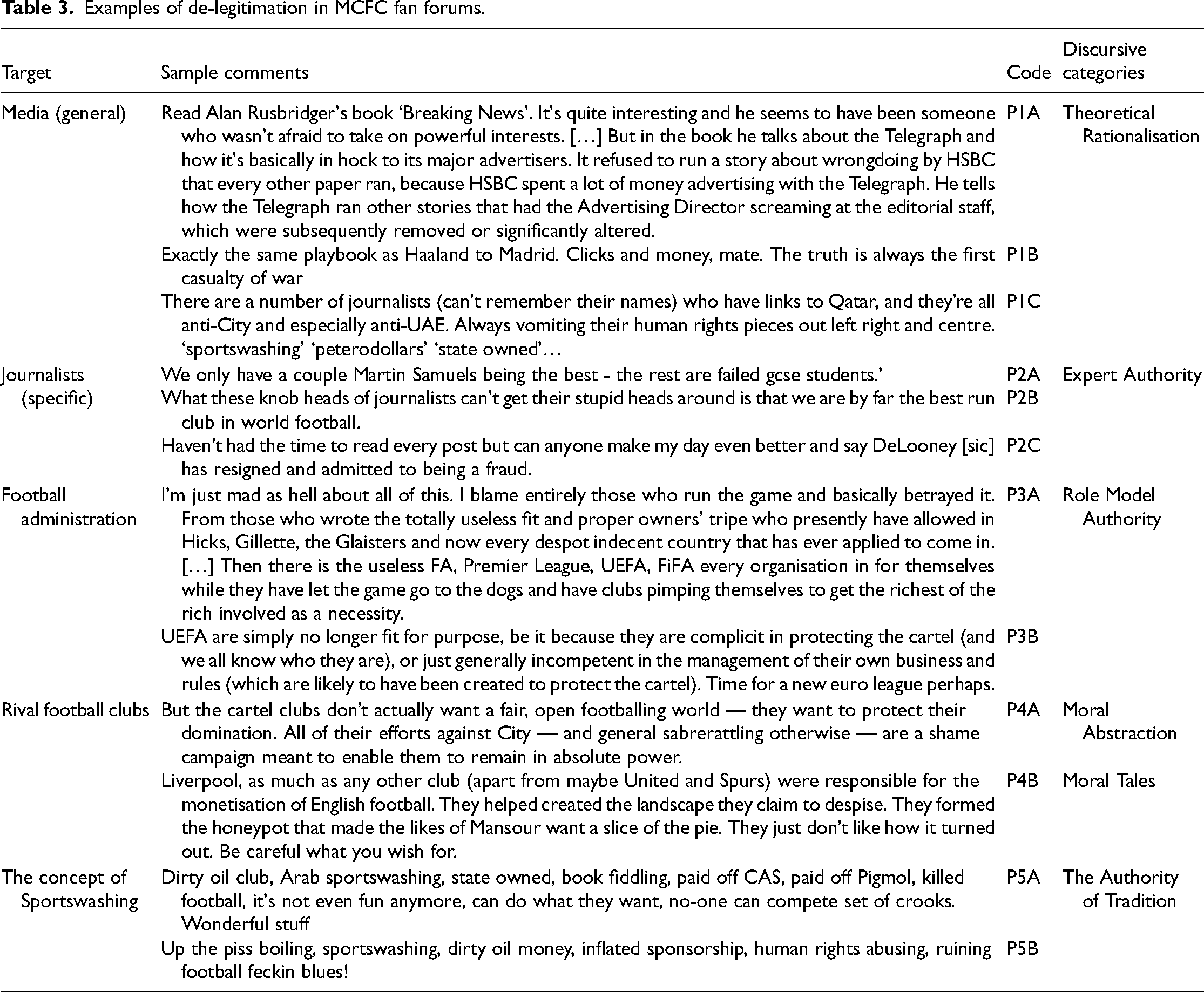
Examples of de-legitimation in MCFC fan forums.
De-legitimation
A similar interweaving of the discursive tactics outlined by Van Leeuwen can be found functioning in an inverse fashion to de-legitimate MCFC's perceived ‘enemies’ and the charges they level against the club. Forum users conceive of their support of MCFC as in continual conversation with other (largely hostile) elements within the wider world of football. MCFC's triumphs are framed against the reactions (actual and anticipated) of a variety of detractors: fans and administrators of rival clubs, journalists, pundits and governing bodies.
Media critics of the club are dismissed in both general and specific terms. Forum users often employ a form of Theoretical Rationalisation, purporting a worldview wherein ‘the media’ in general is inevitably compromised by malign political and economic structures which leave reporters and editors in thrall to moneyed interests. Journalistic integrity is perceived as having been eroded in the efforts to please advertisers and chase readership. One comment which attracted several likes and commendatory replies from other users attempts to bolster this thesis through citing Alan Rusbridger's Breaking News, a book detailing the stresses modern journalism labours under; an explanation which is notably illustrated with an anecdote concerning ‘a Manchester Football Writers Festival event’ where journalists reputedly attested to such editorial censure to the user. It is notable that while the book cited argues for a pattern of compromised interests across modern UK media bodies, the user (and those replying to them) still position the issue as something MCFC are distinct – if not unique – among football clubs in suffering from (Table 3, P1).
In specific terms, individual journalists who have made frequent and/or prominent critiques of MCFC are often referred to by insulting nicknames by forum users. Their critiques are dismissed as ill-informed and the product of an obsessive vendetta against the club. Their journalistic credentials are derided in comparison to supposedly superior colleagues (i.e. journalists who have provided favourable coverage of the club); an inversion of Expert Authority (Table 3, P2). Derision against these journalists is rarely articulated beyond their ‘bias’ against MCFC serving as proof of their professional failings. Criticism of their writing or research does not offer much substance beyond this assertion of obvious bias: ‘What these knob heads of journalists can't get their stupid heads around is that we are by far the best run club in world football’. It is evident from the threads examined that there has been something of a recursive snowball effect with regard to the users’ perception of prominent critics of the club's sportswashing; in many cases, merely the mention of their name (or derisive nickname) is enough to provoke a sarcastic or dismissive response from other users.
Inversions of Personal Authority and Role Model Authority are evident in posts in which users focus on the moral shortcomings of MCFC's ‘enemies’ in the world of football administration (such as La Liga President, Javier Tebas, owners of rival clubs such as Liverpool and Manchester United, UEFA officials, etc.). These figures are criticised as having let down their respective institutions – and the wider game of football – through their obviously self-serving motives: ‘I blame entirely those who run the game and basically betrayed it’. Such posts fulfil the dual function of not only de-legitimating these figures – and their accusations against MCFC – but also the institutions and wider footballing administrative structures they represent (Table 3, P3). In a context where these structures are discredited by the actions of such individuals, any distortive impact MCFC may have on such structures is rendered moot.
Rival clubs – both their fans and their administrative hierarchies – are similarly discussed as irredeemably biased actors when it comes to their opinions and actions concerning MCFC. The competitive logic of football, wherein clubs compete in a zero-sum game in which there can be only one league champion, is projected onto the discursive and administrative arenas of the sport. Any criticisms of, or attempts to address, MCFC's distortive financial might by the administrators of rival clubs are viewed as desperate attempts to preserve their own clubs’ waning dominance in the face of MCFC's dynamism: ‘They helped created the landscape they claim to despise. They formed the honeypot that made the likes of Mansour want a slice of the pie. They just don’t like how it turned out. Be careful what you wish for’. Posts concerning these figures can largely be interpreted as inversions of Impersonal Authority and/or Moral Abstraction. In comments in which users tacitly presume an overarching footballing finance structure that is both neutral and meritocratic, rival clubs are derided for attempting to subvert and evade its rules and conventions. Comments that convey a more critical view of the distortive effects of money on modern football tend to employ inversions of Moral Abstraction, charging their rivals’ administration with having an ongoing and/or historical negative impact on the wider sport: ‘But the cartel clubs don’t actually want a fair, open footballing world — they want to protect their domination’.
Rival fans are – like critical journalists – frequently referred to by derogatory nicknames (‘rags’ for Manchester United fans, ‘dippers’ for Liverpool fans). They are commonly depicted as spoiled by the recent and historical success of their clubs, and their reactions to MCFC are therefore seen to be founded on jealousy and fear rather than on any substantive objections to the club's ownership or impact on the wider sport. Such depictions can be viewed as inversions of Van Leeuwen's Moral Tales; if the MCFC-following protagonists are being rewarded for their loyalty to their historically unsuccessful club, United and Liverpool fans are seen as their foil, suffering their just desserts after decades of hubristically celebrating their clubs’ success (Table 3, P4). In addition to such direct dismissals, the large global fanbases of United and Liverpool are also frequently invoked in attempts to de-legitimate the media as a reliable arbiter of footballing debates. Such comments employ Instrumental Rationalisation to depict a mediascape wherein the greater size of MCFC's rivals’ fanbases will inevitably see them catered to – and MCFC biased against: ‘The gutter press know their audience and pander to it. We will never have the global fan base that the rags and dippers have’.
Notably too, the very term sportswashing – and specifically, its application in relation to MCFC – is discredited through mockery (Table 3, P5). Across the three threads the term is used sarcastically as a patently ridiculous charge against the club. Such posts feature an inverted version of Van Leeuwen's Authority of Tradition; within the community of MCFC fans on the forum, the charge of sportswashing as it pertains to their club is so self-evidently ludicrous that there is no need to substantively refute it but, instead, sarcastically dismiss it: ‘Dirty oil club, Arab sportswashing, state owned, book fiddling, paid off CAS, paid off Pigmol, killed football, it's not even fun anymore, can do what they want, no-one can compete set of crooks’. Its function as a shorthand for the supposedly biased opprobrium the club faces is therefore self-reinforcing; invoked to dismiss criticisms of the club, each invocation serves to further dismiss the term itself as anything beyond a recurring joke among forum users.
Rooting for the underdog
Our analysis reveals little or no opposition to – or even criticism of – the Abu Dhabi United Group's ownership of MCFC, a finding which gels with previous assertions that the club's wider fanbase are united in support of the ownership regime. The closest thing to notable dissent expressed in the threads examined came in the comments which conceded that MCFC would be content to thrive within the stilted structures of top-level football rather than disrupt them. Such comments are not framed as calls for the club to do more to subvert such structures, or for fans to expect them to do so, but rather as attempts to temper the more optimistic assertions of the impact of MCFC's success on the wider world of football. Of course, even these somewhat more sceptical assessments are in the minority when compared with the wholly celebratory comments. It should be noted that prior to the success they have experienced under the Abu Dhabi United Group, MCFC were a byword for comical underachievement in British football circles, whereas their neighbours and rivals, Manchester United were associated not only with on-field success but also with the increasing commercialisation and globalisation of European – particularly English – club football (Shindler, 2012). The notion of MCFC's success under the Abu Dhabi United Group, representing a brave blow against a greedy football hegemony could be argued to allow fans of a club so long defined by its status as underdog and outsider to continue to maintain a semblance of this identity.
A response in the thread of the CAS verdict illustrates this attitude, railing against ‘UEFA's unfair and elite protectionist Financial Fair Play regulations […and…] the established and jealous European elite Premier League clubs who collectively over the years rigged the PL and CL so they would profit and suppress any other PL club's ability to challenge their dominance’. Notably, it goes on to denounce other clubs of a similar position to pre-takeover MCFC – historically successful but currently struggling to breach the upper echelons of an increasingly commercialised sport – indicating an unwillingness or inability to conceive of a paradigm in which MCFC may be considered an elite lording financial dominance over lesser clubs. Elsewhere in the thread, a user denounces UEFA's Financial Fair Play laws as ‘always [being] about protecting the established elite’ and expresses the wish for a ‘level playing field’ – what it would take for other ‘outsider’ clubs to compete with MCFC and the established elite is not directly articulated but perhaps indicated a reference to the elite's anticipated reaction to Newcastle United's takeover by the Saudi Arabian Public Investment Fund (in both the initial comment and several replies to it). Another user expresses a hope that ‘minnows’ can be elevated to a more competitive status, though how MCFC's triumph over UEFA facilitates this is left unclear. That MCFC can compete with the elite through investment from state actors representing a morally questionable foreign government is a development legitimated through a lens which will not countenance seeing the club as anything other than an unfashionable underdog.
Discussion on the forum has legitimated MCFC's ownership regime as benevolent, savvy and business-minded to the extent that there is largely no need for substantive refutation of accusations of sportswashing. The term is treated as facile slander, employed by MCFC's ‘enemies’ to taint their success. Any sense of unethical conduct or financial irregularities with regard to the ownership regime is summarily dismissed. When one user questions the nature of MCFC's accounts in the thread on record profits, they are accused by another of being a Manchester United fan. In de-legitimating the club's critics as jealous, greedy and ethically compromised, forum users succeed in de-legitimating the notion of criticising the club's ownership.
In the thread on the 2019 FA Cup final, for instance, MCFC's finances act as a structuring absence for users. It is rarely discussed directly, but any allusion to it in media coverage of MCFC's victory colours comments, with one user noting ‘Surprisingly gushing from the BBC on our achievements this season but of course a sly dig with potential FFP sanctions’. Another user actually cautions others to ‘not look for BBC or BT being disappointed or making back handed comments’ and just enjoy the victory on its own terms. Notably with the much-discussed incident of journalist, Rob Harris asking MCFC manager, Pep Guardiola, about taking illegal payments in the post-match press conference (see O’Donnell, 2019), the substance of the question is never discussed; instead users criticise it as a breach of etiquette, typical of the supposed media agenda against MCFC and deserving of sanction from the club. Having legitimated the club's ownership so deeply, any accusations of sportswashing or related illicit or immoral activities need not be substantively refuted, but can merely be rejected out of hand in a casual discursive reassertion of the legitimacy of the Abu Dhabi United Group. Furthermore, given the Role Model Authority with which he is discussed, the reaction to Guardiola's evasion of Rob Harris’ question on illegal payments serves as a marked example of the power of status to legitimate the discourses of elite groups.
Most concerningly, with this climate established among the MCFC fans on the forum, there is very little concern – and even occasional glee – at the thought of the club's ownership taking actions against critical journalists: ‘Just a side note that banning journos like this just serves the “they tried to silence me” narrative they are desperate to sell and feeds their persecuted speaking truth to power trip they've been setting up with the Abu Dhabi weaponised fan fiction they write’. One user ominously asserts that ‘The honour and integrity of people with a high, global public profile, such as Sheikh Mansour, Khaldoon al Mubarak and others has been dragged through the mud for years over this […] This will not go unpunished’, a comment that attracts several celebratory replies, including one declaring that ‘They [critical journalists] have no idea with whom they are messing. When Karma arrives expect blood on the carpet’. The legitimation of the Abu Dhabi United Group's ownership of MCFC extends beyond defending their stewardship of the club to denouncing the right to criticise them.
Conclusion
The users of the MCFC fan forum comprise a range of opinions and discourses concerning their club, but while their opinions should not be considered homogeneous, our analysis nevertheless reveals key trends and overlaps in their arguments. If sportswashing is a matter of legitimation, then it is evident that the Abu Dhabi United Group have succeeded through the manner by which the MCFC fans examined here rationalise the immoral, taking an active role in the processes by which ‘attention is routed away from the moral violation […] through sport’ (Fruh et al., 2022: 3).
Previous research into this area had highlighted the uncertainty of the long-term impact of sportswashing (Al-Khalifa and Al-Khalifa, 2022; Crilley et al., 2022), but our examination of this MCFC fan forum attests to club ownership as a significantly effective long-term sportswashing strategy. Recent research by Sinclair et al. (2023) demonstrates how online abuse by fans can sway football journalists from refraining to address certain issues or even leaving the field entirely. Thus, in commanding the fierce loyalty of MCFC fans, the Abu Dhabi United Group have increased their ability to shape the media agenda. Furthermore, previous research has also questioned the intended audience for sportswashing, largely focusing on international observers of sportswashed mega-events and domestic public living under the sportswashing regime (Boykoff, 2022; Meier et al., 2021). However, remaining conscious that the users of the forum analysed cannot be assumed to be representative of the entire fanbase of MCFC, our analysis illustrates the significance of winning over an audience of dedicated, emotionally invested, communicatively active fans. Through their ownership of MCFC, the Abu Dhabi United Group has not only broadened international perception of the UAE beyond repression and autocracy to associations with sporting excellence, but have also co-opted elements of the club's fanbase as aggressive defenders of their regime. With the majority of previous research into sportswashing focusing on short-term event-hosting strategies, our research attests to the distinct significance of long-term institutional-ownership strategies as sportswashing cases worthy of further examination.
The case of MCFC serves to illustrate a hitherto under-examined aspect of sportswashing: its impact on fans. Previous investigations into sportswashing have argued for its ability to distort perception of the moral violations of sportswashing entities, complicating their reputation through association with celebrated and established entities in Western sport (Crilley et al., 2022; Fruh et al., 2022). However, our analysis of the MCFC fan forum reveals the depth of this distortion when it comes to the fanbase of the sportswashed entity itself. The ownership regime of the Abu Dhabi United Group has brought unprecedented success to MCFC and forged emotional bonds with the fanbase in the process that MCFC fans will not only overlook ethical violations by the Group, but decry and – in some cases – attack the Group's critics.
The forum users examined here employ a range of overlapping discursive tactics to legitimate MCFC's ownership regime and its subsequent impacts on the wider world of football, while also de-legitimating critics of the club. It is a significant development to the study of sportswashing that a potential benefit of the strategy for state actors investing in Western sport is the recruitment of a body of aggressive, emotionally invested supporters. Future research into the matter could unearth whether similar developments are afoot at Paris Saint-Germain (a French club purchased by Qatari state actors in 2011 which has similarly experienced historic success since). Fan reaction to the takeover of Newcastle United by Saudi state actors has been examined by Jones et al. (2023), and there is ample scope to build on this work as the club's fortunes further develop (positively or negatively) under this new regime. Like MCFC prior to takeover, PSG and Newcastle were formally successful clubs who had come to earn a reputation for underachievement with considerable discontent between the fan base and the previous ownership. The perception of sportswashing regimes ‘saving’ clubs from unambitious, incompetent or even corrupt ownership is one that should be a particular concern of future research, as our own analysis has demonstrated the persistent potency of MCFC's underdog outsider identity even as they win major trophies and accrue billions in profits.
Ultimately then, our research attests to the variety of discursive tactics employed by MCFC fans in their attempts to come to terms with their club's status as a potential sportswashing project in the face of increasing scrutiny, and in doing so, underlines the success of the Abu Dhabi United Group in winning the loyalty of MCFC supporters and courting an audience hitherto largely overlooked in sportswashing literature. The adaptation and application of Van Leeuwen's framework of legitimisation provides a theoretical toolkit with which to develop a nuanced understanding of the long-term impacts of sportswashing on a club's fanbase. The extension of the examination of club owners’ attempts to establish legitimacy with fans to encompass the category of de-legitimation facilitates studies of the impact sportswashing has not only internally (concerning fans’ perceptions of the ownership) but also externally (how that perception affects fans’ views of other institutions).
Footnotes
Declaration of conflicting interests
The authors declared no potential conflicts of interest with respect to the research, authorship, and/or publication of this article.
Funding
The authors disclosed receipt of the following financial support for the research, authorship, and/or publication of this article: This work was supported by the Arts and Humanities Research Council, (grant number AH/W001624/1).
