



Abstract
In this article, we study social status associated with sport. First, we examine the extent to which sport gives social status to Norwegian youths and athletes, how sport does so compared to other status markers and how sport and other various status markers vary by age, gender and cultural class. Second, we study how sport performances influence social status (popularity and likeability) among athletes. We hypothesise that (i) sport has a high status in general and especially among sport participants, (ii) sport loses attraction by age, but less so among sport participants than the general youth population, (iii) sport gives more status to boys than girls and (iv) sport performances influence athletes’ popularity and likability. We use data from the nationally representative Ungdata project of 2015 (N = 22,856, response rate 70%) and a study conducted by the authors on young athletes participating in organised sport (N = 387, response rate 74%). The results show that sport has a high status, especially among young sporting males. Cultural class seems less important for sport status. For status within the context of sports, the best-performing athletes are the most popular and best liked athletes. The findings are discussed with regard to recruitment, continuation and dropout from sports.
When studying why young people participate in sport, researchers tend to look at their motives (Guedes and Netto, 2013; Moradi et al., 2020; Wold and Kannas, 1993). Youth engage in sport to achieve something – meeting friends, competing, having fun or improving their health – and studies see such motives as the crux of sport participation: motives represent inner forces expressed through sport activities.
Yet, although individual motives matter, much of what people do they do because of others. For young athletes, sport performance might raise (or lower) their worth in the eyes of significant others, let them feel good (or bad) about themselves and their activity and experience a sense of belonging to (or exclusion from) a social group (Frank, 2020; Honneth, 1995; Mead, 1934; Ridgeway, 2019). Youth care about their social standing, they are motivated by status concerns and research shows that peers play important roles in such processes (Adler and Adler, 1998; Frank, 2020; Ridgeway, 2019; Scholte and Van Aken, 2020). Hence, to fully understand youths’ participation in sport, it is timely and useful to examine the importance of sport as a way to gain social status.
To investigate the nature and effect of social status in sport, we seek to answer three questions for two samples of young Norwegians: one nationally representative sample and the other consisting of young athletes. First, we question the extent to which sport gives social status to Norwegian youths and athletes. We also compare social status associated with sport to other social status markers prevalent among youths. Second, sport is a status marker embedded in power hierarchies and influenced by social characteristics as age, gender and socioeconomic status, so we consider how these characteristics matter for the social status associated with sport. Third, we investigate how important sport performance is to athletes’ social status (popularity and likeability).
Most previous studies on social status and sport have been carried out in the USA and with small to moderate-sized samples (see, for example Chase and Dummer, 1992; Chase and Machida, 2011; Thirer and Wright, 1985). Our study is original in terms of geographical context (Europe and Norway), including different sports and school systems. Moreover, the study includes both a large representative sample, allowing for empirical generalisations, and a smaller sample, making it possible to focus on how sport specifically provides status among athletes. Finally, we include and compare a selection of potential status factors–sport, school, look, trust, alcohol, drugs, fashion, social media and politics – and examine the role of social background in social status processes. In addition to filling gaps in the literature, a better understanding of how sport is valued and gives status in peer communities could provide knowledge on young people's attachments to and participation in sport, including recruitment, dropout, inclusion and exclusion.
To answer our three questions, we first present theories, review previous research both on social status in general and in sport and formulate hypotheses. Next, we present the context for the study along with methods and data. Based on the results, we describe the importance of the various status measures among Norwegian youths and young athletes and how the status associated with sport varies between social groups. Then, we look at how popular and likeable athletes are judged by their co-athletes based on sport performance. We wind up the article with a discussion of how insights on social status in sport might help to facilitate and support the administration of youth sport, with respect to recruitment, dropout and inclusion/exclusion.
Theories and previous research
What is social status, and how does it work?
In her seminal work on status, Ridgeway (2019) makes one observation – status is everywhere! – and raises one question: Why does status matter? In this study, we follow up on Ridgeway's queries and assume that status is to be found (almost) everywhere in youth sport and aim to clarify how status matters to youth sport.
The crux of the status phenomenon is that actors look to peers for social recognition, and when they are recognised for something they do (being trustworthy, emphatic, skilled) or something they are (good looking, tall, Dutch) by others, they feel valued and worthy. Recognition then is at the core of status processes where ‘Defined simply, status is a comparative social ranking of people, groups, or objects in terms of the social esteem, honour, and respect accorded to then’ (Ridgeway, 2019: 1). Although a definition is useful, the issues that really matters for Ridgeway (2019: 1) are why status develops, how it works and how it is significant for our lives.
For a study of youth sport, we find that what makes status develop, work and significant is that status captures at least four aspects central to young people's social lives in sport (Frank, 2020; Honneth, 1995; Renger and Simon, 2011; Ridgeway, 2019). First, status – as recognition from a group of others – gives direction and intensity to individual experiences of what is valuable: I am a skilled player, my teammates are grateful for my contributions to our team's success, I feel recognised and sports are fun. Second, because status involves comparing and ranking actors into hierarchies according to what a group consider valuable, status also has repercussions for power and structures within peer groups. Social status provides power and social order. Third, social status could be important for social cohesion. When most know and many accept their social position in a group, status could contribute to coherence, agreement and low levels of (open) conflict (Halevy et al., 2011). Fourth, status could help adjust and align expectations and thereby ease coordination and social interactions (Goffman, 1959; Tavory and Fine, 2020).
In sum, status could matter – positively or negatively – for individual experiences, social structures, cohesion and social interaction in sport. A focus on these aspects of social status is useful for understanding what goes on in sport, how sport is significant, and we will return to these individual and structural factors in the final discussion of the study.
The status of sport in society and among athletes
Our first question concerns the overall status of sport among young people. Several factors point towards sport providing high social status in Norway and similar welfare states.
First, organised sport is an important social arena in the lives of many Norwegian youths. Almost all young Norwegians spend time, for longer or shorter periods, participating in organised sport (Bakken, 2019; Breivik and Hellevik, 2013; Seippel, 2015). This indicates that sport matters and somehow also involves a certain level of status. Second, studies on parents’ involvement in sport have shown that they also consider sport an important social arena (Strandbu et al., 2019). Third, it is commonly agreed in the general population that sport has important social functions and is useful for socialisation and integration (Seippel, 2019). Fourth, sport's status is also echoed in the substantial public expenditure on sport and the centrality of sport in national policies (Kulturdepartementet, 2012). Finally, previous research also supports the assumption that sport leads to high social status among young people (Chase and Dummer, 1992; Chase and Machida, 2011; Coleman, 1961; Green et al., 2015; Jackson, 2006; Seippel, 2006; Shakib et al., 2011).
While many people have positive views about sport, there are also good reasons to be sceptical of sport: doping, cheating, injuries, violence, corruption, hooliganism, fanaticism, nationalism, eating disorders, male chauvinism, narrow-mindedness, smugness, commercialisation and too much (or too little) emphasis on elite sport at the expense of grassroots sport (Bale, 2010; Hughson, 2009; Lasch, 2010; Morgan, 2010; Petroczi, 2009; Pielke, 2016). Some also claim that organised sport is too strictly organised to be attractive to young people (Witt and Dangi, 2018). Yet, despite these negatives and potential status downsides, we hypothesise that, overall, sport has a high status among young Norwegians (HSport1). Furthermore, we assume that this is even more true for those active in organised sport (Hsport2).
Sport and other sources of social status
To interpret the salience of various status markers, we consider three societal trends and their effects on what is considered worthwhile by young Norwegians: (i) post-materialism emphasising values, such as quality of life, self-expression and trustworthiness (Henn et al., 2021; Inglehart, 1977, 1990); (ii) a tendency for young people to be serious and competitive, to do more schoolwork and to be less involved in deviant activities (Aarø et al., 2016; Eriksen, 2020; Raitasalo et al., 2020; Sandberg and Skjælaaen, 2018; Scheffels et al., 2020) and (iii) an increased focus on bodily qualities, health, appearance, fashion and good looks, and for many this plays into their social media lives (i.e. to get virtual likes) (Coffey, 2021, 2022; Walseth and Tidslevold, 2020).
From a general perspective, we assume that these trends in general would support the status of sport. Sport could enhance quality of life (although it could also be seen as trivial or negative), it could be part of a serious and competitive lifestyle (yet it could also be seen as taking focus away from what really matters) and it could be seen as helpful for body and appearance (even though too much of it could have negative impacts).
Sport status and social background
A crucial question is how status associated with sport is impacted by social background factors, such as age and gender, as well as how sport operates as a form of cultural capital and relates to cultural class. It is obviously differences in status of sport, for age (Shakib et al., 2011), gender (Slater and Tiggemann, 2010) and cultural class (Mutz and Müller, 2021).
Regarding age, high dropout rates (Enoksen, 2011; Strandbu et al., 2020) indicate that sport loses attraction by age (Hage1). The age in our athlete sample is higher than in the population sample, so this sample is likely representative of those who continue with sport despite aging, and thus age probably carries less meaning in this group (Hage2).
Sport has ‘always’ been gendered, and previous research shows that boys are inclined to rate sport as more important for social status than girls (Chase and Dummer, 1992; Holland and Andre, 1994; Shakib et al., 2011) and that girls and boys tend to value the social relations in sport differently (Boutilier et al., 1983; Dalen and Seippel, 2019; Giordano, 2003; Soares et al., 2013). So, even though participation rates are (especially for physical activity outside organised club sport) more equal than ever, we assume that taking part in organised sport still gives more status to boys than girls (Hgender).
Studies have shown a class pattern where sport participation is highest among high socioeconomic status groups (Andersen and Bakken, 2018). Higher participation rates likely reflect higher status in high socioeconomic circles, but several studies have found that the meaning of various sports varies across classes (Bourdieu, 1978), complicating this picture. Accordingly, we hypothesise that the impact of cultural class on the status associated with sport is, if anything positive, but probably rather marginal (Hculcap).
Sport status among athletes: social background and performance
We conduct the same analyses for the athlete sample as for the population sample, and we have stated assumptions regarding both samples in the previous section. However, because athletes are all involved in and concerned with sport, just asking for the status of sport likely misses information about what contributes to the real status structures coming from experiences of sport among athletes.
To grasp how sport factually impacts status and social structures among athletes, we asked each person in our athlete sample to rank the other persons in their groups according to three dimensions: level of sport performance, popularity and likeability. Although popularity and likeability are not identical to status, they both address a similar question of reciprocal recognition: how people value others and how these valuations reflect hierarchical structures within each group. Popularity is considered a dimension of social impact related to power, prestige or visibility, whereas likeability indicates acceptance and social preference (Cillessen et al., 2011). The focus of these analyses is to see how social status structures, such as popularity and likeability, depend on athletic abilities. The straightforward hypothesis is that, for athletes, high performers are more popular and better liked, although we assume that this effect is strongest for popularity, which is less personal (Hperformance).
Data and methods
We used data from two sources: (1) the nationally representative Ungdata 1 project and (2) a study conducted by the authors on young athletes participating in organised sport.
Ungdata is a cross-sectional survey of adolescents in Norway and covers participation in sport and other leisure activities, relations to parents and friends, school, health and risk-taking behaviour. In 2015, 22,856 students enrolled in schools in Oslo answered the survey as an electronic questionnaire during a school class administered by the teacher. The final response rate was 70% (Bakken and Andersen, 2015).
To study more in detail how sport impacts social status in a setting where all are concerned with sport:that is, among athletes, we conducted a survey on a sample of 387 athletes from 30 grassroots youth sport teams. Recruiting respondents required cooperation with team coaches, so we adopted a snowball sampling technique that began with the authors’ networks. We used a stratified sampling technique to ensure that the sample had diverse characteristics in terms of sport, gender, age and geography. Coaches were first contacted by phone or email, informed about the aim of the project, and asked whether their teams wanted to participate in the project. Interested coaches were given more detailed descriptions of the research project, which they then presented to their athletes. Next, the coaches returned a list of athletes who wanted to participate. The coaches were instructed to emphasise to their athletes that participation was voluntary.
Data collection took place after training sessions or at social gatherings, and the participants answered the survey on an electronic tablet. Those absent at the scheduled time of data collection received the survey by email the next day, followed by a remainder if the survey was not completed within one week. We registered respondents as missing if they had not completed the survey after three reminders. Participants could decline to participate or discontinue filling out the survey at any time.
From an initial sample of 510 athletes who consented to participate in the study, a total of 387 athletes (56% boys and 46% girls) from 30 sport teams completed the survey (response rate 74%). The average age of the respondents was 17.11 years (SD = 1.52). At the team level, the final sample consisted of 8 ski teams, 11 football teams and 11 handball teams from 8 out of 18 Norwegian counties. The response rate ranged between 37% and 100%, with an average team size of 12.90 (min. 6, max. 20, SD = 3.40). For gender composition, 11 teams were boys only, 11 were girls only and there were 8 mixed-gender ski teams. All ethical aspects of the study were approved by the Norwegian Centre for Research Data (NSD).
Measures
To measure status in the general youth population, the Ungdata survey asks, ‘Do the following things affect your social status within your group of friends?’ The response categories include ‘Being good at school’, ‘Being good at sport’, ‘Being good-looking’, ‘Being trustworthy’, ‘Having lots of ‘likes’ on social media’, ‘Wearing fashionable clothes’, ‘Being interested in politics’, ‘Getting drunk’, and ‘Smoking cannabis’. To measure status among athletes, we modified the question to fit the sport context: ‘Do the following things affect your social status within your sport team?’ We used identical response categories. Respondents in both Ungdata and our study answered the questions using a Likert scale ranging from 1 (‘Increases social status a lot’) to 5 (‘Reduces social status a lot’).
Cultural class was measured with the question ‘Approximately how many books do you have in your home? (1 meter of a bookshelf equals approximately 50 books)’. The number of books in a household operationalises Bourdieu's (1979) notion of objectified cultural capital of symbolic wealth, and it is a well-tested measure of socioeconomic status (see for example Hoffmann et al., 2019; Hoffmann et al., 2018; Sieben and Lechner, 2019). Responses ranged from 0 (no books) to 5 (more than 1000 books).
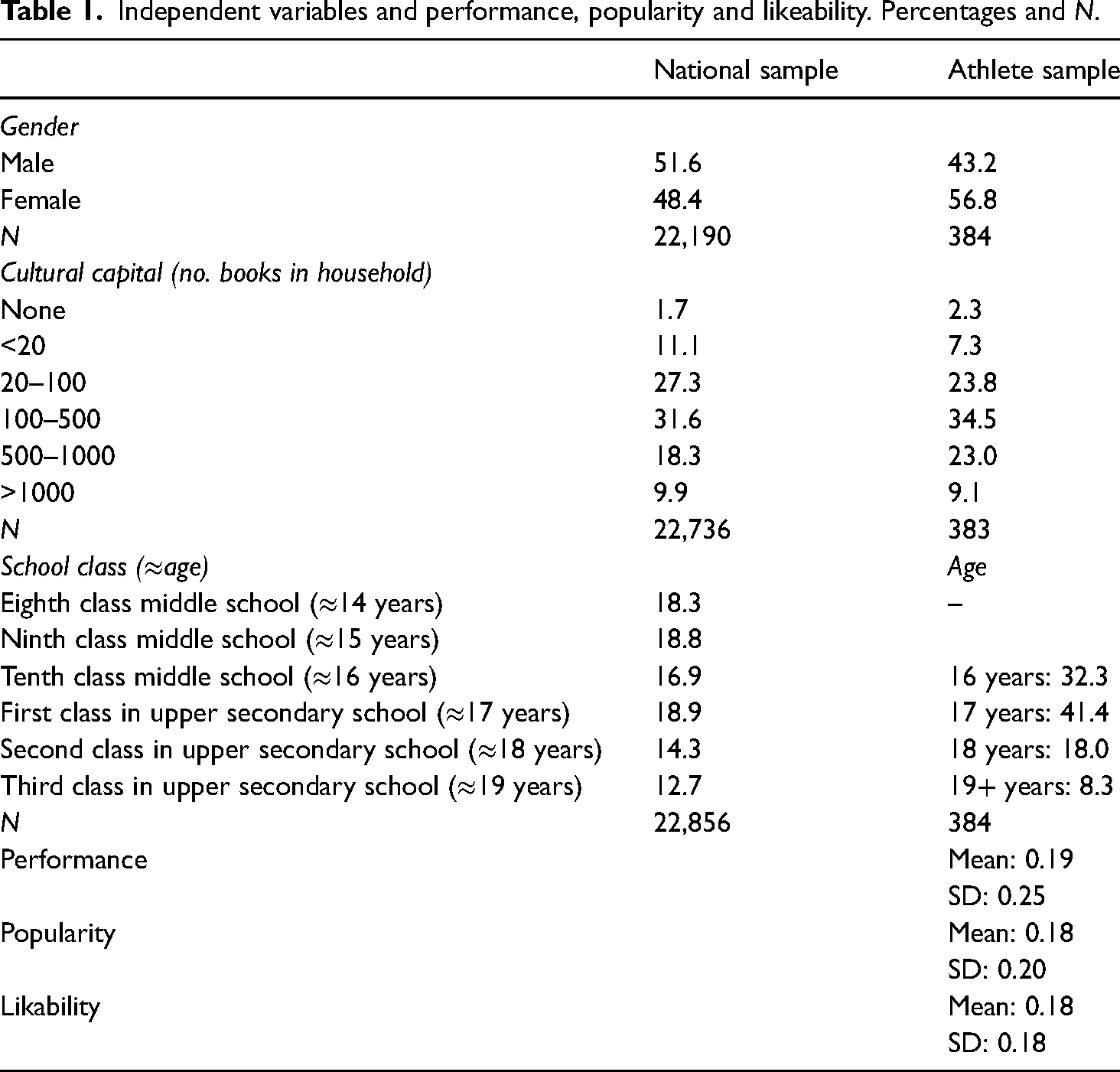
In the athlete sample, we used peer nominations to measure popularity, likability and sport performance. Status is assigned and not chosen (Ridgeway, 2019), so team members’ evaluations of co-athletes’ status are more relevant than the athletes’ self-perception of these measures. Each athlete first selected one person in their team as the most popular/likeable/highest performer in sport and then answered a similar question regarding the second-most, third-most and fourth-most likeable, popular and best-performing athletes in the group (‘Who do you think is the most popular person on your team?’, ‘Who do you think is most liked on your team?’ and ‘Who do you think is the best athlete on your team?’). In sum, the participants could choose up to four co-athletes on all three questions. We counted nominations for each person on each question, weighed them according to whether they were nominated most, second, third or fourth most popular (1, 0.5, 0.33, 0.25), summed the nominations and divided by the size of the group to get a relative ranking of nominations (avoiding the effect of receiving many nominations simply because one is part of a large group) (Table 1).
Independent variables and performance, popularity and likeability. Percentages and N.
Analyses
In terms of social status levels, for both samples, we compared the mean values of the surveyed status markers, with a special focus on sport. We ran a total of nine ordinary least squares (OLS) regression models with each of our two data sets to determine the impact of social background on status, one for each of the status markers. In the case of the athlete sample, we ran multilevel OLS regressions to account for the dependencies of the samples (groups) and to include gender as a variable on the group level. To analyse the influence of popularity and likeability on sport performance among athletes, we ran simple OLS regressions. We included social background variables in these analyses, but they added little insight and are not included in the reported results. The data analyses were conducted using R 4.1.3 (R Core Team, 2022) and RStudio 1.2.5001.
Results
Social status: sport and other issues
Table 2 shows the ranks, means and standard deviations for a set of nine status markers in the general youth population and among young athletes.
For general youth population: what is important to get status? For young athletes: what is important to get status in your team? Mean and standard deviation (scale 1:5).
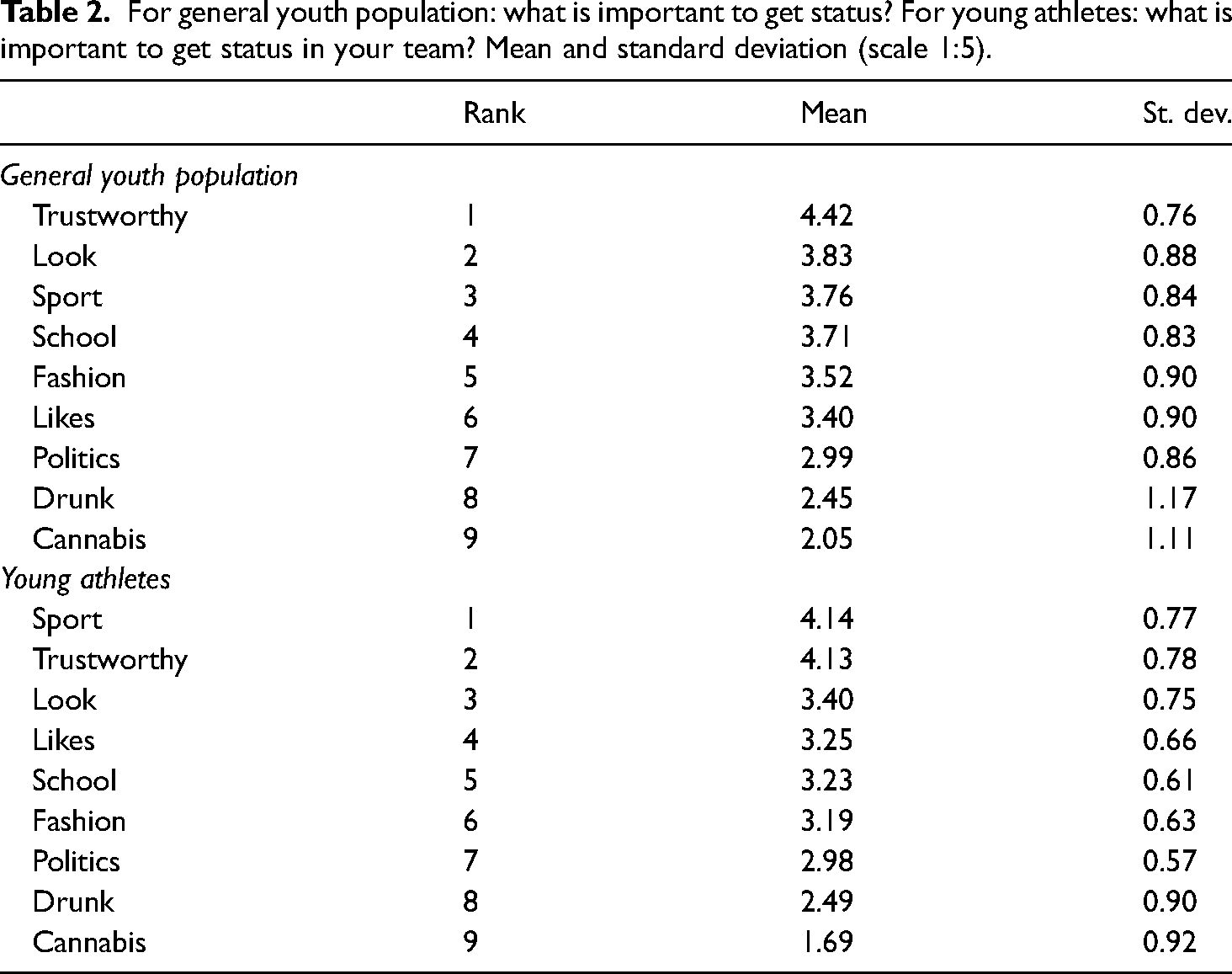
In the general youth population, trustworthiness is by far the most important status marker, with a considerable step down to look, sport, school, fashion and likes. politics, alcohol and cannabis give the least status.
Three societal trends are useful for interpreting these findings: (i) post-material values emphasising values related to the quality of life (normative and expressive factors) (Henn et al., 2021; Inglehart, 1977, 1990); (ii) a serious and competitive youth generation more devoted to schoolwork, competing harder for accessing schools and universities, and being less involved in deviant behaviour and (iii) a trend towards an increased focus on bodily qualities and appearances (Coffey, 2021, 2022). We find traces of all these trends in our results. Trustworthiness is on top of the status list for the general population, representing an expression of post-material values. This is followed by a cluster of issues reflecting appearance and seriousness: sport, looks, school, fashion and likes. Status through politics is ranked lower than might be assumed in a serious and post-material world, but more deviant behaviours, including alcohol and cannabis, are low in status, as would be expected. Compared to the other status variables, sport is unique in that it could reflect several of these trends – non-material qualities of life, serious and body oriented – and, combined with the high sport participation rates, it is apparent that sport is associated with high status.
Unsurprisingly, for athletes, sport leads clearly, with the highest mean values and lowest variation. Except for sport having a higher status position than trustworthiness, the pattern is very much the same as in the population. Athletes are like the general population in having a second cluster of status markers related to appearance and seriousness, and despite some shuffling around of the items, the main pattern is the same. Furthermore, politics, alcohol and cannabis are also at the bottom of the status hierarchy among athletes.
Overall, and in support of our expectation (Hsport), we find that sport is high on the status agenda, probably due to its catch-all-features with respect to the general post-material, serious and body-focused value trends. A second finding is that, apart from sport, young athletes are not special and are mostly like the general youth population when it comes to what conveys status.
Social status by age, gender and cultural class
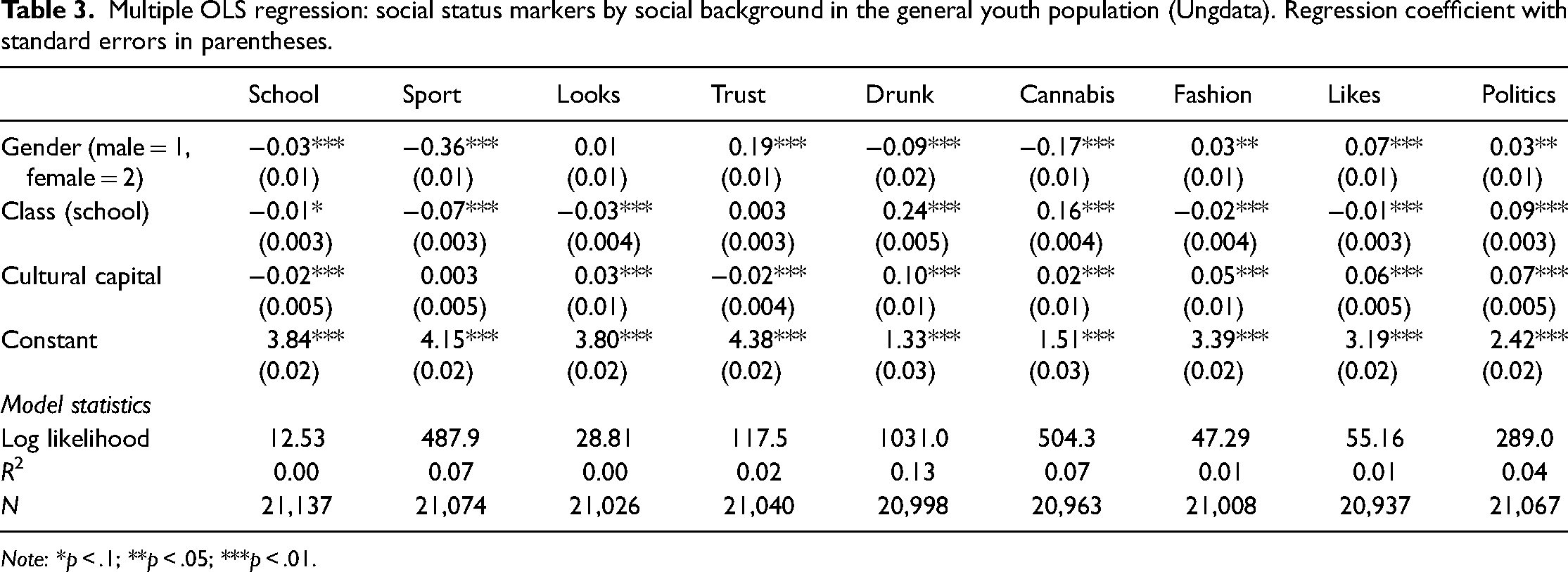
The high status associated with sport is noteworthy, yet a timely question is how social status depends on social background, including age, gender and cultural class. To examine this, we ran nine OLS regression models for each status marker (Table 3).
Multiple OLS regression: social status markers by social background in the general youth population (Ungdata). Regression coefficient with standard errors in parentheses.
Note: *p < .1; **p < .05; ***p < .01.
The status of sport is higher among boys than girls, and it is striking that sport seems to be the most gendered (based on the size of the regression coefficients) of the status markers. The second- and third-most gendered factors associated with status are trustworthiness (female status) and cannabis (male status). Regarding age, there is a significant negative correlation: The older the individual, the lower the status of sport, which support our hypothesis that sport loses attractiveness with age (Hage1). Apart from the deviance statuses (alcohol and cannabis), sport is also the most clearly age-related status. In terms of cultural class, sport stands out as the only status type without a significant class effect.
Compared to the other status items, the full social profile of sport is unique in its constellation of significant variables: young males without specific class characteristics. Nearest in social profile is school, which is also most significant for young males (with much smaller correlations), but school-status also has a clear and consequential class profile and a low model fit. Looks, fashion and likes all have similar social profiles: young females with a high cultural class background. The deviance statuses – alcohol and cannabis – are gendered (male), associated with age (older), and tend towards high cultural capital. Trustworthiness, the most salient status, has a unique social profile: no age effect, female and a negative class effect. Politics convey status for older girls with a high cultural class background.
Our general population sample is large with a low threshold for statistically significant effects. Looking at the fit of the models (R2 and F-tests), we see that only a few models (sport, alcohol, cannabis and politics) have a good fit, indicating that social background makes a difference. Furthermore, we see that sport status is the status that is most dependent on social background among the activities associated with a generally high status (Table 3).
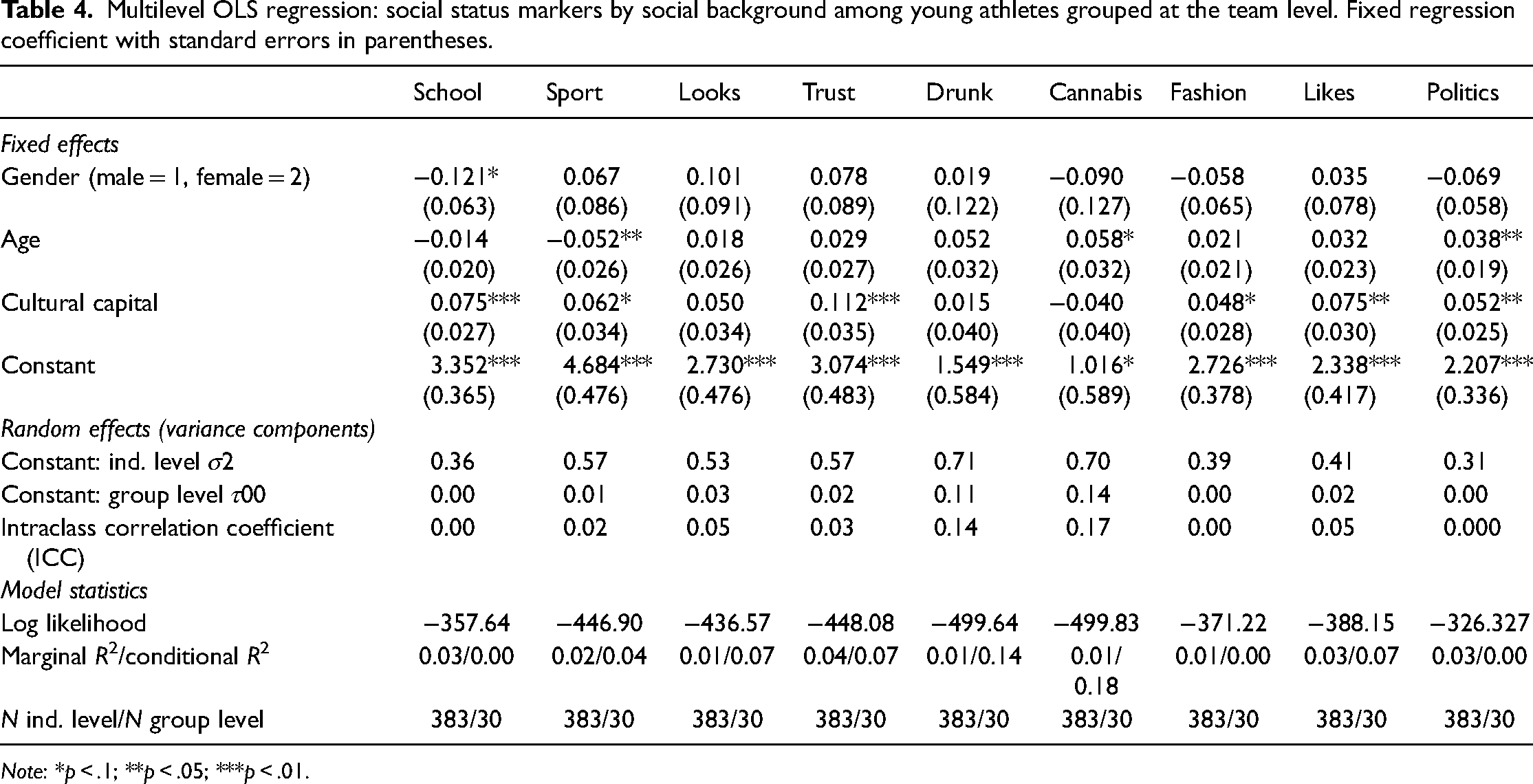
Multilevel OLS regression: social status markers by social background among young athletes grouped at the team level. Fixed regression coefficient with standard errors in parentheses.
Note: *p < .1; **p < .05; ***p < .01.
While the general youth sample is (close to) random and allows for empirical generalisations, the athlete sample is stratified by clubs and chosen to ensure variation (sport and gender). To compensate for this lack of independence in sampling, we performed multilevel analyses (Snijders and Bosker, 2011) (Table 4)
The first finding from the athlete models is that social background has less impact on status for athletes than for the general population (there are fewer significant regression coefficients and poorer model fits) (Table 4). There are two likely reasons for these results. First, there could be less variation among athletes because those ‘selected’ into ‘continued’ sport represent a more socially homogeneous group than the general population and thus ‘agree’ more on what conveys status. Second, the sample is much smaller, so the threshold for statistical significance is higher.
In terms of the status of sport among athletes, the pattern is, compared to the general youth population, both similar and different. The age in the athlete sample is higher than in the population sample, so we expected athletes in this sample to hold on to sport despite aging (Hage2). However, the results show that as for the larger sample, sport is important for the younger athletes. For gender, however, the pattern is different, and status seems to be higher (though not significant) for female than for male athletes. This is probably due to a selection effect reflecting the gendered status hierarchy in the general population: When girls continue with sport despite the lower general status given for girls and thereby the higher threshold for participating, they have to be more devoted to sport – that is, the girls going on with sport are (a bit) special. Hence, our expectation that sport conveys more status to boys than girls (Gender) is only partially supported and only regarding the general youth population. High cultural capital also seems to increase the status of sport among athletes, whereas this effect was positive though not statistically significant in the general population.
Gender matters significantly for the status of school, whereas age matters for cannabis and politics (as in the larger sample). Besides sport, cultural capital is positively correlated with the status associated with school, trust, fashion, likes and politics.
Social structures and performance
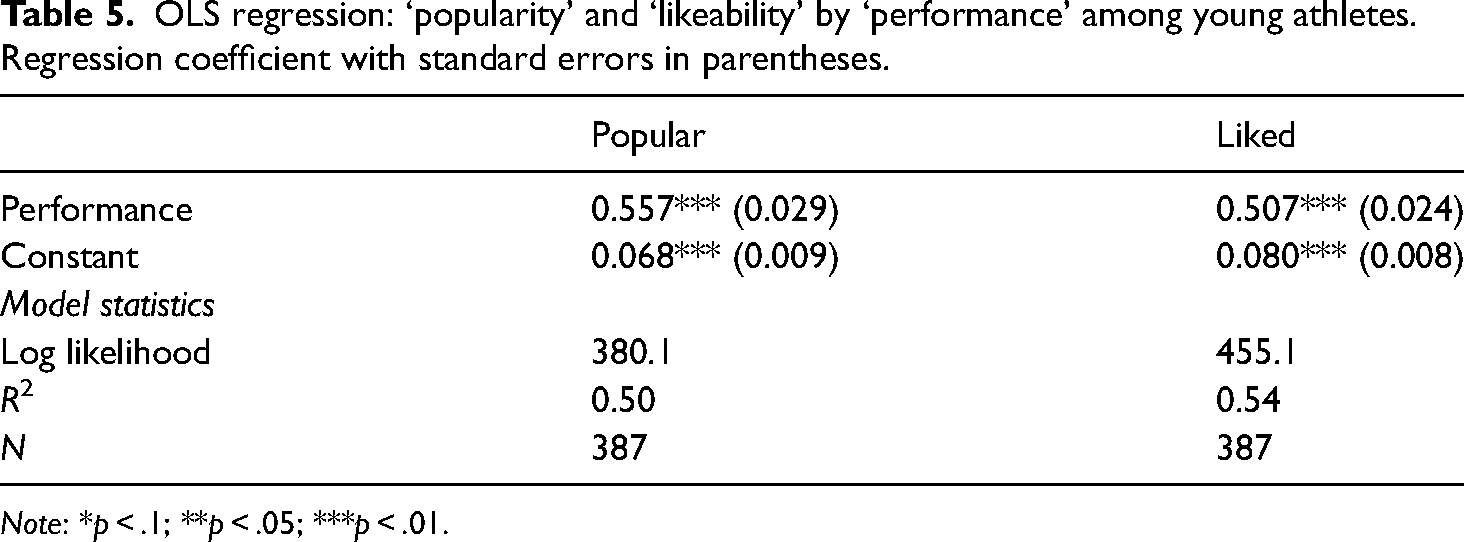
Are the best-performing athletes also the most popular and best liked athletes? Table 5 shows that athletes’ popularity and likeability are indeed related to their performance, and the performance seems to matter more for popularity than for likeability.
OLS regression: ‘popularity’ and ‘likeability’ by ‘performance’ among young athletes. Regression coefficient with standard errors in parentheses.
Note: *p < .1; **p < .05; ***p < .01.
We see that good sport performances increase athletes’ popularity and likeability. Thus, even though athletes report that sport in general brings status, a specific factor that makes a difference in terms of concrete social relations in the athlete group – how athletes appear to one another – is how well they are seen to perform in sport.
Sport performances, popularity and likability, are standardised on a 0–1 scale. A one-unit shift upwards in sport performance increases the mean of athletes’ popularity (0.557) and likability (0.507) substantially. Therefore, sport performance is consequential and spills over into what may appear to be non-sporting social relations.
We included social background variables in these analyses, but they added little insight. Rather, comparing the popularity and likeability of various athletes based on their performance level is what makes a difference.
Summary and discussion
Our results show that sport has high status among young Norwegians, more so for males than for females. The status associated with sport wanes with age, whereas cultural capital is less consequential. Thus, while sport, in general, gives high social status, the level of status of sport also depends on social and individual characteristics. The high status associated with sport is reflected in high participation rates and the high evaluations of the social benefits of sport in the population, and it also seems reasonable to conclude that sport resonates with current cultural trends: post-materialism, competition/seriousness and body/appearance.
Sport has less status than trustworthiness (post-material values), more than deviant behaviours (alcohol and cannabis) and more than socially responsible action (politics). Sport conveys status in ways similar to school, likes, looks and fashion, representing competition and seriousness (school) and body and appearance. To better understand how sport affects status individual experiences and social structures among athletes, we examined how athletes’ evaluations of teammates’ popularity or likeability is impacted by their sport performance. For both popularity and likeability of athletes, individuals’ perceived sport performance seems to imply that social structures and status hierarchies within sport certainly reflect sport performances.
Taken together, sport has a high status among young Norwegians, and this status is affected by social status mechanisms both outside (age and gender identities) and inside sport (performance). The status associated with sport could impact individual experiences of sport activities and the social relations between athletes (structure, belonging and cohesion). Hence, it is reasonable to assume that sport status has a decisive impact on many practical issues related to sport. To conclude the study, we will discuss how our findings help understand sport participation regarding recruitment, continuation and dropout.
The status associated with sport is consequential because status coming from recognition for doing and/or being something could mediate individual experiences as well as social relations – both being essential motivating factors for sport participation. As such, status is one among several social mechanisms that impacts people's reasons to take part and excel in sport (or not). Even though one tends to assume that sport has intrinsic values (Vallerand and Fortier, 1998), social status in most cases is an essential requirement for positive experiences and social relations in sport. If sport did not convey status, sport would lose much of its appeal, even though more than status is required to enhance participation (e.g. social networks, clubs and facilities). For those not being recognised as athletes, sport will be a less attractive activity: It could come with negative individual experiences and be socially exclusive. Thus, it is relevant to discuss the relevance of our findings for the way in which people behave in relation to sport. We will do this in the context of grassroots sports. Three findings guide our discussion: sport has high status, sport status depends on social background and the sport activity itself (performance) impacts social status structures within sport.
On one level, the high status associated with sport implies that participation is attractive, which helps sport recruitment and continuation while deterring dropout. In addition, sport is positively related to general value trends, which makes it even more suitable as a popular leisure activity. The status of sport also appears to be socially inclusive, as cultural capital does not (relative to other status forms) have much of an impact: Sport is considered worthy in most socio-cultural circles. Combining the low socio-cultural effect on sport status in this study with the large and significant impact of socioeconomic position on sport participation in other studies (Andersen and Bakken, 2018) strengthens a claim of economic costs as a decisive mechanism behind social inequalities in sport, not (more culturally based) status mechanisms.
Although participation in sport and physical activity is becoming less gendered, the status ascribed to sport is, among the status markers included in this study, the most gendered. Consequently, sport provides different experiences and social relations for boys and girls and sport is likely more consequential for boys’ sport identities than for girls. Specifically, boys receive more recognition than girls for their sport participation. If (organised) sport conveys less status for girls, this implies that girls’ participation in organised sport will either be lower than that of boys or, when it occurs, involve a higher threshold for participation which will require more effort and/or motivation. There is an additional requirement for female sport careers: Girls must be more committed than boys, or they will drop out.
The connection between sport and age is well known and socially significant. It both clarifies the ease with which young people are attracted and recruited to sport and explains why so many later drop out. The status associated with sport implies experiences and social relations and if these wane by age, sport is simply not as attractive to older youths as it is to youngsters.
The weaker status of sport among older youths likely relates to factors outside of sport (Deelen et al., 2018; Persson et al., 2020). In addition to the increased importance of friendships and partners, school takes up more time, more leisure activities are available and many starts to work (part-time). Consequently, there are more opportunities for social status and tougher competition for sport as a dominant status arena.
Performance is essential in competitive sport, and it also impacts experiences, social relations and status among athletes. Indeed, comparing and evaluating the performance of others is central to how sport is experienced. Initially, sport seems to attract almost all youths, both those who care about performance and enjoy the status it conveys as well as those attracted to friendships but less concerned with sport itself. Over time, however, it seems inevitable that those who succeed in sport will garner higher status, enjoy sport more, develop significant social relations to co-athletes and thus be more committed to sport. Although stakeholders – parents or officials – can intervene and offer guidance regarding the appropriate level of focus on performance and achievement, a self-enforcing interaction of performance and status seem inevitable in sport.
Status has an immediate meaning – ranking people according to specific qualities – at the same time as it also raises more intricate questions relevant for how it matters and what goes on in sport. We think it would be useful for future research to focus on six topics.
First, it would be interesting to study both the relationship between the status of sport and other sources of status and how status processes work differently for specific sports. Second, we have emphasised how status matters for how sports are experienced, how structures are built, and for cohesion and interactions. A more detailed analyses of how sport status matters for such phenomena would be beneficial. Third, we have touched upon three external factors – age, gender and cultural class – that matter both for sport participation and sport status, but a more detailed picture of how these factors matter alone and in interactions could be interesting. Especially, better informed analyses of status and social class could be useful. Fourth, we have shown how sport performances have consequences for status, and a better understanding of how what goes on intrinsically in sport matter for the social qualities of sport could also bring new insights. Fifth, a better understanding of how sport social status also produces negative experiences and social exclusion would be useful in a society where sport's high status is taken more or less as granted.
Finally, status is a complex phenomenon and it is difficult for those involved - e.g. club officials or coaches - to control. Like reputation and trust, status is difficult to construct top–down but easy to tear down. Status is an important factor impacting the attractiveness of sport, but it points to the very complex social forces behind what goes on in sport: how it is experienced, how interactions develop and how social structure takes form. A more detailed understanding of status outcomes is a prerequisite for handling the ever-present question of participation in and drop out from organised sport could give useful insights.
Footnotes
Declaration of conflicting interests
The authors declared no potential conflicts of interest with respect to the research, authorship and/or publication of this article.
Funding
The authors received no financial support for the research, authorship and/or publication of this article.
