




Abstract
The aim of this article is to discuss how Polish non-heterosexual female football players cope with institutionalised normative heterosexuality, which functions in Poland on several levels. The study is based on 25 in-depth interviews with professional Polish female football players. The interviewed women experienced heteronormativity within Polish society, which precluded negotiating the status of homosexuality in the broader social context. The processes of de-normalisation of heteronormativity are also difficult in the field of football. Although many football coaches and club managers display ‘pragmatic acceptance’ of non-heterosexual female players, this attitude is not always accompanied by respect for different sexual orientations. The ways in which female football players deal with such circumstances resulted in creating a safe space of ‘enclaved non-heteronormativity’ within the team. It is a space which protects from socially dominant compulsory heterosexuality. We discuss the role of this enclave and its potential for social change in football cultures in Poland.
Introduction
Football remains a sport generally seen as masculine, and hegemonic masculinity (Connell, 1987; Connell and Messerschmidt, 2005) still significantly impacts gender relations within this sport. Moreover, the close relationship between hegemonic masculinity and heterosexuality causes football to be framed by the heterosexual norm, and, as a result, the fear of experiencing homophobia is common among LGBT+ athletes (Griffin, 2014). 1
Although in women's football there have been attempts to break free from compulsory heterosexuality (e.g. in the form of coming out), the situation of non-heterosexual female players is complex. They experience heterosexism 2 and face unique problems resulting from their place in the structure of sport. We believe that grasping the cumulative effect (Griffin, 2014) of sexism and homophobia is crucial for analysing their experiences. The belief that women who practise sports considered masculine are mainly lesbians, as they allegedly have ‘male’ character traits or features of physical appearance, is still alive (Caudwell, 2006). Consequently, Norman (2016) argues that homophobia is a highly insidious form of discrimination: ultimately, it affects all female athletes regardless of their sexual orientation.
Although in recent years a significant body of research on the situation of non-heterosexual people in sport has been published, the status of women in sport has undoubtedly been analysed more often in relation to their gender. However, most studies on this issue have explored West European and North American cases. This means there is a significant gap in knowledge about the situation of female athletes in different cultural contexts, including in Central and Eastern Europe. Indeed, when discussing female athletes’ experiences of the normative manifestations of gender and sexuality in sport, one should consider differences stemming from the social context and attitudes towards non-heteronormativity in their region. Examples from such countries as Austria, France, Germany, Hungary, Italy, Spain, and the UK demonstrate that the experiences of LGBT+ people in Europe are diverse (Hartmann-Tews, 2023). There are also examples of extreme homophobic sentiment in the domain of sport: a study by Hamdi et al. (2017) shows that unlike in many Western countries, in Tunisia, one can still observe a culture of homohysteria, and heterosexist culture dominates in Tunisian sport.
The situation of LGBT+ people in Poland
Compared to other EU countries, Poles remain conservative about the rights of non-heterosexual people. According to a Eurobarometer survey conducted in 2019, 49% of Poles believe that gays, lesbians, and bisexual people should have the same rights as heterosexual people (EU average 76%), and 45% think the opposite (EU average 20%) (Eurobarometer, 2020). Apart from this, 50% of those surveyed were against the statement that same-sex marriage should be allowed across Europe. Furthermore, a recent survey among LGBTI people across Europe revealed that 44% of those surveyed in Poland never disclosed their sexual orientation (FRA, 2020). Moreover, the respondents from Poland, apart from those from North Macedonia (19%) and Serbia (17%), most often (15%) declared that they had experienced a physical or sexual attack for being LGBT+.
Right-wing political parties in Poland escalate their anti-gender policy and stigmatise members of sexual minorities, which has led to significant social polarisation and intensification of the nationalist discourse in the country (Graff and Korolczuk, 2022). This discourse produces specific patterns of femininity and masculinity: women are responsible for transmitting national identity to their children, and men should form a close, strong group capable of defending the country and its values. In this vision, the revival of the nation amounts to a return to ‘traditional values’ in the sphere of gender and sexuality, which means that sexual minorities must be ‘combated’ to maintain the moral order (Graff, 2010). In addition, the Catholic Church in Poland also engages in fearmongering about sexual minorities, echoing beliefs that LGBT+ communities are invading Poland. Another campaign directed against non-heterosexual people was the adoption of resolutions declaring ‘LGBT-free zones’. As explained by the members of local and regional councils who supported them, these resolutions aimed to protect children and families from ‘LGBT propaganda’ (Ash, 2020). The peak of the homophobic narrative in Poland came in 2020, when Poland's President Andrzej Duda signed the so-called Family Charter, which included a provision on protecting children from ‘LGBT ideology’ and a ban on its promotion by public institutions.
Sport in Poland remains a field where professional athletes ‘coming out’ is extremely rare and has only been the case among female athletes. The experiences of Polish LGBT+ athletes have not been the topic of systematic research. Also, sport is not considered an essential platform for changing social attitudes by organisations active in the movement for LGBT+ rights in Poland. So far, there has been one social campaign involving Polish athletes. The organisation Campaign Against Homophobia invited some famous sportspeople to post on their social media accounts their photos in a T-shirt with the slogan of the campaign: #SportPrzeciwHomofobii [Sport against homophobia]. One of the faces of the campaign was Jolanta Ogar-Hill, who won the silver medal in sailing's 470 class at the Olympic Games in Tokyo. When President Andrzej Duda sent his congratulations on Twitter, he omitted the second part of her double-barrelled surname, which is the surname of her wife, Esperenza Hill. The president was also slow to congratulate Katarzyna Zillmann, a rower who won silver in the quadruple sculls and sent thanks to her girlfriend in a televised interview after the race (Kość, 2021). Considering President Duda's earlier statements on ‘LGBT ideology’, his mistake with the name and his belated congratulations were allegedly associated with his attitude towards homosexuality.
Taking into account the situation of LGBT+ people in Poland and the lack of research on non-heterosexual athletes in the country, the first – more general – aim of this article is to present the situation of non-heterosexual female football players in Poland, that is, how they operate in the space of institutionalised normative heterosexuality. In addition, another aim is to answer the following research question: What strategies do female football players adopt to cope with institutionalised normative heterosexuality?
Analytical framework
The topic of this article concerns the issue of normativity, the power to impose it, and dealing with the dominant discourse about what is normative. In the case we analyse, it is about the ‘normalisation’ of heterosexuality and heteronormativity as a critical discourse on sexual orientation. Following Cathy J. Cohen, we understand heteronormativity as ‘both those localised practices and those centralised institutions which legitimise and privilege heterosexuality and heterosexual relationships as fundamental and “natural” within society’ (1997: 440). In the case we explore, local practices concern everyday interactive spaces in which non-heterosexual female football players confront their orientation and identity with, for example, heterosexual coaches, female athletes, and club managers. Heteronormativity as centralised institutions, in turn, is connected with – and at the same time reinforced and naturalised by – the actions and policy of the conservative Polish government as well as the media it controls. This discourse is reinforced by the Catholic Church, which in mono-religious Polish society has played a key role in the ‘normalisation’ of heterosexual relations. As it is today, politicians, media and the Church are ‘charged with saying what counts as true’ (Foucault, 1980: 131). In the case of Poland, the religious, ideological, and media discourse is also followed by a specific policy – same-sex unions do not have legal status, and some Polish communes declared themselves as ‘LGBT-free zones’.
The role of the structural, institutional context means that one other concept will be helpful in our analysis, namely that of ‘institutionalised normative heterosexuality’, which, according to Seidman (2009), makes it possible – e.g. in the American context – to replace the concept of ‘compulsory heterosexuality’ (Rich, 1980). In the Polish case, however, both of these concepts still overlap. The former concerns the aforementioned institutional sphere, including legislation (e.g. the absence of legislation on same-sex marriage), while the latter affects a broader sphere of everyday practices, discourses, and cultural patterns, which stem from historical conditions, including many years of influence of Catholic teachings, but also the ‘unconscious’ legitimisation of heteronormativity by other actors: the media and business companies. Moreover, heterosexuality is the only sexual orientation that children and youth in Polish schools learn about.
Apart from this, in our study, we understand heteronormativity as part of the patriarchal construction of gender. In the case of women's football, this construction refers, among others, to define the game as a male, heterosexual activity, which means that female players are viewed through the prism of either ‘non-normative’ homosexuality or male features (tomboy). Institutionalised normative and compulsory heterosexuality in Poland goes hand in hand with the strongly masculinised and patriarchal nature of sport.
However, it should be emphasized that individuals always have specific behaviours and reactions that can create resistance. One option in this regard is to develop the ‘lesbian continuum’ (Rich, 1980) not only as an element of resistance but also as a space of solidarity, acceptance, and female community (Béres-Deák, 2016).
Review of literature
The available studies, both quantitative (Denison and Kitchen, 2015; Hartmann-Tews et al., 2021; Symons et al., 2017) and qualitative (Anderson and Bullingham, 2015; Caudwell, 2011; Elling and Janssens, 2009; Kauer and Krane, 2006; Skogvang and Fasting, 2013; Storr et al., 2022) reveal the intricate and complex situation of LGBT+ people in sport, which results from the heteronormativity of this institution. For example, Hartmann-Tews et al. (2021: 6), summarising the results of a growing body of research on the LGBT+ community in sport, have established that homophobic experiences (mostly concerning verbal behaviour) are more often the case among gay and transgender people than homosexual women. Other reviews of existing research also confirm the unequal treatment of LGBT+ people in sport (Denison et al., 2019, 2021; Kavoura and Kokkonen, 2021).
Several studies have emphasised the operating of heteronormativity discourses in women's sport (Caudwell, 2011; Eng, 2008; Kauer and Krane, 2006; Krane, 2001; Martos-Garcia et al., 2023; Norman, 2012, 2013; Pronger, 1990). As analysed, the stereotypical belief that sport is inherently masculine led to the perception of female athletes, especially in team sports, as homosexual. Furthermore, such ideas contributed to the so-called lesbian stigma (Sartore and Cunningham, 2009a), lesbian label (Griffin, 1992), or lesbian myth (Waldron, 2016). It has been pointed out that the lesbian label in sport is a mechanism of social control to correct women's behaviour and stigmatise female athletes as deviant (Griffin, 1992; Lenskyj, 1987). Waldron (2016) stresses that the myth of the lesbian athlete can lead not only to homo-negativism towards female athletes but also strengthens binary gender divisions in sport.
As explored in the literature, the consequences of the heteronormative structure in sport are numerous. They concern employment opportunities and career development, physical and mental health, the level of social support offered and performance in sport, and marginalisation and intimidation of female athletes (Melton and Cunningham, 2012; Sartore and Cunningham, 2009b; Symons et al., 2017). On the other hand, Waldron (2016) emphasises that changing social attitudes towards lesbian athletes contribute to a decrease in the stigmatisation of homosexuality in sport.
The existing research identifies a variety of ‘tactics’ for maintaining compulsory heterosexuality, from distancing, through the culture of silence, to practices of exclusion. For example, Lenskyj (2003) describes symbolic distancing from lesbians by their heterosexual female colleagues, reinforcing the belief that homosexual female athletes were ‘different’. Another strategy is the culture of silence around athletes with non-normative sexualities (Kauer, 2009), which often takes the form of the ‘don’t ask, don’t tell’ principle. According to the studies conducted by Norman (2013) and Krane and Barber (2005: 72), coaches often do not consider sexual identity important in sport, which allows them to avoid the topic.
Thus, despite evidence confirming positive aspects of disclosing one's sexual orientation (e.g. increased self-esteem and acceptance of different sexualities), the phenomenon of coming out in sport is a complex issue (Griffin, 1992; Iannotta and Kane, 2002; Krane and Barber, 2005; Norman, 2012, 2013; Soler-Prat et al., 2022; Stoelting, 2011; Waldron, 2016). For example, a study by Stoelting (2011) revealed that an open, liberal environment was one of the reasons why lesbian athletes decided to come out.
The findings of a study devoted to female football players in New Zealand by Cox and Thompson (2000) indicate that their perception as ‘different’ and the construction of lesbians as deviant made the respondents adopt various strategies of emphasising their femininity, e.g. stressing their heterosexual image. Similar results were reported by Ratna (2014), analysing how Asian British female footballers negotiate their identity. Some created their image as ‘girlie-girl’ to avoid being stereotyped as lesbians (cf. Krane et al., 2004; Veri, 1999). However, according to Krane (2001), emphasising femininity can lead to the sexualisation and trivialisation of the image of female athletes.
Some recent studies indicate a more inclusive climate towards athletes with non-normative sexualities (Anderson et al., 2016; Anderson and Bullingham, 2015; Bush et al., 2012; Fink et al., 2012), which is consistent with Anderson's (2010) inclusive masculinity theory. He claims that in Western culture, we can observe a decrease in homohysteria (defined as ‘the fear of being socially perceived as gay’, see Anderson and McCormack, 2018: 4), which enables men to demonstrate a more inclusive form of masculinity and results in a more conducive climate towards homosexual athletes (Adams, 2011; Murray and White, 2017; Roberts et al., 2017). Although Anderson (2010) developed the concept of homohysteria with reference to men's gendered behaviours, Anderson and Bullingham (2015) argue that it is equally applicable to women in sport. Some studies support this statement. For example, the assumption about the ‘homosexuality’ of women's sport may be a factor motivating some females to become part of it (Mann and Krane, 2018: 80). Similarly, Davis-Delano (2014) has shown that while the homophobic climate in certain sports can hinder same-sex relationships between female athletes, there are also some aspects of sport that nurture the development of same-sex relationships. Cavalier (2014), analysing the situation of sexual minority people working in sports organisations, concludes that they use entirely different terms to refer to the environment of women's sport as opposed to that of men's: the former is characterised as open to LBGT+ people; it is referred to as one that offers ‘safe havens’, while men's sport is considered a dangerous environment for sexual minorities. Studies by Ribalta and Pujadas (2020), Stoelting (2011), and Elling and Janssens (2009) also point to the fact that sport can be a safe zone for female athletes, where they can remain themselves, feel safe and create supportive networks. The findings of a study of Spanish female football players conducted by Martos-Garcia et al. (2023) indicate that the team becomes an ‘oasis’ where they receive respect, unlike outside the team. Other studies (Davis-Delano, 2014; Mennesson and Clément, 2003) have highlighted the existence of homosociability within the club, a phenomenon that facilitates homosexual practices. However, other studies (e.g. Storr et al., 2022) have questioned the progress in including LGBT+ athletes in sport.
Methodology
This article is based on empirical material from 25 semi-structured in-depth interviews with Polish female footballers playing in professional leagues (5 heterosexual, 7 homosexual, 1 bisexual, while 12 interviewees did not provide information about their sexual orientation). Initially, contact with the players was made through friends who cooperated with the football clubs or through people close to the players. Subsequently, the next interviewees were recruited using the snowball method. The interviews were conducted in 2021 and ranged from 1 hour to almost 3 hours each. The data on the respondents is presented in Table 1. For confidentiality reasons, this article does not include the names of any players or clubs for which they played.
Data on the respondents.
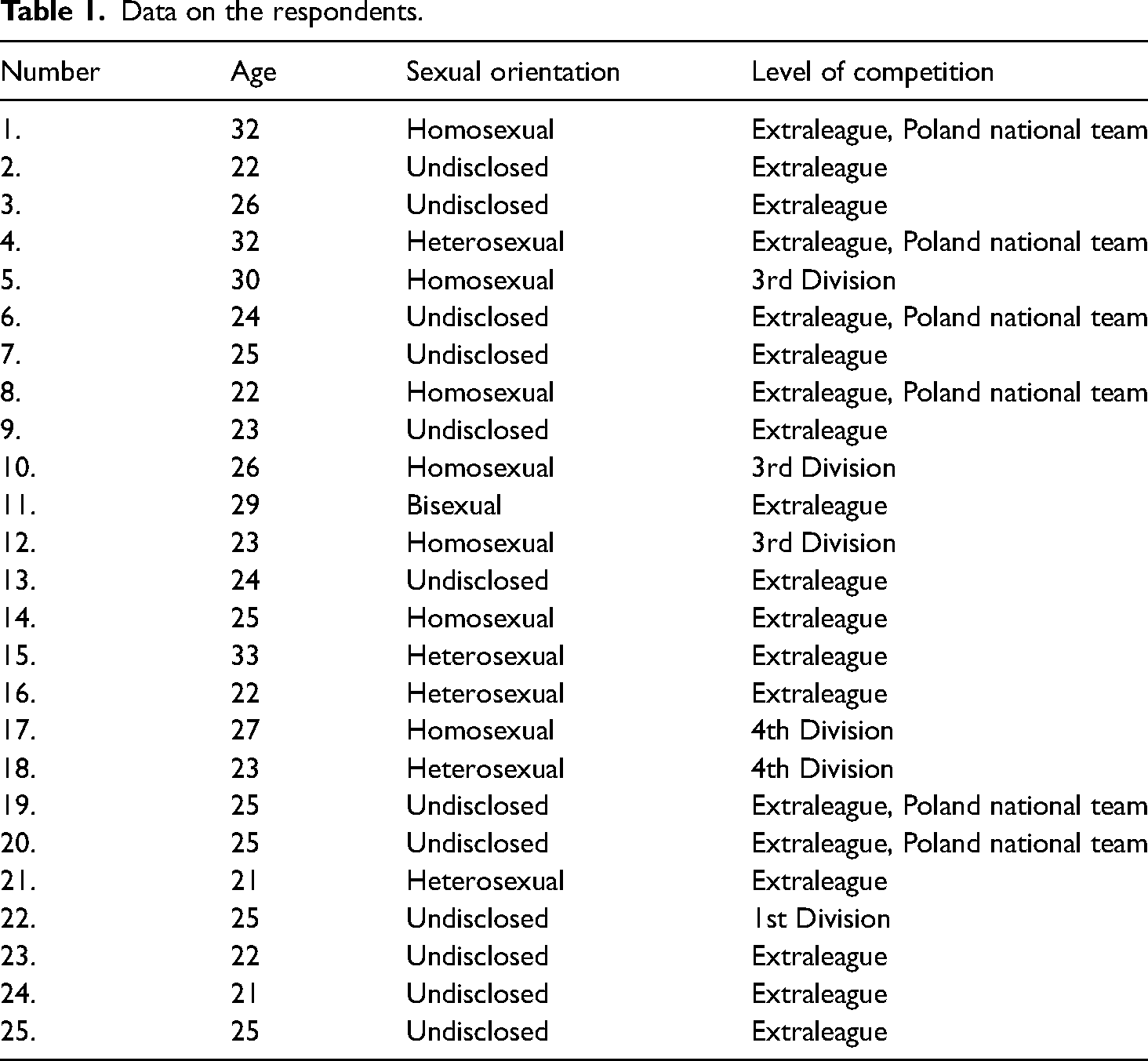
The interviewees willingly answered the questions. However, despite the assurance of confidentiality in the research process, some chose not to provide information about their gender identity and sexual orientation. We assumed that this could be due to the unfavourable climate around the LGBT+ community in Poland and the small number of people publicly discussing their sexual orientation. Therefore, we concluded that a request to declare one's sexual orientation could be considered a violation of certain social boundaries. In cases where the interviewees avoided the topic of their sexual orientation, the researcher did not raise any additional questions on this topic.
For this reason, we decided to include the statements of heterosexual female footballers in the analysis. Although their experiences could not correspond to those of non-heterosexual female players, their statements represented the perspective of people who spend their time with them daily. Therefore, they often had the opportunity to experience first-hand the voice of their teammates. Additionally, because we were interested in the situation within the team, we treated the voice of the heterosexual female players as an ‘insider’ voice.
The next step was the transcription of interviews, followed by the analysis of empirical material using the MAXQDA software. Finally, to maintain the integrity of the research process and ensure its accuracy, we applied the procedure of collaborative data analysis, a ‘process in which there is joint focus and dialogue among two or more researchers regarding a shared body of data, to produce an agreed interpretation’ (Cornish et al., 2014: 79). In the case of this study, there were two researchers involved in the process, working in two fields (sociology and physical culture sciences) and representing two genders: men and women. The attendant differences in perspective helped us to look at the research material in a more nuanced way. Furthermore, the differences resulting from the approaches of the two disciplines, as well as the difference in researchers’ gender, were subject to discussion and joint interpretations. All these factors influenced how knowledge based on our research was constructed.
Considering the topic of the study, the researchers’ sexual orientation was an aspect that was subject to reflective interpretation in the data analysis process. Due to the adopted analytical framework concerning such issues as the normalisation of heterosexuality, both researchers – who identify themselves as heterosexual – had to reflect on and analyse their own sexual identity, mainly in the context of cultural norms dominating in Poland. The analysis of the Polish context and the respondents’ statements about the situation of non-heterosexual female footballers also prompted reflection on the privileged status of a heterosexual researcher in a society where heterosexuality is regarded as ‘natural’. This analytical reflexivity was coupled with the assumption that heteronormativity ‘mediates the production of (hetero)normative knowledge’ (Allen, 2010: 149).
The procedure of collaborative data analysis which we applied involved the following steps. The interview material was first coded line by line independently by each researcher to extract descriptive codes. The emerging preliminary codes were then discussed to resolve differences in data interpretation. The next phase was the collaborative preparation of higher-level categories, which resulted from combining first-cycle codes with theoretically informed categories. Considering the topic of the study, the further analytical process focused on categories relating to sexual orientation and heteronormativity. In some ways, then, our analytical approach was inductive–deductive. We did not apply a pre-defined set of codes drawing on the theoretical framework. However, such a framework was applied at the more advanced stage once the raw data had been investigated inductively. Our approach could be referred to as ‘blended’ (Graebner et al., 2012) or ‘abduction’ (Alvesson and Kärreman, 2007). Adopting this approach means the researcher remains open to being surprised by data. At the same time, the theoretical framework helps to be more focused at the later analysis stage. A blended strategy provides a more flexible option for working with raw data and rethinking theoretical concepts (Linneberg and Korsgaard, 2019).
Findings
When analysing the situation of female football players in Poland, we focused on three fields: the social environment external to the football field (the broader social context), the space of close family relationships, and the field of football, with its several dimensions (the team and its internal structure, and the team's environment, e.g. relations with managers and coaches). Thanks to this structure, it was possible to identify the areas of life in which the non-heterosexual interviewees live ‘in hiding’ and those in which they find an enclave of acceptance and understanding.
Social context beyond football
Backward mentality
Among our respondents, there were women who identified with different sexual orientations. All of them were asked about their opinion on LGB people in Poland in the broader social context, the family sphere, and the field of football. It was interesting whether their narratives would show differences in assessing the situation. If so, this could mean, for example, that heterosexual people do not notice the problems experienced by those who are non-heterosexual (or perceive them differently). However, no such differences were recorded: all the respondents agreed that Poland – as a society – was not ready to recognise non-heterosexual people fully: It seems to me that we are pretty backward when it comes to this issue. It's also something that comes from our mentality all the time. It will take a dozen or so years to accept it (…). Poland is in its infancy in this regard. And many athletes, many people with a different orientation, struggle with this, and it's absolutely tragic in our country. (Interview 6, female player sexual orientation undisclosed)
The above statement refers to the category of point in time – too early (to recognise and acknowledge non-heterosexual people), and the category of mentality – backwardness, lack of acceptance. In the opinion of the interviewed players, in Poland, it is too early to see heterosexuality sexuality as a norm giving way to a mentality that is more open to diversity regarding sexual identity.
The experience of homophobia
When it comes to the experience of homophobia, the respondents’ statements are not unambiguous. Some of them mentioned that they did not experience homophobia, mainly because they surround themselves with people they feel close to, people who accept their identity: Manifestations of homophobia is a very big word; it means a lot, so no, I haven’t [experienced it]. Maybe because I live in an environment of select friends and acquaintances, (…) I have friends who are very open, intelligent, and so on. So, they have no right to do something like that. They know it's just harder to live. (Interview 1, homosexual female player)
However, the above quote includes the phrase ‘it's just harder to live’ – the respondent feels that the broader social environment in Poland does not offer favourable living conditions, but the presence of people who can be trusted means that ‘compulsory heteronormativity’ is not so overwhelming. This example shows that in the Polish context LGBT+ people can function thanks to ‘friendly enclaves’. One of the players said that she ‘didn’t flaunt’ her relationship with her female partner in public space: I don’t walk holding hands in the middle of the street not to get in trouble. Poland is simply not ready for such things. It's obvious that in other countries it's already different, even though there are sometimes some problems and some insults. But it is unacceptable here, so why would you cause yourself a problem. (Interview 17, homosexual female player) (…) maybe sometimes, in some sort of comments, someone says something stupid like ‘they’re all lesbians there’ or something like that; but it's not done on purpose… But also, I don’t know, maybe I just haven’t experienced such things because, I don’t know, I’ve never been walking with a girl holding hands. (Interview 16, heterosexual female player)
Most of those interviewed emphasised that the biggest problem was the discriminatory language used by people reluctant to women's football. The fact that the respondents did not recognise certain situations they had experienced as acts of homophobia, as well as a remark that ‘homophobia is a very big word’, may be associated with a low level of knowledge about what homophobia can be. Indeed, as it is in Poland, homophobic behaviour rarely has any legal consequences for people discriminating against the LGBT+ community, and homophobic remarks by some politicians and public figures are a common occurrence. Therefore, it is also possible that the interviewees who were non-heterosexual considered that they did not experience homophobia because they did not feel any physical threat due to their sexual orientation. In addition, the above quotes reveal that they constantly negotiated their identity, avoiding, for instance, showing up with their partners in public. Such practices in public space resemble the ‘don’t ask, don’t tell’ strategy and indicate that they do not feel at ease and experience fear of homophobia – they exercise self-control. However, interviews with the female football players showed that they did not problematise the need to constantly manage the ‘visibility’ of their sexual orientation, probably normalising the heteronormativity operating in Poland.
The phenomenon of ‘seemingly unremarkable exclusionary practices’, also in the world of sport, was noted, for example, by Krane and Symons (2014). Such practices maintain heteronormativity and make reality challenging to change. This is visible in the statements of our respondents, who played down homophobic jokes or comments although they were aware of them.
Taboo and acceptance in the family
From the interviews, it is clear that in the case of non-heterosexual female players, the key actors are often those who are close – family and friends. Thanks to their acceptance and support, it is easier for them to operate in a situation where the social context is unfriendly. However, this is not always the case at all – in some cases, their sexual orientation is still a taboo topic in the family: But I know that some people still hide it from their parents; that in the club and so on – everyone knows everywhere; but it's not something natural for them [to disclose it] outside the club. (Interview 2, female player, sexual orientation undisclosed)
As described in another interview, one of the respondent's parents knew about non-heterosexual female players in the football community and therefore did not want their daughter to develop her football career in a more professional club: My mother also knew from the very beginning that there is homosexuality there, and… it was also such a priority for her that she didn’t want to let me go. (Interview 15, heterosexual female player)
The above quote indicates that the stereotype of women's participation in sports traditionally considered masculine is still alive and remains a tool to keep women out of them (Griffin, 2014). Pressure from some family members to choose a different sport or quit football, similar to that presented by some of our interviewees, was also analysed in the study of Spanish female football players (Martos-Garcia et al., 2023). Heteronormativity as the only possible discourse had tangible everyday consequences for some interviewed players. Nevertheless, in other cases, their relationships with relatives were a space for breaking the discourse of heteronormativity, allowing them to remain open to their sexual orientation.
In congruence with previous studies (Iannotta and Kane, 2002; Krane and Barber, 2005; Martos-Garcia et al., 2023; Norman, 2012, 2013; Stoelting, 2011), our findings indicate that revealing one's sexual orientation is complex and extends over time. For one of the interviewees, coming out in the family was a long-term process, which concluded practically at the end of her career and caused a significant change in her relationship with family members. The sexual orientation of the respondent was accepted, as was her partner's, which was expressed, for example, by inviting them both to a family celebration: I only told my parents when I was thirty, and they accepted it (…). Only my grandmother knew before them. First, she was like – and what d’you need that for? Don’t do it; it's yuck. And then she understood; she likes [the name of the respondent's partner]; at my uncle's fiftieth birthday party, not long ago, she even danced with her holding hands. The other grandmother got to know now, I mean at Christmas. And now, when I called her on Grandmother's Day to wish her all the best, she was also happy. She said that [the name of the respondent's partner] is great, that she's a great lass and so on. (Interview 11, bisexual female player)
The above quote provides evidence that breaking stereotypes and abandoning prejudice is possible thanks to the experience of meeting a person who represents a different identity and a relationship with such a person. Moreover, this mechanism also applies to the elderly, who were often brought up in a very traditional way.
The situation of non-heterosexual people who find acceptance in their families right from the start is much easier. There were also such cases among our respondents. Those who had no problems in their families stressed the importance of acceptance by their close ones. Our research shows that female football players who identify as homosexual feel better and have a sense of security when their close ones accept their orientation.
The inner field of football (team members and other stakeholders)
The division of the analysis into two levels: the social context and football itself, may be seen as artificial – at first glance, both football and the broader social context in Poland are characterised by intense heteronormative pressures. However, in the Polish case, there are differences between the football field and society (Caudwell, 2011). It also should be emphasised that homophobia and heteronormativity work differently in the men's and the women's game. The phenomenon of coming out practically does not exist in men's football. The cases of Blackpool player Jack Daniels or member of the Czech Republic national team Jakub Janko may be a breakthrough in this regard, but the significance of their decision for the men's game remains to be seen.
The situation is different in women's football, where non-heterosexual relationships are more ordinary. Some female players do not feel intense pressure to conceal their orientation, unlike in the men's game. Still, according to a review study by Soler-Prat et al. (2022: 168–173), homophobia in sport controls women's behaviour. The lesbian stigma attached to women's sport means that all female athletes are ‘suspected’ of being homosexual. What is equally important, as Griffin (2014: 269–270) suggests, is that the differences in the perception of coming outs in women's and men's sport are also a consequence of sexism and established stereotypes about the former. The limited public response or indifference to coming outs in women's football is due to the stereotypical link between female athleticism and homosexuality. On the other hand, more coming outs among female football players may lead to the damaging belief that homophobia is not as pressing a problem in women's sport as it is in men's.
In the Polish context, the problem is twofold: we have investigated whether female players experience discrimination both in the broader social context and in the football field, and how they experience heteronormativity and sexism resulting from the subordinate position of women's football in Poland.
Masculinisation and the lesbian stigma
Although there are cracks in the heteronormative structure in women's football, this does not mean that the game is free from prejudices. The fact that football as such is viewed as a ‘male’ sport – which puts the pressure of ‘hegemonic’ behaviour on male players – has implications for female players as well.
The female footballers interviewed in our study mentioned that their sports activity was accompanied by a stereotype related to their ‘masculinisation’: ‘When it comes to practising sport, sport is associated with rivalry, and rivalry is associated with courage, so here, we touch on this male element’ (Interview 5, homosexual female player). This observation aligns with the tendencies described in the literature whereby sport is viewed as a male domain where the presence of women is questioned (Connell, 1987; Griffin, 2014: 269). This means that women who practise sport fall into a particular trap. If they fulfil their socially assigned roles (e.g. in fields other than sport) – they represent the so-called ‘feminine femininity’, whereas if they engage in domains traditionally associated with masculinity – they are treated by the characteristics of ‘masculine femininity’ (Pope, 2017).
In this interpretation, another consequence is that if female football players are subject to the process of masculinisation, as a result – according to heteronormative thinking – they cannot be interested in men as potential sexual partners. Indeed, our respondents mention that women who are football players are also – almost automatically – identified as homosexual: If you’re a female footballer, you must be homosexual. (…) Most of us are seen like that. If you’re a female footballer, you definitely don’t like guys. Unfortunately, I’ve also encountered this. (Interview 24, female player, sexual orientation undisclosed)
Some respondents who were aware of the lesbian stigma described how they emphasised their femininity. Others expressed surprise that so many female football players cultivated a ‘masculine appearance’. The attempt to go beyond the butch figure can be interpreted in terms of self-control and upholding the normative concept of gender and sexuality. The interviewees feared the image of women's football as a field of ‘masculine femininity’ and consequently emphasised ‘traditional’ femininity through hairstyle, make-up, or manicure. At the same time, however, when asked about the relationship with their bodies, they said that their athletic figure suited them, and they liked their bodies. Sometimes they also mentioned that the ‘masculinity’ of female players was justified and resulted from their profession. It's obvious that people who don’t watch it, who don’t know anything about it – for them a female football player is one who looks like a guy: short hair and gel, so… There are a lot of such people, and they think that all female players look like this. And in fact, even though it's a male sport and it's a discipline for men, because many people think so, I try to behave like a woman to preserve my femininity above all. It's obvious that it works out differently on the pitch, but that's what this discipline, this sport requires from us. But in everyday life, we are normal girls, women, and we don’t really have a problem with the fact that we practise a men's sport (…). (Interview 3, female player, sexual orientation undisclosed)
The statements of our informants clearly indicate that the lesbian stigma remains part of the experience of Polish female football players. Similar to other studies (Caudwell, 2003, 2006; Cox and Thompson, 2000; Eng, 2008; Griffin, 1992; Kauer, 2009; Martos-Garcia et al., 2023; Mennesson and Clément, 2003), they felt a strong pressure and tension related to the heteronormative structure of sport and the normative perception of femininity. Therefore, considering the creation of their image, two tendencies should be noted: firstly, distancing from ‘female masculinity’ as a hindrance to the appreciation of women's football in the reality of compulsory heterosexuality and the normative notion of gender and, secondly, emphasising masculine features as proof of football skills. Moreover, the respondents seem to function in two cultures – sports culture, which is ‘male’, and non-sports one, celebrating traditional femininity. As a result, they ‘move among scripts as well as perform different scripts simultaneously’ (Krane et al., 2004).
Pragmatic acceptance
Women's football as a social field differs from the broader social context in that the approach of various actors in this field to non-heteronormativity is ambiguous. In the field of Polish football, there are no regulations governing, for example, relationships between athletes – these are private matters which are not decided by sports organisations. Some of those interviewed emphasised that there were no such problems in the football environment, which gave them psychological comfort: (…) clubs, managers, board members, I cannot say that they create problems. They understand, and they accept things as they are. It's a good thing because it gives the player psychological comfort; she knows they support her. (Interview 4, heterosexual female player)
In general, the acceptance of the football environment stems from pragmatism or even necessity: But I haven’t encountered such a situation personally that it would be negated in some way [non-heterosexuality – ed. authors]. Because on the other hand, to be honest, it would be shooting yourself in the foot; because if the coach didn’t accept it, the girl or the girls would feel bad, and they wouldn’t do their best because they would just feel bad in the place where they work, after all. (Interview 9, female player, sexual orientation undisclosed)
None of the interviewees seemed to say that there is a social change occurring in the field of women's football, a change which is still not possible in the broader social context. Indeed, what their narratives about acceptance have in common is that they stress that managers or coaches have no alternative, which makes the examined case one of ‘pragmatic acceptance’. Because it is like this: if you don’t tolerate sexual otherness in the sports environment, and it's common, you won’t be able to function in such a club as the president, as a coach. No chance. (…) There is no way; because if out of twenty players, ten have a different sexual orientation and you don’t agree with it, you will either fight them or throw them away. It just doesn’t make sense. (Interview 1, homosexual female player)
Moreover, the fact that the number of non-heterosexual players in women's teams is significant has rather unusual consequences related to relationships between team members. In some cases, the player will only accept a transfer to another club if her partner also receives an offer so that they can change clubs together, even though the latter's performance level is below expectations. Very often, there is a funny situation that when female football players change clubs, they usually come together. The club is simply forced because they want this player and she takes the other one, who is perhaps weaker, and the club is forced to take them both. (…) I think the managers are perfectly aware, and the coaches are aware that there is such a thing. If they want to work in the club, they just have to accept it. (Interview 13, female player, sexual orientation undisclosed)
In such cases, we can even speak of ‘imposed’ acceptance, which may result in additional problems: the coach has to accommodate an additional player in the team, although this was not part of the team-building strategy.
Supportive and homophobic coaches
The situation in which the acceptance of the non-heteronormativity of female football players is mainly pragmatic begs the question of whether such pragmatism eliminates homophobia in women's football. Some respondents talked about their experiences of working with tolerant coaches: I have a coach who knows who is who in the club, and he doesn’t mind. But I think it can happen at every level of this football. It depends on the coach. (Interview 14, homosexual female player)
To some extent, their acceptance may result from the pragmatism mentioned above, especially when it is limited to tolerance towards non-heterosexual players in aspects related only to sports issues. Some of those interviewed, however, pointed out that their coaches were also able to go beyond ‘tactical’ silence and offer an empathetic, supportive attitude. On the other hand, the presence of tolerant and supportive coaches is not the only possibility regarding attitudes towards female players. As can be seen from some of the interviews, there are also attitudes of non-acceptance with homophobic overtones among coaches: ‘There are coaches who write you off kind of for being homosexual, and that is something I totally don’t understand’ (Interview 14, homosexual female player).
The above statements indicate a clash of several tendencies in the football field. According to female football players, some actors pragmatically accept non-heterosexual players as they know that discrimination against them would harm the sports performance of the entire team. This approach is adopted by some coaches who tolerate and sometimes support players. While some of them presumably do it for pragmatic reasons, the mentality of others has most likely changed. However, there are still cases where coaches are unable to reach even the ‘pragmatic’ level and display an openly homophobic attitude.
Our study does not make it possible to answer the question to what extent such different attitudes (ranging from total inclusivity and pragmatic acceptance to homophobia) affect the sports performance of individual female players and teams. However, the existing research indicates that an inclusive environment benefits players. When they feel safe and can freely express their identity, they feel empowered, strengthening the entire team (Cunningham et al., 2014; Van Knippenberg and Schippers, 2007). By contrast, those who internalise the stigma of being lesbian and do not freely express their identity have to deal with negative emotions such as guilt, self-hatred, frustration, and anger due to the suppression of their identity (Melton and Cunningham, 2012). In sport, the minority stress affecting LGB people may occur when constantly reminded of one's marginalised status in the sports environment, which can affect sports results (Symons et al., 2017).
Acceptance of diversity
Our research shows two opposite tendencies in the field of women's football: on the one hand, there are still people (e.g. coaches and fans) who have a homophobic attitude towards female players. On the other hand, there is also an attitude of acceptance of non-heterosexuality (even if this acceptance is pragmatic). The situation is different in teams, where non-heterosexuality is accepted unconditionally, without any pragmatic considerations: ‘It is definitely different than in public space. There is acceptance here’ (Interview 22, female player, sexual orientation undisclosed).
The respondents discussed diversity – heterosexual and non-heterosexual women meet in one team and dressing room. As could be seen in one of the interviews, the term ‘diversity’ was strongly emphasised: The team accepts it because there are a lot of us in the team who have girlfriends, but there are also girls who have boyfriends, husbands, and it's super cool. So anyway, there is no standardisation for me, only diversity. It's beautiful. (Interview 5, homosexual female player)
This indicates that the team is a safe space for the players. Drawing on the ‘safe haven’ hypothesis proposed by Ragins (2004) – organisations and work groups that provide protection against discrimination and support the development of a gay identity – we believe that in the case of our respondents, the team was a safe space of this kind. The existence of such enclaves in sport was confirmed by a study conducted by Stoelting (2011): the interviewed players assumed that a large number of lesbians in college sports teams would contribute to the functioning of ‘safe zones’, which allowed them to disclose their sexual orientation without fear of being rejected. Similarly, the results of a recent study by Martos-Garcia et al. (2023) also indicate that female football players see their team as an ‘oasis’, a safe place where they are respected.
Furthermore, in congruence with other studies (Griffin, 1992; Krane and Barber, 2005; Martos-Garcia et al., 2023; Soler-Prat et al., 2022: 171–172; Stoelting, 2011), our findings show that the respondents were managing their identities and sexual orientation during their careers. This can be seen from the fact that only half of them decided to share the information about their sexual orientation with the researchers conducting the study. Even the assurance of confidentiality of the research process did not change their minds. It is likely that for some of them, keeping quiet seems to be the safest option.
In the case of our respondents, all ‘coming out experiences’ were complex ones. During their careers, they navigate to whom and when they can disclose their sexual orientation. As we presented, the team is an enclave for female athletes, and therefore, it has been relatively easy to disclose their orientation within the team. Although some previous research suggests that the team environment can be unsafe and potentially damaging for female athletes (Krane and Barber, 2005), our study confirms the findings by Martos-Garcia et al. (2023), Stoelting (2011), Elling and Janssens (2009), Ribalta and Pujadas (2020), and Bredemeier et al. (1999), indicating that teammates can provide a welcoming and accepting environment. As in the studies by Martos-Garcia et al. (2023), Ribalta and Pujadas (2020), or Elling and Janssens (2009), our study indicates that the team creates space for the normalisation of homosexuality and gives female football players a sense of security. Moreover, to some extent, the women's football team is a ‘laboratory’ of diversity in terms of sexual orientation. At the level of a small social group like this, the functioning of people of different orientations suggests that first-hand experience of diversity is conducive to its acceptance. This also prompts a hypothesis that if such small ‘laboratories’ of social life were created in various social groups, the effect could impact the broader social context.
The normalisation of non-heteronormativity
In Poland, compulsory heterosexuality is a norm in the institutional and moral context. As our research shows, it is also manifested, for example, in the homophobic language of some coaches. Meanwhile, a completely different situation exists in female football teams, where we can observe acceptance of diversity and the normalisation of non-heteronormativity. Indeed, the word ‘normal’ appeared in various contexts in the interviews: It's so normal among the girls that it's sometimes strange when someone is with a bloke or has never been with a woman. (Interview 2, female player, sexual orientation undisclosed)
Another respondent pointed to the fact that this normality is not simulated, artificial, or staged – the players do not do it for show: It's not like we arrive, the whole team, and we grab our hands in front of the club so everyone can see they are together. Everyone lives normally, lives a normal life; it's not like we show off and want everyone to know or we expect everyone to accept it (…). I have so much contact with it that it's something normal for me. (Interview 3, female player, sexual orientation undisclosed)
In the team, the ‘legitimisation of diversity’ happens, and the whole process results from coexistence, everyday relationships in which people identifying with different sexual orientations can function in mutual respect.
One of the heterosexual interviewees provided an interesting description of this normalisation process. She talked about what coexistence in a diverse environment looked like in various moments, sometimes as private as having a shower together. It is worth emphasising that she openly mentioned her doubts, perhaps even prejudices, and she said how the normalisation of diversity had unfolded in her case. Towards the end of her statement, she also mentioned the stereotypical image of female football players in Poland, according to which they are probably all lesbians ‘by definition’: Everyone has chosen the kind of life they want, and everyone does whatever they want to do in life, so the fact that I like guys and someone likes girls is a separate and personal thing, right? But the thing is that I always laugh that, I don’t know – we get in the shower, and someone looks at me so strangely, and I’m already like, ‘Oh my God’… In general, at the very beginning, when you meet someone, right, they say straight away: ‘Ah, you’re a lesbian, right?’, and I say: ‘No, I’m not’, and they say: ‘And how's that? All girls in football are.’ And the thing is that it's really seen like that, I mean, that all the girls are, right? And they put all of us in the same basket. I mean, let's say there are two [lesbians] in a club, and that surely means we all are as well. (Interview 15, heterosexual female player)
The above quote shows how much sexual identity is accepted and normalised but also constructed in social interactions (interactive normalisation of the meaning that not all women are lesbians). Moreover, it also shows that a case in point involves a twofold normalisation process. First, we deal with ‘institutionalised normative homosexuality’ in female football (lesbian stigma). Later, the fact that female players’ dressing rooms are simply diverse is normalised as a result of interactions in the team.
What comes as a result of such interactive identity work on the de-normalisation of stereotypes and normalisation of diversity is an environment where, as pinpointed by one of the interviewed players, ‘there are practically no divisions’: The cool thing about women's football is that there are practically no divisions. It doesn’t matter if you’re poor or you’re from a wealthy family, if you prefer girls or guys or, I don’t know, whatever, or if you’re black or white; it doesn’t matter in women's football at all. This is cool. I like it. (Interview 2, female player, sexual orientation undisclosed)
Discussion and conclusion
Female football players in Poland experience the influence of institutionalised normative heterosexuality on different levels. They also have to deal with stereotyping beliefs about the masculinisation of female footballers, as being a female player does not fit into the stereotypical image of a ‘feminine’ woman. As a result, there is an assumption that only lesbians or women with butch figures could be interested in football. Our research shows how female players operate when experiencing lesbian stigma and how they create a safe enclave where de-normalisation processes in the field of sexual identity take place.
These processes are related to the work done by female players, mainly in their team, which is a meeting space for various sexual orientations. It should be emphasised that the processes of normalisation of diversity are based on the interactions between hetero- and non-heterosexual female players in the team, as they constantly negotiate their status and relations. The interactive and relational construction of the team as a safe enclave is also related to the influence of the social context. Non-heterosexual players experience intense pressure, which practically makes it impossible to negotiate the status of their sexuality in the broader social context. As a result, most are deprived of the opportunity to function in social life under the same conditions as heterosexual people – regarding legal regulations and morality. Some of them, thanks to the openness of their close ones, can function with a sense of acceptance, but only in a limited context. Others, however, have no support in the immediate social environment, so the team is sometimes the only safe enclave for many of them.
In the case of football as a social field, the processes of de-normalisation of heteronormativity are also problematic. Some actors in the field openly use homophobic and sexist language, and those who do not express discriminatory attitudes are guided by ‘pragmatic acceptance’. This acceptance is based on the assumption that preventing non-heterosexual players from playing would be detrimental to the club, often because such players constitute a significant proportion of the team. Therefore, pragmatism is not necessarily associated with accepting non-heteronormativity, which makes it challenging to build a relationship based on acceptance and understanding (however, the respondents mentioned that they had worked with empathetic coaches who displayed an open, inclusive attitude).
As a result, Polish female players create what we have called ‘enclaved non-heteronormativity’. It is a space that is a crack in the social context in which they function daily. It is an enclave that protects against the pressure of conservative discourses and socially dominant compulsory heterosexuality. In this enclave, they can openly and inclusively negotiate their status and roles in the team – and in this interactive process, neither heterosexual nor homosexual female players have a privileged position from the start. This does not mean that ‘enclaved non-heteronormativity’ is a space where a diverse and open environment is permanent and unconditionally available. Rather, it is a space where the norms and status of female players are constantly developed. Its negotiating character is evidenced by the statements of – predominantly heterosexual – players that joining the team requires re-evaluating mental patterns, sometimes confronting one's prejudices. Nevertheless, what is born as a result of this interaction is a space of acceptance and respect for diversity.
The status of enclaved non-heteronormativity is ambiguous and is prone to the risk associated with change. This risk is exacerbated, among other things, by the precarious nature of women's football in Poland, which still does not guarantee financial and professional stability (Kocemba, 2022). Consequently, the teams are likely to experience constant changes in terms of their composition. On the other hand, however, the peripheral and precarious status of women's football in Poland has contributed – albeit paradoxically – to the development of women's teams as spaces of ‘enclaved non-heteronormativity’.
However, such a safe enclave does not solve all the problems of non-heterosexual female football players. The hostile climate towards LGBT+ people in Poland and the lack of recognition and advocacy for sexual minorities in sport undoubtedly affect how athletes manage their openness about their sexual orientation. Very often, the broader sports environment – coaches, managers, or club administration – was not safe enough for the respondents to disclose and talk about their sexual orientation. Our findings confirm what Sedgwick (2008) claimed analysing coming out in women's sport: silence and openness coexist.
The negotiation of openness and closeness during the careers of our informants shows the high degree of normalisation of heteronormativity in Polish women's football. The Polish case also confirms that heteronormativity is not only a matter of institutional order and works through subtle everyday practices (Norman, 2012). What is needed, then, is a greater knowledge of the entire football community about the functioning of heteronormativity discourses in sport. Without this, non-heterosexual female players will only reveal their sexual orientation within a narrow circle of the team or in a friendly environment outside the team.
Openness is common within the team, and our study confirms a process of resistance and challenge against compulsory heterosexuality. However, it is essential to underline that even if the respondents were courageous enough to disclose their orientation in the team and family, they were often reluctant to be ‘fully open’ as they did not always feel safe in public space. Therefore, the fear of homophobia permeated female players’ behaviours simultaneously with the need to come out. This has created a unique mixture of concealing the differences and embracing them. According to Mann and Krane (2018), ‘inclusion is complicated and constantly (re)negotiated’. There is a need for further research to show if and how the inclusion of non-heterosexuals in the Polish sports field is (re)negotiated and what, if any, effects it would provide.
Further research of this sports environment is also necessary due to certain limitations of the results we obtained. One such limitation is undoubtedly the composition of the sample. It also need to be noted that not all of the interviewed female football players decided to share information about their sexual orientation, which was challenging when analysing the interviews. In addition, the interviews were conducted with players from different levels of competition: the top league and Poland national team as well as lower leagues. Consequently, the interviewees experienced different pressure to achieve sports results, and the level of involvement in their football careers varied. All those factors may differentiate the players’ approach to managing their sexuality and dealing with heteronormativity in the football community and broader social context.
Further research should explore the experiences of female football players from different levels of league competition in detail. Moreover, it is worth comparing their experiences with those of athletes competing in other sports, especially disciplines stereotypically perceived as gender neutral or feminine. This would be particularly interesting, considering that to the best of our knowledge, this is the first study of female athletes’ experiences of heteronormative pressure in sport in Poland. Another issue that should be analysed is the attitudes, beliefs, and awareness of other social actors directly related to the women's football community. The governing bodies of Polish football do not advocate for the rights of LGBT+ players and do not focus on challenging homophobia. Capturing and describing the level of knowledge regarding gender and sexual orientation among members of those bodies would therefore be the first step to improve the situation. Another important issue would be the development of educational programmes or policies supporting open and diverse communities in Polish football.
Footnotes
Declaration of conflicting interests
The author declared no potential conflicts of interest with respect to the research, authorship, and/or publication of this article.
Funding
The author disclosed receipt of the following financial support for the research, authorship, and/or publication of this article: This work was supported by the Polish Ministry of Education and Science within Social and Humanistic Research School of Physical Culture (Research School no. 2) of the Faculty of Physical Education at the Józef Piłsudski University of Physical Education in Warsaw.
