



Abstract
This case study delves into the experiences of a women's basketball team situated in Shenzhen, South China, comprised primarily of members of sexual minority groups. Utilizing qualitative research methods, including interviews and observation of team dynamics, this research examines how lesbian and bisexual female basketball players navigate societal norms and negotiate their sexual identities. It also highlights the team's unique strategies for dealing with social interactions, group membership, and power dynamics in resisting heteronormative norms. Team B exemplifies a form of queer resistance in Chinese society and sports that is distinct from the Western pride movements and political advocacy. This strategy involves avoiding confrontation and integrating the nonheteronormative subculture into mainstream sports and society to gain support from families, the general public, and local communities, thereby promoting sports inclusivity and gaining social recognition. This study argues, from a post-structural feminist perspective, that participation in a gender-inclusive sports group provides sexual minority individuals with a unique social position and an empowering means of destabilizing power relations and reducing sexual identity tensions. In addition, it demonstrates the capacity of sports subcultures to foster collective agency and resilience in the face of dominant cultural norms, despite the constraints posed by the unaltered macro-level structure of gender. This case study provides valuable insights into how gender-inclusive sports groups can challenge and reshape preconceived notions of gender and sexuality in Chinese society while serving as a platform for queer resistance.
Introduction
In recent years, there has been a growing body of research on the experiences of sexual minority individuals and groups in sports activities, including LGBTQ sports (Greenspan et al., 2019; López-Cañada et al., 2021; Kavoura and Kokkonen, 2021). Despite this progress, few studies have focused on the experiences of sexual minorities in sports in China, where the disclosure of sexual orientation is still not accepted in public and often neglected in sports activities (Didi, 2016). With the decriminalization and depathologization of homosexuality in 1997 and 2001, China is witnessing a gradual shift in its perception of LGBTQ individuals and communities (Bao, 2015; Yip Lo Kam, 2015). The growth of LGBTQ-focused organizations, including sports groups, reflects this change (Deklerck and Wei, 2015).
International studies have revealed various mechanisms, both inclusive and exclusive, that shape the experiences of gay and lesbian individuals in mainstream sports activities and organizations (Anderson, 2002; Caudwell, 1999; Elling et al., 2003; Eng, 2003; Hekma, 1998; Kivel and Kleiber, 2000; Ravel and Rail, 2006). For instance, Griffin (1998) argues that sports culture is often dominated by masculine and heterosexual norms, leading to the marginalization of nonheterosexual individuals and resulting in their resistance to these dominant norms through sports participation. Some studies indicate that sport may be a homosocial setting that appeals to gay or lesbian individuals, providing a space for them to express their sexuality (Eng, 2008). Studies have also found that participation in homoinclusive sports organizations and competitions could be a way for sexual minority people to develop a positive nonheteronormative identity (Krane, 1996). However, these findings are primarily based on a Western framework of sexual modernity that is “fueled by a powerful rhetoric of identity-based pride and public visibility” (Engebresten, 2015: 91), and may not generalize to non-Western contexts, such as China. Although same-sex relations are still largely taboo in the leading sports organizations and discourse in China (Tseng and Sum, 2021), the growing diversity and multiculturalism of sport in metropolitan cities is fostering the growth of grassroots sports groups for sexual minority individuals. These grassroots sports groups can glimpse the experiences of sexual minority individuals engaged in Chinese sports (sub)culture.
This study examines the experiences of a women's basketball team in Shenzhen, China, that is predominantly comprised of members of sexual minorities. The long-standing restrictions on women's participation in physically demanding and competitive team sports, as well as the association of basketball with masculinity, aggression, and same-sex attraction, present these female basketball players with unique challenges. How do female basketball players navigate and express their sexual identities within the sport, and how do they react to sexuality, homophobia/lesbophobia, and the male dominance of basketball? Through this investigation, valuable insights will be gained into the experiences of Chinese sexual minorities in sports, and the development of sports multiculturalism in China will be better understood.
Theoretical considerations
Theoretical perspectives to sexual identity formation and negotiation
Sexual identity has been explored in various sociological theories. In this paper, we focus on three specific theories as tools to analyze the development of the sexual identity of the women basketball players: identity negotiation theory, social identity theory, and post-structuralism.
The identity negotiation theory views identity as self-images created, experienced, and communicated by people in a culture and situation. Negotiation is a transactional interaction process in which people try to assert, define, modify, challenge, and/or support their own and others’ self-images (Ting-Toomey, 2005). Through exploration, introspection, and negotiation with others, this process requires balancing personal identity and social acceptance (Burke and Stets, 2009; Rosario et al., 2006). During this process, people may struggle with cultural norms and expectations, personal beliefs and values, and their own desires and experiences (Deaux and Martin, 2020). The identity negotiation theory emphasizes the role of social interactions, relationships, and support in sexual identity formation. Positive experiences and support can help develop a healthy sexual identity, while negative experiences and discrimination can hinder this process and lead to low self-esteem, shame, and mental health issues (Diamond, 2006). The identity negotiation theory can help explain how people construct their sexual identities in different social contexts and what influences this process.
In contrast to the identity negotiation theory, which focuses primarily on the interaction processes of individuals, the social identity theory is useful for examining the group identity (the perception of “we”) of a nonheteronormative community and its effects on the individual members (Krane and Barber, 2003). The social identity theory proposes that individuals can derive their sense of self from their membership in social groups based on various factors, such as race, gender, nationality, or sports team affiliation (Stets and Burke, 2000). It argues that individuals classify themselves and others according to shared features. People's identities are formed by the social groups to which they belong, and they may embrace the group's values and actions (Turner and Penny, 1986). This may include the usage of symbols (such as team logos and colors) and common rituals and practices that help define group identity (Giardina and Donnelly, 2013). According to the social identity theory, a person's sense of self as a sexual being is molded by their involvement in diverse sexual groups (Tajfel and Turner, 1986). People's affiliation with a certain sexual group can have significant effects on their sexual attitudes, beliefs, and activities. It may also affect their experiences of discrimination or acceptance, as well as their pride and sense of agency in relation to their sexual identity (Cass, 1979; Gallagher et al., 2022; Krane, 2003). The social identity theory provides a helpful framework for understanding how sexual group membership may influence an individual's self-perception and relationships with the outside world.
Post-structuralism is a theoretical approach that emphasizes the power dynamics and social constructions that shape our understanding of the world (Pfister, 2016; Young, 2010). Within this framework, sexual identity is a socially constructed and historically contingent category (Butler, 1990). Firstly, post-structural theorists argue that sexual identity is fluid and constantly changing (Caudwell, 2006a, 2006b). Social structure and creative agency shape identity choices (Bennett, 2011; Wheaton, 2004). Secondly, post-structural theorists emphasize that identity is performative, implying that sexual identity is not simply a matter of internal feelings or desires but rather something that is performed through the repetition of socially constructed behaviors, gestures, and interactions (Butler, 1990; MacNeill and Jamal, 2021; Orr and Kramer, 2021). Thirdly, post-structural theorists recognize that sexual identity is shaped by cultural practices and power relations. People use their social position to negotiate the power dynamics (Krane, 1996). Thus, post-structuralists advocate “intersectionality” to recognize the interconnectedness of different forms of oppression, such as racism, sexism, and homophobia, and how they shape the experiences of individuals (Butler, 1990; Crenshaw, 1989; Davis, 2015; Kranz and Ganahl, 2021; Smith et al., 2019). In a word, post-structural theory illuminates modern sexuality's fluidity, performativity, and intersectionality.
These three theories provide useful tools for analyzing the development of sexual identity among women basketball players, highlighting the importance of social interactions, group membership, and power dynamics in forming an individual's sexual identity.
Theoretical approaches to LGBTQ + individuals’ experiences and sexual identities in sport
Sport is an integral part of society, and it plays a crucial role in shaping the individuals’ lives and identities. However, for LGBTQ + individuals, sports can be a daunting experience, given the heteronormative and homophobic nature of sports culture (Anderson, 2015; Cunningham and Melton, 2011). To understand the experiences of LGBTQ + individuals in sport, Cunningham's (2012) multilevel model offers a basic, sociologically founded framework for analyzing the situation of LGBTQ + individuals in sport. It identifies three societal levels that have an impact on the experiences and behavior of LGBTQ + individuals in sport: the macro level (e.g., cultural norms and institutionalized practices), the meso level (e.g., organizational culture, group spirit), and the micro level (e.g., interaction, identity).With regard to macro-level factors, there is an academic agreement that the traditional binary gender order of society is reinforced by the institution of sport through its (re)construction of male hegemony, which privileges males and masculinity. Moreover, its rigid sex segregation and policies regarding transgender, and intersex people reproduce the binary gender order (Krane, 2019). The meso level includes sports organizations and groups, which establish shared values and beliefs that guide the behavior of their members. The organizational culture, including inclusivity and appreciation of diversity, affects communication and the well-being of nonheteronormative athletes (Caudwell, 2007). At the micro level of interaction, the individual identities of the persons interacting become relevant, for example, Bush et al. (2012) found that athletes who strongly identify with competitive sport culture tend to express more sexual prejudice than those with a lower athletic identity.
Although Cunningham's three-level model could be a useful tool for understanding the social mechanism that shapes the experiences of sexual minorities in sport, it fails to explain the response and collective/creative agency of sexual minorities to the mainstream culture of sport. Queer theory, building on post-structural feminism that is more critical and dynamic, not only offers a deconstructionist perspective on gender and sexuality in sport (Caudwell, 2006a, 2006b), but also emphasizes challenging dominant cultural narratives and power structures that marginalize and exclude nonheteronormative individuals and communities (Abes and Kasch, 2007; Caudwell, 2007). Queer theory in sport contests the notion of sport as an exclusively masculine and heterosexual activity (Caudwell, 2007; Eng, 2008; Li, 2016). Wheaton (2002), for instance, has identified forms of female masculinity in windsurfing and argued that women embody multiple and contradictory identities. Jarvis (2015) has demonstrated a more inclusive and pluralistic version of masculinity in a gay sports club, thereby contributing to the decline of cultural homophobia. The queer perspective provides an analytical perspective for examining sexual fluidity in sports culture, which may challenge the homo/heterosexual binary (Broad, 2001).
Queer resistance is an especially important lens for examining the challenges LGBTQ + athletes face in navigating their identities in sports settings, the impact of homophobia/lesbophobia and transphobia, and the strategies LGBTQ + individuals employ to resist and challenge heteronormative norms in sport (Broad, 2001). By highlighting the resistance of queer individuals, the theory highlights their agency and resilience in the face of oppression (Packer, 2019; Ravel and Rail, 2006). It also emphasizes the collective agency that sport subculture may have developed in order to navigate the dominant culture within sports, which is frequently characterized by heteronormativity, homophobia, and masculinity dominance (Carter and Baliko, 2017; Caudwell, 2007; Elling et al., 2003). Queer resistance can take many forms, including activism, protest, art, and cultural production. It can also involve the creation of safe spaces and communities, as well as the development of new language and conceptual frameworks to challenge dominant narratives and power structures. For example, Caudwell (2007) argued that queer teams provide a sense of community, which can be a welcome refuge and offer resistance to compulsory heterosexuality and cissexism, in addition to being places of comradery and comfort (Carter and Baliko, 2017). In academic circles, the significance of the queer resistance theory lies in its capacity to provide a nuanced understanding of the experiences of marginalized communities. Through this lens, we can look at how social structures and institutions shape the lives of queer people and how they fight against these forces in sports.
Contextualization of gendered sport and sexuality in China
From a feminist perspective, sport is a particularly relevant setting for examining gender and sexuality issues because it embodies physical/body emphasis, male-centeredness, masculinity requirements, and domination-celebrated characteristics, providing an idealized image of masculinity for gender construction (Messner, 2007). In China, the intersection of the gender system and the sports system is complicated. Confucian doctrine, Communist/Socialist rhetoric, and neoliberal forces interacted and shaped gender in the current Chinese sports system (Xiong, 2009). Chinese sport is a dual-structured system consisting of elite and mass (grassroots) sports (Xiong, 2007). The elite sport refers to high-level competitive sport, which is a state-sponsored, “gender-equal” (Dong, 2003) or even “gender-free” system in connection with the ideologies of socialism and nationalism (Hong, 2003). Female athletes in the elite system are required to be strong and masculine. They were regarded as the icons of women's liberation and the symbols of gender equality, contributing to political solidarity and national pride (Hong, 2003). The female sporting body, therefore, was suppressed by enforcing masculinity, and the concept of gender became an unmarked and neutralized category, but its role as a vessel for self-identity was greatly diminished (Xiong, 2008). At the grassroots level, physical activities are voluntarily organized, market-oriented, and culturally defined, while sports activities are gender-divided (Xiong, 2009). Gender distinctions are embodied in how men and women participate in sports, which sports and physical activities they participate in, and where they play. Masculinity associated with competitive and team sports discourages female participants, while femininity associated with physical exercises such as square dancing, yoga, and aerobics is welcomed and celebrated by women's mainstream communities. While women's basketball is a mainstream sport at the elite and professional levels, for women at the grassroots, it is a subculture that deviates from the cultural dominance of women's mass sports in China. As a result, the relationship between sport and gender/sexuality is subject to a given society's social settings.
Sexuality and gender are intricately intertwined in sports depictions (Griffin, 1998). However, as Chou (2000) observed, prior to the 1980s, sexuality received little attention from the Chinese populace or academic discourses. Sexuality in China is not dichotomous and independent of the specific kin-class-gender relations in the larger society, but is discursively constituted by them (Chou, 2000; Liu, 2008). In a study conducted by Sun et al. (2006), it was observed that many men who engage in sexual activities with other men do not necessarily identify as “gay” or “homosexual”. For instance, the concept of “tongzhi” (comrade) has been used to refer to same-sex relationships since the early 20th century, and its connotations are not necessarily aligned with the Western categories of “gay” or “lesbian”. Rather, “tongzhi” can encompass a diverse range of nonheterosexual identities and practices (Wong, 2005). The use of the communist addressing term has also been perceived as a means of reclaiming a word that had been previously utilized in an equitable, affirmative, and empowering context within the country (Coleman and Chou, 2013). It is important to note that the Chinese literature has long portrayed homosexuality as a sexual practice rather than an identity (Chou, 2000; Huang, 2016; Kong, 2010). These facts imply the way in which Chinese understand and express their sexuality, which may be different from the Western concepts.
In China, sexuality is shaped by kin-gender-class power relations. Li (2009) argues that Confucian values emphasize filial piety, which involves showing respect and obedience to one's parents and elders. This can put considerable pressure on individuals to conform to heterosexual norms and to marry and procreate as their families expect. The emphasis on traditional gender roles can also make it difficult for individuals to challenge gender norms through their expression. In Zheng and Zheng (2016) investigation, men who are perceived as effeminate may be subject to discrimination and harassment, which can pose significant obstacles for those who identify as gay or bisexual. In China, social class can also have a significant impact on sexual identity and behavior. Individuals from more privileged backgrounds may have greater freedom to explore and express their sexuality than those from lower socioeconomic classes, especially those from rural areas, who are still expected to marry and have children (Kong, 2010).
In tandem with LGBTQ transnational movements and the academic community (Huang, 2016), Chinese LGBTQ movements emerged in the early 1990s with “coming out” as their central theme. For instance, the 2012 “We Do” campaign encouraged LGBTQ individuals to come out to their families and friends. Access to and opportunities for hosting large LGBTQ + events in public spaces are, however, limited. As Miles-Johnson and Wang (2018) have explained, this situation is manifested in structural terms (such as the absence of policy, legislation, and positive endorsement by governmental and socio-political organizations), public expression (such as negative attitudes, beliefs, or reactions toward LGBTQ individuals), and internalized repression. They believe that LGBTQ individuals in China are generally reluctant to disclose their sexual orientation, and they also reject the notion that there has been a cultural shift in China toward a greater acceptance of LGBTQ individuals. This situation also applies to the sports sector. A record number of openly LGBTQ athletes have been reported at the 2022 Winter Olympics in Beijing, but none from China (Lavietes, 2022). In China, very few LGBTQ athletes have come out publicly. Despite this, recent research has shown that female bisexual student-athletes are better able to explore intimate relationships after prolonged exposure to athletic training and competition (Xiang et al., 2023) and that coaches in China become more accepting and tolerant of student-athletes of different sexual orientations (Tseng and Sum, 2021). These findings suggest that sport can be a more welcoming environment for sexual minorities.
Although studies have demonstrated that sports practice has become a field for sexual minority groups in Western societies to resist heterosexual oppression, seek identity, build social bonds, and reproduce sex-gender-sexuality (Carter and Baliko, 2017; Caudwell, 2007), the relationship between sports practices and sexual identity of female sexual minorities (lesbians and bisexuals) in Chinese society is rarely known due to China's heterosexism and LGBTQ apathy. The investigation of how Chinese sexual minorities seek and create space (subculture) by negotiating sexual identity, gender norms, and queer resistance embodied in a voluntary sports group will increase global comprehension of the dynamics and complexities of the physical and social movement of sexual minorities in China.
Context and methods
The aim of this research is to understand the meanings and interpretations that sexual minority basketball players attach to their experiences, so we applied the qualitative research paradigm, which emphasizes the subjective and contextual nature of the phenomena under study. A qualitative case study was used because it allowed for in-depth, multi-faceted looks at the experiences of a team and its members in their real-life settings (Yazan, 2015). The Women's Basketball Team B (a pseudonym) is the case (research setting) of observation. Team B was established in May 2018 in Shenzhen, a metropolitan and immigrant city adjacent to Hong Kong in south China. All around the year, a series of amateur basketball matches are organized either by the local government or commercial departments among different administrative districts; however, due to the small number of female players, only men's competition was organized. In recent years, as young women's interest in basketball has grown, women's amateur basketball leagues have emerged, becoming commercialized and sponsored. The increased matches urged female players to establish women's basketball teams. Team B was founded in this context. Team B began as an alumnae team, with the majority of the members having graduated from College B. After graduation, due to their shared interests in basketball, they got together to continue to play basketball. Team B received professional support (a coach with personal contact with the members) from College B, but team members are responsible for the finance and administration. It is purely a volunteer, amateur, and grassroots team. There are 15 formal players and several temporary members ages 22 to 30. Most players lived in and around Shenzhen; although others traveled significantly to participate.
Since its founding, Team B has followed a formal organizational structure. Coaches, team leaders, and managers are appointed or chosen, with a spiritual leader serving as the convener. They have three self-designed team uniforms with the College B logo on them. In the game seasons, they train two to three nights a week; for the other time, they keep training and playing at least once a week. The membership fee is 150–200 RMB in 3 months, mostly used to rent a basketball court. Apart from playing basketball, social activities are an essential part of team culture, which they call “team rituals”, such as festivals, birthday celebrations, after-match dinners, home parties, and annual review meetings. Among the 15 regular players, 11 are lesbian or bisexual, and 4 are heterosexual. It is important to emphasize that a player's sexual identity is not considered when establishing this team (Table 1).
List of participants.
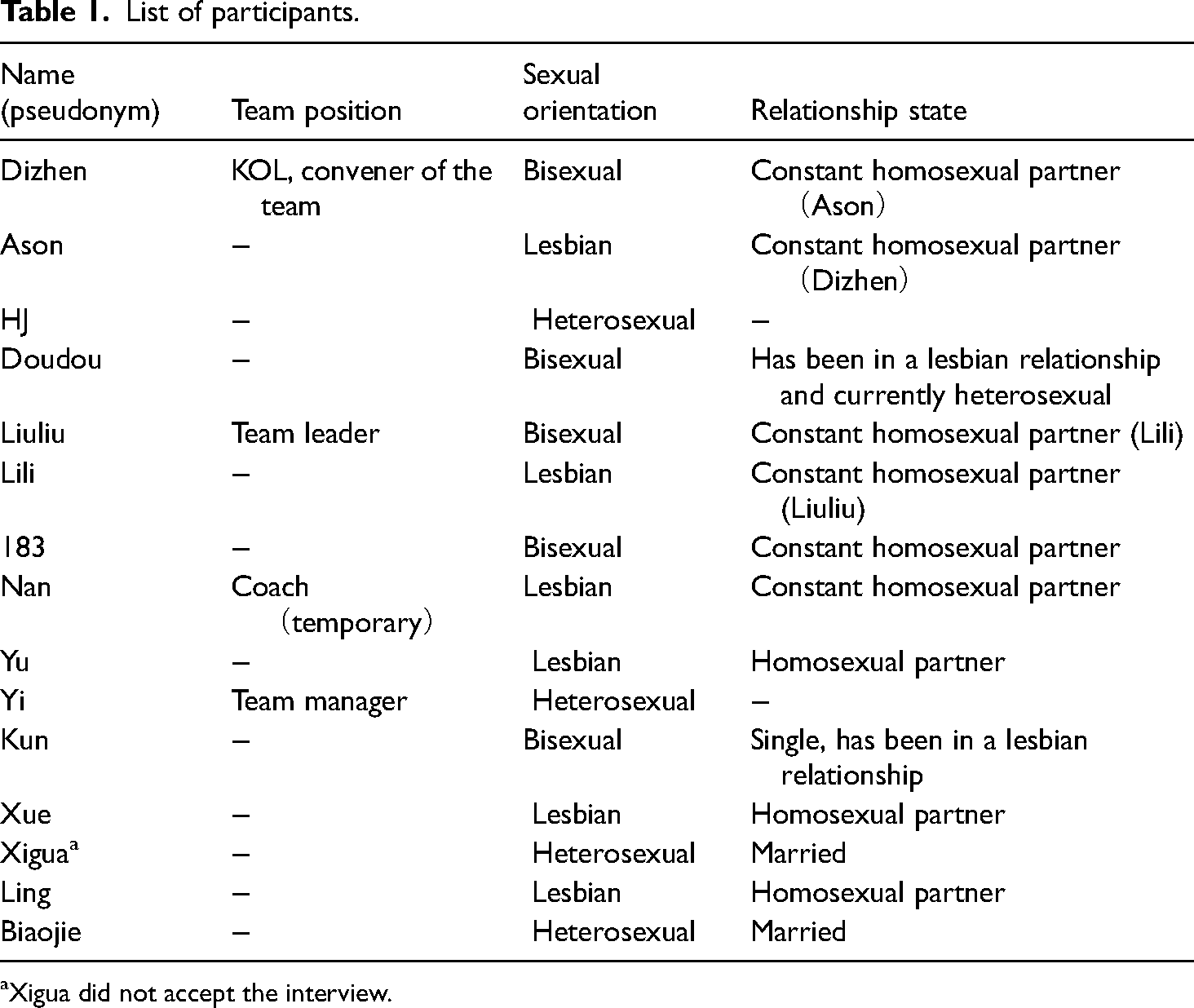
Xigua did not accept the interview.
We primarily used interviews and observations to collect data. Both researchers are female, Chinese, heterosexual, and have experience with sports. One researcher knows about Team B through a close friend who is a member of this team (bisexual). The friend introduced her to the team manager and got permission to enter the “field”. Familiarization is a very important stage in conducting case study in China. Researchers must familiarize themselves with the specifics of the field, and participants must build trust in researchers. As a result, two phases were designed. First, to have a “brief” visit with the team for 1 month (June 2019). During this month, one researcher conducted non-participatory observations on three training sessions and one match and engaged in their social activities, such as dining out and attending a birthday party. Researchers also collected information, documents, and the team's Webo (a Chinese social media) posts. This stage was intended to observe the team members’ interactions and collective behavior. The second phase (July–October 2019) focused on an unstructured, in-depth interview with the participants. Considering the privacy and sensitivity of the sexual minority group, the researcher explained that she has had close friends with sexual minority individuals and understands “the situations”. In addition, the researcher benefited from collaborating with her friend, a member of Team B. The collaboration not only won the trust of other members but also ensured that research questions are relevant, useful, and not offensive to the community. After conveying the intention of this research to the whole team, most players except one showed interest and willingness to accept an interview. Consent forms were received from participants. Fourteen unstructured, in-depth interviews were carried out individually over 2 months. For each interview, the researcher and participants determined the time and place, normally in cafes or parks during their lunch break or after work. Though the interview was unstructured, it revolved around three themes: self and sexuality; sports and life; and individual and team. The interview was conducted in Mandarin and lasted between 40 and 60 min. If there were any points that needed clarification, online communication via WeChat (a Chinese social media platform) supplemented the interview. Recordings were transcribed and read by each researcher. Then the transcription was sent back to the participants for confirmation. One researcher translated the transcripts into English by meaning rather than by words. The names of players present in the article are given as pseudonyms.
The analysis was informed by post-structuralist-inspired feminist (queer) approaches, where structure (power) and agency are conceptualized as the capacity to recognize the multiple discourses at play. In practice, we primarily used narrative analysis, which focuses on understanding the stories and experiences of the participants. We examined the narratives that participants told, analyzing the ways in which they made sense of their sporting experiences as a sexual minority. We also looked for themes that emerged across the narratives, which include, “formation of sexual identity”, “against stereotypes”, “coming out”, and “getting recognition”. The interpenetration of narratives was then thematically organized in conjunction with the literature on sexual identity development and negotiation, gender performativity, and queer resistance in sports. The contexts of sexual minorities and gendered sports (sub)cultures were considered. Researchers attempted to avoid potential biases when analyzing the transcript, such as reflecting our assumptions and interpretations and avoiding stigmatizing or pathologizing language.
Findings and analysis
Formation and development of sexual identity in Team B
From a macro perspective, facing the societal discrimination, censorship of LGBTQ + content, and limited access to resources and support, the LGBTQ community in Mainland China is mostly invisible and left out of society as a whole. This is especially true for women and girls, who face more social restrictions than men and boys on how they act and think, making it more difficult for some women players to recognize their sexual identity. However, at the meso level, the formation of Team B was motivated by a shared love of basketball but also served as a venue for these women to reveal their sexual identities. At the micro level, identity interaction and positive role models provide positive social reinforcement, contributing to the development of nonheteronormative identity among these players (Krane, 1996).
The formation of individual sexual identity among the lesbian players in Team B can be characterized into two categories. Firstly, there are players who, such as Ason, had prior knowledge of their nonheteronormative orientation prior to joining the team. She said, When I realized that some of the other members are similar to me, I felt relieved and secured, and my bond with this group was strengthened (Ason).
Secondly, there are players who developed their sexual identity after joining the team, where their same-sex desires emerged in connection with their experiences in playing basketball. For instance, player 183 had previously been resistant to same-sex relations, but their exposure to the lesbian subculture within the team environment led to the formation of their sexual identity. When I was in high school, I used to reject lesbians. But that all changed when I joined this women's basketball team and got to know the players. I started to admire one player and ended up dating her. It was more about the connection I felt with her and the rest of the group—they made me feel comfortable and loved (183).
According to the identity negotiation theory, the story of player 183 demonstrates the significance of social interactions, relationships, and support in the formation of sexual identity. The nonheterosexual players acknowledged that the inclusive atmosphere within the basketball group made them feel accepted as sexual minority individuals, which to some extent, facilitated the revelation of their nonheteronormative orientation.
The social interaction within the team also allows for fluidity in sexual identity (Broad, 2001). Bisexual player Doudou revealed that while playing on the team, she had experienced romantic feelings toward one particular person, rather than toward a gender as a whole. When the relationship ended, she returned to being heterosexual, as she acknowledged that the group culture of Team B creates an open and malleable space for sexual fluidity.
Performativity of sexual identity: Resistance to “stereotype”
Sport is a significant setting for examining the connection between sexual identity and performance of the sporting body. The masculinity of professional men's basketball culture constitutes the dominant standard in the sport, and the trend of women's basketball culture has shifted toward this standard. However, the players on Team B do not adhere to these norms. Instead, they focus on the performance of women's bodies in the sport rather than imitating the movements and skills of male basketball players. Individual players may watch men's games for entertainment purposes, but they do not actively strive to imitate the masculine qualities present in the sport. I don’t really follow the men's basketball scene. I don’t even watch the NBA, to be honest (Doudou).
I get my inspiration from female basketball players. Guys and girls have different physical capabilities, so some of the things the guys do just don’t work for us girls. But some girls play basketball so well! I love watching their physical performances (Liuliu).
These statements could be interpreted as a resistance to masculine-oriented basketball culture. It can also be perceived as their attempt to eliminate the bias that all female nonheteronormative individuals aspire to emulate masculine traits, such as physical prowess or dominance, that are commonly associated with men's sports.
The researchers also noted that when the basketball players discussed their sexual emotional experiences, they emphasized that basketball had no effect on their sexual orientation (Lili). Ason frequently reminded us, The choice of playing basketball is due to the charm of basketball itself, not because of my sexual orientation or for the convenience of choosing a nonheterosexual partner (Ason).
Their rejection of social prejudice regarding the association between women's competitive sport and nonheterosexuality has challenged conventional assumptions and highlighted the diversity of perspectives and experiences within the sporting world.
It is worth mentioning that when they enter the basketball court, they follow the sporting norm of “style”. As the coach, Nan, stated: When playing basketball, the girls on our team make sure to wear proper basketball attire, tie up their hair, and go without makeup. But when they see other female players on other teams wearing makeup during games, they think it's strange and not necessary. They don’t see the point in wearing it during a game (Nan).
Team B thinks it is very important for basketball players to follow professional standards, which means not wearing makeup (which is usually associated with women) during games. This is in line with their focus on physical performance and the internal qualities of the female body in sports, like strength, endurance, and agility, instead of conforming to heteronormative beauty standards. This perspective is especially pertinent in the context of women's sports, in which female athletes are frequently evaluated based on their physical appearance, which is dominated by the binary discourse of being feminine or masculine, in addition to their athletic ability. By emphasizing physical performance and internal qualities, these players hope to shift the emphasis from appearance to the actual abilities and accomplishments of female sexual minority athletes.
On the basketball court, Team B players maintain a consistent view of the association of performance of the female sporting body and sexual identity. Off the court, however, the performance of gender/sexual identity is more diverse and nuanced. In order to balance the conflict between gender norms and self-identity, Lili refuses to conform to social norms regarding women's roles and behavior, but she accepts the social requirement of women's appearance. This suggests that she seeks to assert her identity while also navigating the expectations placed on her by society. Yu, on the other hand, adopts a conventionally masculine appearance, complete with short hair and neutral attire. She stresses that this style reflects her sporting preferences rather than gender norms, and she views her appearance as a personal choice rather than an expression of her gender and sexual identity. While Dizhen describes herself as follows: “I have short hair and I dress femininely most of the time”. She views her ability to fluidly engage with both masculine and feminine expressions as a form of resistance against the stereotypical characterization of lesbians as “tomboys”. This suggests that she seeks to challenge narrow and limiting gender stereotypes. These three examples illustrate the complexity of nonheteronormative gender performance and the ways in which individuals navigate and resist societal norms regarding gender, sexual identity, and sport.
Negotiating sexual identity: Coming out or remaining hidden?
The identity negotiation theory suggests that the concept of sexual identity is grounded in individual self-identification, which encompasses inner feelings of sexuality, or those located between or outside these gender categories (Wilchins, 2002). Lesbian and bisexual players in Team B engage in the negotiation of their sexual identities under varying social norms and circumstances, alternating between moments of “coming out” and “hiding”.
The basketball court presents an arena in which female nonheterosexual players are emboldened to openly acknowledge their sexual identity, perceiving it not as a personal characteristic but rather as a group identity. As noted by Nan, team members are indifferent to the awareness of their nonheteronormativity by competitors or spectators. Rather, the basketball court is viewed as a venue for relieving the pressures and tensions brought about by external homo-negativism, as well as for exhibiting their collective pride. Coming out is not a big deal because everyone on the team knows how it feels. We tease each other about being sexual minority, but we don’t feel bad about it. It gives you a break from the pressures of the outside world (Doudou).
The subculture formed by Team B is a way to solve the core problem of identity and status frustration (Cohen, 1955). This group has a shared interest in and understanding of sexual identity situations. This makes it possible for female nonheteronormative people to get the support and recognition of the group, which helps them feel less afraid and less alone (King and Smith, 2010). Furthermore, in the sporting context, a sense of group belonging can help them maintain their distinct cultural characteristics of being capable in sports and positive in their nonheterosexual identity in the face of social mainstream culture (Li, 2009).
Although they may be open about their sexual identity within their team, they tend to hide it in other contexts, such as the workplace. Most of the team players feel that revealing their sexual identity could negatively impact their career prospects. Another institution that requires covert identity is family. Almost all nonheterosexual players are afraid to come out to their families. Forced heterosexuality in the family and work places makes them bear more criticism and pressure. “Coming out” may lead to a broken relationship with my parents (183, bisexual). The Chinese mainstream gender norms cannot provide nonheteronormative identity with “legitimacy”. Yu realized that:
Even though this basketball team could help me feel less oppressed, it could never solve the problem of homophobia in society as a whole. Maybe my family knows I’m a lesbian, but they act like they don’t know. So I also keep silent.
The sexual minority population in China frequently employs a strategy of neither confirming nor denying their sexuality to their parents and society as a means of navigating their sexual identity. In response, the majority of parents adopt a passive stance, while the government and educational institutions continue to evade the issue, neither providing support nor actively suppressing it. As a result of this indifference, the public has become more tolerant, so long as it does not interfere with their personal lives. This dynamic offers limited opportunities for the growth and development of the sexual minority population without significantly challenging mainstream social norms or advocating for LGBTQ acceptance through pride movements. Within this context, the formation of group identities within sports teams, such as among female nonheterosexual players, may enhance a positive nonheteronormative identity, but individuals must still contend with external heterosexual expectations. This aligns with the perspective put forth by Hall and Jefferson (2006), who posit that the problems faced by subordinate groups can only be experienced, negotiated, or resisted, but cannot be fully resolved at the subcultural level.
Subculture recognition and inclusion: Collective strategies
When external forces impede the negotiation of individual identities, team identity may generate a collective agency that resists external authority. Team B has developed collective strategies for interacting with the external environment, particularly in relation to the intersection of sexuality and homophobia/lesbophobia and the gender-dominant nature of basketball.
The primary strategy of Team B is to gain recognition and acceptance for their subculture group. However, unlike other lesbian subcultural groups, Team B does not aim to differentiate themselves from the mainstream through distinctive styles and bodily presentations in order to appear unique and unorthodox (Hebdige, 1979). Instead, they adopt a cultural strategy that emphasizes their athletic ability rather than their sexual identity in order to gain acceptance from society. They hope that their sport accomplishments will demonstrate their opposition to gender discrimination. As Dizhen explained,
As lesbian players, we face a lot of challenges on and off the court. The only way to earn respect and to eliminate gender bias is by showing how skilled and professional we are on the court. We try to keep a low profile, not using any obvious signs, like rainbow colors.
Team B members have realized, following their victory in the 2019 Autumn Community Competition, that athletic success is a means of attracting attention and gaining acceptance within the larger authoritarian culture. This is evident in the change in attitude displayed by the parents of Dudou who, after winning first place, no longer opposed her participation in basketball. Similarly, player 183 reported that her mother supports her involvement in the team and is proud of their athletic achievements.
The significant performance of Team B has also garnered attention and support from the local community, with the public commending their skills, perseverance, passion, and teamwork. College B has expressed pride in their sporting success and has offered to provide long-term coaching support. The increased visibility of women's basketball and the availability of dedicated training spaces, as seen with Team B, are significant steps toward challenging men's dominance in basketball in Chinese society.
Four heterosexual players on this basketball team are a “marginal” group in terms of sexual identity. In male-dominated stadiums, gay male athletes are often undervalued due to their sexuality. Conversely, female athletes who exhibit “masculine” traits may face higher expectations (Caudwell, 2006a, 2006b). However, in the Team B's women's basketball court, power is not determined by sexual identity or temperament. The team emphasizes equality, and all players are treated as equals. Sexual orientation does not impact a player's responsibility on the court. A player's level of masculinity is also not a factor in their responsibilities. There is no distinction (between lesbian/bisexual and straight members). We all came together because we love basketball, and being alums brings us closer. We don’t classify people in our team based on their sexual orientation; it's more important for us to be good at the game, perform well in our roles, and be loyal to the team (Biaojie).
The team leader also puts great emphasis on equality: We strive to foster a team culture of relative equality, and while minor disagreements are unavoidable, the players are still equal in the grand scheme of things. This concept of equality is founded on our respect for one another's identities, a sense of proportion in our jokes, and an understanding of one another's boundaries (Liuliu).
The shared passion for basketball and values for equality and respect among team members has served to bridge the gap between individuals of different sexual orientations and forge a sense of unity. Furthermore, the recognition of prevalent discrimination and stigma faced by women basketball players has led to the development of an inclusive and cohesive environment for female players within the sport. Yi addressed:
Finding a girl who loves playing basketball in China is a real challenge. Most girls go for more feminine sports and it's not common for them to openly admit they enjoy playing ball. But that's why we cherish our team members so much and work hard to keep everyone together. It may be easy to find a badminton partner, but forming a basketball team is a whole different story. That's why we’re proud of our basketball sisterhood.
Discussion
Queer resistance in China’s sport: Insights from Team B
Queer resistance can take many forms. The experiences of Team B offer a valuable case study of queer resistance in the context of Chinese society and sports. Firstly, the team challenges prevailing gender norms and the binary discourse of gender stereotypes by taking a proactive stance and engaging in sports. By doing so, they challenge the preconceived notion of the relationship between masculinity in sports and female nonheterosexual identity, providing a form of resistance that differs from overt, formal resistance such as the pride movement and political advocacy documented in the West. Secondly, instead of challenging existing power structures, Team B adopts a strategy of subculture recognition and integration. This approach negotiates the team's position in the sport and broader social contexts by integrating the nonheteronormative subculture into mainstream sport and society, earning recognition and support from families, the general public, and the local community, and promoting a more inclusive view of sports. Thirdly, Team B strives to create a team culture based on inclusion and equality, diminishing the differences between individual players’ sexual identities. Within this autonomous community, they have achieved a level of gender equality uncommon in heterosexual society as a whole, thereby compensating for the powerlessness they may encounter in other areas.
This case suggests that the negotiation of a person's sexual identity in China is extraordinarily complex and context-dependent. The queer resistance of these female athletes is constrained by the unaltered gender macro-structure. Their collective queer resistance strategy and practice in sports reveals the suppression and concealment of sexual identity outside the team, thereby perpetuating the dominant, totalitarian gender culture in general society. Their non-confrontational approach is reflective of the current state of LGBTQ communities in China, where individuals caught between society's rules and their own experiences employ safer, less confrontational methods to gain social acceptance.
Sexual identity, according to the post-structural feminist perspective, is not an innate trait but rather a product of cultural practices and power relations (Kane, 1995). The non-confrontational or less confrontational resistance of Chinese queer subjects, on the one hand, reflects the power relations and cultural practices that shape sexual identity in their society, while on the other hand, it suggests that individuals can utilize their (changing) social position to negotiate the power structure and the dominant cultural norms. Participation in a gender-inclusive sports group, such as Team B, provides sexual minority members with a unique social position that can be used to destabilize power relations and reduce sexual identity tension. Moreover, sport subcultures may have developed collective agency and resilience in order to navigate the dominant culture within and beyond sports.
Conclusion
The case of Team B serves as an example of the role of sports in breaking down barriers and promoting inclusiveness and acceptance. It posits that membership in a gender-inclusive sport collective affords sexual minority individuals a unique social vantage point, which serves as an empowering mechanism for subverting power hierarchies and mitigating the internal struggles related to their sexual identity. This contention is grounded in a critical assessment of the complex interplay between gender, sexuality, and social power, highlighting the transformative potential of non-normative athletic spaces in challenging hegemonic constructions of identity and fostering inclusivity (Price and Parker, 2003). Additionally, it reminds us that to effect meaningful change and empower sexual minorities on a wider scale, it is necessary to address the underlying social culture and structure, as the agency of these minorities can only have a limited impact. The transformation of social norms and values is crucial in creating a more accepting and empowering environment for sexual minorities, enabling them to experience a sense of pride and dignity beyond the realm of sports.
The study provides valuable insights into the intersection of sport, gender, and sexuality in China and the experiences of sexual minority groups in grassroots sports. However, it is also important to acknowledge the limitations of the study, such as its focus on one specific sport and one specific sexual minority group. Future research can expand on this work by exploring the experiences of other sexual minority groups in different sports, as well as the role of media and education in shaping public opinions and identities. Additionally, research can further examine the mechanisms by which social factors, such as community and public opinions, shape the formation and negotiation of sexual identities in sport.
Footnotes
Declaration of Conflicting Interests
The author(s) declared no potential conflicts of interest with respect to the research, authorship, and/or publication of this article.
Funding
The author(s) received no financial support for the research, authorship, and/or publication of this article.
