



Abstract
This paper explores the voices of resistance against the Dakar Rally's decade-long operation in South America. Drawing upon the three-prong framework of environmental justice (EJ), the analysis showcases how the less powerful stakeholders in the hosting countries articulated the deleterious consequences caused by the event to the local communities and ecologies. Moreover, by situating the Dakar Rally's expeditions in South America within the global capitalist economy, the paper explains why the most prestigious car rally is an exemplary manifestation of ecological imperialism, as it is not only a showcase of unsustainable industries (represented by fossil-fuel vehicles) with European colonial hubris but also a newer stage of an ongoing centuries-old process of extracting ecological resources from the Global South to benefit the increasingly mobile, vampire-like transnational capital.
Introduction: the unsustainability of (motor)sport
Climate change and ecological crises have drawn urgent attention to how human activities affect the environment, particularly how energy is extracted and used, and for what purposes (Ghosh, 2021; Indigenous Environmental Network, 2022; Sultana, 2022; The Red Nation, 2021). The “sustainability” of sport is an emerging area of scholarly examination as the contradictory relationship between the sport industry and the environment has drawn increasing attention from critical social scientists (e.g. Lenskyj, 1998; Miller, 2017; Millington et al., 2018; Sze, 2009). While sport might be associated with a “healthy” or “green” image, the growth of the sport industry relies upon extensive consumption of natural resources, directly responsible for significant carbon footprints through facility construction, energy use, traveling, etc. (McCullough and Kellison, 2017). Corporations with immense ecological footprints (e.g. fossil-fuel industries) often associate themselves with the positive image of sport via the means of sponsorship, promoting themselves as “good environmental citizens” (Miller, 2017) and obtaining “the social license to operate” (Boykoff and Mascharenhas, 2016).
Few other sport forms represent this contradiction more acutely than motorsport, which occupies a unique place in popular sport cultures of the overdeveloped societies in the Global North (Dingle, 2009; Hassan, 2011). On the one hand, motorsport is a powerful symbol of modern technology. Miller (2017), for example, argued that fans of the Formula One race are drawn to experience a type of “technological sublime” when consuming the spectacles offered by the race. This façade of techno-power, however, often conceals the direct environmental consequences and unsustainable elements associated with the existence of motorsport: its sheer dependence on the physical resource—particularly fossil fuels as an ongoing energy source for the vehicles and the manufacturing of other equipment—produces local pollution, greenhouse gas, and transforms the landscape of the hosting sites (Dingle, 2009), which leads Miller (2017: 41) to consider the degradation of the environment as an “overt component” of motorsport's essence.
Amidst the intense “natural” disasters across the globe and the looming planetary ecological breakdown, motorsport has encountered a legitimacy crisis, facing growing pressure to reduce resource consumption or at least gesture towards operating in a more environmentally sustainable manner (Robeers and Van Den Bulck, 2018). Dingle (2009) noted that motorsport might present opportunities to inspire more environmentally-friendly designs and innovations of technologies, fuels, and practices that may be conducive to future attempts to resolve some environmental problems. Others cautioned against the ecological modernization approach towards sustainability, that is, the assumption that technological advancement would solely be sufficient in addressing the ecological crises, which disproportionately affect the racialized, impoverished, and disenfranchised communities in the Global South (Millington et al., 2018). As many Indigenous and racialized scholars and environmental activists have persistently advocated, there is an urgent need to foreground alternative voices from “below” in the global dialogues around sustainability, which reveals the profound role of colonialism, transnational capitalism, and imperialism in causing the planetary ecological crises (Deranger et al., 2022; Gilio-Whitaker, 2019; Sultana, 2022). Therefore, extending the earlier scholarship that illuminated the tensioned position of motorsport in relation to sustainability, this paper explicitly situates struggles for environmental justice (EJ) within the larger formations of colonialism, imperialism, and global capitalism, and brings forth the voices of resistance or “counter stories” from South American communities which, for one decade, were affected by one of the most prestigious motorsport competitions in the world, the Dakar Rally.
Few motorsport events can rival the prestige and significance of the Dakar Rally, touted by its organizer and the corporate media as the world's “toughest race” and “biggest rally” (“The world's toughest race”, 2018). Inaugurated in 1978 as the “Paris–Dakar” Rally that departed from Paris, France, and concluded in Dakar, Senegal, it is known for the tremendous challenges that it offers the participants to traverse the Sahara Desert (Hassan and O’Kane, 2011). The race was relocated from Africa to South America in 2009 before it again relocated to Saudi Arabia a decade later in 2020. Unlike other high-profile international motorsport events like Formula One or the World Rally Championship (WRC), the Dakar Rally is unique in that it is held in Global South locations, by an organization from the Global North, the Amaury Sport Organization (ASO) headquartered in Paris, France. Notwithstanding its transpositions across the continents, the “Dakar” name remains intact. Over the course of the decade (2009–2019), the Dakar Rally was an event of social, political, and economic significance to the South American hosting countries (Chile, Argentina, Peru, Bolivia, and Paraguay). Officially welcomed as an opportunity to promote international tourism with anticipated economic benefits, the Dakar Rally's 11 South American iterations were subsidized by the respective hosting national governments. As with its tradition, the Rally continued to serve as a testing ground and “itinerant trade fair” (Kilcline, 2019) for the international auto, energy, and hospitality industries, with the South American scenery as the backdrop, while leaving a series of deleterious impacts on the local Indigenous communities and ecosystems on its paths (“Pueblo Mapuche”, 2009; Watts, 2014). However, this “darker” side of the event has been largely rendered invisible under the hegemonic celebratory narrative co-produced by the ASO, the Rally's corporate sponsors, mainstream media, and the hosting nations (Montoya, 2013).
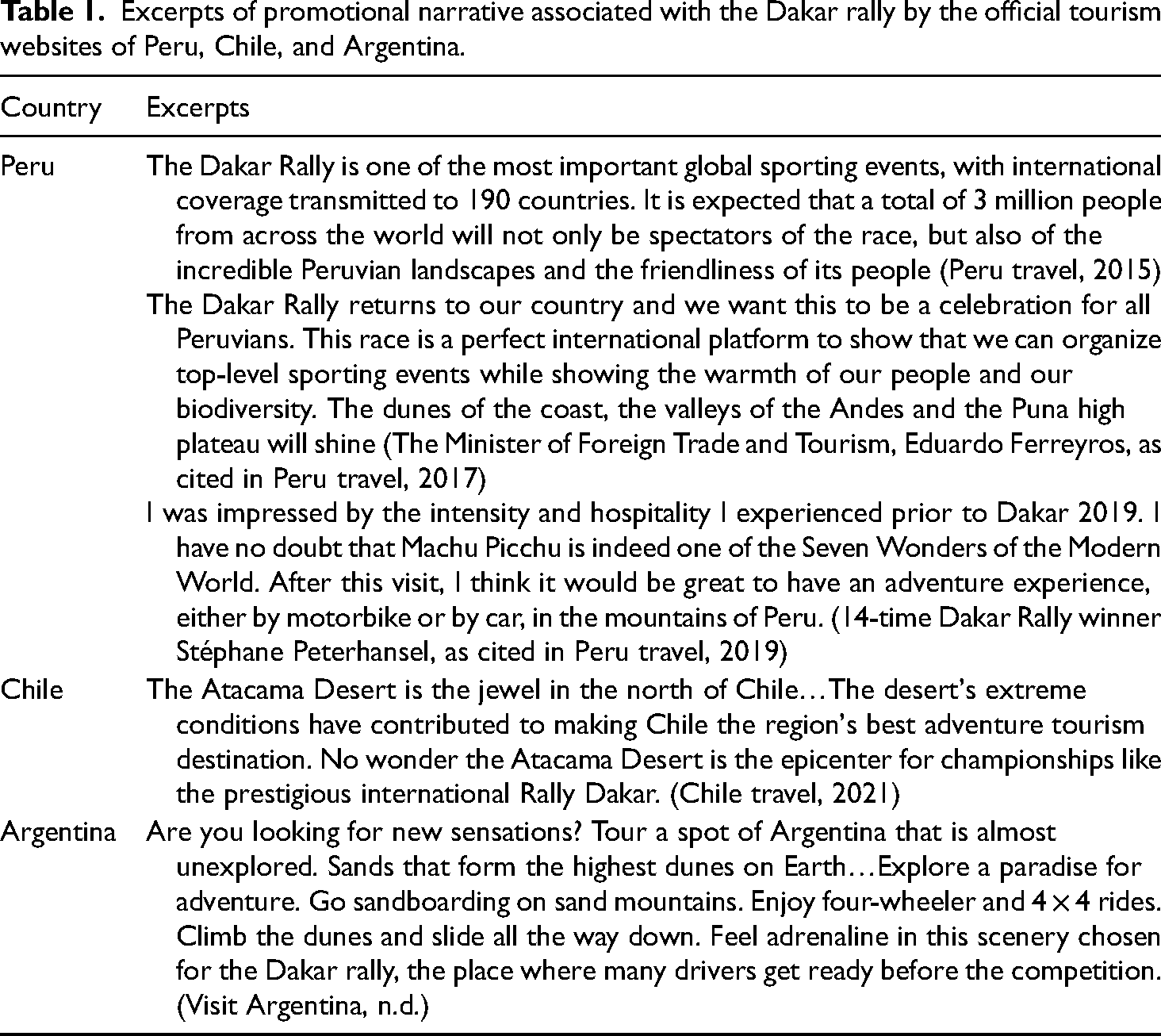
This paper explores the critical analyses and voices of resistance put forth by civil and grass-roots activists and advocacy organizations in various South American locations against the Dakar Rally. These “counter stories” together articulated three forms of closely intertwined environmental injustices manifest in the event's operation (Chen and Kellison, 2023): when transnational capital associated with Global North-headquartered multinational corporations—descends upon Global South locations, it is the local, disenfranchised communities that bear the disproportionate social and environmental consequences (distributive injustice). At the same time, these disenfranchised communities are excluded from the decision-making process as the France-headquartered event organizers and their multinational corporate sponsors, with the support from the local governments, impose temporary authorities on the event sites without obtaining free, prior, and informed consent (procedural injustice). Moreover, while the local political and business elites welcome the Rally as an opportunity to boost international tourism and national prestige with a veneer of “conservation”, the long-lasting damages to the ecological system and particularly, the irrevocable alteration of communities’ relationships to land, are largely brushed aside as issues of secondary concern (recognition injustice). Table 1 shows some excerpts of Dakar-related touristic narratives currently displayed on the websites of the national tourism ministries in Peru, Chile, and Argentina.
Excerpts of promotional narrative associated with the Dakar rally by the official tourism websites of Peru, Chile, and Argentina.
These intertwined forms of environmental injustices illuminate the underlying tensions regarding the perpetual conundrum of “development” versus “conservation” in Global South/developing countries, which are structurally embedded in a continuous formation of unequal exchange that can be characterized as “ecological imperialism” that had its origins in the earlier stages of European colonialism and capitalist expansion (Foster et al., 2019; Hickel et al. 2022). The next section introduces the conceptual frameworks that guide the analysis, before a brief history of the Dakar Rally, including its French colonial lineage, is discussed.
Conceptual frameworks
Environmental justice
The anglophone term “environmental justice” (EJ) first emerged in social movements when the low-income, racialized communities in the United States actively resisted the exposure of pollution and toxic waste disposal practices that affected them disproportionately, highlighting both the state and corporations’ role in perpetuating the harmful consequences (Malin and Ryder, 2018; Murdock, 2020). The movements have expanded to address other types of environmental inequities in a vast variety of areas including transportation, access to healthcare, housing, land and water use, energy consumption, militarism, etc. (Sze and London, 2008). Compared to other approaches to environmental issues, EJ has an explicit focus on power relations (Pulido, 2018), drawing attention to how the existing social structures (including the capitalist system and the nation-state) reproduce environmental injustice (Pellow, 2018). In recent developments of the EJ movement and scholarship, activists and scholars have drawn attention to both the epistemic and material consequences of colonialism in addressing environmental problems (Alvarez and Coolsaet, 2020; Chen and Davidson, 2023).
Broadly speaking, there are three paradigmatic frameworks that help to identify environmental injustice, attribute causes, and propose solutions to address the issue in question. First, the distributive justice framework is concerned with the (in)equitable distribution of environmental amenities and harms to different peoples and communities (Schlosberg, 2004); Second, the procedural justice framework maintains that there should be fair institutional procedures regarding laws, regulations, and policies that may affect the environment in disproportionate ways. Often, the communities that are harmed the most are deprived of access to participation and influence in the environment-related policy and decision-making processes (Bell and Carrick, 2018; Figueroa, 2004). Third, the recognition justice framework draws attention to mainstream institutions’ lack of capacity and/or willingness to respect and accommodate the epistemic differences that various human groups hold towards the environment and the non-human world. It highlights the material consequences of epistemic violence, that is, the privileging of certain forms of knowledge of and practical relationship with the environment (and accordingly, what constitutes “sustainability”) over others (Whyte, 2018). It is important to note that EJ issues are interconnected and reinforce each other: one group not afforded equal respect by powerful institutions/actors is likely to be excluded in the decision-making process and also likely to bear the brunt of environmental hazards; a resource-depleted group or community, in turn, might struggle to fully participate effectively in decision-making procedures and, therefore, unlikely to have their grievances and demands fully recognized by other members of the society (Bell and Carrick, 2018).
Ecological imperialism
As many critical scholars and activists have observed, much of the current mainstream frameworks proposed by the Global North elites to address crises of the environment have remained oblivious to the fundamental role played by colonialism, transnational capitalism, and imperialism (Davis and Todd, 2017; Sultana, 2022). For example, Simms (2009) argued that the developed countries in the Global North owe the Global South an immense “ecological debt,” pointing to the historical “systematic asymmetries” in exploiting the environment (Clark and Foster, 2009). Crosby (1986) first used “ecological imperialism” to describe how Europeans forced the spread of plants and animals to other parts of the world that resulted in displacements of Indigenous ecologies. While acknowledging that appropriation of resources from distant lands had always taken place in human history, Clark and Foster (2009) drew upon a historical materialist understanding of the human-nature relationship to highlight the central role of capitalism in intensifying the said process: the existence of capitalism is dependent upon the incessant exploitation of (an externalized) Nature and ecologically unequal exchange, that is, to funnel resources including raw materials and/or labor into capitalist accumulation in an unevenly developed world.
According to Clark and Foster (2009), ecological imperialism is the formation whereby imperial countries in the core of the capitalist world system carry out an “environmental overdraft” which expropriates the natural resources of periphery countries to serve the capitalist production that disproportionately benefits the capitalist class in the core. After decades, if not centuries of extractive transfusion of resources from what was aptly described by Galeano (1997) as the “open veins” of countries in the Global South to the North, the material conditions of development are severely damaged in the former as they are not only caught in the debt trap but also face ecological costs in the said process of extraction (Foster et al., 2019). On the other hand, however, the principles of “conservation” imposed by businesses and governments in the Global North in the name of rational use of resources, are rarely, if ever, applied to the same extent in the Global South. This “après moi, le deluge” (after me the deluge) philosophy is another important characteristic of ecological imperialism (Clark and Foster, 2009: 330).
Critical sport scholars have noted how the emergence and rapid expansion of the modern sport industry in the late 19th century was coterminous with the rise of monopoly capitalism on the international stage, the formation characterized by some Marxist political economists as imperialism (Brohm, 1978). Just as imperialism has since the 1970s morphed into forms of the growing dominance of monopoly-finance capital that is increasingly mobile, and a high level of “globalization” of production in the form of global commodity chains (Foster et al., 2019), the production of international sporting spectacles also reflects this trend: As Graeff (2020: 20) observed, the production of mega-sporting events such as the Olympic Games have increasingly been “outsourced” by the transnational capitalist class to Global South locations: It would not be implausible to say that the franchise owners outsource them and operate them by means of subcontracts. They outsource them to ‘organising committees’, basically formed by sports and business people, often strongly related to the franchise owners and governments. They operate most of sport mega events’ logistical and commercial aspects through sub-contracts.
In these cases, while the on-the-ground operations associated with the sport events still take place in the host countries, sometimes with exceptional legal frameworks imposed on the local jurisdiction (justified by the international sport event “franchise” owners and local political elites as necessary for the events to be smoothly run), international capital, which dictates and benefits from such conditions, are volatile and agile in moving across borders (Graeff, 2020). In the same vein, Miller (2017: 40) observed that various commercial car rallies “run by and for the Global North tend to be held across the Global South.” Few other car rallies could rival the Dakar Rally in embodying both an unsavory colonial adventurism and a disregard for local ecologies.
The “Dakar” Rally: colonialism on wheels
As explained by historian Kilcline (2019: 92), the Paris–Dakar Rally was, to some extent, a successor of the 1920–1930s inter-war-era motorists raids, when French colonies in North and Sub-Sahara Africa were both “a testing ground and a competitive battleground for the French automobile industry…as the quasi-military missions, raids, and croisieres…were followed by a variety of expeditions, challenges, and rallies.” The Rally initially promoted itself as an opportunity for the average Frenchman to escape the mundane restrictions of modern society, resembling the Club Méditerranée (Club Med), an oversea tourism operator that marketed itself as rebellious, anti-establishment, and provided excursion opportunities for temporary escapes in the mid-20th century (Kilcline, 2019). In the period of decolonization, wherein former French colonies in Africa fought for political independence, members of Club Med maintained the privilege to continue their colonialist “exoticism” even after the French government no longer retained direct control over the region (Furlough, 1993). In post-1968 Western Europe, the idea of sport adventures in “new” territories gained momentum and became increasingly commercialized (Brohm, 1978). Similar to early colonial adventurers and the vacationers of Club Med, the “pioneers” of the Paris–Dakar Rally shared an imagining of their destinations as a land of wilderness, void of inhabitants, exemplified by its founder Thierry Sabine's consideration of Africa as “a land of adventures and peaceful exploits” (as cited in Kilcline, 2019: 94).
Alongside the Tour de France, the Dakar Rally was touted to be the “modern sport epics” for the French: an episodic event that equips the media to offer the French audience a pleasure of consuming the exotic images and sounds from living rooms, purposefully scheduled in early January to meet “an appetite for exotic escapism” among the middle-class French at a post-holiday period with few competing sport events on the calendar (Kilcline, 2019: 90). While the Rally was explicitly founded upon the romantic ideals and débrouillardise (the ability to ‘make do’) of its amateur participants, since late 1980s it became gradually dominated by and organized for, the interest of professional racing drivers and vehicle manufacturers, under the auspices of the international automobile federation (Hassan and O’Kane, 2011; Kilcline, 2019). Broadcast at length by national and international TV networks, the Rally started to receive sponsorships from major car manufacturing firms and other businesses that use the race as billboards. According to an investigative journalism report in 1988, the Rally was also utilized as a military laboratory, as the event's telecommunication network was set up by the French army as a way to experiment with the use of mobile transmission stations in remote regions in Africa (Kilcline, 2019).
As the Rally gained notoriety, it also drew more scrutiny from social groups both in Africa and France. Besides concerns with the material consequences of the event, critics in France considered the rally as an example of the mediatized sporting spectacle of French neocolonial projects in Africa, a “glorified holiday for a wealthy elite in an impoverished continent” (Kilcline, 2019: 104). Many communities in the Sub-Sahara region, unsurprisingly, considered the event as an extension of Western colonialism as the competitors continue to represent “colonial carelessness and arrogance” (Hassan and O’Kane, 2011: 273). As a response to these criticisms, the ASO engaged in a series of corporate social responsibility (CSR) programming starting in 1988, with in-kind donations of water pumps, medical equipment, school supplies, etc. The meager amount of investment delivered by these projects to the local communities, as compared to the expensive cost of entry fees collected from competitors to attend the Rally, however, has not been exempt from scrutiny (Hassan and O’Kane, 2011).
Relocation to South America
In the 1990s, the race faced mounting pressure to drop the “Paris” moniker and eventually re-branded as the “Dakar” Rally, as it increasingly deviated from the traditional “Paris to Dakar” routes, including several iterations that did not feature Paris at all (Trifunetti, 2014). Following the cancellation of the race in 2008 due to threats from armed militant groups in the Sahara, the ASO managed to relocate the race to South America in 2009, not least for the continent's picturesque sceneries and relatively friendly political atmosphere. After 30 years of traversing the Sahara, the marvelous continent of South America was believed to be providing “new, unspoilt and never-before-seen décors” that became increasingly in short supply in Africa (Kilcline, 2019: 132). Despite its relocation, the event did not rename itself as “Rally Atacama” or “Rally Nazca” (Antezana, 2019) and remained as the “Dakar” Rally, drawing questions from African politicians over how the ASO would keep profiting from the “Dakar” name and image (Kilcline, 2019).
The Dakar Rally's impact was first felt in South America almost two decades before the actual transplantation of the event to the continent. In 1988, over 200 teams participated in the first “Trans Amazon” rally, a “cast in the mold” of the Paris–Dakar, in areas across the Amazon jungles, the Atacama Desert, the Pampas, and the Andes Mountains (Lawson, 1988). In the Dakar Rally's 11 years of operation in South America, Argentina served as a host in 10, Chile in 7, Bolivia and Peru both in 4, and Paraguay in 1. Ecuador reportedly declined the offer to host some stages of the race in 2013 (Buxeda, 2014). The generous financial and sponsorship perks provided by South American governments helped the event to survive the decade following the global financial crisis (Kilcline, 2019). For the local governments, the Dakar Rally presented a great opportunity to showcase their natural and cultural “resources” around and to attract global tourists with media coverage in 190 countries (Fleming, 2016). The staging of the Rally in South America, an emerging automobile market, opened up opportunities for corporate sponsors such as the oil and gas corporation Total and the hospitality company Sodexo, to further their market share (Kilcline, 2019).
The enthusiastic reception of the Dakar Rally by South American governmental officials, including Bolivia's Indigenous president Evo Morales, despite the event's apparent environmentally damaging impact, raises important questions concerning the Euro-Western fetishization of “nature,” and the contradictory relationship between traditional Indigenous land-based cultural values, and fossil fuel all-terrain vehicles and motorcycles trampling over the fragile eco-system (Sandoval and Boillat, 2014). As Chilean scholar Montoya (2013) noted, the national media in the hosting South American countries (Argentina, Bolivia, Chile, Peru, and Paraguay) and international mainstream media was largely complicit in portraying the event in a positive and sanitized light while remaining silent on its deleterious consequences as well as voices of dissent. Besides producing an individualistic narrative of the race drivers and the companies, the rankings, and the spectacle of man-made machine persevering in “nature,” the mainstream media was not interested in meaningfully narrating the characteristics of the territories and local communities/peoples. Moreover, press releases about road accidents caused by vehicles in the race were issued as if they were isolated events unrelated to the operation of the Rally (Montoya, 2013). Notwithstanding the Dakar Rally's departure from South America in 2019, there remains an urgent need to highlight and comprehend the resisting voices against the event that articulated its social and ecological impact on the local communities and landscapes: After all, the Rally could easily transport these consequences elsewhere, and similar events bearing other names or symbols might arrive in no time to fill in the void left by “Dakar.”
Research method
The goal of this study is to explore the voices resisting the Dakar Rally's operation within the South American hosting countries and highlight how various non-mainstream actors collectively and systemically articulated their critiques against this event. For this reason, the collection of data for this study primarily focused on publicly-accessible sources published in alternative media and organizational platforms.
Data collection
Within the first round of data collection, a search with the keywords “Dakar Rally,” “protest,” “South America,” and all the hosting country names was performed using Google. Upon preliminary reading, a small number (N = 5) of online publications that substantially addressed issues of controversies and dissents associated with the Rally between 2009 and 2019 were downloaded and saved. These English-language publications, including short scholarly commentaries (by South American scholars) and media reports, served as initial nodes that helped identify a network of dissenters (scholar-activists, investigative journalists, grass-roots advocacy groups, non-profit organizations, or online communities such as “No al Dakar”) that is at best, tangentially mentioned within the mainstream media coverage of the Rally, and at worst, unbeknownst to the international audience. A second round of search deployed a similar set of keywords but exclusively focused on results in Spanish (the official and primary language of all the host countries), and this yielded substantially more qualified documents (N = 19). Amongst the 24 documents analyzed, ten were published by advocacy groups or non-profit organizations, nine were published as reports or opinion pieces on (predominantly non-mainstream) media platforms, three were personal blogs by journalists or scholars, and two were academic publications. In terms of geographical focus, seven were focused on Bolivia, six on Chile, three on Argentina, one on Peru, and seven others covered multiple countries. Next, upon a round of in-depth reading, sentence clusters and paragraphs that involved explicit discussion of the Dakar Rally and its local impact were extracted to a dataset for further coding and analysis.
Data analysis
Reflexive thematic analysis (RTA), a theoretically flexible interpretative approach that facilitates the identification and analysis of patterns or themes, was deployed to analyze the data (Braun and Clarke, 2012). It is an approach that highlights the researcher's active role in knowledge production (Braun and Clarke, 2019), wherein the researcher performs an interpretive analysis of the data within a dynamic, iterative process at the intersection of the dataset, the theoretical assumptions underpinning the analysis, and the analytical skills/resources of the researcher (Byrne, 2022).
Specifically, the analysis proceeded in two stages. First, in a ‘theory-driven’ stage upon some in-depth reading and familiarization of the data, codes were produced in relation to a pre-specified conceptual framework (Byrne, 2022). In this case, the detailed analysis of the data followed the three-pronged EJ framework: distributive (in)justice, procedural (in)justice, and recognition (in)justice (Chen and Kellison, 2023). Upon completing this stage, I recognized that some aspects of the data, when read in their totality, pointed to another theme that cannot be readily subsumed under the EJ framework. This resonates well with Braun and Clarke (2012, 2019), who noted that Thematic Analysis rarely falls cleanly into either deductive or inductive approach and, more often than not, is a combination of both. I followed a ‘data-driven’ approach that then connects the emergent meanings within the dataset to a framework, which addresses the unequal economic and ecological exchange under global capitalism—ecological imperialism. The next section, following these themes, presents the “counter stories” against the Dakar Rally in South America.
Disproportionate environmental consequences: distributive injustice
The Dakar Rally's South American editions took place in some of the economically most impoverished areas of the planet (with mostly peasant and Indigenous communities), which turned local communities and landscapes into a million-dollar tourist attraction aimed at a rich minority who come and go, benefiting from “consuming” the terrain as globetrotters (Montoya, 2013). Notwithstanding the celebratory discourse propagated by the governments, the event organizers, and the mainstream media, activist groups and advocacy organizations voiced persistent concern over the Dakar Rally's disproportionate environmental repercussions to the local communities. These include the race's damaging impact on fragile ecosystems (e.g. soil erosion), archeological and paleontological sites, as well as pollution, and even death to local civilians caused by accidents (Aranda, 2013; Montoya, 2013).
As observed by Spain-based grass-roots confederation Ecologists in Action (Ecologistas en Accion, 2009), every 1000 km traveled by one of the off-road vehicles in the Dakar Rally means the erosion of one hectare of soil, not to mention the disturbance created by noise and lights on wild fauna, the fuel usage by the racing vehicles, supporting cast, and media, etc., the associated atmospheric and acoustic pollution, as well as the waste left behind by spectators. A 2012 report by ASO indicated that the previous year's edition of the rally alone generated 60 tons of waste (collected from camps and roads), 5250 liters of used oil (discarded), 16,500 kg of contaminated solid chemical waste, and 12,200 tires. In addition, the CO2 emissions generated reached 15,500 tons (as cited in Kalazich, 2018).
As Chilean archaeologist Kalazich (2018) noted, high-speed, off-road “invasion” of more than 500 vehicles in each year's Dakar Rally led to irreparable damage to the rich and diverse archeological sites over a span of 1600 km in Chile, including the most challenging stages of the rally in the Atacama Desert. Contrary to the colonial legal notion of terra nullius often associated with the region, Indigenous and peasant communities have cared for and protected them for thousands of years, with the archaeological remains as the historical proof (Kalazich, 2018; Montoya, 2013). Between 2009 and 2010, the Council of National Monuments (Consejo de Monumentos Nacionales), a Chilean governmental agency dedicated to the preservation and upkeep of special natural and cultural sites, estimated that the damage to the archaeological sites by the Dakar Rally was 350 million pesos ($360,000) yet Chile's National Sports Institute, the governmental branch in support of the Rally, only issued 40 million pesos in compensation (San Cristobal, 2013).
In the Bolivian feminist magazine La Malhablada, Aranda (2013) described that the Bolivian government “handed over on a silver platter” to the Dakar Rally one of the most fragile and unprotected regions of the country: El sur Potosino (Southern Potosino). This region contains natural protection areas such as the Eduardo Avaroa Andean Fauna National Reserve, and the world-renowned Salar de Uyuni, which not only shelters and protects a multitude of wildlife but also is home to a significant number of invaluable archaeological sites with more than 3000 years of history, including hunting areas and early stone workshops, rock shelters with cave paintings, petroglyphs, fortifications, ceremonial complexes, etc. (Aranda, 2013).
British journalist Watts (2014), known for his coverage of environmental issues across the world, reported that the Dakar organizers did promise to mitigate these impacts with various measures, including marking historical sites on drivers’ maps, installing temporary fencing, and obliging cars to pass more checkpoints to prevent them from getting lost. However, local governments admitted the challenge of monitoring a racing event that covers a wide geographical area, more so when the race drivers (many of whom were amateurs) were incentivized to find shortcuts due to the nature of the event. According to Paola Gonzalez, a leader of the campaign “No al Dakar,” the financial benefits resulting from hosting Dakar were limited, compared to the 4.4 million euros that the Chilean government spent annually to host the race as well as other additional costs associated with the event (Buxeda, 2014). Other critics like Bolivian journalist Sagárnaga (2015) argued that the organizers of the Dakar Rally contributed minimally to the development of local communities, barely paying any price for violating the territories.
The “state of exception”: procedural injustice
Weeks ahead of the 2014 Dakar Rally, Argentina-based advocacy organization Grupo de Reflexión Rural (GRR) (2010) warned that between the town of Seclantás and the Recta de Tintín in the Salta Province, four hundred vehicles would cross a secondary road that exists within Los Cardones National Park, a nationally protected area of highest priority in Argentina. GRR (2010) criticized both Argentina's National Parks Administration and the Salta Province's Ministry of Environment for their lack of intervention, as no study on the environmental impact of the event was conducted by either the event organizer or the hosting governments.
By the end of the seven-year period of Chile's hosting of the race in 2015, Chile's Council of National Monuments found that 318 archaeological sites had been destroyed since 2009. Notwithstanding the numerous appeals made to the Chilean Supreme Court by archaeologists and Indigenous rights organizations, not a single conviction was made (“Dakar Rally ‘Disastrous’”, 2017). According to Chilean archaeologist Kalazich (2018), the national government played an instrumental and complicit role in damaging the country's archaeological heritage: Chile's National Sports Institute sponsored the Dakar Rally, paying $4 million each year to the ASO but refraining from taking necessary measures to protect the archaeological sites (Kalazich, 2018). According to federal law in Chile (National Monuments Act 17.288), archaeological sites are under the custody and protection of the state, and damage to archaeological sites is considered a felony, yet Chile's legal system dismissed most legal actions against the Rally. Moreover, the event did not undergo the process of approval under the Environmental Impact Assessment System (Sistema de Evaluación de Impacto Ambiental, SEIA), to which all investment and development projects in Chile “must comply with by law” (Kalazich, 2018: 35; Pimentel, 2017). Similarly, in Bolivia, where President Evo Morales is known for embodying and promoting the principle of “decolonization” (Sagárnaga, 2015), critics raised serious questions regarding the lack of demand from Bolivia's Ministry of Culture and Heritage in conducting an environmental impact assessment, as well as an absence of control over the racing route so that the impact to the archaeological sites can be prevented (Aranda, 2013).
When a 28-year-old woman was killed during the opening stage in Argentina in 2010, the organizers announced that the incident took place in an area where spectators were “not permitted” (Phalnikar, 2010). The division of local regions into “authorized” and “unauthorized” spaces for the public, when the rally took place, was an example of private sport organizations imposing a temporary authority, that is, a type of “private indirect government” supplanting the role of the state (Kilcline, 2019: 133). This is not dissimilar to the other more well-known cases of international sport business that negatively affected the local populations with the aid of local authorities. This “state of exception” in hosting cities/countries often occurs during the mega sport events like the football World Cup or the Olympic Games, wherein national and/or municipal laws can be temporarily suspended in favor of private interests so that the celebratory spirit championed by the local and international elites could go on unfettered (Boykoff, 2014).
One of the most contentious issues in the Dakar Rally's South American operation was that the detailed routes were not made public in advance until only 48 hours prior to the start of each stage, making it virtually impossible for local communities to have advanced knowledge regarding the minimization of the event's impact on the areas to be crossed by five hundred off-road vehicles (Fiengo, 2019; “Pueblo Mapuche”, 2009; Trifunetti, 2014). For example, in 2015, the Indigenous communities of Guayatayoc and Salinas Grandes basin in Argentina's Jujuy Province were informed by representatives of the Ministry of Sport and Tourism only days before the race was due to be held in Casabindo, passing over ancestral territories without implementing any of the requirements for prior consultation (International Work Group for Indigenous Affairs, 2016). In Chile, the event authorities and the justice system rejected the actions filed by the College of Archaeologists aimed at protecting the heritage and widely informing about the layout of the route (Montoya, 2013). This created several consequences, including the fact that people who lived in the areas affected by the rally cannot exercise their constitutional right to present administrative or judicial objections or to be afforded something as basic as being forewarned (Trifunetti, 2014). In other words, the local communities, particularly the Indigenous communities, were forced to be involved in the event without free, prior, and informed consent, violating the International Labor Organization Convention 169 (Montoya, 2013).
Après moi, le déluge: recognition injustice
That many local communities were not consulted or informed with advanced knowledge of the racing routes and that the race took place off-road instead of relying on pre-established paths indicate a larger issue reflected by the Dakar Rally's operation in South America: The interests of the elite drivers or cosmopolitan tourists were held superior to the rights, safety, and dignity of local communities, the land, and the cultural heritage, as state officials in Peru and Chile, for example, had stepped forward to defend the secrecy of the layout of the route and deny that the Rally went through archaeological sites (Montoya, 2013).
Among other actions of resistance, the Indigenous Kolla community in Chile blocked roads to protest the rally in 2014, arguing that the televised spectacle of “Dakar” would irrevocably disrupt their existence and relationship to land, turning the community and land into a tourist attraction that benefits a rich minority (Watts, 2014). Raúl Montenegro, a leader of Argentina's Foundation for the Defense of the Environment (FUNAM), a grass-roots environmental organization, lamented: [The] Dakar Rally of secret routes and cross-country competitions is an irritating form of new colonialism, because in Europe or the United States it would never be authorized. We are the last frontier for these shows in which human life and the environment are worth very little (as cited in Observatorio Petrolero Sur, 2015,
1
emphasis added).
As Chilean anthropologist Barros (2014) noted, South America serves as an ideal place to test the state-of-the-art automobile machines, which were to be sold at enormous prices with the “tested in the Atacama Desert” label. The Rally's South American editions, therefore, remained steeped with the ideology of European, civilizing conquest, with some ounces of dogged individualism: The vehicles crossing the “virgin” terrain embodied the control over the environment and its varied and beautiful geography. Following the footsteps of “first world” military personnel in earlier versions of the Dakar Rally (Kilcline, 2019), the participation of a racing team consisting of former U.S. and British military veterans in Afghanistan and Iraq was touted as a story of heroes in 2013 (Sagarnaga, 2015). Perhaps no other example better indicates the colonial hubris represented by the race and its participants than the words of Italian motorcyclist Matteo Casuccio, who was arrested by Chilean police for trespassing at an archaeological site in the desert outside Antofagasta in the 2015 Dakar Rally. In an interview with the Spanish newspaper Marca, Casuccio complained: Estos tíos, por cuatro piedras entre otras muchas de una montaña, no veas como se pusieron. Ni que me hubiera metido por medio del Coliseo. Eso sí que es una ruina arqueológica. Si se pasaran por Roma iban a alucinar.
These guys, you wouldn’t imagine how they got four rocks out of many of a mountain. I wasn’t passing through the middle of the Coliseum. That was an archaeological ruin. If they went to Rome they would hallucinate (as cited in Naranjo, 2015, translation by the author).
For Barros (2014), the event's blazoned attempt to juxtapose racing cars with “protector of heritage” in its marketing materials was deeply contradictory, as destruction and conservation are fundamentally antagonistic terms. Others similarly critiqued that the race represents the exaltation of unsustainable mobility and neocolonial values in the face of enormous environmental and social challenges (Pérez, 2014). As the event's official narrative romanticizes the landscape, it conveniently leaves out the important historical and socio-cultural contexts as well as ongoing struggles such as poverty and social exclusion (Montoya, 2013). Notwithstanding the backlash from local communities, the Dakar Rally has lauded itself for offsetting its carbon emissions resulting from the event since 2009, particularly with its “Madre de Dios” project certified by the non-profit Greenoxx (“A responsible Dakar”, n.d.). As sociologist Wilson (2012) has aptly argued, carbon-offsetting, even if well regulated, constitutes a form of “abstraction”: for instance, after trees are removed for the construction of a highway, the distinctiveness of the trees and the ecological system impacted by increased traffic and fewer trees in that context is lost, even if more trees are planted in another occasion.
Contemporary ecological imperialism
…the history of Latin America's underdevelopment is, as someone has said, an integral part of the history of world capitalism's development. Our defeat was always implicit in the victory of others; our wealth has always generated our poverty by nourishing the prosperity of others—the empires and their native overseers. In the colonial and neocolonial alchemy, gold changes into scrap metal and food into poison. (Galeano, 1997: 2)
In Bolivia, a country that passed a national statute called “the Law of the Mother Earth” that set forth a legal and ethical vision of the rights of the natural world, the national government announced its plan to host three stages of the 2016 “Dakar” Rally, ironically, on the same day that the Marxist, anti-imperialist journalist and writer Eduardo Galeano died (Sagárnaga, 2015). A critical glance at the political economy of the Dakar Rally showcases how the international auto, energy, tourism, and media industries, alongside the local governments, all had something to gain from exploiting the exotic imageries (e.g. desert and sand dunes) of supposedly uninhabited space (Montoya, 2013), which, in turn, is illustrative of the deep tensions underneath many Global South nations’ pathways to achieve development and economic sovereignty under the conditions of imperialism (Hickel et al., 2022).
Due to the unenclosed nature of the Dakar Rally's event setting, the ASO cannot charge the public who chose to spectate on site. It, however, charges the hosting governments for the privilege of hosting a segment of the race. This aspect of earning was significantly higher in South America (each host country reportedly paid the ASO up to $6 million per year) than in Africa (Kilcline, 2019). Moreover, local governments were also obliged to offer labor and facilities to organize the race, and importantly, provide security for the event. As Argentine environmentalist Montenegro lamented in 2015: In Argentina, a country with pressing social priorities, the national government contributed 4 million dollars in cash to the French company, and committed 28.5 million dollars in the budget, all for the…Dakar Rally to take place, that is, more than 32 million dollars, which is unacceptable (as cited in OPsur, 2015).
In addition to committing a large sum of financial resources to welcome the Rally, the state institutions in the hosting countries struggled to effectively regulate the event or enforce policies related to heritage protection (Montoya, 2013). As noted above, while the Chilean National Sports Institute has a mission to “contribute to a healthy, active and happy quality of life of all people” (Kalazich, 2018), its support for the Rally was scrutinized, particularly with the destruction of cultural heritage and the unnecessary contamination of the desert and environment associated with the race. For Paola González, vice-president of the Archaeology Association of Chile, it was apparent that the interests of the international companies override Chile's legal standards that supposedly exist for the protection of the country's archaeological monuments (Watts, 2014).
While various colonial patterns were prominent in the Dakar Rally's decade-long stay in South America, as Montoya (2013) astutely noted, the coloniality of power manifest in the event was more complex than simple dichotomies of European/South American, or the West/East, and instead, might be more accurately described as transnational power coupled with internal (local) power structures to make the global project operational and viable. Here, it is useful to consider Mignolo's (2011: 184) argument that the “Global South” is not merely a geographical location, but a “metaphor that indicates the region of the world in the receiving end of globalization” (emphasis added), suffering prolonged consequences of unequal and dependent relations in economic, political, epistemic, and ecological terms in relation to the Global North.
Bolivian journalist Sagárnaga (2015) observed that the cost to participate in the Dakar Rally was prohibitive and that although a fraction of the elites, for example, the Qatari prince Al-Attiya can afford this luxurious hobby, the vast majority of the competitors must rely on funds from the true owners of the rally: the powerful corporations of global capitalism. Montoya (2013) highlighted the similarities between how the Dakar Rally descended in South America and similar processes in the extractive, banking, commercial and other transnational corporations: both fulfill the double functions of consolidating surplus for the ruling elites both economically and symbolically. In a sense, then, the Dakar Rally is another node of the global commodity chain that facilitates the process of extraction and transfer of physical raw material resources (including the supposed “virgin” and scenic landscape craved by the Dakar organizer, the media, the vehicle manufacturer, and corporate sponsors) from poor to rich communities/nations, leaving the former with local ecological damage and meager economic benefits (Foster et al., 2019). The Rally, in Bolivian journalist Pérez's words (2014), is a great example of imperialist capitalism's vampire-like operation: “a nomadic company that has no interests in investing in any country”—it specializes in sniffing out easy prey—in this case, Global South elites who crave “modernity,” “cosmopolitanism,” or “globalization,” in countries with the already weak legal system to protect their nature and culture (Barros, 2014).
Implications for future research in sport, event, and tourism
The deleterious consequences of Dakar Rally's operation in South America might not induce much optimism. It should not escape our view that the world's most prestigious car race, with various associated forms of injustices discussed above, is firmly locked within contemporary imperialism, a stage of global capitalist development characterized by Foster et al. (2019) as “exterminist” due to the ever-growing degree of world-wide environmental degradation and human exploitation in sustaining the capitalist mode of production. On the other hand, the counter stories as highlighted in this paper should serve as not only rich sources for deep learning but also calls to action.
In The Nutmeg's Curse, Ghosh (2021: 257) warned that “even the sciences are now struggling to keep pace with the hidden forces that are manifesting themselves in climatic events of unprecedented and uncanny violence.” With the continuous turn towards green-capitalism and ecological modernization within the international auto industry, including the much-hyped introduction of electric cars in the Dakar Rally (Acciona, 2017) and other high-profile races (Robeers and Van Den Bulck, 2018), opportunities are abundant for critical inquires in the studies of motorsport on the ongoing contradictions between technological fix and capitalism's unlimited thirst for the exploitation of Nature (Miller, 2017). For sport ecology research, an emergent research agenda led by scholars located in the Global North, it remains urgent to foreground global capitalism and imperialism when examining the multitude of efforts aiming to make the sport industry “greener” (Chen, 2022; Chen & Kellison, 2023), as these corporate endeavors take place within the developed parts of the world that continue to enjoy the spoils from the imperialist unequal exchange.
On the other hand, in showcasing the dissent against the endorsing role played by the hosting governments in South America, this paper highlights another example where Global South states and local elites, at the behest of international capital, actively co-produce exotic imageries and conditions of exploitation of the local landscapes, communities, and peoples (Arellano, 2011; Fiengo, 2019; Mendoza et al., 2017). As the endeavor of hosting mega-sport events seem to have lost some popularity in many countries and cities in the Global North, it remains to be seen whether the “outsourcing” of events like the Dakar Rally would start to face increasing scrutiny in Global South locations (Graeff, 2020), especially amongst the working-class communities who might aspire international prestige but often receive little benefit in economic terms. There remain opportunities for deepening our understandings and making interventions on the epistemic and material barriers for developing more just versions of sport tourism practices within the limits of racial capitalism and imperialism (Maris, 2022). Furthermore, the findings of this paper might be generative for scholars interested in (sport) governance and policy-making to examine the tensioned process to balance sometimes directly competing interests and demands of various social forces in the context of “sustainable” development, environmental protection, and ecological conservation in both South America and other Global South locations.
Coda
The ideal rally, in the mind of the organisers, is one in which the political and material realities of the location should have no impact on the race or its participants. The countryside and people it passes are to provide aesthetically pleasing and exotic décor only. The rally, as a private business, is free to profit from the lands over which its passes but, above all, local politics, crises or deaths should not impinge on the race itself. (Kilcline, 2019: 125)
The Dakar Rally has shown great fluidity and adaptability, evident in the various routes taken throughout its history (Hassan and O’Kane, 2011). After the 2019 edition, the ASO decided to again relocate the “Dakar” Rally to Saudi Arabia in 2020. As many have reminded us, capitalism needs a less-developed outside to manage not only its economic contradictions but also its ecological contradictions (Brand and Wissen, 2013; Foster et al., 2011). It is within this context that the Dakar Rally's adventure in South America must be situated. As this paper shows, it is impossible to understand the deleterious environmental and ecological consequences of the Dakar Rally without seriously accounting for the colliding social interests and value systems manifest in the process. It is also no easy task to resist the financially powerful and legally astute private sport organizations that obtain state support, like the ASO, which will continue to exploit the predicament faced by political leaders in the Global South, wherein investment from international finance capital is rendered structurally necessary to sustain the domestic economic growth, a condition of contemporary imperialism (Patnaik and Patnaik, 2015). Therefore, for sport-related scholarly inquiries to make meaningful contributions to the battle against planetary ecological crises, it is imperative to retain an analytical focus on the history and contemporary formations of capitalism, colonialism, and imperialism. As also shown in this paper, resistance in the South has always persisted. It is imperative that more actors and communities in the Global North not only be more respectful and accountable in their participation in events in the Global South but also actively confront and undermine, within the imperialist core, the structural conditions that render communities in the South vulnerable to the vampire-like transnational capital in the first place.
Footnotes
Declaration of conflicting interests
The author declared no potential conflicts of interest with respect to the research, authorship, and/or publication of this article.
Funding
The author received no financial support for the research, authorship, and/or publication of this article.
