




Abstract
Exercise-at-work programmes have been identified as venues to decrease inequalities in physical activity and exercise between socioeconomic groups and to improve employees' health and wellbeing. Drawing on a multiple institutional logics perspective and adopting a mixed-methods approach, this paper investigates how employees, exercise-ambassadors and managers at five Danish workplaces experience Covid-19 induced changes to a 1-year exercise-at-work project, and how these changes impacted upon the workplace. Our results suggest that Covid-19 and the altered format of exercise and delivery polarized employees' opportunities for exercise at work. However, the generally positive experiences of exercise-at-work activities and their influence on social environment and collaboration (identified prior to Covid-19 lockdown) remained among those employees who continued with activities. Self-organized adaptions and models of employee exercise which emerged suggest that community logic endured despite the crisis. We show how Covid-19 induced organizational changes led to interplays between institutional logics, with family and state logics becoming more prominent. Specifically, the exercise-at-work programme changed from an aligned model, with complementary logics and minimal conflict, to a model where logics of profession and corporation became dominant at the expense of community logic (exercise-ambassadors activities), but constrained by a state and a family logic.
Introduction
Lack of physical activity has been identified as a major threat to public health associated with increased risk of diabetes, immobility, and cardio-vascular complications. It was labelled a pandemic (Kohl et al., 2012) before the current Covid-19 crisis. The World Health Organization has recommend physical activity (henceforth PA) as a response to the threat to health posed by inactivity (WHO, 2018). PA and sport have also been linked to other positive impacts on psychological wellbeing (Werneck et al., 2021). Furthermore, sport has been considered as a tool for facilitating social and community cohesion, e.g. for inclusion of people from disadvantaged backgrounds (Meir and Fletcher, 2019). Despite efforts to promote a ‘Sport for All’ perspective, inequalities related to age, ethnicity, (dis)ability, and social class are still reflected in sport and exercise participation (Ibsen et al., 2022; Scheerder et al., 2018). Population studies reveal inequality in PA and sport participation according to socio-economic divisions, with lower levels of leisure-based PA among people with low income (Lima et al., 2019) and shorter education (Hoebel et al., 2017). Even in egalitarian Scandinavian countries, with a high rate of participation in sport for both genders, inequalities related to social class exist within the organized, associational sport setting (Skille, 2011).
To address socio-economic barriers and inequalities in PA, the workplace has been identified as an appropriate setting to seek to increase exercise levels and prevent work-related injuries (WHO, 2018). The workplace can be an inclusive setting in reaching and engaging different groups, as it is often comprised of numerous individuals across social strata. In this context, exercise can be part of a broader vision for health promotion at work and/or improvement of work ability and productivity (Rongen et al., 2013). Several studies documented health gains from exercise interventions at work (Goetzel et al., 2014) showing positive effects in preventing the deterioration of workability (Jacobsen et al., 2015), reducing neck/shoulder problems (Andersen et al., 2008), and improving mental health (Chu et al., 2014). However, exercise load needs to be correctly balanced (Holterman et al., 2019) to avoid overload in physically demanding occupations. The health balance (effects) differs between occupations: “sit less-move more” recommendations will not improve health for adults in physically active occupations (Holterman et al., 2021).
Introducing exercise during working hours is far from innocuous, as it can blur the boundaries between work and leisure (McGilivray, 2005). It can turn into a subtle power technique fostering an individualization of the health question (Maravelias, 2009) in a quest to match productivity goals (McGilivray, 2005) and management standards (Zoller, 2003), or to incidents that lead to strong employee resistance (James and Zoller, 2018). Interestingly, Costea et al. (2005) claim that in contemporary capitalism play-like activities at work introduced by management have a dual and paradoxical character, which transcends a ‘productivist imperative’ of management by drawing attention to other human potentials. Hence, while workplace exercise programs may reflect power structures and managerial efforts to control employees (Allender et al., 2006), they may simultaneously be perceived by some employees as enjoyable and a help in alleviating stress (Waring and Waring, 2009), and by managers as a way to escape work-life frustrations (Costas et al., 2016). Moreover, expecting employees to sit at their desk all day working with little flexibility can negatively impact wellbeing.
Barriers for implementing PA during paid work time have been related to the workplace culture and norms, work day structure, and organisational concerns such as cost of work time lost (Ryde et al., 2020). Recent initiatives highlight the importance of identifying sustainable models that continue beyond the short periods of the exercise interventions (Gough et al., 2020) and circumvent the negative aspects of workplace exercise that are so richly documented by critical management scholars.
In 2020, the world was hit by the Covid-19 pandemic that affected all aspects of social life. PA levels were negatively affected by the pandemic (Mutz and Gerke, 2021) as Covid-19 restrictions limited the opportunity for social gatherings, sport club activities, and activity at sport facilities. Researchers suggest that the decline in participation in leisure sport and PA during the pandemic potentially had severe health and wellbeing consequences (Mutz, 2021; Ronkainen et al., 2021). Public campaigns encouraging PA and bodily control were run, e.g. Sport England ‘Join the movement’ #Stay in Workout (Malcolm and Velija, 2020). In Denmark the initiative ‘Sammen i Bevægelse’ (‘Together in Movement’), initiated by four sport federations and a television broadcaster, received considerable media coverage. Aside from Covid-19 negatively affecting opportunities for PA, efforts to reduce the risk of spreading the virus also impacted on working life (Kniffin et al., 2021) with the enforcement of working from home, strict hygiene rules, and social distancing. Working from home has become a major, much debated, policy instrument (Reuschke and Felstead, 2020), and it constitutes new challenges for exercise-at-work projects.
The aims of the study
This paper investigates a 1-year project involving five Danish workplaces that introduced voluntary exercise and PA during working hours for employees at the outset of 2020. Temporary research interventions with the purpose of introducing exercise-at-work often face a vacuum after termination of the project (Gough et al., 2020). To reduce this risk, a characteristic of the current project was that exercise was facilitated by employees themselves. The exercise intervention was designed by the Danish Federation for Company Sports (DFCS), which also provided material and a training session for selected employees, who then acted as ‘employee exercise-ambassadors’ at their respective workplaces (for a similar model, see Edmunds and Clow, 2016). The authors of this paper acted as independent evaluators. The employee exercise-ambassadors were to facilitate PA and motivate their colleagues to participate over the 1-year project period. Prior to project start, managers indicated their support for one hour of exercise activity weekly within normal working hours. Importantly, DFCS promoted the programme primarily as activities to enhance the feeling of community among employees, though workplace health promotion and wellbeing were also anticipated. The activities at the worksites were introduced January 2020. Denmark faced the first severe lockdown from 12th March 2020, which greatly impacted the opportunity to continue the workplace exercise activities in the planned format. The project was heavily affected by the pandemic and subsequent varying restrictions throughout the remainder of 2020. Managers had to make decisions and communicate to employees in an environment of uncertainty and constant change, often necessitating implementation of new digital technologies (Sanders et al., 2020). Simultaneously, employees were forced to change working patterns overnight (Kniffin et al., 2021). From a sociology of work perspective, this is interesting as it elucidates what happens to managerial practices when existing techniques and practices are constrained and the people who managers are supposed to manage are suddenly either absent, are working partly in isolation, or are working from a distance. Thus, our study engages with how the social organisation of work is made possible and how this organisation shapes and defines work, which can be conceived as a cornerstone of the sociology of work (Strangleman, 2016).
The present research explores how employees, managers, and exercise-ambassadors perceive and experience the changes to the exercise-at-work project caused by Covid-19 restrictions, and how they evaluate work organizational conditions for exercise activities during the pandemic. To capture the challenges and complexity of exercise during working hours, we argue that exercise implemented at workplaces can be viewed as a matter of assembling multiple institutional logics (Thornton et al., 2012), but that an environment shock radically impacts how logics are enacted and interconnected. Sport and exercise in a Scandinavian context are heavily influenced by a community logic infused with values such as voluntarism and social proximity (Bairner, 2010), but once activities are transferred to a work setting a profession and a corporate logic adhering to a management hierarchy influence and frame PA/exercise. Furthermore, during a pandemic a state logic promoting public health standards and increased influence of a family logic led to additional complexity. This mix of logics may lead to co-existence and hybrid forms of organization, but also to tensions and conflicts (Besharov and Smith, 2014). Through this analytical lens the following research questions addressing the core problems will be assessed: First, how did exercise activities change due to Covid-19? And how were the changes experienced and perceived by employees? Second, from the perspectives of employees, ambassadors, and managers how did these Covid-19 induced organizational changes lead to interplays between institutional logics and new constellations? To address the research questions, a mixed methods design is applied, exploring perceptions and experiences of employees, employee exercise-ambassadors and managers at five workplaces. Applying this methodology also addresses implications that transcend the Covid-19 pandemic context.
The Danish context: COVID-19 and PA and exercise during working hours
A comparison between Covid-19 responses in Denmark, Sweden and the UK suggests that the timing and effectiveness of Covid-19 interventions in Denmark played a substantial role in minimising death rate, which was comparatively low (Mishra et al., 2021). Simultaneously, behavioural data illustrates an initially more dramatic change among Danes compared with British and Swedish citizens in avoiding crowded public places, improving personal hygiene, and staying away from the workplace (Mishra et al., 2021). The public trust in the ability of the National Government and National Health Authority to respond to Covid-19 was very high in Denmark, and consistently higher than in Sweden (Hassing and Lindvall, 2021). In other words, Danes were supportive of, and appeared to be compliant with, the decreed lockdowns and restrictions, particularly during the first Covid-19 lockdown.
In Denmark, the pandemic resulted in an average increase in working from home from 8% in 2019 to 17% in 2020. However, including employees working from home ‘every now and then’ the proportion increases to 40% during the 2nd wave of Covid-19 in Autumn 2020, and some sectors had higher rates (Danmarks Statistik, 2021). For Danes with full time work and children, constraints were considerable when combining work at home with home-schooling and childcare. Volunteers do not play an important role in the provision of health care in Denmark. However, facing the pandemic, the Prime Minister called for “civic mindedness” [samfundssind] leading to a successful mobilisation of civil society, which had gendered implications (Andersen et al., 2022). Danish women carried out significantly more unpaid voluntary care work and organised voluntary work through personal networks during Covid-19 lockdown than Danish men, and it was experienced by some as imposed volunteering due to lack of alternatives in the pandemic context (Andersen et al., 2022).
The Danish ‘flexicurity’ model combining flexibility and security (Hansen and Andersen, 2008) may have curtailed concerns about losing jobs, but the comprehensive restrictions endangered all sectors. Therefore, the government help packages (compensation agreements of more than 30 billion DDK paid out in the first 11 months; Em, 2021) seemed pivotal in limiting damage caused by the lockdowns for wage earners and companies (Danmarks Statistik, 2021). Denmark is a universal welfare state financed through taxation, providing free health care and education for all. This was reflected in the Covid-19 testing regime, which provided unlimited access and free Covid-19 testing for all, both citizens and visitors.
Club-based sport and exercise are organized under three large federations (DFCS being one of these), with considerable overlap in membership. In agreeing to the “Vision 25-50-75”-“Bevæg dig for livet” (“Exercise for Life”) in 2015 two organizations, The Danish Sports Confederation and DGI, committed themselves to engaging 50% of Danes in a sports club and making 75% physically active by 2025. The initiative ‘Sammen i Bevægelse’ (“Together in Movement”), which also involves the DFCS and ‘Danish School Sport’ is one tool for accomplishing this mission. Prior to the pandemic participation in PA, exercise and sport was high in Denmark compared to most other EU member states (van Tuyckom et al., 2010), with gender equality in recent decades, but with differences between social classes. Covid-19 impact on PA levels among Danes showed broadly similar trends as those in Germany (Mutz and Gerke, 2021), with some decrease in PA levels and increased polarization between the very active and the less active (or inactive), with seemingly no real gender differences, but with some age differences (Ibsen et al., 2021). A Danish report show that around 6% of working adults are involved in company sport/exercise at the workplace or at a company sport club, and that company sport has the potential to recruit groups normally less likely to be active in sports in society (Engell and Ibsen, 2021).
Theoretical frame: The institutional logics perspective on exercise-at-work and the COVID-19 pandemic
New institutionalism marked a return of sociology to the study of organizations, culture, and management. An institution is perceived as a ‘social order or pattern that has attained a certain state or property' where ‘an institution is then a social pattern that reveals a particular reproduction process' (Jepperson, 1991:145). Hence, institutions are perceived as socially constructed rather than pre-given natural settings, but over time they can turn into durable taken-for-granted structures. Contrary to early new institutional contributions emphasizing organizational similarity and isomorphism within an organizational field (DiMaggio and Powell, 1983), the institutional logics perspective draws attention to organizational heterogeneity by emphasizing that logics can be conflicting (Reay and Hinings, 2009) as well as leading to logics co-existing (McPherson and Sauder, 2013) or blending (Binder, 2007). Individual and organizational behaviours are located within a societal context, and involve several, often contradicting, institutional logics that form, constrain, and enable human and organizational agency (Friedland and Alford, 1991). Building on this, an institutional logic can be defined as both being material and symbolic, as logics guide and constrain how individuals produce and reproduce patterns of behaviour and ways to organize (Thornton and Ocasio, 1999). Accordingly, by emphasizing the presence of multiple logics within an organization this will also impact how work is perceived and enacted by organizational actors. This will address one of the key questions within sociology, namely the division of labour and how work is organized and managed (Strangleman, 2016).
In a Scandinavian context exercise and movement culture is primarily embedded in a community logic held up by voluntary work and membership in civil society associations (Bairner, 2010). However, as part of welfare capitalism framed by a state logic the financial support model confirms the externally attributed values attached to club-based sport and exercise activities. Thus, PA initiatives regularly become public health themes induced by political actors directed towards certain interest groups (e.g. to improve mental and physical health among workers). Exercise communities are traditionally either linked to geographical location such as municipality, neighbourhood or to affiliations enabled through social networks (Almandoz et al., 2017). Thus, exercise adheres to what classical sociologists like Tönnies define as ‘gemeinschaft’ (Tönnies, 2004 [1887]). However, when exercise is transferred to and anchored at the workplace, the activity is confronted with two additional logics: profession and corporation. This potentially alters its organizational form as well as how employees perceive the activity. The logic of profession is associated with the quality of the craft often authorized by a professional association (e.g. a trade union or a professional society, Abbott, 1991) and as such focuses on the outcome of professional expertise, for instance a product or a service delivered by an employee. The corporate logic is authorized by hierarchy identified by bureaucratic roles, e.g. employees, support personnel, or middle or upper management, and its source of legitimacy is how the organization performs on a market (Thornton et al., 2012).
The Covid-19 restrictions may alter the influence of a family logic. Understood as an ideal type, family gains its legitimacy from unconditional loyalty from family members. The focus of attention is to status in households (Thornton et al., 2012). Women are more burdened at home and expected to balance work and family life, thus they can struggle more with work-life balance than men (Emslie and Hunt, 2009), and exercise during working hours may provide women with an opportunity for exercise. Particularly women with children can experience difficulties in combining family role/life with exercise (Roessler and Overbye, 2006), but the leisure time of middle-aged Danish women is also constrained by family duties (Hybholt et al., 2022). The Covid-19 disruptions may increase the dominance of a family logic preventing exercise, when working from home is combined with caring responsibilities (Fisher et al., 2020).
By adopting an institutional logics perspective we can illustrate the complexity and contested arena surrounding exercise while simultaneously considering how these orders interact. The inter-institutional order can alter over time (Thornton and Ocasio, 1999), and the influence of nonmarket institutions such as community can lead to organizational heterogeneity (Greenwood et al., 2010), or PA can – as in the case of work place exercise programs – be subjected to new organizational frames dominated by other logics. Simultaneously, multiple logics enable individuals to make sense of varying scripts by blending, interpreting, and twisting elements (Bévort and Suddaby, 2016). According to Campbell (2004) two mechanisms can induce such institutional change: i) An innovative process of bricolage recombines elements of existing institutions and logics will differ from, but still resemble, existing ones; ii) The mechanism of translation combines new externally derived institutional practices with existing old ones. Applying these mechanisms adds a dynamic perspective to institutionalization processes and change.
As argued by Amis and Greenwood (2021), the Covid-19 pandemic occurred as an environmental shock (Jepperson, 1991) that accelerated organizational changes and shifted the role of interest and values from the periphery to the centre of research. Accordingly, to understand the role of institutionalized values and interests and changes, we need also to address how logics are interrelated, i.e. are they compatible or is one logic predominant. Using this distinction, Besharov and Smith (2014) outline four types of logic multiplicity within an organization: i) Contested, with multiple logics core to organizational functioning and a low degree of compatibility, which leads to extensive conflict; ii) Estranged, with one logic core to functioning and a low degree of compatibility, which leads to moderate conflict; iii) Aligned, with multiple logics core to organizational functioning and a high degree of compatibility, which leads to minimal conflict, and iv) Dominant, with one logic core to functioning and a high degree of compatibility, which leads to no conflict. Building on this typology we seek to understand the changes and inter-institutional arrangements that enable or constrain exercise-at-work during the Covid-19 pandemic.
Material and methods
Study design
Adopting a mixed methods research design requires explicit reasoning (Sparkes, 2015). Our design is qualitatively driven (Mason, 2006), and we adhere to an interpretive methodology acknowledging that lived experiences are multi-dimensional (e.g. conditioned by multiple institutional logics and subjectivities influenced by varying organizational levels such as being employees, exercise-ambassadors, or managers). Relying on an interpretive methodology also acknowledges some level of epistemological relativism, as our design in terms of the theoretical lenses and methods applied mediate our understandings. Our reasoning for utilizing several methods resembles that of bricolage (Kincheloe, 2005), in that we employ several strategies for constructing our empirical material. It is a way of respecting the complexity of the lived world, including multiple ways of seeing which urge researchers to engage with several methods to ‘employ “any means necessary,” as many methods as possible to make their [bricoleurs] way through a world of diverse meanings…’ (Kincheloe, 2005: 332). Employing a variety of methods is beneficial due to the explorative nature of research into impacts of the Covid-19 crisis.
Taking these reflections into consideration, and to enable our theoretical position to engage in a critical dialogue with our empirical material (Alvesson and Kärreman, 2007), we combine semi-structured interviews with a questionnaire with both closed- and open-ended questions. These insights will be related to themes or ‘knots’ (Mason, 2006) – i.e. various perspectives in accordance with institutional logics around implementation of exercise-at-work during the period of Covid-19 and changes during the 1-year project period. The longitudinal design (e.g. measuring selected themes and developments during a period of time, Figure 1) enables an understanding of the sustainability, barriers, and possibilities of implementing exercise by means of employee-ambassadors during periods of disruptions.
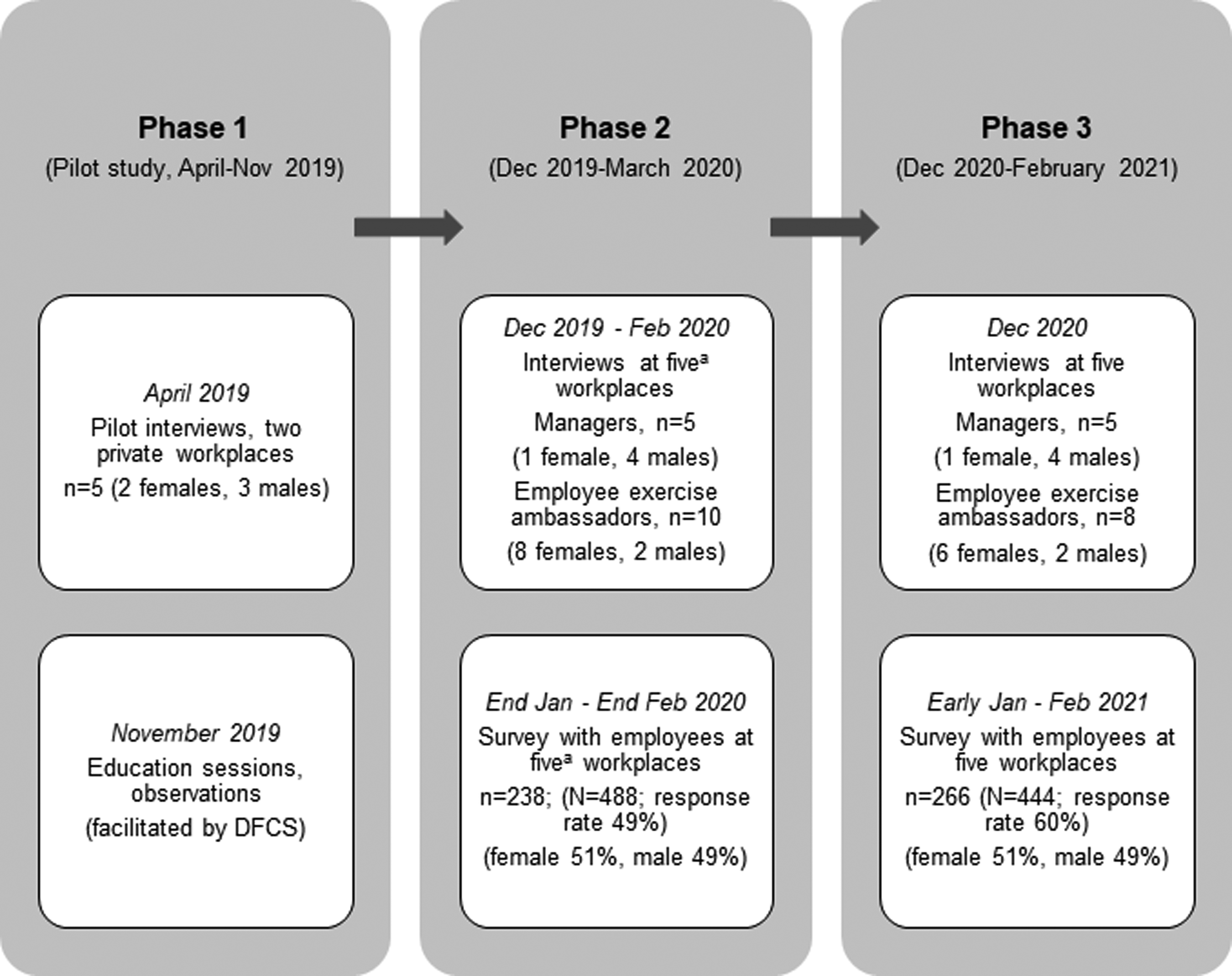
Overview data collection and process. aA public service department that withdrew early in the project (March 2020) is not included in the figure or in the article.
Procedure and participants
Five workplaces recruited by DFCS were included in the study. The workplaces comprised two private production companies (furniture and insulation products), and three workplaces delivering public services (healthcare, municipal administration, and waste and renovation) situated in towns and villages in rural areas of Denmark. See Figure 1 for an overview of data collection. During one-day education sessions in phase 1, one manager and two employee exercise-ambassadors from each workplace were recruited for phase 2 interviews. During phase 3, the same group of managers and employees (except two) were interviewed again by the second author. In phase 3, eleven of the thirteen interviews were conducted online due to Covid-19 restrictions. Interview length varied between 25–45 min. Interviews were conducted in Danish, transcribed verbatim and anonymized. The quotes in this article were translated into English by the authors. The quantitative data was collected in phase 2 and 3: All the employees offered activities initiated by ‘exercise-ambassadors’ were invited to participate in the survey, regardless of whether the employee had taken part in exercise-ambassador initiated activities. Inviting all employees allowed us to identify barriers and reasons for not participating in the exercise activities at work. The surveys were distributed anonymously. The first survey (response rate 49%) was distributed 3–4 weeks after the exercise initiative was first introduced at the individual workplaces. The second survey (response rate 60%) was distributed just after the project with exercise-ambassadors initiated activities was finalised in January 2021 (Figure 1). The response rates are judged satisfactory for web-based questionnaires distributed to all employees, thus including employees not participating in exercise-ambassadors’ activities who might be less likely to reply (Table 1).
Overview of participants, answer rate, percentages of all possible employees participating in the PA activities and answering the survey, proportion of the respondents participating in PA activities.
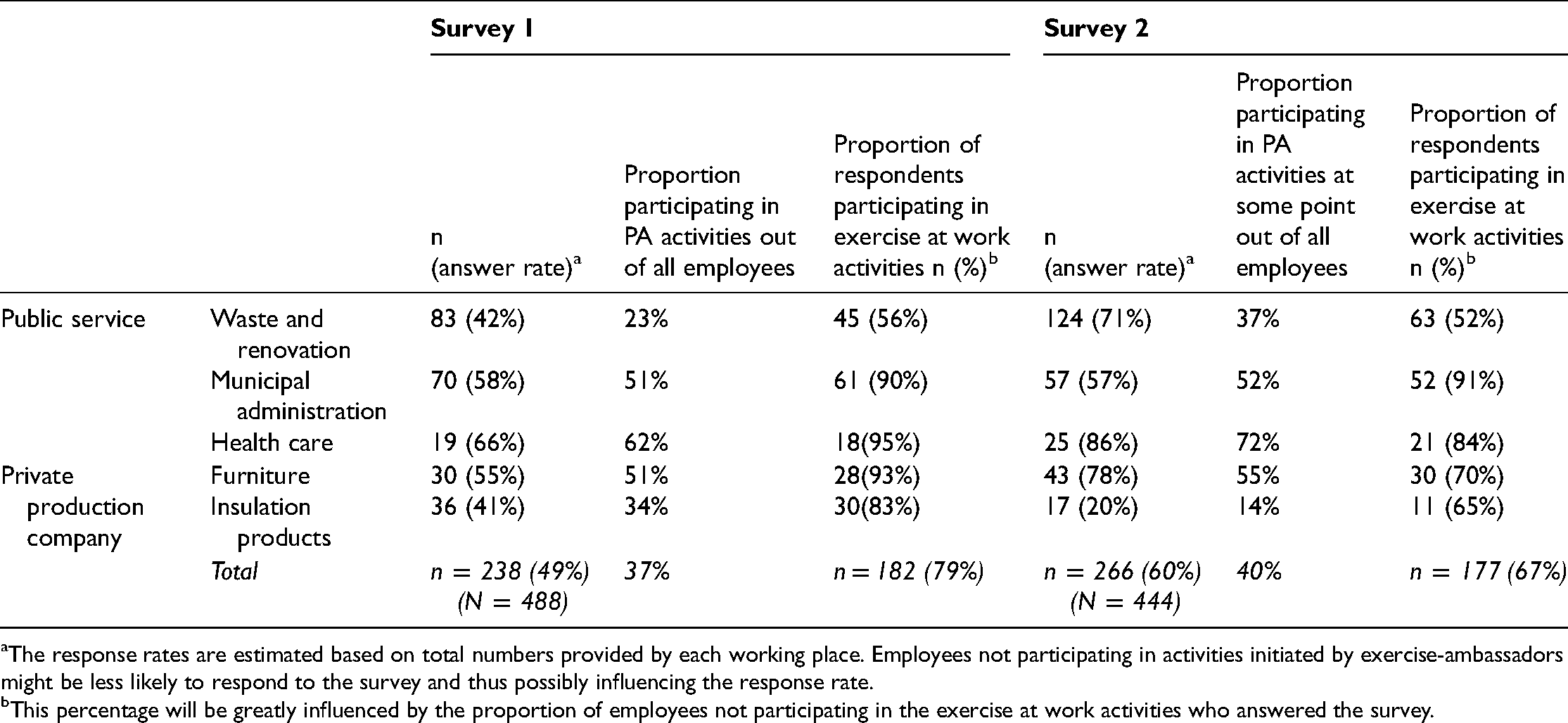
The response rates are estimated based on total numbers provided by each working place. Employees not participating in activities initiated by exercise-ambassadors might be less likely to respond to the survey and thus possibly influencing the response rate.
This percentage will be greatly influenced by the proportion of employees not participating in the exercise at work activities who answered the survey.
Measures
The questionnaires assessed employees' self-evaluated PA and health, experiences and perceptions of exercise-ambassador activities; the influence of the activities on the working environment; motivation and barriers for participation in activities. Additional items and questions measuring the impact of Covid-19 on activities and evaluation of the changes were integrated in the second survey. Open and closed-ended questions were included. The survey questions were developed drawing on findings from interviews previously conducted and research around exercise at-work-programmes (Coulson et al., 2008), PA and social identity (Stevens et al., 2017) and experiences and motives for PA/exercise (e.g. Kendzierski and DeCarlo, 1991). Survey questions are available on request to the first author.
The semi-structured interviews included questions related to Covid-19 and followed up on insights gained during phase 2 interviews. The questions aimed primarily to obtain first-hand impressions from managers and employee exercise-ambassadors by asking: How the lockdown was communicated by the leadership, how they experienced the lockdown, whether they evaluated activities in their original format could have proceeded, if they felt insecure, and if they experienced pressures from external actors regarding how to handle activities.
Data analysis
The quantitative data analysis: The data were analysed using SPSS 27. Descriptive data were reported as frequencies and percentages. Bivariate distributions were used to examine whether experiences with manager, exercise-ambassadors and workplace handling of Covid-19 depended on continued engagement in activities during Covid-19. Differences were assessed using chi-square (χ2) tests.
The qualitative data analysis: All answers to the open-ended questions from survey two were read (n = 684) to identify the qualitative statements from employees related to perceptions and experiences regarding issues around Covid-19 and the subsequent activities, different forms of impacts, barriers and conflicts, and the role of managers and exercise-ambassadors during Covid-19. The analysis of the semi-structured interviews was informed by the theoretical design as a lens for understanding what was at stake during the Covid-19 disruptions. The idea is to transcend a deductive/inductive binary and allow the theoretical framework to engage in a critical dialogue with empirical material (Alvesson and Kärreman, 2007). A central focus coinciding with the second research question guided the reading of the interview transcripts (equivalent to a coding process). Following our theoretical argument of logics multiplicity (Besharov and Smith, 2014), our interview focus provides insights into the relations between employees, ambassadors, and managers which are used to discuss interplays between logics and new constellations in the wake of Covid-19. Hence, in the coding we focused on issues related to co-existence, as well as on frictions and contradictions between logics.
Findings and discussion
To address our research questions we present, discuss, and link our qualitative and quantitative findings in relation to themes or ‘knots’ (Mason, 2006) with regard to the implementation of exercise-at-work and Covid-19 changes, our theoretical framework and existing studies in the field. Following a brief description of participants, the first research question will be addressed in the section: “Altering logics? Employees' perceptions and experiences of change due to Covid-19” and the second research question in the section “The interplay of institutional logics and new constellations in the wake of Covid-19”.
Exercise-at-work programme and participation characteristics
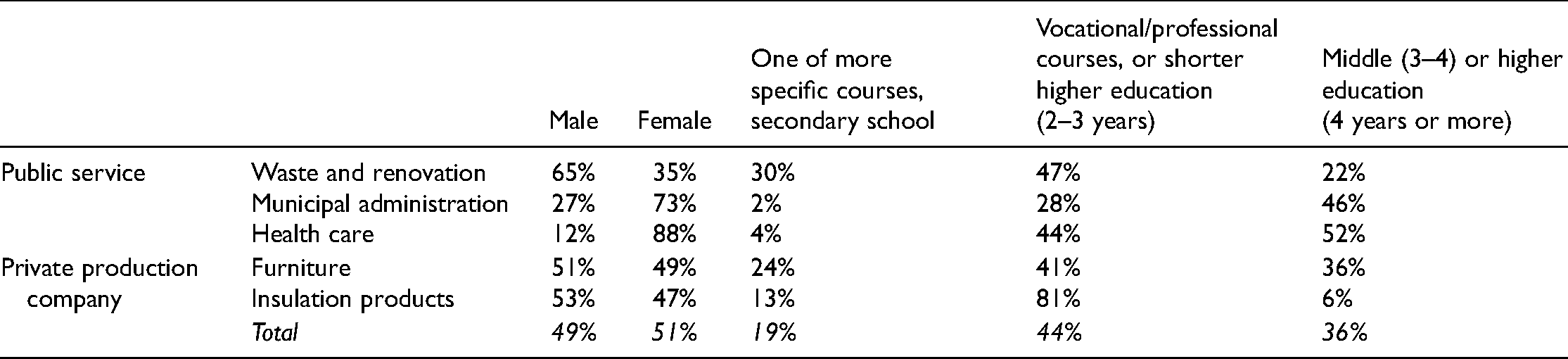
Table 1 provides an overview of answer rates and participation in activities initiated by exercise-ambassadors in the survey 1 and 2. The proportions of gender, length and type of education (Table 2), and self-evaluation of the physical demand of work (Table 3) varied between the five workplaces. The wish to reach groups not active in sports/exercise (Engell and Ibsen, 2021) via the exercise-at-work programme may have been partially successful, as 39% (survey 1) and 56% (survey 2) of the respondents participating at exercise-ambassador activities did not regularly exercise outside working hours (no differences between genders were identified) (see Table 3 for details regarding each workplace).
Participant characteristics – second survey.
Overview of participation and experiences among employees engaged in exercise-at-work activities at the five workplaces before and after COVID-19 lockdown.
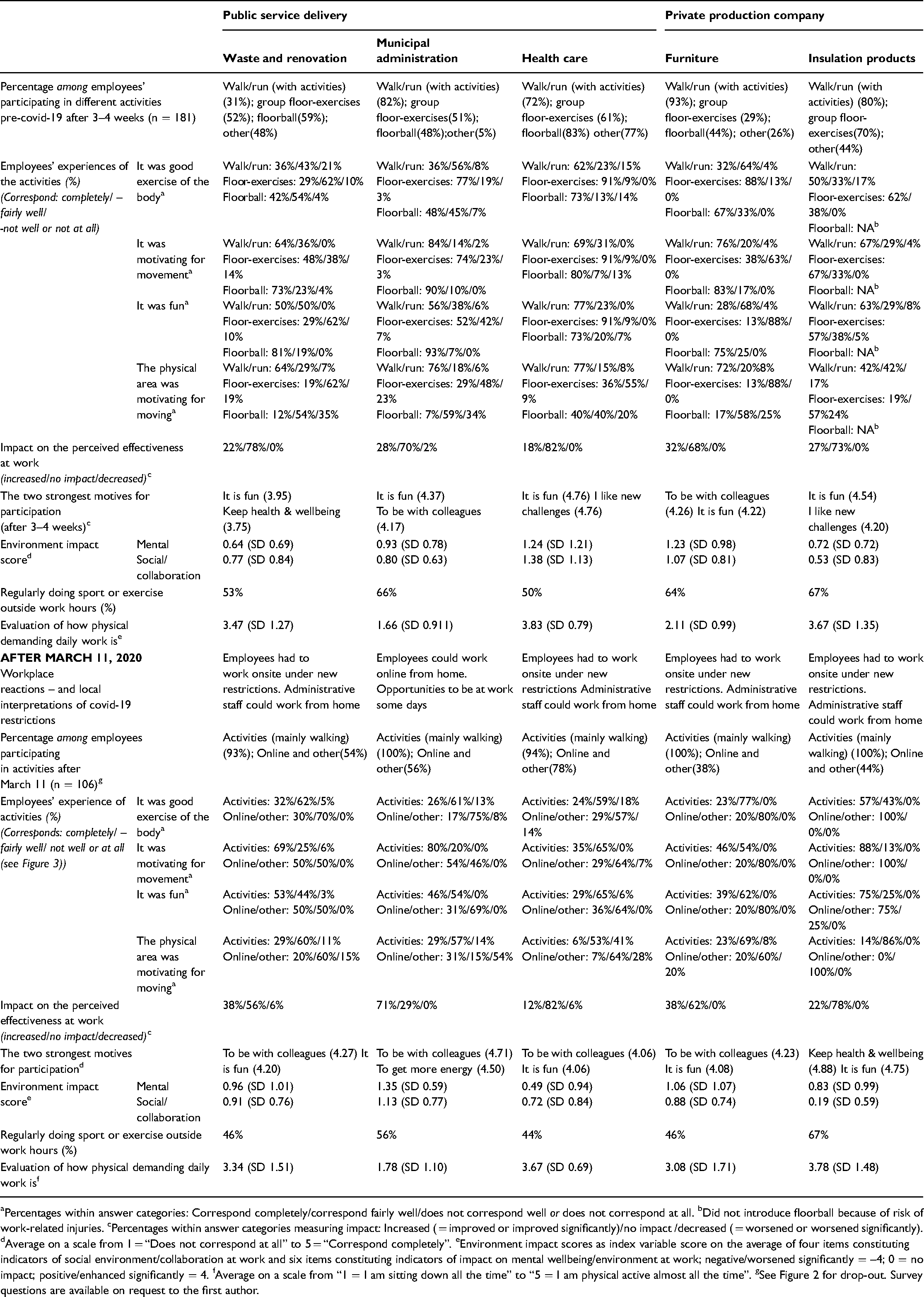
Percentages within answer categories: Correspond completely/correspond fairly well/does not correspond well or does not correspond at all. bDid not introduce floorball because of risk of work-related injuries. cPercentages within answer categories measuring impact: Increased ( = improved or improved significantly)/no impact /decreased ( = worsened or worsened significantly). dAverage on a scale from 1 = “Does not correspond at all” to 5 = “Correspond completely”. eEnvironment impact scores as index variable score on the average of four items constituting indicators of social environment/collaboration at work and six items constituting indicators of impact on mental wellbeing/environment at work; negative/worsened significantly = –4; 0 = no impact; positive/enhanced significantly = 4. fAverage on a scale from “1 = I am sitting down all the time” to “5 = I am physical active almost all the time”. gSee Figure 2 for drop-out. Survey questions are available on request to the first author.
Unlike James and Zoller's (2018) findings, employee resistance towards exercise-at-work during working hours was not dominant in the current study. Only 6% of the employees surveyed disagreed that it was a good idea to have exercise/PA during working hours, the majority (80%) regarded exercise/PA during working hours as a good idea, while 14% were somewhat supportive. This suggests that most employees perceived the workplace exercise programme as ‘supportive’ rather than a workplace interference in personal life. That said it should be recognised that employees critical towards exercise during paid work time might refrain from answering the survey.
In line with Mutz and Gerke (2021), our results indicate marked differences in the impact of the Covid-19 situation on PA levels, with one third of employees experiencing decreased fitness (33%) and PA levels (36%). A small majority experienced no impact on their fitness (60%) or PA levels (55%) and only a few felt they increased their fitness (7%) or PA levels (9%). The polarisation tendencies were more pronounced among women than men. Experiences of decreased fitness (47%) and PA levels (54%) were particularly high among employees who stopped participating in the exercise-at-work project after March 11. Employees’ answers in open-ended survey-questions about the general impact of Covid-19 indicate the polarisation of opportunities for exercise/PA and provide explanations for changes due to the varied personal impact of Covid-19 lockdown. Some experienced negative impacts on mental wellbeing of the lockdown of sports facilities/sports clubs and time constraints (e.g. home schooling of children, extra work because of Covid-19). Others experienced positive impacts, such as more time when working from home and increased exercise or PA levels.
Altering logics? Employees' perceptions and experiences of change due to COVID-19
A total of 181 respondents had participated in exercise-ambassador activities before the first Covid-19 lockdown (Table 1). The early activities were generally positively evaluated by employees in relation to experiences of the activities and participating. However, the facilities and surroundings were often not regarded as motivating for exercise/PA (Table 3). Between 18–32% felt participating in activities made them more effective at work and employees often experienced the activities positively influenced collaborations and the social and mental environment at work (Table 3). These findings suggest that exercise-at-work, by improving some employees' perceived effectiveness in work, support a logic of profession, which obtains its legitimacy through personal expertise related to the craft. Simultaneously, it positively affected collaborative elements derived from a community logic.
The originally standardized activities with floorball, walking with play-like activities, and gymnastics-like floor-exercises were stopped abruptly or changed in delivery after 11th March 2020 and various forms of walking and digitally promoted activities (Teams/Zoom training group sessions and tutorials for individual exercises) were introduced (Table 3). In this context the activities initiated by the exercise-ambassadors cannot be defined as institutionalized as this requires a certain repeated pattern to emerge (Jepperson, 1991). Simultaneously, our findings illustrate how an ‘environmental shock’ (Jepperson, 1991) leads to rapid organisational changes.
The five workplaces implemented different adaptions during the periods of lockdown, re-opening, and the new restrictions during the 2nd wave. While staff from the municipal administration could work online from home, the remaining four worksites (except administrative staff) had to work onsite under new restrictions (Table 3). A total of 106 respondents participated in PA/exercise activities during working hours after March 11, with 83 participating throughout the entire period (2020), and 23 only after March 11. Seventy-one respondents reported only to have participated before March 11. Respondents from the furniture company and the municipal administration in particular seem to have experienced barriers for (continued) participation after March 11. No gender differences were identified (Figure 2).
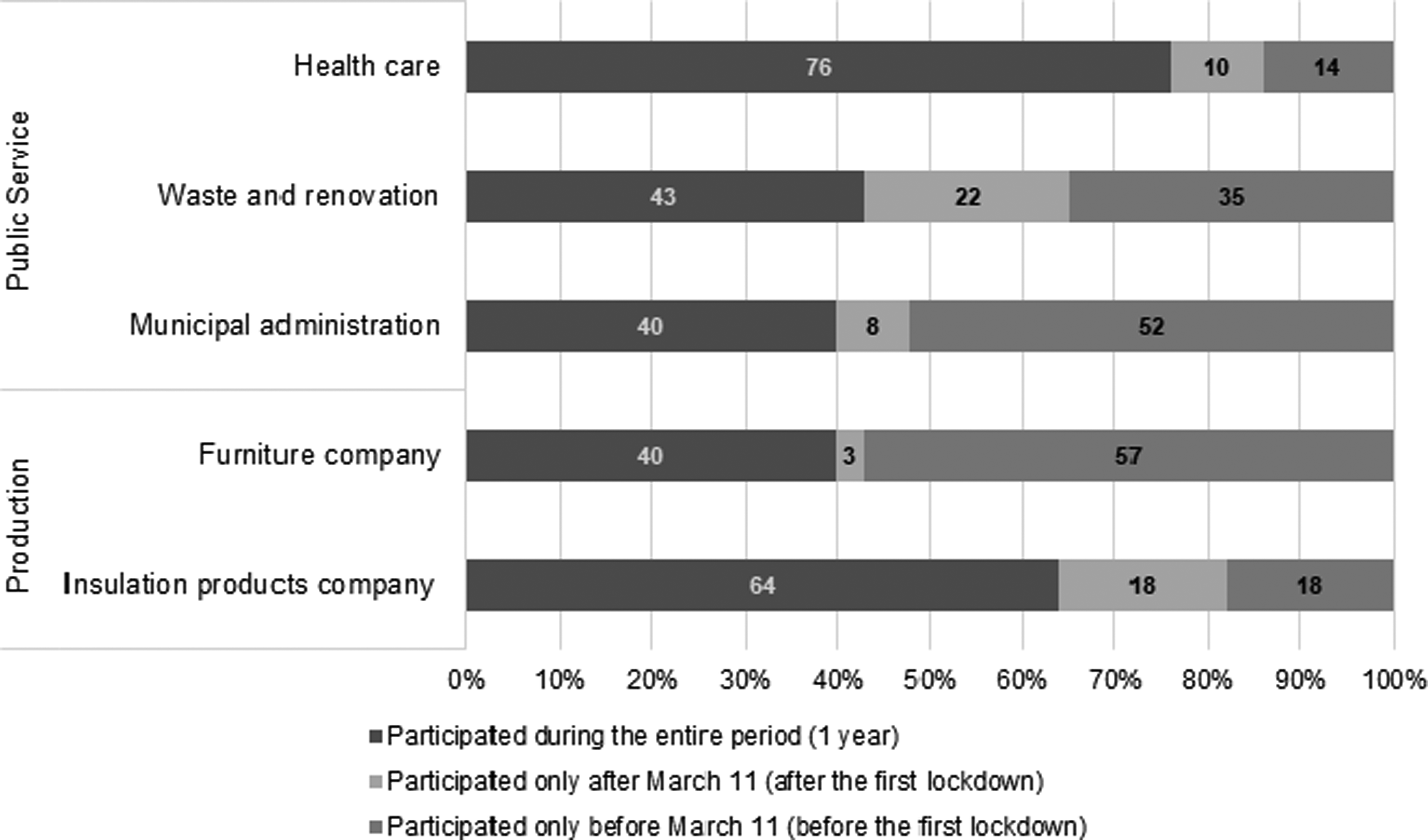
Participation in PA and exercise activities during working hours before and during the pandemic, listed according to working place; n = 177 (83 participated the entire period; 23 only after March 11; 71 only before March 11). There were no gender differences between employees only participating before March 11 and those participating during the COVID-19 period (p = 0.811).
Reasons and barriers mentioned by employees in response to open-ended questions about stopping participation in activities after March 11 were related mainly to there being fewer activities available, or to periods of stop/standby in exercise/PA activities and Covid-19 related changes in working conditions. Broadly in line with tendencies shown in other studies (Ibsen et al., 2021; Mutz and Gerke, 2021), Covid-19 seemed to increase polarisation by creating unequal opportunities for exercise during working hours among employee groups, with increased working constraints or cessation of activities for some. However, most respondents participating in the altered activities during Covid-19 restrictions were positive despite the change in format (Table 3, Figure 3) and several respondents stressed that keeping some activities going was an advantage: We have tried to keep certain activities, but because most of our colleagues have been sent home it has been very difficult to follow the plan and do the activities according to the plan. Therefore, we only had a couple of activities. But those we had have been very good. (female employee, furniture)
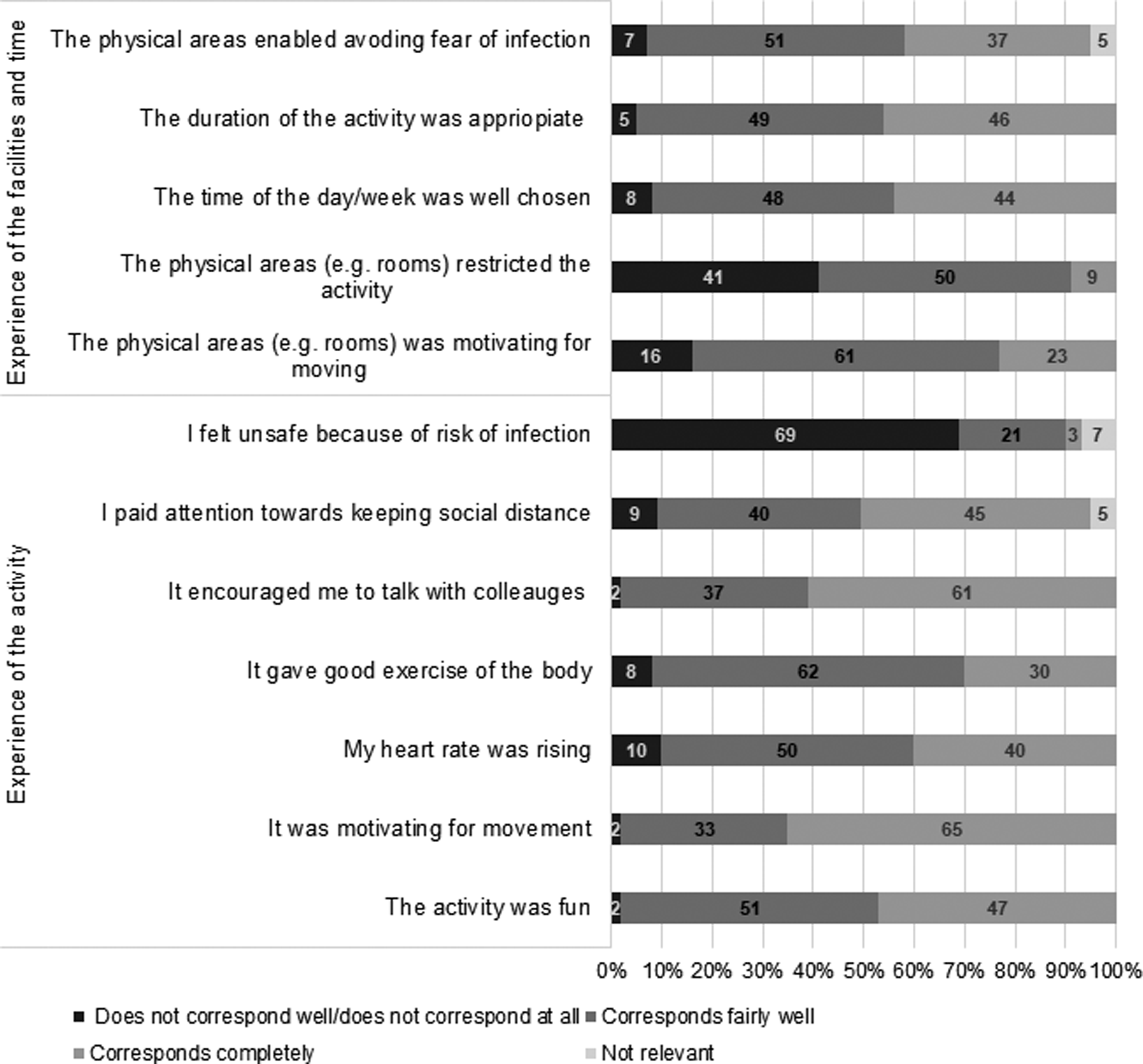
Experiences with PA and exercise activities initiated by exercise-ambassadors (excl. online activities) among employees participating the entire period, or only after March 11 (n = 86–100) (Respondents were asked how the statements corresponded to their experience of participating in the activity/activities).
Being sent home has not made it easy. During a period, we met at work one day a week – then we placed a good, long walk that day. Generally, I actually think the walks were the best with colleague-exercise, and here it was easy to keep social distance. We have very good surroundings for walking very close to the workplace, so it worked well. (female employee, municipal administration)
Particularly employees from the municipal administration felt their effectiveness in work increased when exercising during working hours after March 11. Interestingly, this group often worked from home and had low self-evaluated scores on physical demands of their work (Table 3). The differences in the nature of work might help explain this finding: desk-based workers can feel a greater need for PA breaks, whereas for employees engaged in physically demanding work it can become an overload. These findings might be interpreted as supporting the importance of correctly balancing the exercise-load with the physical demands of the work (Holterman et al., 2019).
Other themes identified by open-ended questions related to the interpretation of the changed signals of how managers communicated guidelines to employees for taking time for exercise during working hours, but also how self-organised bricolage (Campbell, 2004) activity with colleagues occurred during the pandemic. Several respondents elaborated on how they liked the change in activity or the new forms of activities. Walking with colleagues was considered enjoyable: We look forward to the walks and have kept these up regularly during the lockdown, by meeting at a beach, a lake, or forest to go for a walk outside, while simultaneously seeing each other. (female employee, municipal administration)
The quantitative findings also indicate that employees participating in activities experienced a positive impact on work environment with sometimes higher environment scores on social/collaboration and mental wellbeing at work (compared to before March 11), particularly among employees from waste and renovation and from the municipal administration (Table 3). These experiences support values and practices ascribed to a community logic, which might play another role during the Covid-19 pandemic because of changes in the organization of work, and the social and mental impact of lock-down/isolation and restrictions. This notion is also supported by the finding that “being with colleagues” became the strongest motive for participating in four workplaces (Table 3). Additionally, considering the sometimes negative impact of the lockdown on wellbeing and loneliness (Varga et al., 2021), the appreciation of social aspects of activities (reinforcing community logic values) may increase. In this context, walking with colleagues – without any activities during the walk due to Covid-19 restrictions – was ‘inclusive’ for some, as employees not usually attending joined once they found out they would just go for a walk. However, the lack of physical challenge and/or competition elements was missed by some employees. Floorball was highlighted as an activity that was missed, which was expected in that floorball (before the pandemic) was more often evaluated as fun than other activities (Table 3). Online activities were often perceived as less motivating than face-to-face exercise with colleagues, but were considered a good alternative during the pandemic (Table 3). The only activity after March 11 has been walking because it was possible to keep social distance. Really good to be able to walk with colleagues – to talk and to move. Though it is a pity that there were no other activities – particularly floorball was fun and made your heart rate raise. During the period of homeworking, it has been limited with activity because it has not been possible to do it together, and there have only been online activities with colleagues. It is not as motivating to attend online activities yourself. (female employee, municipal administration) Some colleagues have expressed that they lack the challenge at the physical level – which to me was a worrying factor (due to Covid-19), because they wanted floorball and similar to be re-introduced. (female employee, health care)
The concerns about risk of infection and aligning behaviour to governmental recommendations were prevalent among Danes (Varga et al., 2021). Additionally, interacting in a society characterised by high levels of social trust (the world's highest levels on average from 2002–2018; European Social Survey) while not being compliant with government social distancing recommendations, which can occur when exercising in a group, might cause feelings of guilt or concern. Our results showed that the implementation of safety measures, such as changes in activities and social distancing, seem to have been mostly successful. Only a small minority (7%) felt that the physical space was insufficient to prevent fear of infection. In line with Varga et al. (2021) findings that Danes adapted quickly and avoided crowded places, most respondents (85%) reported they paid attention to social distancing while participating in exercise during working hours. However, 24% of employees participating in activities reported that they exercised despite feeling somewhat unsafe during the activity because of the risk of infection (Figure 3), and one employee stressed there was great uncertainty around the activities and what was allowed. The finding that one quarter exercised despite feeling somehow unsafe during the activity because of the risk of Covid-19 infection, might suggest that the activities had gained some momentum before the lockdown. It may also be interpreted as an indication of increased social pressure or imposed external expectations for bodily control during the pandemic (e.g. public campaigns to do PA/exercise) that are internalised as bodily self-regulation through exercise (Malcolm and Velija, 2020), which are stronger than concerns for risk of infection. Hence, effects of a state logic's public health theme encouraging PA might be identified as well. Importantly, the survey-question addressed concerns about risk of infection during the activity, and therefore cannot quantitatively determine the extent to which such worries may have worked as a reason to refrain from participating after March 11. However, all participants were asked about barriers and experiences in open-ended survey-questions. While some elaborated on Covid-19 related barriers such as changed life circumstances, mental wellbeing, extensive workload, and “Covid-19” was mentioned as a barrier/reason for stop participating, only a few explicitly expressed worry about risk of infection as a barrier.
The exercise-at-work initiative can, partly, be characterized as momentum lost as empirical insights indicate a sudden decline/change in focus and opportunities of activities. Thus, our study corroborates the findings of Varea et al. (2020), illustrating how workplaces, like schools, suffered from constraints regarding providing PA/exercise, and how a decrease in PA/exercise occurred for many (Mutz and Gerke, 2021). However, it can also be argued that momentum changed: findings illustrate that the crisis and the new demands led to several alternative models of PA and exercise (adapted at some workplaces), due to mechanisms of bricolage among smaller employee groups and the increase in social/collaboration environment score in some workplaces. We interpret this as the strength of the community logic: despite the short period of the exercise-project before Covid-19 lockdown, community elements such as valuing exercise together with colleagues survived in other organizational forms. An explanation for the enduring effects might also be found in the combination of societal influences during Covid-19, existing civil society associations and movement cultureś strong embeddedness in a community logic (Bairner, 2010). The mobilisation of civil society after March 11 was urged by political calls for “civic mindedness”. This encouraged solidarity, social responsibility, and community feelings and the high levels of social trust may have worked to facilitate this call, which enabled a community logic in work settings. Moreover, media promotion of community logic (e.g. “community-singing” and “Together in Movement”) might also contribute to enduring effects at work.
The interplay of institutional logics and new constellations in the wake of COVID-19
Managers and exercise-ambassadors unanimously described that their workplace had a good start implementing exercise during working hours prior to the first lockdown. I believe we had created a good offer that could accommodate a relatively broad group of employees and I think there was good support to join – also from management. (Anders, manager) It is simply not whether employees are able to exercise for one hour during work hours that is at the fore. So, we downplay the importance of it [exercise] here [at the workplace]. (Flemming, manager)
The employees with experience of participating varied in their perception of their line manager's involvement and handling of Covid-19 (Figure 4). A majority (59%) did not feel their line manager had inspired them to exercise after the first lockdown. Additional analysis showed that respondents (83%) who only participated in activities before March 11, were more likely to disagree that their line manager had inspired them after March 11 (compared to 46% of those participating (also) after March 11, p < 0.00). This may suggest the line manager plays a pivotal role for continued engagement in new activities during a crisis. It illustrates how a corporate logic that emphasizes the market position of a workplace/company, i.e. its core activity, gradually prevails as Covid-19 accelerates and how it forms and influences the individual behaviour of managers. However, one employee provides a contradicting statement, expressing how the manager put too much pressure on exercising, which demotivated some employees from taking part in activities. Feeling forced to participate might sometimes be interpreted as an example of blurring the boundary between leisure and work (McGilivray, 2005) as some can experience the voluntary exercise-at-work community activity as akin to a required work task. Additional analysis revealed that employees who discontinued activities after March 11 often did not feel their workplace was good at: continuing with exercise/PA during working hours after March 11 (75% vs. 27% who participated (also) after March 11; p < 0.00); in organizing exercise activities in a way that met Covid-19 restrictions (59% vs. 17%; p < 0.00); or adapting overall to the new situation after March 11 (38% vs. 10%; p < 0.00). These findings suggest that the way the workplace handled Covid-19 might have prevented some employees from engaging in the activities after March 11. The assessment of the workplace reactions may, in some situations, be a result of manager and exercise-ambassador decisions. The fact that many employees had reservations regarding the role of managers in handling PA/employee-exercise and Covid-19 supports studies on managers during the pandemic (Sanders et al., 2020) showing the period was characterized by unprecedented demands on managers under very uncertain conditions.
Results showed that employees often had positive experiences of exercise-ambassadors regarding their role during exercise activities (Figure 4). However, 42% experienced that exercise-ambassadors did not adapt well to the Covid-19 situation in terms of initiating activities and motivating during the periods of lockdown. Additional analysis illustrates that respondents (71%) who only participated before March 11 were more likely not to regard exercise-ambassadors as being good in encouraging activities after March 11 (vs. 33% of those who continued participating, p < 0.00). Responses to open-ended questions illustrate how some employees felt their exercise-ambassador motivation and engagement had faded. However, the opposite development was stressed by one employee (who preferred to work and not exercise), but experienced the exercise-ambassador's enthusiasm as pressure, so it became more stressful to say ‘no’ to the exercise-ambassador than to participate in the exercise.
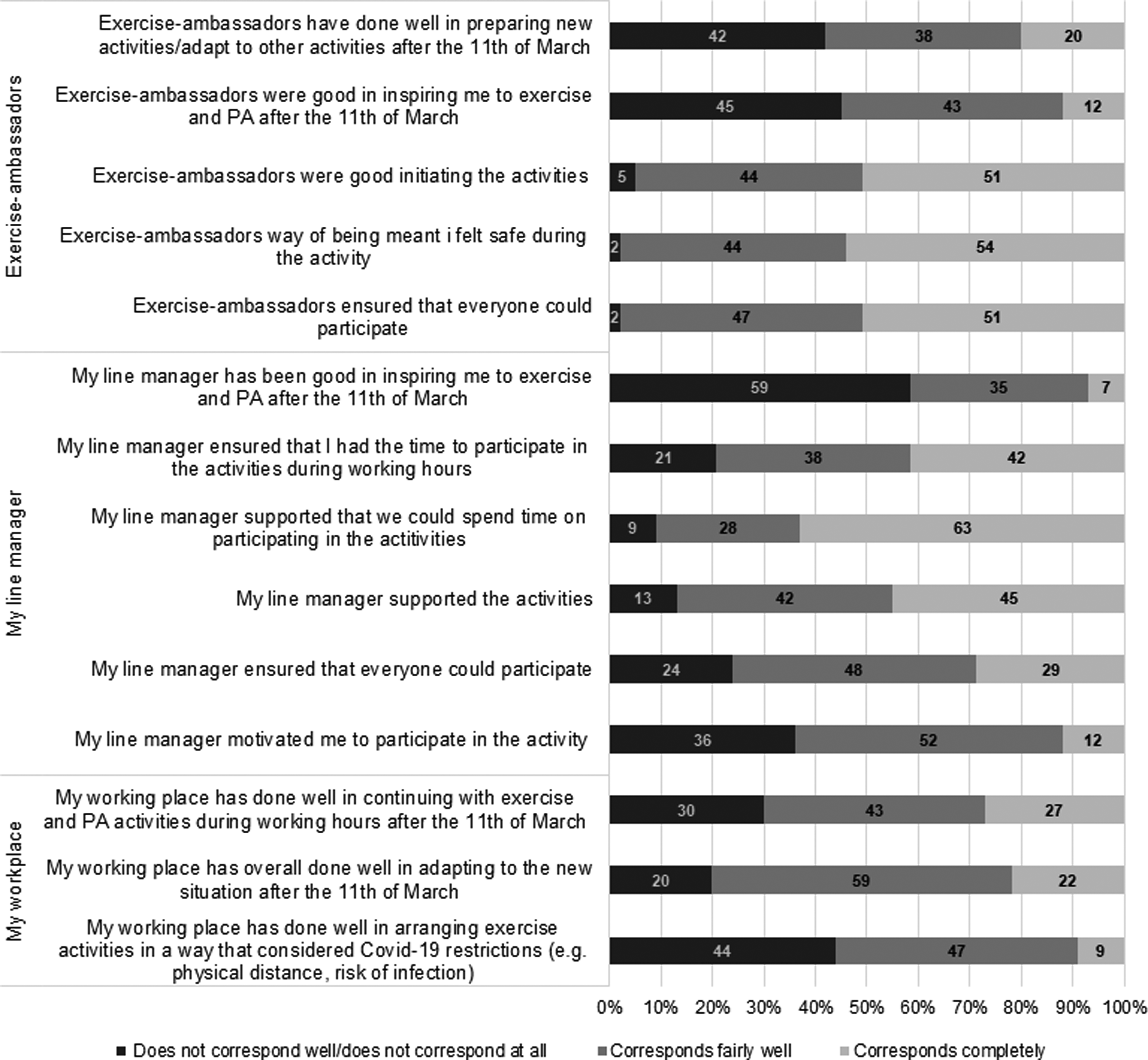
Employees’ experiences of employee exercise-ambassadors, the line manager, the workplace involvement, and handling of the situation in relation to physical activity/employee exercise. The figure includes respondents who had experience of participating in exercise/PA initiated by employee exercise-ambassadors. (n = 116–147) (Respondents were asked how the listed statements corresponded to their experiences).
As argued, the design where employees act as role models (Edmunds and Clow, 2016) draws on elements associated with a community logic, such as voluntarism (Bairner, 2010) and play (Costea et al., 2005). Nevertheless, responses on the micro-level, with self-organised exercise with colleagues, indicate that employees blended, twisted, and interpreted existing elements as a bricolage mechanism (Campbell, 2004) and, when working tasks and restrictions allowed it, that the community logic had some enduring influence. Some employees enjoyed the new flexibility, do-it-yourself initiatives flourished, and new interpretations of exercise-ambassador initiatives continued to run independently in some situations. This suggests that although the original model was considered successful by managers, exercise-ambassadors, and many employees before Covid-19, the altered crisis models with increased flexibility compared to the “original model” may potentially enhance the exercise-at-work programme and motivate more employees to join. Accordingly, a new constellation, slightly different but with similarities to an existing order of logics, arises.
Simultaneously, the model relying on physical presence of exercise-ambassadors and a sense of community was challenged by a situation where some employees worked from home using digital technologies whilst others remained at work subject to new restrictions. Consequently, some exercise-ambassadors felt they could not perform their best. Social distancing and online communication were barriers: It was a bit hard socially [..] I could feel when I was sent home that it declined in terms of how I could express myself. (Lotte, exercise-ambassador)
I didńt always feel I was the best role model. (Maria, exercise-ambassador)
Covid-19 created an unstable and dynamic inter-institutional order, for example, working from home makes a hitherto marginal family logic become influential in work situations. Increased imposed voluntary work (particularly for women) during Covid-19 (Andersen et al., 2022) combined with the society-enforced lockdown of schools and home-schooling of children increased gender inequality and changed priorities and opportunities for engaging in activities. Qualitative insights from some employees in response to open-ended survey-questions similarly suggest that the family logic particularly for women sometimes became predominant during lockdown and prevented some employees from taking part in activities when working from home. Hence, the family logic imposes constraints and reproduces existing pattern of time bind (Emslie and Holt, 2009; Hybholt et al., 2022).
While all managers interviewed retrospectively expressed that the lockdown constituted a radical new constellation, some reflected that activities could have continued in a format much closer to the original: I believe that what takes place outdoor, for instance a walk or a ball game, could easily have been carried out because there is no physical contact as such. (Linnea, manager) I feel if you can walk around 110 persons all together then you can [continue activities]. Whether you walk together inside the factory or you walk outside I believe does not make a difference. But there we did not completely agree. (Jens, exercise-ambassador)
Asked explicitly about pressure from outside, this also highlights the hierarchal structure in a critical situation: Of course it is management that made the decision that we should not continue with the exercise. But there has also been an understanding from all parties because everyone was uncertain regarding the circumstances, so it is not that we believe it was not the right decision back then. (Vibeke, exercise-ambassador)
Conflicting statements in response to open-ended questions suggest that employees experienced the lockdown – and signals and expectations from management – differently. For example, one employee explained that the introduction of colleague-exercise before Covid-19 led to a change in discourses that was still apparent after lockdown: We have been sent home most of the year after March 11, so it has been limited how much I have been physical present at the workplace. But because we had had a period with colleague-exercise before the lockdown there was a discourse around that it was okay to go for a walk during working hours, while working from home, and this has been nice. (female employee, Municipal administration)
However, the increase in workload because of Covid-19, and perhaps changes in signals from management around support of the activity, impacted other employees, causing feelings of guilt for spending time on exercise during working hours. Hence, this indicates that the co-existence of a community logic with the new dominating regime is not as easily compatible as prior to Covid-19: [I have a] bad conscience with regard to manage working tasks as a consequence of the lockdown [this] has led to me have a bad conscience for exercising during working hours. (female employee, municipal administration)
Conclusion
The study applies a multi-dimensional mixed-method approach and draws on multiple institutional logics perspective to explore how employees, managers and exercise-ambassadors perceived and experienced the changes to the exercise-at-work project caused by Covid-19 restrictions, and how changes lead to logics' interplay and new constellations. The study suggests that prior to the Covid-19 lockdown most employees at the five workplaces had positive experiences of participating, and environment impact scores on how activities influenced the social environment/collaboration and mental environment were positive. The Covid-19 changes altered the delivery and type of exercise, and the situation created a polarization of employees’ opportunities for engaging in exercise at work. Once the pandemic dominated the public agenda, managerial values and interests in the core activity of the workplace (i.e. formed and influenced by a profession and a corporate logic) gained a dominant position at the expense of employee-ambassador initiated activities (i.e. elements adopted from a community logic). Transforming a community logic from a geographical destination to digital affiliation (Almandoz et al., 2017) was a challenge for exercise-ambassadors' promotion of exercise/PA. Some employees participated in exercise requiring physical presence despite fear of Covid-19 infection. Among those employees participating experiences were still mainly positive, and the social/collaboration environment impact scores were sometimes higher than before Covid-19. This suggests that the social aspects of exercise with colleagues might have been important during lockdown and restrictions, and the findings support that the community logics endured despite the changes in activities and delivery. Hence, our study supports the idea that PA/exercise can transcend a productivist imperative by emphasizing community elements (Costea et al., 2005). Due to employees adopting a bricolage practise, new constellations of self-organised adaptions of colleague-exercise and alternative models emerged. This illustrates the strength and enduring effects of a community logic, which influenced workplace exercise/PA programmes, despite these only having been in place a short period before the Covid-19 restrictions. Covid-19 created an unstable and dynamic inter-institutional order, for example working from home increased the influence of a family logic in work situations. A family logic represented constraints and may have reproduced existing gendered time binds. Therefore, working from home does not necessarily foster inclusivity for women. Our study indicates that managerial power and pressures affect exercise-at-work, which became evident once profession and corporate logics became dominant in the wake of Covid-19 restrictions. Logics multiplicity can inspire future research and practitioners to view exercise-at-work as multi-dimensional, considering how elements emerging from a community logic facilitate and enable exercise activities at the workplace in a sustainable manner, which can endure despite unforeseen and uncertain conditions.
Footnotes
Declaration of Conflicting Interests
The author(s) declared no potential conflicts of interest with respect to the research, authorship, and/or publication of this article.
Funding
The author(s) disclosed receipt of the following financial support for the research: This work was supported by the Danish Foundation TrygFonden.
