




Abstract
Association football has been viewed as an industry with considerable lucrative career prospects; however, this has not prevented the use of unpaid staff throughout football in the UK. There has been increasing academic research regarding the professionalisation and commercialisation of football, yet there has been little acknowledgement of the role of those working in football in an unpaid capacity. Therefore, this paper examines the culture of unpaid work in football scouting, by exploring the motivations of 12 unpaid scouts at professional clubs, from a figurational perspective. Our findings suggest that scouts want to work in the industry because of their ‘love of the game’, in a ‘quest for excitement’ in their career. Unpaid work was in the pursuit of experience and contacts, the latter of which was highly valued in the industry. Football clubs are enclosed figurations and the scouts placed importance on developing interdependent social relations to gain entry to the industry, demonstrating how football may be perceived nepotistic. The likelihood of gaining a paid role directly from an unpaid position was low and therefore the decisions to continually accept unpaid work represented the notion of fantasy-laden thinking.
There has been growing research concerning men's professional football clubs and those who comprise them, however, there has been limited exploration of the important role of football scouts therein. Football scouting refers to individuals watching matches to collect information, either through identifying talent or analysing opposition teams (Nutt, 2007). The financial rewards for successful on-the-pitch performance have risen in recent years and wages and transfer fees have escalated (Platts and Smith, 2010). As such, ‘scouting’ has become a key position in attempting to develop financial and performance-based success. The role of a scout has developed considerably, incorporating aspects of sports science and performance analysis, becoming more specialised (Kidd, 2020). The Football Association (FA) introduced talent identification courses in 2016 (The FA, 2016) to teach ‘good practice’ within football clubs and enhance knowledge of recruitment processes. This was in part to encourage greater professionalisation of the role of a scout, which demonstrates the perceived importance of this role. Despite this, many scouts work for free.
Unpaid work across football is relatively common internationally. Across Scandinavia, voluntary work is deeply rooted within recreational sports clubs, and, for example, football only became professional in Norway in 1991 (see Seippel, 2010; Tuastad, 2019). Similarly, in Germany (Wilkesmann and Blutner, 2002), Switzerland (Schlesinger et al., 2019) and Denmark (Bennike et al., 2020), football has traditionally been included in the voluntary sector, with some elite sports clubs utilising volunteers. The game in England, on the other hand, has long been associated with professionalism. Most clubs are private organisations receiving external funding (Deloitte, 2021). As Dobson and Goddard (2011) state, by 1921, all but two of the English football league's 86 members were private companies, and contemporarily, all but three (Exeter City, Newport County and AFC Wimbledon) of the 92 league clubs are partially or fully funded by private investors (Football Supporters’ Association, 2021). Despite this, unpaid work, even in elite men's clubs in England, exists, particularly in non-player related operations such as office work and media positions. Player-related roles in coaching and healthcare, in English professional clubs at least, are much less likely to be unpaid. Therefore, the role of an unpaid scout is of interest, and we argue that examining the role will help to understand the culture of unpaid work within football in England more adequately. Unpaid work in sport has previously come under scrutiny, with the British Association of Sport and Exercise Sciences (BASES) arguing that there is an increasing trend for unpaid internships and work in sport, which ignores the concept of mutual benefit (Pye et al., 2013). BASES is critical of such unpaid internships, however, there are no laws in England directed at the payment of interns and, thus, organisations can class individuals as volunteers rather than workers to avoid providing remuneration. The Taylor Review (Taylor et al., 2017), conducted on behalf of the United Kingdom (UK) government, argued there is a need to clarify the laws regarding unpaid work due to their vague and exploitative nature, describing contemporary unpaid work as an ‘abuse of power by employers’. The fact unpaid work is still prevalent in England, and common across professional football clubs for scouting roles, despite this widespread criticism and calls for action, justifies this sociological analysis.
The role of a scout has been seen as being uncertain and precarious. Reddy (2020) stated that only financially profitable football clubs can retain full-time, paid scouts, however, sometimes even then some utilise unpaid scouts. Furthermore, during the coronavirus pandemic, a period of financial and societal uncertainty, Arsenal, for example, fired members of their scouting department, including 10 part-time scouts, the head of youth and first team recruitment, and several key full-time European scouts (Ames, 2020). This demonstrates the fragility of scouting, as while Arsenal dismissed members of their scouting team, they renewed high-waged contracts, signed new players and retained the jobs of several boardroom level staff whose roles were equally impacted by the pandemic (BBC Sport, 2020). Despite this, there has been no research examining the perspectives of scouts regarding their role. Therefore, the aim of this study was to examine the culture of unpaid work in professional football clubs by exploring the working lives of scouts. The paper will highlight how figurational sociology has helped to understand the experiences of the participants. We will provide a summary of the research methods used, before examining the three key themes identified within the data. Firstly, the paper will establish why unpaid work has become increasingly prevalent within professional football.
The prevalence of unpaid work in football
A key development in the increasingly normalised practice of using unpaid scouts appears to have been what Elias (1978) would consider an unintended outcome of the Elite Player Performance Plan (EPPP). Established in 2012, the policy aimed to increase the number and quality of home-grown players in England in part by professionalising the recruitment systems across professional clubs (Premier League, n.d). This included the introduction of FA accredited qualifications. Following this, several media reports focused on the increasing number of unpaid roles in football (Gibson and Walker, 2013; Taylor, 2013). It is likely that in developing this policy, governing bodies did not intend for this apparent rise of unpaid roles. As Elias (1978) has argued, even those in positions of greater power (the Premier League and FA in establishing this policy), are not able to control all outcomes as they intend.
Implementing the EPPP was too financially challenging for some clubs, with many closing their academies (Aarons, 2017; O’Keeffe, 2018), in part due to the increasing related demands for more qualified staff. Aside from the introduction of FA accredited qualifications, there has been limited assistance in improving employment opportunities for scouts and of all the roles most noticeably impacted upon by the EPPP, there was not necessarily a significant concomitant rise in paid positions. Whilst many professional football clubs in England appear wealthy, many further down the English football pyramid struggle financially whilst being held to the same policy expectations. Therefore, for less affluent clubs, the need to utilise unpaid workers to abide by EPPP guidelines appears out of necessity. However, their normalisation has set a precedent to use unpaid staff, irrespective of finances. Unpaid scouting has appeared to accelerate since 2012 to meet EPPP expectations and, thus, provides a meaningful case study for a prevalent form of ‘hope labour’ present within the football industry. It is this hope labour that this paper will now turn to consider why people are willing to work for free.
Why do people work for free?
To gain insight into why people undertake unpaid work, and the lack of relevant research concerning this issue within football, we examined research conducted within the creative industry in England (work in fashion, publishing, television and music), given the longstanding position of unpaid roles therein. In England, as elsewhere, the creative industry labour market has long been associated with unpaid work. Research has indicated that individuals undertake unpaid work to develop contacts and gain experience in order to get their ‘foot in the door’ of the industry (Percival and Hesmondhalgh, 2014). This is what has been referred to as ‘hope labour’, meaning ‘un- or under-compensated work carried out … for experience or exposure, in the hope that future employment opportunities may follow’ (Kuehn and Corrigan, 2013: 10). Whether hope labour does provide these benefits is uncertain. Rogers et al. (2019) argue that it is difficult to definitively state whether the intangible benefits compensate for the lack of pay, maintaining the need for further research to explore why people work unpaid. This current study does that, with the aim of providing greater theoretical understanding around the decision to work unpaid.
The UK Government state that for unpaid workers to be used there cannot be a promise of future work (Department for Work & Pensions, 2020). This is to avoid companies classifying workers as ‘interns’ or ‘unpaid workers’ to either not pay them or to pay below the National Minimum Wage. Therefore, in the creative industry, labour practices are informal – coercing individuals to engage in ‘hope labour’. Given the government ruling, there is no formal or written promise of work, leaving those working voluntarily with the ‘hope’ that this would help them secure a permanent, paid position (Siebert and Wilson, 2013). Hope labour acts as a coping mechanism to navigate uncertain employment conditions by promoting the opportunity, however remote, for paid work to be achieved (Kuehn and Corrigan, 2013). Siebert and Wilson (2013) argue that the lack of career structure in the industry, specifically in the UK, means that securing reliable employment following unpaid work is difficult. Therefore, given there is limited evidence to suggest that unpaid work does increase employment opportunities, it is important to examine why this hope for paid work exists.
This hope is grounded in the unwritten implication that working unpaid will increase the chances of receiving paid work. It is claimed that individuals’ motivations to work in the creative industries stems from their passion for the industry (Alacovska, 2021; Bennett, 2018). Therefore, there is an expectation that individuals will do unpaid work to gain employment. This is often viewed as exploitative and by normalising unpaid work it provides prospective workers with little alternative other than to accept it. Individuals often do not recognise their own exploitation, or at least feel they have limited opportunity to question it and because there is no shortage of individuals wanting to work in the industry, the culture is perpetuated.
The record revenues reported in men's professional football in England (Ahmed, 2019), at least prior to the pandemic, coupled with the passion some individuals have for football, demonstrates why some people may have a strong desire to seek employment within professional football, as we show below was the case for our participants. Therefore, a central focus of this paper is to explore why, from a scout's perspective, the football industry is seen as a desirable area of employment and why they choose to engage in ‘hope labour’. In the next section, we will provide a brief overview of figurational sociology and its use in this study.
Theoretical framework
Figurational sociology deals with processes of interdependence and explores the networks of relations between individuals within figurations. For Elias (1978), figurations are networks of interdependent human beings with fluctuating balances of power. It is impossible to separate individuals from their figurations – they are bound by interdependence (Dunning and Hughes, 2013). Figurational sociology has been used previously in researching football. There is an extensive body of work on football hooliganism (Dunning et al., 1988), Elias himself explored the issue of group dynamics (Elias and Dunning, 1966) and the ‘sportization’ of football (Elias and Dunning, 1971), whilst more contemporary research has examined power balances between individuals, clubs and organisations within the industry (Hopkins, 2012) and figurational relationships within clubs (Law and Bloyce, 2019).
In this paper, the football club was analysed as a figuration, assisting the examination of the relationships that exist within clubs and how this impacts entry into the industry. This helped to shed light on the position of scouting by considering the complexities of the figuration and highlighting the relational dynamics that are characterised by asymmetrical balances of power, to more adequately understand the interdependence of individuals within football. To examine power in a figuration such as a football club, Elias and Scotson’s (1994) concept of established-outsider relations was used. This concept was originally used to examine power and inequality amongst two clearly differentiated groups in a suburban community. Their findings demonstrated that power does not always follow conventional lines, with those who possess characteristics traditionally associated with being part of the ‘established’ potentially perceived as ‘outsiders’ within a particular figuration. This concept therefore helps to understand the value of resources within a specific figuration (Elias and Scotson, 1994). The obvious distinction between paid and unpaid employees within different football clubs was financial, however, differences in terms of length of time employed and relationships with other staff members were explored to understand how an individual's position within the figuration can impact upon their working lives. Elias (1978) also placed considerable focus on unintended outcomes. Whilst such a concept is not unique to his approach, what is key to our understanding is the particular emphasis he gave to considering such outcomes as a key feature of power relations. In this respect, he argued that no one person or group could ever be ‘all powerful’. Even those in positions of power are not able to ‘control’ every outcome, indeed, on many occasions, even undesirable, unintended outcomes may emerge. In this study, we used the concept of unintended consequences to more adequately understand power relations between members of the football figuration.
Habitus was also applied to understand the behaviours exhibited by the scouts. This refers to an individual or group's predispositions developed through interdependence (Elias, 2000). Elias (1978) stated that habitus guides a person's actions through life, which is constrained by their figurations. For this study, the concept was used to examine the behaviours of the participants within their figurations, specifically in relation to accepting unpaid work. Also, to understand the behaviours of the scouts, the concept of ‘quest for excitement’ was applied. This, according to Elias and Dunning (1993), relates to the way in which society has become increasingly routinised and civilised, in terms of resisting the demonstration of strong feelings and acts of high excitement. Consequently, there has been a greater need for individuals and society to exhibit excitement in more nuanced ways. Sport, for many, provides this release and an escape from the routinisation of life. Conceptually, this provided the study with the opportunity to explore the motivations of the scouts and how this is linked to the culture of unpaid work in football, as well as tying into Elias's notion of fantasy-laden thinking. By this we mean the way in which people's more emotional thoughts constrain their ability to develop ‘relative adequacy’ (Wilterdink, 2003). This concept was used to glean the participants’ understanding of their employment situation and to examine why they continue to participate in ‘hope labour’.
Methods
Professional football has been viewed as a socially closed world – making access difficult (Kelly and Waddington, 2006). The lead author of this study was also an unpaid football scout. Researchers have suggested that being an insider in qualitative research can be a threat to objectivity (Greene, 2014), however, the goal of qualitative research is not to achieve objectivity. Researchers are always part of the figurations in which they explore and therefore to strive for impartiality would be misdirected. Instead, ‘involvement’ within the figuration had benefits including accessing otherwise unattainable individuals and legitimising the researcher's focus on the topic (Dwyer and Buckle, 2009). Elias (2007) advocated that researchers engage in a ‘detour via detachment’ focusing on the development of more ‘reality-congruent’ knowledge which more adequately resembles the experiences of the participants. Malcolm (2011) suggests that the term ‘reality-congruence’, however, can often confuse the reader into a positivist reading of Elias, due to the suggestion that knowledge should be judged on its approximation to the truth. Therefore, he suggests ‘relative adequacy’ is a preferable term, emphasising the experiential and social form of human knowledge. Applying the concept of ‘detour via detachment’ allows the researcher to blend levels of involvement and greater levels of detachment to strive to develop ‘relative adequacy’.
To achieve a greater degree of detachment, the lead author was required to be reflexive throughout, being aware of preconceptions and opinions on the topic, especially in the construction of questioning and interpretation of the results (Roderick, 2014). This required consistent dialogue with the co-author, who was not involved in the scouting industry and could provide a more detached perspective on the findings. This dialogue helped to identify the lead author's emotional involvement in the subject, to use involvement-detachment as a sensitising framework for exploring the project, helping to balance the more involved position of the lead author (Perry et al., 2004). Overall, the use of this concept as a framework helped us develop greater control over the emotional involvement towards the subject and strive to develop relative adequacy within the findings.
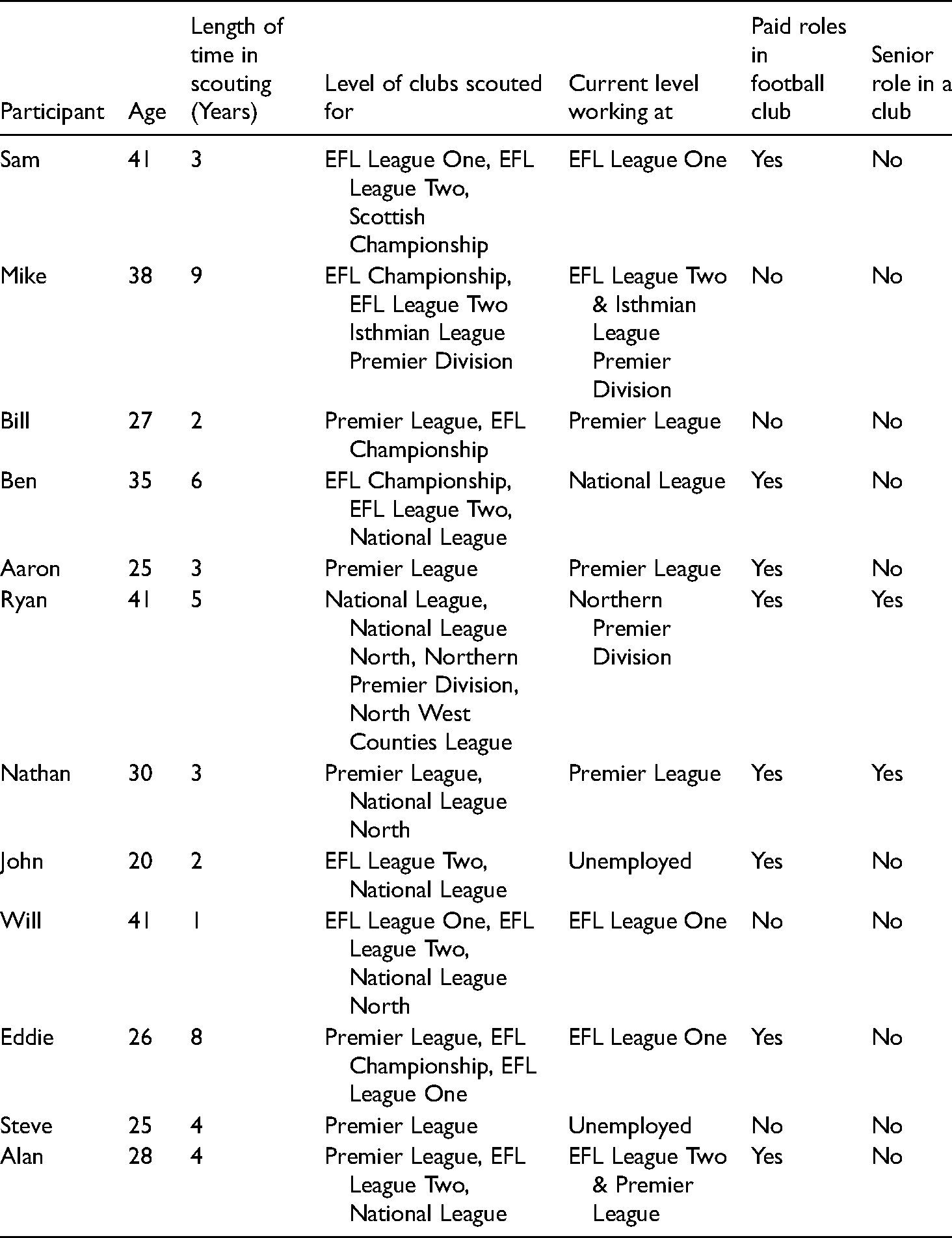
A purposive sampling technique was employed. Participants were selected based on specific characteristics appropriate for the study (Smith, 2010). Football scouts who had previously worked or were currently working in an unpaid role within men's professional football in England were approached. Individuals working in senior roles related to scouting, such as a head of recruitment or chief scout, who had experience of utilising unpaid scouts were also approached to provide a greater breadth to the sample. 12 male football scouts participated in the study. Of these, two previously had experience of working in a senior role within a football club, as a head of scouting and a scouting coordinator. At the time of interview, both individuals had left these roles and moved onto part-time, paid positions elsewhere. All participants were assigned a pseudonym to protect their identity (Bryman, 2016). See Table 1 for a participant biography.
Participant biography.
The aim of the study, in line with Baur and Ernst’s (2011: 134) recommendations for a figurational-informed methodology, was to explore the ‘individual's placement within, perception of, and ability to change the figuration’. Therefore, semi-structured interviews were deemed most appropriate for the task of developing rich data regarding the participants’ experiences. An interview guide was utilised as a means of directing questions towards the prominent areas of literature and the research questions, however, this was used fluidly to enable a flexible style of questioning. This allowed the interviewer to probe and seek clarification on participants’ responses. Furthermore, this helped the lead author remain relatively detached, limiting the effects of their involved perspective on the ability to strive for realistic, not objective, knowledge (Baur and Ernst, 2011). The interview guide was developed in discussion with the co-author to avoid value-laden questions based on the lead author's experiences of the industry – with departures from the interview guide instigated by the interviewee, rather than being led by the interviewer's pre-existing beliefs. Overall, this helped to be reflexive throughout the data collection process.
Interviews took place during July 2020 and were conducted over the telephone because of COVID-19 restrictions. The interviews were transcribed verbatim and NVivo software was used to aid the thematic data analysis procedure. This approach is a way of ‘identifying, analysing and reporting patterns (themes) within data’ (Braun and Clarke, 2006: 79). Initially, it is important to become familiar with, and become immersed in the data. This enabled initial ideas to be generated. From here codes were generated, which were features of note in the data and these formed the key themes. 32 different codes were generated which were classified into seven overarching categories. These categories related to themes derived from the literature such as ‘culture of unpaid work in football’ and ‘motivations to work unpaid’, to theoretically driven categories such as ‘relationships within the club’ and ‘transitions from unpaid to paid work’. From these seven categories, a thematic map was produced to summarise the findings into refined themes which explain what the data represents. These themes identified were: ‘for the love of the game’, ‘getting your foot in the door … becoming established?’, and ‘a culture of nepotism?’ We now turn to our analysis of these three themes, before we then discuss our findings from a figurational perspective.
Analysis
‘For the love of the game’
A fundamental difference between football and some other industries is the emotional attachment people have for sport. This was reflected in many participants citing their ‘love of the game’ as a reason for working unpaid. Many of the scouts were first and foremost football supporters: ‘It starts off as a hobby and then it turns into a passion … a lot of the time it's something [watching football matches] you’d be doing anyway’ (John). Alan also added: I think it was more a case of “can I manage it alongside a full-time job?” … Most of my downtime is spent watching football anyway. It was more or less a hobby … It could lead to something a little bit more interesting than my current day job at the time, which wasn't very exciting.
The enjoyment of an industry has led to people wanting to become involved professionally. An individual's love of their job often encourages them to persevere, even in the absence of pay or comparatively low pay (see Sandiford and Green, 2021). Football is frequently romanticised. These views can become ingrained to such a degree that people ignore the realities of football and consequently engage in behaviours which, to an outsider, may be perceived as futile. The participants accepted unpaid work as ‘part of the experience’ (Aaron) that was ingrained into the fabric of the role. These individuals indicated that they were willing to dedicate significant time because they saw the potential for a career: ‘I don't think I would have been doing it voluntarily if I didn't believe I could have made something from it’ (Alan). Alan, who worked as an unpaid video scout at the start of his career, went on to state that he watched six games per week, writing reports on each, while working full-time outside of football alongside this. Similarly, Mike spent upwards of 18 h per week working unpaid in his roles with EFL League Two and Isthmian League Premier Division (Tier 7) clubs. Spending this amount of time working unpaid is a significant commitment and the participants believed that working unpaid was a requirement to attain paid work, yet the evidence that this would guarantee full-time paid employment was largely absent.
Of the 12 participants interviewed, eight had moved from unpaid to paid positions during their scouting career; six of which were either part-time or they received infrequent payments such as match fees or travel expenses as part of their ‘agreement’ to work. Only two participants were working in full-time, paid scouting roles at the time of the interview. This was at a Premier League and, more surprisingly, an EFL League One club. Despite the lack of evidence suggesting that working unpaid would guarantee full-time, paid scouting work, many participants held the view that a paid role was just around the corner. ‘Hope labour’, as well as their deep-rooted love for the game, appear to be central to enable the participants to cope with their employment frailties.
The indication of emotionally attractive work was prevalent in the interviews. Many of the participants discussed how they would attend football matches irrespective of whether they were scouting. It provided the opportunity to transform their spectatorship into involvement, as John affirms: ‘If you’re going [to football matches] anyway, why not try and get involved in football, try and do something more than just watching as a fan.’ Ben, who had progressed into a paid role at an EFL Championship club, also said: ‘I love doing what I do. It's probably something I would have done for free anyway.’ In this way, scouting can be seen as a productive hobby, retaining the enjoyment of sport, whilst also creating the chance, however remote, of future employment. This shows how the opportunity to become involved in football was not solely linked to the participants’ ‘love of the game’ but also their desire for a career within football. As Will stated: ‘I’m not just doing it because I enjoy it, I’m doing it because it could hopefully … open up doors for future roles.’ Similarly, Ben stated that: ‘It's six years later down the line, it's still not there [full-time, paid role], but it's getting closer every day.’ The evidence from this study suggests that paid, full-time roles in scouting are limited and therefore Ben's continued pursuit appears grounded more in hope than evidence. Gambling time and effort to strive for work deemed emotionally attractive appeared an attempt to break away from ‘normal life’: ‘I didn't want to sit in an office for the rest of my life and do something I didn't enjoy.’ Ben was not the only scout to express this; the participants generally were striving for work which they deemed more exciting.
Getting your foot in the door … becoming established?
Much like in the creative industries, the participants cited gaining access to previously inaccessible networks as one of their main motivations for working unpaid. Unpaid scouting roles provided the opportunity for individuals to ‘get their foot in the door’ of professional clubs, as none of the participants had scouting experience at the level (i.e. first team or academy) at which they accepted their first unpaid role. For instance, Nathan had been paid as a part-time academy scout for a Premier League club, however, he accepted an unpaid role to ‘get involved with the first team in any way, shape or form’. Similarly, Alan stated: ‘I think without the unpaid roles I would have found it very difficult to just walk into a club’. Moreover, five of the participants had previous experience working in a coaching capacity across youth and adult teams. Football has previously been perceived as an insular industry (Kelly and Harris, 2010) and gaining access is difficult, however, it is important to examine why some participants, despite having their ‘foot in the door’ through their coaching roles, then decided to seek unpaid scouting roles.
Generally, the participants felt that scouting, even unpaid, would open more doors to roles in the football industry compared to coaching roles: I’ve managed to get nearer the first team levels in scouting than coaching. There are much fewer obstructions you might call it within the last three years (Mike).
I’d like to coach or manage at the highest level I can as well, so that's kind of another ambition but I think in terms of coaching and management it's pretty difficult to land a high end [role] … scouting and player recruitment I guess is top of my agenda (Bill)
Therefore, unpaid roles specifically in scouting were deemed particularly important. Ben discussed what he perceived to be the further benefits of this unpaid work: The benefit to me was that I was getting to go to these games, make those contacts, networking and so I felt like there was other value involved in it. So, all the people that I was getting to know … I wouldn't be where I was now without that.
As Ben explains, scouting provided the opportunity to attend games and develop a network of contacts, which coaching did not allow to the same degree. Conventionally, scouts attend live matches, enabling them to meet others in the football industry and widen their networks of interdependency and communication (Elias, 1978). This enabled these unpaid scouts to develop contacts they may have been able to call upon to attain a paid role, especially if they saw limited opportunity to progress or become established at their existing club. It could be argued that of all the ‘backroom’ roles in football, scouting provides the most opportunities to network and develop contacts across a variety of clubs, immersing oneself in the wider football figuration. This may, in part, help to provide a more adequate explanation for why individuals with existing contacts, and even with existing paid roles within football, still engaged in unpaid scouting roles. Scouting was perceived to be a more accessible route to the elite level than coaching, despite the lack of available evidence.
The participants recognised that gaining access to the industry was difficult and even though all participants possessed scouting qualifications, the need to develop scouting-specific contacts was central to their ambitions. It was not sufficient to get their ‘foot in the door’, they were required to ‘get further in the door’. The participants recognised the hierarchical structure of football clubs (Cushion and Jones, 2014; Schyns et al., 2016). Being an outsider was associated with being less likely to hear about upcoming jobs, especially given the lack of advertising for roles in player-related operations (Malcolm et al., 2017). Thus, the motives of these scouts appeared grounded in their desire to become part of the established – with the aim of increasing their perceived chances of receiving peer-recommended roles or being more likely to hear about unadvertised roles. From the perspective of the scouts, gaining scouting-specific contacts was an important aspect of remaining interconnected within the figuration, however, this was limited by the perceived nepotism in the industry, which we now turn to.
A culture of nepotism?
The participants valued trusted social relations, since greater lines of communication were perceived as crucial to attaining paid roles. Unpaid roles did provide access for some to previously inaccessible networks, however, the extent to which scouts could become established was limited. The secretive nature of football means when paid roles become available, they often go to those with existing contacts within that club – they are not always advertised in the traditional sense. Alan explained: ‘A lot of jobs are kind of peer recommended … It's quite enclosed. It's quite hard to get in.’ Moreover, Aaron discussed his interview process at a Premier League club: I walk into the interview and there were two people [interviewing me] that already knew my face so that made it a lot easier … I literally walked in and one of the interviewers smiled at me, he knew me that well already because I’d done a lot of stuff for him coaching-wise.
Similarly, Bill discussed how his relationship with his Premier League club facilitated gaining his first scouting role: I was pretty lucky to get the interview because I hadn't done scouting work previous to that, but I’d taken a lot of coaching qualifications and was working within the club … I was pretty lucky to get the interview and get in the room.
These experiences demonstrate how having contacts can be the difference between gaining access or not. All participants possessed scouting qualifications, yet this was frequently insufficient. The existing contacts helped gain access to football clubs in a scouting capacity. For example, Eddie's scouting career began because of a friendship with somebody at a professional club; ‘Every so often … he’d ask me to go to some games up north … rather than them employ a scout, they’d just send a mate’. This exchange shows how informal and unstructured scouting opportunities can be, yet this resulted, for Eddie, in his first paid scouting opportunity in a professional club. This example and the overall recognition that the participants placed on knowing the relevant people and being within the figurations demonstrates that they perceived a high degree of nepotism within football.
Unpaid roles appear to be a risk-reward scenario – coercing workers into hope labour, hoping their dedication will increase the chances of being recommended for a paid role. This hope is grounded in the perception that being ‘connected’ with more established members of the figuration would give individuals greater access to the lines of communication, especially in relation to hearing about upcoming jobs: I think that it is really important having them connections … I’ve certainly had a conversation with people at another club about a job that isn't advertised … if I didn't have that contact with [Premier League Club], I wouldn't [have] had that contact which led to that potential opportunity (Bill).
There was a lack of evidence supporting the idea that unpaid work would directly lead to becoming established, yet the scouts recognised that if they did not work unpaid then there would be no chance of gaining a paid position – thus they were tied into this risk as it was considered their only option. Individuals began with the ambition of gaining qualifications to develop a career within scouting, however, they soon became constrained by the culture of ‘hope labour’ in the football figuration. The unpaid positions were seemingly used as ‘bait’ by football clubs with the lure of future potential paid roles: There was always that discussion and the unofficial word from [Head of Recruitment] when I went down and met with the [Premier League Club] guys that eventually it would lead to a full-time job … I understand a lot of part-time scouts don't ever get told that you will be full-time. (Eddie)
This shows that despite the UK law stating that there can be no promise of future paid work upon the conclusion of any unpaid work, some clubs enticed people to work unpaid by using informal and unofficial means. The ambiguity of the law, as highlighted earlier in this study, means it can be open to exploitation and while unpaid positions remain lawful and are clearly prevalent in football, exploitation of this kind will persevere.
The inclination for employers at football clubs to have people they know also helps to explain why certain groups were at a perceived advantage when vying for paid opportunities. For example, former professional footballers were, according to the participants, more likely to ‘walk into’ paid roles. Nathan, who was previously a semi-professional footballer and currently an experienced academy coach and scout discussed this: There's always gonna be people that get opportunities in the game based off their contact base … If people have been a professional footballer, for example, someone they played with is our manager … they’re gonna know these people, they’re gonna value their opinion and because of that they can maybe get opportunities ahead of, for example, a student who doesn't have those contacts.
This example from Nathan demonstrates the degree of control football clubs seemingly have over individuals wanting access to the industry as well as their employees within the club, regardless of whether they are paid or unpaid. The stature of professional football clubs within contemporary society means there will always be individuals looking for a career within the industry, coercing those already working within football to accept their working conditions. The competitiveness of the industry means there will always be the risk of being replaced: ‘Everyone wants to be in football. Everyone wants your role. So, you’ve got to really prove that you can do the role and you’re the best man for the job’ (Alan). Clubs can be selective with who they want to be part of the established group within the figuration, utilising their greater control of lines of communication and the esteemed paid roles into enticing individuals to work for free and exploiting the hope these scouts retain. This shows how club figurations are developed from a relatively small, tight-knit network of ‘insiders’ with experience in the game. The industry appears guarded against ‘outsiders’ – safeguarding existing jobs and positions within the figuration.
Having provided an analysis of our three core themes, it is to a discussion of how figurational sociology helps us examine these themes in greater detail that we will now turn.
Discussion
The apparent ‘love’ for the game of football that was unanimous amongst our participants arguably stems from their emotional connection tied to their socially embodied habitus. Habitus can impact on an individual's ability to recognise their own circumstances and contribute to behaviours which are more entrenched in fantasy (Elias, 2001). Having such a deeply engrained passion for football severely impacted on their ability to make more ‘reasoned’ analysis of the likelihood of gaining full-time, paid positions within the football industry. Developing fantasy-laden thoughts, Elias (2001) argued, helps develop a greater feeling of control, especially in circumstances in which little to no control seems achievable. Sport can be deeply emotional and when this is tied to an embodied habitus developed from social integration across a variety of figurations, it can contribute to more fantasy-laden decisions, such as engaging in ‘hope labour’ – which is often emotionally more attractive for people then their current working lives (Elias, 2007).
Whilst society has become increasingly routinised, there has become a greater need for individuals to exhibit excitement in more nuanced ways. Leisure time acts as an opportunity to develop pleasurable excitement away from work, yet the perception of work and leisure as separate entities is a false dichotomy (Elias and Dunning, 1993). Leisure can be complementary to work, and the two can often overlap, especially when traditional forms of work are perceived as mundane (Elias and Dunning, 1993). In this respect, Elias and Dunning’s (1993) work on a quest for excitement helps explain our participants becoming so entrenched in unpaid work which seemed to derive from the need for emotional stimulation – an ‘escape’ from the routinisation of their current everyday lives (Elias, 2001). Sport for many evokes pleasurable excitement and, as Elias and Dunning (1993: 49) argue, it can have a ‘liberating, cathartic effect’. For these participants, trying to transform spectatorship into involvement seemed a way to gain these pleasurable experiences, tied to the notion of their socially embodied habitus. This was to escape from the feelings of routinisation and monotony in their current working lives. The emphasis on ‘enjoyment’ and ‘love’ for football generally highlighted this. Even though scouting, specifically unpaid, could be argued to be a leisure pursuit, the opportunity to transform this into enjoyable, full-time work meant some participants were willing to walk away from their non-football, paid work – arguably placing themselves into a more precarious situation. This was in their quest for what they perceived, at least, to be a more ‘exciting’ working life.
Gilmore et al. (2018: 428) argue that precariousness is made ‘routine and habitual’ within football clubs. Similarly, we found that it is the excitement and pleasure our participants associated with football which contributed to them continuing to strive for full-time, paid scouting positions without more adequately contemplating the evidence of achieving such roles. Emotional involvement often blinds people to what outsiders would deem ‘the obvious’, therefore in this case, their emotions clouded a more realistic assessment of likely job opportunities (Elias, 2007). We argue that this is linked to their socially embodied habitus and attachment to football. Furthermore, the consistent precariousness of paid positions, were they to be possible, was rarely acknowledged as they narrowly focused on achieving paid roles. None of the participants discussed the idea of potentially leaving the scouting industry. Therefore, the love our scouts expressed for football helps to understand why they wanted to become entrenched in the industry and explains their often fantasy-laden behaviours. Their romanticised accounts of the football industry and the idealised benefits they held about engaging in unpaid work clouded their perception of reality.
The difficulty in gaining access to the football industry was related to the high levels of social cohesion and strength of interdependency ties present amongst the established already within the clubs. Elias and Scotson’s (1994) concept of established-outsider relations helps us more adequately understand the motivations of the unpaid scouts and explain why they felt unpaid work was beneficial. Established members have stronger mutual identification with one another and this helps them monopolise resources and lines of communication (Elias and Scotson, 1994). Specifically, the established members of the club figurations had some level of control of who gained access to paid, full-time roles, as well as perpetuating the process of using unpaid scouts. There was a strong belief that accepting unpaid scouting work would provide greater opportunities to cultivate social relations with members of the club in control of hiring staff, with the view that developing a stronger sense of social cohesion, group charisma and being entrenched within lines of communication – what Elias and Scotson (1994) referred to as ‘praise gossip’ – would potentially lead to paid roles. Outsiders were unable to call upon these forms of gossip because of their lack of network and strong ties of interdependency (Soeters and van Iterson, 2002). Surrounding oneself with ‘trusted’ individuals is important for hierarchical figures in football clubs, especially in recruitment. This type of employment practice has been seen across various football roles such as physiotherapists (Waddington et al., 2001), coaches (Blackett et al., 2017) and managers (Bridgewater, 2010). The resources of value are figurationally generated (Elias and Scotson, 1994) – trust is developed from within the figuration, social cohesion enhanced through being amongst the established and this allows the established to be in a position of greater control of valued resources, such as unadvertised, paid positions. Thus, to become part of the established, one must acquire contacts and develop trust; if this cannot occur through a playing career, working unpaid offers one of the only opportunities to gain access. As such, our scouts recognised the need to engage in scouting specific ‘hope labour’ to develop a wider network of contacts so they could access praise gossip and lines of communication Having trusted social relations, which in an industry masked by uncertainty and secretiveness was valued, allowed individuals to more adequately utilise their networks of communications to ensure gossip, such as unadvertised job roles, could flow through the figurational networks.
Scouting, nevertheless, remains on the periphery of football clubs, often attributed to the fact their work takes place externally to the training ground (Bate, 2020). Thus, in the wider context of the club, even individuals who we identify as ‘established’ scouts may not be ‘established’ employees. The scout operates at an outsider level – they are not traditionally part of the inner sanctum of the backroom staff. The inherent fragility of scouting reveals the value football clubs place on the scout. With participants identifying full-time, paid scouting positions as the aim of their ‘hope labour’, it would appear even if this were achieved, it would not come without the caveat of constant precarity and being positioned as an outsider within the wider club figuration.
Power is an integral component of all human relations, however, when there is an uneven balance of power there is a degree to which the established member of a figuration can exploit an outsider (Elias, 1978). It appears the practice of utilising unpaid work exists to maintain the greater power amongst the established, allowing them to largely control resources of influential positions, enabling them to ‘exclude’ outsiders, keeping them in subordinate positions and reinforcing the dominance of established groups (Goodwin and Hughes, 2016). Hiring individuals with existing relations and perpetuating the process of unpaid positions helped maintain the divide amongst established members and outsiders who were unable, without developing stronger networks of interdependency, to become part of the established themselves. Despite economic status fluctuating throughout the English football pyramid (Plumley et al., 2018), arguably these clubs could provide some financial remuneration to scouts. However, whilst there was a willing market for unpaid ‘hope labour’ and the need to reinforce exclusivity within professional football clubs, it is clear why this practice has persisted. This creates a dilemma for those wanting to become involved in the industry. The emphasis on the ‘love of the game’ attracted the participants to this work, however, they were heavily constrained by the cultural standards within the football figuration. The participants were acutely aware of the nepotistic culture within football. Individuals felt constrained to engage in ‘hope labour’ and many appeared to have convinced themselves that they would be the one to achieve the unlikely feat of gaining a paid role – tying further into Elias's notion of fantasy-laden behaviours. Their behaviours were not related to the evidence available to them, but the need to alleviate their thoughts about their situation, blurring the lines between their own perception of fantasy and reality in favour of the former (Elias, 1978).
We argue that the clubs for whom our scouts were seeking employment, were constrained with the introduction of the EPPP. This provides just one example of how clubs are constrained by their interdependence with governing bodies. Functional democratisation, a concept focusing on the social transformation of power balances between more complex networks of interdependence (Dunning and Hughes, 2013), can help explain this. Elias argued that functional democratisation occurs when increasing specialisation and bureaucratisation arises (Dunning and Hughes, 2013) – policy implementation being an example of this. The enactment of the EPPP shifted power away from football clubs, as governing bodies placed tighter controls and restrictions upon clubs, administering what they can and cannot do in relation to academy player development, transfers and scouting. Placing restrictions on football club activities can be seen as distributing power more widely across the figuration and the relations of interdependence being less one-sided in favour of the clubs (Wilterdink, 2021). An unintended outcome from the EPPP, we argue, has contributed to a growth in unpaid positions within football. This was part of the response from some within the clubs to regain a sense of control seemingly reduced because of the EPPP. Using unpaid scouts, as well as being selective with who can enter the figuration and become established, is an opportunity for key individuals at clubs to reassert their influence within the figuration. Therefore, despite this study focusing on the exploitation of scouts, this example shows how it is equally important to focus on the context in which the exploitation occurs. It would be too simplistic to draw such conclusions without assessing how clubs themselves are constrained by the wider footballing context and figurational dynamics at play (i.e. EPPP and policy), and subsequently, the impact this has upon the clubs.
Conclusions
The aim of this paper was to examine the culture of unpaid work within men's professional football clubs in England by exploring the working lives of unpaid scouts. Using semi-structured interviews, we have highlighted the position of scouts within the football industry, outlined their motivations for working unpaid and explored the challenges faced within the figuration. The football industry has been notoriously difficult to gain access to, yet the opportunities to work for professional football clubs are highly coveted due to the emotional attachment many have to the sport. Some of the scouts in the study dedicated up to 18 h per week to their unpaid scouting roles and declared that it was their ‘love for the game’ which enticed them to become involved in football. However, it was the need for scouting-specific contacts to progress which led to this commitment. The behaviours exhibited by the scouts demonstrated a quest for excitement, looking towards a career they felt would engage them emotionally, breaking away from their traditional working lives. Emotional involvement in football appeared to cloud the judgement of the participants who believed a paid role was ‘just around the corner’, yet the evidence suggested that this was unlikely and stemmed from a romanticised account of how they wanted the football industry to be. In actuality, the industry, based on this study, appeared precarious and uncertain. Nonetheless, with a constant supply of individuals wanting to work in an industry viewed as more ‘exciting’ than the mundane jobs that exist outside of football, allows for the continuation of these employment practices. Working for free represented what Elias referred to as fantasy-laden thinking – which helped the participants cope and navigate through the precarity of the football industry.
The scouts felt recruitment strategies in football were nepotistic. Trusted social relations were valued and allowed established members of figurations to have greater access to and control over lines of communication and gossip regarding unadvertised jobs, and in some cases, the selection of individuals for specific positions. The importance placed on relationships was key to protecting the established core of the football club, limiting the opportunity for ‘outsiders’ to enter the industry. Football is viewed as a ‘who you know’ sport and employing nepotistic practices of this kind appeared to be a mechanism to safeguard the positions of those within the established core and allow clubs to remain selective with who they wanted to enter the industry. Individuals with specific contacts or experiences (e.g. former professional footballers) are advantaged in attaining roles of this kind. The way in which clubs are constrained by governing bodies and policy, with the EPPP being just one example of this, helps to more adequately understand why clubs retain these practices to seemingly regain a sense of control within a figuration in which their balance of power is lessening.
Prior to this study, there was no research from the perspective of scouts exploring the prevalence of unpaid work in football and thus, we hope we have opened several avenues for future research to explore. The context of work in football differs from nation to nation. Therefore, the experiences and even presence of unpaid scouts may be unique to the English men's professional game. Future research should further examine the role of a scout to identify their position in club figurations and their employment status across international contexts and in the women's game. Similarly, future research might examine more comprehensively the recruitment methods within football. Research has indicated that recruitment procedures in football have developed, yet many roles are still not publicly advertised, and interviews are not always conducted (see Malcolm et al., 2017). It would be beneficial to not only examine scouts but to investigate employment within the wider football industry. This study has provided a basis from which the working lives of scouts can be explored. Exploring their working lives can contribute to further understanding the inner workings of professional football clubs. The study has also revealed some of the exploitative features of precarious work and highlights the inequalities which exist within the industry. This helps to shed light on the motivations of individuals to engage in hope labour but also the perpetuation and normalisation of these practices within a multi-billion-pound industry.
Footnotes
Declaration of Conflicting Interests
The author(s) declared no potential conflicts of interest with respect to the research, authorship, and/or publication of this article.
Funding
The author(s) received no financial support for the research, authorship, and/or publication of this article.
