



Abstract
Racist stacking is a phenomenon in team sports in which Black players are underrepresented in tactical and leading positions, while they are overrepresented in decentralized and physical positions. In this article, we propose that racist stacking is a type of institutional racism characterized by racist ascriptions incorporated in the daily routines of sport institutions. We explored whether racist stacking happens in soccer in Germany based on these assumptions. The results of an examination of the 36 teams in the male divisions of the first and second Bundesliga in the 2020/2021 season are presented in this article. We discovered patterns in our data that support a theory of racist stacking. White players are more likely to play positions associated with leadership, oversight, responsibility, intelligence, and organization, whereas Black players are more likely to play positions associated with aggressiveness, speed, and instinct. We conclude that, contrary to popular belief, professional sports do not just rely on the competitiveness principle. Instead, some decisions appear to be made on the basis of racist attributions, whether purposefully or accidentally.
Introduction
In the last 20 years, there has been a surge in research about the role of sport in immigrant societies. In Europe, research in this field often focuses on sport as integration. It investigates to a much lesser extent whether and how racism manifests itself in sport. This is not to suggest that there is a scarcity of studies on racism in sport. Whether it is research on stacking (for prior research see next section), how Black people and People of Color experience racism in sports (e.g. Burdsey, 2011; Engh et al., 2017), racist ascriptions in media representations (e.g. McCarthy et al., 2003; van Sterkenburg et al., 2012), the underrepresentation of Black people and People of Color in leading positions of sports organizations (e.g. Bradbury, 2013; Bradbury et al., 2018) or further topics (e.g. Adjepong and Carrington, 2014; Carrington, 2010; Douglas, 2005): research consistently demonstrates how deeply ingrained racist beliefs manifest themselves in the realm of sport. However, in Germany – the focus of this article – very little academic attention has been paid to racism in sports (Nobis and El-Kayed, 2022). In light of this discourse, this article focuses on one type of anti-Black racism possible in team sports: racist stacking. We raise the research question of whether racist stacking – which refers to Black players’ underrepresentation in central, tactical, and leadership positions, as well as to their overrepresentation in decentralized and physical positions – occurs in German men's professional soccer and, if so, how this phenomenon ought to be viewed as a form of institutional racism.
Many prior empirical studies have termed this phenomenon ‘racial’ stacking or ‘racial’ (position) segregation. The authors of the present article deliberately refer to this phenomenon as racist stacking as an alternative, political standpoint against a latent belief that human ‘races’ exist. It is argued in this positionality that becoming more mindful about the power of language is a critical course of action in overcoming the concept of ‘race’ – even if it is used in a social constructivist way. “Even though it is the intention of most constructionists to distance ‘race’ from biology” it is likely that the continued use of this concept reinforces “racial naturalism in the public imagination” (Hochman, 2017: 66). This is not to say that focusing on ‘race’ as processes involved in embodying genealogically and culturally inherited histories, traditions, and imaginations is obsolete (Saharso and Scharrer, 2022). Rather, we believe that racism is far more complex than the concept of ‘race’ alone can explain, and that it should therefore be positioned in a way that acknowledges overlaps with concepts such as gender, class, migration, language, and citizenship (e.g. Heinz et al., 2014). It is in this context that it is furthermore crucial to note that the terms Black and white, which are used in this article, are not to be understood as adjectives which refer to biological markers or to skin color, but as categories which point to processes of racialization, to positions in societies and to differences with regard to power. The capitalization of Black and the italicization of white is often used in the German context to emphasize this standpoint (e.g. Ha et al., 2021; Hasters, 2019).
Prior research about racist stacking
The first research on racist stacking was published in 1967 in the United States by Rosenblatt. He found that Black athletes in baseball were underrepresented in the central position of pitcher and overrepresented in the outfield positions (Rosenblatt, 1967). Following this study, racist stacking in men's professional and collegiate baseball (e.g. Curtis and Loy, 1978; Margolis and Piliavin, 1999), American football (e.g. Jones et al., 1987; Lewis, 1995; Loy and McElvogue, 1970) and basketball (e.g. Coakley, 1990; Eitzen and Yetman, 1979) became a well-researched topic in the United States in the 1970s, the 1980s, and the 1990s.
From the 1990s onwards, this area of research expanded to cover further countries (e.g. Australia, New Zealand, Canada, France, Britain) and sports (e.g. Australian rugby, ice hockey, basketball, cricket). On the one hand, outside of the United States, racist stacking research remains a somewhat isolated discourse typically based on single studies that refer to one specific national league, in one specific sport and in one specific season. On the other hand, these single studies have added up to a substantial number of publications (e.g. Hallinan et al., 1999; Lavoie, 1989; Melnick, 1996; Perchot et al., 2015), all of which highlight the same pattern as US-studies: Black athletes are underrepresented in central positions and in positions requiring leadership, tactical and decision-making skills, while they are overrepresented in positions requiring more athletic abilities.
Four empirical studies on soccer have been conducted, all of which have focused on England (Maguire, 1988; Melnick, 1988; Mills et al., 2018; Norris and Jones, 1998). Three of these studies were conducted 20 or 30 years ago, and the game has developed in terms of physical, technical and tactical parameters since then (Barnes et al., 2014; Haugen, Tønnessen, & Seiler, 2013; Wallace and Norton, 2013; Wilson, 2011). Nevertheless, all of the studies suggest that Black players disproportionately occupy positions associated with speed, aggressiveness and physique while white players “dominate the types of positions traditionally associated with organization, communication and creativity” (Mills et al., 2018: 402).
Taking a closer look at the current state of research has revealed some important themes:
(1) Most frequently, researchers aim to discover if Black players are overrepresented in spatially decentralized positions (centrality hypothesis) and/or in positions that aren't as important to the game's result (outcome-control hypothesis).
(2) When doing so, they tend to make a binary distinction between Black and white players, without clearly specifying the classification criteria utilized.
(3) Various explanations have been proposed to explain the phenomena of stacking: (a) One framework suggests that coaches, managers and scouts play an important role, when determining which players will be contracted, allocated to, or scouted for a specific position. Their racist beliefs regarding Black people's athletic superiority and intellectual inferiority could contribute to stacking (Bopp and Sagas, 2014; Jones et al., 1987; Lewis, 1995; Pitts and Yost, 2013; Spracklen, 2013; Woodward, 2004). (b) According to the economic hypothesis, stacking is the result of differentiation. It is suggested that a player's position choice before entering professional sports is determined by the costs of developing specific skills. Thus, the lack of Black players in technical positions such as quarterbacks, pitchers, and catchers, which require more training and development costs, can be attributed to their low socioeconomic status (Margolis and Piliavin, 1999; Medoff, 1977, 1986). (c) Many scholars argue that stacking can be traced back to ‘self-segregation’ (self-stacking hypothesis). They suggest that Black players assign themselves to certain positions because they believe it will be more difficult for them to attain other positions successfully in high-level competition (differential-attractiveness hypothesis) or because there are no Black role models in those positions (role-modelling hypothesis) (Curtis and Loy, 1978; Eitzen and Yetman, 1979; Lewis, 1995; Margolis and Piliavin, 1999; McPherson, 1975; Medoff, 1986; Perchot et al., 2015).
(4) The racist stacking discourse is still overwhelmingly empiristic as Maguire (1988) already pointed out three decades ago. Some publications’ theoretical sections are primarily dedicated to discussing prior empirical investigations on stacking, while others don't have one at all. Furthermore, some authors tend to limit themselves to discussing the concept of centrality. However, centrality merely demonstrates how stacking can occur, not why it occurs.
But what is the point of research on racist stacking if it is not clear what this phenomenon means and from which theoretical standpoint it is of interest? With this question in mind, we will shed light on the phenomena of racist stacking, with a particular focus on theoretical considerations of how racist prejudices have inscribed themselves in sports institutions.
Racism (in Germany) and how it is related to stacking
Racism is based on the belief that humans may be classified into biologically – or culturally – distinct ‘races’, which are then ranked in a hierarchy of superiority and inferiority (Auma, 2018; Miles and Brown, 2003; Rommelspacher, 2011). Racist ideologies include the belief that so-called inferior ‘races’ are incapable of contributing intellectually and artistically to society, as well as the belief about anatomical differences between so-called superior ‘races’ (white people) and so-called inferior people (Black people). In Europe, these attitudes were substantially put forward within the racist scientific community during the 18th and 19th centuries. By dividing humanity into four ‘races’ and proclaiming white people's intellectual superiority over people from Sub-Saharan Africa, white people established the concept of ‘race-typologies’, which served to preserve and justify power disparities, colonialism, slavery, oppression, and exploitation during a time when the enlightenment movement promoted the idea of universal human rights (Geulen, 2007; Hochman, 2017; Saini, 2020).
Racist ideologies are not a relic of the past. Racist notions are profoundly established in people's thinking as well as inside our societies’ institutions and structures, despite the fact that ‘race’ science has no scientific validity (Hochman, 2017; McCann-Mortimer et al., 2004; Saini, 2020; Zuber, 2015). The alleged knowledge about ‘races’ is taught and acquired through socialization, and racialization reinforces and reproduces it. Racialization is the hegemonic and powerful process of ascribing otherness to racialized groups, of marking them as being essentially different, of generalizing and decontextualizing alleged differences and – quite often – of transferring the alleged otherness into inferred inferiority (Eggers, 2017; Gans, 2017; Hochman, 2019). However, racism does not only manifest itself as an individual act of racialization. It must also be recognized as a macro-level and meso-level issue entwined in broader society and its institution's subtext. Racist ascriptions – as they are expressed during racialization processes – can become incorporated in organizational routines, norms, and practices, producing and reproducing racism over time (Carmichael and Hamilton, 1967; Henry and Tator, 2005; Kelly, 2021).
Racialization processes and structural racism also occur in Germany. Germany is a country with a colonial past and a country where ‘racial policies’ have led to the Holocaust and to the killing of about six million Jews and further racialized groups. With reference to this history, it is notable that racism in general, and anti-Black racism in particular, have not been prominently addressed in public conversation, nor has it been a major focus in research, until the death of George Floyd (Kelly, 2021). The concepts of ‘race’ and ‘ethnicity’ have rather been disavowed than discussed, as most of the public and academic debate centers around the so called “migration background” – a term which is commonly used to refer to first- and second-generation immigrants, or – according to the recent definition of the Federal Statistical Office of Germany – is based on the criterion of whether an individual or at least one of his/her parents did not acquire German citizenship by birth. This specific focus inter alia becomes apparent when considering that the English term ‘Black and People of Color’ (BPoC), which specifically aims to capture experiences of racism, has only recently gained more attention within the public discourse (e.g. Ha et al., 2021); or when considering that the Federal Statistical Office of Germany has provided data on the number of “people with a migration background” living in Germany and on specific subgroups (e.g. those with a Turkish, a Polish or an Italian ‘migration background’) for over 15 years now (for an in-depth-discussion see, Will, 2019), while reliable data on the number of Black people living in Germany is still missing. The very recently published and first ever ‘Afrocensus’ estimates that over one million people of African descent are currently living in Germany, yet it also states that up until the implementation of this very study “Black, African and Afro-diasporic experiences have largely been made invisible through the use of the analytical category ‘migration background’ and through subsuming their experiences under general racism” (Aikins et al., 2021: 24; translated by Tina Nobis). A closer look at the “Report of the Federal Government Expert Commission on the Framework Conditions for Integration Potential”, which was published by 25 experts from various scientific, political and civil society fields points into a similar direction. The English version of the report, which amounts to 268 pages, mentions the term ‘migration background’ 168 times and the term ‘immigrants’ 510 times, while the terms ‘Black’ and ‘race’ are each only mentioned 14 times (references to international literature included). The table of contents also reveals that anti-Black racism is a rather marginal point of discussion. Even though racism is mentioned as a “conlict area”, it is only discussed in a three-page long subchapter on “Racism, antiziganism, islamophobia and anti-Semitism” (Expert Commission on the Framework Conditions for Integration Potential, 2020). It is in this subchapter that the authors of the report consequently state: “In contrast to other countries, research on racism has hardly been developed in Germany; it is not yet an established and well equipped field with funding, training and research traditions” (Expert Commission on the Framework Conditions for Integration Potential, 2020: 57).
This is neither to claim that anti-Black racism does not exist in Germany nor that is has not been researched at all in the past. Some academics in Germany have emphasized how deeply ingrained racist beliefs are in German society and how colonial images are still present in everyday life (e.g. with regard to street names or language). It has, for example, been shown how teachers and pupils of Color experience othering and racialization in the educational system in Germany (Fereidooni and El, 2017; Nguyen, 2013); studies demonstrate that children already refer to racist ‘knowledge’ at a very young age (Eggers, 2005); that racist beliefs are transported and socialized through children's books, teaching materials and school books (e.g. Marmer and Sow, 2015; Mätschke, 2013); and several authors have argued that being Black remains to be seen as incompatible with being German and that Afro-Germans are often regarded as being ‘the others’ who don’t entirely belong to Germany (e.g. Kilomba, 2012). Furthermore, and based on a survey of almost 6000 Black, African and Afro-diasporic individuals living in Germany, the abovementioned ‘Afrocensus’ demonstrates that the vast majority of the respondents has either experienced discrimination or anticipates discrimination in one of the 14 domains and institutions addressed in the questionnaire (Aikins et al., 2021).
Unfortunately, and despite the unique chance given, the sport sector was not specifically addressed in the ‘Afrocensus”. Furthermore, a review of recent German-language academic articles shows that racism has hardly been a specific topic within the academic discourse in Germany and that some researchers even tend to decontextualize and overemphasize differences between immigrants and non-immigrants, thus contributing to the phenomenon of ‘Othering’ (Nobis and El-Kayed, 2022). Even though some works have focused on ethnic identity, the construction of ‘ethnicity’ in or through sports or on ethnic discrimination in sport in Germany (e.g. Bartsch et al., 2019; Burrmann et al., 2017; Gehring, 2016; Nobis et al., 2021; Seiberth et al., 2019; van Campenhout and van Houtum, 2021), hardly any of these studies (for exceptions see, Ungruhe, 2014) focus on anti-Black racism in sport in Germany.
We thus refer to international research, which demonstrates that racism can also be found in the structure of the sports sector. Ben Carrington (2010) has elaborated how the racist archetype of what he refers to as ‘The Black Athlete’ was created at the beginning of the 20th century (Carrington, 2010). This mythical representation implies, as he points out, that Black people are physically superior to whites. He explains how “a sharp distinction is drawn between the body and the mind” in this racist archetype and how, thereby, “Blacks became creatures of the body and the body alone, helping to further consolidate colonial myths that sought to connect Black Africans to the animal world rather than with emerging human civilizations” (Carrington, 2011). These imaginations can also be witnessed in media representations, which are of specific interest in terms of racialization processes and the (re)construction of racist beliefs: “Mediated sport is often seen to be presented within certain ideological discourses which reflect existing power structures” (McCarthy et al., 2003: 217). Racist stereotyping in sports media can be regarded as a reflection of white society's perspective on Black people's function and position in its society (Ndiaye, 2008). Media representations may have evolved over time and the racist ‘Black Athlete’ archetype may have become more taboo than it once was (Ogasawara, 2004), nonetheless, it is still prevalent in sports media. Albeit more hidden than it once was due to social acceptability conventions or the evolution of racism into plural forms or into racism without ‘races’ (Balibar, 2008; Goldberg, 2008; van Sterkenburg, 2015). A range of studies shows that Black athletes are often represented as natural athletes with a God given talent and that they are more often described in terms of their physical skills than white athletes (Bruce, 2004; Eastman and Billings, 2001; McCarthy et al., 2003; van Sterkenburg et al., 2012, 2019).
With these considerations in mind, it should be evident how and why a study on stacking can be regarded as a study on racism in sports. If racist ascriptions, which include mythical imaginations about Black athletes’ physical superiority and intellectual inferiority, have become part of sports institutions’ routines, practices, and value systems, then racist stacking could be one result of institutionalized racism. In other words, if Black players are stacked into playing positions that are associated with speed, physique and aggressiveness whereas they are underrepresented in positions that require tactical and intellectual skills (like game overview, game organization, leadership or build-up play), then this pattern closely relates to racist stereotypes and their embeddedness in sports institutions.
Research hypotheses
In order to assess whether racist ascriptions have found their way into sports institutions this study focuses on the male divisions of the first and second soccer Bundesliga in Germany. The study investigates whether Black players are underrepresented in playing positions that are associated with tactical skills and intelligence, and whether they are overrepresented in playing positions that are associated with physical abilities. It thus becomes clear that it is not the aim of this study to test the centrality or the outcome-control hypothesis. Instead of regarding only one characteristic that is assigned to a playing position (centrality or outcome-control), a profile-related approach that considers the multiple and sometimes ambivalent descriptions of different playing positions is used. We argue that this profile-related approach is suited to examine the connection between racist ascriptions and the soccer team line-up more directly than the centrality- or the outcome-control-approach.
As a first step, preliminary research was conducted to identify the profiles of the different playing positions on the soccer pitch. Various materials about playing position profiles in soccer, ranging from catalogues provided by soccer federations to empirical studies that investigate characteristics of professional soccer players by position were analyzed (Bundesliga, 2020; Cavia et al., 2019; Konefał et al., 2019; Lago-Peñas et al., 2011; Link and Hoernig, 2017; US Soccer, 2014; Wiemeyer, 2003). Recently published materials were read to identify the current profiles of the playing positions in soccer, because the game has changed over time. For example, professional soccer has become faster and more dynamic in the past decades and athletic skills have become increasingly important (e.g. high intensity running, distance covered during a match, number of sprints, speed) (Barnes et al., 2014; Haugen et al., 2013; Wallace and Norton, 2013). Furthermore, modifications of the laws of the game have led to an alteration of playing profiles and playing formations. For example, since the introduction of the back-pass rule in 1992 the goalkeeper is not merely responsible for preventing goals but he has become more important for build-up play and the skills required from him have risen in both technical and tactical terms. Accordingly, and as playing systems have shifted to a 4-2-3-1-formation the athletic requirements of the wing backs have also risen as these players are now meant to support the attacking wingers and the build-up play (Bisanz and Gerisch, 2013; Wilson, 2011).
Based on a content analysis of these materials and with regard to the commonly played 4-2-3-1-formation seven (sets of) playing positions that are each described with distinguishable profiles have been identified: (1) the goalkeeper (#1), (2) the center backs (#4 and #5), (3) the (right and left) wing backs (#2 and #3), (4) the (defensive) center midfielder (#6 and #8), (5) the attacking center midfielder (#10), (6) the right and left wingers (#7 and #11) and the (7) striker (#9). With regard to the outcomes of this content analysis (see Figure 1), it is now possible to set up the following research hypotheses.
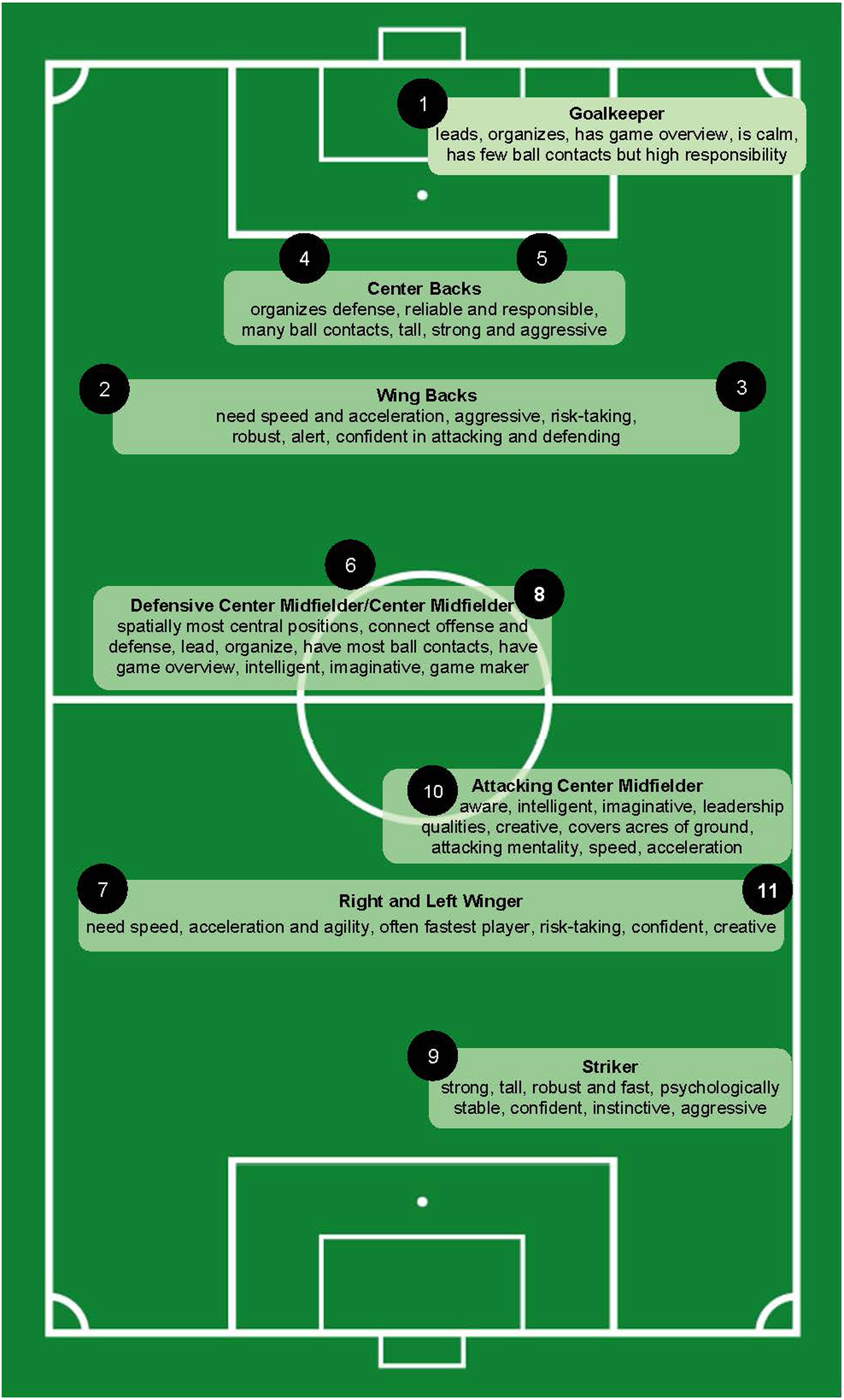
Attribution to playing positions.
Research hypothesis 1: The goalkeeper, the defensive center midfielder and the center midfielder are positions that are mostly described in tactical terms and to which skills such as game-overview, game-organization, leadership, intelligence and responsibility are attributed. The skills required for these positions thus match with racist stereotypes about white players superior cognitive abilities and Black players intellectual inadequacy. Consequently, we expected that Black players will be underrepresented in these positions.
Research hypothesis 2: The (right and left) wing backs, the (right and left) wingers and the strikers are often portrayed in physical terms and it is often stated that these players require skills such as speed, acceleration, aggressiveness, confidence, the capacity to take risks and – with regard to the striker – instinct. We thus expected an overrepresentation of Black players in these positions, because the skills required for these positions match with racist stereotypes about the athletic superiority of Black people.
In the materials analyzed, the profiles of the center backs and of the attacking center midfielders are described in different ways. For example, the center backs are described both as reliable and responsible and as strong and aggressive. As there was no major theme about these positions in the documents analyzed, it is impossible to deduct whether an over- or an underrepresentation of Black players in these positions would be found if racist ascriptions apply.
Methodological summary
The data set about the players from the 36 clubs that competed in the first and second soccer Bundesliga in the 2020/2021 season consists of 967 cases. The data was retrieved from the transfermarkt.de website. This website was used to gather information about each player's citizenship and each player's primary position on the field. If the primary position of a player did not match with one of the playing positions of interest, those players were excluded from our data set. This was the case for 16 players whose primary position was a ‘false nine’ (‘hängende Spitze’ in German), for 12 players whose primary position was right midfielder and for 12 players whose primary position was left midfielder.
Furthermore, based on the pictures that were provided for each player, players were classified by the study team as ‘Black’, ‘white', or ‘further People of Color' (PoC). This procedure requires some elaboration:
(1) By referring to these terms and distinctions we aim to acknowledge the right to self-ascription and to capture the fact that a binary distinction between ‘Black’ and ‘white’ tends to overlook the complexity of racialization processes. The English term ‘Black and People of Color’ (BPoC) was primarily introduced by activist groups to overcome colonial practices of external attribution. Both terms (‘Black’ or ‘Person of Color’) are often used by individuals from the African diaspora as a self-reference, whereas further ‘non-Black’ individuals who may be subjected to racism in Germany (e.g. people with a Turkish, an Arabian or an Asian background) often self-identify as ‘Person of Color’ (e.g. Ha et al., 2021; Hasters, 2019). However, it should be highlighted that while the language chosen here is sensitive to the right of self-ascription, the procedure chosen fails to accurately reflect all players’ own perception of themselves, as a picture does not tell, how a person will identify himself/herself. Instead, our procedure represents racialization processes that Black players and players of Color most likely face and that impose labels to persons from the outside.
(2) Before categorizing the players as ‘white’, ‘Black’ or ‘further People of Color’, it was necessary to define a set of ground rules. The research team agreed that a player would be categorized as ‘Black’ if he phenotypically appeared as an individual from the African diaspora and that a player would be categorized as ‘further Person of Color’ if he phenotypically appeared as a person that is most likely neither read as Black nor as white in the German context (e.g. German players of Turkish origin, Turkish players, Indian players, Japanese players, South American Indigenous peoples) or that phenotypically appeared as white but that had a Muslim name (e.g. some of the players with Bosnian citizenship).
(3) In a next step, four members of the research team categorized the players based on their images. If they were unsure how to categorize a player, the respective image was shared with the whole research group and all of the six members independently decided on how they would expect the player to be read by their coaches or by further decision-makers within a soccer club. This decision was split in 19 cases, which were excluded from the analysis.
(4) It is important to note that the category of ‘further Person of Color’ is very heterogeneous. The players that were coded as ‘further Person of Color’ are likely to face different and also contradicting racist stereotypes (ranging from hot-tempered to disciplined) and might thus be – if stacking occurs – stacked in very different positions. As a consequence, it is not possible to interpret the distribution of these players to the different playing positions in a meaningful way.
Report of results
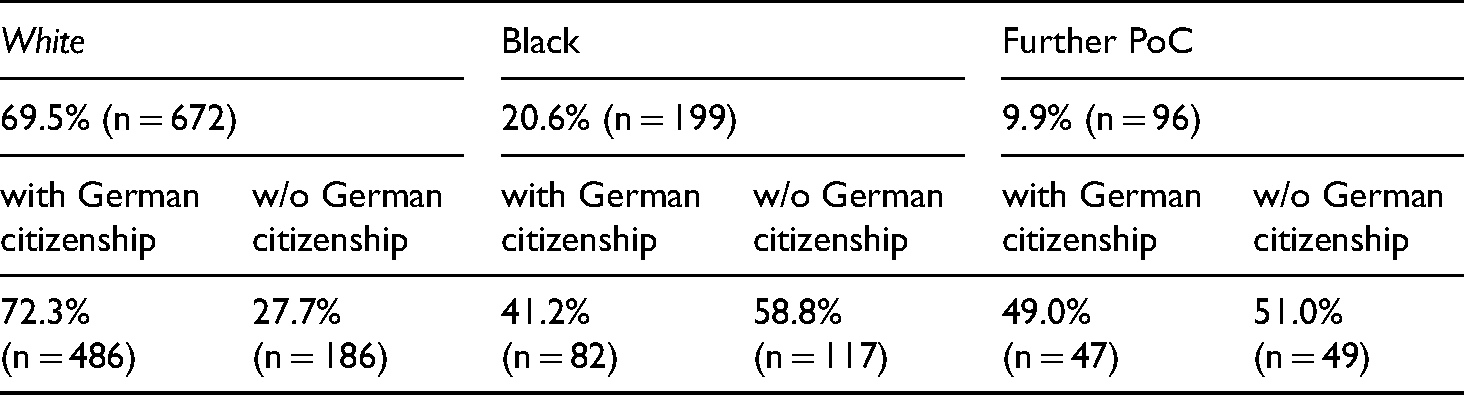
All in all, 69.5% of the players in the first and second division of the Bundesliga were categorized as white, 20.6% as Black and 9.9% as further People of Color. As we will later argue that (a) stacking patterns in the Bundesliga might at least partly be a path-dependent result of stacking patterns in amateur sports in Germany, and as we will (b) contradict the argument that the absence of Black goalkeepers can be explained by a supposedly strong tradition in educating goalkeepers in Germany alone, it is worthwhile to know whether the players were socialized in German amateur sports. Even though there was no accurate information about this on transfermarkt.de, the citizenship of the players can serve as an indicator. It can be assumed, for the most part, that players with a German citizenship also grew up in Germany. Our respective data analyses show that 72.3% of the white players, 41.2% of the Black players and 49.0% of the players of Color are German citizens (see Table 1).
Players in the first and second division of the soccer Bundesliga, by racialized group and citizenship.
It has been argued that it is meaningless to test for statistical significance in full population samples (Behnke, 2005; Gibbs et al., 2015), therefore, the current analysis relies on descriptive statistics. The relative number of Black players in a specific position is compared to, (a) the relative number of other players in this specific position and (b) to the number of all Black players in the Bundesliga. The results of these analyses are unequivocal: there is a clear pattern of racist stacking in the soccer Bundesliga.
Black players are highly underrepresented in the position of goalkeeper. Despite the fact that 20.6% of the players in the Bundesliga were categorized as Black, there is not a single Black goalkeeper. 96.7% of the 121 goalkeepers were categorized as white, and 3.3% as People of Color. The results for the defensive center midfielder and the center midfielder are not as clear cut. However, the data still shows that Black players are slightly underrepresented in those positions. 20% of all of the 967 players occupy the position of defensive center midfielder or center midfielder, but this only holds true for 16.5% of the 199 Black players (see Table 2). Our first research hypothesis can thus be confirmed.
Occupation of playing positions in the first and second division of the soccer Bundesliga (season 2020/2021), by racialized group.
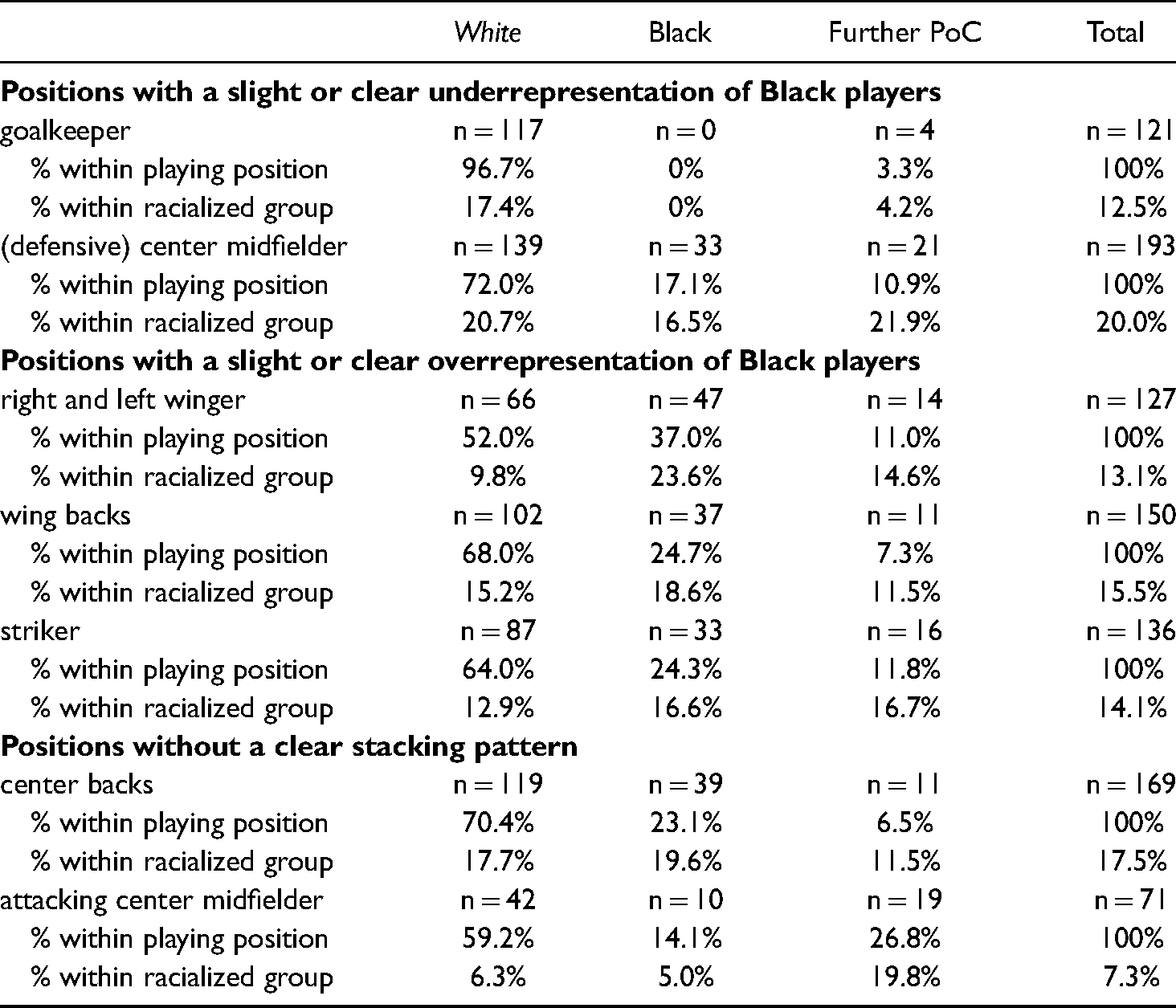
The empirical findings also confirmed the second research hypothesis: Black players are slightly overrepresented in the positions of wing backs and strikers. With regard to the right and left wingers the differences were substantial. 37.0% of all right and left wingers were categorized as Black, whereas only 52.0% were categorized as white. In other words: while 42.7% of all of the 967 players either occupy the positions of right and left winger, the position of a wing back or the position of a striker, this holds true for 58.8% of the 199 Black players (see Table 2).
Interestingly, there was no evident pattern of stacking in the positions of center backs and attacking center midfielders. Despite the fact that Black players were significantly overrepresented in the position of center back, white players were not underrepresented. Furthermore, the data showed a significant underrepresentation of Black and white attacking center midfielders, as well as a significant overrepresentation of further People of Color (see Table 2). On the one hand, one may argue that when determining which players will play in these positions, racist preconceptions are unimportant. On the other hand, it is important that the descriptions of the skills required of center backs and attacking center midfielders are not that clear cut. Different decision-makers may perceive these stances differently, which might mean that the impacts of racist ascriptions overlap and rule each other out, making them undetectable but not demonstrating their absence.
Discussion of results
The current study showed that racist stacking exists in the soccer Bundesliga in the 2020/2021 season. The playing positions, in which Black athletes are overrepresented and those in which they are underrepresented are not randomly distributed. The expected differences may be smaller in some positions (defensive center midfielder/center midfielder, wing-backs and strikers) and larger in others (goalkeepers, right and left wingers). However, overall, the data shows the pattern that we would expect if racist stereotypes are relevant for assigning players to certain positions. These findings given, our study largely corresponds with results from prior research on stacking in other sports and in other national contexts and with results from prior studies on stacking in soccer. For sure, positions are different in soccer than in other sports and some of the requirements for certain positions on the soccer pitch have changed over time. However, the present study supports prior findings that Black athletes are underrepresented in positions requiring leadership, oversight and tactical and decision-making skills, while they are overrepresented in positions requiring more athletic abilities.
It has often been claimed within the prior discourse on stacking that decision-makers have an important role in racist stacking. Racist stereotypes may lead decision-makers to believe that Black players are better suited to athletic positions and less suited to tactical positions (Bopp and Sagas, 2014; Jones et al., 1987; Lewis, 1995; Pitts and Yost, 2013; Spracklen, 2013; Woodward, 2004). Scouts may recruit Black players for certain positions, managers and coaches may have a say in which players are contracted for specific positions, and coaches are likely to have a say in the specific line-up used during training sessions and, as a result, during competitive matches. With regard to our theoretical assumptions, we propose that racist stacking may be the result of a network of explicit and implicit views, which these decision-makers have incorporated through socialization and which might also manifest themselves in unconscious ways. They may be unaware that their explicit attitudes are racist (e.g. the presumption that Black athletes can run faster), or they may be unaware of their implicit attitudes and how they influence their conduct. The common argument that competition reduces discrimination (Kalter, 2005), because the enormous pressure to win in professional sports makes it unlikely to select and assign players based on racist ascriptions (see Pitts and Yost, 2013 for a critical discussion), is not necessarily a counterargument for this interpretation. It rather supports the argument that decision-makers are unaware of how racist beliefs shape the team line-up. However, one point must be made: even if racist ascriptions occur unintentionally, racism is nonetheless destructive to those who are affected by it.
Furthermore, stacking may be related to the underrepresentation of Black people and People of Color at the level of governance, in that the majority of decision-makers are white, perpetuating institutional whiteness (Bradbury, 2013). Originally, the present study intended to broaden prior research on stacking by exploring its connection to institutional whiteness. However, testing whether less stacking is found in teams with Black coaches, managers, and scouts, remains a task yet to done. This hypothesis was untestable because an insufficient number of diverse management teams were located. White privilege operates as an advantage in many ways, but a crucial one is the privilege of not having to deal with racism as a topic because one is not directly affected by it (Leonard, 2017). Privilege and power can amount to a lack of awareness among white people about how whiteness operates and how it biases decision-making processes in their favor (van Sterkenburg et al., 2019). These decision-making processes that perpetuate whiteness by recruiting within white networks and that perpetuate negative coaching education environments for aspiring coaches racialized as Black and Of Color, are part and parcel of institutional racism (Bradbury et al., 2018). Stacking in soccer and soccer media can be seen as a material manifestation of ‘racial neoliberalism’ (Goldberg, 2009) which, on the one hand, blurs the boundaries of national belonging in the public sphere when non-white players excel, while on the other hand, reinforces old boundaries of exclusion from national belonging when they do not. Therefore, Mesut Özil, a former German national team player stated, “I am German when we win, but I am an immigrant when we lose” (van Campenhout and Houtum, 2021).
When discussing and explaining prior results on stacking, the differential-attractiveness hypothesis, the role-modelling hypothesis or the self-stacking hypothesis have often been put forward. To some extent all of these hypotheses assume that Black players may rather consider some positions for themselves, while not considering others and that stacking should thus be seen as a result of self-recruitment that already starts at an early point within the athletic career (Curtis and Loy, 1978; Eitzen and Yetman, 1979; Lewis, 1995; Margolis and Piliavin, 1999; McPherson, 1975; Medoff, 1986; Perchot et al., 2015). Even though we hold it plausible that stacking in professional sports may indeed be a result of a path-dependent process, we still see how these processes may relate to racism and we emphasize the importance of not confounding victims and perpetrators when raising these arguments. If Black youths select peripheral positions due to a lack of role models, this does not rule out the possibility of racism, but it rather begs the question, ‘Why’? If they feel that they are more likely to be selected for the team if they play in these positions then this rather points to the presence than to the absence of racism. Theories about learned helplessness (Seligman, 1975) can help to explain the problem of becoming so accustomed to denigrating theories about one's inferiority with regards to intelligence (Jensen, 1969) and personality (Kardiner and Ovesey, 1962), and the value attached to those constructs in society, that one resigns to a mindset whereby expectations of social pain are the default.
Some US-American studies have shown that Black players often change from central to non-central positions when transferring from high school to collegiate or from collegiate to professional sports. However, they also found patterns of stacking in the lower leagues which they examined (Eitzen and Sanford, 1975; Pitts and Yost, 2013). Although it was beyond the scope of this study to empirically investigate how stacking in professional sports relates to stacking in amateur sports, and how implicit and explicit attitudes may influence the routines and practices in amateur soccer clubs, this issue is of specific relevance to discuss. To investigate stacking in amateur sports and to prospectively analyze how positions change within the career of soccer players may initiate a broader discourse on sport and racism in Germany, both in the academic and the public sphere. At least one argument should be mentioned in this respect: Within the broad media coverage that this first study on stacking in Germany has received, it has been argued that the absence of Black goalkeepers in the Bundesliga might be a result of Germany having a powerful tradition in educating goalkeepers and that the Bundesliga can thus rely on German goalkeepers instead of contracting them from abroad (e.g. Sutera, 2021). However, this argument fails to explain why there are no Black German goalkeepers in the Bundesliga. Given the fact that 41% of the Black Bundesliga players are German citizens and assuming that those players were socialized in German soccer clubs, the absence of Black goalkeepers in the Bundesliga encourages rather than dispels the assumption that racist stacking may already be present in amateur soccer. If Black players who were socialized in Germany had the same chance of being educated as goalkeepers in amateur sports as white players, then some of them should be able to make it to the Bundesliga.
Conclusion
The focus of the study which we have discussed in this article is racism, namely racist stacking in top German sports. The study found that while Black athletes are well-represented as players in the soccer Bundesliga, they are disproportionately concentrated in positions that are regarded as requiring athletic abilities and they are underrepresented in positions associated with tactical abilities. As a result, the presence of Black players on the pitch does not necessarily imply the absence of racism in sports (Elling and Claringbould, 2005). Racism can take many forms, and as a result, it should be explored and investigated in a variety of ways. Setting up an empirical study on racist stacking can thus be viewed as one viable method of doing sport and racism research, as it prompts us to consider the power of racist ascriptions and how they are established in sports institutions.
As a result, we see our research as a contribution to the field of sports racism research. Although there is widespread recognition that racism in sports is a problem, racism has particularly remained understudied in sport sociology in Germany and the field of sport has hardly been addressed in German research about anti-Black racism. This also concerns the public discourse in Germany, where sport is mostly seen as an arena of integration and where racism in sport is often solely mentioned as a single coincidence within fan cultures but hardly ever as an institutional problem. Furthermore, we claim that our study contributes to international sport sociology research on racist stacking because of its methodological and theoretical approach. We see our preliminary research on the descriptions of different playing positions in soccer as a strategy that can be used in future stacking research, as we believe that this enables the most straightforward way to analyze racist stacking. Most importantly, we emphasize that our work contributes to international stacking research by explicitly studying stacking via the lens of racism. We contend that many stacking studies to date have failed to effectively address racism. This can be regarded as a form of structural racism or even a replication of racism that occurs through a sophisticated method of avoiding or concealing it. As a result, we believe that academics who study stacking should be more cognizant of how racism is related to stacking.
We have argued that racist stacking is a type of institutional racism characterized by racist ascriptions incorporated in sport organizations’ routines, which may drive decision-makers to recruit, contract, and deploy players based on racist ascriptions given to their Blackness. Critics may argue that in order to make a statement about causation, a variable-oriented, controlled experiment must be conducted (Light et al., 1990). They would be leaning on Hume's philosophical knowledge of causation in this way, which Hempel eventually contributed to and codified in numerous deductive-nomological statistical models of explanation (e.g. Hempel and Oppenheim, 1948; Salmon, 1989). In adopting a realist approach to causation, in comparison to a positivist approach, our conclusion is compatible with and supported by the assertion that assignment of meanings, the interpretations, in other words, are a valid deducement of causation (e.g. Blumer, 1956; Maxwell, 2004).
However, we are aware that the researchers’ overall interpretative framework has a big influence on how they explain causal links. As a result, particularly in the context of future research, it may be beneficial to (a) create experimental designs that test the hypothesis that racist ideas lead to stacking, and (b) combine data concerning stacking with qualitative work that would add a layer of comprehension to our findings. To understand how stacking manifests from the perspective of Black players, approaches that attempt to explore collaborative research with Black people and People of Color rather than studies about them are required. Furthermore, mixed methods research should be used in future intersectional and systemic analyses of how institutional whiteness is related to stacking.
Footnotes
Data availability
The data can be shared upon reasonable request by the first author for secondary use or for a replication of the study.
Declaration of Conflicting Interests
The author(s) declared no potential conflicts of interest with respect to the research, authorship, and/or publication of this article.
Funding
The authors disclosed receipt of the following financial support for the research: This work was supported by the German Federal Ministry for Family Affairs, Senior Citizens, Women and Youth (BMFSFJ).
