




Abstract
For many high-performance athletes, competing in the Olympic Games is a major goal. Achieving this goal requires more than ever substantial investments of time and personal resources towards the sports career over several years. Thus, some athletes neglect other areas of life (e.g. education), which can pose a problem for the time after high-performance sport, while other athletes pursue a dual career. Previous studies have shown that former high-performance athletes achieved higher levels of education and better vocational positions than the general population. Due to the advancing professionalization and commercialization of high-performance sport, the question emerges whether these results are valid for athletes that are more recently retired. In addition, cross-cultural generalisability of these findings are of interest. For this purpose, 341 former athletes representing Switzerland at the Olympics were surveyed about their athletic, educational, and vocational careers. It turns out that these athletes obtained more degrees of higher education than the general population. Relative to their siblings, they have higher school-leaving certificates and work in more prestigious occupations. Following the holistic-interactionistic paradigm, person-oriented analyses was performed and revealed nine – mostly satisfactory – vocational career patterns. Hence, involvement in high-performance sport facilitates rather than hinders a successful vocational career.
Keywords
Introduction
A successful career in high-performance sport requires an athlete's long-term investment of time and personal resources. The statement of Bruce Kidd, a Canadian middle-distance runner competing between 1960 and 1964, supports this claim: “If it gets to the point where people are training twice a day, then they will move on to three times a day because probably there is a marginal efficiency to be gained with a lot more training” (Dubin, 1990: 475). This hypothetical scenario has become a reality: Olympic rowers, for example, are training up to 21 times per week (Tran et al., 2015). In addition, there are some sports which are characterised by a travel-intensive preparation and competition period. For instance, Olympic alpine skiers typically train and compete on snow for about 130–150 days per year (Gilgien et al., 2018). Thus, other areas of life (e.g. education, family) often have to be neglected in favour of sport, which may prove effective in the short term (i.e. being rewarded with success in sport), but can pose problems after the sports career (Alfermann and Stambulova, 2007).
There are different career models found for athletes: linear, where the dedication to sport is exclusive; convergent, where sport is prioritised but compatible with higher education; and parallel, where sport and higher education are balanced (Pallarés et al., 2011). Several studies emphasize the importance of educational attainment for athletes (e.g. Cecić Erpič et al., 2004; López de Subijana et al., 2020) and the use of personal strategies (e.g. saving money, entering a new job before ending the sports career, taking advantage of the sporting capital) to facilitate transitioning to a vocational career (e.g. Vilanova and Puig, 2016). Notably, a study by Conzelmann and Nagel (2003) demonstrated that former German Olympic athletes had higher educational levels and professional positions compared to the general population. In addition, the majority of these athletes have transitioned to vocational careers that are congruent with their educational degrees. Around 40% of these athletes showed upward mobility (i.e. rising career), meaning that they had higher vocational positions than their education level would have predicted. On the other hand, downward mobility (i.e. occupying a lower professional position than expected based on their educational level), was observed in only 5.8% of athletes (Conzelmann and Nagel, 2003). Similar findings were reported by López de Subijana et al. (2020) who found a lower unemployment rate among former elite athletes in Spain (see also Barriopedro et al., 2018). However, there was no difference in the average monthly income between former athletes and the general population. Eisen and Turner (1992) observed that most former Olympians benefited from increased social prestige and both an upward economic and social mobility. In Switzerland, Lötscher et al. (1979) found that despite substantial investment in high-performance sport, there were positive consequences (e.g. transfer of skills from sport to workplace) for the vocational career of athletes. Similar results were found by Baltisberger and Nagel (2016), who examined the vocational careers of former professional Swiss ice hockey players. The authors concluded that high-performance sport seems to have no adverse, but rather positive effects on the vocational career after high-performance sport. However, when investigating the relationship between athletic performance level and vocational career, mixed results were observed. Some studies have shown that successful athletes perform better in their vocational career than less successful athletes (e.g. Cecić Erpič et al., 2004; Kneyer, 1980; López de Subijana et al., 2020), while other studies found no differences (Hackfort et al., 1997; Nagel and Conzelmann, 2006). Thus, a successful vocational career does not seem to be very closely linked to athletic success. A reason for this might be that successful athletes can compensate a lack of educational degrees with fame and popularity, while less successful athletes focus more often on their education and end their sports career early to pursue their vocational career (Nagel and Conzelmann, 2006). Cartigny et al.’s (2019) results also show that athletes who are struggling during their sports career (e.g. experiencing injury, deselection) are more likely to focus on education or profession (i.e. pursuing an educational or vocational pathway).
However, the economic importance of high-performance sport has considerably increased in recent decades, which has led to an advanced professionalization, mediatisation, and commercialization of high-performance sport (e.g. Westerbeek and Hahn, 2013). For instance, the trend of increasing the number of competitions, developing new competition formats, and holding more global competition series has emerged. On the one hand, this has increased the demands on athletes (e.g. increase in time commitment and performance pressure). In some sports, for example tennis, it is nearly impossible to complete education while competing and thus prepare for a vocational career outside of sport (e.g. Nagel, 2002). On the other hand, there are also opportunities associated with the recent developments. For example, the professionalization in sport has created new possibilities for work and earnings (e.g. as a professional coach; Nagel and Conzelmann, 2006). Additionally, there are also social changes that facilitate careers in high-performance sport (e.g. awareness of dual careers, flexibility of the educational system). In light of these recent developments and the recommendation of Stambulova et al. (2020) to take culture-specific circumstances (i.e. different sport contexts, education systems, or labour market situations) into account, the question arises whether the findings from Germany and Spain are still valid today and generalise to a different environment (i.e. Switzerland). For example, depending on the national context, there is often a typical way of combining sport and education. Specifically, Kuettel et al. (2018b) found that in Switzerland a convergent dual career path is often opted for. This means that Swiss elite athletes choose an education that is compatible with sport, but after all prioritise sport in search of athletic success. In this process, athletes need to mostly organise and help themselves. There is little institutionalised support from higher education institutions (Kempf et al., 2014; Kuettel et al., 2018b).
Therefore, the primary objective of this study is to answer the following three questions: (1) What is the educational and vocational status of former Swiss high-performance athletes after their career termination compared to non-athletes? (2) What educational and vocational career patterns can be found among these former athletes? (3) What influence on vocational careers is attributed to sport?
Theoretical framework
Similar to Conzelmann et al. (2001), the present study follows the heuristic guidelines of life course research (see Baur, 1998; Elder et al., 2003; Mayer, 2004). In this context, individual life courses are referred to as careers, which can be seen as a sequence of activities and events in different areas of life. These areas are not to be understood as isolated from each other, but rather constitute an interdependent relationship (Mayer, 2004). In addition, the life course is dependent on institutional and organisational contexts (e.g. educational system). It follows that an individual career path is dependent on a variety of internal and external factors. Further, the life course approach conceptualises the person as a holistic entity or system (Vondracek and Porfeli, 2002) – a conceptualisation which is also at the core of the holistic-interactionistic research paradigm and of the person-oriented approach (Bergman and El-Khouri, 2003; Bergman et al., 2003).
A characteristic element of the person-oriented approach is that an individual is seen as a functioning and developing whole and can be best described by analysing patterns rather than separate variables (Bergman et al., 2003). These patterns reflect interactional processes between an individual and its environment, which are assumed not to be accidental, but rather occurring in a lawful way within organised structures in order to optimize the overall system (Bergman and El-Khouri, 2003).
In the given context, the holistic athletic career model (Wylleman, 2019) provides an overview of the entire system of high-performance athletes. According to this model, the athletic career can be viewed at six different levels (i.e. athletic, psychological, psychosocial, academic/vocational, financial, legal). However, because it is not feasible to examine all levels in an empirical study (see Bergman and Trost, 2006), this study focuses on the educational and vocational level (or subsystem), particularly educational qualifications, occupational position, and field of vocational activity (see Conzelmann and Nagel, 2003). In addition, it may prove important to include contextual characteristics (e.g. parental vocational background, family belief in sport capital; Moret and Ohl, 2019) as well as interactions between the different levels (e.g. Bergman et al., 2003). The study of these interactional relationships requires the diligent recording of various educational and vocational aspects at different times during a person's life. Furthermore and in line with career research, subjective ratings should accompany objective parameters of an individual's career path (e.g. Conzelmann et al., 2001).
Method
Participants
In order to analyse the potential influence of high-performance sport on vocational careers, it is necessary to observe individuals who have been competing in elite sport for a substantial period and have ended their careers several years ago (e.g. Conzelmann et al., 2001). One group that undoubtedly invested extensive resources into their athletic development, are participants in the Olympic Games. Therefore, the population inclusion criterion was defined as all Olympic participants from Switzerland. Athletes who participated in the Olympic Games before 1988 or after 2012 were excluded, as the former have reached the retirement age, the latter have not had time for establishing themselves in a post-sports career and thus assessing potential influences would be hindered. This resulted in a population of 694 suitable participants (33.7% female, 66.3% male).
The current contact addresses of the former athletes were obtained through various sources: national sport associations, sport clubs, former national team colleagues, personal contacts or internet sources (e.g. telephone directories or social media). Despite an extensive search, the current contact data of 44 people could not be found and 12 people have passed away, resulting in a total sample size of 638 former athletes that received an invitation to an online survey (91.9%). The data collection period was six weeks. During that time, each person was contacted a maximum of three times. For the present study, the sample was composed of 341 former athletes (32.8% female, 67.2% male) with a mean age of 47.16 years (SD = 7.72) from 42 different sports. This resulted in a response rate of 53.5%. A total of 15% (n = 51) won at least one Olympic medal and 32.0% (n = 109) won an Olympic diploma (ranks 4 to 8). Moreover, four cohorts were formed based on the year of the termination of the sports career: 19.1% (n = 65) of the athletes ended their career up to 1996, 32.6% (n = 111) between 1997 and 2004, 36.1% (n = 123) between 2005 and 2012, and 12.3% (n = 42) after 2012.
A binary regression was conducted in order to examine possible selection bias in terms of gender, year of birth, type of sport (i.e. summer/winter sport), success at the Olympics, and popularity. The full model containing five variables was not significant, χ2 = 6.300, N = 694, df = 5, p = 0.278; R2 (Nagelkerke) = 0.012, indicating that the model was not able to significantly distinguish between individuals who participated in the study (n = 341) and those who did not (n = 353). The results therefore indicate that the sample is a good representation of the population in terms of the information available. The athletes retired from high-performance sport at an average age of 31.38 (SD = 5.83). The average duration of the career in competitive sport was 16.88 (SD = 6.06) years. On average, the career length over these four cohorts has increased by one Olympiad for women (4.09 years) – and by almost two Olympiads for men (7.11 years). At the time of the survey, the respondents have retired from high-performance sport for an average of 15.30 (SD = 7.09) years.
Measures
The questionnaire was constructed based on the theoretical framework and survey developed by Conzelmann et al. (2001). The original questions were adapted to suit the Swiss sport and education system. The career trajectory was subdivided into the athletic, educational, and vocational career. For each trajectory, objective variables (e.g. age at career end in sport, duration of sports career; athletic success; type of education, highest educational level, and duration of education; job titles and positions) and subjective ratings regarding the influence of sport on the trajectory (e.g. on length of schooling, job position, professional network) were also assessed. As for these subjective variables, the respondents had to rate the influence on a Likert scale (1 = clearly extended/strong negative effect, 3 = no influence, 5 = clearly shortened/strong positive effect). Athletic success was rated on a three-point scale (1 = participation at the Olympic Games, 2 = top 8 at World Championships or Olympic Games, 3 = top 3 at World Championships or Olympic Games). In order to estimate educational achievement, the highest school-leaving certificate (1 = none to 5 = baccalaureate schools/entrance qualification for universities) as well as the highest educational level (0 = none to 5 = university of applied sciences or university level) were recorded. Vocational status was examined by transforming the coded job titles (i.e. ISCO-08) into occupational prestige (SIOPS; Ganzeboom and Treiman, 2003; Treiman, 1977) and job autonomy scores (Hoffmeyer-Zlotnik, 2003; Hoffmeyer-Zlotnik and Warner, 2011). Ganzeboom and Treiman’s (2012) conversion tools were used to transform the ISCO-08 codes to the SIOPS scale. This index ranges from 12 (shoe shiner) to 78 (medical doctors, university professors) (Ganzeboom and Treiman, 2003). Hoffmeyer-Zlotnik’s (2003) scale organises job autonomy of employees into five categories (1 = low autonomy to 5 = high autonomy). In addition, it was checked whether the vocational activity (5 years post sport) was outside the field of sport. In order to take the socio-economic status of an athlete's family of origin into account (cf. López de Subijana et al., 2020), school-leaving certificates and occupational prestige of the siblings, where present, were assessed. In addition, the parental socio-economic status was assessed by transforming coded job titles (i.e. ISCO-08) into the International Socio-Economic Index of Occupational Status (ISEI; Ganzeboom and Treiman, 2003; Ganzeboom et al., 1992).
This version of the questionnaire was pilot-tested with 43 former elite non-Olympic athletes. The final version was translated into French and double-checked by two bilingual sport and language experts and subsequently programmed on a digital survey tool (LimeSurvey, version 2.50).
Procedures
Similar to Conzelmann and Nagel (2003) a retrospective longitudinal research design was chosen to capture the personal time series data. Advantages of this research design are that different cohorts can be examined and historical changes registered (Conzelmann and Nagel, 2003). In order to reduce recall biases, each respondent listed all educational and vocational milestones chronologically for the individual stages in their life – similar to a tabular CV. In order to compare the career of the different athletes, occupational prestige, job autonomy, and field of activity (within sport vs. outside of sport) were analysed for all athletes five years after the end of their career. The timing of five years after the end of the career was chosen to ensure that as many athletes as possible have completed post-sports career education (e.g. university degree). Before the study was conducted, the authors’ institutional review board approved an ethic application. All respondents gave their written informed consent to participate.
Data analysis
Because biased or incomplete data can be prominent in retrospective longitudinal surveys, all data were checked for plausibility and completeness. As a result, inconsistent or missing data were corrected by the use of available survey data or publicly available information (e.g. results databases). All available data was included in the different analyses, i.e. also from respondents who did not fill in the questionnaire completely, but who answered the particular questions (complete case analysis). The missing values in the variables under consideration range from 0% (school-leaving certificates) to 17.6% indication of the subjective influence of engagement in high-performance sport on the vocational career. In order to compare the educational qualifications of the sample with the general population, a chi-square analysis was carried out. Paired sample t-tests were carried out to compare school-leaving certificates and professional prestige of the athletes with those of their siblings.
To implement the theoretical conceptualisations of the person-oriented approach, the different career patterns within the sample were examined by means of a hierarchical cluster analysis (Ward's method, average squared Euclidean distance). A prior outlier analysis was performed due to a potential distortion of the cluster solution. Using the squared average Euclidean distance of 0.8 calculated on standardised variables, no outliers were detected (Vargha et al., 2015). To determine the final cluster solution theoretical aspects as well as statistical criteria were used, in particular the elbow criterion, the total weighted mean homogeneity coefficients (HCmean < 1.0), the size of explained error sum of square percentage (EESS > 67%), and the silhouette coefficient (SC > 0.5). The cluster solution was optimized by means of cluster centre analysis (k-means method). In the process of further describing or externally validating the clusters, several variables were taken into consideration (i.e. gender, parental socio-economic status, age at career end in sport, duration of sports career, athletic success). To test for significant differences between clusters, different tests were conducted (based on scale of measure): a one-way MANOVA followed by one-way ANOVAs (subjective influence of the engagement in high-performance sport on education and vocation), one-way ANOVAs (parental socio-economic status, age at career end in sport, duration of sports career, athletic success) and Fisher's exact test (gender, cohort). Due to lack of space, the reporting of post-hoc test was omitted. For all statistical tests the level of significance was set at 5%. As estimate of the effect size eta-square (η2) was used (0.01 = small, 0.06 = medium, 0.14 = large) for one-way ANOVAs, Cohen's d (0.2 = small, 0.5 = medium, 0.8 = large) for t-tests, and Cohen's w (0.1 = small, 0.3 = medium, 0.5 = large) for chi-square tests (Cohen, 1988). The cluster analysis was carried out with ROPstat 2.0 (Vargha et al., 2015), all other analyses were performed with IBM SPSS Statistics (Version 27.0).
Results
Descriptive results and comparison with non-athletes
Looking at the school-leaving certificates, slightly more than one third (36.4%) had obtained the highest level school certificate (baccalaureate schools; entrance qualification for universities), while 13.8% had completed an upper secondary specialised school, and half of the respondents (49.9%) at least compulsory school. When all educational degrees were taken into account, it is noticeable that almost half of the former athletes (45.9%) had completed tertiary education at university of applied sciences or university level. 21.0% had completed higher vocational education, 24.3% a vocational apprenticeship, 8.6% a general education qualification, and one person (0.3%) basic compulsory school. In comparison, 29.6% of the general population in Switzerland (aged 25–64) has a tertiary education at university of applied sciences or university level and 14.8% has a higher vocational education (see Federal Statistical Office, 2020, April 7). The complete comparison between the sample and the general population can be found in Table 1. Thus, the former high-performance athletes had higher educational level than the general Swiss population, Χ2(4) = 87.51, p < 0.001, n = 338, w = 0.51.
Comparison of educational level between the athletes (n = 338) and the general population in Switzerland (aged 25–64).
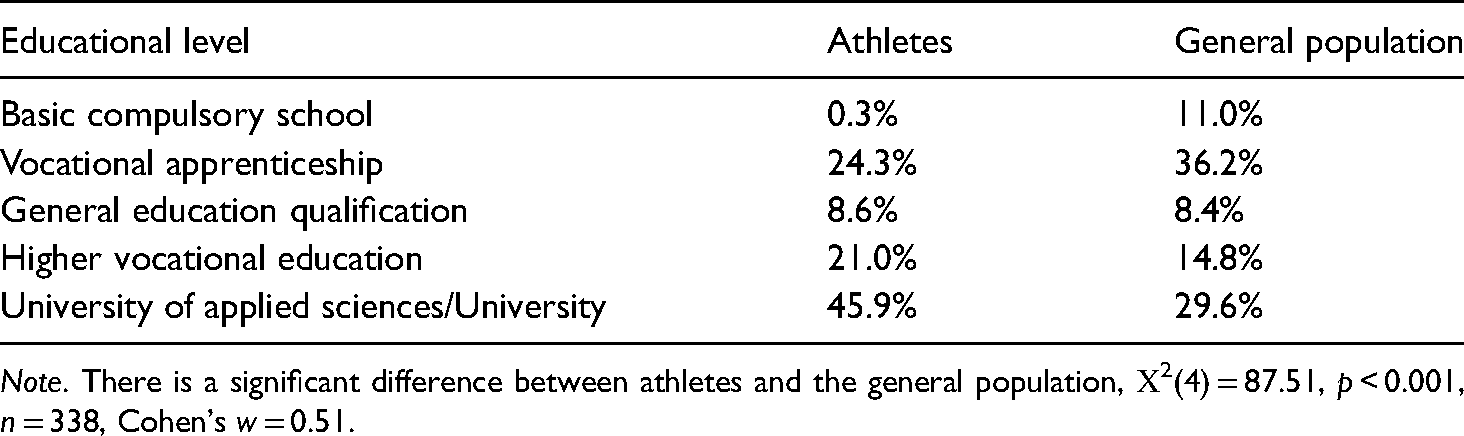
Note. There is a significant difference between athletes and the general population, Χ2(4) = 87.51, p < 0.001, n = 338, Cohen's w = 0.51.
Relative to their siblings, the former athletes had achieved higher school-leaving certificates as well as higher occupational prestige (see Table 2). Because these results may be confounded by gender (gender-specific social norms and opportunities) and age of the siblings, additional analyses were performed: Comparing male athletes with their brothers, similar results were observed. However, the difference between female athletes and their sisters with respect to both school-leaving certificate and occupational prestige was no longer significant. However, due to the small sample sizes in the female same-sex siblings (n = 48 and n = 34, respectively) these tests had clearly not sufficient power (1 – β = 0.21 and 0.36, respectively) to detect small effects. In addition, there was no significant mean age difference between the former athletes and their siblings, t(302) = −1.80, p = 0.072, d = −0.10.
Comparison of school-leaving certificate and occupational prestige between former athletes and their siblings.
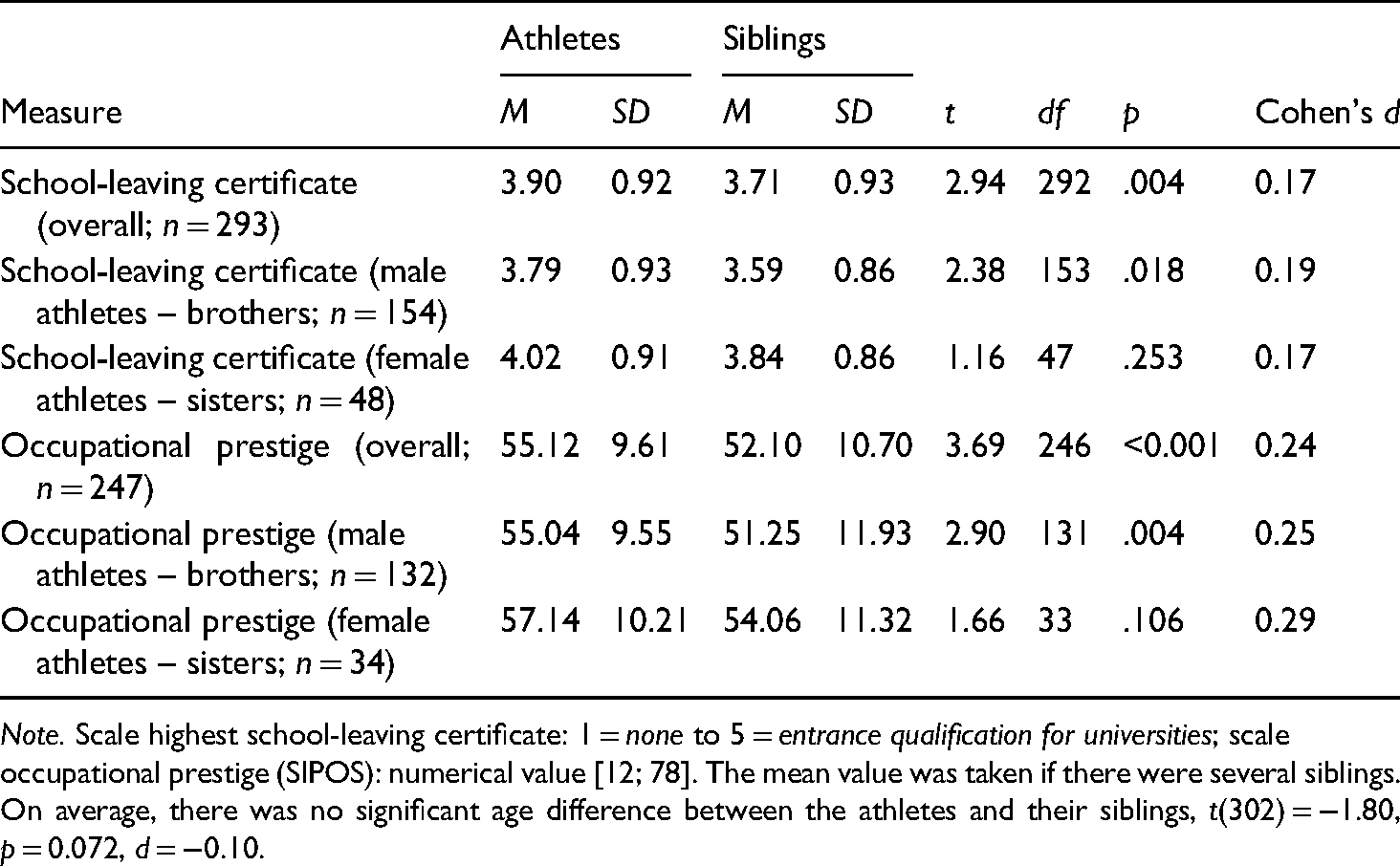
Note. Scale highest school-leaving certificate: 1 = none to 5 = entrance qualification for universities; scale occupational prestige (SIPOS): numerical value [12; 78]. The mean value was taken if there were several siblings. On average, there was no significant age difference between the athletes and their siblings, t(302) = −1.80, p = 0.072, d = −0.10.
Gender-specific analyses among the former athletes revealed higher school-leaving certificates for women than men, t(339) = 2.93, p = 0.004, d = 0.34. However, no differences were found with regard to the highest educational degree, t(336) = 2.30, p = 0.818, d = 0.03, and occupational prestige 5 years after career termination, t(280) = 0.12, p = 0.902, d = 0.02, as well as in the current profession between the men and women in the study, t(294) = −0.32, p = 0.750, d = −0.40.
The respondents’ subjective assessments of the influence of sport on their educational and vocational careers showed that the majority of respondents did not attribute much influence of elite sport on their school career. Nevertheless, 31.4% of former athletes indicated a positive effect on school performance, while 47.4% indicated no effect and 21.1% said that it had a negative effect. The duration of school-time was perceived to be prolonged for 21.5% and shortened for 7% because of their engagement in high-performance sport and 71.5% did not report any effect. Regarding the influence on the vocational career, 52.1% of former athletes stated that their entry into (ordinary) working life was delayed by high-performance sport, 29.8% attributed no influence of sport and 18% assumed that career entry was accelerated. For 45.6% of the respondents, the position at the start of their vocational career was elevated as a result of their involvement in elite sport, while 19.0% indicate a negative effect and 35.4% no influence. In addition, 62% of respondents stated that their professional network had benefitted from the involvement in high-performance sport, whereas 32.1% could not identify any influence and 5.9% identified a negative influence.
Classification of vocational careers
Cluster analysis were based on 280 individuals who provided complete data in the variables used for pattern detection. According to both statistical as well as content-related criteria, the 9-cluster solution was found to be the most suitable. This solution fulfils all criteria proposed by Vargha et al. (2016) with an EESS of 74.85%, a SC of 0.68, and a HCmean of 0.52 [0.36; 0.94]. In Table 3, descriptive statistics of the five variables before z-standardisation for the overall sample as well as for the 9-cluster-solution are presented. The cluster names were chosen so as to highlight the most notable characteristics of each cluster. Whenever appropriate, similar designations were chosen as in Conzelmann and Nagel (2003).
Descriptive statistics for the educational and vocational variables as function of clusters.
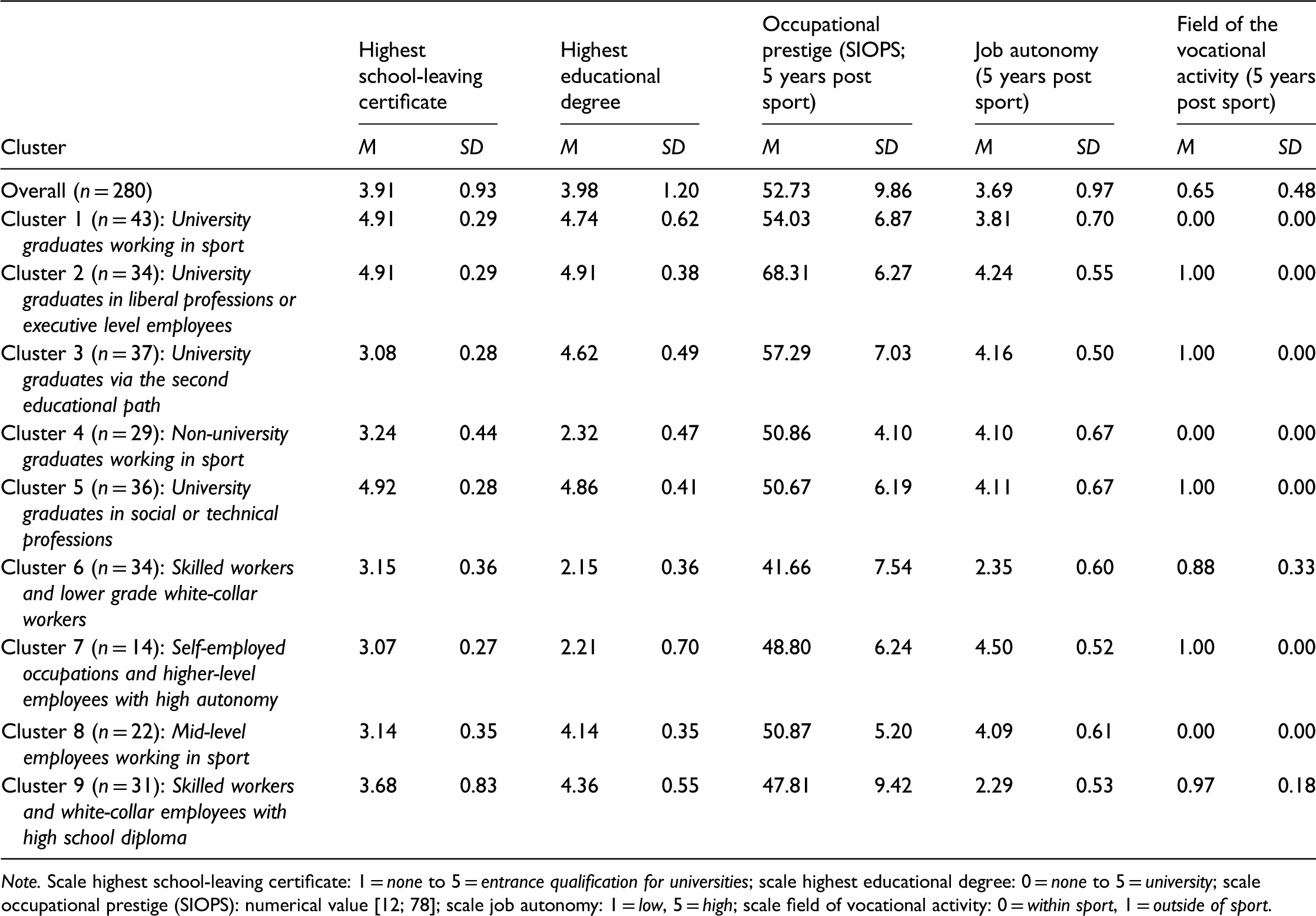
Note. Scale highest school-leaving certificate: 1 = none to 5 = entrance qualification for universities; scale highest educational degree: 0 = none to 5 = university; scale occupational prestige (SIOPS): numerical value [12; 78]; scale job autonomy: 1 = low, 5 = high; scale field of vocational activity: 0 = within sport, 1 = outside of sport.
The former athletes in cluster 1 held above-average school-leaving and educational degrees (83.7% had a degree from a university) as well as occupational prestige and job autonomy; all of them were working in the field of sport. They were therefore named university graduates working in sport. The individuals in cluster 2 also possessed high educational degrees (94.1% had a degree from a university), high occupational prestige and job autonomy, but none of these individuals were working in sport. Because they were often working as medical doctors, lawyers or mangers, this cluster was named as university graduates in liberal professions or executive level employees. Cluster 3 contained respondents who achieved an average school-leaving certificate, frequently followed by an apprenticeship, which is a typical occupational pathway in Switzerland. After a certain time, they obtained high educational degrees (e.g. university degree) and held positions with an above-average prestige and autonomy outside of sport. This profile is typical for university graduates via the second educational path – a peculiarity of the Swiss education system: After completing a vocational apprenticeship, many former athletes took the vocational baccalaureate and subsequently study at a university of applied sciences. Cluster 4 were non-university graduates working in sport. Here, the former athletes had a basic level of education, work in average vocational positions with average prestige and slightly above average job autonomy within the field of sport. About one third were self-employed (e.g. as personal trainers or ski instructors). In cluster 5, despite having had high educational degrees, only jobs with an average prestige were pursued. Most of these university graduates in social or technical professions worked outside of sport in the social sector (e.g. social education worker) or technical positions at large companies. Respondents with below-average educational degrees, occupational prestige and job autonomy working outside of sport were most often skilled workers and lower grade white-collar workers (cluster 6). Self-employed occupations and high-level employees with high autonomy were characterised by relatively low educational level but a very high degree of job autonomy (cluster 7). Cluster 8 contained former athletes that were still professionally working in the field of sport. The majority of this cluster were mid-level employees working in sport (e.g. coaches in high-performance sport). Despite a slightly above-average educational attainment, the skilled workers and white-collar employees with high school diploma in cluster 9 had a below-average prestige and are professionally active outside of sport (Figure 1).
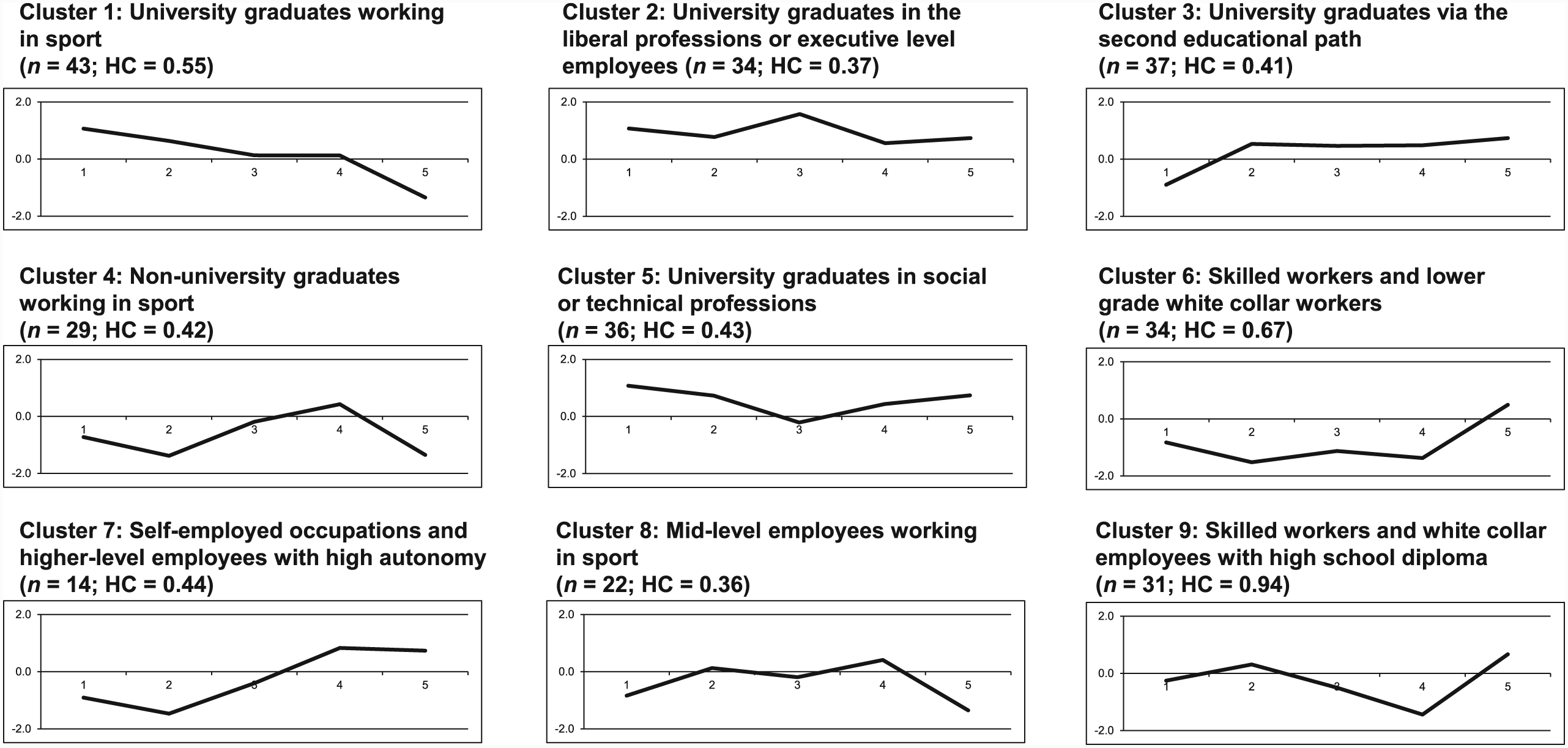
z-standardised vocational career patterns for the 9-clusters solution. HC = homogeneity coefficient per cluster. Operating factors: 1 = highest school-leaving certificate, 2 = highest educational degree, 3 = occupational prestige (5 years post sport), 4 = job autonomy (5 years post sport), 5 = field of vocational activity (5 years post sport).
Objective and subjective characteristics of the clusters
In order to better describe and interpret the nine clusters, they were compared with regard to the following objective variables: gender, parental socio-economic status, age at career end in sport, duration of sports career, athletic success, and cohort of career termination. Results of Fisher's exact test with a hypergeometric distribution showed that there were significantly (ps < 0.05) more women and fewer men located in cluster 1 and cluster 6. In addition, there were significantly (ps < 0.05) more athletes from the youngest cohort (career end between 2013–2018) in cluster 4 and more athletes from the cohort of 1997–2004 in cluster 6. Moreover, the nine clusters differed in terms of the parental socio-economic status, F(8, 258) = 7.76, p < 0.001, η2 = 0.19, age at career end in sport, F(8, 271) = 5.81, p < 0.001, η2 = 0.15, duration of the sports career, F(8, 271) = 6.45, p < 0.001, η2 = 0.16, and athletic success, F(8, 271) = 2.58, p < 0.010, η2 = 0.07. Looking at the descriptive statistics (see Table 4), it is noticeable that the members of cluster 4 (non-university graduates working in sport) retired at the highest age (36.72 years), had the longest careers in sport (22.52 years), and their parents had the lowest socio-economic status compared to the other clusters. In addition, the parental socio-economic status was higher in the clusters with university degrees (cluster 1, 2, 3, and 5) compared to the other clusters with lower educational degrees (cluster 4, 6, 7, 8, and 9). The highest value of parental socio-economic status was found in cluster 5 (university graduates in social or technical professions) followed by cluster 2 (university graduates in liberal professions or executive level employees). Cluster 2 and 9 had the least athletic success, while cluster 4 and 7 had the most athletic success. In addition, those in cluster 2 had ended their careers at the youngest age (29.03 years), while cluster 6 had the shortest careers (13.85 years).
Further characterisation of the nine-cluster solution.
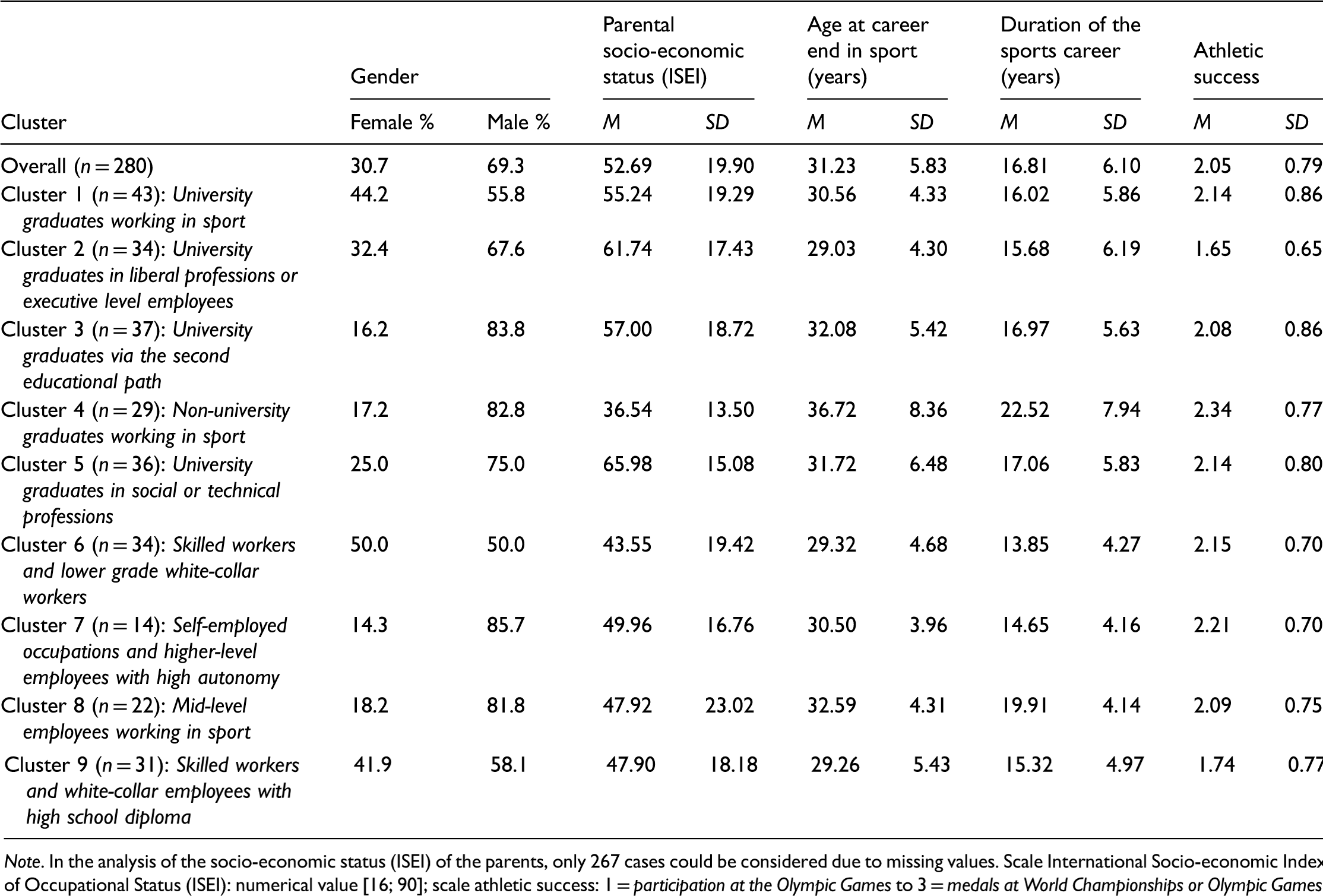
Note. In the analysis of the socio-economic status (ISEI) of the parents, only 267 cases could be considered due to missing values. Scale International Socio-economic Index of Occupational Status (ISEI): numerical value [16; 90]; scale athletic success: 1 = participation at the Olympic Games to 3 = medals at World Championships or Olympic Games.
The perceived influence of sport on the educational and vocational career was analysed by clusters (see Table 5). There was a statistically significant difference in five subjective influences based on the nine clusters, F(40, 1070.725) = 2.49, p < 0.001, Wilk's Λ = 0.679, ηp2 = 0.74. There were significant differences in duration of school-time, F(8, 249) = 4.14, p < 0.001, η2 = 0.12, age when starting the vocational career, F(8, 249) = 2.06, p = 0.041, η2 = 0.06, position when entering vocation, F(8, 249) = 3.42, p = 0.001, η2 = 0.10, and professional network, F(8, 249) = 4.46, p < 0.001, η2 = 0.13. However, the clusters did not differ in terms of subjective influence regarding school performance, F(8, 249) = 1.25, p = 0.270, η2 = 0.04. The descriptive examination of the nine clusters reveals that the respondents in cluster 4 reported that sport had the most positive influence, while those in cluster 5 and 6 indicated the least positive influence.
Subjective influence of an engagement in high-performance sport on the educational and vocational career.
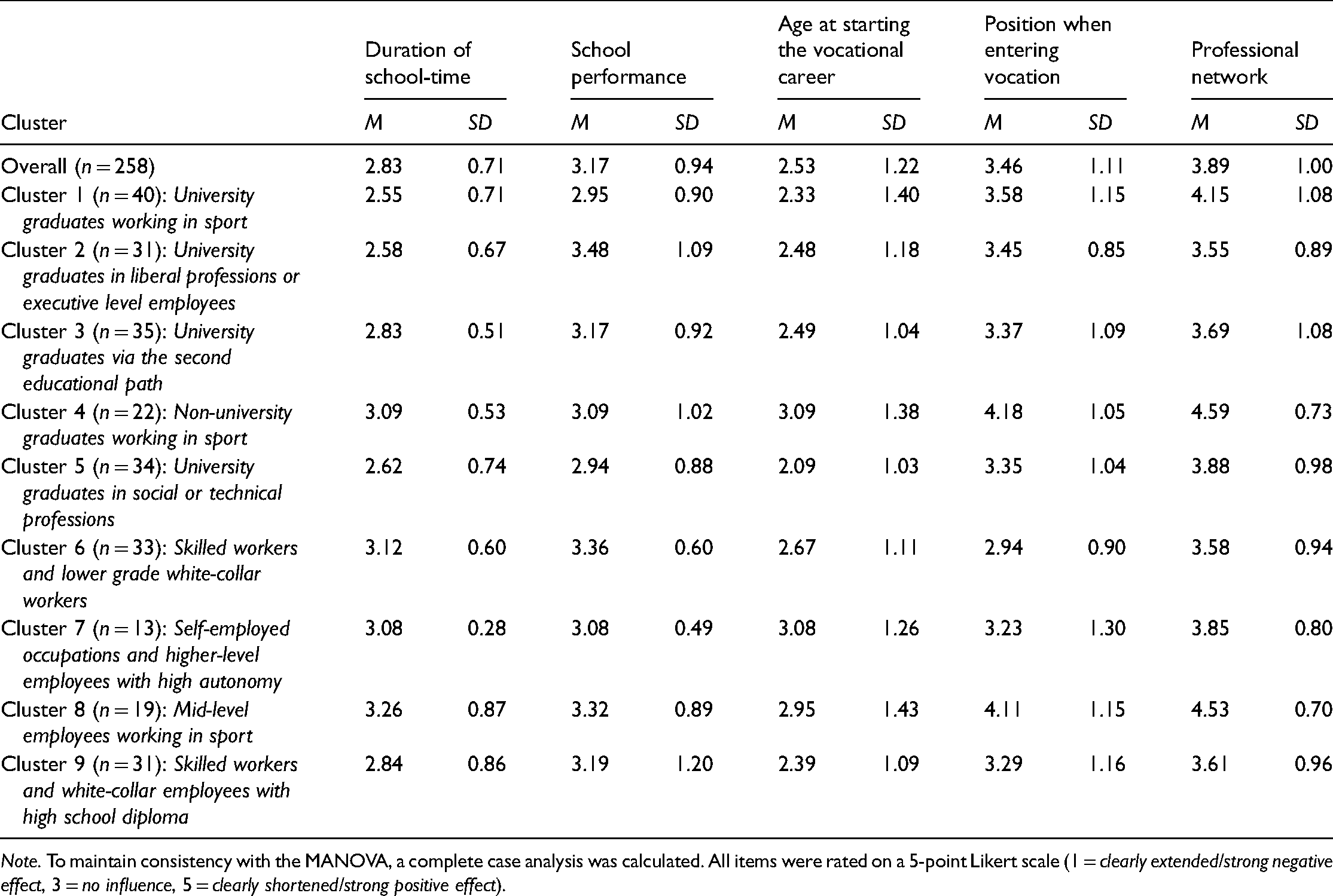
Note. To maintain consistency with the MANOVA, a complete case analysis was calculated. All items were rated on a 5-point Likert scale (1 = clearly extended/strong negative effect, 3 = no influence, 5 = clearly shortened/strong positive effect).
Discussion
In line with previous studies conducted in Switzerland and other countries (e.g. Germany; Conzelmann et al., 2001), the results of the present study show that former Olympic athletes representing Switzerland possess higher educational degrees relative to the general population. In addition, these findings reinforce the conclusion of Conzelmann and Nagel (2003) that Olympic participants have better school-leaving qualifications compared to their sibling(s). It has also been demonstrated that former Olympic athletes have higher occupational prestige compared to their sibling(s). This is interesting, as common sense would suggest that former high-performance athletes have less time for their education and job training because of their previous commitment to sport. This result is also in support of Storm and Eske (2021), who found better academic performances of elite athletes compared to non-athletes. Moreover, similar to the study of López de Subijana et al. (2020), female participants of the current study had higher school-leaving certificates than men.
In general, the former athletes perceived their engagement in high-performance sport to have had a positive influence on their (somewhat delayed) vocational career. This finding is in line with Alfermann and Stambulova (2007) who point out that intense engagement in elite sport may prolong the occupational development. The classification of vocational careers after elite sport on the basis of educational aspects, occupational prestige, job autonomy, and vocational field results in nine different patterns. The subjective ratings and the comparisons across clusters led to a comprehensive characterisation (see Table 6). Among the nine clusters, it is noticeable that clusters with high parental socio-economic status achieved high educational certificates. This might be explained by the fact that families with high economic and cultural capital are more likely to make their children aware of the importance of preparing for a second career (Vilanova and Puig, 2017; see also Bourdieu, 1986). A study among Swiss ice hockey players also showed that athletes with parents from the lower-middle class neglect their schooling especially when the parents believe very strongly in the value of sporting success but are not sensitive to the value of education (Moret and Ohl, 2019). In addition, parental socio-economic status has been linked in many studies outside of sports to children's cognitive and educational attainment (for an overview, see Bradley and Corwyn, 2002).
Typology of the vocational careers (9-cluster solution).
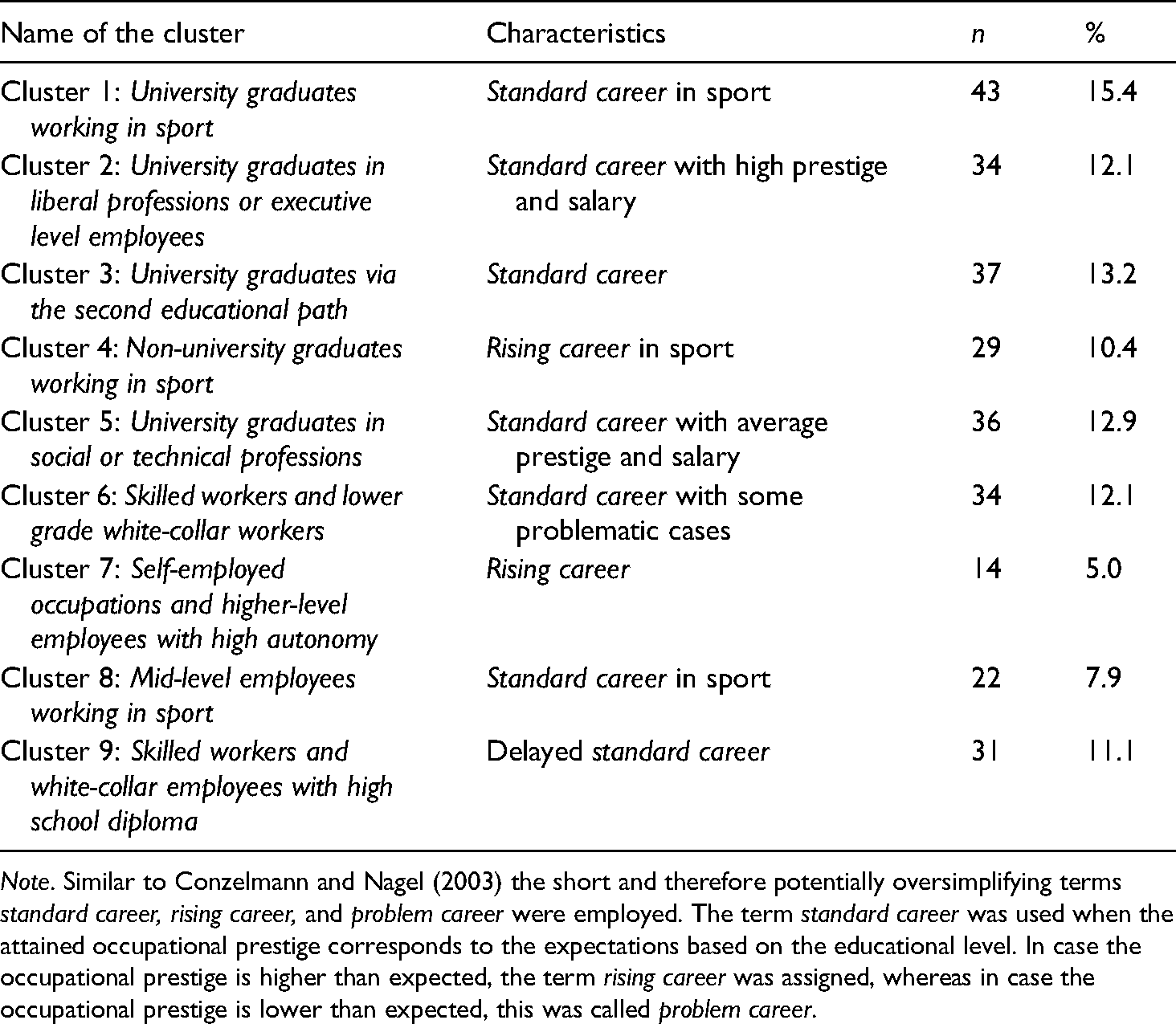
Note. Similar to Conzelmann and Nagel (2003) the short and therefore potentially oversimplifying terms standard career, rising career, and problem career were employed. The term standard career was used when the attained occupational prestige corresponds to the expectations based on the educational level. In case the occupational prestige is higher than expected, the term rising career was assigned, whereas in case the occupational prestige is lower than expected, this was called problem career.
For a standard career, it is assumed that a high-performance sports career does not impair the development of the vocational career. While the former athletes in clusters 1 and 8 remained in the field of sport and have occupations with average prestige (e.g. coach), those in clusters 2 and 3 held prestigious positions outside of sport (e.g. lawyer). Cluster 2 was the one with the highest occupational prestige, but with the lowest athletic success. In combination with the age at career termination in sport, this might indicate that these athletes left their sports career in favour of their vocational career. A rising career characterizes athletes with below-average school-leaving certificates but achieving a high level of prestige and autonomy in their career. A minority of the participants in the study showed upward mobility (i.e. rising career). This was the case for the non-university graduates working in sport (cluster 4) and the self-employed occupations and higher-level employees with high autonomy (cluster 7). These were also the two clusters with the most athletic success. Therefore, it seems possible that these individuals could compensate for their lack of educational degrees in part through fame and popularity. Interestingly, these were also the individuals who retired from sport at the highest age and had the longest sports career. Moreover, cluster 4 contained more athletes from the youngest cohort. This indicates that the progressing professionalization of sport makes it easier to remain a high-performance athlete for a long time and to stay in sport after retirement. Similar results were also found by Nagel and Conzelmann (2006), who studied different cohorts of tennis players.
The comparatively low parental socio-economic status of non-university graduates working in sport (cluster 4) indicates that sport was probably used as an opportunity for upward mobility. The sports career seems to be “protected” to some extent from the negative effects of a low parental socio-economic status. Similar to Moret and Ohl (2019), this result shows that upward mobility by means of a successful sports career can work even without education. Nevertheless, the question arises whether these athletes were voluntarily staying involved in sport or whether they had no other option. In a study of Spanish Olympic athletes, Vilanova and Puig (2017) found a type similar to the non-university graduates working in sport: the lifetime athletes. These athletes also remained professionally in the field of sport after their sports career and did not have much support from their family. The reason why they stayed in sport “is not because they chose to, but because they felt disoriented, confused and unprepared for their new life” (Vilanova and Puig, 2017: 7).
An unequivocal downward mobility (i.e. problem career) as found by Conzelmann and Nagel (2003) was not identified in the present study, although a cluster of skilled workers and lower grade white-collar workers was identified (cluster 6) who had relatively low levels of education as well as low vocational positions, perceived their professional position as being slightly negatively affected by sport, and have had the shortest career in high-performance sport. However, it would be misleading to speak of a problem career, as it is not known whether these athletes are satisfied with their vocational career. An additional finding was that these individuals were more often from an older cohort and there were relatively more women than men in this cluster. Several reasons could explain this gender difference: On the one hand, the overrepresentation of women in this cluster could be due to the fact that some women started a family after their sports career and put their vocational career on hold. On the other hand, it could be that women were less able to save money during their sports career given the lower income levels of female athletes and thus did not have the resources to pursue, for example, an education besides the sports career. Due to the enhanced reconcilability of work and family life as well as valorisation of women's sport in Switzerland, the situation might have improved in recent years. Hence, individuals from older cohorts were more likely to be found in this cluster. Again, Vilanova and Puig (2017) described athletes with a similar profile as non-strategist: it's a job, meaning that these athletes had often not made any specific preparations for life after sport. Therefore, future studies should examine how the skilled workers and lower grade white-collar workers prepare for their second career.
Cluster 9, skilled workers and white-collar employees with high school diploma, could be identified more easily as a problem career, since (rather high) educational degrees usually entail elevated prestige and autonomy values. However, apart from the duration of school-time and the age at starting the vocational career, these individuals did not feel that sport significantly influenced their vocational careers. When inspecting data on the career progression beyond the five-year mark (i.e. prestige of the current job), these careers appear less problematic but merely delayed. The individuals in cluster 5 (university graduates in social or technical professions) had parents with the highest socio-economic status but had jobs with an average prestige five years after the end of their careers. Considering the other variables (level of education and subjective assessments), it is also not appropriate to speak of a downward mobility (i.e. problem career).
Overall, it can be stated that the vocational and educational careers of Swiss Olympic participants were not negatively influenced by a long-term involvement in high-performance sport and that the majority experienced a positive influence on their vocational career.
The question arises as to which factors are decisive for these results. The popularity, the network or the social support within the sport are certainly beneficial for vocational success (e.g. Torregrosa et al., 2015). However, the above-average school-leaving certificates cannot be explained by popularity or the professional network, because most athletes were already active in the junior categories. It is therefore necessary to investigate whether further school education (i.e. baccalaureate schools) can be combined with sport more easily than work or further vocational training (i.e. apprenticeship). In addition, it could be that certain skills which are fostered in sport can be transferred to the non-athletic setting (e.g. dedication and perseverance; McKnight et al., 2009). Yet another explanation would be that only individuals with certain personality traits (e.g. ambition) enter high-performance sport.
Nevertheless, two profiles were found that indicate potentially problematic career paths (i.e. cluster 6 and 9). It is therefore recommended to focus on these individuals in career counselling as well as in research. For example, it would be interesting to examine these clusters more closely in order to better understand the underlying reasons and causes of these career paths (e.g. through in-depth interviews). This would make it possible to create specific support programmes provided by sports federations. Furthermore, as there is a relatively high proportion of women in these two clusters, it is necessary to clarify what role gender plays in the development of vocational careers of former high-performance athletes.
Limitations and future research
The present study has some limitations. Firstly, only Olympic athletes from Switzerland were examined. Results of cultural comparisons have shown that Swiss athletes tend to have fewer transitional difficulties (e.g. problems finding a job) after their sports career compared to other countries (Kuettel et al., 2018a). In addition, Switzerland has a flexible job market and overall a relatively low unemployment rate (for a more detailed characterization of the Swiss sport and education system, see Kuettel et al., 2018a, 2018b). Therefore, it would also be interesting to know how the vocational careers of former Olympic participants develop in countries that are culturally different from Switzerland. Moreover, to improve generalisability, future research should examine professional athletes who did not take part in the Olympic Games, either because they were involved in non-Olympic sports or because they failed to qualify despite a similar level of athletic engagement to more successful athletes (e.g. football players).
Secondly, although the response rate of 53.5% was relatively high and the sample is representative of the population in terms of gender, success at the Olympics and popularity, the results may be biased by a systematic dropout of athletes with an unsatisfactory vocational career after sport remains.
Thirdly, the results should always be interpreted with due caution not least because of the peculiarities of the assessed cohorts: The majority of the sampled Olympic athletes were active in the nineties and noughties. The Swiss elite sport system has changed considerably in recent years. For example, athlete-friendly schools have been created (e.g. Swiss Olympic Partner Schools), a network of athlete-friendly employers has been initiated, and the financial support for the athletes was increased (Kempf et al., 2021). However, globalisation has resulted in an increased number of competitions – leading to prolonged competitive seasons and intensified travel schedules for athletes. Together with the lengthened sports career of the athletes, this has resulted in an increased amount of time spent on sport in recent years, which impedes the pursuit of a dual career (sport and education/vocation) and delays entry into the vocation outside of sport. For the benefit of former athletes, however, this professionalization is generating more vocational career opportunities within the field of sport (e.g. Nagel and Conzelmann, 2006). Thus, the future development of this situation is difficult to predict. Researchers in this area always emphasise that careers should be examined holistically (e.g. Wylleman and Lavallee, 2004; Wylleman et al., 2013). In the present study, an attempt was made to examine the vocational careers of former high-performance athletes as holistically as possible. However, other important aspects (i.e. psychological aspects) of the transition from high-performance sport to a post-sports career could not be investigated due to the retrospective research design. Years after sports career termination, it is not possible to confidently evaluate the psychological effects of retirement and how the former athlete's mental well-being developed in this transition period. To meet the demand of a fully holistic approach, a prospective longitudinal study would be required, which examines high-performance athletes prospectively and multidimensionally during a length of time after their career in sport. At the same time, it would be interesting to evaluate these results with in-depth interviews and individual case studies in order to better understanding the phenomenon.
In this study, the educational and vocational careers were described relatively comprehensively and associations with certain explanatory variables were identified (gender, social class, athletic success). The question therefore arises regarding the specific influence of these variables on vocational careers of former athletes. However, in terms of interactionist theories of development, there is never just one single variable responsible for a particular development, but rather a set of different variables and their interplay (e.g. Bergman et al., 2003). Therefore, future research should make a precise analysis of patterns of sports-related and socio-economic variables that influence post-sports vocational careers.
Additional limitations of the retrospective design are possible recall biases that may affect the integrity of the results. Although the majority of the questions asked for objective event data of major social and personal significance (e.g. educational degrees) and the questionnaire was constructed to detect inconsistencies, a certain degree of uncertainty remains. The same applies to socially desirable answers in the subjective ratings: Despite the guarantee of anonymity, it is not clear whether the answers correspond to the real situation.
Conclusion
Overall, the present findings show that a long-term engagement in high-performance sport does not have a negative impact on either a person's educational or vocational career. The majority of the former Olympic athletes from Switzerland were able to launch a successful educational and vocational career despite their involvement in high-performance sport. This is in line with an earlier study by Conzelmann et al. (2001) in Germany. Furthermore, the result of the cluster analysis shows nine different career patterns. Four clusters in particular stand out because of their profile. The former athletes in the clusters non-university graduates working in sport and self-employed occupations and higher-level employees with high autonomy both stood out as holding above-average vocational positions compared to their educational degrees (i.e. rising career). Conversely, the skilled workers and white-collar employees with high school diploma had a lower occupational prestige than would be expected based on their educational degrees and the skilled workers and lower grade white-collar workers had lower educational certificates and prestige values. It is therefore recommended to focus on these individuals in career counselling as well as in research.
Footnotes
We would like to thank the Swiss Olympic Association for funding this research project, Andreas Bieri for his support in the data collection and Bryan Charbonnet and Frédérique Rol for their help in translating the questionnaire. We would also like to acknowledge Cyril Bucher for proofreading the final manuscript.
Declaration of conflicting interests
The authors declared no potential conflicts of interest with respect to the research, authorship, and/or publication of this article.
Funding
The authors disclosed receipt of the following financial support for the research, authorship, and/or publication of this article: This work was supported by the Swiss Olympic Association
