




Abstract
This article explores an important measure in current prevention policies in sport: guidelines against sexual harassment and abuse. Because little is known about how people involved in sport understand and relate to such guidelines, it fills a gap in current research on sexual harassment and abuse prevention in sport. We draw on ‘video elicitation’ focus group interviews with sport students in Norway. Our analysis is guided by Norbert Elias's sociology of knowledge and particularly his concept of ‘degrees of involvement and detachment’. First, we found that the students had limited knowledge about the sexual harassment and abuse guidelines. Second, we saw how their discussions alternated between different positions when reflecting upon the guidelines’ usefulness. From a relatively detached position, the students supported the general idea of guidelines. From the more involved position they voiced concern related to conduct regulations that conflicted with valued aspects of sport practice and mentioned problematic aspects of sport culture that the guidelines do not target. In a blend of involvement and detachment, the students drew on their sport experiences to reflect critically on both the potentials and limitations of the sexual harassment and abuse guidelines. Finally, we draw some implications of the analysis for the improvement of prevention work.
Keywords
Introduction
Until the 1980s, the subject of sexual harassment and abuse (SHA) in sport was rarely discussed, and very few cases surfaced (Brackenridge and Fasting, 2002). During the last few decades, however, SHA has increasingly been recognised as a serious problem in recreational, amateur and professional sport. One example is the International Olympic Committee's consensus statement on SHA in sport, which recommends that all sport organisations should have codes of practice that will ‘set a clear benchmark for what is acceptable and unacceptable’ (Ljungqvist et al., 2008: 5). Alongside broader societal developments in gender relations and attitudes towards violence, sport research has been important in this ideological shift, not least by demonstrating both the prevalence and consequences of SHA in sport (e.g. Fasting et al., 2002; Fasting et al., 2003; Fasting et al., 2011). In the wake of these advances, sport-governing bodies have pursued effective ways to minimise the risk of SHA and to handle any cases that do occur. A central part of their response has been the development of guidelines to regulate situations and behaviours that can be experienced as abusive, intrusive or degrading (Lang and Hartill, 2015). Such guidelines are most often part of broader policy responses designed to combat SHA in sport, which is also the case in Norway, the empirical context of the present study. 1
Within the academic literature on preventing SHA in sport, codes of practice are commonly viewed as a promising tool for crafting safer and more inclusive sport spaces (Donnelly et al., 2016; Kerr et al., 2014; Parent and Demers, 2011; Rulofs et al., 2019). At the same time, scholars caution that also warranted and well-intended policies can have unintended and undesirable outcomes (Waddington and Smith, 2009). The case of sport policies restricting physical contact between coaches and athletes illustrates how personally invested people in the sport community may question and challenge new standards of practice (see Gleaves and Lang, 2017; Öhman, 2016). Lang, for instance, found that the pressures of meeting child-safety standards made UK-based swimming coaches feel ‘unable to carry out their duties to the best of their abilities and … alienated from the young people [they coached]’ (2010: 33). Such examples illustrate that, in the face of new policy-mediated standards, coaches may experience insecurities and respond in ways that run counter to the intention of fostering safe sport environments (Piper et al., 2013; Taylor et al., 2016).
Against this background, and especially given the importance of guidelines in sport federations’ overall prevention strategies, it is essential to know more about their legitimacy and perceived usefulness ‘on the ground’, among those they are implemented to instruct and protect. The purpose of the present paper is to add to this type of knowledge, which we consider important to further sport communities’ progress in preventing and responding to SHA. As Brackenridge et al. (2004) point out, a lack of support among those involved in sport represents a risk of backlash against SHA-prevention work. Our study is empirically informed by a focus group study among sport students, most of whom had been active in grassroots sports. As the way in which SHA-prevention policies and approaches are received and regarded is an empirical question, bringing in sport students’ perspectives may offer clues to their promise as well as potential limitations.
Theoretical perspective
To understand how sport students assess the legitimacy and relevance of SHA guidelines and their content, we draw on Norbert Elias's ideas about the ‘civilising process’. The civilising process refers to how, in the course of history, social standards for behaviour have become more refined (Elias, 2000). With advances in the ‘threshold of repugnance’, for example, interpersonal violence is increasingly regarded with distaste and intolerance, and people's social habitus has ‘gradually transformed in the direction of more habitual and reliable self-restraint’ (Elias, 2008: 135). This idea is related both to the monopolisation of violence (Elias, 2000), which compels ‘greater self-demands on the individual through the threat and imposition of sanctions or the withdrawal of resources or privileges’ (Connolly, 2015: 1040), and the internalisation of a conscience (Elias, 2008), whereby deviation from social standards leads to feelings of shame and embarrassment (Elias and Scotson, 1994).
Particularly relevant to our exploration, and central to Elias's sociology of knowledge, is the concept of ‘degrees of involvement and detachment’. Elias proposes that civilising processes are enabled by a gradual increase in people's capacity for ‘relatively detached’ modes of thinking that allow people to take a longer term perspective and to distance themselves from immediate personal concerns and engage with problems ‘more generally experienced by people in similar social contexts’ (Malcolm, 2011: 289). ‘Relatively involved’ modes of thinking, in contrast, entail immersion in the present and a stronger orientation towards ‘the interests, the well-being or suffering of oneself or of social units to which one belongs’ (Elias, 1956: 228). Relatively involved forms of thinking are also ‘apparent in the value placed on internal, “microsocial”, systems of knowledge’ and may thus involve the rejection of influences from far-removed places and people (Malcolm, 2011: 292). Importantly, Elias (1956: 226) observes that ‘the very existence of ordered group life depends on the interplay in men's thoughts and actions of impulses in both directions’: those that involve and those that detach. It is the balance, or blend, of involvement and detachment that determines people's course of action (Elias, 2008). Malcolm (2021: 1) further underlines the contextually contingent and dynamic movements in modes of human thinking in his Eliasian analysis of knowledge in the 21st century. He argues that new forms of communication and social interrelationships have led to a ‘complex commingling of increased emotion and increasingly “rational” debating techniques’ as well as advances in people's capacity for self-reflexivity and multi-level thinking.
The processual and context-sensitive aspects of Elias's approach makes it suitable for studying how people in specific times and social contexts receive and react to new standards for behaviour – such as those represented in guidelines against SHA in sport. The reception and consequences of such policies in terms of changing standards of behaviour is bound to vary according to the knowledge claims they make and how these claims resonate (or not) with the relevant practice community at specific times. The complexities of sport as a social phenomenon come across clearly in Elias's own writings about sport and make it an intriguing context of study. Elias contends that sport fills an essential function in people's lives: the ‘quest for excitement’ (Elias and Dunning, 2008). It offers a site for deep involvement that is greatly sought after in modern (and arguably ‘detached’) societies. Sport as an arena for expressivity, playfulness and involvement – physically, emotionally and socially – sets it apart from other activities in everyday life. For Elias (2000), sport is, at the same time, part of broader civilisation processes that progress towards greater self-restraint over emotions and more refined standards of behaviour.
Within an Elisian framework, guidelines against SHA may be understood as part of a civilising offensive – where, in response to a perceived social danger in a specific domain, governing entities attempt to invoke or accelerate a cultural shift in people's values, dispositions and habits (Powell and Flint, 2009). Historically, sport in Western societies has been a largely autonomous and self-regulating sphere – perhaps explaining a gradual lagging behind as society at large progresses on issues of gender, violence, and equality. Thus, the increasing tendency for national sport-governing bodies to issue policies against SHA that sport clubs are encouraged or required to implement locally should be understood against the backdrop of broader societal developments (Donnelly et al., 2016; Lang and Hartill, 2015; Rulofs et al., 2019). To situate the current study, we now turn to the Norwegian sport setting.
Prevention policy developments in Norwegian sport
The Eliasian approach, which we utilise here, takes a broad time perspective on current policy developments. Prevention policies on SHA are in their infancy from a historical viewpoint, which is also true for Norway, although the first guidelines to prevent SHA in sport were issued in 2000 by the Norwegian Olympic and Paralympic Committee and Confederation of Sports (NIF). Consistent with developments in society at large, where sexual violence has moved from the margins to the centre of welfare state policies (Skilbrei et al., 2019), the Norwegian sport community is now committed to combatting SHA in sport. An illustrative example from Norway is the inclusion of a seminar about sexual harassment at the 2020 Sports Gala, the annual celebration of sport achievements.
Two research reports on gender equality in Norwegian sport illuminate developments over time, related to anti-SHA policies in this particular context. In 2006, almost all national sport federations reported knowing of NIF's guidelines against SHA but not being particularly familiar with their content; with one exception, none of them linked to the guidelines via their websites (Fasting et al., 2008). Knowledge of the guidelines was far lower at the grassroots level. Fewer than half of the sport clubs in the study (n = 39) knew about the guidelines, and none had clear guidelines or routines for addressing SHA incidents. Ten years later, almost half the national sport federations reported working actively to make NIF's guidelines against SHA known within their sport, primarily through coaching education, but also through presentations and the use of NIF's online video material on SHA (Fasting and Sand, 2017). Because the 2017 report focussed on national sport federations, whether these prevention efforts have translated into increased awareness and implementation of the guidelines among sport leaders and athletes at the local club level remains uncertain.
In our analysis and interpretations, we draw on NIF's definitions of sexual harassment as ‘unwelcome sexual attention that is offensive to the object [of] such attention’, and sexual abuse as ‘to trick or coerce a person into a sexual relationship the person does not want or is not sufficiently mature to consent to’ (NIF, 2010: 4). Our focus is exclusively on SHA that occurs within sport settings, meaning sport grounds and relationships between sportspeople, such as between athletes and coaches and between fellow athletes. The analysis presented below addresses the following research question: How do sport students regard the significance and effectiveness of guidelines against SHA in sport?
Methods
Participants and procedure
This article is part of a broader research project about the ambiguity surrounding physical and emotional intimacy in sport (see Stefansen et al. 2019). To explore assessments of guidelines to prevent SHA, we conducted focus group interviews with bachelor-level sport students. Along with a broad range of topics from physiology, coaching, sociology and history, the curriculum of the study programme they attended included (but had, at the time of the interviews, not yet covered) SHA. A team of researchers and PhD students (10 women and 5 men) facilitated a total of 20 mixed-gender focus group interviews with altogether 112 participants (52% women, 48% men). At the end of each interview, the participants answered a one-page questionnaire about basic background characteristics. 2 The results showed that 58% were 19–22 years old, 30% were 23–24 years old and the remainder (12%) were 25 years or older. In addition, 59% had been active in team sports, 32% had been active in individual sports and 8% had not been active in organised sports. Most of the participants had played grassroots-level sports, while some had experience from elite sports. Finally, 21% of the participants had experience with administrative tasks in a sport club, and 60% had coaching experience, reflecting the fact that Norwegian grassroots sport often involve athletes who are eager to coach from a young age (Chroni et al., 2018).
NSD – The Norwegian Centre for Research Data was consulted about the study, which was conducted according to ethical standards for social research. All participants provided active informed consent and were informed of their right to withdraw from the study at any time. Whenever indirectly identifiable information was revealed during the interviews, the data was anonymised during transcription.
The interviews
The participants were allocated into groups of five or six people. To provide a common starting point for discussions, the participants watched four short video vignettes, one minute each, featuring interactions between young athletes and their coach – that could be seen as too intimate or as crossing a line. Researchers have used this methodological approach, referred to as video elicitation interviews, in studies on different topics, including sport (Kwon et al., 2020). The vignettes we used were originally produced by NIF under the title The Coach's Responsibility to spur nuanced discussions about physical contact, intimacy and sexual behaviour in sport and did not provide answers or indications about what is right or wrong. The actors in the films were sport students, and as described in another study (Stefansen et al., 2019) the amateurish feel of the films seemed to loosen up the situation by allowing for less serious, “back-stage” comments.
The interviews followed a semi-structured interview guide and had two parts. The vignettes were used in the first part of the interview. After each video, the specific interaction was discussed, guided by questions such as: What happened here? Was the coach's behaviour appropriate or not? How do you understand the athlete's reaction? Could/should the coach have done something differently? What about the athlete? We also explored whether the students’ perceptions of the situation changed as we modified the athlete and coach's age and gender.
In the second part of the interview, the interviewers distributed NIF's guidelines against SHA (henceforth ‘the guidelines’) for the participants to read before engaging them in discussions about the guidelines as such and their specific content. The facilitators asked if the students had seen the guidelines before, if they considered them important, how they viewed the advice they provided, and if they had gleaned any problematic aspects in the guidelines. The students were also asked to picture themselves as young coaches who were being introduced to the guidelines in their sport club for the first time, and then describe how they would feel and respond.
How the students’ reflections on the guidelines were affected by the video vignettes and related discussions in the first part of the interview, is difficult to assess. In both parts of the interview the discussions were nuanced and broad – and hence reflective of the very purpose of the video vignettes from NIF; to facilitate open exchange on the appropriateness of behaviours and interactions in sport settings. While the participants were encouraged to speak freely, and seemed to do so, we cannot preclude that the student–teacher interview setting inhibited controversial views from being shared.
NIF's current guidelines were issued in 2010 and consist of 10 items, mostly in the form of ‘dos’ and ‘don'ts’ for how to act. The guidelines cover issues such as physical contact, dual relationships, and respect for diversity.
As Figure 1 shows, most items are general (e.g. items 1 and 2), while some are quite specific and provide more concrete guidance (e.g. item 6). The guidelines apply to everyone in the sport setting, although some items, such as numbers 5 and 6, appear to be directed at those in charge of the sport activities, such as coaches, volunteers and sport leaders (NIF, 2010: 4).
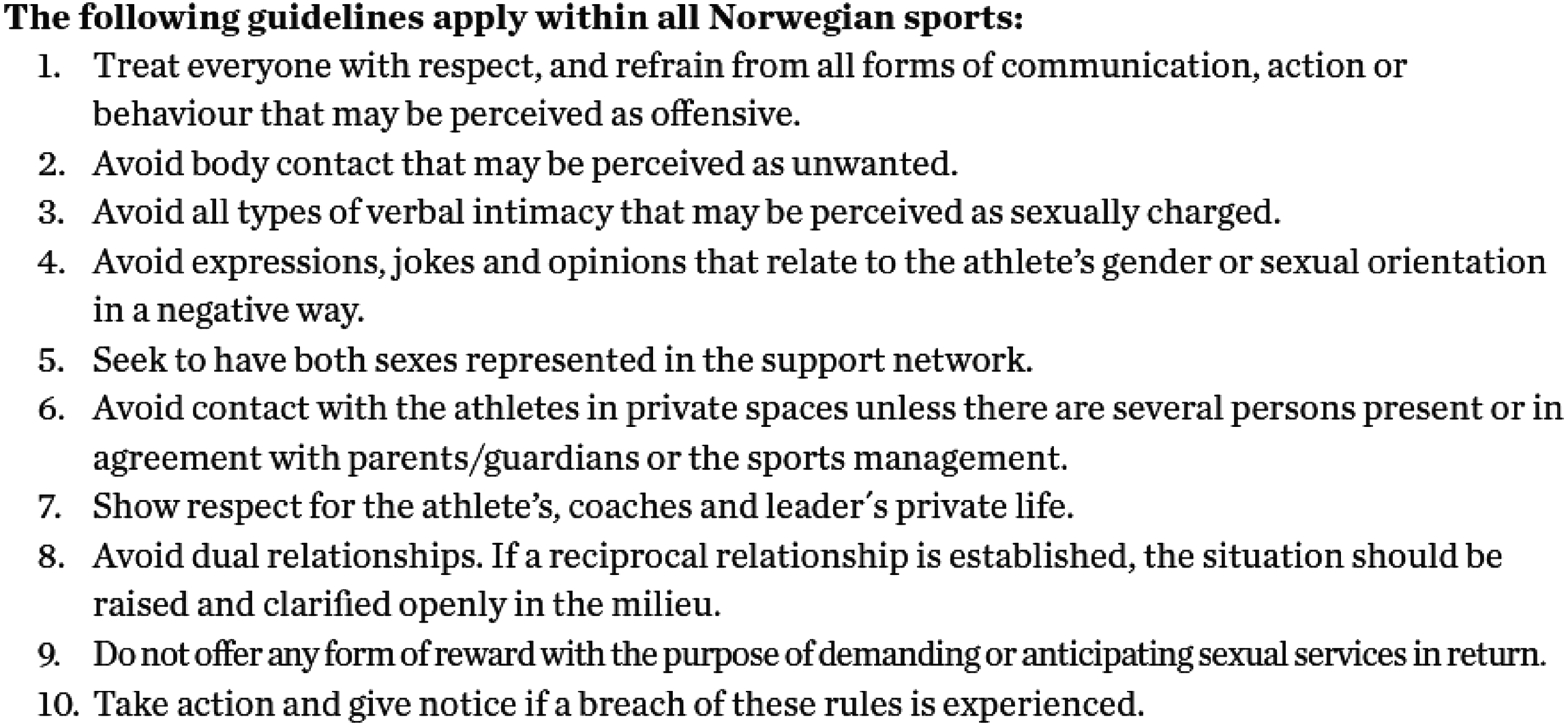
Guidelines to prevent sexual harassment and abuse (NIF, 2010: 4).
Analysis
The interviews lasted between 50 and 60 min. They were recorded and transcribed verbatim. The analyses initially involved several transcript readings, with the aim of identifying key themes in the discussions related to the guidelines. This empirically based process was followed by an abductive analysis (Tavory and Timmermans, 2014), which involved being attuned to Elias's concept of degrees of involvement and detachment and possible mixes of the two when reading, coding and interpreting the interview transcripts.
Abductive analysis commonly departs from ‘observational surprises or puzzles’ (Timmermans and Tavory, 2012: 169) that are then brought into dialogue with multiple existing theoretical ideas and concepts. It is therefore premised on what Timmermans and Tavory refer to as the researcher's ‘affinity and familiarity with broader theoretical fields’ (2012: 172). In our case the analysis proceeded in a back-and-forth movement between data and already known concepts from Elias’ sociology of knowledge. This movement is then what led us to identify reflections as either relatively sport-detached, relatively sport-involved or a blend of involvement–detachment, by which we ordered the empirical material. We are inspired by Malcolm (2011) when using the terms relative and blend for degrees of involvement and detachment, signalling that they are coexisting, overlapping modes of engagement. Importantly, and in line with Elias (2007), these positions should not be considered fixed but are illustrative of fluctuations along the involvement and detachment dimensions visited in the course of the discussions.
Findings
One general finding is that most of the sport students could not recall having previously seen the guidelines against SHA, and only one of five indicated that they had heard about them before. Still, they engaged in nuanced discussions about the issue of SHA in sport and the role and content of the SHA guidelines currently in use in Norwegian sport. In the following section, we detail the three positions we drew from the interviews, with a focus on how the different modes of thinking were expressed as well as the tacit question each mode revolved around. The citations illustrate shared ideas across the focus groups.
Relatively sport-detached discussions
Discussions where sport-related values and concerns were in the background, and the topic of SHA appeared to be the foremost frame of reference, can be placed towards the relatively sport-detached end of the spectrum. The tacit question guiding these discussions was, ‘What do the guidelines mean for the reduction of SHA [in sport]?’
The sport students spoke positively of the guidelines when discussing them at this general level and conveyed that SHA was an important topic for sport authorities to address. ‘Sexual harassment in sport is not talked about enough’, one said, hoping for more focus on the issue going forward. The sport students generally expressed that the guidelines resonated with decent and respectable conduct, thus serving to reinforce already-established norms. They used phrases such as ‘common sense’, ‘proper behaviour’ and ‘decent upbringing’ to describe how they viewed the guidelines’ content in general. While such references could be interpreted as a sign that the sport students considered the guidelines superfluous, that did not appear to be the case. Instead, they were generally positive, as illustrated in the dialogue below (from Interview 11): But does that mean that it's not important to have the guidelines? Well, no, because it's likely that some people will defy them. In that case, they’re good to have for those people who go around and just touch a lot of people … Because some people are just like that. Then they should be aware that there are guidelines you’re supposed to follow as a coach. Every coach should be informed, really. And the athletes as well, I think, so that they’ll know that it's actually a rule that my coach shouldn't touch me if I don't like it … And it may be easier to speak up if the coach does something. So, they’re important for athletes? Yes. It's important to have guidelines because it's the case, unfortunately, that someone out there perhaps has ill intentions. So it's important to have [guidelines].
Relatively sport-involved discussions
We coined discussions where the participants assessed the guidelines in reference to their potential influence on sport practices and sport culture as relatively sport-involved. These discussions often emerged in those parts of the interviews where the sport students were asked to imagine themselves as young coaches who were receiving the guidelines in a new club. They then appeared to consider the implied question, ‘What do these guidelines mean for my sport, for athletes and for me as a coach?’ In these discussions, the sport students distinguished between the guidelines as an idea and their specific content, and they expressed certain reservations about the practical usefulness of certain guideline items. As one stressed, ‘It's easy to read [the guidelines] and agree, of course, but it's difficult to take a specific situation, like those we’ve just watched [in the films], and actually apply them’ (Woman 1, Interview 2).
One recurrent concern was that certain guideline items clashed with some of the sport community's core practices, ideals and goals. The sport students often mentioned sport performance, the physicality of sport, easy-going interactions among sport participants, and trust between coaches and athletes. Many drew upon their own coaching experience to explain that the advice found in the guidelines did not always align with their idea of the right thing to do as a coach. One such example emerged during a discussion of the guidelines’ advice to refrain from contact with athletes in private spaces (item 6). A sport student recounted his experiences from coaching a youth team: I conducted a player conversation once with someone … where an extra person was present the whole time. And [the player] freaked out when there was someone else there … I didn't manage to get a single word out of him because he was just sitting there, terrified. When I spoke with his dad afterward, because I didn't understand what had happened, he said it was because of the other person who was present. And [the player] didn't trust him that much, or he didn't know him that well. So the player explicitly asked if it could be just the two of us. So… that's difficult to say no to … When it was two of us [coaches], it was precisely to be a bit attentive to these issues … But when it was someone he didn't have a good relation to … And it's difficult to talk about weaknesses and stuff, right? ‘Where can you improve? What are you struggling with?’ Those kinds of things. It was his first player conversation, and it can be very tough for 12-year-olds to share these things with someone they don't feel comfortable with … (Man 1, Interview 15)
In this example, the sport student drew upon his experience and acquaintance with the player to assess a specific situation and decide on his course of action. In contrast to guideline item 6, the sport students often referred to one-to-one conversations with athletes as common, appropriate and desirable. They associated such situations with establishing familiarity and building trusting relationships and viewed them as essential for carrying out basic coaching duties. The interviewees thus appeared to contest the assumption implied in the guidelines that a coach being alone with an athlete constitutes a risky situation. They also pointed out that what people experience as acceptable will vary between individuals and across situations, and that they expected coaches to know their athletes well enough to be sensitive to such differences. Being able to deviate from the guidelines when necessary thus emerged as an important coaching quality: It's very individual. Like [the guideline item] says, ‘can be experienced as’, and different people experience things differently. A touch for one athlete can be okay for that athlete but can be experienced as inappropriate by another. So you have a responsibility as a coach to know your athletes well enough to know where their personal boundaries are. (Woman 2, Interview 10) I think [the guidelines] should be followed as much as possible, but it's important to exercise your own judgement in different situations … Sometimes you might transgress in terms of the guidelines, but [that transgression] might be necessary in that exact situation. It's … something you need to work up an understanding about that can't be captured … in ‘black on white’.
3
(Woman 3, Interview 6) [Continued from above] … When we had the player conversation, just the two of us, it went really well. There are probably some rules [in the guidelines about that], but so be it. It wasn't [held] in my hotel room
4
or anything, so it was very okay. It was [held] in an office, [with an] open door; it was completely … everything was proper. (Man 1, Interview 15) That's what's a bit scary. There's a lot that can be misunderstood. Even if you, as a coach, don't mean anything by it, onlookers can register what you’re doing as something that's wrong. (Woman 3, Interview 15) I’m completely paranoid about that stuff. I [audio] record the formal conversations with my players, too, so that nobody will be able to ‘arrest’ me on anything afterward. (Man 1, Interview 17)
The sport students believed that young male coaches, in particular, would be inclined to feel insecure about their own conduct, thus pointing towards the possibility of gendered outcomes of guidelines for conduct and their influence (Lang, 2010). This situation is an interesting twist on the genderedness of SHA as a social problem in sport, where female athletes are known to be at greater risk of being targeted than male athletes. Young men's risk mentality may be an expression of people's awareness of the external gaze and their own positioning in social space – not just as individuals but as members of a certain social group. Their gender attaches them to narratives of men sexualising, objectifying and violating women, which forms an imperative to act in ways that clearly distinguishes them from such men in the eyes of onlookers. Failing such a self-presentation is not without consequences and, especially in the age of social media, poses a risk of long-lasting social stigma and exclusion. From this perspective, the sport students demonstrate modes of advanced and multi-level reflexive thinking that Malcolm (2021) notes is becoming more prominent in modern times together with technological advances and societal shifts in gender relations and social interdependencies.
The sport students expected that young and inexperienced coaches would treat the guidelines as rules rather than recommendations and err on the side of caution rather than risk doing something wrong. In contrast, the sport students expected older and more experienced coaches to relate more flexibly to the guidelines and to rely heavily, or even primarily, on their accumulated coaching competence to determine their course of action. While that may or may not be the case, the observation highlights, in line with Elias (2007), the potential for social policies to have differentiated impacts on different groups – perhaps, for some sportspeople, boosting feelings of insecurity and social danger rather than minimising them.
Blend of involvement and detachment
We identified parts of the interview talk as reflecting a blend of involvement and detachment, where the sport students retained emotional commitment to sport as such while simultaneously being attuned to SHA as a frame of reference. In these discussions, the underlying question we inferred was, ‘What do the guidelines mean for SHA prevention and for the practice of sport?’ When balancing sport-involved interests with concern for SHA, the sport students expressed a form of conditional endorsement for the guidelines. This position emerged from their critical reflections about normalised practices in sport that they regarded as problematic, but also what they saw as shortcomings in the guidelines. Prominent examples of accepted sport practices the sport students questioned included sexualised locker-room culture and aggressive coach behaviours. While referring to these behaviours as normal or normalised, and at times as beneficial for sport performance, they considered such behaviours differently when assessing them in relation to the risk of SHA, as illustrated below (from Interview 17): I got quite a shock when I arrived at a new club where they had a certain jargon, a certain way of talking. Just like – where you’re scolding. And at the beginning I thought, ‘Shit, what are they saying? Is talking like that to kids allowed?’ But after a while, it was okay; it was just the way they talked, and it's not … nobody was offended by it. Or … but yes, as outsiders, it becomes a bit … But … should you change [a certain behaviour] or just accept it? Because some things are – how do I put it – it's just how they talk. But then it might not really be okay at all. No, sometimes I said, ‘Hey now, that's too much’ … For example, it's very typical that you can be … homophobic in some settings when talking. ‘No, that's just how you talk’. But it's really not good, because it contributes to … It's … not quite good anyway, regardless of what you mean by it, going around using ‘gay’ as a curse word. It's not good, even if you don't mean anything by it. Yeah. Because you have a responsibility, really; that's what I’m thinking. Because you’re sending a signal to the group as well – that it's okay to talk that way, which it isn't, really.
The sport students also identified that the guidelines in their current articulation may not have fully accounted for the social and cultural problems they faced in sport. As illustrated in their talk about who perpetrates SHA in sport, they appeared to question the ‘relative adequacy’ of knowledge reflected in the guidelines (Malcolm, 2011). For example, they sensed an emphasis on coaches’ conduct and wondered if other sources of SHA, in line with their own experiences, should not be afforded more attention: I think it's a problem that [harassment] happens within the team, that it's not so much [happening] from coach to athlete, but that it happens among the athletes – from that locker-room culture. But it's reflected in the attitudes the coaches show that it's okay to have [such a culture] among the team. If it's okay to joke around with sexual orientation and that kind of stuff, then [these tendencies are] bound to spread within the group. If the coach condones [that culture] and doesn't intervene … (Man 2, Interview 14). On the women's side, at least, you experience [football] fans yelling ‘fucking cunt!’ and that kind of thing. They’re really nasty. If you play on the wing, you hear it. Like a girl on our team, she was called tons of words I’d never even heard before. And then there's … nothing you can do about it, because it's coming from the spectators … it happens all the time. Everywhere. And … while item 10 says to ‘intervene and report if you see any breaches of the guidelines’ … I mean, we’ve done that, but nothing happens, because it's women's football … (Woman 2, Interview 4) I find it incredibly odd that I haven't seen these [guidelines] before … When you’ve worked in club administration for years and have never seen them? I find that quite baffling. And then, if not even we – those who work in sport every da – have seen them, then nobody else would have, either. (Man 2, Interview 15) [The situation] also depends on the leaders, and what kind of culture they have in the club. If it's a club that strives towards these things, then I think it will be reflected [in practice]. But if it's a club that thinks, ‘What we’re doing has worked for years, so let's keep up with that’, then I don't think [the guidelines] will have much of an effect. (Man 2, Interview 14)
In summary, their talk within the blend of involvement–detachment frame illustrates that strong involvement in the sport milieu does not preclude having critical perspectives on the social problems therein. Rather, the sport students’ emotional involvement in sport seems to have allowed them to see how regulations could help to provide safe spaces for sport involvement while simultaneously constructively identifying certain limitations related to the guidelines. Drawing on their sport experiences, they problematised normalised sport practices and ideals that could be associated with a culture permissive of SHA: what researchers of sexual violence refer to as the cultural ‘scaffolding’ of transgressions (Gavey, 2013). Involvement in the sport environment hence emerged as a valuable source of insight about SHA in sport and how it can be prevented.
Conclusion
The present study explored sport students’ views of the legitimacy and applicability of guidelines against SHA as they were expressed in focus group interviews. Below we will highlight the findings from the empirical analysis relevant to the furthering of SHA-prevention work.
A key finding was that the sport students we interviewed had little if any knowledge of the SHA guidelines. This finding was surprising, given that (a) they had spent their sporting lives in an organisation where the guidelines had been in place for almost two decades and that (b) half of them had also been coaches for younger athletes, and hence responsible for maintaining sport as a safe space. This finding points to a lack of attention to implementation of SHA guidelines among sport federations and local clubs. If guidelines are to heighten awareness of SHA in sport and protect athletes, then an initial precondition is that they must be visible and known among those involved in sport. The continuous influx of new athletes and coaches in children's and youth sports means that ensuring visibility must be a regular task for sport clubs. Having guidelines in place and informing current coaches about them is not sufficient.
Although the sport students had little knowledge of the SHA guidelines, they viewed prevention of SHA in sport as important and offered nuanced opinions about the role of guidelines in that regard. Overall, we found Elias's (1956, 2007) construct of degrees of involvement and detachment helpful in drawing out how the students assessed the potentials and risks of behavioural guidelines for preventing SHA in sport. We found that the students alternated between three types of discussions, each of which involved a different outlook on the SHA guidelines. When talking from a relatively sport-detached position and taking the social problem of SHA as the starting point, the sport students expressed general support of the guidelines, thus underlining the usefulness of having something formal and law-like to refer to in problematic situations.
When talking from a relatively sport-involved position, in contrast, they pointed to certain possible problems with the guidelines related to preserving the spontaneity and playfulness of sport, as well as the intimacy and trust between those involved, and they questioned the practical value and applicability of some of the recommendations.
The third type of discussion was characterised by a blend of involvement and detachment, where the sport students demonstrated their support for the anti-SHA policy goals in sport but identified problems related to SHA beyond those targeted in the guidelines. In line with Piper et al. (2013), our study thus indicates that offering critiques of specific policy tools against SHA does not necessarily imply opposition to addressing SHA as a social problem.
The nuanced positions detailed in this paper point to group discussions as having some potential as part of anti-SHA strategies in sport, especially in light of two specific findings in the study. First, the sport students felt that SHA guidelines could induce a form of insecurity in young coaches that could lead them to self-restrict in problematic ways. The finding indicates a need for forums where sport leaders and coaches can discuss issues related to SHA prevention, including how to align coaching practices with policy regulations without compromising valued aspects of coach–athlete relationships.
The students also pointed to certain blind spots in the SHA guidelines, especially the lack of attention to the cultural climate within sport settings, a topic they considered equally important as individual coaches' behaviour. They distanced themselves from the view that gendered banter and sexualised talk is simply how sport culture is and that it is nothing serious, pointing to how a hostile cultural climate could work as a barrier against athletes’ deep involvement in sport. The students thus recognised how safeguarding policies could facilitate excitement in sport, by relieving (particularly female) athletes’ concerns about experiencing SHA.
A final contribution of this study is to underline the inherent complexities of sport as a social phenomenon – which contributes to making regulation of conduct a delicate and difficult task for sport organisations. By drawing on the concepts of civilising offensive, involvement and detachment, this study illustrates the value of an Eliasian approach that takes a long-term perspective on social processes and emphasises the social figurations in the given context. A number of insights are likely to be relevant for anti-SHA work in sport in countries that share similarities with Norway's approach, such as Denmark, the United Kingdom, the Netherlands, Belgium, Australia and Canada (see Lang and Hartill, 2015). At the same time, an Eliasian perspective compels extra consideration of the contextual specificities and limitations of our own study. The points and tensions about SHA guidelines expressed by the students in our study, may resonate with sport participants elsewhere but may also differ in significant ways. We welcome future research – in diverse settings, among different social groups and by means of complementary theories and methods – that explores the complexities, pitfalls and potentials of SHA prevention in sport.
Footnotes
Declaration of Conflicting Interests
The authors declared no potential conflicts of interest with respect to the research, authorship, and/or publication of this article.
Funding
The authors disclosed receipt of the following financial support for the research, authorship, and/or publication of this article: This work was supported by the The Norwegian Ministry of Justice and Public Security
