




Abstract
On 6 May 2020, photos were leaked from a conversation in which Brendan Leipsic of the National Hockey League’s Washington Capitals, his brother Jeremy of the University of Manitoba Bisons and several others made vulgar, misogynistic comments about women and about other hockey players’ girlfriends and wives. Following the release of the conversation and the subsequent dismissal of both Leipsic brothers from their respective teams, many took to Twitter to explain their thoughts on this situation. This study analyses nearly 1000 Twitter replies to the Leipsic situation and explores how these responses are shaped by questions of masculinity, accountability, legality, privacy and hockey culture. Contrasting responses to both the scandal and the institutional response to it are emblematic of larger contemporary questions regarding narratives of ‘cancel culture’, ‘woke capitalism’, acceptable masculinities and interactions between them.
Keywords
On 6 May 2020, Instagram user @Angelszeee2020 posted multiple photos of a private Instagram conversation featuring then-Washington Capitals forward Brendan Leipsic, his brother Jeremy and several other hockey players. In the conversation, Brendan Leipsic made several misogynistic, racist and vulgar comments about women and other players on the Capitals and in the National Hockey League (NHL) (Wyshynski, 2020). Pictures of the conversation were then posted on Twitter by kyro (@pxlitic). Following the release of these photos on both social media platforms, the leaked conversation evolved into a larger news story, mostly focused on Brendan Leipsic, the highest-profile participant in the conversation. Leipsic’s comments included referring to a woman as a ‘little whore cunt’, another as a ‘slut’, and saying of a third that ‘my finger was up her ass in Hollywood’. He commented on several women’s appearance, stating ‘look at how fat Pearson’s (a teammate’s) wife is’ and ‘holy fucking acne’, and compared a woman to a male football offensive lineman. He also ‘liked’ a comment from another participant referring to a woman as a ‘fat native pig’, and discussed having sex with women saying he would ‘crush’ or ‘pump’ them.
Several news articles described the leaked conversation, commenting on what was said and discussing what the Capitals might do in response (Wyshynski, 2020). Less than two days after the conversation went public, the Capitals released Brendan Leipsic (Oland, 2020) and Jeremy Leipsic was kicked off of the University of Manitoba hockey team (Teague, 2020), prompting a variety of responses on Twitter. These events, as well as the public response to them, will hereafter be referred to as the ‘Leipsic situation’.
The responses to this situation point to questions regarding the proper consequences for inappropriate actions and acceptable masculinities among athletes. The first of these questions, regarding consequences for people publicly accused of sexism, racism or homophobia, is based on public debates about what is colloquially known as ‘callout culture’ or ‘cancel culture’ (Clark, 2020; Nguyen, 2020), where individuals ‘withdraw attention from someone or something whose values, (in)action, or speech are so offensive’ (Clark, 2020: 88). Spurred by Black Twitter, the #MeToo movement and other social justice movements aimed at amplifying the voices of traditionally marginalized groups (Roos, 2020), this ‘cancelling’ strategy has been used to hold people in power accountable for their behaviour.
Like with most social movements, this movement has prompted a backlash, often from those who believe that many of these initiatives have gone ‘too far’ in policing behaviours (Ng, 2020). ‘Cancel culture’ has been cited as partially responsible for the reputational loss of celebrity figures never formally convicted of criminal offenses such as Aziz Ansari, Roseanne Barr and Louis C.K., as well as for convicted sex offenders such as Harvey Weinstein and R. Kelly (Ng, 2020). Concern about ‘cancel culture’ has also been raised by high-profile writers and intellectuals such as J.K. Rowling, Malcolm Gladwell and Noam Chomsky (Norris, 2020), However, others have noted that the demonization of ‘cancel culture’ is used to protect those who have historically been privileged in terms of gender, race and sexuality, and these privileged voices frame the accountability that they are now facing as exaggerated to minimize the severity of their behaviour and discredit marginalized voices (Butler, 2018; Hagi, 2019).
Twitter response to the Leipsic situation also illustrates different levels of acceptance for orthodox hockey masculinities (Allain, 2008; Connell, 1995) and ‘inclusive masculinity’ (Anderson, 2010). While athlete masculinity is generally ‘based in antifemininity, patriarchy, misogyny and homophobia’ (Anderson, 2014: 32), Canadian hockey masculinity in particular is rooted in colonial and often-rural Whiteness, where predominantly White hockey-playing ‘boys’ and men perform their masculinity through loyalty to one another, sacrifice for their team and violence directed at opponents on the ice and to women and racialized ‘others’ (MacDonald, 2014; Razack, 2000) off of it. In contrast, ‘inclusive masculinity’ (Anderson, 2010) is purported to feature ‘decreased violence and sexism’ (Anderson, 2014: 50), an environment of greater acceptance and tolerance for different sexualities and races, and reduced misogyny (Anderson, 2014).
The varied public commentary surrounding the Leipsic situation makes it an ideal ‘cultural incident’ (McDonald and Birrell, 1999) to analyse questions of cancel culture and accountability, and hegemonic Canadian hockey masculinity and more inclusive masculinity. By ‘reading sport critically’ (McDonald and Birrell, 1999), I can examine the Leipsic situation as more than just a case of an athlete’s misogynistic comments and his subsequent termination of employment, but rather as a cultural incident that produces multiple narratives related to cancel culture and masculinities. Analysing these narratives will allow for both an investigation of the multiple cultural meanings of these concepts, as well as an understanding of how they are shaped by specific hegemonic relations of power along with gender, class and racial lines (McDonald and Birrell, 1999). Twitter is a context particularly well suited to this analysis, as it is a publicly available and widely used forum (Pegoraro, 2010) that allows for an examination of ‘how power is discursively practiced in the everyday’ (Szto, 2016: 210).
In examining this cultural incident and the responses to it, I show that while most respondents support Leipsic’s punishment, many still frame Leipsic’s behaviour and sanctions as unfair, using narratives of cancel culture and the glorification of Canadian hockey masculinity to shield misogynistic behaviour from criticism. This analysis also reveals the centrality of maleness and Whiteness in both cancel culture and Canadian hockey masculinity, as well as the importance of market incentives in how sport organizations handle athlete (mis)behaviour.
Theoretical framework
Cancel culture
‘Cancel culture’ can be ‘defined broadly as attempts to ostracize someone for violating social norms’ (Norris, 2020: 2). Originally termed ‘reading’ or ‘calling out’, cancelling is an ‘“indigenous expressive form” particular to the Other’ historically used by marginalized people as a tool for collective power and agency (Clark, 2020: 89). This practice is analogous to a boycott or strike, where consumers or workers withdraw or withhold their support or labour as a response to powerful people or organizations’ abuse of power or morally questionable behaviour (Coates, 2019).
The term ‘cancel culture’ originated from Black Twitter, with hashtags such as #cancelled or #’x’isover (‘x’ being a placeholder for the name of a person or organization) (Roos, 2020). Black Twitter refers to the ‘substantial Black presence on Twitter’ where ‘millions of (B)lack users on Twitter’ are able to network, connect and engage ‘with others who have similar concerns, experiences, tastes, and cultural practices’ (Florini, 2014: 225). It is from this historically marginalized place that debates of ‘cancel culture’ arose, as many Twitter accounts operated by Black women worked to moderate racist and misogynistic speech (Roos, 2020).
Proponents of cancel culture argue that the act of ‘cancelling’ a person or organization is not new; as Coates (2019) writes, ‘until recently, cancellation flowed exclusively downward, from the powerful to the powerless’. National Football League quarterback Colin Kaepernick (Coates, 2019) and National Basketball Association guards Craig Hodges (Berkow, 1996) and Mahmoud Abdul-Rauf (Giles, 2017) were ‘cancelled’ from their respective sport leagues for their social justice stances. Throughout history, racially and ethnically marginalized people have been silenced or ‘cancelled’ if they do not fit in with or uphold the historically White and male status quo, as have workers who do not support the interests of their more powerful employers (Roos, 2020).
To many, cancel culture is simply a reversal of who has the power to hold others accountable, a subversion of the ‘Hamermascean concept of the public sphere which assumes public discourse is the realm of the elites’ (Clark, 2020: 89; Habermas, 1962). Widespread use of social media gives voice to those outside of mainstream media organizations and those in less advantageous positions in Collins’ intersectional matrix of domination (Clark, 2020; Collins, 1990). Combined with a gradual shift in public opinion towards ‘a more socially liberal and progressive direction in many affluent’ societies (Norris, 2020: 16), those who wish to hold others accountable for morally objectionable behaviours (Ng, 2020) have more space to do so online.
Detractors of ‘cancel culture’ object to this phenomenon on the grounds that it stifles open debate and free speech, promoting ideological conformity and self-censorship (Norris, 2020). Many also liken ‘cancel culture’ to ‘mob rule’, whereby groups of people ‘rush to collective judgement’ (Norris, 2020: 3) to oust a person from their job or ruin their reputation. They also claim that these ‘social justice warriors’ are only interested in policing other people’s behaviours and forcing their value system onto others (Roos, 2020).
However, while much of the demonization of cancel culture comes from those on the political right, this rhetoric shares much in common with past moral panics, in that the material losses of those allegedly ‘cancelled’ are often small relative to their media coverage (Lerer, 2021). The cancel culture-based ‘censorship’ on speech imposed by the political left is especially negligible compared to the limits that have always existed for those with less economic and social capital, including workers without recourse to discuss their workplace conditions or express views that counter those of their employer.
According to some, ‘cancel culture’ has also resulted in ‘woke capitalism’ (Lewis, 2020), where organizations or brands purport to take a stand against social injustice by removing a person from a job or releasing a statement, without making any substantial changes to the systems that allow those behaviours or beliefs to perpetuate. This critique of ‘cancel culture’ notes that ‘brands will gravitate toward low-cost, high-noise signals as a substitute for genuine reform, to ensure their survival’, using (Lewis, 2020). Employers in these cases are responding to market imperatives, determining what type of speech or behaviour is inappropriate based on how it will affect their bottom line. While this strategy can sometimes result in reprimanding those who express bigoted views or behave in racist, sexist, or homophobic ways, it has also often resulted (and still results) in the censoring of left-wing views that promote labour rights, anti-imperialism or decolonization.
Canadian hockey masculinity
Hegemonic masculinity is a ‘configuration of gender practices… which guarantees the dominant position of men and the subordination of women’ (Connell, 1995: 77). Practiced and demonstrated in a multitude of ways, ‘hegemonic masculinity is represented via discourses of appearances (e.g. strength and size), affects (e.g. work ethic and emotional strength), sexualities (e.g. homosexual vs. heterosexual), (and) behaviours (e.g. violent and assertive)’ (Ricciardelli et al., 2010: 64–65). Among other contexts such as the military, police and corporate firms, men have historically performed and represented hegemonic masculinity through participation and success in violent, homosocial male team sports (Kalman-Lamb, 2020). This participation often includes misogynistic, homophobic and homoerotic behaviour and joking (Pronger, 1990.
Canadian ‘hockey masculinity’, defined by Allain (2015) as ‘a sense of masculine style linked to hitting, fighting, and physical confrontation’ (119), is a close cousin of hegemonic masculinity. Canadian hockey masculinity is marked specifically by its glorification of White colonial violence and the pre-eminence of White men as stewards of Canadian identity. This has historically helped protect White hockey players from punishment for violence or misogyny off of the ice, especially when directed at racialized women (Razack, 2000). Combined with the erasure of Indigenous, Black and other racialized groups’ contributions to Canadian hockey history and culture (Fosty and Fosty, 2007; Pitter, 2006), this privileging of White bodies and White experience reifies the ‘well-told lie’ that hockey is only a ‘White man’s game’ (Szto, 2020: 3).
Hockey remains a predominantly White male space, with a ‘sexist, homonegative, racist, and elitist’ (Szto, 2020: 165) culture. In Szto’s (2016) analysis of Twitter commentary of Hockey Night in Canada Punjabi, she found that many commenters ridiculed the idea of this ‘ethnic’ version of the famed Canadian program. Canadian identity formation and Canadian normative masculinity is so intertwined with White male hockey masculinity that even as racialized athletes join the sport, they are ‘absorbed into a Whitestream 1 that capitalizes on racialized desires to integrate into Canada’ (Krebs, 2012; Szto, 2020: 27). This hockey culture celebrates and preserves White colonial entitlement to power and Canadian identity through the glorification of White male dominance on the ice, and the excusal of violence and misogyny off it.
Violence, sexual coercion and objectification of women and racialized ‘others’ by hockey players are often still expected and celebrated as a way to demonstrate hockey masculinity and become ‘one of the guys’ (MacDonald, 2018; Pappas et al., 2004). As Alsarve and Angelin (2020) write, ‘joking as a social process functions as an inclusive bonding and as social glue in the (hockey) team, although, at the same time it also reflects exclusive, undemocratic (sexist, racist and homophobic) attitudes’ (p. 36). This behaviour can be an ‘entrance ticket’ to the team community (Alsarve and Angelin, 2020), as ‘to debase and degrade a woman in the presence of other men secures the masculinity’ (Razack, 2000: 108) necessary for Canadian hockey players.
This misogynistic, racist and homophobic ‘joking’ often takes a particularly violent and degrading shape, as evidenced by the lengthy recent report of ‘abuse, sexual and otherwise, harassment and hazing in (Canadian) junior hockey’ (Westhead, 2020). These stories echo findings from other scholars regarding expectations of violence and sexual violence, misogyny, racism and substance abuse in hockey (Pappas et al., 2004; Robinson, 1998), and contribute to normalizing sexually violent masculinities and rape culture among hockey players.
Inclusive masculinity
Anderson and McCormack (2018), in a more progressive theorization of sport masculinities, contend that the existence of one ‘culturally exalted masculinity’ (Connell, 1995: 77) based on violence, domination and heterosexism does not account for the ongoing ‘fundamental shift in the practice of masculinities’ (Anderson and McCormack, 2018: 6) they have observed. In their research of male adolescents and athletes, Anderson and McCormack (2018) have found that an ‘inclusive masculinity’ is in the process and in many cases has already replaced ‘orthodox masculinity’ (Anderson, 2010). Inclusive masculinity theory posits that in a culture of declining homophobia and homohysteria – defined as the ‘fear of being homosexualized’ (Anderson, 2010: 7) – men will be less ‘trapped by the oppressive cult of masculinity’ (Anderson, 2010: 74).
According to Anderson and McCormack (2018), this inclusive masculinity celebrates more inclusive behaviours. Anderson posits that ‘men ascribing to inclusive masculinity will also show improved social attitudes concerning women’ (Anderson, 2010: 97), including reduced misogyny (127). However, it is important to note that scholars such as O’Neill (2015) and Bridges (2014) have critiqued inclusive masculinity theory for its reductive, linear take on progressing gender relations and its post-feminist lens. These scholars interrogate the claim that hegemonic masculinity and inclusive masculinity coexist on an equal hierarchical plain, and that men and male athletes have moved on from hegemonic masculinity to this more inclusive version (Bridges, 2014). They are also wary to accept that inclusive masculinity will lead to decreased misogyny, given that inclusive masculinity is a concept aimed at ‘understanding power relations between men’ rather than ‘to theorize power dynamics among men and between men and women’ (O’Neill, 2015: 110). Even Anderson and McCormack admit that a restructuring of the hierarchy of masculinities may not alter unequal positions between men and women, as ‘these (masculinity) hierarchies are not synonymous with patriarchy’ (Anderson and McCormack, 2018: 555).
Beyond these concerns, it is also unclear whether inclusive masculinity has or is in the process of replacing Canadian hockey masculinity. On the one hand, the importance of fighting in hockey, long glorified in hockey culture as a way to prove one’s masculinity and devotion to their team (Allain, 2008), has declined (Wyshynski, 2018). There has also been a recent influx of diversity initiatives in hockey aimed at expanding the game beyond its White, heterosexual, colonial roots. These include the NHL’s Hockey Is For Everyone campaign (Doyle, 2020) and the independent Hockey Diversity Alliance (Jhaveri, 2020), as well as grassroots organizations such as ‘You Can Play’ (for LGBTQ+ athletes) and Black Girl Hockey Club (Smith, 2020).
On the other hand, however, many of these diversity projects, especially those promoted by the NHL, have been met with scepticism from the groups they seek to aid (Doyle, 2020; Jhaveri, 2020). McKay’s (2017) analysis of official NHL communications found that the league still promotes violence and ‘messages of hegemonic masculinity, while trying to create a sense of inclusiveness’ (p. 63). Fighting and violence also still hold an important place in the sport for many, with calls for its removal prompting backlash (Sailofsky and Orr, 2020). Canadian hockey masculinity – given its high levels of body contact (Tjønndal, 2016) and romanticization of White working-class identity – may be particularly resistant to inclusive masculinity, which is associated with more progressive social values (Anderson, 2010).
Method
Data collection and sample
To conduct this analysis, I began by gathering a purposeful sample of Tweets that posted news updates about the Leipsic situation. Purposeful sampling is the practice of selecting ‘information-rich [cases] … from which one can learn a great deal about issues of central importance to the purpose of the inquiry’ (Patton, 2002: 264). Sailofsky and Orr (2020) and Szto (2016) provide templates for studying hockey masculinity and hockey culture on Twitter, as both conducted analyses of how the public responds to perceived changes to hockey’s historically White, hegemonic masculine culture. Rather than assessing commentary through an analysis of Tweets from a particular search term (Szto, 2016) or of replies to one particularly high-traffic, ‘viral’ Tweet (Sailofsky and Orr, 2020), I combined the two approaches, capturing Twitter conversation about the Leipsic situation from many individual Twitter users replying to different Tweets.
On 9 May 2020, I searched for Tweets that mentioned ‘Leipsic’ between 6 May and 8 May 2020. I then chose seven Twitter accounts that provided news updates about the Leipsic situation, each of which published a Tweet that garnered over 50 replies. Most of these tweets did not provide any editorial-style commentary on the morality of Leipsic’s actions, though some pointed out that they were misogynistic or vulgar. These initial Tweets are found in Table 1.
Tweets.
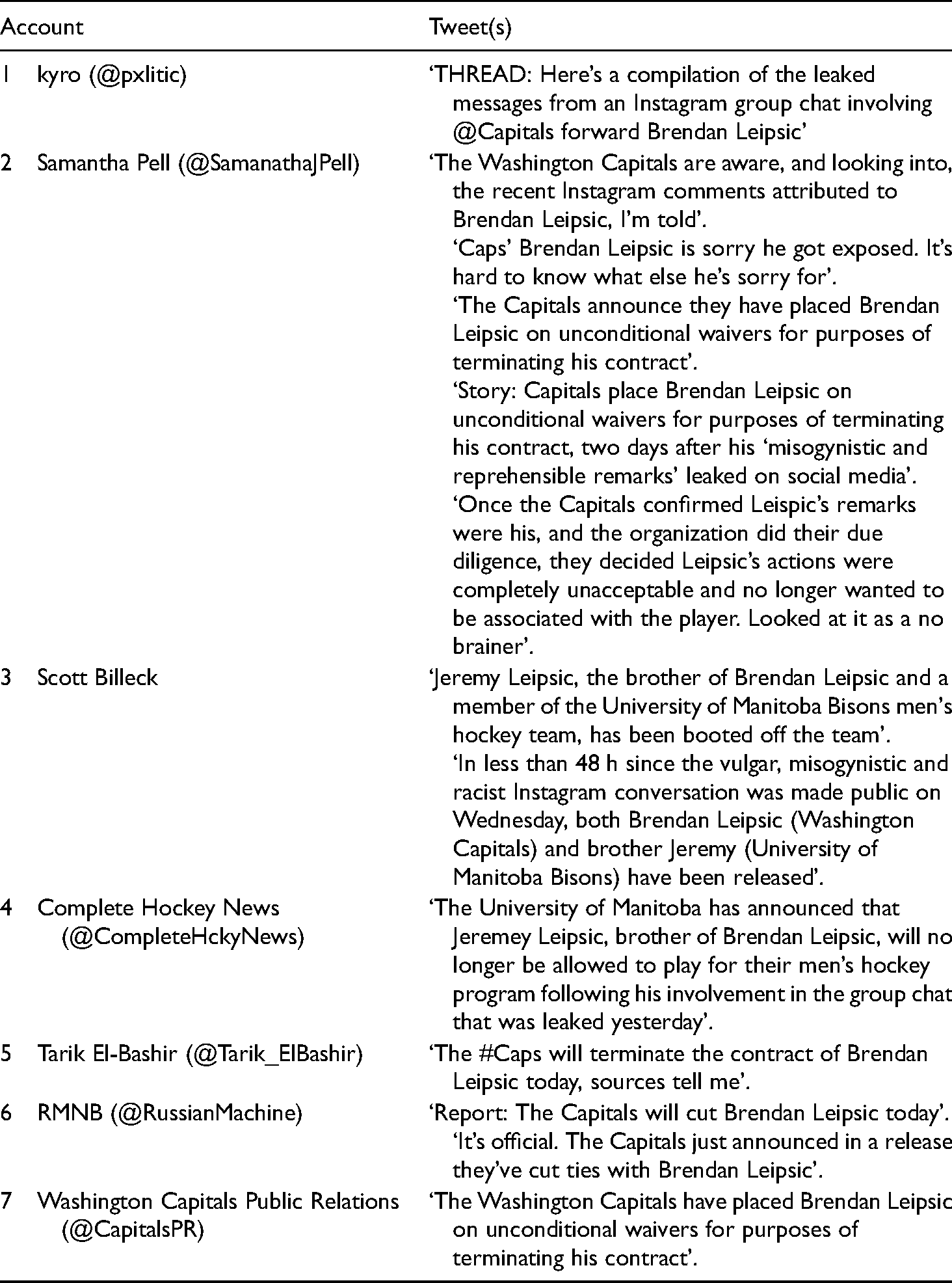
Using Twitonomy, a Twitter utility search program, I gathered all of the replies to these Twitter users’ accounts between 6 May and 8 May, while this scandal was being publicly discussed. Because these gathered replies contained all Twitter replies to these seven users over this period, rather than just the replies to the Leipsic-related Tweets I was interested in, I then conducted a thorough filtering of the data. I filtered out any replies that ‘retweeted’ (copying and rebroadcasting) the initial Tweet rather than responding to it, as well as those that only ‘tagged’ another Twitter user. The meaning of most Tweets was clear and I used my own assessment of the combination of words, punctuation and images or video links to determine meaning. If the meaning of textual, image-based or mixed replies was too difficult to discern, they were coded as ‘unclear’. The final sample contained 969 individual replies to the various Tweets about the Leipsic situation.
Analysis
I then conducted a thematic content analysis (Frederick et al., 2020). Twitter content analyses have been used to examine a variety of sport issues, including public discussion of sporting events and sport-related news (Burch et al., 2015). This approach allows for the identification of ‘core consistencies and meanings’ (Patton, 2002: 264) within the responses posted by Twitter users, to better understand how the public viewed this situation as it was happening.
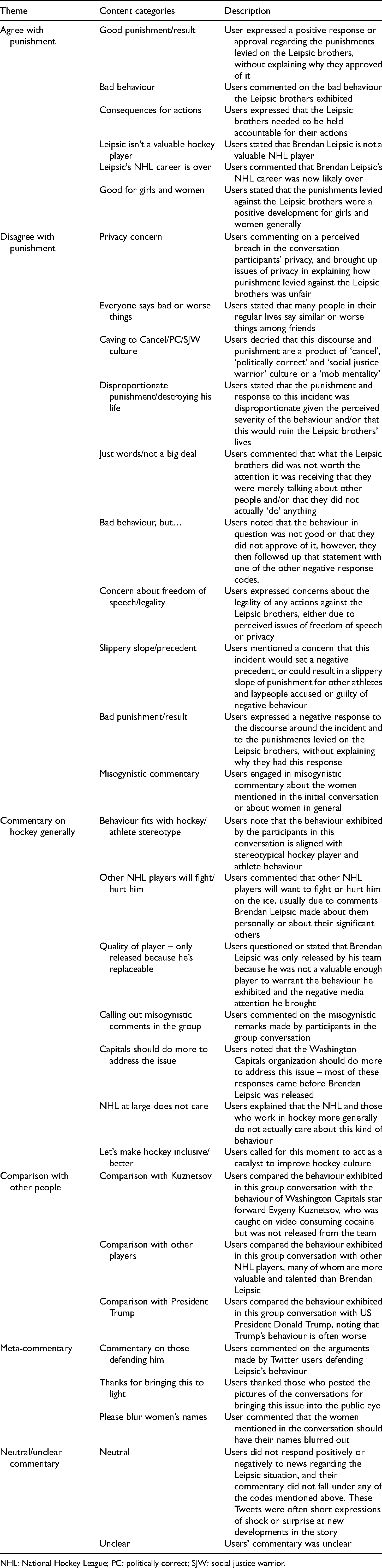
Each Tweet reply was inductively coded for its content and meaning by the author. Coding was left open ended, to let ‘the collected data to speak for itself’ (Saldaña, 2015: 54) and allow meaning and content categories to emerge. I determined code categories after a first round of coding (see Appendix A), and conducted a second round of coding to correct inconsistencies with the developed code categories and for the grouping of codes under specific themes. An external coder then used this codebook and the themes to complete a deductive coding analysis on all the tweets. Some Tweets could be coded with more than one code and could fall into multiple code categories and themes, and were thus coded with all that applied. Peer debriefing resolved disagreements regarding inconsistent coding (Nowell et al., 2017).
Findings
I identified 31 codes in the responses to Tweets about the Leipsic situation. These codes were then grouped into six themes. These themes are agree with punishment, disagree with punishment, commentary on hockey generally, comparison with other situations, meta-commentary and neutral/unclear. Each of these themes and their associated codes are found in Table 2.
Codes and themes.
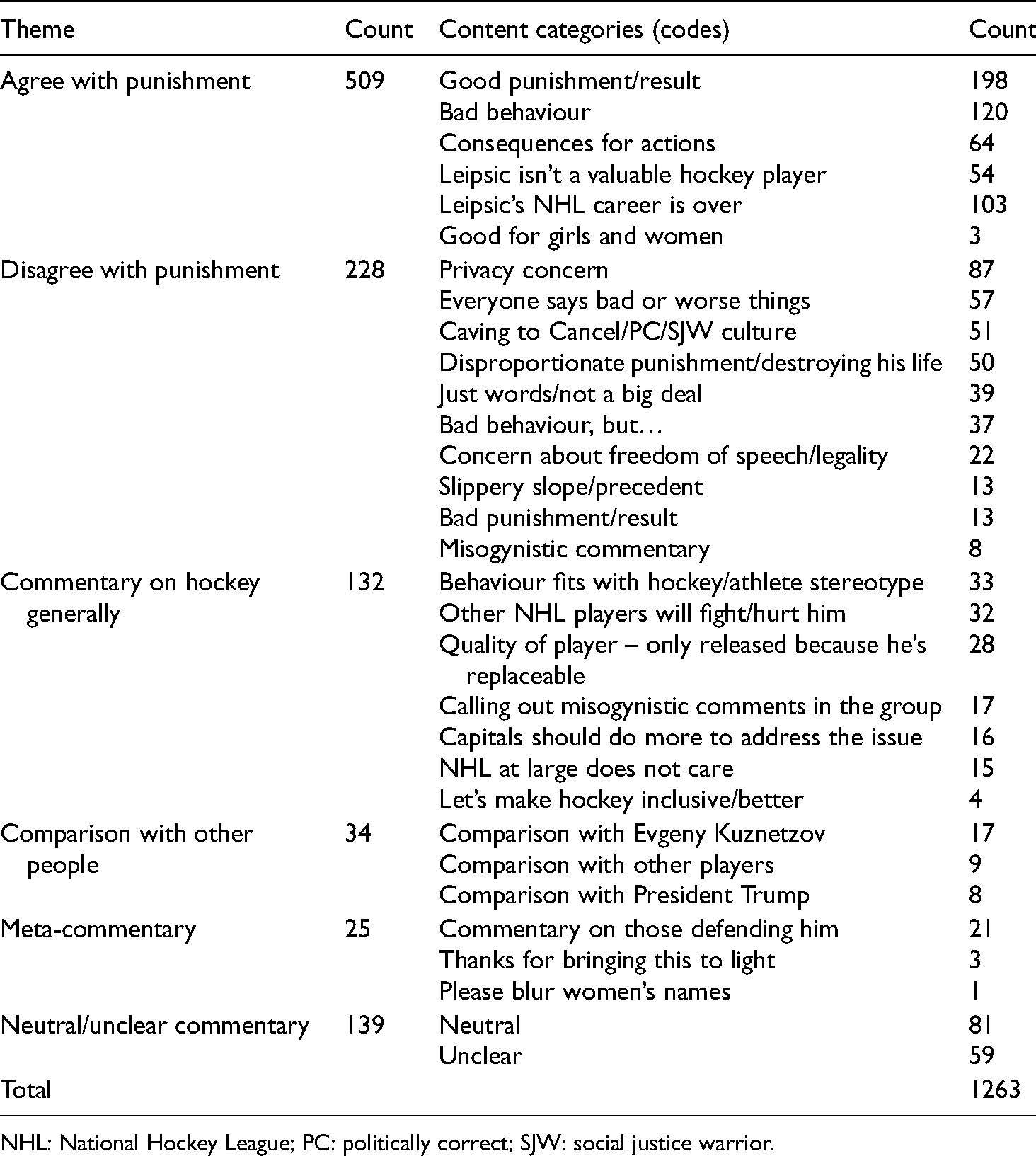
NHL: National Hockey League; PC: politically correct; SJW: social justice warrior.
Agree with punishment
The largest theme uncovered in my analysis was agree with punishment (hereafter ‘agreement’) (n = 509) situation. Many of these agreement Tweets simply expressed general approval of their punishment and were coded as good punishment/result (n = 198) if they did not provide a reason for their support of decisions made against the Leipsic brothers. All Tweets coded good punishment/result were posted following the announcement of Brendan or Jeremy’s removal from their teams. These responses include many short Tweets such as ‘Well done!’, ‘good’, or ‘Good to hear’.
Tweets coded as bad behaviour (n = 120) linked their approval of decisions against Leipsic with commentary on the negative behaviour shown by the brothers. This includes Tweets such as ‘not a single more game for this scumbag’, ‘I watched him play in juniors. He had a terrible attitude then too’, and ‘Later POS’. The third-most common agreement code was Leipsic’s NHL career is over (n = 103). This was often stated through jokes or commentary about Brendan Leipsic playing in the KHL (Russia’s professional hockey league) or in other minor leagues, in Tweets such as ‘Guy needs to simply be done. Sure, he can go to the KHL…’ and ‘Good bye. Enjoy beer league in Belarus’.
Some Twitter users noted that there should be consequences for the actions of the brothers or expressed happiness when these consequences occurred. These Tweets were coded as consequences for actions (p. 64), and included ‘… I think it’s absolutely the right move. They should have to face consequences for their actions just like everyone else does!’ and ‘Freedom of speech isn’t freedom from consequences’.
The other agreement codes were Leipsic isn’t a valuable hockey player (n = 54) and Good for girls and women (n = 3). In their support for discipline for Leipsic, Twitter users noted that he was not a valuable performer, saying ‘guy is a plug’, and ‘16 goals in 4 seasons in the NHL. He’s completely replaceable’. Tweets coded as such were also sometimes combined with the bad behaviour code, in Tweet excepts such as ‘this guy isn’t even fourth line material on any team, what a disgrace #4thlinejunk #ToxicMasculinity’.
Disagree with punishment
The second-largest theme was disagree with punishment (hereafter ‘disagreement’), which included 10 different codes. A total of 228 of the 969 Tweets examined expressed disapproval or anger at the leaking of the Instagram conversation, the reaction to it and/or the subsequent release of the Leipsic brothers. Only 13 of these Tweets did not state a reason for their disapproval and were thus coded as bad result/punishment, compared to 198 Tweets coded as good result/punishment.
The most common code in the disagreement theme was privacy concern (n = 87), which covered any Tweet where users expressed concern or anger at the breach of Brendan and Jeremy Leipsic’s privacy. These Tweets include ‘Meh, I don't care what was said in a private conversation between friends…’, ‘Private chat and it costs him his job? Sad!’, ‘This is ridiculous. Let's see all the private chats of all players so we can keep it steady and consistent’. This perceived breach of privacy was often used to explain why the Leipsic brothers should not have been punished or were being unfairly treated. The concern about freedom/legality code (n = 22) was similar to privacy concern, though these Tweets focused on the strict legality of the situation. This code includes tweet excerpts such as ‘Do I agree with what he said? No. I do think people have a right to free speech and to privacy…’.
Many disagreement codes were combined with the bad behaviour, but… code (n = 37), used when Twitter users noted that while the members of the Instagram conversation displayed bad behaviour, their conduct is excusable. This code was necessarily coupled with another disagreement code – such as privacy concern – in Tweets and excerpts such as ‘He messed up pretty badly. But at what point is privacy considered?’ and ‘It wasn't nice but it was never meant to be public…’.
The everyone says bad or worse things code (n = 57) was used when users justified the behaviour of those in the conversation in Tweets such as ‘Everybody has said shit to their friends in private that would look bad if it came out…’. In caving to cancel culture coded Tweets (n = 51), users expressed anger at the ‘cancelling’ of Brendan Leipsic and his brother due to their comments and the conversation, often blaming this ‘cancelling’ on contemporary social justice warrior (SJW) or politically correct (PC) ‘culture’. Tweets and excerpts include ‘Witch hunt. American classic’, ‘Oh Christ, our cancel culture in full on action’, and ‘Destroy a mans career over a private conversation. Thats the Hockey SJW way’. This code was often combined with other disagreement codes, including disproportionate punishment/destroying his life, in Tweets such as ‘Damn bruh, people make mistakes we don't gotta ruin everything they've ever done in their lives. I hate today's Society’.
Disproportionate punishment/destroying his life (n = 50) was coded for Tweets where users expressed disapproval at the punishment levied on the Leipsic brothers. This was observed in Tweets and excerpts such as ‘This response is disproportionately severe, by comparison to the “offence” itself’ and ‘really? I don't know about all this… careers are ruined for locker-room chat… I've heard worse on rap’. Users also noted that the conversation was not offensive or worthy of complaint (just words/not a big deal, n = 39), in Tweets such as ‘Bullshit. People make bad jokes all the time. It's just words…’ and ‘Haha. For words. What a soft world’.
Commentary on hockey generally
The next theme was commentary on hockey generally, which included seven different codes that discuss how this situation fits with larger hockey culture. The most frequently cited code under this theme was behaviour fits hockey/athlete stereotype (n = 33), used when a Twitter user explained that this behaviour was common or expected for a hockey player or athlete, in excerpts such as ‘This is the trickle down effect of a culture rich in bigotry, sexism, racism… This is common locker talk for hockey players’. The second most frequently cited code was other players will fight him (n = 32), where Twitter users mentioned that other NHL players would want to fight Leipsic due to his comments, in Tweets such as ‘I got a feeling the entire 4th line and Wilson might kill him if he returns to practice’.
The quality of player – only released because he is replaceable (n = 28) code differs from Leipsic isn’t a valuable player in that the user did not express happiness at the Leipsic brothers being released or applaud teams for their decision, but rather pointed out that this decision was only made because of the replaceable nature of the players. This is exemplified in Tweets such as ‘There was no way they were going to risk blowing up their dressing room and dealing with the distractions for a mediocre player. If he was a star he'd still be there’. Similarly, the Capitals should do more to address the issue (n = 16) and NHL at large doesn’t care (n = 15) codes were also used when Twitter users expressed scepticism around how the team handled this situation.
The last two commentaries on hockey codes were calling out misogynistic comments (n = 17) and let’s make hockey more inclusive/better (4), where users commented on the misogynistic commentary seen in the conversation, calling it ‘absolutely toxic behaviour’ or stating that ‘Leipsic is a misogynist and a fool’.
Comparison with other people
This theme contains three codes, comparison with Evgeny Kuznetzov (n = 17), comparison with other players (n = 9) and comparison with President Trump (n = 8). These Tweets often combined other codes, such as quality of player, in Tweets such as ‘Imagine if he was a top 6 forward? … Kuznetsov does coke and more importantly lies about it, but he's too important to make an example of’. These comparison Tweets were used to show how this is a disproportionate punishment relative to the Leipsic brothers’ offense, or to show how other players (and even the United States President) commit similar acts.
Discussion
Defending Leipsic through Canadian hockey masculinity and cancel culture
The variety of responses to the Leipsic situation emphasize differing perspectives on cancel culture and the acceptance of misogynistic, Canadian hockey masculinity. Those who expressed that the Leipsic conversation was evidence of bad behaviour exhibited a strong distaste for behaviour historically associated with Canadian hockey masculinity (misogynistic and racist banter). These views were countered by opposing narratives concerning the acceptability of both Canadian hockey masculinity and cancel culture. Many expressed that the behaviour exhibited by those in the leaked conversation was nothing to be concerned about, that it depicted a normal conversation between men or male athletes, and/or that the participants should not be punished for speaking this way privately. These comments normalize misogynistic commentary both generally and in athletic environments, in Tweets such as ‘No reason he needs to go anywhere. Guys were making locker room talk’. These Twitter users framed the behaviour and conversations as acceptable and normal for White, heterosexual hockey players, reifying norms of historically hegemonic Canadian hockey masculinities (Allain, 2008; Krebs, 2012).
While some comments combined discussion about the ubiquitous nature of this kind of misogynistic rhetoric with a critique of the behaviour, many downplayed it or noted that ‘lots of people, pros and normal people alike say this kinda shit all the time w(ith) there boys’. Other Twitter users also noted that while the behaviour was bad, it did not merit the response it was getting (bad behaviour, but…). Excusing behaviour that includes referring to a woman as a ‘fat native pig’, another a ‘slut’ and a third a ‘whore cunt’ relies on the continued acceptance of Canadian hockey masculinity that condones misogyny and is built on colonialist, sexist and racist foundations (Razack, 2000).
Those who responded negatively to the Leipsic situation often combined narratives regarding the acceptability of orthodox masculinity with critiques of what they perceived as cancel culture. While the caving to cancel/PC/SJW culture code was only used in cases where users made specific reference to ‘cancelling’ or to variations of terms such as ‘politically correct’, ‘social justice’ and ‘mob’, several other codes reflect the arguments typically made against cancel culture. Rather than focusing on the behaviour in question, many Twitter users opined that the conversation participants should be protected by freedom of speech and that publicly posting the conversation was an illegal breach of the conversation participants’ privacy. These narratives were often combined to explain how the Leipsic brothers were being treated unjustly, with some even going as far as to say that ‘Leipsic is the real victim here’.
Given the public nature of this scandal, it is unclear what effect Leipsic’s punishment will have on future discussion or policing of hegemonic Canadian hockey masculinity. While it could deter future athletes and people from engaging in misogynistic behaviour, it might only push this behaviour deeper into the shadows – into the often-misogynistic ‘safe space’ of the locker room or online right-wing platforms such as Parler and Telegram. Leipsic’s sanctioning could also provoke sympathy from fans and backlash among those who believe that the behaviour in question was acceptable or even that Leipsic is the victim of a figurative ‘public execution’ based on ‘illegally obtained’ private communication.
This type of himpathy – which describes the sympathy shown towards perpetrators of sexual violence or those who engage in abusive misogynistic behaviour – is ‘frequently extended in contemporary (North) America to men who are White, nondisabled, and otherwise privileged “golden boys”’ (Manne, 2017: 67–68). The protection of ‘golden boys’ applies especially in the Canadian hockey context, as hockey’s media and stakeholders romanticize its purported ‘working-class’ (coded language often used to signify White) roots (Allain, 2015). Both legal courts and courts of public opinion can be wary of harshly judging White, hockey-playing ‘boys’, for fear that this judgement might hurt their life prospects, ignoring marginalized victims in the process (Ahmed, 2020; Robinson, 1998).
Some of the framings from Leipsic defenders is also reminiscent of the discourse used to defend Brock Turner, the 2016 ‘Stanford rapist’ whose background as a student and collegiate swimmer was used to frame him as a potential victim, due to how much he had ‘at stake’ (Baker, 2016). These arguments resemble those against cancel culture, where Twitter users shift victimhood from the person who was attacked or hurt by the behaviours to the party who now might suffer consequences due to these behaviours. In the Leipsic situation, Twitter users similarly emphasized the lack of due process and the perceived mistreatment of the participants in the conversation, which they found to be disproportionate given the harm they believe these participants caused.
The combination and overlap between positive views of Canadian hockey masculinity and negative views of perceived cancel culture are particularly interesting when viewed through the lens of intersectional relations of power along with class, gender and racial lines. Although ‘cancelling’ is a tool of the marginalized (Clark, 2020) and Canadian hockey masculinity is mythologized as a working-class masculinity, those that supported norms associated with this supposedly working class masculinity also opposed Leipsic’s ‘cancelling’. This is likely due to the pre-eminence of maleness and Whiteness (over class considerations) in both Canadian hockey masculinity and cancel culture. Acceptance of the behaviours and norms associated with Canadian hockey masculinity and rejection of cancel culture both act to preserve White male access to power, which likely explains why these two narratives were used in tandem.
Anti-sexism and anti-misogyny as the dominant – but still contested – public discourse
It is still important to note that most opinions expressed on Twitter supported the consequences levied against the Leipsic brothers and/or called out their behaviour as harmful. Users also often felt comfortable expressing their approval of the punishments handed down without feeling the need to justify their stance (good punishment/result code, n = 198), posting one word replies such as ‘good’, or even simply sending ‘clapping’ or ‘thumbs-up’ emojis. These Twitter users did not explain why they agreed with the punishment, as it seemed to be obvious to them why this behaviour was unacceptable and worthy of punishment. This group likely includes many hockey fans, which points to an important potential turn to more inclusive masculinities among fans of the sport. Conversely, only 13 respondents posted a similarly short Tweet expressing disapproval, often providing multiple justifications for why the behaviour in question was acceptable or the punishment too severe. Respondents supporting a more traditional Canadian hockey masculinity were in the minority, with more inclusive views critical of the misogyny in Leipsic’s messages representing the mainstream (in this sample).
However, this finding should be viewed with some caution. While disagreement-coded responses were in the minority, it is possible that others who may have supported Leipsic and disapproved of his punishment decided not to engage on Twitter. Twitter is also often described as politically left-leaning and socially progressive spaces (Mellon and Prosser, 2017), compared to other social media platforms (i.e. Facebook, Reddit and Parler) that have more conservative political orientations (Heilweil, 2020). This could have caused some self-censorship on the part of those who might actually support the behaviour of the players or at least support lighter consequences for this behaviour. While I did use a representative sample of responses, it is possible that other public forums or social media platforms may have shown different splits in terms of public response. At the same time, it is nevertheless significant that most respondents on Twitter agreed with Leipsic’s punishment.
Woke capitalism
Other users did not focus directly on whether Leipsic was deserving of consequences, but rather commented on the hockey teams using this situation to engage in ‘woke capitalism’ (Lewis, 2020). While never explicitly using the term, 2 Twitter respondents noted in a variety of ways how the Washington Capitals may have used this situation to signal that they do not tolerate misogynistic behaviour by members of their organization, without working to change the underlying issues and causes of this behaviour. These users questioned whether a more valuable, talented or famous player would have received the same punishment (‘Would everyone be so quick to “cancel” if this was Ovechkin or Crosby?’), or outright stated that ‘(Brendan Leipsic) isn't good enough to be an asshole and get away with it’. Comparisons with Evgeny Kuznetsov – the star Capitals forward who was caught on video consuming cocaine but did not receive a similar punishment – were also thinly veiled criticisms of ‘woke capitalism’. While some of these comparisons were used to trivialize Leipsic’s behaviour by framing it as less harmful than that of Kuznetsov, others noted that the disparity in treatment is due to players’ skills on the ice.
In many ways, this situation was perfectly suited for the Capitals to engage in ‘woke capitalism’. From a labour perspective, the value of individual NHL players varies tremendously, more than in other industries. Brendan Leipsic has never scored more than seven goals or more than 23 points in his four years in the NHL and had only registered 11 points in 61 games in his most recent season with the Capitals. As many Twitter users noted, he is a back-of-the-roster, largely replaceable player and employee. Other more productive (i.e. high-performing) NHL players have been caught voicing similarly hateful, misogynistic, racist or homophobic rhetoric without receiving the same punishment as Leipsic, including Tony Deangelo (Fortunato, 2018) and Andrew Shaw (McKenna, 2016). In the case of Deangelo, his remarks and behaviour have been a recurring issue throughout his professional and junior career, and yet until February 2021, he was still employed by an NHL team (Fortunato, 2018; Hanold, 2020). Brandon Manning offers a parallel that also points to the importance of player performance, as he is a similar calibre player to Leipsic who was released by the Chicago Blackhawks in 2020 after uttering a racial slur (Clinton, 2020).
The leaking of this conversation also occurred when all North American professional sports were suspended due to the COVID-19 pandemic, which likely increased media attention to the issue. It is possible that the Capitals calculated that the negative attention around Leipsic was not worth his performance or even that the team could benefit more financially in the long-term by ‘taking a stand’ against misogynistic behaviour. Removing Leipsic from the team allowed the Capitals to flip their media narrative from negative to positive, without hurting the team’s chances of success and without doing any substantial work to change the underlying institutions and culture of hockey that allow this behaviour to continue.
While comments pointing out ‘woke capitalism’ could be grouped with a larger critique of ‘cancel culture’, they differ in that they do not condone the behaviour exhibited, or do they say that the Leipsic brothers and those involved in this conversation should be free from consequences. Rather, they focus on the performative nature of the organization’s handling of the issue, the lack of consistency in other similar issues, and the potential inefficacy of this approach in actually curbing future instances of misogynistic behaviour. This commentary on the performative nature of organizational decision making also mirrors critique of inclusive masculinity, as some scholars (De Boise, 2015; O’Neill, 2015) have noted that while athletes may present that they are inclusive or anti-sexist, their behaviour behind closed doors might suggest otherwise.
Conclusions and directions for future research
In this analysis, I explored how public commentary about a professional sports scandal produces competing narratives around acceptable masculinities and cancel culture, as well as how these narratives interact due to gender, race and class considerations. While most responses expressed disapproval of the behaviours observed and approval for the consequences delivered, a vocal minority did not view this misogynistic behaviour in the same way. The narrative that the behaviour of the participants in this leaked conversation was acceptable or at least not worthy of punishment, combined with the framing of the Leipsic brothers’ punishments as a case of ‘out of control cancel culture’, helps protect future misogynistic behaviour and reifies Canadian hockey masculinity’s hegemony. The intersection between support for Canadian hockey masculinity and opposition to perceived cancel culture also points to the importance of maleness and Whiteness in these concepts, as narratives supporting this masculinity and opposing cancel culture can both be used to preserve White male power.
Other Twitter users highlighted the possibility that the Washington Capitals may have used this moment to condemn misogynistic behaviour to score ‘woke points’ and secure their bottom line. However, given the non-trivial number of hockey fans who seem to feel that the team disproportionately punished these players, as well as how many people highlighted the performative nature of this gesture and the inconsistency teams show in handling player misbehaviour, perhaps this organizational strategy is not very effective. To be clear, I am not advocating that sports organizations excuse this type of misconduct because of past mishandling and inconsistency. Rather, these teams should consistently call out and punish misconduct to raise expectations for all athletes and employees, from those deemed ‘replaceable’ to those performing at the highest levels, to eradicate misogynistic behaviour and move to more inclusive masculinity.
While this study illuminates how those on Twitter assess acceptable behaviour by athletes, future research should examine players’ views of similar situations. Interviewing current, former and incoming professional hockey players would allow for a more complete analysis of contemporary hockey masculinity, as only an understanding of the within-team dynamics can provide a proper assessment of whether inclusive masculinity is making in-roads in hockey. However, it is notoriously difficult for researchers to gain access to these quasi-sacred spaces (MacDonald, 2018). While a shift in public discourse can certainly help disrupt entrenched notions of masculinity, athletes still often determine and drive perceptions of hegemonic masculinity (Messner, 2007).
This type of participant-led research could also investigate views of ‘cancel culture’ and ‘woke capitalism’, providing insight on how players view situations involving their peers and the responses of their employers. Research specifically examining those directly involved in organizational operations at both the team and league level could also help assess whether teams are engaging in ‘woke capitalism’, by examining what other changes or responses these organizations have made and how they handle player misbehaviour by different levels of players.
Footnotes
Declaration of Conflicting Interests
The author declared no potential conflicts of interest with respect to the research, authorship and/or publication of this article.
Funding
The author received no financial support for the research, authorship and/or publication of this article.

Notes
Appendix A. Codebook with descriptions
| Theme | Content categories | Description |
|---|---|---|
| Agree with punishment | Good punishment/result | User expressed a positive response or approval regarding the punishments levied on the Leipsic brothers, without explaining why they approved of it |
| Bad behaviour | Users commented on the bad behaviour the Leipsic brothers exhibited | |
| Consequences for actions | Users expressed that the Leipsic brothers needed to be held accountable for their actions | |
| Leipsic isn’t a valuable hockey player | Users stated that Brendan Leipsic is not a valuable NHL player | |
| Leipsic’s NHL career is over | Users commented that Brendan Leipsic’s NHL career was now likely over | |
| Good for girls and women | Users stated that the punishments levied against the Leipsic brothers were a positive development for girls and women generally | |
| Disagree with punishment | Privacy concern | Users commenting on a perceived breach in the conversation participants’ privacy, and brought up issues of privacy in explaining how punishment levied against the Leipsic brothers was unfair |
| Everyone says bad or worse things | Users stated that many people in their regular lives say similar or worse things among friends | |
| Caving to Cancel/PC/SJW culture | Users decried that this discourse and punishment are a product of ‘cancel’, ‘politically correct’ and ‘social justice warrior’ culture or a ‘mob mentality’ | |
| Disproportionate punishment/destroying his life | Users stated that the punishment and response to this incident was disproportionate given the perceived severity of the behaviour and/or that this would ruin the Leipsic brothers’ lives | |
| Just words/not a big deal | Users commented that what the Leipsic brothers did was not worth the attention it was receiving that they were merely talking about other people and/or that they did not actually ‘do’ anything | |
| Bad behaviour, but… | Users noted that the behaviour in question was not good or that they did not approve of it, however, they then followed up that statement with one of the other negative response codes. | |
| Concern about freedom of speech/legality | Users expressed concerns about the legality of any actions against the Leipsic brothers, either due to perceived issues of freedom of speech or privacy | |
| Slippery slope/precedent | Users mentioned a concern that this incident would set a negative precedent, or could result in a slippery slope of punishment for other athletes and laypeople accused or guilty of negative behaviour | |
| Bad punishment/result | Users expressed a negative response to the discourse around the incident and to the punishments levied on the Leipsic brothers, without explaining why they had this response | |
| Misogynistic commentary | Users engaged in misogynistic commentary about the women mentioned in the initial conversation or about women in general | |
| Commentary on hockey generally | Behaviour fits with hockey/athlete stereotype | Users note that the behaviour exhibited by the participants in this conversation is aligned with stereotypical hockey player and athlete behaviour |
| Other NHL players will fight/hurt him | Users commented that other NHL players will want to fight or hurt him on the ice, usually due to comments Brendan Leipsic made about them personally or about their significant others | |
| Quality of player – only released because he’s replaceable | Users questioned or stated that Brendan Leipsic was only released by his team because he was not a valuable enough player to warrant the behaviour he exhibited and the negative media attention he brought | |
| Calling out misogynistic comments in the group | Users commented on the misogynistic remarks made by participants in the group conversation | |
| Capitals should do more to address the issue | Users noted that the Washington Capitals organization should do more to address this issue – most of these responses came before Brendan Leipsic was released | |
| NHL at large does not care | Users explained that the NHL and those who work in hockey more generally do not actually care about this kind of behaviour | |
| Let’s make hockey inclusive/better | Users called for this moment to act as a catalyst to improve hockey culture | |
| Comparison with other people | Comparison with Kuznetsov | Users compared the behaviour exhibited in this group conversation with the behaviour of Washington Capitals star forward Evgeny Kuznetsov, who was caught on video consuming cocaine but was not released from the team |
| Comparison with other players | Users compared the behaviour exhibited in this group conversation with other NHL players, many of whom are more valuable and talented than Brendan Leipsic | |
| Comparison with President Trump | Users compared the behaviour exhibited in this group conversation with US President Donald Trump, noting that Trump’s behaviour is often worse | |
| Meta-commentary | Commentary on those defending him | Users commented on the arguments made by Twitter users defending Leipsic’s behaviour |
| Thanks for bringing this to light | Users thanked those who posted the pictures of the conversations for bringing this issue into the public eye | |
| Please blur women’s names | User commented that the women mentioned in the conversation should have their names blurred out | |
| Neutral/unclear commentary | Neutral | Users did not respond positively or negatively to news regarding the Leipsic situation, and their commentary did not fall under any of the codes mentioned above. These Tweets were often short expressions of shock or surprise at new developments in the story |
| Unclear | Users’ commentary was unclear |
NHL: National Hockey League; PC: politically correct; SJW: social justice warrior.