




Abstract
For over a century, violence has plagued Argentinian football. Popular understandings of the problem, however, are sorely lacking, with violence too often written off as an external force invading the game. This article provides an alternative view, arguing instead that violent behaviours are endemic to the sociocultural composition of the game itself, and that incidents of belligerence and antagonism cannot be separated from its wider context. To approach this, I analyse a corpus of chants produced by supporters of River Plate, one of the largest clubs in Argentina, and indeed Latin America. The aim is to provide a more nuanced vision of violence, taking into consideration how it is conceived, regulated and discussed by a plurality of supporters. Focussing on the native concept of aguante and the specific sociocultural formation of masculinity in Argentinian football, I suggest that a range of aggressive, harmful behaviours are naturalised and legitimised by prevailing cultural tendencies in Argentinian football.
Violence has always gone hand in hand with football in Argentina. Reports of pitch invasions, vandalism and assaults stretch back to the late 19th century (Szlifman, 2010), and by 1912 the Buenos Aires Herald was lamenting the ‘chronic rowdyism’ of a sport whose matches were regularly disrupted by gunshots (Mason, 1995: 104). In 1924, the Argentine authorities surrendered to the ferment, throwing up barbed wire fences to seal off the pitch from supporters (Rinke, 2007: 93) whom the novelist Roberto Arlt (1994 [1927]: 210) described luridly as ‘gun-toting ruffians’. To date, 334 people have perished in clashes linked to the game (Salvemos al Fútbol, 2020), a figure which is inconceivable for any other leisure activity.
Football violence is certainly not unique to Argentina, but what situates the country as a global outlier is the durability of death and destruction in the sport. For over 25 years, the number of fatalities has remained constant – at between five and 10 a year – in a seemingly permanent and immutable relationship between football and death (Murzi, 2011: 29). The current average of nine deaths a year over the past decade (Segura Trejo et al., 2019: 838) is almost double that of the ‘golden age’ of hooliganism in England (Hobbs and Robins, 1991: 553), widely considered the Founding Father of footballing mayhem. While other countries, especially those in Western Europe, have made great strides in reducing violence (Best, 2010), Argentina seems unable to follow their example. On the contrary, although every government since 1985 has had a specific policy to address the scourge, Argentinian stadiums remains a ‘space of violence’ (Bergés et al., 2019: 3).
One explanation for this failure is the deeply flawed public discourse surrounding football violence, from which academics remain notably ‘absent’ (Alabarces, 2015: 22). Two main frameworks of understanding dominate: firstly, violence is ascribed to individual deviance and anti-sociality. This view interprets the sport as a ‘flag of convenience’ (Kerr, 1994: 5) for naturally belligerent actors, whose inherent aggression separates them from the bulk of ‘normal’ supporters. According to this argument, violence is an episodic, irrational, chaotic act which can only be carried out by socially maladjusted, mentally unsound ‘beasts’ and ‘savages’ (Szlifman, 2010). Secondly, violence is attributed to the barras bravas (literally, fierce gangs), organised groups of militant supporters who engage in a raft of illegal economies linked to football. Since the 1980s, there has been ‘an automatic metonymy between barras bravas and violence’ (Segura Trejo et al., 2019: 849). The barras are often labelled as ‘mercenaries’ (Murzi and Czesli, 2015: 105) motivated only by financial gain and with no allegiance to their respective clubs, as was clear in Mauricio Macri’s 2016 Emergency Security Plan, which classified them as ‘organised criminals’ (Bergés et al., 2019: 5–6) rather than football supporters. It is undeniable that barras are heavily involved in violence, but these groups certainly have no monopoly on conflict. Further, the notion that these groups are somehow disconnected from the wider world of football has been thoroughly debunked by scholars who stress their centrality to the game’s culture and folklore (Alabarces, 2006, 2014; Garriga Zucal, 2005, 2009; Murzi, 2011).
These understandings – trafficked by footballing authorities and politicians and repeated uncritically by the popular press (Szlifman, 2010) – conceptually separate violence from Argentina’s wider football culture, ascribing the problem to an exogenous presence which threatens the naturally pacific festival of the national game. The dominant term used in these discourses is ‘inadaptado’ (Alabarces, 2006: 11) – an adjective used as a noun which roughly translates as ‘misfit’, ‘maladjusted’ or ‘antisocial’ – which positions those responsible for violence outside a metric of social ‘normality’. A phalanx of scholars has shown the weakness of these understandings, as well as the role they play in exculpating those in power from critique (Garriga Zucal, 2009; 2015; Moreira, 2007; Murzi and Czesli, 2015; Romero, 1997; Szlifman, 2010). Clearly, a new paradigm is needed, and as Javier Bundio (2019) convincingly argues, ‘we must stop thinking that violence is solely produced by barras or groups of inadaptados and start to view it as a systematic problem in Argentinian football’.
This paper responds to this appeal by situating incidents of violence within a wider cultural array. This is in line with Victor Turner’s (1957) work on ‘social dramas’, or ‘social interactions of a conflictive, competitive, or agonistic type’ (1957: 33). Turner (1957) argues that social dramas must be understood within their ‘field context’ (1957: 90–91), that is, the array of beliefs, traditions and perceptions which give them meaning, and a useful way of exploring this context is through the chants and songs which have filled Argentinian stadiums since the turn of the 20th century. Researchers have shown the centrality of chants to a huge array of football cultures from Scunthorpe (Clark, 2006) to Istanbul (Kytö, 2011), stressing their suitability for exploration of a social universe of intense affective energies and ‘ferociously demonstrated cultural identity’ (Armstrong and Young, 1999: 173). In Argentina, chants are a festive performance, accompanied by musical instruments and often mimicking existing pop and folk songs (Parrish and Nauright, 2013: 2). In the first large-scale analysis of football chants in Argentina, Gándara (1997) stressed their capacity to develop and express nuanced ideological standpoints and coherent worldviews. As such, chants are an invaluable resource for mapping Argentinian football’s sociocultural topography, permitting an understanding of the various meanings of violence within the social event of football fandom. In general, chants are largely started by the more ‘militant’ fans behind the goals, but are nevertheless ‘mass participatory’ (Herrera, 2018: 474) events, incorporating, indeed requiring, an entire stadium of fans from across class strata (Parrish and Nauright, 2013: 2) in their production. Through these powerful discursive tools, I argue that violent acts are normalised and imbued with positive sociocultural connotations, becoming legitimate, acceptable and even laudable in the context of Argentinian football.
Approaching football violence in Argentina
There is by now a tremendous body of work on football violence, a wealth of research which has led some scholars to comment that ‘violence in football has been overstudied’ (Frosdick and Newton, 2006: 403). However, analyses and theoretical models remain overwhelmingly Anglo- and Eurocentric, and of questionable application beyond these contexts. In general, the field has been slow to realise that ‘universal explanations cannot accommodate all cross-cultural variations’ (Frosdick and Marsh, 2005: 111), and there is a conspicuous need to more sensitively attend to the specific ‘social and cultural dimensions’ which ‘give violence its power and meaning’ (Scheper-Hughes and Bourgois, 2004: 1).
Work on Argentinian football violence began the 1980s, with Romero’s (1985, 1986) pioneering historic analyses of incidents of violence dating back to 1953. In 1994, he and Archetti – who pioneered the deployment of anthropological concepts like ethos and ritual to situate the game as a potent arena for identity construction – combined to write a highly influential chapter which insisted on the need to link such incidents to wider social processes. The chapter sparked a fresh interest in the violence that was rapidly engrossing Argentinian football, and since then the field has expanded massively, now boasting an impressive range of studies from an array of disciplines. The primary research tradition has been ethnographic, but this paper engages with the less common though equally insightful discursive approaches exemplified by Gándara (1997), Bundio (2013) and Herrera (2018).
The central focus of most scholarship is aguante (Moreira et al., 2013: 221), a native concept which has structured fandom since the 1980s. To ‘aguantar’ is to ‘tolerate’, ‘endure’ or ‘put up with’ something unpleasant or harmful (my translation) but has a much broader basket of connotations in Argentinian football. Aguante is tenacity, endurance and stamina, a moral and practical framework which demands total devotion to one’s chosen club. On occasion, such devotion is shown through exaggerated displays of loyalty and support, such as travelling great distances for away matches, but the principal way of proving aguante is violence against rivals on behalf of one’s team (Garriga Zucal, 2005: 208). In this, aguante can be understood as a code of honour in the traditional sense of the term, as ‘a form of social status founded on the willingness and ability to use force’ (Cooney, 2015).
Aguante is central to studies of football violence in Argentina (Alabarces, 2006; Alabarces and Garriga Zucal, 2008; Garriga and Zucal, 2005, 2009; Hasicic, 2016a, 2016b; Moreira, 2007, 2008, 2015), but finds imitators in several other footballing cultures, especially Mexico (Hernández, 2018) and Colombia, where it has become a coherent ‘lifestyle’ choice (Castro Lozano, 2013: 87). The term is most used in the Argentinian context, however, where its presence is ubiquitous and unchallenged. In their work with schoolchildren, Murzi and Czesli (2015) show how the concept is ‘deeply rooted’ among young boys in Argentina (2015: 111), and even supposedly ‘peaceful’ supporters proudly chant that they have the most aguante (Alabarces, 2014: 71). Aguante is a cornerstone of group identity in the following chant, in which one’s belonging to the collective of the Gallinero (a common nickname for River Plate) is dependent upon it:
(1) Yo no soy de La Boca, Yo no soy vigilante, Yo soy del Gallinero,
I’m not from La Boca, I’m not a snitch, I’m from the Gallinero,
Although women are increasingly represented in football, aguante remains a narrative which is ‘produced and reproduced, starring and administered by men’ (Alabarces, 2014: 108). Football has been central to male identity in Argentina since at least the 1920s, when newspapers implored a Boca Juniors team touring Europe to showcase the nation’s ‘potent and virile young men’ (Karush, 2003: 22) to the Old Continent. In his ground-breaking work on Argentinian football, Eduardo Archetti (1985, 1992, 1994, 1999) repositioned the sport as a highly productive foundry for masculine ethos, a ‘symbolic and practical male arena’ (Archetti, 1999: 15) in which idealised senses of maleness can be imagined, represented and embodied by players and supporters alike.
Archetti (1999) linked these idealised forms of masculinity to aggression and sexual dominance, and such belligerent masculinities – pluralised, following Connell (2005) – are key themes in sporting research (Kian et al., 2011: 681). Across the world, organised sports, and particularly football, have been linked to a ‘violent, dysfunctional, and oppressive version of manhood’ (Ralph and Roberts, 2019: 19) which celebrates and demands displays of ‘excessive or problematic masculine practices’ (Pringle and Hickey, 2010: 119). In 1987, Connell advanced hegemonic masculinity theory, according to which multiple types of masculinity exist simultaneously in an intra-masculine hierarchy, with men and boys gaining social capital if they aspired to one hegemonic archetype of masculinity. For Connell, this encouraged exaggerated practices of violence, homophobia and sexism. A useful example of the process in action in football is observed by Alan Bairner in Northern Ireland, where ‘men find themselves in a situation that encourages the sort of aggression that wins them greater respect from their peers’ within an ‘ascendant mode of masculinity which demands participation in sexist and homophobic rhetoric, and which can encourage violence by men at large’ (Bairner, 1999: 284–285). Similar processes were found in Brazil by Teixeira and Buarque de Hollanda (2016). Indeed, masculinities are central to football violence across Latin America (Castro Lozano, 2010: 143) and indispensable to understanding the situation in Argentina, where many supporters ‘consider violent practice as a key instrument to define manliness’ (Garriga Zucal, 2005: 208).
In a sociocultural context structured by belligerent masculinity and aguante, aggressive behaviours can be acceptable and even socially valuable. This follows more general work on violence, particularly that of Sauvadet (2006) in the cités of Paris and Bourgois (2004) with inner-city gangs across the US and Central America. These authors show how ‘valuable symbolic and cultural capital’ can be gained through violent actions which, in other sociocultural contexts, would mark one out as ‘a dysfunctional antisocial psychopath’ (Bourgois, 2004: 302). Central here is the notion of cultural capital (Bourdieu, 1986), which refers to the collection of symbolic elements (skills, posture, mannerisms, etc.) which confer social status and prestige. Cultural capital can only exist in relation to a specific ‘field’ in which certain actions, behaviours and attitudes take on symbolic value. Within this field, individuals are deeply ingrained with a set of habits and dispositions which colour their perception of the world around them, known collectively as the habitus (Bourdieu, 1977).
Violence is often ‘individualized and pathologized as deviance’ (Scheper-Hughes and Bourgois, 2004: 4), a tendency which is clear in typical discourses on football violence in Argentina. I argue here, however, that the prevalent habitus in Argentinian football encompasses a celebration of the philosophy of aguante and an understanding of masculinity which attaches prestige and social capital to acts of extreme aggression. Considered in this way, the obvious incidents of aggression and confrontation which dominate the press are inseparable from a wider cultural framework, and even those fans who do not engage in violence per se but nevertheless reproduce the discourses which celebrate it are contributing to a climate of violence. The analysis of these discourses, in the form of chants, must be primordial in understandings of football violence in Argentina.
In their 1994 article, Archetti and Romero identified four main categories for violence: police repression, political persecution, and both spontaneous and planned confrontation between rival fans. In recent years, new motives for conflict have emerged, especially the internal power struggles within a single barra brava, which now represent one of the chief causes of violence in Argentinian football (Segura Trejo et al., 2019: 849). This was made clear in the 2007 death of Gonzalo Acro, a high-ranking member of River Plate’s barra, Los Borrachos del Tablón, who was murdered by members of a splinter group, the Banda de los Patovicas. The enormous variety in cause, expression and practice of violence in Argentinian football makes a full taxonomy impossible, so I have focussed here on chants directed at rival supporters, which make up the bulk of stadium productions. Through this, following Archetti (1999: 210), I intend to capture ‘a particular “state of mind”, “a general attitude”, on the basis of the explicit discourses of fans’.
Methodology
Owing to the sheer number of teams, traditions and chants, I focus here on the supporters of one club, River Plate, chosen because of its status as one of the premier clubs in Latin America, the fearsome reputation of its supporters, and its participation in one of the most intense derbies in world football with Boca Juniors. My decision to focus on a single club was influenced by the lack of variation in football supporters’ discourses, which tend to draw from a common well of themes and insults. Many of the chants I analyse are performed by several fanbases in Argentina, albeit with superficial alterations to ‘rebrand’ them for particular teams. This commonality allows for a generalised cultural analysis with River Plate as a case study.
Impelled by the limitations of COVID-19, I was forced to abandon plans to travel to Buenos Aires to conduct fieldwork and turned instead to online sources. However, this itself represents an exciting opportunity for study, because, as Kian et al. (2011) note, academic inquiries into sporting fandom on social media and internet message boards are sorely lacking. The growth of new technologies are changing the way supporters interact with the game, creating more ‘active’ football fans (Cleland, 2014: 416) who engage with their chosen club in fresh and unexpected ways which demand attention.
For this study, I carried out a content analysis on a corpus of over 250 chants sourced from a range of social media sites (Twitter.com; Facebook.com), video-sharing platforms (Youtube.com), and websites devoted to fan cultures in general (Barrabrava.net) and River Plate in particular (Elaguantederiver.com; Lapaginamillonaria.com; Turiver.com). In the first cycle of my coding process, I assigned a mixture of descriptive (‘homosexuality’, ‘femininity’, etc.) and in vivo (‘huevos’, ‘aguante’, etc.) codes to these chants in order to link them to wider categories or thematic ‘families’ (Saldaña, 2009: 8). The number of chants used by these supporters is limitless and constantly increasing, and my second cycle of coding focussed on selecting which chants were to be used in this paper. The most common categories of chant were by far those related to aguante and masculinity (among other categories such as ‘racism’ and ‘barrio identity’), which intersected well with existing literature on football violence in Argentina. Of course, this attempt to select the most ‘important’ themes can never be neutral, since ‘our analysis and interpretation will reflect the constructs, concepts, language, models, and theories that structured the study in the first place’ (Merriam, 1998: 48), but I have endeavoured to be as loyal to the source material as possible.
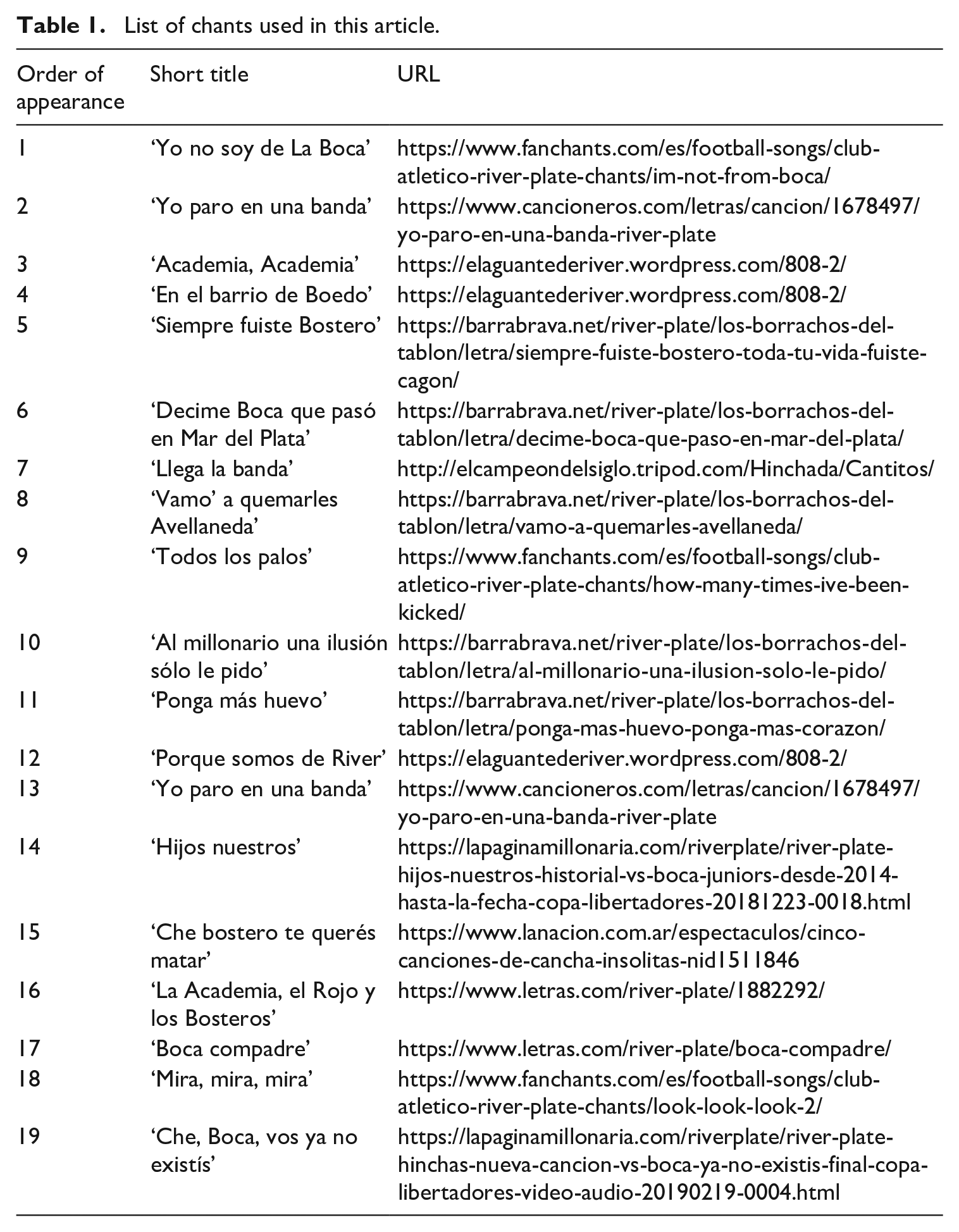
The following is a list of all chants used in this paper. In many cases, there are multiple sources with slight differences in lyrics, but I have attempted to give the most common formulations (checked against performance videos) for each example. No authors are available for these chants, so listed instead is the website which has published them (Table 1).
List of chants used in this article.
Capture the flag
In their work on ‘hypermasculinity’ in sport, Pringle and Hickey (2010: 119) note that males engage in ‘a particular form of gendered performance’ to win prestige from other males. Often, these performances involve ‘demonstrations of physical prowess’, which is legible in the Argentinian context in the theft and prominent exhibition of flags, banners and shirts from opposing supporters. This exercise is so common that article 22 of Ley 11929 – which targets football disorder – explicitly forbids supporters from displaying ‘flags or trophies from clubs which are not their own’ (Senate of the Province of Buenos Aires, 1997). The wording of the law underscores the parallels with the practice of taking ‘war trophies’ in battle, with such prizes serving as tokens of victory and proof of bravado and power. The following chant refers to supporters of Boca Juniors (nicknamed ‘Bosteros’) and Racing:
(2) Yo paro en una banda, Que corre a los Bosteros,
A Racing le roba trapos. . .
I’m from a gang,
That runs off the Bosteros
That steals flags from Racing. . .
Like military standards, these objects must be jealously guarded, often leading to extreme violence involved in their protection. This is clear in the testimony of an unnamed supporter interviewed by Alabarces (2006: 1–2) (my translation):
You turn up with your flag and someone wants to steal it from you for a war trophy, and it’s as if they were trying to take a part of your life, of your body.
Moreira (2007: 16) compares the loss of such symbols to the profaning of the bodies of Greek heroes, and elevated to such importance, it is unsurprising that violence is employed to defend an otherwise meaningless piece of fabric. This is consistent with Cohen’s (2007: 212) observation that many violent incidents in honour cultures are sparked by ‘what might be considered a trivial incident to outsiders’, and examples abound of flags, shirts and other paraphernalia triggering conflicts and even murders among Argentinian football supporters. The reason for such intensity of action is that at stake for supporters is much more than cloth, but one’s own reputation, both as a man who can defend himself in combat, and as a fan who tenaciously protects his team’s symbols. Failure to do so is met with withering criticism, as in the following chant aimed at supporters of Racing (nicknamed ‘La Academia’), which gleefully revels in the theft of their flags:
(3) ¡Academia, Academia
Qué amargada se te ve!
¡Las banderas que perdiste
Nunca más las vas a ver!
Academia, Academia,
How bitter you look!
The flags that you lost,
You’ll never see again!
Unlike ‘more stable values like dignity’, honour can be won or lost by one’s inability ‘to physically defend himself, his intimates, or his property’ (Cooney, 2015). In the following chant, for instance, directed at supporters of San Lorenzo, based in the Boedo neighbourhood of Buenos Aires, the profound dishonour and shame which results from this inability is striking:
(4) En el barrio de Boedo hay una banda, Se quedaron sin bandera y sin telón, San Lorenzo ya sabemos sos cagón,
San Lorenzo ya sabemos sos cagón
In the barrio of Boedo there’s a gang, They ended up without their flags and cloths, San Lorenzo we know you’re a coward,
San Lorenzo we know you’re a coward
With a supporter’s honour mortgaged on these emblems, the social meaning of violence is altered. In this context, the aggressive defence or seizure of these symbols is justifiable, laudable and even necessary to enhance and safeguard personal and collective reputations, both as a man, and as a fan. These clashes become even more intense because other supporters look to gain their own cultural capital through these attempted thefts.
‘Sos Cagón’
That San Lorenzo fans are cagón (‘coward’, ‘chicken’ or ‘pussy’) for having lost their flags is an explosive insult in the world of Argentinian football. In many cultures across the Western world, ‘there is nothing worse than a coward’ (Walsh, 2014: 1–2), and for Argentinian football supporters the accusation is intolerably toxic. Of note in the following chant is the causal link between being a cagón and supporting Boca Juniors, as River Plate’s fans mobilise the abominable connotations of cowardice to denigrate their rivals:
(5) Siempre fuiste Bostero,Toda tu vida fuiste cagón,Boca sos vigilante,La puta madre que te parió
You were always a Bostero, All your life you were a pussy, Boca you’re a snitch,
Fucking son of a bitch
Cooney (2015) reminds us that ‘honour’ depends on ‘a willingness to fight’, and the cagón is one who is unable to do so. Instead, the cagón will correr (run away), proving his cowardice and stripping himself of honour in the process. This dynamic is clear in the numerous chants referring to a clash between River Plate and Boca Juniors fans during the 2002 Copa Mar del Plata, a tournament held in the eponymous resort. This also spotlights Alabarces’ (2006: 4) observation that in the world of football support, the memory of a specific clash is as important as the clash itself, since it can be mined for symbolic capital:
(6) Decime Boca que pasó en Mar del Plata
Que no te dio la nafta, no pudiste aguantar
Todos esos gordos que se la dan guapos
Vieron a los borrachos y se fueron para atrás
Tell me Boca what happened in Mar del Plata
You didn’t have the gas, you couldn’t aguantar
All those fat guys who fancy themselves
Saw the borrachos and hid at the back
Notable here is the vergüenza (shame) of failing to plantarse (stand one’s ground) in combat. This is because, according to the strict honour-codes of aguante and masculinity any show of ‘fear, weakness or cowardice leads to low esteem and a loss of reputation’ (Moreira, 2007: 13). In other words, the only way to avoid a painful, public disgrace is to fight, to engage in violence against an enemy force. On the other hand, there is ample cultural capital to be made from forcing a foe to flee. This is regularly communicated through a feat of linguistic dexterity, with correr transformed into a transitive verb:
(7) Ya corrimos a todas las hinchadas,
Ninguna de ellas nos vino a buscar
We ran off all the other fans,
None of them came to find us
The pride inherent in belonging to a fearsome collective which can conquer other groups of supporters is self-evident and entirely coherent with Garriga Zucal’s (2005: 202) observation that, according to the philosophy of aguante, fans bind up ‘the honour of the club with violence’, taking for themselves the mantle of ‘actors defending the virtue of the institution’. This also responds to a particular conception of masculine honour which holds enormous rewards for success in combat, and crushing penalties for failure. This converts fandom itself into a competitive category, with physical force useful and necessary to gain the apex. Here, for instance, it is the supporters of River Plate, rather than the playing squad, who are going to copar (conquer) the Bombonera (home of Boca Juniors) and Avellaneda (home of Racing and Independiente, known as ‘el Rojo’), and they are going to do so through violence. Also in the crosshairs are supporters of San Lorenzo (‘el Cuervo’) and Huracán (‘los Quemeros’):
(8) Quiero correr al Rojo en Avellaneda, robarle Racing otra bandera, Vamos a coparle la Bombonera, quemar los ranchos de la ribera, Vamos a coparle Avellaneda, correr al Rojo y a La Academia,
Correr al Cuervo y a los Quemeros, son todos putos no tienen huevo
I want to run off the Rojo in Avellaneda, rob another flag from Racing
We’re gonna conquer the Bombonera, burn down the huts on the shore, We’re gonna conquer Avellaneda, run off the Rojo and the Academia,
Run off the Cuervo and the Quemeros, they’re all faggots without balls
‘Man up’
Of course, there are consequences to this violence, and a number of scholars have stressed the corporeal elements of aguante, especially the paramount importance of ‘poner el cuerpo’ (putting your body on the line) for the collective cause (Alabarces, 2006; Alabarces et al., 2008; Alabarces and Garriga Zucal, 2008; Garriga Zucal, 2005; Moreira, 2007). To put one’s body at risk means accepting and revelling in the consequences of ‘physical violence’ (Alabarces, 2006: 1), and the River Plate fans’ chants are littered with celebrations of this sacrifice:
(9) Todos los palos que recibí, todas las veces que preso caí,
A la cancha voy igual, aunque nos busque toda la federal
All the hits I took, all the times I went to jail,
I still go to the pitch, even though all the cops are after us
The body functions here as a kind of discursive tool which allows one to perform an idealised form of conduct. This is not only informed by aguante but by traditional masculinities which pride physical resilience and an acceptance of physical harm, as across cultures males are less likely to ‘admit’ to pain for fear of jeopardising their ‘ranking among “real men”’ (Courtenay, 2000: 1390). Returning to Bourdieu, the habitus is composed in part by abstract mental habits and schemes of perception, and in part by the hexis, or the tendency to hold and use one’s body in a certain way. This is consistent with Garriga Zucal’s (2005) work on the bodily performances of supporters, who proudly display scars from previous combats or stand stripped to the waist in torrential rain, ‘tolerating pain as a form of inscription into the masculine universe’ (2005: 211). This is because honour requires neither skill or power, only ‘bravery: a willingness to risk injury or death’ (Black, 2011: 72), as is intensely clear in the following chant. It appears in a YouTube video titled ‘Walter presente’, which echoes the language used by dissident guerrilla groups to remember fallen comrades. Here, however, the cause worth dying for is the ‘Millonario’, a common nickname for River Plate:
(10) Al Millonario una ilusión, solo le pidoPara los pibes que desde el cielo te alientan conmigo,Vos no los ves, no los tocás, pero están presentesEsos recuerdos inolvidables quedan en mi mente
I only ask one thing of the Millonario
For the lads who support you from the sky with me,
You don’t see them or feel them but they’re here
Those unforgettable memories remain in my mind
Bourdieu (1997: 50–51) observes that manliness, especially ‘the capacity to fight and to exercise violence. . .is first and foremost a duty’. In the chants of River fans, one must embrace pain as a necessary condition of manhood and a demonstration of one’s own aguante. Damage and harm are not to be avoided, but celebrated, and those who endure such suffering rewarded with a cultural capital derived from violence.
The ‘unmanly’
Masculinity is never stable, but rather is a quality which must be ‘earned, often through trials or rituals, and can be lost if a man fails to live up to the demands of his gender’ (Cassino, 2018: 49). In the sociocultural climate of Argentinian football, these demands are often expressed through the shorthand of huevos, a slang term for ‘testicles’ which stands in for a broad cluster of ‘male’ values, such as vigour, aggression and strength. River Plate supporters regularly position their own huevos as a central component of masculine identity and demand the same from their team on the pitch:
(11) Ponga más huevoPonga más corazón
Show more balls,
Show more heart
And we need to win (my emphasis)
To not play with huevos is to ‘create a link with subordinate feminine ideology’ (Parrish and Nauright, 2013: 7), but the surest way to prove that one has huevos is not on the pitch. Rather, it is to demonstrate a capability and zeal for violence, with the world of football reflecting and amplifying the common assumption in Latin America that males should be aggressive and physically dominant (Baird, 2017: 192). This is apparent in the following chant, which stresses that being a ‘real man’ is necessary for being a ‘real fan’ (‘we are River because we have balls’), and that being a man means engaging in violence (‘because we go to the front’):
(12) Porque somos de River,
Traigan más policías, traigan más patrulleros.
¡Prepárate Bostero, porque del Gallinero vas a salir corriendo!
Because we are River, Bring on more cops, bring on more troopers, Get ready Bostero, because you’re going to run from the Gallinero! (my emphasis)
At work here is a conceptualisation of masculinity based largely on violence, one in which the ‘manliest’ men gain their position at the zenith of a male hierarchy thanks to their superior belligerence. Those men who are considered deficient in this hierarchy are dishonoured and denigrated, often not considered ‘real men’ at all (Alabarces, 2014: 158). In this chant, for instance, supporters of Boca Juniors (‘Bosteros’) and Independiente (‘el Rojo’) are lyrically castrated, denied their manhood by the ‘true’ men of River Plate, who prove their masculinity through aggressive conquest of enemy territory:
(13) Yo paro en una banda que es la más loca de todas,
Para correr a River hay que poner más huevo,
I’m from the craziest gang of all,
To run off River you need to show more balls,
Archetti (1985) notes that masculinity in Argentinian football is binarily organised, with ‘men’ on one side and ‘not-men’ on the other. Besides lacking huevos, the unmanly are often described as children, as in the ubiquitous use of the word ‘papá’ (daddy) to place the singer in the ‘dominant’, fatherly position, with the ‘children’ of the rival team under his power. This dynamic is also at play in the following chant:
(14) Que nacieron hijo nuestro
,
Hijos nuestros morirán
They were born our children,
And they’ll die our children too
More often, however, supporters mobilise the rampant homophobia which dominates the sport to imply that other men are less ‘authentic’ in their maleness. This is consistent with Gándara’s (1997) findings that ‘homosexuality is used as an insult’ in chants, and little seems to have changed in the subsequent two decades. Here, for instance, Boca Juniors are labelled as homosexuals through their cultural consumption, with the ‘shame’ (vergüenza) of their homosexuality emphasised throughout:
(15) Che Bostero te querés matar, Qué vergüenza ese recital, Acá en Núñez tocan los Stones, En La Boca toca Backstreet Boys, Los de Boca son todos putos,
Los de Boca son todos putos
Oh Bostero you want to kill yourself, This recital is a disgrace, Here in Núñez the Stones are playing, In La Boca it’s the Backstreet Boys, Boca fans are all faggots,
Boca fans are all faggots
Following Galtung (1969), there is a clear form of structural violence latent in these discourses, insofar as merely implying another man is homosexual is an effective way to dishonour his masculinity. The River fans here mobilise a pervasive ‘homohysteria’, that is, the intense fear of being thought of as homosexual (Anderson, 2009), which continues to denigrate LGBTQ people and ensures football remains an unwelcoming, unsafe environment for them.
‘Te cojimos’
Homophobia, however, is much more complex in Argentinian football, and much more vicious. This is because, for many supporters, homosexual encounters function as a contest of power, allowing one to strip an opponent of masculinity through sexual domination. As Archetti (1992: 223) notes, ‘the conquered, the weak, in other words the one who is not a “real man”, has to do, or be supposed to do, things that go against his nature’. Particular attention must be paid here to the use of the term ‘puto’, a common insult in Latin American Spanish which recurs in the chants. ‘Puto’ roughly translates as ‘male prostitute’ but is used generally to denigrate homosexuals by ‘labelling a male in the women’s role that engages in sexual intercourse with another male’ (Prieur, 1996: 44). Performing this ‘women’s role’ is viewed as deeply shameful in Argentinian football, and in the following chant it is not homosexual intercourse as such which is used to degrade, however, but the performance of this ‘female’ role in the encounter:
(16) La Academia, El Rojo y los Bosteros
A todos los de River, nos chupan bien los huevos
La Academia, El Rojo and the Bosteros,
All of them suck our River balls
Allusions to intercourse tend to be much more directly violent, however, because for many supporters the ultimate expression of dominance is forced sexual conquest. Within the language of Argentinian football, ‘the only authentic fans are those who fuck and tear open the anuses of all other fans’ (Low, 2000: 51), with victory, defeat, strength and weakness all encoded within a paradigm of graphic sexual domination. Here, for instance, footballing victories over Boca Juniors are interpreted as an instance of forcefully ‘fucking’ an unwilling rival:
(17) Boca, Boca, compadre, La concha de tu madre, Te cojimos en Mendoza, Te cojimos en La Boca, Te cojimos en la Copa,
Te cojimos en Europa
Boca, Boca, mate, Son of a bitch, We fucked you in Mendoza, We fucked you in La Boca, We fucked you in the cup,
We fucked you in Europe
This discursive paradigm is profoundly violent, and places aggression and physical domination as a central tenet of male identity as well as a necessary step of demonstrating one’s aguante. River Plate fans, in short, find their masculinity in the metaphorical rape of other supporters, as in the following chant, which stresses the physical damage inflicted on supporters of Gimnasia, based in La Plata:
(18) ¡Mira, mira, mira!
Sácale una foto,
Se van para La Plata
con el culo roto. . .
Look, look look!
Take a photo,
They’re running to La Plata
With their arses broken. . .
The viciousness of this specific form of masculinity is even more striking in this chant, which features the common phrase ‘no existís’ (you don’t exist). Alabarces (2006: 10) notes that this phrase ‘bespeaks a context in which the death of the other is legitimate’, reflecting a coherent worldview in which sexualised violence is a necessary precondition of manhood, and the humiliation and destruction of the enemy an essential and socially valuable component of fandom:
(19) Che Boca vos ya no existís porque en España yo te vi morir
Cuánta alegría en el Gallinero, cuánta alegría en el mundo entero
Pobre Bostero, qué sufrimiento, lleva la pija de River adentro
Oh Boca you don’t exist because I saw you die in Spain
How much joy in the Gallinero, how much joy in the whole world,
Poor Bostero, how much suffering, you’ve got River’s cock inside you
Conclusions
It is typical to present violence as an exogenous force in Argentinian football, a product of invasive actors who are alienated from the ‘normal’ mass of supporters. This paper has provided a counterpoint, arguing instead that the cultures, values and identity structures of the sport can encourage and legitimise violence. Far from an irrational mass, supporters who engage in violence are actually manipulating already extant meanings in the specific semiotic universe of Argentinian football. Through the chants which ring around Argentinian stadiums, we can trace the contours of a worldview in which engagement in violence is an effective method of improving social capital and a necessary demonstration of personal honour, aguante and masculine virtue.
In many cases, such behaviour may even be necessary, since a man’s honour is constantly at hazard in the world of Argentinian football. River Plate supporters’ chants reflect and confect a hegemonic form of masculinity which encourages and rewards violence, the acceptance of pain and the forceful emasculation of other men. The social consequences for not living up to this ideal are enormous, with one’s manhood mocked, shamed and denied altogether. In this fraught context, then, aggression and violence emerge as compulsory actions to prove one’s masculine bona fides and inoculate oneself from such degradation. This belligerent masculinity is alloyed to the philosophical lodestar of Argentinian football, aguante, which rewards with cultural capital a varied set of violent behaviours and practices.
In this sociocultural context, violence is recast as an incredibly productive social tool, as group identities and personal honour are reified in combat. In this fraught climate, rival supporters become oppositional, hostile forces, providing a constant opportunity for, and risk to, one’s own sociocultural standing within a commonly accepted ethical framework. Though violent behaviour may well be widely condemned by society-at-large, within a large sub-group of supporters and a broadly unchallenged cultural climate, this kind of aggression is understandable and ethically acceptable. An individual may commit an act of violence on their own, but there is a stadium full of people telling them that it is acceptable.
Bundio (2013: 61) notes that violent football fans don’t act ‘according to their personal idiosyncrasies or individual identities, but rather they act “like” hinchas, a social identity upon which they rarely reflect’. If there is to be any chance of reducing the amount of violence in Argentinian football, it is first necessary to change what it means to be an hincha. There are myriad examples of how these cultural arrays can be altered. Los Dogos, for instance, flies the flag for Argentina’s LGBTQ footballers in tournaments organised by the International Gay and Lesbian Football Association (IGLFA), and Salvemos al Fútbol (SAF) is an NGO which is tireless in its attempt to understand and combat violence. Examples such as these are important and encouraging, and ought to challenge the pessimism which regularly dominates discussions of football violence in Argentina and across the continent.
Given the limitations of time and space, this article cannot be exhaustive, and must be combined with more broad-reaching, comparative studies of different club, class and geographical situations in order to yield a fuller understanding of the cultural bases for football violence in Argentina. In particular, attention must be paid to the intersections between fan violence and questions of race, gender and class. Recently a series of high-profile cases have underscored the need for interventions regarding domestic violence committed by players, and the perennial problem of policing also demands more study. Further, the kind of macrocontextual cultural analysis provided here must be combined with approaches to the cognition underlying violence as exemplified by the micro-sociology of Collins (2008), Stott and Pearson’s (2007) Elaborated Social Identity Model (ESIM) and Newson’s (2019) work on identity fusion.
As a final coda, it must be highlighted that although these cultural patterns are widespread and influential, a totalising narrative which condemns Argentinian football fans as irredeemably violent would be exactly as reductive as those perceptions this paper has earlier critiqued. This is a point well made by Hasicic (2016a, 2016b), in his ethnographic work on older supporters who reject the ‘Culture of aguante’ in Argentina.
Footnotes
Declaration of Conflicting Interests
The author declared no potential conflicts of interest with respect to the research, authorship, and/or publication of this article.
Funding
The author received no financial support for the research, authorship, and/or publication of this article.
