




Abstract
This article focuses on the meaning of sport activities for refugees living in a reception centre. We conceptualise the reception centre as a liminal space and analyse how this liminal space affects the meanings of sport activities for refugees. Based on interviews with refugees living in a reception centre we show how sport in this liminal space is to a large extent experienced as a way to overcome the boredom experienced at the centre, to forget about their daily struggles, but also has a large social function as it is an easy opportunity to meet with others. We argue that liminal spaces constrain the organisation of sport activities and its possibilities for realising sport’s ascribed positive spill-overs, such as increasing feelings of belonging. We call for future research, including creative social research approaches, that focus on refugees’ own narratives in order to better understand the role social space plays for the meaning of sport activities for this particular vulnerable group.
Keywords
Introduction
This study focuses on the meaning of sport activities for refugees living in spaces of liminality. Several scholars have shown that participation in sport can have positive spill-over effects for the well-being of refugees (Campbell et al., 2016; Jeanes et al., 2015; Spaaij, 2012, 2015). While much research has focused on exploring and describing the role of sport clubs and of participation in sport activities in the social inclusion of immigrants in host communities (Doherty and Taylor, 2007; Janssens and Verweel, 2014; Long et al., 2014; Spaaij, 2013; Waardenburg, 2016; Walseth, 2008), the role that sport activities might play for refugees’ well-being and feeling of belonging in a reception centre – a place where refugees can live and are being looked after by the government – has largely been overlooked.
By the end of the 1980s, several European countries, including the Netherlands, had chosen to accommodate refugees in (remote) reception centres while considering their applications. Research on the living conditions of refugees shows that these centres are specific social spaces where larger institutional powers are at play (Dupont et al., 2005; Geuijen, 2003; Ghorashi, 2005; Kohlman, 2003; Korac, 2003; Van der Horst, 2004; Van Dijk et al., 2001). In general these spaces can be identified as ‘total institutions’ (Goffman, 1961) because they are places where a great number of similarly situated people, who have been cut off from the wider society for a considerable period of time, together lead an enclosed, formally administered, lifestyle (see also Larruina and Ghorashi, 2016). This condition, also referred to as ‘in-betweenness’, is associated with limbo or liminality (Hynes, 2009; Knudsen, 2009; Smyth and Kum, 2010).
The context of a reception centre is a unique one: the temporality and uncertainty of living in such a centre makes the experience of processes and activities particular. In this article we conceptualise reception centres as liminal spaces (Agier, 2016; Mortland, 1987; Mountz, 2011). A liminal space refers to a space that is ‘at the boundary of two dominant spaces, which is not fully part of either’ (Dale and Burrell, 2008: 238), like borderlands and customs areas. The French anthropologist Michel Agier (2016: 36) argues that the border places where refugees are located (camps, reception centres) produce ‘the experience of a gap with the official social world’ in which the inhabitants are ‘pushing time’. There is an omnipresence of boredom. Several authors (Agier, 2016; Burrmann et al., 2017; Steindl et al., 2008) have shown that refugees try to find activities that help to fill the time and give some sense to their everyday experiences. Sport could be a practice that makes the reception centre more meaningful to refugees by providing them with (physical) activities, encounters with ‘others’ (such as other refugees, Dutch citizens and volunteers), a feeling of belonging (Yuval-Davis, 2011) and, possibly, sport activities might also lead to discussions among refugees about experiences with inclusionary and exclusionary practices within the host society (see also Burrmann et al., 2017). Following public policy rhetoric, these encounters might subsequently provide refugees with social contacts. The hypothesis in many sport projects aimed at refugees is that the practice of sport activities might lead to more connectivity with and feelings of comfort and home in the host country (e.g. COA, 2016; see also unhcr.org, 2008). Places that support learning and play (such as sport activities) can be viewed as sources of personal development and restorative experience, and have been defined as ‘places of opportunity’ (Campbell et al., 2016; Sampson and Gifford, 2010). However, as such activities take place in a liminal space where official bodies discourage feelings of being at home and attachment to the local community, it is expected that regular, positive spill-overs ascribed to participation in sport will be surrounded with ambiguity and uncertainty (see also Van der Horst, 2004).
In this study, we focus on the meaning of sport activities for refugees living in a reception centre in the Netherlands and how this liminal space contributes to their feelings of well-being and belonging. The aim of this article is to scrutinise the meaning of the reception centre as the place where the ascribed benefits of sport participation should be constructed. The research question this article sets out to answer is: What is the meaning of sport for refugees in a reception centre and how, within this liminal space, do sport activities contribute to feelings of well-being and belonging?
The remainder of this article starts with a conceptualisation of reception centres as liminal spaces. Next, we describe the methods used, focusing on informal conversations and open interviews, participant observation and working with students as research assistants during data collection. Subsequently, the results are presented. In the discussion, we argue that a reception centre as a liminal space might have a detrimental impact on the ascribed positive spill-over effects of participation in sport. We close this article with a future research agenda for the field of refugees and sport.
Reception centres as liminal spaces
Many researchers have compared the concept of liminality with the process that refugees have to go through when fleeing from their home country (Agier, 2016; Brekke, 2004; Sutton et al., 2011; Thomassen, 2009). This process has been characterised by a transition: refugees have to pass from one defined position to another, wherein they experience the following phases: separation, transition and incorporation (Van Gennep, 1960). The first phase is separation, which is characterised by symbols of detachment (e.g. crossing the border of the refugees’ home country). The second phase is transition, and the final one is incorporation, which is characterised by a new identity position (Van Gennep, 1960: 11). In the transition phase the refugee’s position is ambiguous and passes through a realm that has few or none of the attributes of the ‘before’ and ‘after’ states (Beech, 2011; Van Gennep, 1960). This definition of liminality implies the existence of a boundary, a ‘limes’ – the Latin word for threshold – from which the concept of liminality is derived (Thomassen, 2012). According to these previous studies, three dimensions of liminality can be distinguished: the social, the temporal and the spatial (Agier, 2016; Thomassen, 2012; Turner, 1974).
First, the social dimension of liminality shows that liminality can be experienced by single individuals, by social groups or by a whole society. This article focuses on refugees as people who experience living in a liminal space, as they still are in the phase of transition from their home country to a new country. In the literature, the people who go through this process are called ‘liminars’ (Van Gennep, 1960). While not the prime focus of this article, there are of course also important internal differences within the group of refugees like gender, age, class and sexuality in how this particular liminality is experienced.
Second, a temporal dimension of liminality can relate to different moments, periods and epochs (Thomassen, 2009). However, the basic procedure is always the same: liminars must stop, wait, go through a transitional period, enter and then be incorporated in the new country (Van Gennep, 1960: 27). In addition, Beech (2011) argues that the liminal process always starts with a ‘triggering event’, after which the liminal phase starts. Fleeing from their home country marks the starting point of their liminal identity as a refugee. Most refugees are however forced to move various times before they can settle somewhere.
Third, the spatial dimension of liminality can relate to specific places or thresholds, areas or zones and countries or larger regions (Thomassen, 2012). Likewise, the reception centre’s geographical location, quality of housing, the building and other spatial characteristics can be understood and analysed from this spatial dimension of liminality. Because a reception centre is a place where refugees are socially in between their old and their new identity, this place can be seen as their ‘liminal space’. Agier (2016: 35) explains this as follows: ‘At the moment one arrives at the actual place of the border, one becomes a foreigner and even momentarily – but sometimes for longer – without status’. They stand in a no-man’s-land, where they are no longer in their home country but are also not yet legally in their host country (Sutton et al., 2011: 32). Agier (2016) argues that, because of its temporality, refugees experience the reception centre itself – the spatial dimension of liminality – as a gap with the social world. Their surroundings supply refugees with constant reminders that their situation is temporary, as classmates, teachers, personnel and neighbours leave, move to other reception centres or return to their home country (Brekke, 2004: 28). Feelings of marginalisation – such as a loss of confidence, limits for participation and boredom – seem to be of focal importance in understanding the everyday world of refugees in reception centres (Agier, 2016; Korac, 2003; Van der Horst, 2004).
The effects of liminal spaces on refugees
Three important characteristics of liminal spaces and their effects on refugees – so-called ‘liminars’ or persons who find themselves in the liminal space – arise from the literature: waiting, the loss of social status and the lack of a sense of community. We consider these as relevant for our study, as they appear to be at odds with the characteristics generally ascribed to sport activities, such as energy and freedom of expression (Coakley and Pike, 2009).
Waiting
Living in a liminal space impacts in multiple ways on the lifestyle of human beings. One important characteristic, as stated by many authors, is that liminality always comes with some degree of waiting (Brekke, 2004; Sutton et al., 2011). Waiting for the outcome of the asylum application, according to Sutton et al. (2011: 31), is a ‘black box replete with ambiguity and uncertainty’. The uncertainty about how long refugees have to wait for the outcome of their ‘case’ is accompanied by a lack of certainty about the outcome itself. Living with an unclear time horizon has serious consequences for refugees (Brekke, 2004). Sutton et al. (2011: 30) describe these consequences as ‘a mixture of hope and despair’. Hope, because of a longing for and expectation of a new status or identity at the end of the waiting period (2011: 30). The hope of refugees transforms collective waiting into a ‘weapon of the weak’ – or what refugees hold on to during the waiting period (2011: 36). On the other hand, waiting causes despair among refugees because of the possibility that it might culminate in an end result that they do not wish for – a fear which causes feelings of powerlessness, helplessness and vulnerability (2011: 30). Moreover, for refugees facing the considerable threat of being an illegal immigrant who can be thrown out of the country, they experience feelings of outright anger, fear and dread (2011: 32). Because of their uncertain future refugees go through a directionless period in a reception centre: situated between past and future, their present does not point in any specific direction (Brekke, 2004: 28). Sport, for some refugees, could be a meaningful activity to use time in a reception centre in a satisfying way. However, the destructive aspect of waiting or of suspended time for refugees needs to be taken into account, as this may negatively impact on the energy they have to start taking initiatives (Griffiths, 2014).
Loss of social status
Another important characteristic of living in a liminal space is that the classifications on which social order normally depends differ from order in liminal spaces. This means that old hierarchical and social statuses no longer apply among refugees – it is a reversal that puts refugees outside their everyday structural positions (Turner, 1974, cited in Cook-Sather, 2006: 111). This characteristic of liminality also applies to refugees’ experiences. Diplomas, as well as other previous qualifications, take on another meaning in a new country, and therefore cannot always be used to create a similar or new social status. This loss of social status in a reception centre can have a number of positive as well as negative effects on refugees’ well-being and feelings of belonging. For example, it offers individuals opportunities to share secrets and speak honestly (Shortt, 2015; Sturdy et al., 2006). Thinking without the old restrictions caused by social classification may spark new ideas and enact the otherwise unimaginable, causing new positive energy (Cook-Sather, 2006). In this framework, a refugee reception centre, experienced as a liminal space, could potentially also trigger social activities like sport – arranged by the refugees themselves – and have a positive impact on their well-being and belonging. The centre could also provide an opportunity to start over, and can be seen by refugees as the start of a new life.
On the other hand, the lack of classification, structure and social norms may of course also create negative experiences – such as being viewed as strangers – as well as have serious mental consequences: a feeling of being lost without their old social status, which can cause anxiety or a sense of social separation (Agier, 2016). For refugees, these feelings might negatively impact on their sense of belonging and result in a lack of energy to initiate activities or social contact.
The lack of a sense of community
The fact that refugees live together in a specific area, and experience the same circumstances – such as losing their social status – can create a sense of togetherness among them (Turner, 1969, cited in Garsten, 1999: 611). Metaphorically speaking, they are in the same boat. However, the world of refugees also clearly consists of discontinuity and fragmentation, mostly determined by the temporal dimension of liminality. In such a rapidly changing and temporal world, it can be difficult to attach oneself to other people. Therefore, refugees often lack the togetherness that arises from long-term emotional or social investments (Garsten, 1999: 611). On top of that, internal differences are often very large with reception centres hosting people from different parts of the world with various backgrounds. This lack of togetherness in this particular space impacts on refugees’ sense of belonging to the liminal space of a reception centre and can be an important explanation for their willingness – or lack of willingness – to organise sport activities themselves.
Methodology
The reception centre
In the Netherlands asylum seekers are housed at a variety of reception locations. The location depends on where they are in the process of their asylum procedure. Immediately after they arrive in the Netherlands, they are housed at the central reception location (Ter Apel) where they are given provisions including a roof over their heads, pocket money and supervision focussed on the preparations for their request for asylum. Once they are in the procedure they are housed at so called process reception locations. These locations are always close to the Immigration and Naturalisation Service’s office handling the asylum seekers’ request for asylum. After that, people are moved to what is called ‘regular asylum seeker centres’. Our research took place in a regular asylum seekers’ centre. On average asylum seekers’ centres in the Netherlands house about 400 occupants of as many as 40 nationalities (https://www.coa.nl/en/reception-centres/types-of-reception-centres).
The reception centre where we conducted our case study is located on the outer edges of a middle-sized municipality on a former military camp and situated in a forested area. The centre itself is a former prison and has been in use in its current function since 2013. From the reception centre, it is a 15-minute bike ride to the municipality’s centre or a 10-minute walk to the centre of a small neighbouring village. The former military camp is surrounded by high fences and there is a control post situated at the entrance. When visiting the reception centre by car, one has to wait at the barrier before being allowed by a guard to enter the compound. The security officers working at the centre are equipped with walkie-talkies. When looking from the outside, you can see several sport facilities on the east side of the main building – an artificial football pitch, next to it a grass volleyball court and a concrete basketball court and, at the far end, next to the fence, a small playground with a tarmac surface.
Despite these visible sport facilities, several characteristics in the reception centre create an environment in which activities seem to be scarce. This can be seen in the appearance of the building, which gives off an atmosphere of control instead of freedom, and silence instead of activity. In general, the corridors are empty and quiet, except for some children playing a game. The adults walking through the corridors are mostly on their way to something – for example, to the information desk or the kitchen. There are almost no people in the hallway just chatting or meeting others; during daytime people seem to usually stay in their rooms. These long, empty hallways, with their grey walls and solid door after door, are a symbolic artefactual reminder of its use as a prison some years ago, and give the site a rather depressing atmosphere.
All around the building, prohibition signs and regulations can be seen hanging on walls or doors. The most important rule in terms of legal implications is that there is a weekly mandatory check: everyone living in the centre has to show up on Monday before 10 o’clock in the morning. Another rule concerns a sign on the information desk, which instructs refugees that they have to hand over their ID document if they want to borrow sport equipment like a basketball or table tennis bats. Residents are allowed to cook; however, there are instructions to leave the kitchens clean and empty, and everyone has to take their equipment and ingredients back to their rooms. Therefore, the kitchen is not used as a place for gathering or socialising. Altogether, it is obvious that these rules do not create an environment in which refugees can gain confidence and be stimulated to take initiatives.
During our study, which took place in January 2017, the reception centre housed about 300 refugees, the majority of them from Syria and Iraq. Furthermore, a large group of refugees came from Iran, Afghanistan and Eritrea. The majority of the refugees were men. A group of 70 residents were aged 18 to 26. This age group was our primary focus, because of the comparable ages of our students involved in this project. We imagined it would be easier to start a conversation with a similar age group.
Doing field work at a reception centre
As our students had no experience in working with refugees and conducting interviews in this demanding context, they were prepared by one of our team members who has extensive research experience in this field and has co-edited a book about research ethics in the field of refugee migration (Van Liempt and Bilger 2009). Students also received interview training by her. In total 12 refugees participated in this part of the study – three women and nine men between the ages of 20 and 35. The interviews were conducted in English, which was, for both the interviewers and the interviewees, a secondary language. Although both students and refugees could express themselves relatively easy in this secondary language, in their research report students reflected on the possible implications for the level of depth of the conversations they had with refugees, suggesting that more creative methods such as using visuals could help to overcome this issue. We will come back to this point in the final section of this article.
The research team consisted of two assistant professors, one specialised in sport management research and the other in refugee migration research. One PhD candidate and a junior researcher complemented the team to help supervise the eight students. Through communication with the Central Agency for the Reception of Asylum Seekers (COA), one location director of a reception centre reacted positively. Two research team members conducted an interview with the location director before we started and arranged access to the site. A week before the first site visit with the students, the main author put a poster up on the wall in the front office and circulated a flyer that informed refugees of the research project. During the field work that followed, three members of the research team visited the centre on three separate afternoons in a two-week period of time.
In total we conducted five field visits in January 2017. Surprisingly, on none of these occasions did we observe any sport activities organised by the reception centre staff or by the refugees themselves. To make sure that the visits were spread over the week, we conducted them on a Friday morning, a Wednesday afternoon, a Tuesday afternoon and two Thursday afternoons. On our visits on Tuesday and Thursdays, we also entered the living area of the reception centre. While sport activities during the winter would understandably be less frequent, it was a mild month and the afternoons we visited were dry and relatively warm. In addition, the refugees informed us that these weeks were quite normal compared to other times of the year in terms of activities organised by the centre’s staff.
On our third visit, we organised several sport activities to help us make contact with the residents of the centre in an informal way. We started playing football, and later on also played some field hockey, volleyball and a few games of Twister® with a couple of the children. These activities created a lively atmosphere in which we interacted with around 20 refugees. Both refugees and students reacted positively to these encounters, which already provided ample opportunity for informal conversations on sport, refugee backgrounds, their recent journeys from their home countries and their experiences with the Dutch immigration system and with specific reception centres – as most refugees had been in more than one facility in the Netherlands already. After the sport activities had ended, we informed the refugees about our follow-up visits in which we wanted to conduct semi-structured interviews on the meaning of sport within reception centres and how sport impacts on their well-being and belonging. With four refugees, a specific appointment for an interview was scheduled immediately.
On our fourth and fifth visits we gathered in an instruction room at the centre of the housing facility. This room was normally used for educational purposes and now served as a location for conducting interviews. One of the researchers stayed in this room during the visit, to provide guidance/support for the students who encountered difficulties. After a plenary start in the instruction room, we first walked around the corridors of the living area. We asked inhabitants whom we met in the hallway if they wanted to participate in our research. With those with whom we had scheduled an appointment for an interview, we met in their private rooms. We conducted seven interviews on the third visit and five on the fourth, the majority of which took place in the central instruction room. Almost all interviews were conducted by two students and, in several cases, were assisted by one of the researchers. All interviews were extensively evaluated immediately afterwards, in a discussion meeting between the students and the research team at the site of the reception centre. Not all interviews were recorded but students always took extensive notes during the interviews, including verbatim quotes for which we obtained consent to use them.
The topic of sport and the fact that our students and the refugees were of a similar age group made it relatively easy to have open conversations with our respondents. We did train the students on how to deal with traumatic encounters during the interview in case respondents felt the need to share these past experiences but it was deliberately not put at the centre of our conversations. In the interviews, connections were made to the dominant, taken-for-granted and marginal meanings of sport, feeling at home in a reception centre, feelings of belonging in the host community and also their experiences of social inclusion and/or exclusion in the wider Dutch society.
At the end of every visit, students took 15 minutes to reflect on what happened that day and write down their experiences and observations. This enhanced the students’ reflective skills and the intersubjectivity of the research.
Research population and analysis
In order to place the findings of the case study in a broader context, six additional interviews were conducted with refugees from other reception centres in the Netherlands. These refugees were approached via a university programme which offers refugees the opportunity to participate free of charge in courses at Utrecht University. The six interviews gave an insight into the experiences of refugees in other reception centres. These were photo-elicited interviews, which gave a more in-depth insight into refugees’ experiences of sport in reception centres, and more reflexive, as these refugees talked about their past experiences in reception centres with greater hindsight.
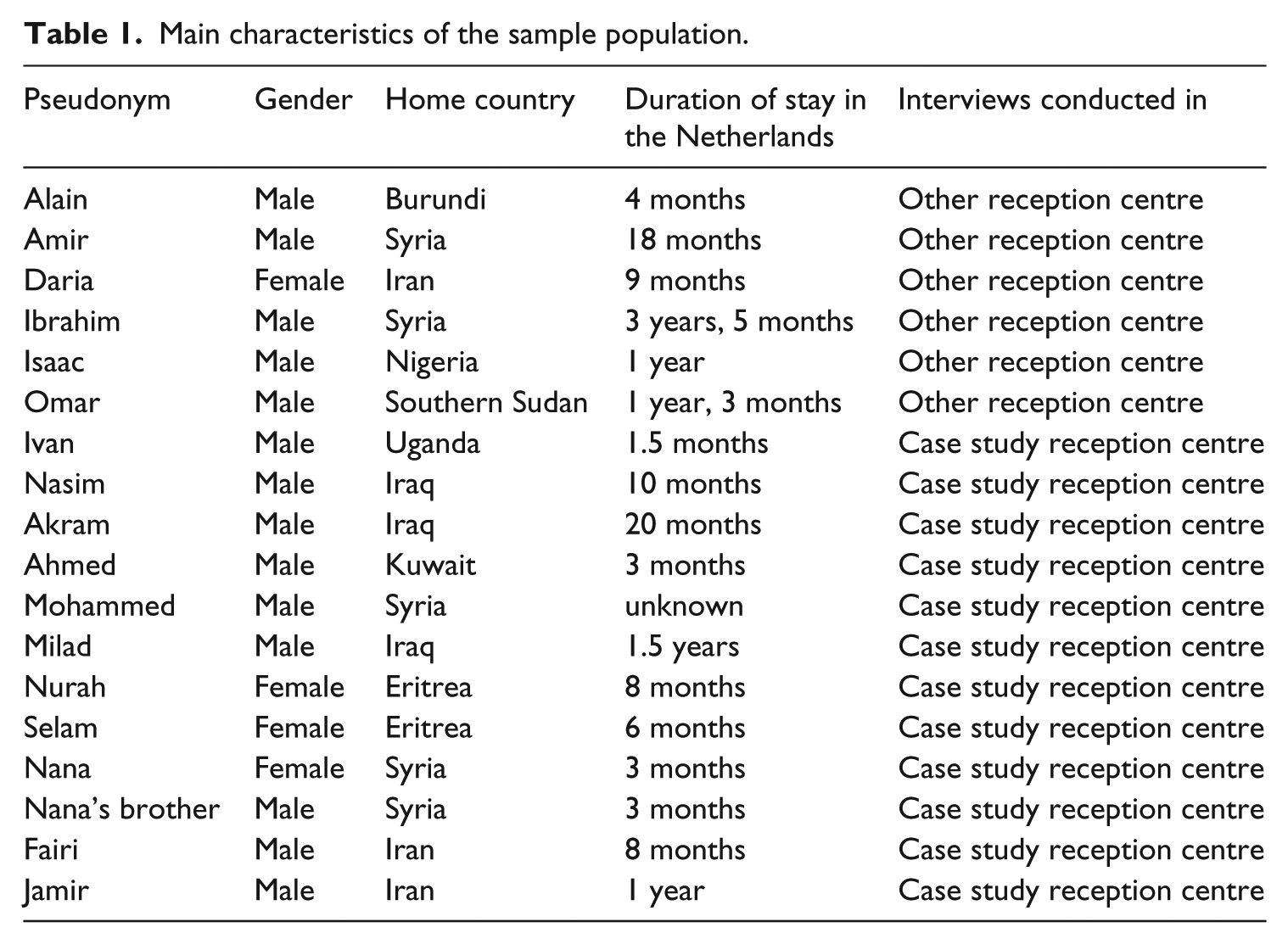
Taken together, the research population of this project consists of 18 refugees with different backgrounds, living in various reception centres in the Netherlands. Twelve of them lived in the reception centre we visited and which we observed more closely. We use pseudonyms to secure respondents’ anonymity. Table 1 sets out the main characteristics of the 18 refugees.
Main characteristics of the sample population.
All interviews were processed and analysed in the same way. After transcribing the recorded interviews, the interview transcripts and the field notes were coded. By using open coding, axial coding and selective coding, the same approach was used to analyse the data of both parts of the research. Codes that arose from the case study did inform the analysis of the additional interviews. Already established categories such as waiting and self-organisation of sport steered the analysis of the second part of the study, although we were also open for new insights coming from an open coding process.
Findings: How refugees experience sport in a reception centre
This section presents the findings of our study. First, the feeling of waiting as experienced by refugees living in the reception centre and the role of sport therein is presented as a way to purposefully spend the time that is to a large extent lost. Next, we take a look at an observed lack of sense of community among refugees that hinders them in initiating or participating in sport activities. We close this section by showing how sport activities are to a large extent experienced as a temporary relief from the daily difficulties concerning the identity of a refugee.
Waiting: Sport as a way to kill time
Refugees living in the reception centre experience their time there predominantly as a period of waiting. Several refugees we spoke with stated, in an emphatic manner, that there is ‘nothing to do in the centre’. For instance, Ahmed stated that you have to find something to do for yourself otherwise the days at the centre are long and boring. Most of the respondents shared their negative experiences to characterise this situation in the reception centre, as stated by Alain as follows: I think most guys are very frustrated. They are not very happy, because they have nothing to do. You can stay at the same place from Monday to Sunday, that… I think they are not very happy. You really need something to do, then it is better here.
The respondents often described the atmosphere in reception centres as tense. When respondents were asked about the situation in the reception centre, they informed us about the sharing of rooms and the ensuing collisions (Alain, Isaac). As Daria states: People are fighting with each other, and they cannot tolerate each other. Because it is not normal life; it is life under pressure.
This life under pressure may be the result of uncertainty about the personal asylum procedure, the home situation left behind and the encounter of different cultures. According to Alain, these tensions are also the result of a lot of misconceptions between cultures and people in the centre. In addition, the interviews revealed that some respondents felt that they had no control over the situation. Because they were forced to migrate, they stressed the lack of freedom of choice.
As a result of this life under pressure, refugees often feel unhappy and are mentally suffering. Some refugees constantly seek something to do, to break through the frustration and boredom that comes with waiting. According to Akram, sport is one such an activity – people in the reception centre practice sport so they can relax; it functions as a form of relief for them. Ahmed, a 20-year-old male from Kuwait who has just received a residence permit, confirms this statement: ‘I have to fill up my time with something’. On a daily basis, he practices fitness outside the centre and studies the Dutch language.
Almost all respondents have in common that they wish there were a greater supply of organised activities at the reception centre, including sport. A number of respondents said that they have tried to participate in all (sports) activities that were organised at the reception centre. This is in line with the finding that respondents consider it very important to remain busy in their situation. This is not only about participating in sports activities, but also about music lessons, language lessons and other activities.
Whether I could play music, listen to music or be around musicians… For sports as well, of course. Each time I had the chance to be with people, playing basketball or swimming, anything. Also it was really nice for me and in general I didn’t miss any event for refugees.
In general, our respondents looked forward to making contact with other people more frequently and to have the opportunity to meet others through such activities. Some respondents previously experienced sport as a means to get to know more people and make friends in the reception centre. For instance, both Ahmed and Mohammed recognise this social function of sport. In the reception centre in which they had previously lived, many activities, including sport, were initiated by the reception centre’s staff, which enabled the refugees to create new relationships. However, they miss these activities at the reception centre in which they are currently residing.
Lack of sense of community
As stated above, sport activities are popular for their distraction propensity, breaking through boredom and creating social contacts. However, most respondents informed us that there were only a few activities organised during the week. For instance, Selam loved playing basketball in her home, Eritrea. However, she cannot practice this particular sport in the reception centre as no one is organising it and she cannot find other female residents to practice with. Ahmed compared the centre he currently lives in with a centre in another Dutch municipality in which he used to live: They don’t play matches here. Because we were in [other municipality] before and they used to put on football matches and stuff. But here, they don’t do much.
However, looking at the central information area by the reception desk, there are at least a few leaflets advertising sport activities. For instance, one leaflet informed inhabitants about a Sunday morning yoga session for females living at the reception centre. Next to this, there was a registration list for ice-skating, organised by a voluntary ice-skating club in the municipality where the reception centre is located. The registration list showed about 30 names of refugees between the ages of five and 45 who wanted to participate in the event. These activities were put on by external organisations, including voluntary sport clubs. However, these are one-time activities, which do not offer sport on a regular basis.
When sport activities are not facilitated, one alternative would be that the refugees living in the reception centre organise them themselves. However, refugees do not feel at ease organising or initiating a sport activity with or for other refugees. A lack of trusted social contacts within the reception centre and a lack of knowledge about the structures of the centre are perceived by refugees as a barrier for initiating sport activities. Already within their first two weeks at their current reception centre, Ahmed and Mohammed noticed this lack of community and saw a striking difference with the centre they lived in before. ‘So it’s not that environment. There [other reception centre] it is a little bit different. There we felt that everyone was more friends than over here’. Ahmed explained that this was because the people lived there for a longer time, and because most of the people there were Syrians; ‘So we have chemistry’.
Gender, ethnic and language barriers seem to cause a lack of social contacts among refugees and, therefore, a lack of self-organisation of sport activities. Selam stated that, if someone would round up the girls in the reception centre she would like to play basketball. Despite the fact that she has been in the Netherlands for six months now, Selam only knows two other girls with the same ethnic background in the reception centre and states that there are no other girls around to practice sport with. Nurah, an Eritrean girl, does not play football at the reception centre, because she does not know other women who want to play. According to some respondents, another related obstacle is the language barrier. The many different languages spoken in the reception centre might cause a problem when refugees want to organise activities there. Following these language and ethnic differences, Ivan (28, Uganda) sees a lack of social contacts as a reason why people do not organise sport themselves.
Sport as a temporary relief from the reception centre
An interesting aspect we found in some of the stories we collected was the positive effects which the refugees experience through participating in sport activities outside the reception centre. Some refugees actively searched for other options than practicing sport at the reception centre, e.g. they became a member of a local gym or participated in a student basketball team at the nearest university. In this way, organising your own sport was seen as a temporary relief from the reception centre, as Alain illustrates: When you are staying in the AZC [reception centre], it’s very boring. There is nothing new. People there are not very happy because of the situation they are living in, because they share a roof with other people. But when you play basketball outside and make new friends… I think [this creates] some big opportunities to forget the hard life.
As for Isaac, he tried to be outside the reception centre as much as possible. He feels like he has no privacy, as he has to share everything with other refugees in the centre. Another respondent, Omar, also mentioned the difference between being inside and outside the reception centre: After the football, you have to go back to the camp, which is very isolated and you continue to feel alone when you are there.
While most stories of sport participation as a temporary relief from the reception centre focus on social connections between refugees, there are also some examples of refugees making connections with Dutch citizens. Amir, for example, became friends with one of the volunteers at his former reception centre, and was once invited to have dinner at her house. There he met her husband, who invited Amir to join his running group. This resulted in weekly running sessions and new friendships with this group of Dutch long-distance runners. Following his experience, Amir states that ‘home has nothing to do with a building or a land, but with having friends and family around you’. Even though he had to leave his own family behind, he found a new family here in the Netherlands, which gives him the feeling of being at home. Amir gained these friendships by participating in sport activities outside the reception centre. The interviews with Ibrahim and Daria reflected a similar urge to make new connections with Dutch citizens and become a member of Dutch society.
As a final motivation, participation in sport activities outside the reception centre can be a way for some to escape the label of ‘refugee’. Alain explains that he wants people to judge him for who he is and not for being a refugee, with all the prejudices that go with that image: That’s why I avoid telling people that I’m a refugee. Because I don’t want people to feel … to have a bad feeling about me. I want people to judge me for who I am. About my being an actor, not because I’m a refugee.
This statement shows that some respondents feel that refugees are associated with bad and negative characteristics. Both Alain and Daria provide examples of how refugees are linked to crime, terrorism, danger and lack of intelligence. Because some respondents (Alain, Amir, Omar) do not want to be associated with this label, they would rather interact with international students or Dutch citizens. As a consequence, they seek out and participate in activities outside the reception centre. However, it is not only the meaning the receptive community attaches to the label they want to escape, it is also meanings refugees themselves attach to it: In the camp, you feel you know you are a refugee, because everybody is the same. But when you go out to play football and to interact with, let’s say a different community somewhere or with some friends at the club, you feel as if you are no longer a refugee. You feel, maybe a slightly more important than the level of a refugee.
These quotes referred to sport as a place where refugees were able to be themselves, alone or among other Dutch citizens. It provided a moment of rest and a time to let go of issues – for instance, traumatic experiences or insecurity with regard to their legal status. Most respondents who practiced sport outside the reception centre were more highly educated. Among them, we saw a strong motivation to go outside, in contrast to other respondents who usually stayed in the reception centre.
Discussion
The goal of this study was to explore the meaning of sport activities for refugees living in a reception centre and how these activities contribute to well-being and feelings of belonging. Our analysis has shown that a liminal space, such as a reception centre, affects the organisation of sport activities and the potential impact that these activities can have on individuals.
Reception centres, conceptualised as liminal spaces, dampen initiatives for self-organised sport and prevent the realisation of the potential benefits of sport participation at the reception centre. While the waiting creates a draining feeling (Brekke, 2004), the appearance of the reception centre, combined with the number of rules and regulations (e.g. signs prohibiting this or that), creates an environment that does not stimulate taking initiatives and positive energy for the refugees (see also Pozzo and Evers, 2015). There is a lack of social contact between residents because people are preoccupied with their individual transitory processes. Both legally, in terms of asylum claims, and psychologically, the transitory phase hampers social contacts. This is strengthened by the loss of social status (Agier, 2016) and a possible individual negative spiral because of his or her traumatic experiences, grief, depression and other feelings that might impact on well-being (Sutton et al., 2011). Although sport participation might represent a coping mechanism (Burrmann et al., 2017; Goodman, 2004), their minds are usually elsewhere.
We further found that language barriers and ethnic differences limit the possibilities for self-organised sport. When people have a different ethnic background and speak a different language, it is not always easy to feel comfortable enough with each other to organise social activities or to have contact at all. This is especially so in the context of a liminal space. As Eriksen et al. (2010: 12) argue: ‘People who encounter one another in this kind of field are much less secure as to whom they are dealing with and, as a result, they are less sure as to who they are looking at in the mirror’. As language and cultural barriers are difficult to overcome, it would be logical for refugees to seek people with the same ethnic background to socialise with. On the other hand, tensions between different social groups with a similar ethnicity might linger in a reception centre and withhold individuals from practising sport together. In addition our findings match with other studies that confirm that socio-demographic factors such as ethnic background and gender play an important role in the (non-)participation of sport (e.g. Spaaij, 2015). An experienced lack of social contacts fits with the results of Garsten’s (1999: 611) study, which showed that the world of liminars is changing and transient, and consists of discontinuity and fragmentation. Refugees therefore might lack the togetherness that arises from long-term emotional or social investments. A paradox is evident here: while refugees state that they are willing to create new social relationships through social activities, they are reluctant to initiate these activities themselves because of their lack of social relationships. This would suggest that social contacts should not only be seen as an outcome of participation in sport, but also as a precondition for sport activities to develop.
Living in a liminal space means dire living conditions, a lack of resources, unequal power relations with top-down structures and a multitude of disciplinary measures (Agier, 2016; Ghorashi et al., 2017). However we also found that marginality and agency are not dichotomous situations and that there is always the possibility to transform a liminal space – such as the reception centre – into a space where social relations take on meaning and where people can engage in activities that improve their well-being. Our research shows that some refugees do (want to) organise sport activities themselves (cf. Pozzo and Evers, 2015). However, they prefer to go outside the centres and make an early start on the long process of integration into Dutch society by joining sport clubs, sometimes helped by others. Their search for other options outside the reception centre illustrates the constraints which refugees experience from within the centre in terms of activities that are offered to them or opportunities to organise something themselves. The in-between position makes some refugees more resourceful by thinking and acting outside the given structures. So, even in the direst of situations, structural constraints are not complete and individuals can always find ways to evade or resist them (Ghorashi et al., 2017).
Our study has several implications for practitioners. By demonstrating that the potential of sport activities to realise positive spill-over effects is affected by the specific social space in which these activities take place, we challenge conventional understandings of sport activities as a means for personal well-being and belonging. In this sense, the reception centre does not seem to be an ideal environment in which to realise the ascribed spill-over functions of sport participation because of its liminal character. Our respondents observed a lack of sport activities at their reception centres. There are only a few sport activities organised by employees or volunteers. The liminal character of the reception centre further hinders refugees in initiating sport activities there themselves. This suggests that there is a need for more organised sport activities at Dutch reception centres. Another implication concerns the organisation of sport activities outside the reception centre. In the Netherlands, as well as in some other European countries these activities are mostly provided by voluntary sport clubs. Because of refugees’ precarious situation, fuelled with uncertainty and characterised by many social and spatial changes, sport activity organisers should realise that refugees might not always be as structurally committed to participate as regular sport club members are. Yet, those refugees that do participate outside the reception centre speak fervently about this possibility. Our analysis brings forward the importance of close and enduring personal contact. Sport organisers will have to decide how they want to establish that personal relationship with a refugee, if they want their sport activity to be more than a temporary relief from refugees’ daily issues. For refugees, participating in sport outside the reception centre can be a way of belonging to Dutch society, rather than to a liminal space where one’s temporary and precarious situation is overemphasised.
Developing the research agenda
We end this article by formulating a future research agenda. Our conceptual understanding of a reception centre as a liminal space offers an alternative explanation for the observed absence of self-organised activities there. While we underscore the relevance of social and cultural differences, we argue that social spaces could potentially be either more detrimental to or enabling in the stimulation of the positive spill-overs of sport activities. This takes us to a first line of future research. In the field of the sociology of sport, scholarly work on the meaning of sport for a range of target groups has predominantly focused on individual and social characteristics as variables for understanding differences in sport participation and related experiences (Elling and Claringbould, 2005; Walseth, 2008). The influence of spaces on the meaning of sport participation has – with some exceptions (e.g. Silk, 2004; Van Ingen, 2003; Vermeulen, 2011) – moved to the background in this field of research. We argue for a resurgence in the spatial dimension (Van Ingen, 2003) in sport sociology and a need to study how sport is experienced in different spaces and which meanings are attached to it. In relation to refugees, it is not only reception centres that should be of interest. It is still very unclear which social spaces refugees, whether or not living in a reception centre or already assigned a house, seek out and use to make themselves feel at home in the receiving community. Such research efforts would strengthen our knowledge of stimulating and disabling spatial characteristics for the meanings which sport may have for individuals and where exactly they are materialized.
A second line of research could focus on methodologies to capture the lived experience of sport in liminal and specific social spaces. Strikingly little research puts the lived experiences of sport among refugees in reception centres to the fore. Several scholars use a narrative or interpretive lens to make sense of refugees’ experiences with sport (e.g. Burrmann et al., 2017; Evers, 2010; Spaaij, 2013); however, none have concentrated on the meaning of social spaces therein. We therefore argue for broadening the scope of research on reception centres to focus on refugees’ narratives. Narrative analysis has proved valuable in understanding individual and group identities (Czarniawska, 1997; Riessman, 2005) and sport practices (e.g. Waardenburg et al., 2015). Furthermore, a focus on different stories told about the reception centre could provide meaningful insights and inform policy developments. Such narratives could be gathered through the use of more creative approaches, such as visual methods (Banks and Zeitlyn, 2015; Gauntlett and Holzwarth, 2006), performative methods (Conrad, 2004) and (auto-)ethnography (Denzin, 2013; Khosravi, 2007). We also call for more longitudinal research, by following refugees’ narratives over time, to capture the (changing) impact of sport participation on their belonging and well-being.
Footnotes
Acknowledgements
The authors would like to thank the nine students from Utrecht University who participated in the project, all partners from the working group Sport and Refugees (COA, Kenniscentrum Sport, NOC*NSF), as well as Utrecht University for making this project possible, and four anonymous reviewers for their helpful comments on the original manuscript.
Declaration of conflicting interests
The author(s) declared no potential conflicts of interest with respect to the research, authorship, and/or publication of this article.
Funding
The author(s) received no financial support for the research, authorship, and/or publication of this article.
