



Abstract
Culturally appropriate research frameworks are needed for investigating Pacific well-being. This study expanded on existing Pacific methodologies and presented a well-being research framework by studying the Niue community. Traditional storytelling or talanoa methodology, referred to as tala in the Niue context, was used to explore and understand the lived experiences of well-being from Niue elders. The elders described traditional activities and objects that are required to sustain well-being, as well as relationships with family, community, and the environment. Three interconnected principles that influence the well-being of the Niue people emerged from the tala, namely, Vahā Loto-Agaaga Ofania (Spirit of Care), Fakafetuiaga (Inclusive Relationship), and Fakamalolo (Empowerment). Using a Niue lens, the key three principles were developed into the Matalili-Aga Gahua (Matalili Wellbeing Framework), based on a circular woven pattern that is distinctive to the Niue culture. The principles of the Matalili Wellbeing Framework are proposed as a guide in future Niue-centered research.
What We Already Know
There are significant disparities in the health outcomes of Pacific Island communities. Current research has often aggregated Pacific Island communities in public health reports, despite the communities being highly heterogeneous.
The Niue identity, language, and culture are linked to the community’s sense of well-being. However, Niue culture and language is endangered, and there is a dearth of literature about the well-being of the Niue people.
There is a need for research methods that are culturally appropriate when investigating the well-being of the Niue community in the diverse New Zealand population.
What This Article Adds
This article is among the first to explore well-being in the Niue context and the first to present the Matalili-Aga Gahua (Matalili Wellbeing Framework) for the Niue people.
Based on the lived experiences of Niue elders, the findings show that well-being is associated with (1) the spirit of and care for objects that provide sustenance, shelter, and maintain health and well-being; (2) the relationship and bonds between people, families, communities, the space, land, resources, and environment; and (3) the connections between physical and spiritual dimensions that symbolizes the reciprocal empowerment of individuals and communities.
The three principles of Vahā loto-Agaaga Ofania (Spirit of Care), Fakafetuiaga (Inclusive Relationship), and Fakamalolo (Empowerment), and the synergetic relationship between them provide a deeper knowledge of the ways in which well-being is established and maintained in the Niue community.
Introduction
Pacific Island communities experience significant disparities in health outcomes, with higher occurrences of preventable diseases, including obesity, diabetes, cancer, and cardiovascular diseases. 1 Pacific communities are extremely heterogeneous but are often aggregated together in public health reports, which can conceal important social and health characteristics and have implications for health policies and allocation of resources. 1 Culturally tailored interventions and community-based initiatives are crucial in addressing the unique health needs of Pacific communities. Health models or frameworks for indigenous communities, such as Te Whare Tapa Whā Māori health model 2 and the Fonofale Pacific model of health, 3 have been conceptualized to provide culturally informed perspectives on health and well-being. These models adopt a holistic approach to health and well-being, with the inclusion of physical, mental, social or family, and spiritual health, as well as considering the environment, culture, and roots as factors that support well-being. The health models also emphasize the interconnectedness of these dimensions, highlighting that if any of the dimensions are compromised, it can lead to imbalance and negatively affect the well-being of individuals.
In this study, we focused on the Niue community, which is an integral part of the broader Pacific communities. Niue is one of the largest raised coral atolls in the world, with a land area of approximately 259 km2 in the South Pacific Ocean. 4 The population of Niue was counted as 1681 in the 2022 census. 5 However, many people with Niue heritage live outside the island of Niue, mainly in Aotearoa New Zealand, with 30 867 Niue people recorded in the 2018 census, 6 Australia (4958 Niue people recorded in the 2016 census), 7 and other Pacific Islands. Niue has been part of New Zealand since 1901 and became a country in free association within the New Zealand realm in 1974. 8 Under this arrangement, Niue and its people maintain their identity and culture and, at the same time, Niue people receive the right to become citizens of New Zealand. The Niue identity, language, and culture are linked to the community’s sense of well-being, 4 as highlighted by the holistic view of well-being in the Moui Olaola–the National Niue Strategic Wellbeing Plan. 9 Despite the importance of these cultural factors, the Niue language has been classified as an endangered language by UNESCO 10 and registered as threatened. 11 Although the inequities in health and well-being between the general Pacific populations and non-Pacific populations in New Zealand have been well-reported,12,13 there has been limited research relating specifically to the Niue community, and how the Niue people sustain their well-being.
To understand how Niue people sustain their well-being, we decided to draw on the knowledge of elders in the Niue community. Elders of indigenous communities play an important role in revitalizing and preserving the traditional knowledge of their culture.14,15 Elders bring a wealth of lived experiences, cultural knowledge, and wellness practices. Integrating their indigenous knowledge and wellness practices has been suggested as a mode to move forward to decolonize health inquiries. 16 The aims of this study were (1) to understand factors that foster well-being of the Niue people from traditional knowledge as conveyed by Niue matua or elders, and (2) to synthesize these lived experiences into a research framework for well-being that aligns with Niue principles.
Methods
A traditional storytelling, or talanoa research methodology was used to capture the view of the elders on well-being. The research methodology will hereafter be referred to as tala in the Niue language, after feedback from the elders. Two key questions were used to instigate the tala process:
Tuga e tagata Niue, ko e heigoa e kakano he agaaga fakamalolo kia koe? As a Niue person, what does spiritual wellbeing mean to you? Maeke nakai ia koe ke kitekite fakatonu a mena ke toko aki hāu agaaga fakamololo ke he tau aho oti? Can you give an example of things that support your spiritual wellbeing in your daily life?
In the context of this study, the tala questions were based on the Niue phrase “agaaga fakamalolo”, which encompasses a holistic view of well-being, including values, beliefs, rituals, feelings, thoughts, and various elements that contribute to overall health. By focusing on “agaaga fakamalolo”, we aimed to explore the comprehensive aspects of well-being2,17 as understood by the Niue elders. While the English translation of the phrase is “spiritual well-being,” the Niue language does not differentiate between well-being with and without a spiritual element.
Ethical Approval and Recruitment Procedure
Ethics approval was provided by the Monū Education and Social Services Trust (MESST) Ethics Committee (approval no. 1-3012/2021). The MESST is a New Zealand-based charitable trust with a focus on working with the Pacific communities. The MESST ethics committee comprises academic and Pacific expertise, among others, and is responsible for reviewing and monitoring the ethics of research programs conducted by the organization.
Elders from eight Niue weaving groups in New Zealand were invited to join the study using community meetings and networks. The weaving groups are an integral part of the Niue community, and central to the promotion of Niue culture and identity. The selection criteria required that the participants identified as having Niue heritage, were aged at least 50 years, and have lived in Niue for at least 20 years. Meeting dates and times were arranged with participants who met all the selection criteria. A Participant Information Sheet was used to share information about our project, and informed signed consent was obtained from all participants prior to enrolment in the study.
Data Collection
The tala were facilitated during community meetings held in Auckland, New Zealand, where groups of two to eight elders participated in the group tala conducted in Niue and/or English languages, according to the preference of the participants. In the talanoa methodology, it is very important for the researcher to make cultural connections with the participants and create a comfortable and safe environment. Therefore, the tala were facilitated by the first author who has Niue heritage and is fluent in both English and the Niue language. The tala were conducted among elders who are familiar with each other in weaving groups, often in the context of an informal gatherings over food, with no formal time limits for the conversations. The two key questions encouraged the elders to share their individual experiences. The tala were recorded electronically and transcribed by the researchers. Responses in the Niue language were then translated to English. Translations were independently checked by at least two translators. Transcripts and translations were returned to the participants for member-checking, 18 which allowed the participants to correct mistakes and gave them the opportunity to add further information.
Data Analysis and Interpretation
Inductive thematic analysis 19 was performed manually on the transcripts in both Niue and English languages and interpreted for patterns and themes that reflected well-being. This process involved having at least two different researchers read the transcripts, coding the data, and then organizing it into meaningful categories. By examining these themes, we gained insights into the participants’ experiences and considered how these findings relate to existing Pacific literature and theoretical frameworks. Pseudonyms were used to maintain confidentiality and anonymity of participants. Using data and themes that emerged from the tala, a Niue lens was applied to synthesize and develop the Matalili framework. The Niue lens or perspective was used in the framing of the themes. It was driven by the lived experiences of the first author as a tagata Niue (Niue person), his interactions with the Niue community during the practice of providing social services to this community, and his experiences of developing and delivery of programs for Niue preschool children. These experiences brought deep knowledge of the culture to the framing process. The Niue lens emphasizes individual and collective contributions, and therefore the themes and initial framework were then taken back to the community members for review and refinement.
Results
Tala from 17 groups consisting of 31 Niue elders were recorded and analyzed (Table 1). Elders in this study bring with them knowledge and experiences from across the island of Niue, including from the villages of Alofi, Avatele, Lakepa, Liku, Mutalau, and Tuapa.
Demographics of Elders Who Participated in the Study.
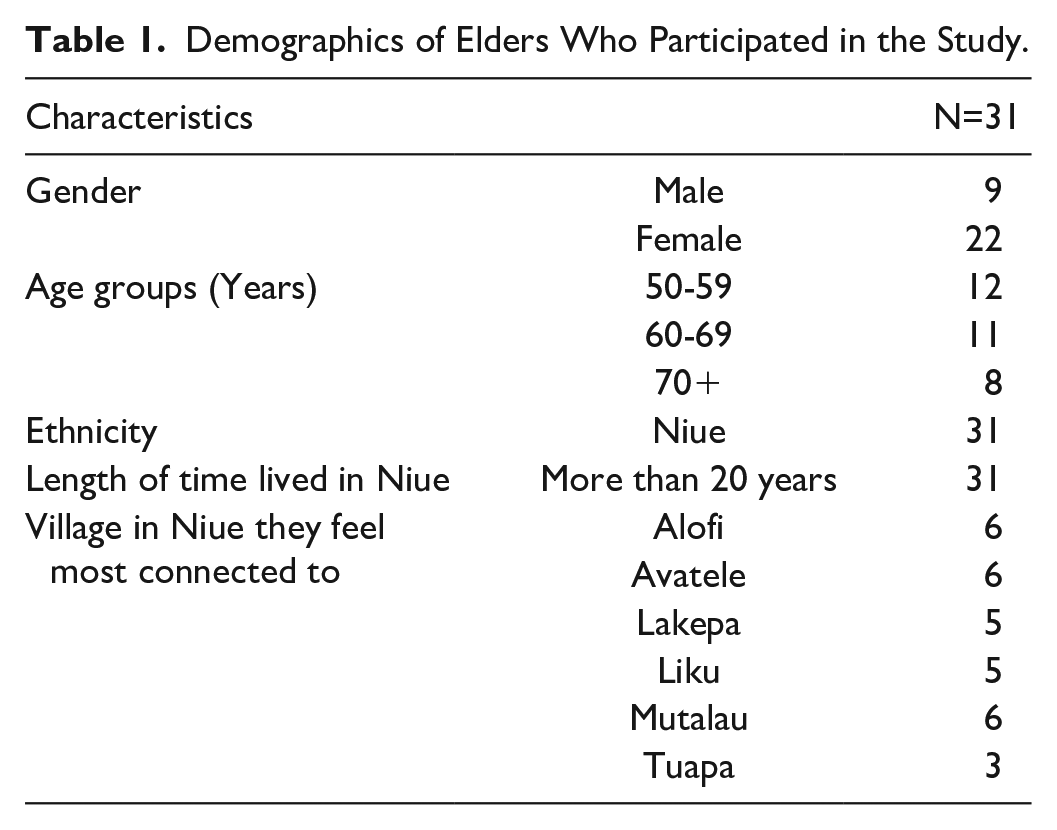
In the tala, well-being is recognized and described by participants according to their life experiences where they used traditional practices and knowledge, especially in times of need (Supplementary Attachment). When participants were asked how they nurtured their well-being, they described well-being in association with performing their daily activities. The descriptions and stories of well-being are articulated through a variety of customary activities, such as growing taro (root crop), weaving, harvesting coconut, and preparing the umu-ti (huge earthen oven). For example, in the tala provided by Elder 1, the concept of well-being was illustrated through the description of the process of growing taro:
Ko e talo, ko e mena kai he tagata Niue. Ka to e koe e talo, fifili e kelekele talumelie. To e huli/vaka talo he luo (fakatai ke he agaaga he kelekele). Fagai aki e vala vai tumau. Ko e vai ke fakamoui aki e talo. 9-12 e mahina ke motua e talo to huo. Talo (taro) is the food of the Niue people. When you want to grow a good taro crop, you make sure the ground is fertile. Then you place the roots in holes/space, like the spirit in the soil. You take care by giving water regularly. Water is another element that is required by the taro plants to interact with minerals and soil. Takes about 9-12-months to get full taro. We collect after a period of sufficient time. Time is important to get a good harvest. Taro is the stable food for our people. (Elder 1)
The process requires the careful planting of the taro roots, and continuous care through watering regularly and giving enough time for the taro to mature are needed for a good harvest. Well-being was also associated with objects such as vaka (canoe), required for voyages and when gathering food from the sea (Elder 8), and shelter, such as caves, which provides a safe space. Taken together, these activities and objects are required to provide sustenance, and maintain health and well-being. The tala also give insights into how traditional practices can promote resilience and cohesion, especially in times of extreme needs:
Ko e vaka akau ka uta ki tahi ke hi e tau ika ke kai e magafaoa. Faka malolo e tino he tagata ke aalo haana vaka ki tahi. Mautali haana fenoga ke fano ki tahi, ha ko e tau aau, mo e tau lekua ka tupu i tahi. I loto he vaka kua talaga ke lata mo e tino he tagata mo e haana tau mena ke eke aki e gahua i tahi. Ko e gati vaka fakatai ke he agaaga ke tua e tagata haana moui ka fenoga ki tahi. Vaka, is made of wood and helps fishing for food . . . makes possible to get food for magafaoa (family) from the sea. It also gives exercise and strength to body because you need to row hard to journey further out to sea to get food for the magafaoa. This is also risky and needs thinking because you must be able to navigate the water and environment. The internal space in the vaka is created for the individual and his equipment for the journey out to sea. This empty space/spirit ensures and gives confidence to the individual and his safety while out in the ocean. (Elder 8)
The descriptions of a hollow or empty space together with a physical material illustrates the connection between the spiritual and physical dimensions. The spaces are viewed as the spiritual dimension, and they are protected by the outer layers of the physical dimension. An example of this can be seen in the tala provided by Elder 1, where the roots of the taro are placed in the hole and protected by the soil. Another example is the space within the vaka (canoe) can be interpreted as the spiritual dimension (Elder 8). The physical structure of the vaka protects the person sitting in it when they are out at sea. The connection between the spiritual and physical dimensions helps the understanding that one cannot be without the other, and one empowers the other. The interaction between the spiritual space and physical material denotes the alliance between people and things in the context of obtaining food and necessities for the individuals, magafaoa (families) and communities to empower them to sustain their well-being. Individuals need to understand themselves and that constant nourishment is required for their wellness. Only then can they contribute constructively to the community and the environment. Individuals cannot contribute to the whole unless they are in a good place to do so.
The tala demonstrates that well-being necessitates a reciprocal and inclusive relationship between the individuals with their magafaoa (families) and community, as well as with the land and environment. For example, traditional activities such as umu-ti (Elder 14, Supplementary Attachment) and weaving (Elder 13, Supplementary Attachment) are communal activities that require participation from the whole community, which enables the cultivation of relationships and ultimately results in benefits for all participants. In addition, people and the environment also need to have a reciprocal sustainable relationship that enables continued sustenance and well-being of both, respectively. Having respectful relationships, for example, “not over harvesting” (Elder 10, Supplementary Attachment) ensures that the people have sufficient food to nourish them, while the land is also given the ability to replenish. Another example of this reciprocal relationship of care was provided by Elder 2 (Table 2): “The cave gives shelter in times of storm, and it is a source of fresh clean water, everyone is encouraged to keep the caves clean from rubbish.” These practices coincide with aspects such as space, environment, land, resources, and community relationships, and give insights into their holistic view of well-being.
Examples of Tala or Stories From Elders Showing the Interconnectedness of the Three Key Principles.

From Lived Experiences to the Matalili-Aga Gahua (Matalili Wellbeing Framework)
Three key themes emerged from the traditional stories, namely, how they recognize aspects of the spiritual dimension, relationship and empowerment, and their synergistic role in maintaining and sustaining well-being. The three themes were found together in most of the group tala about well-being, which highlights the interwoven nature of these themes (examples shown in Table 2). These themes are proposed as principles for well-being for the Niue people and named Vahā loto-Agaaga Ofania (Spirit of Care), Fakafetuiaga (Inclusive Relationship), and Fakamalolo (Empowerment).
The three principles can be portrayed in the pattern of the matalili, which is a circular woven Niue motif or pattern (Figure 1). Each element is codependent in the weaving pattern and forms a circle that continues throughout the matalili and has no ending to signify one eternal round. The weaving creates continuous links and interactions between all the themes, corresponding to the holistic view of well-being of individuals, families, and the environment for the Niue community.
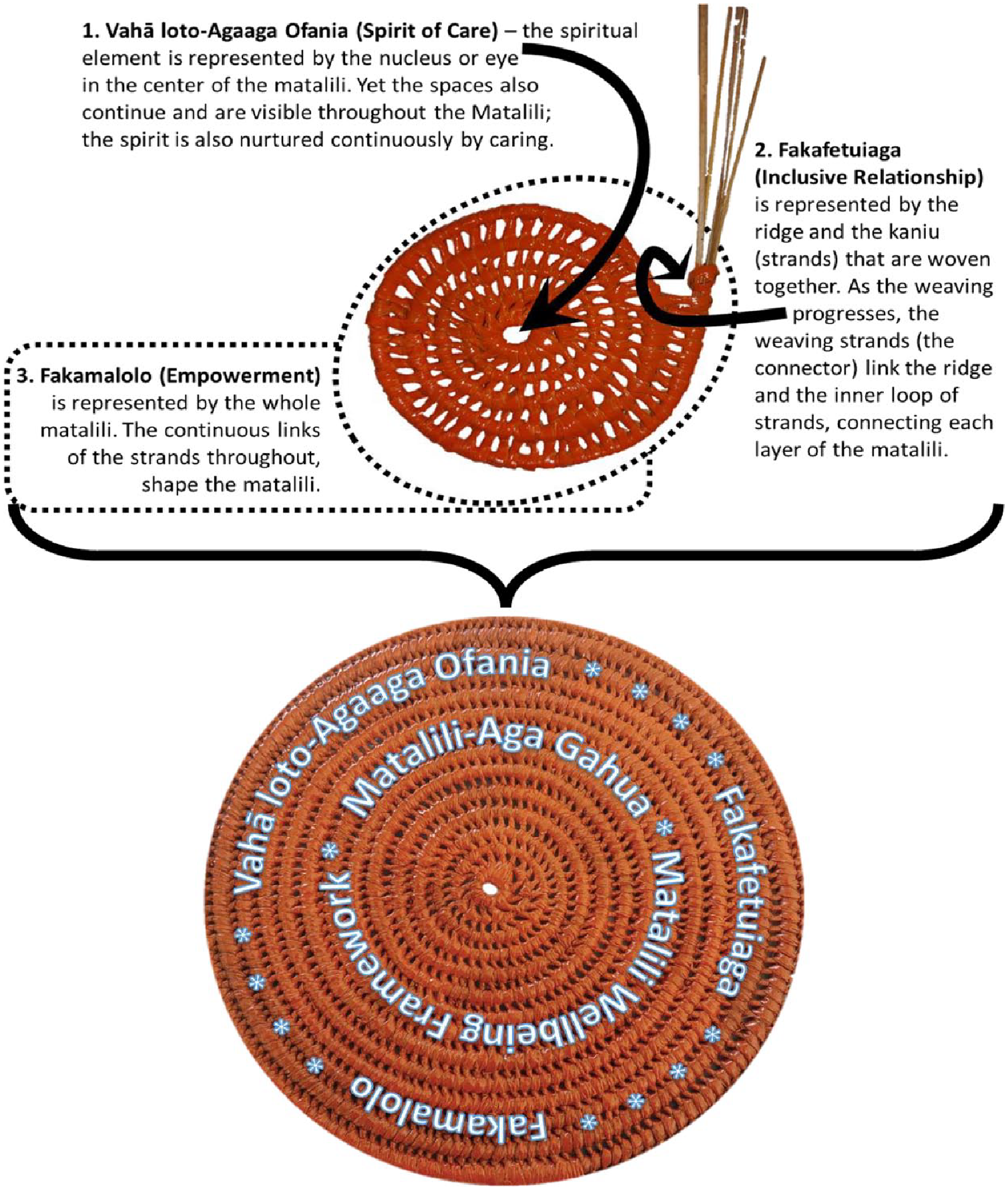
Matalili-Aga Gahua (Matalili Wellbeing Framework) and the three key principles of Vahā loto-Agaaga Ofania (Spirit of Care), Fakafetuiaga (Inclusive Relationship), and Fakamalolo (Empowerment).
The descriptions of the three key principles in Figure 1 draw on the examples in Table 2, and are elaborated as follows:
Discussion
In this study, traditional knowledge relating to well-being was recounted from the lived experiences of Niue elders using tala or traditional storytelling. Known as tala in the Niue language, or talanoa in the wider Pacific literature, this research methodology is a cultural practice and a form of narrative inquiry that arose from the oratory tradition of the Pacific communities.20 -23 The tala approach was used because it removes the distance between researcher and participant, 21 providing a better understanding of our findings from a Pacific lens. Enabling the tala to be conducted in the Niue language and/or English allowed the elders to share their lived experiences using the language in which they felt most comfortable expressing themselves. The Niue language might have provided a deeper connection to their cultural heritage, allowing for a more nuanced and heartfelt description of their experiences. Others might have felt more at ease using English and were able to participate accordingly. The tala approach ultimately enables stories to flow more naturally by creating a cultural connection with the participants in a safe and comfortable environment. Tala also encourages the fluid expressions of their experiences in response to the two key questions, with no formal time pressures.
The current Niue community-based research demonstrates an important way of sustaining and sharing indigenous knowledge and culture from elders, who are keystones of the community. 14 Census data5 -7 shows that most people with Niue heritage live outside the island of Niue. The common link between people with Niue heritage around the world is the ancestral connection to the island of Niue, and traditional cultural practices originating from the island. For these reasons, elders who have lived on the island for at least 20 years were chosen to develop a framework with principles rooted to the island of Niue, which enables Niue people living around the world to connect back to their island.
The Matalili Wellbeing Framework as a Guide for Research Involving the Niue Community
The tala of the Niue elders were integral not only to understanding and capturing their worldviews and lived experiences 22 but also identifying ways in which health and well-being practices could be established and perpetuated. The key themes that emerged from the tala were synthesized into the Matalili Framework to specifically highlight Niue values and provide the cultural context to address and promote well-being. The Matalili is a tradition unique to the Niue culture, 9 which provides a relevant cultural anchor to help the interpretation of the principles. The principles Vahā loto-Agaaga Ofania (Spirit of Care) and Fakafetuiaga (Inclusive Relationship) of Matalili-Aga Gahua share similarities with elements in other indigenous models, which considers health and well-being holistically. The novelty of the Matalili-Aga Gahua is the addition of the perspective of Fakamalolo (Empowerment) to existing Pacific well-being frameworks.
Culturally informed health frameworks are required to guide community engagement, and can promote health equity, inclusivity, and authentic relationships with the community.24,25 Although the Matalili-Aga Gahua was developed to illustrate three key principles for well-being of Niue people, it is a flexible framework that we propose can be applied to research projects with and on Niue people, particularly those with a focus on outcomes that enhance well-being. The framework can promote relational accountability by guiding engagement in research and how knowledge is attained. 26 For instance, Vahā loto-Agaaga Ofania (Spirit of Care) mirrors awareness and prompts researchers to recognize gaps in related literature and the need for investigations. Fakafetuiaga (Inclusive Relationship) emphasizes the importance of acknowledging and understanding the worldviews of the Niue community. The principle calls for respectful affiliation between all related variables including context, culture, and stakeholders. The Fakamalolo (Empowerment) enables researchers to show the ways in which the research outcomes of an investigation contribute to the element of well-being that is being investigated. When conducting research, attention to all three principles can contribute to achieving successful public health outcomes for the Niue people. The Matalili Framework may also have shared principles with the worldviews of the broader Pacific community and other indigenous peoples.
Limitations and Future Research
Although this is a small-scale study with 31 participants, the elders involved actively shared their lived experiences and traditional knowledge. The participants all lived in South Auckland at the time of the study, but they brought with them rich experiences from villages across the island of Niue. Accessing more members from the Niue community, including those who reside in other regions of New Zealand, other parts of the world, and on the island of Niue, has the potential to extend the scope of the findings and provide deeper insights. With the focus on the lived experiences of elders, a limitation in this study was the absence of younger participants’ perspectives. Given that most young people with Niue heritage live outside the island of Niue, 6 their inclusion could provide a more comprehensive view of Niue identity across generations. Nonetheless, this research addresses a knowledge gap for the Niue community and can contribute to the preservation of Niue cultural knowledge, and the revitalization of the endangered Niue language.
Conclusion
The current qualitative research shared the lived experiences of elders in the Niue community that related to well-being, using a tala or storytelling methodology. The tala illustrates well-being through traditional activities and objects that are required to sustain health and well-being, such as taro planting, weaving, umu-ti, vaka for fishing, and caves for shelter. These activities highlight the reciprocal and inclusive relationships between the individual with their family and community, as well as with the environment. Another theme is the connection between the spiritual and physical dimensions, where care is needed to nurture the spirit of the individual, so that they can be empowered to contribute constructively to the community and the environment. The experiences of the elders were synthesized into three key principles that contributed to their well-being: Vahā loto-Agaaga Ofania (Spirit of Care), Fakafetuiaga (Inclusive Relationship), and Fakamalolo (Empowerment). We developed the three interconnected principles into a framework based on the principles of weaving a matalili. The Matalili-Aga Gahua represents a first step toward articulating a Niue perspective that is currently not represented in existing Pacific worldviews. The Matalili-Aga Gahua is adaptable and can be expanded to encompass other research domains involving the Niue people, ensuring outcomes that promote well-being.
Supplemental Material
sj-docx-1-aph-10.1177_1010539524129214 – Supplemental material for Matalili-Aga Gahua: Development of the Matalili Framework as a Holistic Model for the Well-being of the Niue People
Supplemental material, sj-docx-1-aph-10.1177_1010539524129214 for Matalili-Aga Gahua: Development of the Matalili Framework as a Holistic Model for the Well-being of the Niue People by Elviso Togiamua, Cecily Eruthayam and Kelvin Lau in Asia Pacific Journal of Public Health
Footnotes
Acknowledgements
This paper is dedicated to the memory of Vetehemana Inoke Togiamua. She was our inspiration and pillar of strength through this journey, but she is not here with us to celebrate the fruition of her vision of conservation and revival of the Niue language and culture. Her tireless effort toward this cause resulted in the establishment of a Niue preschool—Matua moe Tama Aoga Vagahau Niue-Trust-Mana Tama and Monū Education and Social Services Trust (MESST). Her tala/traditional stories are integral to the completion of Matalili-Aga Gahua—The Matalili Wellbeing Framework. Vetehemana’s strength and faith gave us an appreciation for her vision. This is for her. We would also like to show our gratitude to the members of the Niue community weaving groups, Niue Selemania Falanelafa, Tupuna, Niue Community Today (NCT), Makauga, Fisi Piu, Ukufakina! “mau nakai” Mau! Fisi Niu, and Mumui He Tua for sharing their experiences with us during this research. We acknowledge New Zealand government agency support for social research and services for Niue people, including the Ministry of Health, Te Whatu Ora—Health NZ, and the Ministry of Education, which contributed to the background information that led to the development of the framework. We are also grateful to members of the ethics committee of MESST and academics of Auckland University of Technology, Dr Barbara Hock, Dr Saeed Roshan, Vijay Kumar Thambimuthu, George Sionetuato, Richard Taurima, Dr Evangeline Singh, Dr Anja Vorster and Associate Professor Nick Garrett, respectively, for their support and insights on the manuscript.
Author Contributions
ET conceived the study, connected and conversed with the community, collected data, and translated the Niue language data to the English language, reviewed and edited the English version of the manuscript, hence, adding the Niue lens to the process through being one and by working with Niue people in his capacity as a social worker. CE co-conceived the study, conducted the analysis, wrote the first draft of the manuscript in the English language, and reviewed and edited the English version of the manuscript. KL co-conceived the study and provided feedback on research design and analysis, and contributed to the writing of the manuscript.
Declaration of Conflicting Interests
The author(s) declared no potential conflicts of interest with respect to the research, authorship, and/or publication of this article.
Funding
The author(s) received no financial support for the research, authorship, and/or publication of this article.

Supplemental Material
Supplemental material for this article is available online.
References
Supplementary Material
Please find the following supplemental material available below.
For Open Access articles published under a Creative Commons License, all supplemental material carries the same license as the article it is associated with.
For non-Open Access articles published, all supplemental material carries a non-exclusive license, and permission requests for re-use of supplemental material or any part of supplemental material shall be sent directly to the copyright owner as specified in the copyright notice associated with the article.
