



Abstract
Recent international public health guidelines now address reducing and breaking up time spent sitting (sedentary behavior). Japanese people spend considerable time sitting in workplaces and other contexts. With potential future public health guidelines in Japan, there is the need for greater public awareness of the importance of reducing sedentary time and of practical ways to do so. From the five major Japanese national newspapers, articles on sedentary behavior published between 2000 and 2021 were identified and coded for content analysis, including the main topic of the article, population group, sedentary behavior context or domain, health outcome, and solutions for reducing sedentary time. There were 53 articles identified, with sedentary behavior being the main topic in 22; workers as a population group appeared in 20 articles and workplaces as a domain in 22. More than 70% mentioned health influences, but fewer than 60% mentioned solutions. Further to informing the public about adverse health influences and consequences for workers and workplaces, there is also the need for improved coverage of the broader benefits of reducing sitting time, sedentary behavior among older adults and children, sitting in all aspects of daily life, and, importantly, considering public health guidelines and solutions for reducing prolonged sitting.
What We Already Know
Sedentary behavior is associated with an increased risk of long-term diseases and mortality.
There has been increased public attention to sedentary behavior, but this has mainly focused on workplace sitting.
Mass media news sources can be effective in informing the public and increasing public awareness and knowledge about health-related behaviors.
What This Article Adds
Japanese newspapers have been publishing an increasing number of articles addressing the health issue of sedentary behavior, but the number of articles is still small.
The quality of the content of the articles is insufficient for there to be an informed public prepared for future initiatives on sedentary behavior, with limited material of relevance to some of the key target audiences and domains, with few solutions addressed.
As the examination of Japanese media illustrate, health communication strategies using mass media can have unrealized potential for informing the public more broadly about sedentary behavior and strengthening debate around new public health guidelines.
Introduction
In recent years, the time spent sitting has become an important public health and disease-management issue, in addition to long-standing concerns about a lack of physical activity (PA) or exercise. 1 Sedentary behavior (SB), defined as any waking behavior characterized by an energy expenditure of ≤1.5 metabolic equivalents (METs) in a sitting or reclining posture, 2 is associated with a risk of gaining weight, development of long-term diseases, such as type 2 diabetes, cardiovascular disease, certain types of cancer, and all-cause mortality. 3 Moreover, the links between SB and these risks are distinct from a lack of moderate-to-vigorous PA: large amounts of sedentary time can increase the risk of health problems, even in those who meet moderate-to-vigorous PA recommendations. 4 Therefore, the public health debate now focuses not only on the adverse consequences of physical inactivity, but also on the new evidence that SB itself is a noncommunicable disease risk factor.
There is an increasing trend toward desk work that requires prolonged sitting, and many adults spend more than one third of their daily hours at work. 5 Thus, much of the SB research has focused on workers. 6 A broad evidence base on the health influence of prolonged sitting time has accumulated rapidly, with findings not only in the general adult population but also among older adults, children, and adolescents. In children and adolescents, excessive sitting is related to poorer health outcomes, such as fitness, cardiometabolic health, mental health, and sleep duration.7,8 Studies in older adults have also identified relationships between television viewing time and frailty, functional limitations, 9 and cognitive function. 10 Studies have also examined SB according to domains, such as leisure, housework, mobility, work, and school, to provide clues for identifying opportunities to intervene against SB. 11
A multicountry study found that Japanese and Saudi Arabian adults had, on average, the longest sedentary times (some 7 h/day). 12 One investigation among a nationally representative sample of Japanese adults observed that 25.3% constituted the “high sedentary” (≥8 h/day) group. 13 Although evidence on the adverse health consequences of SB is rapidly increasing, many Japanese may be unaware of this. Findings from a recent study suggest that increasing awareness regarding the problem of SB can lead to changes in intention and behavioral change. 14
News media play an important role in public awareness and as a vehicle for debate that builds wider community understanding and shapes new policy. In the context of public health, it is necessary to proceed from an understanding based on evidence regarding how new perceptions, ideas, and practices spread among people, organizations, and society. Mass media can be important in appropriately helping to propagate health information 15 and can either bring about positive changes or prevent negative changes in health-related behaviors across large populations. 16 In the case of SB, understanding news coverage can help to more effectively communicate about this relatively novel health risk behavior to the media and the broader public. 17
Presenting examples by the mass media is assumed to increase observability and make it easier for people to change their behavior. Understanding the current state and the volume of news coverage will help researchers and policy makers to better communicate new health risks and more effectively convey potential future public health guidelines to the mass media and the broader community. However, the issue of SB in the mass media has not been widely examined; most relevant evidence is derived from Australia. 17 In Japan, the number of newspaper subscribers is decreasing. 18 However, approximately, one in two Japanese encounter newspapers every day and the newspaper audience exceeds 88%, including both subscribers to newspapers and people who encounter newspapers and newspaper company information in some way, such as through the Internet. 19 In contrast to the Internet and social media, which are interactive and allow anyone to disseminate information, information in newspapers is disseminated by public organizations and scrutinized to a certain level by newspaper editors and reporters. Thus, among the type of mass media in Japan, newspapers are considered to be more reliable sources of information than television and the Internet. 19 Newspapers are one of the most familiar and reliable sources of information for the Japanese public. Articles published in newspapers can influence awareness of SB, intention to address related behaviors, and ways in which it might be practical to do so. It is thus important to confirm the dissemination status of articles describing the problem of SB in newspapers throughout Japan.
To gather relevant evidence regarding strategies to more broadly disseminate informative, helpful information about SB and health, we addressed the following two research questions: How often (and how much) is the issue of SB reported in newspapers in Japan? How (in terms of content and quality) is the issue of SB reported in these news outlets? Thus, we employed content analysis to examine the number of articles and information content related to SB in five major Japanese national newspapers.
Methods
Study Design
We conducted a content analysis of newspaper articles coverage of SB published between January 1, 2000 and December 31, 2021. The methodological approach used was to develop a coding protocol, search the database, select relevant articles, and conduct content analysis.
Sample
A content analysis of newspaper coverage of SB was conducted using 22 years’ content in five national Japanese newspapers (Figure 1). The five selected newspapers (Yomiuri, Asahi, Mainichi, Nikkei, and Sankei) all have nationwide coverage and the largest circulation in Japan. The sample included all articles published in these five newspapers during 2000-2021. The articles were obtained electronically from the news archive services of each newspaper. The search terms used were “座り過ぎ”, “座りすぎ”, “すわりすぎ”, “座りがち”, “すわりがち”, and “座位” (eg, SB, sitting) in Japanese. These were translated and developed based on previous research. 17 In the initial search, we identified 2189 newspaper articles. First, we excluded articles describing sitting positions, introducing exercises that can be performed while seated, nonhuman sitting, readers’ letters, and duplicates. Sixty-seven newspaper articles were eligible for study inclusion. Among these, we excluded advertorials introducing products such as chairs and desks, personal opinions in interviews with celebrities, and contributed articles with copyrights. Finally, 53 newspaper articles were identified, which included the coverage of SB that met the inclusion criteria.
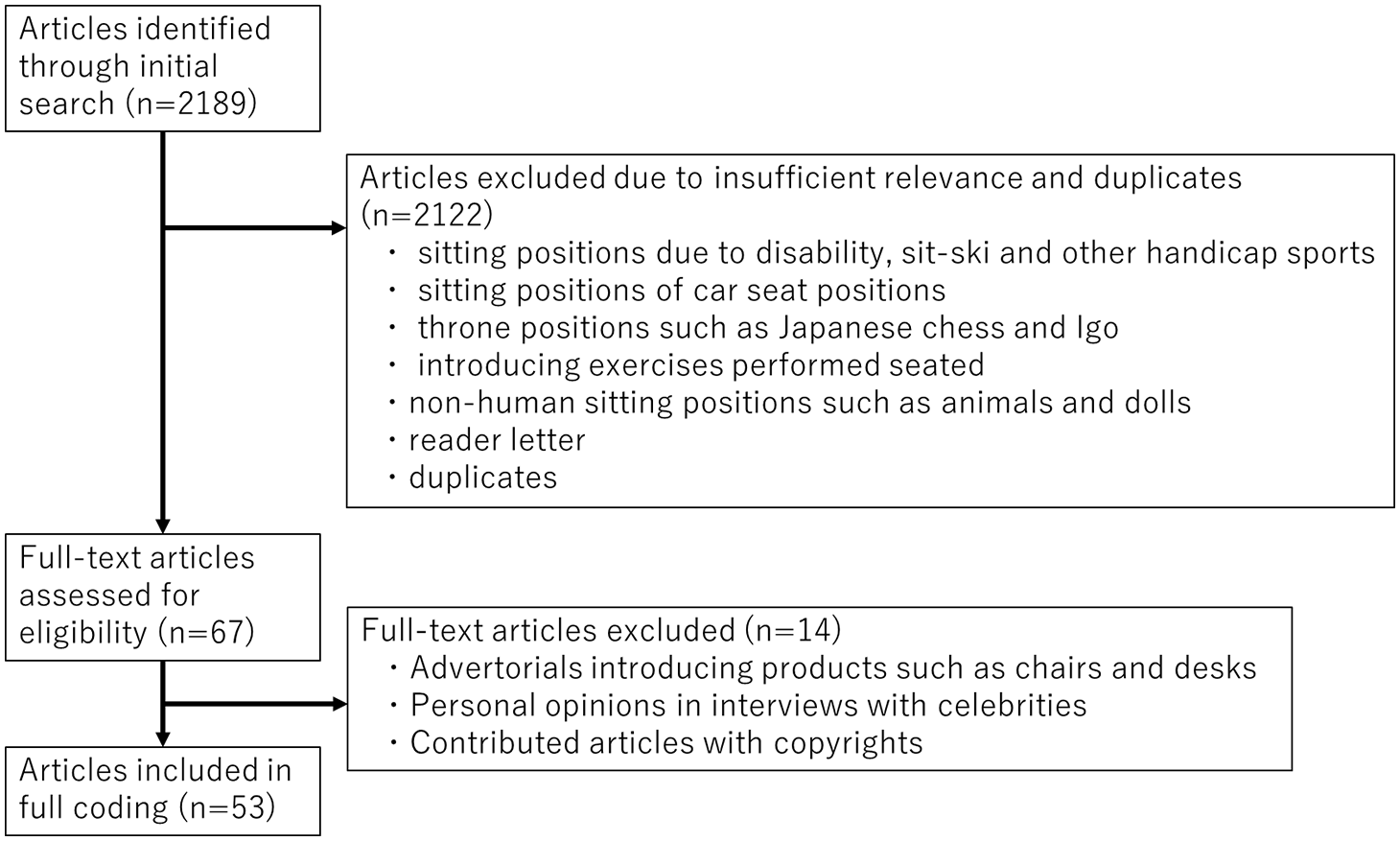
Flow chart showing of the process of selecting newspaper articles for content analysis.
Measures
A coding protocol was developed using a previous newspaper analysis as a guide. 17 After sample coding based on that protocol, our protocol was adjusted to fit the context of Japanese culture and newspapers.
Characteristics of newspaper articles
The coders recorded the name of the newspaper, date of article publication, article publication page, length of the article, and presence of infographics. The coders then determined whether the article’s main topic was SB. Next, the coders identified the representative population group for SB-related content and the context and domain of SB mentioned in the article. If more than one population group or context of domain was mentioned, all of these were coded.
Sedentary behavior
The coders analyzed the following five variables for SB: whether any patterns of sitting behavior were mentioned, whether there were mentions of the health outcomes of SB, whether solutions were offered to deal with too much sitting, whether there sources of information, and whether there was any content about PA. If more than one pattern of SB, health outcome, or type of solution was mentioned, all of these were coded.
Intercoder reliability and analysis
All articles were coded by two researchers. The inter-coder reliability was assessed by testing all included articles. Any disagreements among the coders were resolved in discussions until complete agreement was reached among the three reviewers, including the expert supervisor. Descriptive statistics, including frequencies and percentages, were used to calculate and summarize different types of data. To clarify annual changes in the documented content, the documented years were divided into 5-year blocks. For 2020-2021, however, the period was set to 2 years. Data analyses were conducted using IBM SPSS version 28.0.
Results
Characteristics of Newspaper Articles
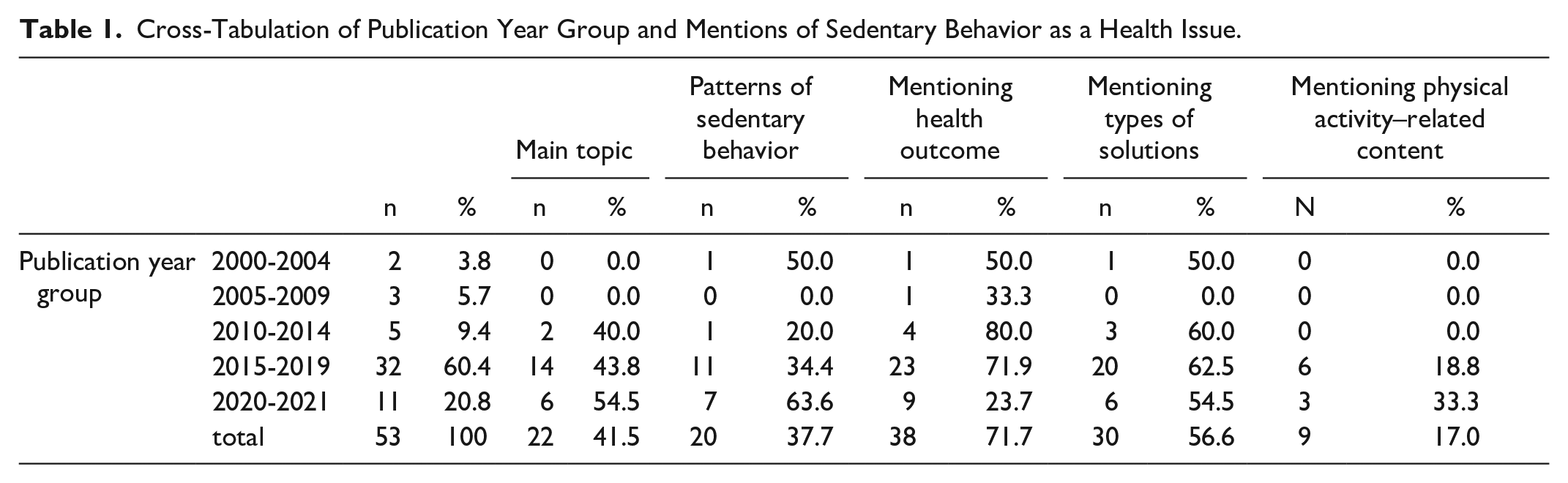
A total of 53 articles about SB were identified (16 articles in Yomiuri, nine in Asahi, eight in Mainichi, 12 in Nikkei, and eight in Sankei). Japanese newspapers published an average of 2.4 articles about SB per year (range, 0-11) during 2000-2021. The largest number of articles (11) appeared in 2011. We identified 8 years in which no articles about SB were published. In terms of the number of articles published per 5-year periods, the largest number (32) was published during 2015-2019, accounting for 60% of the total. Eleven articles were identified in the 2-year period 2020-2021, more than in any other period. Table 1 shows the characteristics of the newspaper articles about SB.
Cross-Tabulation of Publication Year Group and Mentions of Sedentary Behavior as a Health Issue.
In 22 articles (41.5%), SB was the main topic (Table 2). Furthermore, SB was mentioned as a subtopic in articles on other main topics, such as exercise promotion, diseases and conditions, healthy lifestyle, work style reform, chair development, and the health benefits of mah-jongg. The average number of characters in the identified articles was 1189.2 ± 735.2 (202-4220). Two articles (3.8%) were on the front page and 14 articles (26.4%) included an infographic on SB. The target population group was noted in most articles, with the biggest groups, comprising workers (37.7%, 20 articles) and the general population (35.8%, 19 articles). Fewer articles mentioned older adults (11.3%, 6 articles) and children (5.7%, 3 articles).
Characteristics of Newspaper Articles About Sedentary Behavior (N=53).
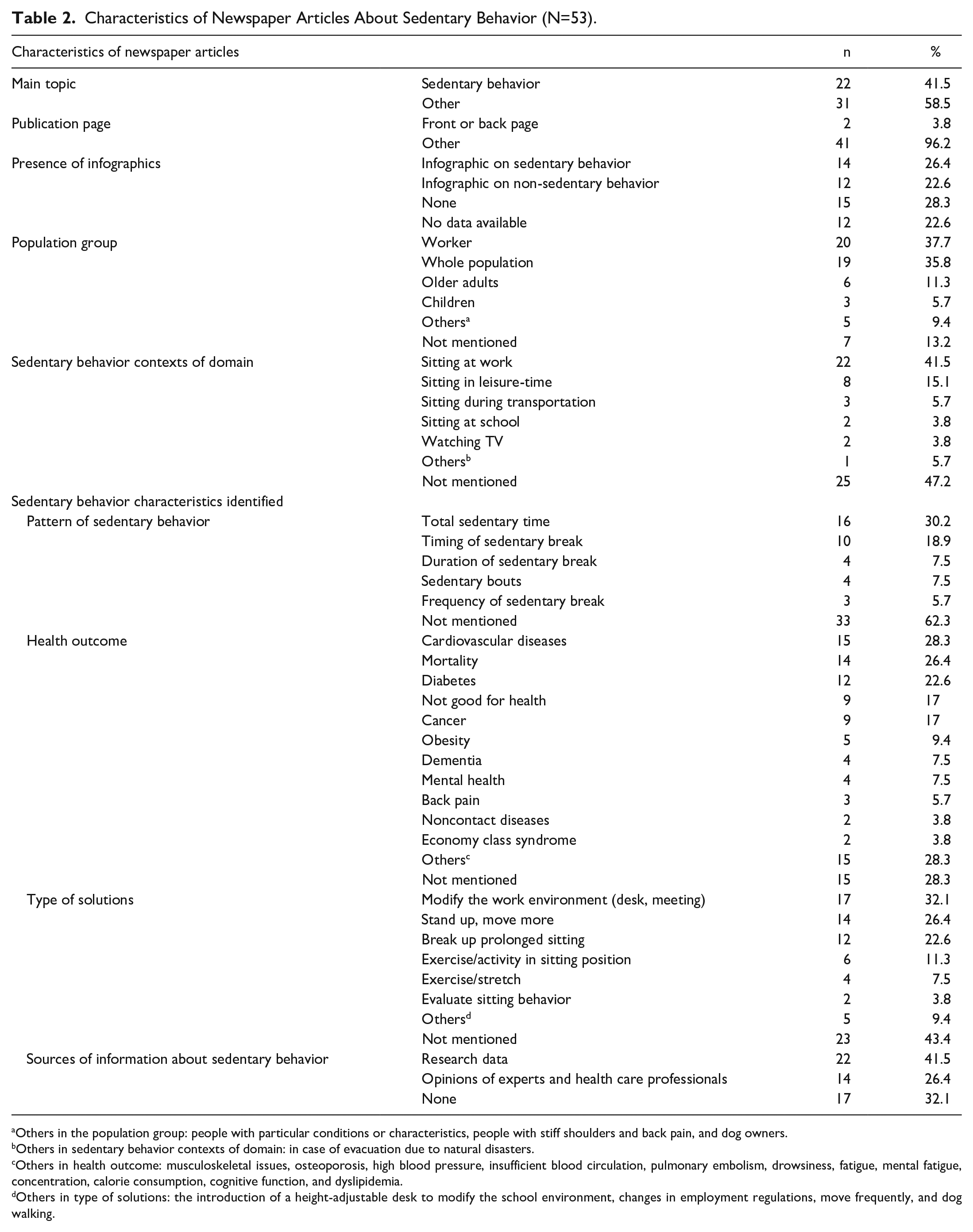
Others in the population group: people with particular conditions or characteristics, people with stiff shoulders and back pain, and dog owners.
Others in sedentary behavior contexts of domain: in case of evacuation due to natural disasters.
Others in health outcome: musculoskeletal issues, osteoporosis, high blood pressure, insufficient blood circulation, pulmonary embolism, drowsiness, fatigue, mental fatigue, concentration, calorie consumption, cognitive function, and dyslipidemia.
Others in type of solutions: the introduction of a height-adjustable desk to modify the school environment, changes in employment regulations, move frequently, and dog walking.
Approximately, half the articles (52.8%, 28 articles) described the context and domain of SB. Many articles focused on sitting at work (41.5%, 22 articles), with others discussing leisure-time sitting (15.1%, 8 articles) or sitting while commuting or using transportation (5.7%, 3 articles), watching TV (3.8%, 2 articles), and at school (3.8%, 2 articles).
Characteristics of SB
The pattern of SB was noted in 20 articles (37.7%). The most frequently mentioned pattern was total sedentary time (30.2%, 16 articles), followed by timing of breaks from sitting (18.9%, 10 articles). A few articles specified the duration and frequency of breaks from sitting and sedentary bouts.
Approximately, 70% of newspaper articles mentioned one or more health outcomes. There were many descriptions of the impact of SB on long-term diseases and mortality. Dementia, mental health, back pain, and the economy class syndrome were also described in a few articles. Nine articles simply vaguely stated that SB was not good for health.
Fewer than 60% (30 articles) mentioned solutions to address SB. The most common solution was to modify the working environment (e.g., introduction of a height-adjustable desk and standing for meetings; 32.1%, 17 articles). This was followed by standing up at regular intervals (26.4%, 14 articles) and breaking up prolonged sitting (e.g., interrupting sitting to visit the office kitchenette or restroom, light stretching, setting a regular standing time for the entire company, encouraging teachers to stand up in the middle of class, standing up between television commercials, and using smartphone apps; 22.6%, 12 articles). Six articles (11.3%) mentioned sedentary exercises or activities that included shaking the legs or bending the knees. Four articles (7.5%) introduced exercises and/or stretching, and two articles recommended wearable devices, applications, or other means of evaluating sitting behavior. However, more than 40% (23 articles) did not offer any solution for the problem of SB. Only 10 articles (18.9%) indicated that SB could be considered a problem even if individuals met the amount of PA recommended in the guidelines. Twenty-two (41.5%) articles contained information on these SBs, which was according to research data, 14 (26.4%) comprised the opinions of experts or health professionals, and 17 (32.1%) did not provide any evidence.
Finally, in terms of changes over time in the content of newspaper articles, Figure 2 shows the number of SB-related articles per year and Table 1 shows a cross-tabulation of publication year group and mentions of SB as a health issue. The largest number of articles were published in the most recent 5-year block (2015-2019) and in 2020-2021. During these periods, SB was the main topic in approximately half the identified articles.
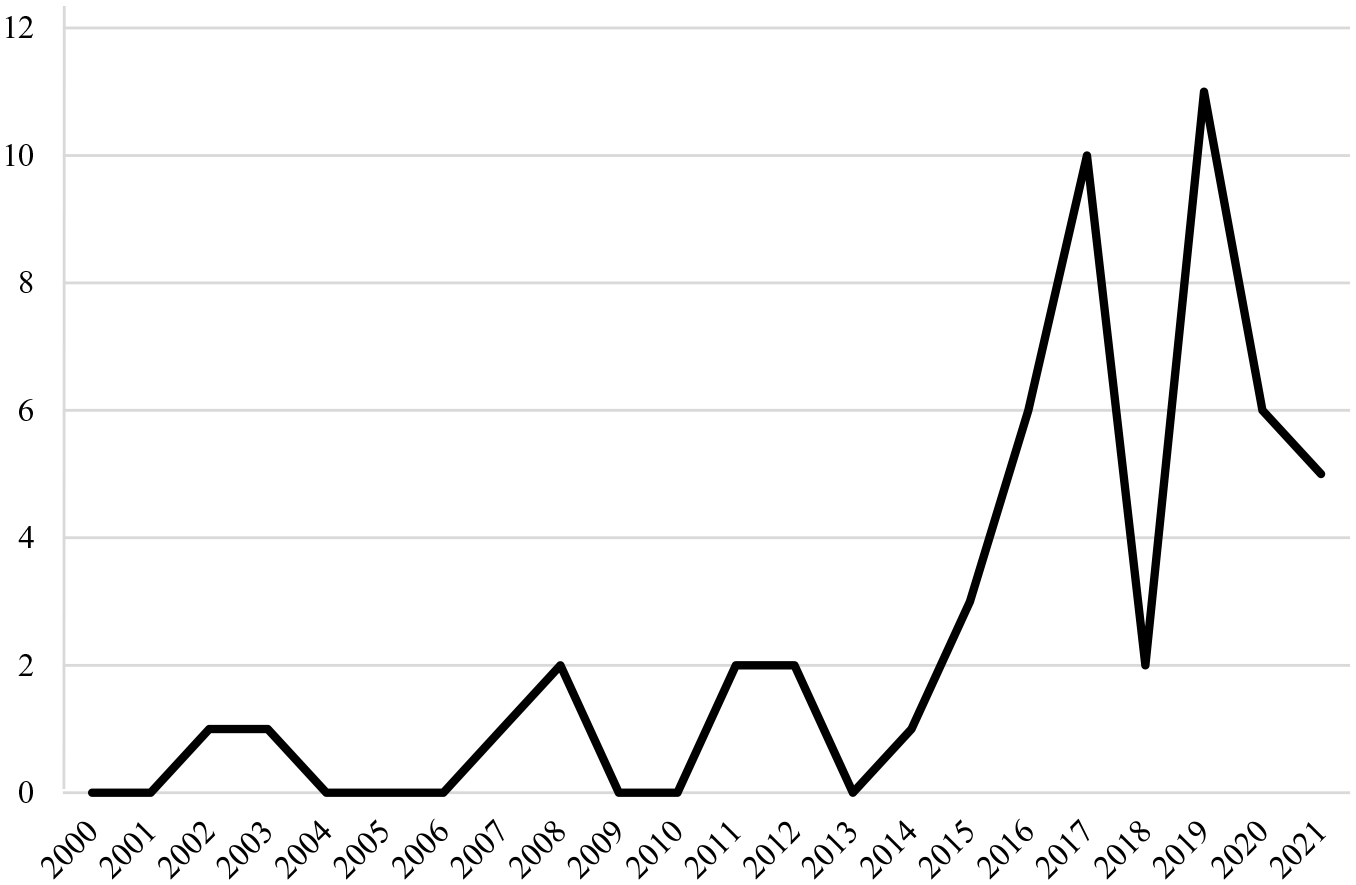
Number of sedentary behavior–related articles, 2000-2021 (N=53).
From 2010 onward, the patterns of SB, health outcomes, and solutions were discussed more often, but the interrelationship between SB and PA was identified only from 2015 onward.
Discussion
We examined the number of articles and the content of information related to the health issue of SB in five major national newspapers of Japan. Monitoring newspapers in this way can help researchers and policy makers to think about how to effectively communicate new guidelines regarding PA and SB to the mass media in the future. As a result, the mass media’s understanding of the need to properly disseminate new guidelines should help to ensure that SB is properly communicated to the broader community. This is especially important in the context of future dissemination of SB guidelines for Japan. The number of articles in newspapers on the health issue of SB has been increasing in recent years. However, the number of such articles in Japan is small, compared with that in Australia. 17 We found that articles discussed workers: many discussed sitting in the work domain and suggested modifying the work environment as a solution. Several articles mentioned adverse effects on health; however, few showed the pattern of SB or indicated excessive sedentary time as a problem even if overall PA sufficiently met the guidelines. These findings suggest that there are insufficient articles and insufficiently useful content in published articles to properly inform public health and occupational health agendas in ways that could influence community norms and encourage behavioral change.
The issue of small number of articles may be due to insufficient evidence on SB for the Japanese population. Furthermore, the current lack of indications of SB in Japanese PA and health guidelines may be a reason for the lack of broader public discussion and debate around this newly emerged health issue. However, observing the changes, the articles during 2015-2019 and 2020-2021 accounted for 80% of all articles. The articles in this period also treated SB as the main topic while also providing further details. This finding could be linked to an increase in published evidence on the relationship between SB and health problems in Japan. Australia, United States, United Kingdom, and Canada and the revision of the World Health Organization 1 PA guidelines indicate for SBs. The new Japanese PA guidelines ideally will deal with SB in addition to PA. In this way, broader public attention and the number of articles addressing SB may increase, although this will depend on the approach taken by researchers and policy makers to the mass media. In addition, in the articles’ analyses for this study, even if published articles appeared on the front page as editorials, they were not published as articles. Among articles identified in the database for which print data were extracted, in addition to text, infographics on SB could only be found in one third of these. Front-page coverage and infographics may increase interest among many articles in newspapers and promote the public’s understanding of SB. Therefore, when more articles are published as a response to the release of new guidelines for SB, we expect more articles to be published on the front page and to include infographics.
The content as well as the number of articles in major Japanese national newspapers was limited. A relatively large number of articles (approximately 40%) focused on workers and workplace aspects. This result is similar to findings in Australia 17 and many articles covered specific issues and solutions. Prolonged sitting is especially notable among desk workers in offices during working hours in Japan. 20 Therefore, it is considered that coverage of this issue in numerous newspaper articles would help promote health support for workers as part of companies’ management strategy. Some articles introduced solutions that could help companies in which such measures have not yet been implemented.
There were few articles on the issues of prolonged sitting among nonworkers, older adults, 21 and children. 22 This problem in the domestic, leisure, and travel domains is reported to be as much as 351.8 hours on average during weekdays and 437.8 hours on weekends in Japan. 23 Television viewing time increases with age in Japan, whereas younger people spend more time on the Internet. 23 One study found that nearly half of the total sedentary time (45.5%) among Japanese older adults was spent watching television. 24 Individuals can improve their own leisure-time sitting. Targeting articles toward older adults, who are more likely to read them, 19 may also help to improve their health.
Several articles mentioned the adverse effects of SB on health, but few discussed the pattern of SB. An interview survey of office workers who had read a newspaper article about SB reported that they recognized the need to reduce their sitting time but found it difficult and harder to see how to do so. 25 Research on cancer prevention and the dissemination of information by mass media has found that perceiving risk factors increases awareness 26 but is unlikely to lead to behavioral change unless coping strategies are provided. 27 Articles on SB should not only describe the problem but also provide specific and feasible solutions. When considering the issue of SB, it is important for individuals to reduce their total sitting time. However, interrupting SB, for example, by short periods of standing or walking, can reduce its adverse effects on health. 28 It is therefore important to communicate this pattern, indicate how easy it is to tackle SB, and encourage people to engage in breaking SB. It is also important for newspaper articles to focus on the relationship between SB and PA when providing solutions to SB as a health issue. Articles should mention that SB can negatively affect health status even among active adults who meet PA guidelines. Newspaper articles should stress the importance of frequently interrupting SB and replacing it with low-, moderate-, and high-intensity PA for health benefits. Furthermore, among the articles included in our content analyses, none provided erroneous information about SB, but one third of the articles were based neither on research evidence nor on expert opinion. As SB is a relatively new public health issue, evidence-based content and specific solutions may be more likely to lead to relevant knowledge and potential behavior change among the public.
This was the first study to examine the status of articles on SB in Japanese newspapers. Our findings provide basic data for future studies on how to disseminate and raise public awareness about SB as a health issue and about solutions, including press releases by researchers and policy makers as well as mass media reports.
However, this study has some limitations. We covered newspapers only during 2000-2021, so it is important to investigate newspaper articles published since then. We also analyzed articles only from five major newspapers. The living environment, including transportation, differs between urban and rural areas and between inner and outer areas of large urban conurbations. 29 Some information will therefore be handled differently or exclusively by local or regional newspapers. Although the results of this study may be representative of a type of mass media, caution should be exercised in generalizing the findings. Moreover, social media may be a more familiar source of information for younger, “digital native” generation. Japanese public institutions are gradually beginning to utilize social media; therefore, it may be necessary to conduct a content analysis of social media communications by public institutions and experts as well as public reactions to these. Future research should consider information obtained by the public from newspaper articles and other mass media, and it should examine whether this information is related to public knowledge, awareness, behavioral intentions, and actual behavioral change.
Conclusion
Japanese newspapers have become active in covering the issue of SB, and there has been an upward trend in coverage over time. However, the number of articles and quality of content can be considered insufficient to inform broader public debate and support more healthy behavioral changes. Because previous studies have shown that the Japanese population has the longest sitting time in the world, increasing the number of informative articles on SB may help to solve the public health problem of prolonged sedentary time in Japan. News coverage should be broadened to include more mention of groups impacted by too much sitting, including older adults and children. In addition to workers and workplaces in Japan, sitting in other aspects of daily life needs to be addressed. The negative health impacts, solutions, and benefits of reducing or breaking up SB should also be discussed. It is worth encouraging newspapers to publish more evidence-informed articles such as new PA and SB guidelines for Japan that are likely to be considered in the near future. Mass media news sources can effectively communicate useful and accurate information to the public and help increase public awareness and knowledge about SB as a public health issue. These outlets should be encouraged to do so more widely and with greater diversity of focus.
Footnotes
Declaration of Conflicting Interests
The author(s) declared no potential conflicts of interest with respect to the research, authorship, and/or publication of this article.
Funding
The author(s) disclosed receipt of the following financial support for the research, authorship, and/or publication of this article: This research received no specific grants from any funding agency, in the public, commercial, or not-for-profit sectors. Among the authors, RM is supported by a Grant-in-Aid for Scientific Research (grant no. 20K18970) from the Japan Society for the Promotion of Science (JSPS); AS is supported by a Grant-in-Aid for Scientific Research (grant no. 21K11693) from the JSPS; KI is supported by a Grant-in-Aid for Scientific Research (grant no. 20K11473) from the JSPS; NO was supported by a JSPS/Australian Academy of Sciences Short-Term Fellowship and by the Victorian State Government’s Operational Infrastructure Fund; and KO is supported by a Grant-in-Aid for Scientific Research (grant no. 20H04113) from the JSPS and Health Labor Sciences Research Grant (grant no. JPMH20FA0401) from the Ministry of Health, Labor, and Welfare.
