



Abstract
This study established the clinical conclusiveness of Cochrane reviews (CRs) in family nursing. We extracted relevant characteristics of CRs to determine the methods of obtaining high-level evidence for family nursing. We performed a systematic search of all CRs on family nursing published in the Cochrane Library between January 2014 and April 2023. After screening 1212 titles and abstracts, we identified seven potentially relevant articles. Upon reviewing their full texts, we included six CRs with a total of 34 interventions. Of these, 22 (64.7%) interventions were conclusive and 12 (55%) were inconclusive. Thus, the number and percentage of conclusive CRs is lower in family nursing versus other fields.
What We Already Know
Family support is important in public health.
Nursing plays a significant role in providing this support.
What This Article Adds
We present data regarding the conclusiveness of family nursing based on Cochrane reviews.
Moreover, this study recommends support.
Introduction
Families worldwide are changing in diverse ways, especially in Asia, which has a changing aging population. Nursing helps support families and individuals, and family nursing interventions have positive outcomes for family health. Therefore, clarifying the rationale behind the current family support is important from a public health perspective. This study thus established the clinical conclusiveness of Cochrane reviews (CRs) in family nursing. The Cochrane Collaboration is a global independent network for health care decisions, and CRs are the global gold standard for high-quality and updated systematic reviews. 1 This study thus extracted relevant characteristics of CRs to determine the methods of obtaining high-level evidence for family nursing.
Methods
Search Methods
We performed a systematic search for all CRs published in the Cochrane Library (http://www.cochranelibrary.com/) between January 2014 and April 2023 in the family nursing field. (The search strategy is available to interested researchers upon request from the corresponding author.) We included reviews assessing the effects of family nursing, defined as any type or intensity of family nursing by nurses. Outdated versions of reviews, withdrawn reviews, and protocol reviews were excluded. This project did not constitute research. Therefore, ethics committee approval was not required.
Selection of Reviews
Three review authors (K.K., Y. I., and M.T.) independently screened the titles and abstracts of references obtained from searches and excluded irrelevant reports. We retrieved full-text articles for the remaining references, and three review authors (K.K., Y. I., and M.T.) independently screened them to identify studies for inclusion. We identified and recorded the reasons for excluding ineligible studies. Disagreements were resolved through discussion or consultation (M.K., T.K., and J.K.). We recorded the selection process and completed a PRISMA flow diagram.
Data Extraction
The reviewers (K.K., Y.I., and M.T.) independently extracted the included reviews’ characteristics (year of publication, Cochrane Review Group, conclusiveness or inconclusiveness, and number of randomized controlled trials) and checked each other’s work. Disagreements were resolved through discussion.
Conclusiveness was assessed using the following criteria 2 : one intervention is superior to the alternative, the interventions are equivalent, no decision can be reached because the quality of studies is inadequate, no decision can be reached because of inadequate data, and no decision can be reached because existing randomized controlled trials are outdated. The first two categories were classified as “conclusive” and the last three as “inconclusive.” Only the main outcome of each review (and not the secondary outcomes) was considered.
Statistical Analysis
We used descriptive statistics for “conclusive” and “inconclusive” and the SPSS software (IBM SPSS Statistics 24, IBM Corp., Armonk, New York).
Results
After screening 1212 titles and abstracts, we identified seven potentially relevant articles (Figure 1). Upon reviewing their full texts, we included six CRs3-8 with 34 total interventions: 22 (64.7%) of these were conclusive and 12 (55%) were inconclusive (Table 1). Of the conclusive ones, 5 were effective (15%), and 17 showed no difference (50%). Many interventions were psychological.
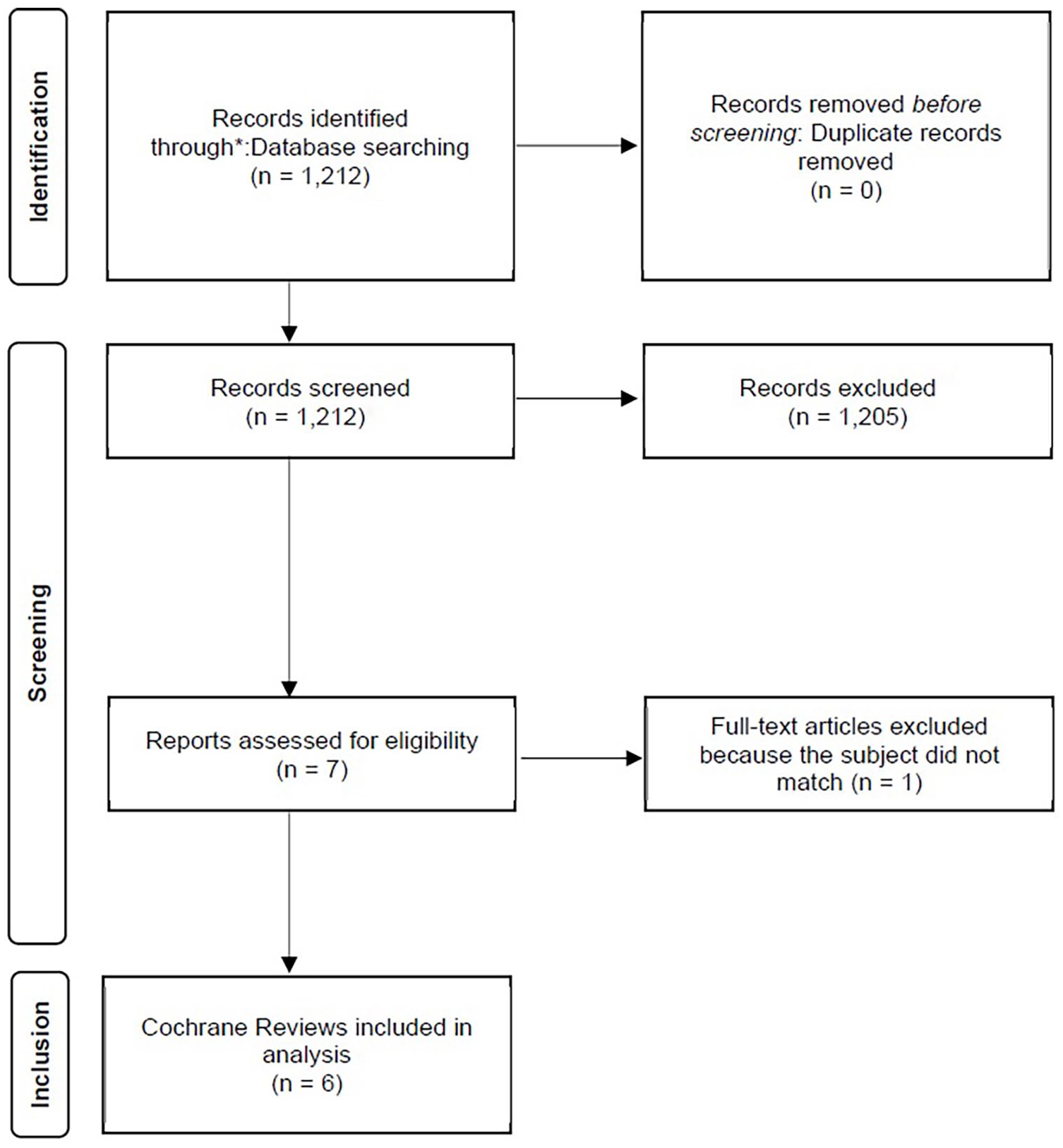
Study flow diagram.
Characteristics of the included Cochrane reviews on family nursing (n = 6).
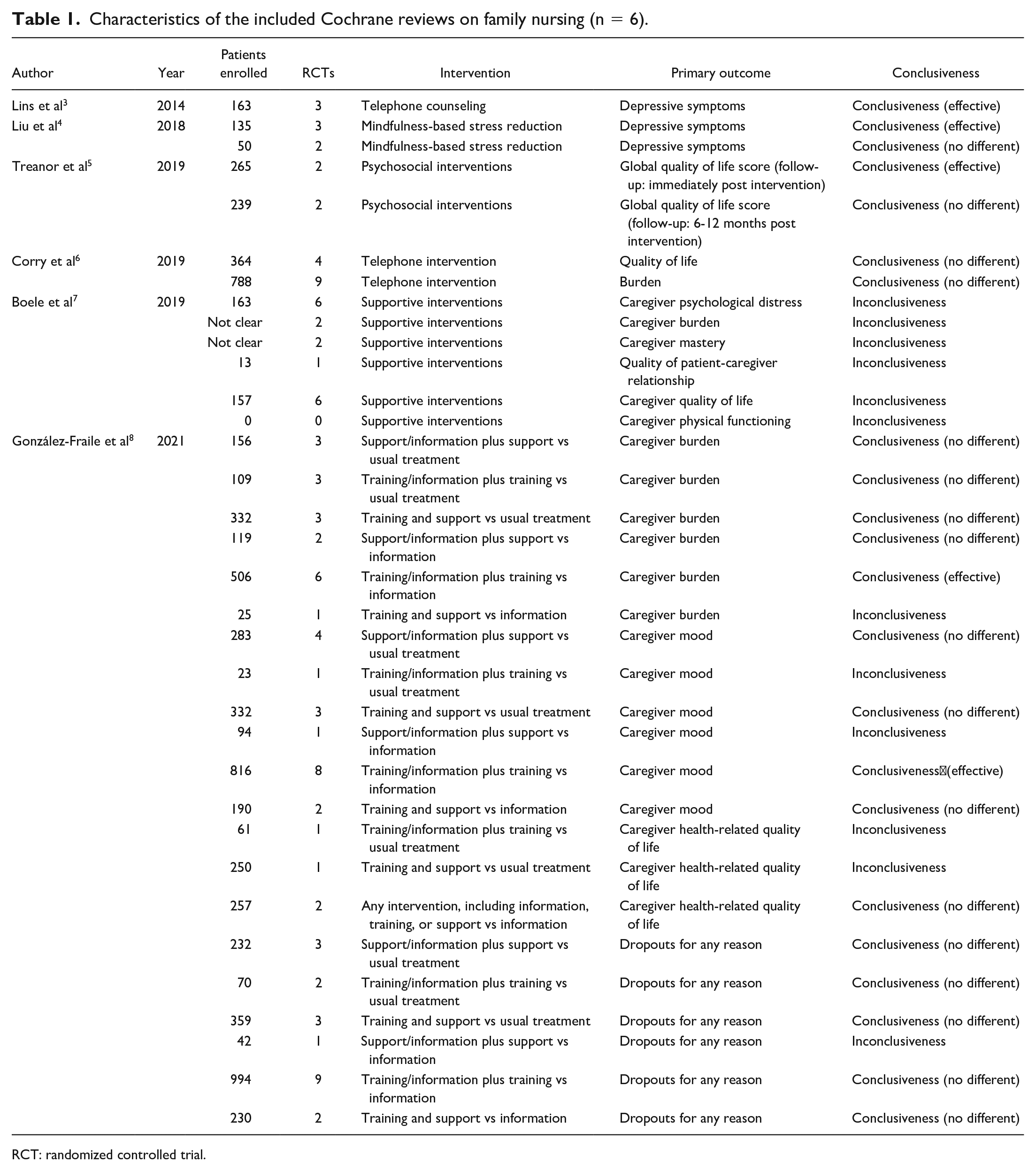
RCT: randomized controlled trial.
Discussion
We found that approximately 60% of interventions in family nursing were conclusive; of these, 15% were effective and 50% were ineffective. This is inconsistent with previous analyses of CRs in different fields. There were 61 CRs (with 30 conclusive) 9 on palliative and supportive care and 283 CRs (with 16 conclusive)2,3 on physiotherapy. Moreover, we showed that clinical nurses cannot necessarily turn CRs into definite answers in family nursing.
The effective interventions were almost exclusively psychological. Psychological interventions are effective in supporting various family members,3-5,8 and the same trend was observed in a previous study. Moreover, Asian countries have many challenges for family caregivers due to their aging populations. 10 Therefore, family nursing is becoming increasingly important in public health.
This study has some limitations. First, we did not include non-CRs published in other journals or databases because non-CRs often have different levels of evidence. Second, we did not perform any subcategory analyses, because the number of CRs in each subcategory of family nursing was too small. Third, the number of CRs extracted was small, and unlike previous studies, it was difficult to test statistically. Potential biases were identified during the analysis that might have affected the study’s final conclusions.
Conclusion
We concluded that very few clinical studies have been conducted in the family nursing field. Fifteen percent of the CRs presented definitive clinical recommendations based on their effectiveness. The number and percentage of conclusive CRs was lower in family nursing versus other fields. Thus, future research on family nursing and CRs is warranted.
Footnotes

Declaration of Conflicting Interests
The author(s) declared no potential conflicts of interest with respect to the research, authorship, and/or publication of this article.
Funding
The author(s) disclosed receipt of the following financial support for the research, authorship, and/or publication of this article: This study was supported by JSPS KAKENHI (grant number: 21K11073). The funders played no role in the study design, data collection and analysis, decision to publish, or preparation of the manuscript.
Ethical Approval
This project did not constitute research. Therefore, ethics committee approval was not required.
Data Availability Statement
All relevant data have been included in this article.