



Abstract
This article presents the preliminary findings from a five-day dietary record of 105 iTaukei (indigenous) Fijians in seven rural communities on remote islands, Fiji. Although the literature on noncommunicable diseases (NCDs) has discussed the potential reasons for the NCD increase in Fiji, research has relied on secondary data on the consumption patterns of limited food items. Hence, this research is one of the first in the country to analyze detailed dietary patterns. A high body mass index rate in the case study communities is observed. We also find that carbohydrate sources dominate the diet of the participants, while the consumption of protein sources (including canned products) and vegetables/fruits is limited. In addition, the diversity of food items is limited. Meanwhile, the major carbohydrate sources are locally produced cassava, although rice and flour products are also consumed. We suggest integrating these factors into the determination of the cause of the NCD increase.
What We Already Know
Fiji is observing a non-communicable disease increase and the literature has discussed possible reasons for the increase based on secondary data with limited food items.
Low fruit and vegetable consumption is prevalent in Fiji, while imported food items and/or canned products are said to be replacing locally produced food items.
What This Article Adds
Our project is one of the first in the country to record study participants’ (n = 105) dietary patterns over five days.
Carbohydrate sources dominate study participants’ diets while the consumption of protein sources including canned meats and vegetable/fruit is very limited.
Although the diversity of food items is limited, locally produced products, especially cassava, are more widely consumed than imported rice and flour.
Introduction
Pacific Island countries including Fiji have recently experienced a significant increase in noncommunicable diseases (NCDs). The 2011 STEPS survey found that 32.1% of Fijian adults were classified as obese. 1 However, the previous research on NCD in Fiji has relied on secondary data and only covered the consumption pattern of a few specific food types.2,3 As such, this research was conducted as one of the first projects to record comprehensive individual dietary patterns among rural iTaukei (indigenous) population.
Methods
The research was collaborated with the Ministry of Health and Medical Services of Fiji and ethics approval was obtained from the Research Office, the University of the South Pacific (approval # “Dr. Naohiro Nakamura/2017/”). Data collection was undertaken between June and December 2018 in seven rural iTaukei communities, all located outside of the main island Viti Levu. These sites were chosen based on student research assistants’ connections. After having obtained the village headmand’s approval to conduct a survey, the research assistants recruited participants, primarily targeting those who appeared to be overweight and obese in terms of body mass index range. A total of 105 individuals of 18 years or above participated in the study (Supplementary Table); however, a few did not complete the five-day record as they left the community for some reasons. On occasion, multiple members from the same household participated so that we were able to record the variety of consumption amount among the members. Despite population, dialect, and cultural differences, land and/or sea is the common livelihood platform across the seven communities. Under the chiefly governing system, the lifestyle of iTaukei villagers tend to be homogeneous. Also, the dominance of domestic duty (mostly female participants) and farmer (mostly male participants) in the participant body typically represents rural iTaukei communities. Hence, our samples arguably represent the rural iTukei population in Fiji.
This research adopted the five-day weighed dietary record method.4,5 This method records foods and beverages, amounts, and preparation methods at the time of consumption for several consecutive days. The research assistants stayed with or visited multiple times a day, participant households and recorded every single meal, together with a photograph, over five consecutive days (three weekdays and two weekend days). 4 On each meal, the amount of consumption (number/per bowl/per cup/per spoon), means to cook, and means of the acquisition of each food item were recorded.
Referring to Horsey et al, 6 Vogliano et al, 7 and the Pacific Islands food composition tables (second edition), 8 we assessed whether each participant consumed three major macronutrients: carbohydrates, protein, and vegetable/fruit in each meal. A score of “1” was assigned if food from a group was consumed in each meal, regardless of the quantity. A score of “2” was assigned to any food group that was not consumed. A total of 15 meals (three meals/day) of 105 participants were assessed.
Results
Table 1 shows the count of the consumption of carbohydrate sources. The participants hardly miss to consume carbohydrate sources. The major sources of carbohydrates observed are cassava, dalo (taro), rice, flour (pancakes, bread, biscuits, tavioka, pies, crackers, muffins), instant noodles, and breadfruits. Overall, wheat products including pancakes, biscuits, tavioka, and bread are preferably consumed for breakfast, while rice, cassava, dalo, and breadfruits are consumed for lunch and dinner. Thereafter, we roughly counted the times of consumption of rice, flour products, cassava, dalo, and breadfruits. The latter three are considered to be traditional iTaukei sources and locally produced. Cassava was by far the most widely consumed carbohydrate source (n = 310), followed by flour products (n = 167), rice (n = 143), breadfruit (n = 71), and dalo (n = 69). Combined, traditional iTaukei carbohydrate sources are more consumed in the case study communities.
Count of the Consumption of Carbohydrate Sources (n = 525).
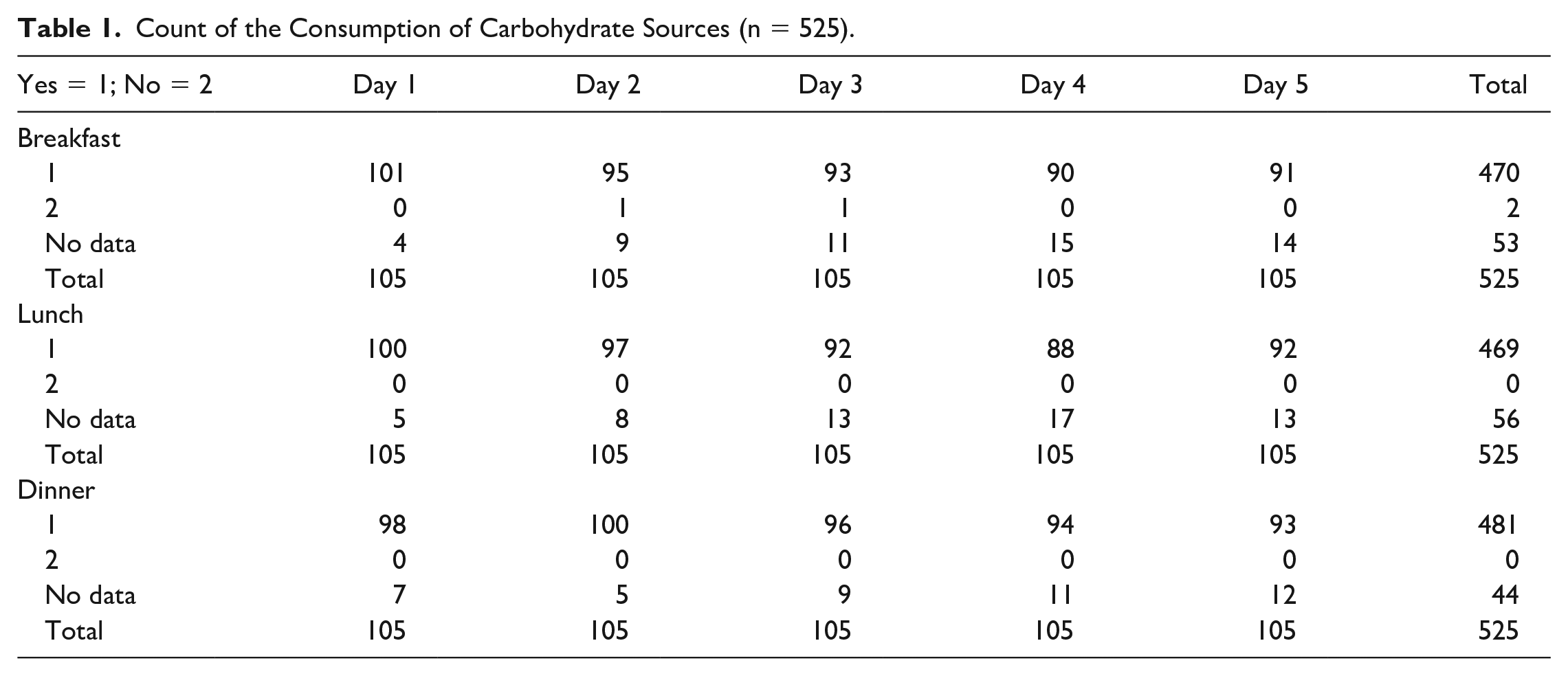
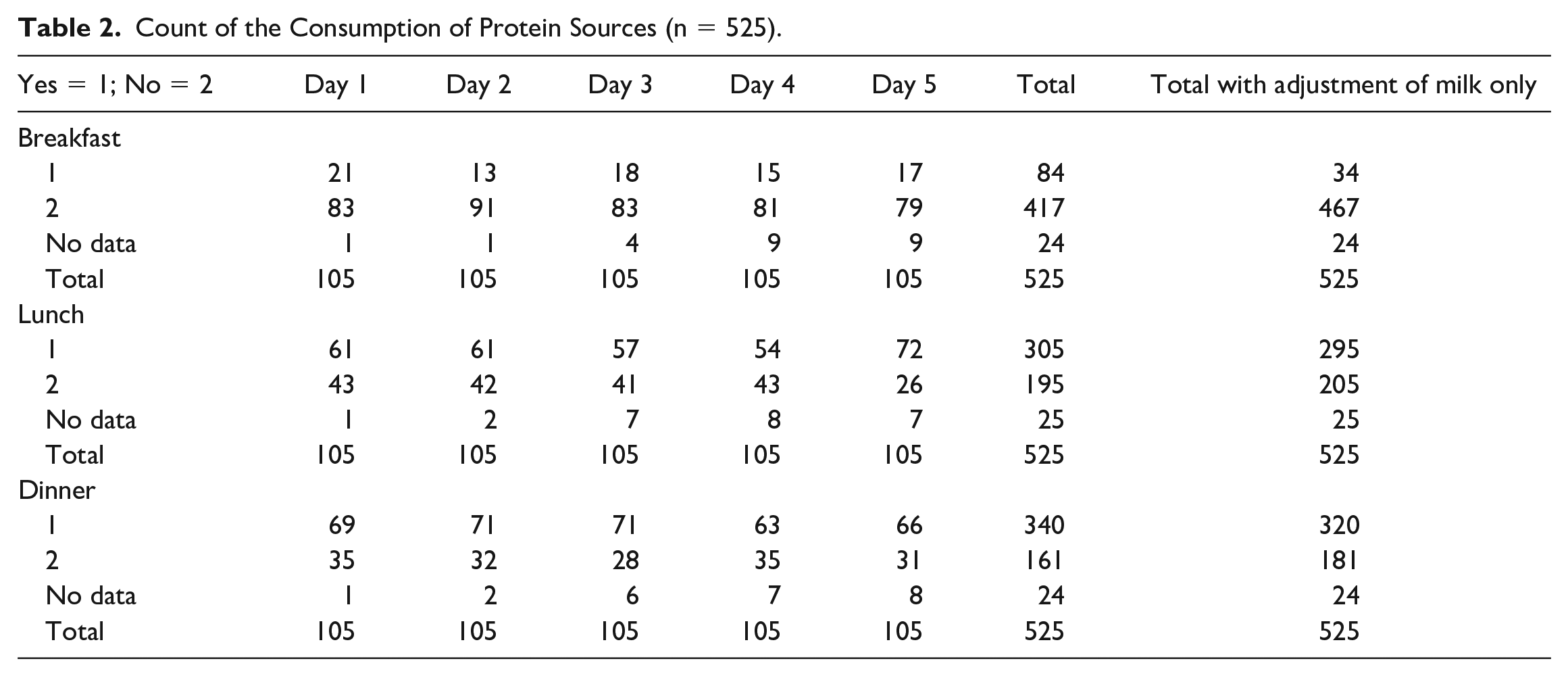
Table 2 shows the count of the consumption of protein sources, which include tinned fish, mud crabs, fish, dahl, and milk, while eggs, chicken, and red meats are rarely consumed. For lunch and dinner, protein sources were consumed in more than half of the total counts (305 and 340 out of 525 counts, respectively); however, the consumption count of protein sources for breakfast is substantially less, with 84 out of 525 counts (16%). During analysis, we often found that milk in a few cups of tea was the only source of protein consumed for breakfast. Such breakfast typically consists of pancakes or biscuits and milk tea only. We also counted the number of this type of breakfast, assuming that the amount of protein consumption in such a meal is very less. After having excluded such breakfast from the counts of protein consumption, we found that merely 34 out of 525 (6.5%) breakfasts contained protein. We further analyzed how many meals out of 15 over the five days each participant consumed protein sources. Less than half of all the meals observed (46%) contain protein sources.
Count of the Consumption of Protein Sources (n = 525).
Like protein sources, vegetables and fruits were not widely consumed, especially in breakfast (11.4%, 41.3%, and 30.3% for breakfast, lunch, and dinner, respectively). Consumed vegetables and fruits are mostly mango, ota, bele, pawpaw, and rourou. Merely 32% of all meals recorded contained vegetables/fruits.
Discussion and Conclusion
As one of the very first assessments of dietary patterns over five-day period of a rural iTaukei population, we attempted to identify macro nutrition intake on the individual level. Our findings show that dietary diversity in the case study communities is limited and is consistent with some similar studies conducted in Fiji. 9 Meanwhile, our findings suggest that rural iTaukei populations do not consume enough protein sources and the increase in animal protein intake may help diversify macro nutrition sources. Furthermore, our findings suggest that although the case study communities are integrated into the modern economy and contemporary globalization in the sense that participants purchase and consume imported rice and flour, traditional carbohydrate sources such as cassava and dalo are equally consumed. As such, one needs to be cautious with blaming the modern economy or contemporary globalization and the increasing rice/flour consumption for the contribution to NCD increase.
Supplemental Material
sj-docx-1-aph-10.1177_10105395231212796 – Supplemental material for Dietary Patterns of iTaukei (indigenous) Fijians: Preliminary Findings From a Five-Day Dietary Record in Rural Communities
Supplemental material, sj-docx-1-aph-10.1177_10105395231212796 for Dietary Patterns of iTaukei (indigenous) Fijians: Preliminary Findings From a Five-Day Dietary Record in Rural Communities by Naohiro Nakamura, Peni Wainimala, Metia Ratuyawa, Fulori Tawakedina and Elisabeta Waqa in Asia Pacific Journal of Public Health
Footnotes
Declaration of Conflicting Interests
The author(s) declared no potential conflicts of interest with respect to the research, authorship, and/or publication of this article.
Funding
The author(s) disclosed receipt of the following financial support for the research, authorship, and/or publication of this article: This project was funded by Research Office, The University of the South Pacific.

Supplemental Material
Supplemental material for this article is available online.
References
Supplementary Material
Please find the following supplemental material available below.
For Open Access articles published under a Creative Commons License, all supplemental material carries the same license as the article it is associated with.
For non-Open Access articles published, all supplemental material carries a non-exclusive license, and permission requests for re-use of supplemental material or any part of supplemental material shall be sent directly to the copyright owner as specified in the copyright notice associated with the article.
