



Abstract

Background
Older people are considered the most vulnerable population in the current COVID-19 (coronavirus disease-2019) pandemic. While the negative impacts on health in the present are important, negative impacts on future health should also be considered. During the COVID-19 pandemic, older people have had more restrictions placed on them. This includes restrictions on going out, meeting other people, and participating in activities, all of which may negatively affect their social relationships.
The Japan Gerontological Evaluation Study (JAGES) has collaborated with more than 40 municipalities throughout Japan and has promoted evidence-based, gerontological research, targeting approximately 300 000 adults aged 65 years and older. To mitigate post-COVID-19 negative health impacts among older people, this article presents the results of JAGES, and discusses the importance of social relationships on the health of older people.
Indirect Negative Health Impacts of COVID-19 on Older People
First, since the COVID-19 pandemic may increase social isolation among older people, opportunities for contact with others should be maintained, with special attention paid to frequency of contact (Table 1). According to Saito et al, 1 older people who were in contact with others “from once a month to less than once a week” demonstrated a 1.40 times increase in the risk of functional disability, a 1.39 times increase in the risk of dementia, and a 1.15 times increase in the risk of premature death, when compared with individuals who reported they were in contact with others “frequently, every day (more than 9 per week).” Moreover, older people who were in contact with others “less than once a month” demonstrated a 1.37 times increase in the risk of functional disability, a 1.45 times increase in the risk of dementia, and a 1.34 times increase in the risk of premature death, when compared with individuals who were in contact with others “frequently, every day.” Similar results were also seen in a study by Aida et al. 2 Therefore, to reduce the negative impact of COVID-19 on health among older people, contact with others at least once a week should be needed.
Studies that Used Data From the JAGES (published 2011-2020) a .
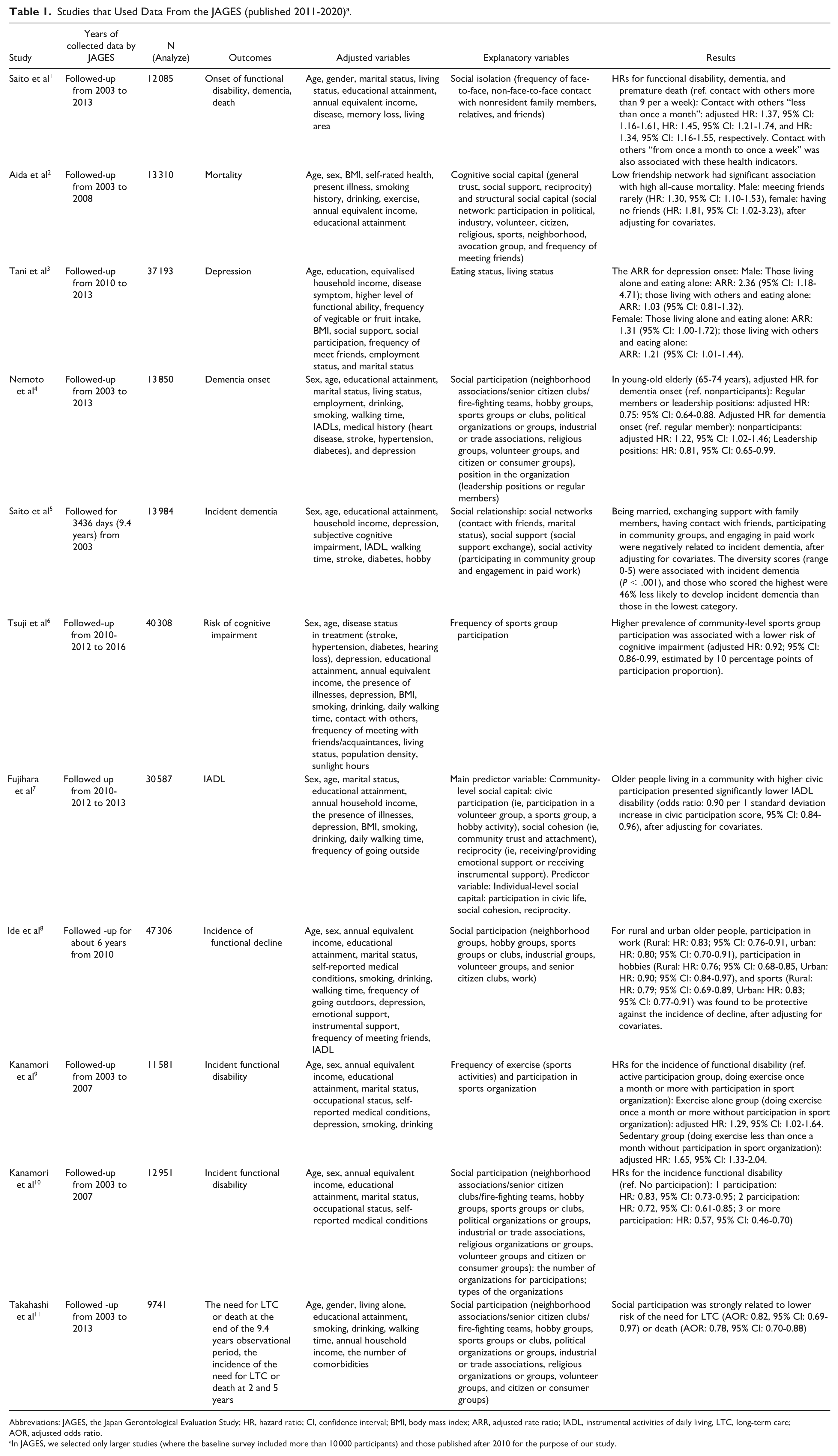
Abbreviations: JAGES, the Japan Gerontological Evaluation Study; HR, hazard ratio; CI, confidence interval; BMI, body mass index; ARR, adjusted rate ratio; IADL, instrumental activities of daily living, LTC, long-term care; AOR, adjusted odds ratio.
In JAGES, we selected only larger studies (where the baseline survey included more than 10 000 participants) and those published after 2010 for the purpose of our study.
Second, while eating a healthy, balanced diet may be challenging during the COVID-19 pandemic, not only nutrition but eating status among older people should also be considered. According to Tani et al, 3 compared with older males who ate with others, older males who ate alone and lived alone were 2.36 times more likely to demonstrate the onset of depression, while those who ate alone, but lived with others were 1.03 times more likely to develop depression. Similarly, compared with older females who ate with others, those who lived alone and ate alone were 1.31 times more likely to develop depression, while those who ate alone, but lived with others demonstrated a 1.21 times higher risk for the onset of depression. 3 These results indicate that eating alone may increase the risk of depression, especially when combined with living alone, in older males. During the COVID-19 pandemic, older people living alone should receive special consideration, as they may face difficulties in going to restaurants or having lunches/dinners with others. Thus, the creation of opportunities to eat and communicate with others through virtual lunches and dinners should be considered.
Third, while social gatherings increase the risk of spreading the coronavirus, the benefits of social participation should also be taken into account. Using data from JAGES, various studies have presented the relationships between increased social participation and health, such as a decreased risk of dementia,4,5 and cognitive impairment, 6 increased instrumental activities of daily living scores, 7 decreased incidence of functional disability,8-11 and death. 11 For example, Kanamori et al, 10 found that older people who participated in one group demonstrated a 0.83 times lower incidence of disability, while those who participated in two groups demonstrated a 0.72 times, and those who participated in three or more different types of groups demonstrated a 0.57 times lower risk of disability than those who did not participate in any group. Similarly, Ide et al 8 reported that the number of groups an older adult participated in was associated with lowered risk of functional decline in both rural and urban areas (0.76-0.92 times lower risks than those who did not participate in any group). Furthermore, compared with the active participant group (ie, exercising once a month or more, and participation in a sports organization), the sedentary group (ie, exercising less than once a month and no participation in a sports organization) exhibited a 1.65 times increase in risk, while the exercise-alone group (ie, exercising once a month or more and no participation in a sports organization) demonstrated a 1.29 times increased risk for incidence of functional disability. 9 In other words, while regular exercise may reduce the incidence of functional disability, participation in a sports organization increases the preventive effects. Taken together, the above research suggests that participation in social activities is beneficial for health, and that if older people lose such opportunities for extended periods of time, their health may be negatively affected. Thus, the maintenance of social participation among older people during the pandemic is a critical health issue.
Conclusions and Recommendations
The COVID-19 pandemic has restricted people’s lives, and its impact on health may be prolonged. This article has discussed the impact of social relationships on health among older people, based on cohort studies of JAGES, from a “super-aging” society. To ameliorate negative health impacts among older people post-COVID-19, these individuals should be encouraged to contact others, eat with others, and maintain organized social participation by practicing physical distancing. During mandated isolation, a minimum of weekly contact with others is recommended. Even non-face-to-face methods of contact could be beneficial, such as telephone, text, and/or video chat. Additionally, while eating with others and maintaining social participation in organized groups in-person may be difficult during a pandemic, participation could still occur via the internet. However, since internet use may be challenging for some older people, the construction of technological support networks may be needed. Avoiding pandemics such as COVID-19 may be impossible, but social relationships may help minimize the associated health risks in older individuals.
Footnotes
Author Contributions
Writing—original draft preparation, MK; review and editing, TO, KK, and KI; supervision, TO and KK; project administration, KK. All authors have read and agreed to the published version of the manuscript.
Declaration of Conflicting Interests
The author(s) declared no potential conflicts of interest with respect to the research, authorship, and/or publication of this article.
Funding
The author(s) disclosed receipt of the following financial support for the research, authorship, and/or publication of this article: This study was supported by Japan Society for the Promotion of Science KAKENHI (JP20H00557, JP18H03047, JP17H02612), the Research and Development Grants for Longevity Science from Japan Agency for Medical Research and Development (AMED; JP19dk0110034, JP20dk0110034), the Research Funding for Longevity Sciences from National Center for Geriatrics and Gerontology (20-1, 20-19)
