




Abstract
The microRNA family, miR-30, plays diverse roles in regulating key aspects of neoplastic transformation, metastasis, and clinical outcomes in different types of tumors. Accumulating evidence proves that miR-30 family is pivotal in the breast cancer development by controlling critical signaling pathways and relevant oncogenes. Here, we review the roles of miR-30 family members in the tumorigenesis, metastasis, and drug resistance of breast cancer, and their application to predict the prognosis of breast cancer patients. We think miR-30 family members would be promising biomarkers for breast cancer and may bring a novel insight in molecular targeted therapy of breast cancer.
Introduction
The past decade has shown remarkable significance in microRNA (miRNA) functions ranging from physiological mechanism to pathological process. These endogenous noncoding small RNAs, which consist of 20 to 22 nucleotides, negatively regulate posttranscriptional expressions of target genes by binding to the 3′-untranslated region (UTR) of target messenger RNAs (mRNAs), thus resulting in corresponding mRNA degradation or translational inhibition. 1 In recent years, accumulating evidence has demonstrated that some miRNAs are aberrantly expressed in various cancer types, such as lung cancer, 2 multiple myeloma, 3 breast cancer,4,5 colorectal cancer, 6 glioma, 7 and hepatocellular carcinoma (HCC). 8 Indeed, miRNAs, either as tumor suppressor or promoter, are shown to take part in many cancer-related bioprocesses, including tumorigenesis, cell proliferation, differentiation, apoptosis, angiogenesis, invasion, and metastasis.9,10
Breast cancer, as the leading cause of cancer-induced mortality among women around the world, 11 has been drawn much attention in the relations between miRNAs and its pathophysiology.12,13 Notably, miRNAs and their targets perform an orchestrated network in breast cancer, and the miRNA expression analysis has identified several promising markers for diagnosis, prognosis, and treatment of breast cancer.14,15 In this regard, accumulating evidence demonstrates that miR-30 family members, significantly downregulated in breast cancer, and act as tumor suppressor during breast growth, metastasis, and drug resistance.16,17
In this review, we aim at reviewing the most common roles of miR-30 family members in the development of breast cancer, focusing on recent advancements on miR-30 family members as novel cancer-related biomarkers. Altogether, these studies underscore the potential applications of miR-30 family members for the prognosis and treatment of breast cancer.
Overview of miR-30 family in tumors
Genomic location of miR-30 family members
The miR-30 family, which contains five members and six distinct mature miRNAs (miR-30a, -30b, -30c-1, -30c-2, -30d, -30e), 18 is encoded by six genes located on human chromosomes 1, 6, and 8 (Figure 1).These miRNAs share the same seed sequence located near the 5′end, but have different compensatory sequences located near the 3′end. The differences in compensatory sequences allow miR-30 family members to target different genes and pathways, 19 and sometimes lead to totally opposite behaviors. Consistently, a variety of physiological and pathological conditions have been correlated to a differential expression of miR-30 family members through altering targeted gene expressions. Accumulating studies demonstrate that miR-30 family members, either as tumor suppressor miRNAs or onco-miRNAs, were described as a function center of the miRNA signal network involved in oncogenesis and invasion in different types of tumors 20 (Table 1), especially breast cancer.

miR-30 family members and their genomic locations. (a) Genomic location of miR-30 family members. (b) Mature sequences of miR-30 family members that arise from the 5′arm of the precursors. The seed sequences highlighted in red and green represent conserved nucleotides. (c) Mature sequences of miR-30 family members that arise from the 3′arm of the precursors.
miR-30 family members in different types of tumors.

BCL9: B-cell lymphoma 9; MTA1: metastasis-associated protein 1; FOXD1: forkhead box D1; AVEN: apoptosis and caspase activation inhibitor; VIM: vimentin; EMT: epithelial–mesenchymal transition; Cthrc1: collagen triple helix repeat containing 1; KPNB1: karyopherin subunit beta 1; SNAI1: snail family zinc finger 1; IER2: immediate early response protein 2; STAT3: signal transducer and activator of transcription; GFAP: glial fibrillary acidic protein; IRS2: insulin receptor substrate 2; NOTCH1: Notch 1; EZH2: enhancer of zeste 2.
miR-30 family members as tumor suppressor miRNAs
Most of the relevant studies show that miR-30 family members act as tumor suppressors, which were frequently discovered to be downregulated in multiple types of tumors, such as lung cancer, 48 HCC, 33 and gastric cancer. 49 Moreover, miR-30d and miR-30a were identified as anti-metastasis factors in different tumors.50,51 Several studies found that some of miR-30 family members reversed chemoresistance and/or promoted cancer cells apoptosis.26,52 These findings were later confirmed in prostate cancer, 53 breast tumor, 23 clear cell renal cell carcinoma 15 and acute myeloid leukemia. 54 miR-30 family members were also shown to suppress oncogenic abilities by affecting other signal pathways, such as interference with the epithelial–mesenchymal transition (EMT), 53 induction of Rb-driven cellular senescence via binding the 3′-UTR of B-Myb, 27 inhibition of self-renewal capacity and promotion of apoptosis through silencing Ubc9 (ubiquitin-conjugating enzyme 9) and ITGB3 (integrinβ3). 55
miR-30 family members as onco-miRNAs
However, since one miRNA may have many different target genes in different cells, 56 several miR-30 family members were reported to be tumor-promoting and cell-specific. The overexpression of miR-30a, which acts as an oncogene, could upregulate BCL2A1, IER3, and cyclin D2 by inhibiting FOXL2 in granulosa cell tumors. 57 Moreover, miR-30a was notably upregulated in ovarian serous adenocarcinoma, and its knockdown significantly suppressed the proliferation and migration of ovarian cancer cells. 58 Like miR-30a, both miR-30d and -30b also play significant roles in promoting cellular invasion and immunosuppression in melanoma. 59
Interestingly, both miR-30a and -30d were proved to block tumor growth and invasion in non-small cell lung cancer.60,61 These differential behaviors may be due to the different targeting ends or different types of tumors.42,62 Indeed, these behaviors were not unique and also found in the well-studied miR-200 family. 63 Therefore, summarizing the roles of miR-30 family members in a certain specific tumor—breast cancer (Table 2)—is necessary for both scientific research and clinical treatment.
The role of miR-30 family members in breast cancer.

Eya2: eyes absent 2; CCNE2: cyclin E2; KRAS: Kirsten rat sarcoma viral oncogene homolog; MAPK: mitogen-activated protein kinases; TWF1: Twinfilin 1; VIM: Vimentin; YWHAZ: tyrosine 3-monooxygenase/tryptophan 5-monooxygenase activation protein zeta; Ubc9: ubiquitin-conjugating enzyme 9; ITGB3: integrinβ3; AVEN: apoptosis and caspase activation inhibitor; FOXD1: forkhead box D1.
Functions of miR-30 family members in tumorigenesis
Tumorigenesis is always related to many factors, and dysregulation of miRNA expression has been proved important in the regulation of breast cancer development.71,72 The miR-30 family members that mainly function as tumor suppressors could cause tumor inhibition, 16 apoptosis, 55 and cell cycle arrest 64 through negative regulation of oncogenes and oncogenic pathways (Figure 2).

miR-30 family members in tumorigenesis. miR-30 family members act as tumor suppressors by targeting oncogenes such as Ubc9, ITGB3, AVEN, MTDH. miR-30a overexpression induces cell apoptosis and G1 cell cycle arrest through AVEN and Eya protein, respectively. Moreover, miR-30c promotes tumor growth through the activation of KRAS/MAPK signal pathway.
Mediation of MTDH (metadherin)
MTDH, also known as astrocyte elevated gene-1 (AEG-1) or 3D3/LYRIC, participates in multiple pathological steps and is highly correlated with cancer progression, including carcinogenesis, metastasis, and chemoresistance. 73 Downregulation of MTDH mediated by miR-30a and other miR-30 family members could suppress proliferation and tumorigenesis in breast cancer cells. 16 Furthermore, clinicopathological analysis revealed that downregulation of miR-30a expression level was significantly associated with lymph node metastasis (LNM). A more recent study also revealed that miR-30d posttranscriptionally suppressed expression of the oncoprotein MTDH and reduced cell proliferation and induces apoptosis in renal cell carcinoma. 74 Therefore, in light of their involvement in tumor progression, a miR-30 family-MTDH-based therapeutic strategy could prove to be promising.
Suppression of Eya2 (eyes absent 2)
Recently, the Eya family, which modulates eye development, embryonic development, and organ differentiation,75,76 was found involved in angiogenesis, 77 tumor initiation, 78 and metastasis in several types of cancers, including lung, breast, and ovarian cancers.79–81
It has been reported that Eya protein blocked protein tyrosine phosphatase activity, which promotes the growth, transformation, and metastasis of breast tumor. 81 Consistent with these findings, Eya2, a direct target of miR-30a, was found to upregulate in breast cancer tissues and thus facilitate tumor proliferation and migration in breast cancer progression. 64 Furthermore, the miR-30a/Eya2 axis could administer G1/S cell cycle progression, accompanied by the regulation of expression of cell cycle-related proteins, including cyclin A/D1/E and c-Myc.
Blocking of KRAS/MAPK pathway
Kirsten rat sarcoma viral oncogene homolog (KRAS)/mitogen-activated protein kinases (MAPK) pathways, which enhance tumorigenesis and tumor development through altering signal transduction, have been recently recognized as oncogenic factors in breast cancer.82,83 This pathway significantly enhanced in breast cancer development, and contributes to cell survival, HER2 overexpression, poor differentiation, and tamoxifen resistance.84–86 Since the KRAS/MAPK pathways promote the process of breast cancer, its direct regulator—miR-30c—may have important consequences in tumorigenesis. As reported, miR-30c contributed to malignancy formation through release of KRAS suppression and targeting KRAS/MAPK signaling in hereditary breast cancer. 66
Other factors involved in tumorigenesis
Several studies demonstrate that the miR-30 family could block nonattachment growth of breast tumor-initiating cells (BT-ICs). A target-based screening showed that miR-30 family regulated the expressions of apoptosis- and proliferation-related genes, such as anti-apoptotic protein AVEN and forkhead box protein 1 (FOXD1), which lead to inhibition of breast tumor progression and apoptosis, respectively.23,87 Furthermore, ectopic overexpression of miR-30 significantly inhibited self-renewal and induced apoptosis in BT-ICs by silencing Ubc9 and ITGB3. 55 In vivo functional experiments also showed that miR-30 overexpression remarkably reduced tumor growth and lung metastasis, whereas the interference of miR-30 expression promoted tumorigenesis and migration of breast cancer.
Mechanisms of miR-30 family members in metastasis and invasion
Metastasis remains a significant challenge in the therapy and outcomes of breast cancer, and many studies suggest that it may be linked to dysregulation of miRNA functions. Indeed, miR-30 family members were identified in many studies as tumor suppressors that inhibit metastasis and invasion of breast cancer by targeting corresponding genes and pathways (Figure 3).

miR-30 family members in metastasis and invasion. miR-30 family members act as tumor suppressor miRNAs by targeting TWF1, Ubc9, and ITGB3. miR-30a and miR-30c block EMT progression by downregulating MTDH and VIM, respectively, and thus inhibit tumor metastasis and invasion.
EMT
EMT, which sometimes caused by the dysregulation of miRNAs, frequently recognized as a key molecular step during tumor metastasis, and local or distant invasion.88,89 Indeed, miR-30 family members are proved to regulate tumor metastasis and invasion through modulation of EMT. Aberrant miR-30c expression affected the expressions of EMT markers, such as E-cadherin, snail, and vimentin (VIM), and resulted in the suppression of EMT. 88 Moreover, miR-30c could suppress EMT and reduce cancer cell invasion through targeting cytoskeleton genes, Twinfilin 1 (TWF1) and VIM. 67 Similarly, upregulation of other miR-30 family members also reduced metastatic potential in cancer development. In a recent study, miR-30a was proved to inhibit the EMT-promoting migration of breast cancer by binding to the 3′-UTR of VIM, and lead to suppression of VIM expression and tumor invasion. 24
Interestingly, a major characteristic of EMT is to reduce E-cadherin expression and subsequently upregulate the expressions of mesenchymal markers (e.g. VIM), leading to the loss of cell-cell contact in epithelial cells which facilitates the local invasion and metastasis of tumor cells. 90 In this regard, reducing the expressions of VIM and other EMT promoters by miR-30 family members may be an effective way to suppress metastasis and invasion in epithelial tumors, especially aggressive breast cancer.
Other mechanisms
In addition to the suppression of EMT, miR-30 family members also targeted other various pathways and genes to suppress tumor metastasis and invasion. One study reported that miR-30a suppressed migration and invasion of breast cancer mediated by metadherin, a potent mediator in promoting the development of malignancies. 16 Moreover, downregulation of miR-30a was proved to be associated with tumor hematogenous metastasis by targeting angiogenesis-specific delta-like ligand 4 (DLL4), which expression level was linked with nodal and distant metastasis.91,92 Therefore, miR-30 family may serve a unique function in angiogenesis and metastasis of breast cancer.
miR-30 family members in therapeutic applications
Despite the development of multiple cancer treatments, surgical operation, chemotherapy, and radiation therapy are still prominent in breast cancer treatment, and one major problem in breast cancer postoperative treatment is generally recognized as drug resistance. According to different targets of drug resistance–induced recurrence and distal metastasis, we mainly focus on three drugs: tamoxifen, doxorubicin, and trastuzumab, which are commonly used in breast cancer therapy (Figure 4).
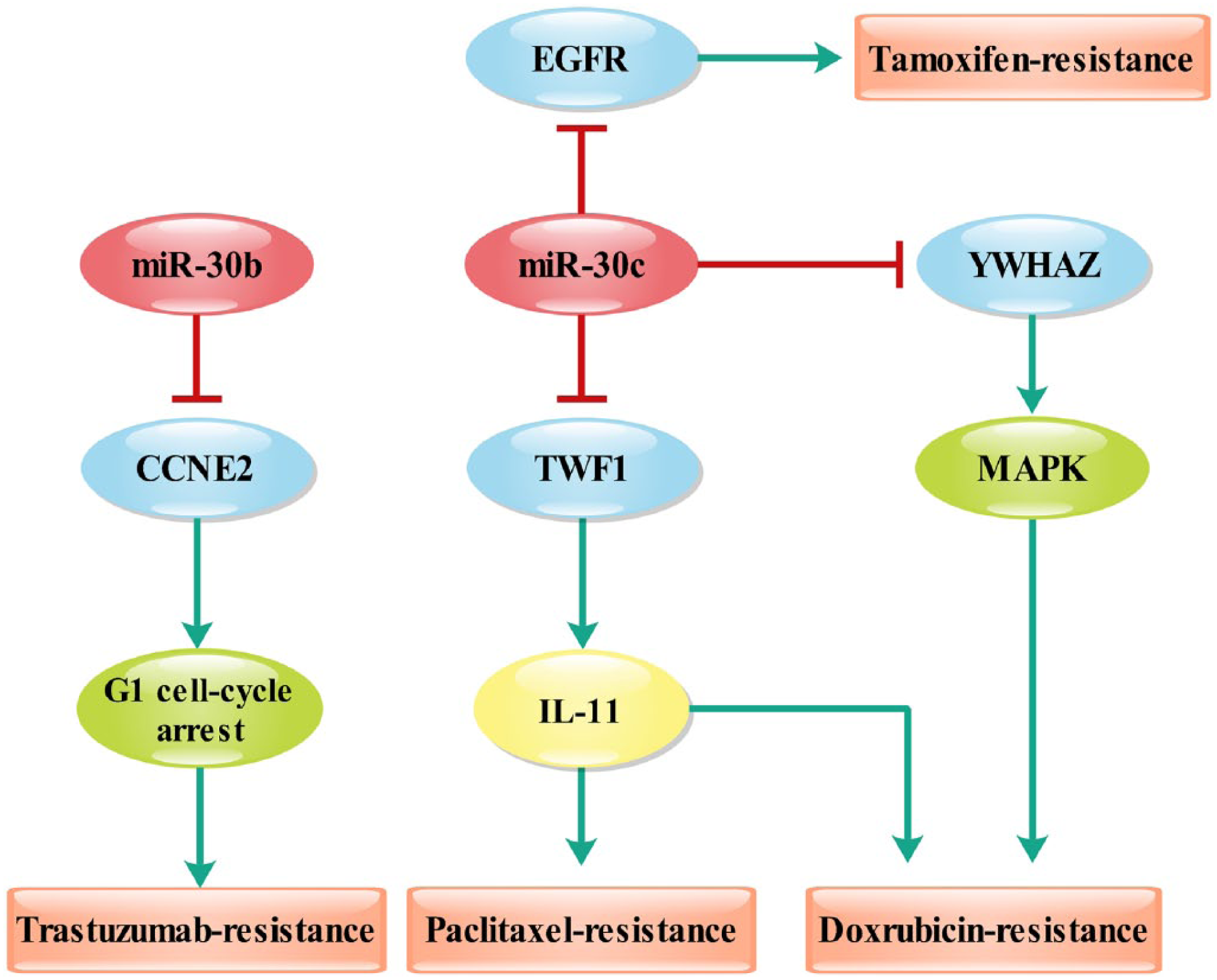
miR-30 family members in drug resistance. miR-30c promotes paclitaxel- and doxorubicin-resistance by targeting TWF1-IL-11 pathway. miR-30c downregulates YWHAZ following the activation of MAPK pathway, resulting in doxorubicin-resistance. In addition, miR-30c facilitates tamoxifen resistance through reducing EGFR expression. miR-30b could induce G1 cell cycle arrest through targeting CCNE2 and following trastuzumab-resistance.
Estrogen receptor-α (ERα) and endocrinotherapy
Studies indicate that miR-30 family plays important roles in the acquisition of anti-estrogen resistance. ERα, expressed in almost 75% of breast cancer, is pivotal in the development and progression of breast cancer. 93 Tamoxifen, a selective ER regulator, is recognized as the first-line endocrine therapy that can significantly prolong the relapse-free and overall survival of ER-expressing breast cancer patients.94,95 However, many ER-positive tumors that initially respond to tamoxifen eventually develop resistance with the continued administration in few years. 96 Studies have identified that miR-30c was positively correlated to ERα and negatively to epidermal growth factor receptor (EGFR); moreover, high expression levels of both miR-30a-3p and -30c could induce clinical benefits in tamoxifen treatment and prolong progression-free survival (PFS) in advanced ER-positive breast cancer patients.69,97 Based on global testing and gene expression data, it was found that miR-30c and miR-30a-3p were both negatively associated with the “RAC1 cell motility signaling pathway” and its driving growth factor receptor (PDGFRa), and enhanced tamoxifen resistance in breast cancer cells. 98 Regarding these findings, miR-30 family may be novel therapeutic strategies to prevent the development of tamoxifen resistance or resensitize tumors to tamoxifen in ER-positive breast cancer patients.
Chemotherapy and chemoresistance
Adjuvant chemotherapy is effective to reduce metastatic recurrence for breast cancer patients after surgery. Unexpectedly, a considerable proportion of women suffer from recurrence or metastasis due to natural or acquired chemoresistance. Recently, chemoresistance was found correlated with miR-30 family members. As reported, the overexpression of miR-30c downregulated the MAPK pathway and resensitized breast cancer cells to doxorubicin by targeting tyrosine 3-monooxygenase/tryptophan 5-monooxygenaseactivation protein zeta polypeptide (YWHAZ). 17 YWHAZ, which codes an anti-apoptotic protein 14-3-3ζ, is frequently reported to modulate MAPK pathways17,99,100 and participate in tumor cell proliferation, apoptosis, and drug resistance.101–104 Overexpression of YWHAZ could contribute to de novo chemoresistance and is permissive for metastatic recurrence in breast cancer cell lines, 101 indicating that reducing YWHAZ expression by miR-30c may enhance chemotherapeutic efficiency or even reverse chemoresistance in some extent. Furthermore, upregulating the miR-30c expression can remarkably reduce the expression of cytoskeleton gene TWF1 and its downstream factor cytokine IL-11, which caused several breast cancer cells resensitized to paclitaxel and doxorubicin treatments. 68
HER2-positive breast cancer and targeted therapy
Trastuzumab (Herceptin), a humanized monoclonal antibody, was recently used to treat HER2-positive breast cancers by targeting HER2 and blocking its function. 105 More recently, miR-30b, -30a, and -30c have been identified that these miRNAs were all related with the trastuzumab response of breast cancer, and moreover, trastuzumab could increase the expression of miR-30b to induce G1 cell cycle arrest and cell growth inhibition by cyclin E2 (CCNE2). 65 Indeed, overexpression of cyclin E1 (CCNE1) was also found to enhance trastuzumab resistance. 106 Since CCNE1 and CCNE2 activate cyclin-dependent kinase 2 (CDK2) and thus initiate DNA synthesis, it is reasonable to consider that the miR-30 family may be a key factor for cell cycle check and apoptosis, and thus affect clinical outcomes of CCNE-mediated trastuzumab treatment in HER2-positive breast cancer patients.
miR-30 family members as prognosis biomarkers
Accumulating evidence suggests that some miRNAs that function as oncogenes or tumor suppressors play crucial roles in tumorigenesis and metastasis, and their expressions are correlated to clinical recurrence, metastases, and survival.107–109 According to many studies, miR-30 family members were recognized as diagnostic and prognostic factors in lung cancer, breast cancer, chondrosarcoma, and prostate cancer (Table 3).69,110–112
Clinical significance of miR-30 family in breast cancer.
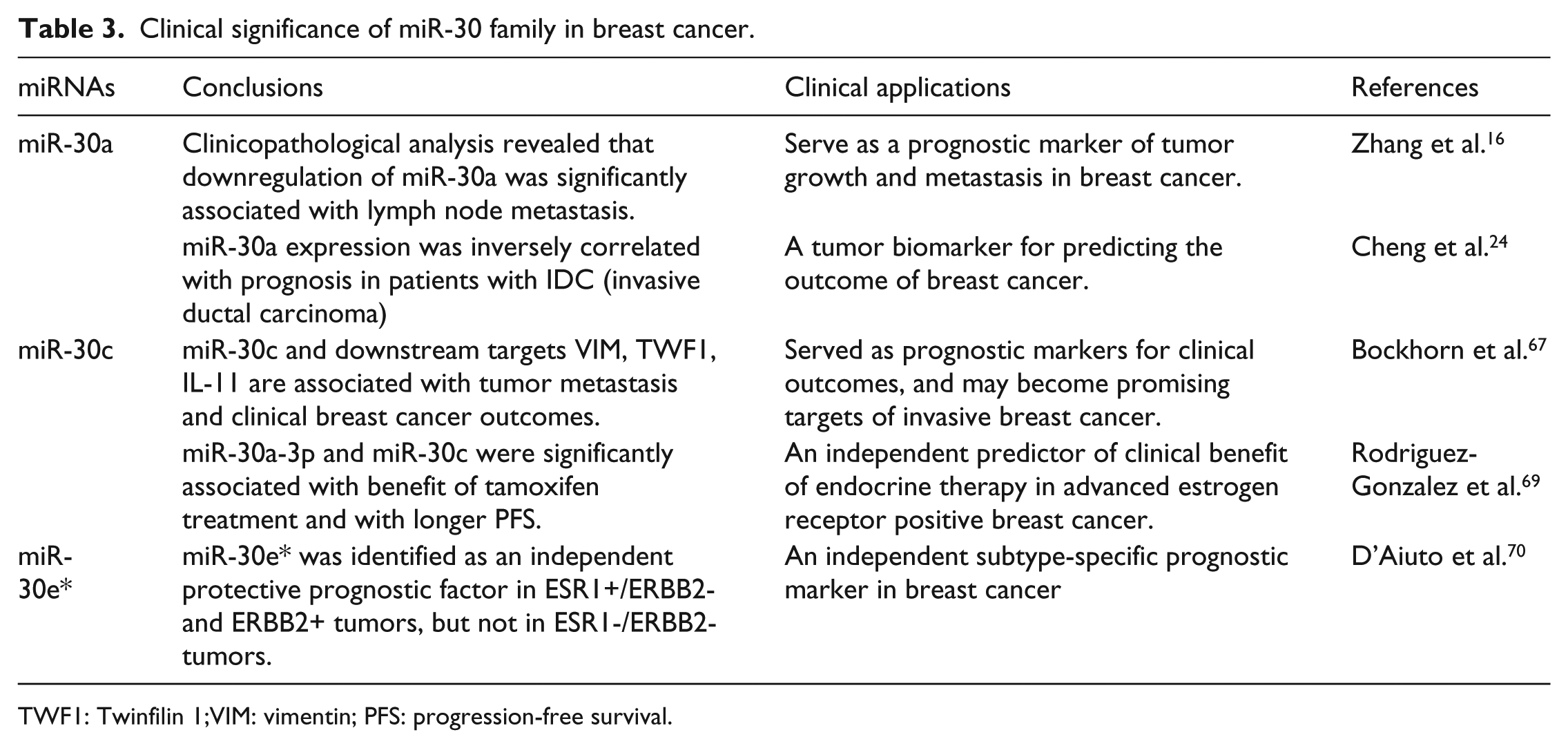
TWF1: Twinfilin 1;VIM: vimentin; PFS: progression-free survival.
In a recent study, miR-30e* was found correlated with a favorable prognosis in ESR1+/ERBB2− breast tumors, and this protective effect on disease-specific survival was proved to be independent of other clinically relevant prognostic factors. 70 However, miR-30e* failed to affect the prognosis of patients with ESR1−/ERBB2− tumors, indicating the relation of miR-30e* expression to protective prognosis was subtype specific. 70 Moreover, miR-30c was discovered as an independent predictor for clinical benefit of tamoxifen therapy and PFS in advanced ER-positive breast cancer patients. 69 Similarly, lower expression of miR-30a was found associated with LNM, advanced stage, and shorter disease-free survival (DFS) in breast cancer patients. 24 All these findings further indicated the crucial roles of miR-30 family in breast cancer development, and the potential ability of these miRNAs served as promising factors for clinical prognosis of breast cancer.
Questions and prospectives
miR-30 family members, which shared the same seed sequence located near the 5′end, have different compensatory sequences located near the 3′end, which endow them with distinct biological behaviors in neoplastic transformation. Accordingly, despite the numerous studies on the relations between miR-30 family members and cancer progression, the differential behaviors of oncogenesis and tumor suppressor in various tumor development make it difficult to summary the functions of miR-30 family in all tumors. In this regard, future studies should be designed to identify the accurate function of each miR-30 family member in one specific tumor.
Although miR-30 family members play various roles both in tumorigenesis and suppression, they mainly act as tumor suppressors in breast cancer genesis, metastasis, and drug resistance, and even become anti-cancer predictive factors for DFS and LNM of breast cancer patients. More interestingly, miR-30e* was proved as a subtype-specific prognosis factor for ESR1/ERBB2 breast cancer, 70 suggesting that miR-30 family members may be subtype-specific factors for either prognosis or clinical treatment of breast cancer.
Conclusion
This review is focused on the roles of miR-30 family members in breast cancer: regulation of tumorigenesis, interference with tumor invasion and metastasis, and reversal of drug resistance. In addition, some miR-30 family members have independent protective effects on prognosis of breast cancer patients. We further elaborate the functions of different family members. Almost all of the miR-30 family members are involved in tumorigenesis, while miR-30b and miR-30c are proved to be able to alter drug resistance in breast cancer. In addition, miR-30a and miR-30c are more associated with EMT progression which has a highly positive correlation with tumor metastasis. Furthermore, miR-30e*, miR-30a, and miR-30c were identified as novel prognosis biomarkers for DFS and LNM of breast cancer patients.
Nevertheless, more studies are needed to explain the functions of the miR-30 family members, and miR-30 family members do act as promising biomarkers and therapeutic targets of breast cancer. Our understanding of the miR-30 family will accelerate the translation of these findings from in vitro to in vivo and bring a novel insight in diagnosis, prognosis, and molecular targeted therapy of breast cancer.
Footnotes
Acknowledgements
The authors thank Su-Yu Yang for useful discussions and helping in revision of this paper. Su-Jin Yang and Su-Yu Yang contributed equally to this work.
Declaration of conflicting interests
The author(s) declared no potential conflicts of interest with respect to the research, authorship, and/or publication of this article.
Ethical approval
This article does not contain any studies with human participants or animals performed by any of the authors.
Funding
This study was funded by the National Natural Science Foundation of China (grant no. 81272470), the National key clinical specialist construction Programs of China (No. 2013[544]), Major Program of Natural Science Foundation of Jiangsu Province (No. BL2014090), Natural Science Foundation of Jiangsu Province (No. BK20151579), the Key Research Program for the Social Development of Jiangsu Province, China (BE2015718), the National Natural Science Foundation of China (grant no. 81602551).