



Abstract
Introduction
A mole or naevus is a lesion that can exist from birth. While some moles are present at birth, others become apparent later in life. The two main symptoms associated with moles are black spots and potential disfigurement. In Ayurveda, an elevated mole is comparable to a condition known as Mashaka. Mashaka is described as a firm, painless, black, and raised eruption on the skin, typically caused by an aggravated Vata Dosha (humor). Modern medical practice commonly manages moles through surgical excision and radioactive procedures to prevent potential malignancy or aesthetic concerns. However, in the Ayurvedic tradition, Mashaka is treated using the Agnikarma (cauterization) procedure. This approach is efficient as it soothes the Vata-Kapha Doshas (humors).
Materials and Methods
Agnikarma (cauterization) is a minor surgical treatment that involves the application of heat (Agni) for therapeutic purposes aimed at reducing and eliminating the lesion. In this case study, a patient complained of a lesion on the right side of the nose. The lesion was diagnosed as Mashaka based on the ABCDE criteria for melanoma assessment, which considers Asymmetry, Border irregularity, Color variation, Diameter, and Evolution of the lesion. An Agnikarma procedure (cauterization) was carried out in a single sitting for this lesion.
Results
After four weeks, the lesion had healed without complaints of bleeding, wound infection, pain, or scarring.
Discussion
The case study demonstrates the efficacy of Agnikarma (cauterization), highlighting its scope as a treatment option for similar conditions, providing a safe and satisfactory outcome for the patient.
Introduction
A pigmented naevus, or mole, is a lesion rich in melanin produced by melanocytes. 1 These cells move from the neural crest to the basal epidermis during development. A naevus is formed when melanocytes group in the dermis or at the dermo-epidermal junction. 2 Moles are commonly found on the face, limbs, and mucocutaneous junctions like the mouth and nose, typically measuring 1–3 mm. 3 They are usually smooth and soft but can also be warty and protrude. In Ayurvedic texts, moles are described under Kshudra Rogas (minor diseases). Acharya Sushruta described Mashaka (elevated mole) as a firm, painless, black, raised eruption caused by Vata aggravation, resembling a Masha (urad) pulse. 4 Acharya Vagbhata refers to black, painless skin sprouts similar to Tilakalaka (nonelevated mole), which, when elevated, are called Mashaka (elevated mole). 5 Agnikarma (cauterization) is considered superior to other parasurgical techniques by Acharya Sushrut. 6 It treats various Kshudra Rogas (minor diseases), including Mashaka (elevated mole). 7
Case Report
Patient Information
A 25-year-old female patient visited the Shalya (Surgery) outpatient department (OPD) of our Ayurvedic college with a complaint of a black, raised lesion on the right side of her nose that had been present since birth.
Clinical Findings
The patient was examined thoroughly; a complete medical history was obtained when she arrived at OPD. The patient was understanding, punctual, and spatially aware. She had no prior history of discomfort, fever, or swelling, and no contributing or exacerbating factors existed. She had not received any medical treatment for the lesion and sought its removal for cosmetic reasons. The patient did not have diabetes, hypertension, or any chronic illnesses, and there was no family history of carcinoma.
Physical and General Examination
The patient’s general and systemic examination results were expected, with no abnormalities detected in vital signs, cardiovascular, respiratory, gastrointestinal, and neurological systems.
Timeline
For the patient, Agnikarma (cauterization) was scheduled. The process was completed in one sitting. The first follow-up was conducted at the one-week mark, and the second follow-up occurred four weeks later.
Diagnostic Assessment
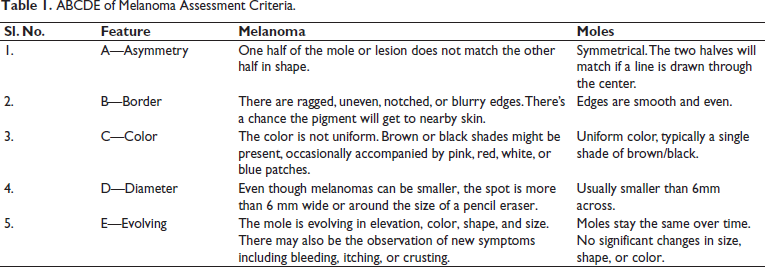
The patient’s lesion was evaluated using the ABCDEs of melanoma assessment criteria (Table 1) and Ayurvedic textual references. 8
ABCDE of Melanoma Assessment Criteria.
The Evaluation Details
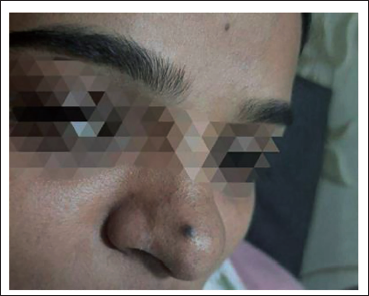
The mole was symmetrical, with both halves matching shape (Asymmetry). The mole’s edges were smooth and even, without any irregularities (Border). The mole’s color was uniform, consisting of a single shade of black (Color). The mole measured 2.5 mm in size (Diameter). There had been no change in the mole’s size, shape, color, or elevation (Evolving). Based on this assessment, it has been determined that the lesion is a Mashaka (elevated mole) (Figure 1) and does not exhibit any signs of melanoma.
Before Treatment.
Therapeutic Intervention: After a thorough evaluation, the patient was scheduled for an Agnikarma procedure (cauterization). The Agnikarma procedure, a traditional Ayurvedic method of cauterization, is divided into three parts: Purva Karma (Preoperative Procedure), Pradhan Karma (Operative Procedure), and Paschata Karma (Postoperative Care).
Purva Karma (Preoperative Procedure): The Agnikarma (cauterization) theater was prepared with essential materials, including Betadine solution for cleansing, Yastimadhu Ghruta (Glycyrrhiza glabra Linn. ghee) for postburn application, Ghritkumari (aloe vera) pulp for cooling, toothed forceps, a flame source, and Panchdhatu Shalaka (probe). The patient was advised to follow a light, oily diet before the therapy. Routine blood tests and a tetanus shot were done. The Agnikarma Shalaka (probe) was heated until red hot. The patient was made to lie on a minor table, the affected area was cleaned with Betadine solution, and the lesion was covered with a sterile drape.
Pradhan Karma (Operative Procedure): The mole base was raised with toothed forceps. When Agnikarma Shalaka (probe) became red hot, it was directly put on the base of the mole. Immediately following the cauterization, aloe vera pulp was administered to the lesion. After that, the process was repeated until Samyaka Dagdha Lakshanas (superficial burned signs) were observed.
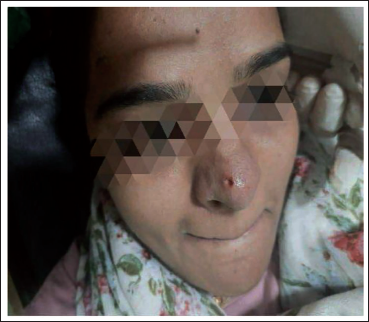
Paschat Karma (Postoperative Care): The lesion was covered with Yashtimadhu Ghruta (Glycyrrhiza glabra Linn. ghee) and left open (Figure 2). The patient was instructed to rest in the supine position in inpatient department (IPD), while careful observation was conducted for complications. After an hour, the patient was advised to go home and not to wet the area for 24 hours. The patient was advised to apply a Yashtimadhu Ghruta (Glycyrrhiza glabra Linn. ghee) locally on the burned lesion site starting the next day and continuing until the wound is healed. 9
After Treatment.
Follow-Up and Outcome
At the first follow-up after seven days, the lesion site was thoroughly examined, revealing a scar.
The patient was advised to continue using Yastimadhu Ghruta (Glycyrrhiza glabra Linn. ghee) and was asked to return for the subsequent follow-up after four weeks. In the ensuing follow-up, patient and observer evaluations were conducted using the Patient and Observer Scar Assessment Scale (POSAS) (Table 2). 10
POSAS Results at Second Follow-Up.
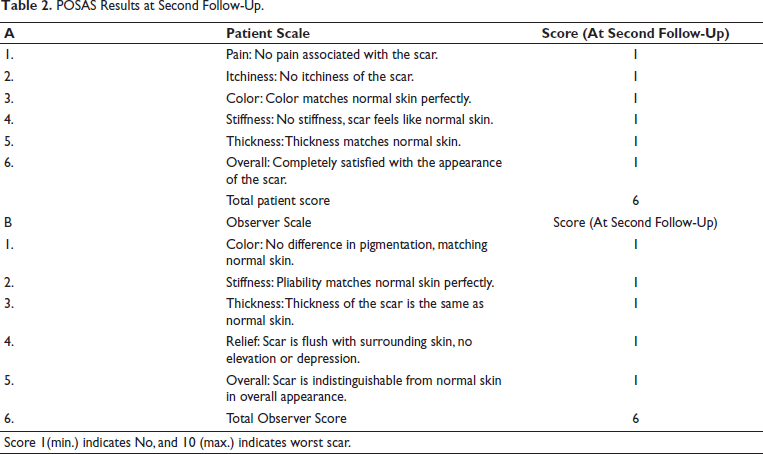
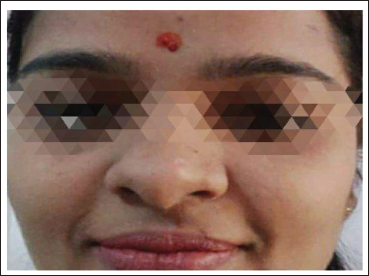
The POSAS indicated that the lesion site had healed perfectly, with no noticeable scar. The patient reported no discomfort or dissatisfaction, and the clinical examination confirmed that the skin at the site matched the surrounding normal skin in all evaluated aspects. The patient’s complaint was resolved entirely within a month, and the lesion healed without leaving any scar (Figure 3).
After Four Weeks (2nd Follow-Up).
Discussion
Agnikarma, also known as cauterization, is a traditional Ayurvedic treatment that uses heat to address various medical conditions. It is particularly effective for conditions like elevated moles, which are associated with an imbalance in the body’s Vata (humor) and Kapha (humor) elements. In Ayurveda, each tissue in the body has an inherent energy, known as Dhatwagni, responsible for maintaining its health and balance. When this energy is low, diseases can develop. Agnikarma works by applying external heat to boost this internal energy, helping to balance the body’s elements and promote healing. The heat from Agnikarma helps to “digest” the imbalanced elements, reducing symptoms and preventing the recurrence of the condition. It also enhances local circulation and metabolism, which supports the growth of new tissue and minimizes scarring. 11 After the procedure, aloe vera pulp is often applied to soothe any burning sensation. Additionally, Yastimadhu ghee (a medicinal ghee made from the Glycyrrhiza glabra plant) is used for its antiseptic, anti-inflammatory, and wound-healing properties. 12 The Panchadhatu Shalaka, a unique metal probe, is used during Agnikarma to deliver therapeutic heat deep into the tissue, effectively reducing pain and inflammation. 13 In this case, a patient’s elevated mole was successfully removed with Agnikarma in a single session, leaving no scars.
Conclusion
Agnikarma (cauterization) is more cost-effective than surgical excision in managing Mashaka (elevated mole). Additionally, there is no possibility of bleeding or recurrence. In managing Mashaka (elevated mole), the Agnikarma (cauterization) was highly successful and curative, as demonstrated by this case study. In this case, no scar remains; it might also be produced for cosmetic reasons. Agnikarma (cauterization) is a very effective treatment for Mashaka (elevated mole).
Footnotes
Abbreviations
Acknowledgments
Jagrati Gautam would like to express my sincere gratitude to my guide and all those who have contributed to this case report.
Declaration of Conflicting Interests
The authors declared no potential conflicts of interest with respect to the research, authorship and/or publication of this article.
Ethical Approval
Not applicable.
Funding
The authors disclosed receipt of the following financial support for the research, authorship, and/or publication of this article: Datta Meghe Institute of Higher Education and Research (D.M.I.H.E.R), Maharashtra, India.
Informed Consent – Case Reports/Clinical Images
Consent was taken from the patient before doing Agnikarma.
