




Abstract
Background
In the modern era of dentistry, natural and herbal alternatives are favored since they are renewable, have fewer adverse effects, and are cost-effective.
Purpose
To assess the effectiveness of different intracanal medications in eliminating Enterococcus faecalis.
Materials and Methods
In total, 50 single-rooted extracted teeth were decoronated at the cemento-enamel junction followed by the preparation of the canal. Then, in each of the presterilized samples, inoculum containing the E. faecalis was transferred and incubated at 37°C for 24 hours. Samples were allocated into 5 groups of 10 each: Group A (saline), Group B (calcium hydroxide), Group C (Curcuma longa), Group D (honey), and Group E (nitrofurantoin group). The medicaments were injected into the canals respectively, the antibacterial assessment was done on the 1st and 7th day. Dentinal shavings are incubated and streaked on Mueller–Hinton agar plates and incubated for 24 hours at 37°C and the colony forming units (CFUs) were assessed.
Results
Among all the groups, there was a significant change in the number of colonies from Day 1 to Day 7, except in Group A (saline). Comparison between the groups revealed significant differences, with better efficacy by Group D (honey) followed by Group E (nitrofurantoin) and Group C (C. longa). The least antimicrobial efficacy was observed with calcium hydroxide and no activity with saline.
Conclusion
Honey has the greatest antimicrobial efficacy among all the tested intra-canal medicament groups.
Introduction
The most prevalent and resistant pathogen causing recurrent peri-radicular lesions and ultimately endodontic failure is Enterococcus faecalis, a facultative, anaerobic, gram-positive bacteria. 1 By culturing techniques, this bacteria is detected in root canal failures in about 24%–70% of cases, and in 67%–77% of cases by molecular techniques. 2 Antimicrobial drugs known as intracanal medications are primarily used to treat infections, periapical discomfort, possible inflammation, and the breakdown of organic and inorganic materials. 3 An ideal intracanal medicament should be non-toxic and have greater absorptivity into all components of the root canal, as well as anatomical complexity.
For decades, calcium hydroxide (Ca(OH)2) was considered the primary choice as intracanal medicament due to its potent antimicrobial and anti-inflammatory properties, thereby accelerating the repair process of periapical lesions. 4 However, it does not eliminate the whole spectrum of microorganisms including E. faecalis, and also makes the tooth more susceptible to fracture. 5 The above limitations of Ca(OH)2 led researchers to begin exploring medications with a wider range of antimicrobial activity. A wide spectrum of bacteria as well as multidrug-resistant microbes can be successfully treated with nitrofurantoin. 6 Some of the negative consequences include hypersensitivity, immunological suppression, and allergic reactions, which made it necessary to look for new and potent antimicrobial substances in plants and herbs. 7
Among the innumerable species of medicinal herbs, turmeric (also known as “Curcuma longa”) is one of the most popular medicinal plants used to treat various diseases due to its biological properties like anti-inflammatory, antimicrobial including viral and fungi, anti-diabetic, anti-coagulant, hepatoprotective, hypotensive, and hypocholesterolemic effects. 8 Honey is another natural product that has a potent broad-spectrum antimicrobial activity and has been used in the treatment of gingivitis, stomatitis, and erosion, suggesting a therapeutic role. Several enzymes, including glucose oxidase, catalase, and acid phosphatase, present in honey are crucial for the generation of hydrogen peroxide, which has an antimicrobial impact.9, 10
These natural substitutes have long been utilized in both traditional and modern medicine. But there has not been much research done on their application in dentistry. Also, to date, there is no reported dental literature on the comparative evaluation of antimicrobial efficacy between the herbal and medicated intracanal medicaments against E. faecalis, therefore an attempt was made to evaluate their antimicrobial properties when compared with Ca(OH)2. Hence, the present study was performed to evaluate the antimicrobial efficacy of C. longa, honey, nitrofurantoin, and Ca(OH)2. The study’s null hypothesis was that the aforementioned antimicrobials do not significantly differ from one another in their ability to eliminate E. faecalis bacteria.
Materials and Methods
The current in vitro study was done in the Department of Conservative Dentistry and Endodontics, in collaboration with the Microbiology Department, Panineeya Mahavidyalaya Institute of Dental Sciences and Research Centre, Dilsukhnagar, Hyderabad. Ethical clearance was obtained from the Institutional Review Board (PMVIDS&RC/IEC/CONS/DN/334-20).
The study comprised 50 single-rooted human teeth extracted for orthodontic and periodontal reasons with mature and straight roots, free of cavities, morphological abnormalities, calcifications, and root resorption, which were collected from the Department of Oral and Maxillofacial Surgery. The 50 teeth were allocated into 5 groups of 10 each based on the type of intracanal medicament used: Group 1 (saline), Group 2 (calcium hydroxide paste [Ivoclar, Apexcal, India]), Group 3 (C. longa gel [Curenext, Abbott, India]), Group 4 (honey [Dabur, India]), and Group 5 (nitrofurantoin paste).
Sample Preparation
The teeth were rinsed under running water to clean any material from the teeth. To keep the teeth from drying out, specimens were stored in 0.9% saline at room temperature until their use. Using a rotary diamond disc, the crowns of all the specimens were cut perpendicular to the long axis at the cemento-enamel junction (CEJ). Using the Vernier calipers, the length was reduced and consistent to 10 mm. After pulpal extirpation, the canals were examined for apical patency and instrumented with the nickel-titanium Pro-Taper universal rotary system within the working length until size F2. The samples were irrigated for 2 minutes each with 3% sodium hypochlorite solution, 0.9% w/v saline solution, and 17% ethylene diamine tetra acetic acid (EDTA) solution.
Three coats of clear nail polish were applied to all exterior root surfaces, except the coronal access, in order to seal the apical foramen of the root and stop bacterial leakage. After that, the teeth were allowed to dry. Then, the samples were autoclaved at 121°C for 20 minutes while being covered in green cloth.
Preparation of Microbial Cultures
The laminar airflow chamber served as the backdrop for all of the tests. In brain heart infusion (BHI) broth, E. faecalis was cultured for 24 hours at a concentration of 1 × 10⁶ cells/mL with the turbidity adjusted to Mc Farland 0.5. Following that, the samples were placed in microcentrifuge tubes, the canals were filled with 100 µL of bacterial inoculums using a sterile 100 µL pipette, and stored in an incubator at 37°C for 24 hours.
Preparation of the Medicaments
Water-based Ca(OH)2 paste was used which is available in a syringe form (Apexcal, Ivoclar, India). A paste-like consistency of nitrofurantoin was achieved by combining 25 mg of nitrofurantoin powder, 80 mg of methylcellulose, and 1 mL of sterile distilled water on a glass slab. Curcuma longa was used in gel form which is commercially available (Curenext, Abbott, India), whereas honey was used in viscous liquid consistency which is commercially available (Dabur, India).
Dispensing of Medicaments
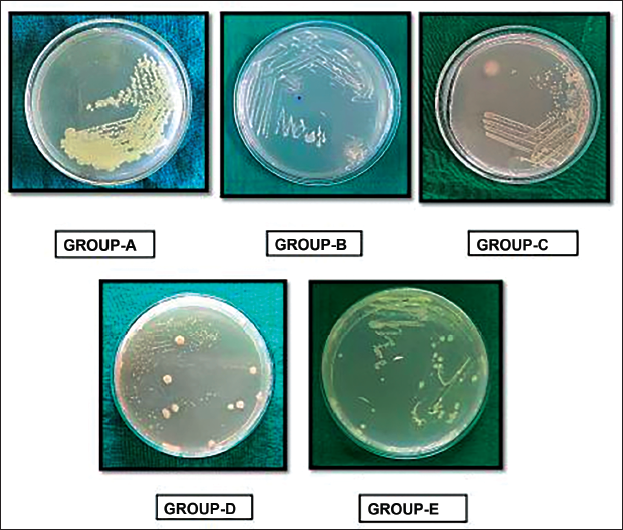
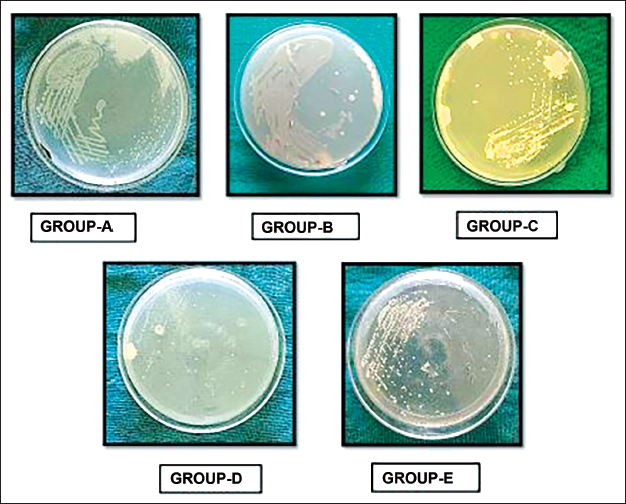
All the specimens were irrigated using 10 mL of saline to remove the incubation broth. Then, each root was taken from the microcentrifuge tube. Using lentulospirals, in each group the canal space of all the samples were filled with their respective prepared medication. The negative control group (Group A) roots received saline in the same manner as the medicament groups. All the specimens were sealed using paraffin wax, placed in sterile microcentrifuge tubes, returned to the incubator at 37°C, and evaluated on Day 1 and 7 (Figures 1 and 2).
Inhibition of Enterooccus Faecalis After One Day.
Inhibition of Enterococcus Faecalis After 7th Day.
Antimicrobial Assessment
The roots were taken out of the incubator and given a serial number after the 24-hour incubation period. To assess bacterial viability and measure CFUs, the contents of the canal were collected using a paper point of size 40, streaked on Mueller Hinton agar plates, and cultured for 24 hours at 37°C in an incubator. CFU counts of all the samples were kept track of.
Sampling of the Lumen Content After One Day
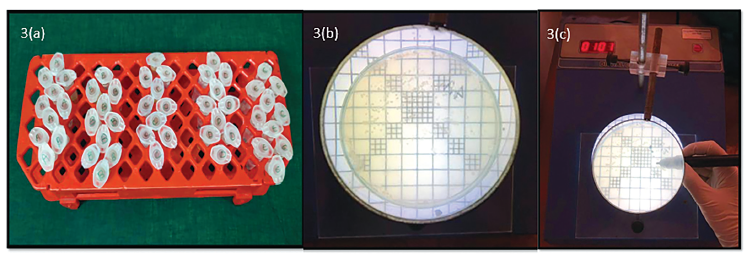
Half of the samples from each group were randomly selected, sealed wax was removed and canals were irrigated with 10 mL of distilled water by using a sterile syringe, dried with paper points followed by collection of dentinal chips (Figure 3a) in BHI broth by using sterilized H-files, the broth with viable bacteria was streaked on Muller Hinton agar plates under laminar airflow and incubated for 24 hours at 37°C. The procedure was repeated for the rest of the samples after 7 days of intracanal medicament placement, incubated similarly and CFUs for all the teeth were recorded.
(a) Dentinal Chips Collected in BHI Broth for all Medicated Samples and Returned to Incubator; (b) Agar Plates Mounted on Illuminated Colony Counting Machine; (c) Colony Counting in Digital Colony Counting Machine.
Colony Counting Under the Colony Counting Machine
The agar plates containing the viable microbes were placed on the digital colony counting machine. They were illuminated and placed on an electronic pressure pad and touched with a felt tip pen to mark each colony as shown in Figure 3b and c. The touch pressure caused a count to be registered on the digital display, which is confirmed by an audible tone, advancing one digit on an LED display. Counting was made convenient by dividing the plate into several square divisions and magnifying the colonies with a magnifying glass that was mounted on a flexible arm usually provided as an accessory.
Statistical Analysis
Data was compiled using a Microsoft Excel spreadsheet, and statistical analysis was performed using SPSS version 20 software (Statistical Package for Social Sciences from IBM Corp. in Armonk, New York, USA). Paired t-test and one-way analysis of variance (ANOVA) with a post hoc test were the statistical tests used. Statistical significance for the least significant difference (LSD) approach was established at a p value of .05.
Results
Table 1 shows an intragroup comparison of the mean log of colony forming units (CFUs) at Day 1 and Day 7 using paired t-test. The results indicate that after the placement of intracanal medicaments, there was a significant reduction in the numbers of the CFUs in Group B (p = 0.000 ≤ 0.05), Group C (p = 0.005 ≤ 0.05), Group D (p = 0.012 ≤ 0.05), and Group E (p = 0.011 ≤ 0.05). While the Group A did not reveal any reduction in the microbial count. p < 0.05 considered statistically significant.
Descriptive Data and Intragroup Comparison of Means of CFU at Day 1 and Day 7 Post Intra-canal Medicament.
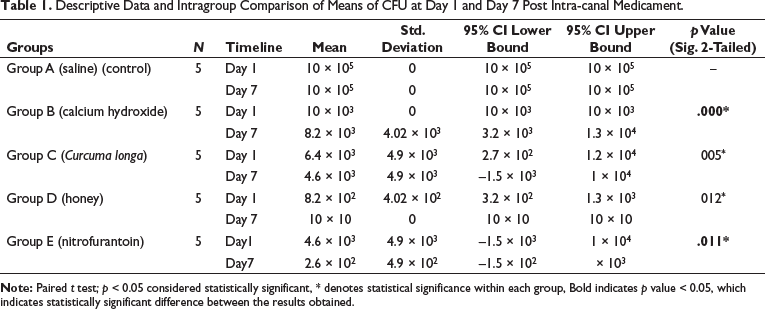
Table 2 shows an intergroup comparison at the end of Day 1 and Day 7 post intracanal medicament using one-way ANOVA. After Day 1, there was an overall significant difference in the mean log CFU (p = 0.000). After Day 7, there was an overall significant difference in the mean log CFU (p = 0.000). Group A, the negative control group (saline), showed the highest mean CFU among all the groups after Day 1 and Day 7. Group C (C. longa) showed significantly less mean CFU compared to Group B (calcium hydroxide) but more compared to Group D (honey) and Group E (nitrofurantoin). Group E (nitrofurantoin) showed significantly less mean CFU compared to Group B (calcium hydroxide), Group C (curcumin) but more compared to honey group. Group D (honey) showed significantly least mean CFU among all the groups.
Intergroup Comparison of Numbers of CFUs at the end of Day 1 and Day 7 Post-medicament.
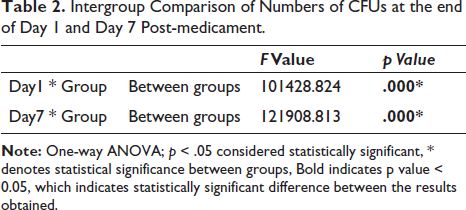
Table 3 shows the post hoc analysis done with the LSD method to further analyze pair-wise differences. Intergroup comparison on Day 1 revealed that there was a significant difference in the reduction of colony count except when Group C (C. longa) was compared to Group B (calcium hydroxide) (p = 0.083 ≥ 0.05) and Group E (nitrofurantoin) (p = 0.37 ≤ 0.05), and also between Group D (honey) (p = 0.012 < 0.05) and Group E (nitrofurantoin) (p = 0.07 ≥ 0.05). While on Day 7, there was no significant variance in colony count between Group B (calcium hydroxide) (p = 0.083) and Group C (C. longa) (p = 0.06), and between Group D (honey) (p = 0.012 ≤ 0.05) and Group E (nitrofurantoin) (p = 0.844 ≥ 0.05).
Intergroup Comparison of Number of CFUs at the End of Day 1 and day 7 – post hoc Analysis.
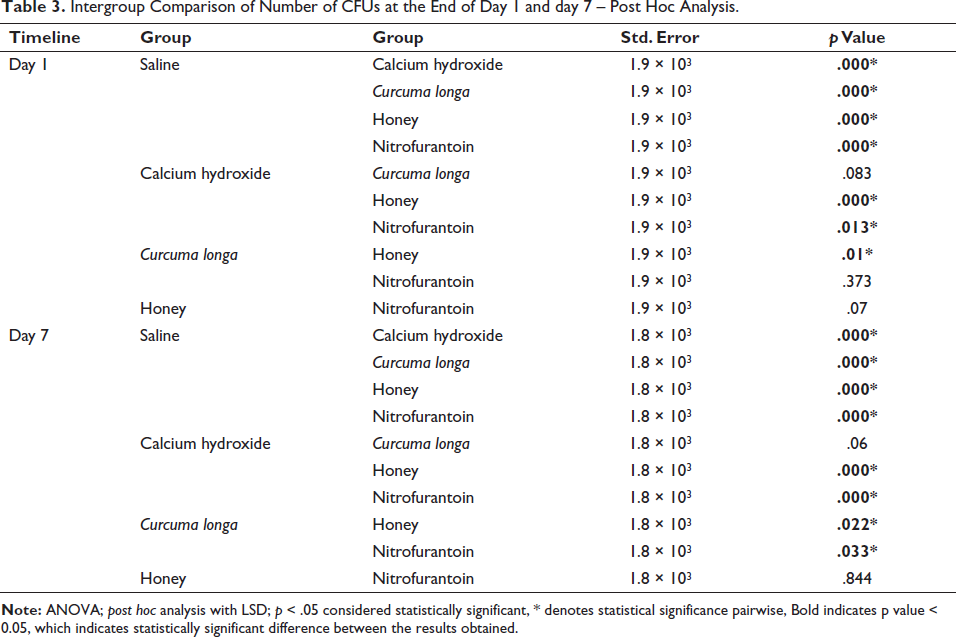
To sum up, the antimicrobial efficacy or the inhibitory effect against the growth of E. faecalis is in the following order:
Group D (honey) > Group E (nitrofurantoin) > Group C (C. longa) > Group B (calcium hydroxide) > Group A (saline)
Discussion
Enterococcus faecalis microorganism has a variety of unique traits that allow it to persist in root canals, including the capacity to withstand high temperatures (60°C), extreme pH levels (9.6), salt concentrations, and starvation periods, antimicrobial resistance, to deeply invade dentinal tubules and adapt to changing environmental conditions.11, 12 Therefore, the eradication of this facultative anaerobe requires an effective antimicrobial treatment regime. Intracanal medicaments are antimicrobial agents that help eliminate residual bacteria after biomechanical preparation of the infected canal. However, the biocompatibility of these medicaments should be assessed due to the potential risk of hypersensitivity and inflammatory reactions caused by chemical leakage through the apical foramen. 6
For antimicrobial assessment, the CFUs counting method was employed as it is considered the gold standard for bacterial count and can count any number of bacteria using dilutions. This method gives accurate results as it does not include dead bacteria or debris and only the viable bacteria are counted. 13
The antimicrobial efficacy of Ca(OH)2 is well documented in endodontics. However, fewer studies reported its lower efficacy against E. faecalis even after applying it for a long time.14, 15 Hence, in the present study, the antimicrobial efficacy of Ca(OH)2 was verified against the potent antimicrobial agent named nitrofurantoin, and natural products like turmeric and honey. The reason nitrofurantoin was chosen antibiotic as it has a nitro-substituted furanyl side chain that the bacteria will metabolize to form reactive chemicals that have bactericidal action. Additionally, the sensitivity of E. faecalis to nitrofurantoin ranged from 95% to 100%. 12
The main benefits of employing natural and herbal alternatives are their accessibility, affordability, longer shelf life, low toxicity, and the absence of microbial resistance. 16 Curcuma oral gel (Curenext) was used in the present study as each gram of gel contains 10 mg of C. longa extract (Rhizome) and gel base. It was chosen owing to its easy availability and proven efficacy against E. faecalis.17, 18 Honey was considered in this study as it has a broader spectrum of antimicrobial action including E. faecalis. High osmotic pressure, low pH-acidic environment, hydrogen peroxide produced by the glucose oxidase system, low protein content, low redox activity (Eh), and high amount of reducing sugars are the factors that may be responsible for the antimicrobial characteristics of honey. 19
The findings of the current study indicated that natural treatments have a substantial potential to be used in root canal therapy. All experimental drugs considerably outperformed Ca(OH)2 in terms of antimicrobial activity. Thus, the null hypothesis was denied. In the present study, Group A (saline) which is a negative control group showed the highest mean CFU as no medicament was administered in this group.
In Group B, that is the positive control group, with Ca(OH)2 the mean CFUs were significantly less compared to Group A, but significantly higher than the other experimental groups suggesting reduced activity of Ca(OH)2 against E. faecalis. This result was in accordance with the results of Safavi et al., 20 Sequiera et al., 21 and Singh et al. 22 indicating that E. faecalis may remain viable even after relatively longer exposures to Ca(OH)2 . In line with the present study findings, Chamele et al. 23 also reported lower antimicrobial activity of Ca(OH)2 than Curcumin due to the inability of the hydroxyl ions to diffuse in the dentinal tubules at sufficient concentration.
Curcuma longa belongs to the family, Zingiberaceae and is commonly known as Turmeric. Curcumin an essential component of C. longa possesses antibacterial, antiapoptotic, antiangiogenic, antineoplastic, antithrombotic, immunomodulatory, and wound healing properties. In the present study, C. longa has shown moderate activity in disinfecting the dentinal tubules, which may be ascribed to its ability to remove the extracellular polysaccharide matrix of bacteria by membrane disruption and cell wall perturbation. It is a polyphenolic compound which strongly inhibits bacterial cell proliferation by hindering the assembly dynamics of FtsZ in the Z-ring needed for bacterial cell division. 17 This is in accordance with studies done by Kumar H et al. 24 and by Vasudeva et al. 25 who compared various herbal intracanal medicaments and showed that C. longa performed better than Ca(OH)2 and saline because of its phototoxic effects against a wide spectrum of bacteria.
The study done by Eskandarinezhad et al. also showed that curcumin had the most significant effect, followed by Ca(OH)2 and aloe vera. 26 The results of the present study are in contrast to those of Upadhyay et al., who found that turmeric alone exhibits the lowest mean value for the zone of inhibition, followed by Metapex, Ca(OH)2, and turmeric combined with Ca(OH)2, which exhibits the maximum mean value for the zone of inhibition for all three-time intervals tested. The probable reason could be aqueous extracts of turmeric and Ca(OH)2 were employed in this study. This caused turmeric to be less effective than Ca(OH)2. This is most likely due to the use of less viscous Ca(OH)2, which is known to be more effective at removing E. faecalis from dentinal tubules than viscous preparations of Ca(OH)2. 1
Further Prabhakar et al found that chlorhexidine alone completely inhibited the bacteria, followed by Ca(OH)2 (64%) and turmeric (54%). The use of an aqueous extract of turmeric that was converted into a paste with a pH adjustment of 6.5 resulted in less efficacy. The limited antimicrobial effectiveness of curcumin in a study by Swapnil et al. 27 may be caused by the use of varied concentrations as well as depending on the plant section utilized and the extraction technique used. They proposed that climatic conditions under which the rhizomes of curcumin collected also influence the availability of active elements in the plant material.
In Group D (honey) the mean CFUs were less than Group C (C. longa) indicating better antimicrobial efficacy of honey compared to C. longa, which is in accordance with the study done by Damre 28 and Bilal et al. 29 found that honey exhibited good antimicrobial activity against gram-positive and gram-negative bacteria. Raied T ahe Al-Naama (2009) reported that 100% honey concentration showed a higher zone of microbial inhibition when compared to that of 50% honey concentration. 30 In a study conducted by Litik Mittal et al. (2012) 100% honey had significant antimicrobial action against a broad spectrum of bacteria. 31 In contrast, Vasudeva et al observed better activity of C. longa than honey, despite taking the pure form (100%) of honey. Pure honey consists of alkaloids, auterquinone glycosides, flavonoids (pinocembrim), and reducing compounds. The release of hydrogen peroxide (inhibine), antibacterial compounds (enzyme lysozyme), and osmotic effect of high sugar content in honey inhibits microbial growth. 28
Not many articles are reported in previous literature regarding the efficacy of nitrofurantoin toward E. faecalis, However, Alrahman et al. 12 reported excellent antibacterial activity of nitrofurantoin against E. faecalis. Nitrofurantoin showed better efficacy than Ca(OH)2 which is in accordance with the study done by Mann et al. 32 in which nitrofurantoin paste showed zero CFUs, indicating that E. faecalis had been completely eradicated. But, the Ca(OH)2 group showed the presence of CFUs, indicating its inefficiency in eliminating E. faecalis. In the present study, the activity of nitrofurantoin can be attributed to its broad spectrum bacteriostatic and bactericidal activity. It denatures the bacterial ribosomal proteins, which suppressing many vital processes in the bacteria such as aerobic energy uptake and synthesis of cell walls, DNA, RNA, and protein.
In this study, the intra group comparison shows decrease in the mean CFUs from Day 1 to Day 7 in Group B (calcium hydroxide), Group C (C. longa), Group D (honey), and Group E (nitrofurantoin). According to the literature, it was proposed that the efficacy of medicaments increases with increase in the application time. Sjogren et al. demonstrated in their study that using Ca(OH)2 powder with different vehicles such as saline, distilled water and anesthetics helps in maintaining the high pH for at least 7 days. 33 The results of the present study were in accordance with study by Singh et al. who concluded that C. longa showed 60% reduction in bacterial cell count of E. faecalis over a period of seven days. 22
Conclusion
Under the limitations of this study, it can be concluded that
Honey has the highest antimicrobial efficacy against E. faecalis after Day 1 and Day 7 when used as an intracanal medicament.
Nitrofurantoin, C. longa, and Ca(OH)2 also showed good efficacy against E. faecalis but less than honey.
When a comparison was made between Day 1 and Day 7 efficacy of the medicaments, there was a statistical decrease in the mean CFUs after one week in Group B (calcium hydroxide), Group C (C. longa), Group D (honey), and Group E (nitrofurantoin).
Therefore, natural products like honey, C. longa and nitrofurantoin antibiotics have good antimicrobial properties and hold a promising future as intracanal medicaments against E. faecalis but further clinical research is required to advocate their use in vivo.
Abbreviations
Footnotes
Declaration of Conflicting Interests
The authors declared no potential conflicts of interest with respect to the research, authorship, and/or publication of this article.
Ethical Approval
Ethical clearance was obtained from the Institutional Review Board (PMVIDS&RC/IEC/CONS/DN/334-20).
Funding
The authors received no financial support for the research, authorship, and/or publication of this article.
Informed Consent
Not applicable.