




Abstract
Fragility refers to weak regional institutions that fail to respond to specific risks and needs of the community. The article aims to measure fragility and its effects on labour market employment and wages. The observed non-work-related migration is used to derive annual fragility indices for regions that are then incorporated into standard labour market employment and Mincer wage equations. The estimates indicate higher employment but lower wages in fragile regions. Under weak institutions, workers will decide to engage in alternative low-paying work arrangements in anticipation of conflict, environmental or income shocks. Furthermore, biases on effects of macroeconomic policies can be noted in regression estimates that do not control for fragility.
Introduction
Fragility refers to the weak capacity of the state to carry out basic functions of governing a population and its environment, and the inability to mutually build constructive and reinforcing relationships with society (Hoeffler, 2013). Specifically, this refers to the incapability of the state to deliver its basic functions of human security, economic inclusion and social cohesion (Baliki et al., 2017; Brinkerhoff, 2011).
Fragile states partly explain middle-income traps in which a country is unable to complement its growth strategies with appropriate institutional reforms at the local or regional level (Desai & Forsberg, 2020). After reaching a certain level of growth, the state becomes incapable of designing a political process to properly manage risks, reconciling the welfare of the citizen and interests of the state and enforcing a more equitable equilibrium. Kaplan (2008) pointed out that fragile states are underpinned by structural problems, that is, political identity fragmentation and weak national institutions that preclude the formation of a dynamic and inclusive state. Besley and Perrson (2011) point to the fiscal capacity of governments as a key ingredient for existing fragility. The issue of inclusivity or redistribution, thus, lies at the heart of fragile states. These issues are crucial in responding to unexpected crises, such as post COVID-19 scenario, as well as intermittent farmer and labour union uprisings.
In the Philippines, fragility stems from the insufficient delivery of basic services and security that have been devolved from the national government to local government units (LGUs) since 1991. As growth is centered in Metro Manila and neighboring regions, other areas, especially in Southern Mindanao, faced difficulties in delivering services beyond providing basic facilities for agriculture and fisheries and health. General and economic services, such as communications and roads, as well as agrarian reform, public order and safety and social security that are crucial to addressing the connectivity, efficiency and inequality are therefore outside the reach of these regions. Social protection measures, such as conditional cash transfer programs, are run only by the national government, although LGUs can institute family programs not covered by the state if resources are available.
The regional fragility can be traced to four structural constraints (World Bank, 2021). First, these LGUs collect insufficient revenues, thus contributing to a mismatch between their budget system and their service delivery responsibilities. Second, given various legal restrictions of regions to raise their revenues, the inter-governmental fiscal transfer system created horizontal fiscal imbalances and inequality across local governments. Third, overlapping service delivery responsibilities across the national, sub-national and local levels of government diffuse accountability. Fourth, LGUs continue to depend on the national government for the delivery of devolved public services due to the lack of technical capacity.
These institutional weaknesses, especially their limited funds, lack of accountability and technical capacity, affect labour market outcomes as these heighten the problem of asymmetric information in the labour market. A well-established principle of economics, asymmetric information results in imperfect labour markets because uninformed workers are exposed to potential exploitation, depressing wages that employers are willing to pay for a service and discouraging many transactions that would otherwise be desirable to workers and employers (Akerlof, 1970; Kar & Datta, 2015). 1
Because of fragility, institutional reforms needed to enforce market adjustments to address these problems are not implemented. De Dios and Williamson (2015) and Tecson (2007) pointed to the path dependence of Philippine institutions that resulted in regional concentration.These policies persisted in favoring industrial regions, due to political values and beliefs, despite strong macro-economic fundamentals and several reforms aimed at region decentralization. 2 Because of the lack of social services in non-industrial regions, workers there are forced to accept low-quality jobs as a way of coping with the situation (Brück & Schindler, 2009). Despite lower unemployment rates compared to the national average in fragile regions, underemployment and poverty rates are relatively higher (see Appendix A).
Specifically, fragility and associated information costs created disincentives for the use of permanent, regularly compensated contracts as market uncertainty impeded long-term worker-specific investments. Informal, mostly part-time and irregularly compensated, arrangements are then preferred by employers and workers. Informality is, thus, correlated with weak institutions (Kanbur, 2009; Singh et al., 2012) and participation in informal markets becomes a means of survival for most workers (Mallett & Slater, 2012).
In non-fragile regions, lower wages results from lower productivity and thus, decreased labour demand (e.g., Belser, 2013; Franceschelli et al., 2010). In fragile states, the overabundance of labour and institutional weakness, which is associated with capital scarcity, can lead to an increased labour supply in less specialized, mostly informal, lower-scaled, sectors, hence resulting in lower wages (e.g., Banerjee & Duflo, 2007; Campbell, 2013).
Adapting from Lanzona and Evenson (1997), this article will test these arguments by estimating an index for regional (not state) fragility that can be used to measure the effects of fragility on wage labour market employment and earnings. Unlike the existing fragility indices 3 , this article measures fragility in terms of how much workers in the regions are exposed to institutional weaknesses.
The article measures fragility in terms of the correlation of involuntary migration with institutions found across the regions. Given its adverse effects on households and individuals, fragility is associated with forced or involuntary migration as people seek to avoid its debilitating effects (Martin-Shields, 2017; Sørensen et al., 2003). Using regional dummy variables to instrument for regional institutions, indices of fragility are thus exogenously derived for each region.This index, thus, allows an analysis of institutional weaknesses within the region that forms the basis for state fragility.
This formulation of a regional index then allows a microeconomic perspective of fragility that is missing in the literature. Unlike aggregate indices, the regionally-based fragility index used in this article is independent of broad-based policies, making it possible to measure without bias their joint effects on labour market outcomes.
Finally, by adopting this measure of fragility, the article shows that macro-economic policies that do not incorporate fragility in their design are not effective in improving these labour market outcomes. In this regard, Chami et al. (2021a) claim that interventions, such as macro-economic stabilization policies that aim to improve growth and reduce market disruptions can cause perverse effects on welfare if institutions are incapable of delivering necessary services in fragile states. The macro-economic interventions that ignore fragility can reinforce uncertainties and risks in fragile regions, increasing the costs of labour-intensive enterprises, and promoting a search for alternative arrangements to traditional contracts.
The rest of the articleis divided as follows: Section II features the theoretical model used to analyse the presence of state fragility in labour market decisions and how this influences the effects of macro-economic policies. In Section III, the data and empirical methodology are assumed. The assumptions for measuring state fragility are discussed, using as background the migration decisions of individuals in low-income, institutionally weak regions. The different types of migration are discussed to determine the procedure for estimating state fragility. For the estimation of wage labour decisions and wage function, the two-step maximum likelihood estimate using the Heckman (1979) procedure is adopted. Section IV discusses the data and results of empirical tests. Section V provides conclusions and policy implications.
The Impact of Fragility on Labour Outcomes
For workers who choose to remain in their areas of origin, the fragility of regional institutions can cause them to participate less in the labour market. However, in the absence of insurance markets and capital investments (mainly, for basic services) to mitigate the impact of weather and other income shocks, risk-averse workers might seek contractual labour arrangements that substitute in part for absent insurance markets but pay lower wages (Behrman, 1999). With their assets being depleted or sold, adult workers have a greater tendency to work despite decent work deficits; especially, if fragility is viewed to be longer-lasting (Fallon & Lucas 2002; McKenzie, 2003).
A fundamentual feature of weak institutions is the absence of a mechanism that mitigates the asymmetric information problem in the labour market (Leonard et al., 2013). Asymmetric information before the transaction and difficulties in assuring worker quality after contract agreements can lead to market failure. Such a situation necessitates the formation of alternative contractual arrangements, which involve enormous administrative and transaction costs for both employers and workers (Barbaroux, 2014; Haltiwanger, 1984).
Chami et al. (2021b) pointed out that the impact of fragility is absorbed by the household sector as a form of transaction cost, analogous to ‘shoe-leather costs’ associated with inflation. Given liquidity constraints, households carry out various activities, including labour supply, to achieve their consumption objectives. In their model, equilibrium is achieved once reservation wages of household workers are equal to wages in the industry or export sector. Nevertheless, if stabilisation policies reduce the liquidity constraints of these households, transaction costs faced by the household sector are decreased.
Kaplan (2008) highlights the role of political fragmentation that impinges on the ability of a country to foster an effective institutional environment necessary to encourage productive economic, political and social behavior by undermining traditional formal institutional systems and reducing the built-up social capital that creates trust and social cohesion. The net result is a society with low levels of interpersonal trust and extraordinarily high transaction costs. The combination of asymmetric information and transaction costs results in incomplete contracts and welfare losses (Spier, 1992). As North (1990) explains, ‘the greater the uncertainty of the buyer, the lower the value of the asset’ (p.63). ‘The costs per exchange are much greater—sometimes, no exchange occurs because costs are so high’ (p.67).
Fragility is related to costs arising from the problem of institutional failure (Chami et al., 2021b; Kaplan, 2008). As already discussed, employers and workers in these situations are faced with indistinct and unclear rules and enforcement mechanisms, causing greater uncertainties for workers to offer their labour and employers to invest their financial resources. This forces them to engage in inefficient and unspecialized activities, often dealing with informal sector (Banerjee & Duflo, 2007; Baumol, 1990). In effect, workers in fragile conditions seek out not opportunities for greater earnings but simply a strategy for survival (Amorós et al., 2019; Gries & Naudé, 2011).
This can be shown in the following framework. Figure 1 depicts a wedge between the selling wage, Ws and the buying wage WB, suggesting the presence of a transaction cost. Given the uncertainty in a fragile state, the quality of labour and the stability of labour demand cannot be fully determined. The wedge between the buying and selling price of labour stems from the possible information asymmetry, for example,the failure of the market to evaluate the value of labour exchanged (adverse selection) and costs of providing and ensuring expected incentives to ensure the continued service (moral hazard).
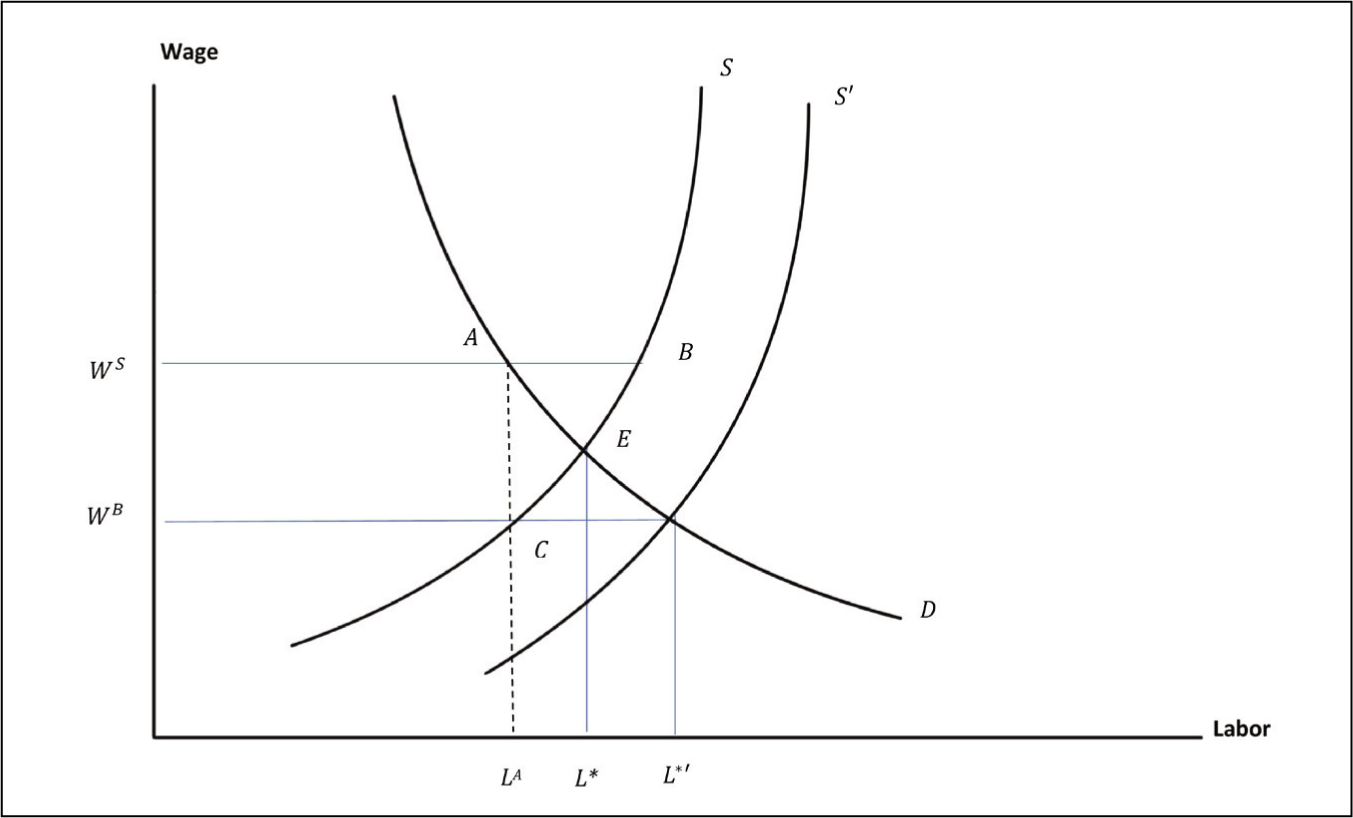
In this graph, S is the labour supply curve while D is the labour demand curve. The difference between WS and WB is also the discrepancy of the pooled wage in the market and workers’ reservation wages in the face of asymmetric information. Because of state fragility, workers will be receiving wages that are lower than what they expect to receive. As a result, they engage in involuntary migration, shown here as the distance between points B and A For regions that are relatively better-off and possess stronger institutions, wage differences may be reduced as the demand for labour and WB increases. In this case, the fragility is assumed to be wholly determined by specific regional effects.
Because of fragility, markets are presumed to be inefficient. 4 If fragility does not exist, the equilibrium labour employment should be found in L* with wages equivalent to E. However, because of fragility, firms are not willing to raise wages and hire more workers under permanent formal contracts. In this case, wages will be lower as labour contracts become less permanent in the presence of this uncertainty. The decreased wages, WB may cause workers not to participate in the labour market, resulting initially in depleted labour supply or lower labour participation due to disability and depressed overall skills (International Labour Organization [ILO], 2019), represented as the distance from L* to LA.
However, both employers and employees can share these costs of fragility through alternative arrangements. For instance, in rural areas, permanent output-based contracts remove the need for the screening and monitoring of workers (i.e., also solves incentives problems) and may eliminate obstacles caused by the fragmentary nature of other markets, such as that of labour and credit (Leavy & White, 2000). Landless workers smoothen out consumption over time by engaging in various forms of work arrangements (Kochar, 1999). In urban areas, fragile contracts can be forged so that, during a period of depression, employers form a bond with workers to assist them during this period of hardship.The jobs are mainly based on small-scale operations and include unpaid family labour, informal part-time jobs and other forms of commission or task-based contracts (Fallon & Lucas, 2002; Ramey & Watson, 1997; Schoofs, 2015). In both cases, arrangements—characterised by an interlocking of markets, including credit—offer wages lower than the market wage, but the landowner or the employer ensures employment in times of need.
Nevertheless, these coping mechanisms intended to maintain a stable wage employment arrangement may prove to be detrimental to the worker (Skoufias, 2003). For the worker, the job is seen as the only viable alternative to unemployment given the limited options in the market and the lack of social protection. If further displacement is expected, then a phase of lower wages will be expected. In the absence of options, as well as of social services, risk-averse workers are fully forced to internalise the negative externality caused by fragility in exchange for continued employment, eventually reducing unemployment but achieving a lower level equilibrium (McKenzie, 2003).
In Figure 1, supply shifts to S′ and full employment for those remaining workers will be found in L*′. This employment equilibrium however results in a distribution of welfare that is highly favorable to firms and less favorable to workers who must offer their services at a low level of wages, equivalent to WB. 5
At the equilibrium, high forced migration (high fragility) is simultaneous with high employment rates. Those remaining in the region are forced to accept lower wages. Migrants are not expected to be more productive, since the basis for their migration is not entirely due to productivity. Thus, entry to the local labour market results in a lower wage even for workers who are more productive as migrants. The lower wage is a manifestation of decent work deficits in fragile situations (ILO, 2019). Furthermore, while a negative relationship between private investments and labour demand is expected, as capital utilisation in formal firms rises, activities in the smaller scale and mostly, informal firms can rise as workers towards these sectors (Collier et al., 2018; International Finance Corporation [IFC], 2019).
In this model, macro-economic stabilisation policies can shift labour demand. This includes public investment and trade that involve improvements in resource flows that create opportunities for greater labour productivity. However, macro-economic policy can either strengthen or weaken fragility traps and thus, either reinforce a lower-level equilibrium or move it closer to the higher-level equilibrium (Chami et al., 2021a). Policies can offset fragility if these were designed to address limitations of institutions and focus on resource-poor regions. Otherwise, policies can trigger social disruptions and lead to further fragility. A well-integrated macro-economic policy that takes into account the fragility of vulnerable regions should be developed (Speakman & Ryosova, 2015).
Chami et al. (2021b) noted that the effect of macro-economic stabilisation policies depends on the type of governance used in implementing these policies. Policies are determined by policymakers who have different motivations in undertaking their programs. One type is a political policymaker who understands fragility, understands the role of government control but has a limited time horizon or erroneous social discounting rate, which can result in distorted policy incentives and corruption. A second type is a ‘technocratic’ policymaker who does not differentiate between fragile situations from any macroeconomic program, thus ignoring institutional weaknesses and providing no incentives for public sector expansion. The third is a ‘social planner’ who uses the correct social discounting rates, behaves like the technocratic planner but recognises the probability of fragility. The third policymaker is more likely to create a favorable social outcome. Gelbard et al. (2021) noted certain countries in Africa, such as Rwanda and Côte d’Ivoire, that have been able to address fragility issues through a series of capacity building programs and macro-economic policies, resulting in better delivery of public goods, greater stability and achieving higher growth rates.
Because of issues of governance and social cohesion, effects of these macro-economic reforms on employment and wages can only be empirically determined (ILO, 2016; Zheng et al., 2017). Given weak regional institutions, much of these programs, especially in trade, will affect only larger industrial regions and linkages across regions are insufficient to cause change for all workers (Calì, 2015; Elbadawi et al., 2021). Furthermore, while a negative relationship between private investments and labour demand is expected, as formal firms accumulate more capital slow down, the smaller scale and mostly, informal firms can expand and cause more fragility (Collier et al., 2018; IFC, 2019).
Finally, the labour supply can be shifted also because of changes in worker characteristics and preferences. Education and experience, for example, raise wages, as well as opportunities available to the worker, resulting in increased labour employment (Becker, 1993; Bloch & Smith, 1977; Furia et al., 2010).
The data are based on pooled Philippine Labour Force Surveys (LFS) from 2010–2018.These provide quarterly labour market information from all regions in the Philippines, gathered from a sample designed to represent the labour market conditions across 16 regions in the entire country. The April surveys are used as the basis for the yearly data and other information related to wages and labour participation. For worker characteristics, the data include the worker’s completed education and age.
These data cover the period of two administrations where significant macro-economic changes were undertaken. In the period from 2010–2016, under the presidency of Benigno Aquino III, a series of institutional reforms were implemented to raise investments and were able to achieve significant gains in economic growth, as well as poverty reduction. The next period, 2017–2020, was followed by the presidency of Rodrigo Duterte, who continued to undertake similar reforms but whose strong populist governance contrasted with the previous administration. The data then were chosen to reflect significant variations in macro-economic policies and governance programs. The extended period also takes the account the time needed to modify institutions. Furthermore, the period from 2010 to 2018 was mainly chosen for the study because it was period when no international financial crisis was felt in the Philippines, which could have affected the consequences of these macro-economic policies.
Among other labour market outcomes, the data provides information on worker decisions on employment, employment on alternative contracts, daily basic wages, type of employment and outmigration to other countries. Surveys have been conducted to ensure that a sample of workers in each of the sixteen regions comprising the Philippines represents the population. In 2016, one-fourth of total employment is in agriculture and more than 50% are in services. However, in the more vulnerable and fragile regions, the proportion of workers in agriculture is much larger. In the same year, the Autonomous Region of Muslim Mindanao (ARMM) 6 that is the most fragile of all the regions after decades-long conflict due to the Muslim insurgency has 65% of its employment in agriculture and a little more than 30% is in services.
To create the fragility index, migration is considered. The standard theory of migration posits individuals who seek to maximise incomes as producers and sort themselves into more productive jobs (Fields, 1979; Harris & Todaro, 1970). Extension to this theory considers migration as a mechanism for matching consumer heterogeneity with regional variations in prices and wages and access to public programs (Rosenzweig & Wolpin, 1988; Schultz, 1988). These theories assume that individuals respond to incentives arising from moving to another destination subject to costs of mobility. Migration is viewed as skill-biased, self-selected and an investment, yielding particular returns. As such, this type of migration can cause negative effects on the sending countries that are not able to generate positive migration externalities (Biavaschi & Machado, 2020).
Another theory of migration, while not entirely contradicting the standard theory, points to migration as being involuntary where individuals are forced to change their place of work and residence because of fragility (Martin-Shields, 2017; Sørensen et al., 2003). There is an increasing awareness that migration is not solely driven by differences in labour outcomes and amenities between destination and origin areas.
Different drivers can trigger involuntary migration. The most common of these involves individuals fleeing from war and persecution based on religious, ethnic, racial, political or social reasons (Castles, 2003). Another main driver is migration due to environmental or human-induced disasters (Myers, 2002, p. 609). Related to the previous driver is displacement caused by natural disasters. These events are sometimes made worse by government policy on the choice of infrastructure and industrial sites (Castles, 2003).
A third driver involves the impact of weak institutions and poor public goods on economic performance (Acemoglu et al., 2005; North et al., 2007). Large-scale development projects, such as dams or mining companies, may impinge on property rights of groups of people without providing appropriate compensation and settlement. A more serious manifestation of this issue is the absence of borrowing, insurance and savings facilities that make one vulnerable to various health and income shocks. The absence of clear reforms can cause a sense of despair and deprivation, forcing people to involuntarily migrate.
Forced migration is not self-selected since the decision does not depend on the person’s skills and characteristics but more on features of locations where the person resides. The common thread in the literature of forced migration is the presence of an externality that creates a discrepancy between the reservation wage of the worker and the actual wage that the market offers the worker. This is the same externality described in the previous section.
Formally, forced migration of individual i at time t, Mit, is viewed as a function between the discrepancy of two valuations:

where
The exogenous term μit refers to transaction costs due to the information asymmetry. Firms will be unwilling to offer long-term contracts at a critical time in period t. Given the incapacity of regions to address information problems, workers will require more income and will engage in various activities to secure their basic needs. Costs incurred in doing so is measured by μit. The greater the μit, the more likely the worker will migrate. Eliminating transaction costs and improving institutions will result in a single wage and the likelihood of migrating.
Since μit is determined by regional institutions, forced individual migration per year can be measured as:

where Rd refers to a dummy variable for the region where the worker originates. 7 The crucial element here is that fragility pertains to general features of the region and not to community or individual characteristics. It indicates the level of weakness of institutions in regions.
The coefficient, γ
i
, measures the degree to which institutions can affect forced migration. A higher γ
i
denotes institutions’ limited scope in minimising fragility for the individual i, while lower γ
i
indicates the efficiency of the institutions in reducing such costs. By averaging the coefficient γ
i
per region, the fragility index,
Individual characteristics are included in estimates to isolate regional effects on involuntary effects. Migration models with uncertainty posit that migrants move to other locations without complete knowledge of their destinations. Characteristics of the locality can only be known by living there. Because of this, it can be hypothesised that the more educated and experienced individuals are more likely to migrate voluntarily or involuntarily migrate to farther places (Lanzona, 1998).
The fragility regional indices,


The model presumes that ordinary least squares estimate of wage equations can be biased if a covariance between error terms of the employment decision and the wage function exists (Heckman, 1979). If the probability of being in the wage labour market is a significant factor in explaining the observed wages, then the OLS-estimated wage equation will be conditional only on the characteristics of those who reported wages. Hence, a Heckman sample selection procedure is applied.
There are two ways of estimating the Heckman model: (a) the first is a two-step method using probit to estimate the first equation and then, estimating the selectivity term that in turn is included in the second equation using OLS; and (b) the second is a two-step applying maximum likelihood estimation (MLE) approach for both equations. Since the former uses limited-information maximum likelihood (LIML) and sensitivity to the distribution of the unobserved error term (Newey et al., 1990), the former assumes full-information maximum likelihood (FIML) and greater flexibility in the distribution will be used.
The model also assumes that entry into the wage labour market is a binary choice and is independently determined of the decision not to engage in the market. One possible option is to consider all possible worker decisions (noted in Figure A2), that is, non-participation in the labour force, unemployment, alternative arrangements and traditional contracts. However, as noted, these four choices can be substitutes (as in the case of alternative and traditional arrangements) or complements (as in the case of alternative contracts and labour force participation in fragile areas). Hence, because these decisions are not mutually exclusive, the common assumption of independence of irrelevant alternatives (IIA) used in estimating simultaneously multiple decisions, for example, the multinomial logit approach (Lee, 1983), is violated a priori. 8 However, grouping these categories into a binary choice—wages versus.no wage reported—allows one to consistently measure wage market participation using probit or maximum likelihood estimates. The choices between wage and no wage are seen as the only two options, eliminating the unobserved and unchosen choices that can prevent a preferred option from being the best one.
For the employment equation, given the available data, independent variables are defined as follows:
Human capital: Human capital refers to education and potential experience
9
measured by age. Given the lack of household and individual factors in the data, these variables will be used to capture factors affecting the supply of labour. Macro-economic policies: These variables reflect policies of the central government as distinguished from regional reforms. Intended to stabilise the economy and promote the structural transformation, macro-economic policies affect the resource flows, as well as relative prices of capital and products that influence the demand for labour. Given data availability, gross capital formation (or fixed) assets, including infrastructure, exports and imports are used as proxy variables for the resource flow and trade policies that are expected to result in more production and hence employment. Private investments: Firm inventories are included to take account of private sector investments. Time and region effects: These are defined as year and region dummy variables that are instrumental variables for both time and region varying factors. Time-varying factors may include changes in the gross domestic product and interest rates, while regional dummy variables comprise infrastructure, as well as other physical attributes of the region.
For the wage equation, independent variables include the standard Mincerian wage function variables, for example, potential labour market experience and years of schooling (Willis, 1986). In addition, the fragility index will be included since these measure differences in social investments that affect worker quality across villages. As hypothesised above, workers employed in highly fragile environments are allocated to lower-paying jobs in mostly informal and part-time AWAs. Moreover, because of the wedge between hiring and selling wages, only workers with lower opportunity costs of time would be willing to work in these highly fragile conditions.
Further, insight can also be gained by comparing estimates with and without the fragility index. If differences are observed between these two estimates, one can determine how much fragility affects the returns to either experience or schooling. If experience is given a higher premium than education in the more fragile areas, one will expect a positive covariance between experience and fragility for data with reported wages. This results in a higher return for experience in the estimates without fragility. On the other hand, assuming that experience is less preferred than education, then a negative covariance between education and transactions costs will be present, making returns to education lower in estimates omitting transaction costs.
A sample selection term based on the labour participation estimates is included to correct for possible sample selection biases (Heckman, 1979). This variable is determined by the probability that the person will enter the market and subsequently types of unobserved abilities and motivation he or she brings into the wage job. A statistically significant positive selectivity term indicates that the worker has a comparative advantage in these wage activities, thereby, resulting in greater productivity and earnings.
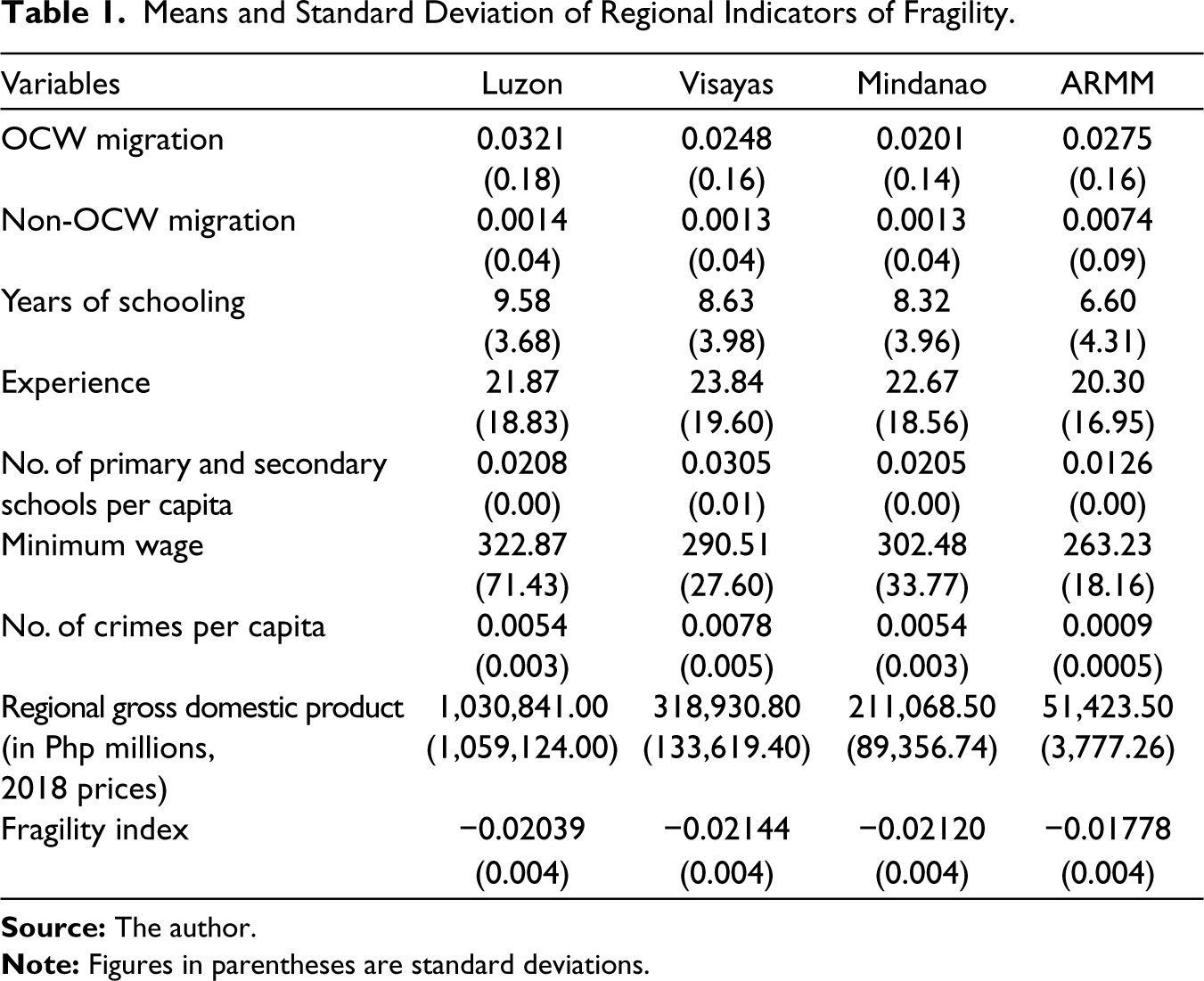
Table 1 shows the means and standard deviation of variables that were used to derive the fragility index and the fragility index itself by major geographic divisions in the country and the region considered the most fragile, the ARMM. As already indicated in Figure 1, ARMM has the highest international non-OCW migration rate of the regions, indicating the possibility of fragility. The choice of variables to a large extent reflects the available data. The following points are noteworthy. First, the average schooling and working years of individuals are also the lowest in ARMM, which is surprising since workers with more skills and experience are more likely to migrate. These individual characteristics can thus affect the decision to migrate, as well as employment.
Means and Standard Daeviation of Regional Indicators of Fragility
Means and Standard Daeviation of Regional Indicators of Fragility
Second, the number of basic (primary and secondary) schools per capita reflects the region’s ability to deliver basic services. ARMM has the lowest figure in this regard. Luzon that has the most economically advanced regions, and, despite having the highest total number of schools, has also attracted more regional in-migrants resulting in a lower number of schools per capita, compared to the Visayas. The population growth due to in-migration in the region can be a source of fragility.
Third, minimum wages that are regionally determined manifest the region’s goal of providing workers a decent income and so of developing social cohesion. This can, however, be a two-sided sword since it can force employers to layoff workers if wages are greater than what employers wish to offer to the workers. ARMM has the lowest minimum wage compared to other regions on average, and Luzon regions have the highest.
Fourth, the number of crimes per capita is an indicator of human security in the region. ARMM where insurgence exists has the lowest crimes per capita. Because of the insurgency, the government has established a considerable military presence in the area, thereby discouraging crimes. Regions in the Visayas, where communist movements persist and most political offenses are committed, have on average the highest crime number per person.
Fifth, the regional gross domestic product (RGDP) of the region represents all time-varying economic factors, such as credit and infrastructure. A higher RGDP indicates a higher potential for economic opportunity for workers. On average, ARMM has the lowest RGDP and is the region with the highest poverty incidence. Regions in Luzon, where industrial centers of the country are located, have the highest average RGDP.
Finally, the average yearly fragility index per region based on non-OCW migration estimates using Equation (2) is found in the last row in Table 1. The coefficients are negative, indicating that workers, in general, remain in the country. The smaller the negative value, the greater (or the larger in value) the fragility. On average, as expected, ARMM has the highest index, followed by the regions in Mindanao, Visayas and Luzon. In general, regions that had lesser educated and experienced workers, a smaller number of schools, a lower minimum wage and a lower RGDP were also those that had the higher fragility.
In Table 2, migration measures were regressed on specific worker and regional variables to determine differences between the two measures and whether the indices from non-OCW migration are capturing general regional features and not particular characteristics of the household and villages. For ease in the explanation of results, logit estimates are used for these tests. 10 Note that except for worker characteristics, the results for OCW migration are entirely reversed in results for non-OCW migration. For former decisions, results hold the theory that migration involved the investment of regional and household resources in mobility in exchange for returns in the future. Hence, individuals exposed to more schools and higher RGDP are more likely to work outside. In the case of non-OCW migration, individuals residing in regions with less basic schools and low RDGP are more likely to migrate outside the country. This supports the notion of workers seeking to avoid a fragile environment.
Logit Estimates of Non-OCW and OCW Migration
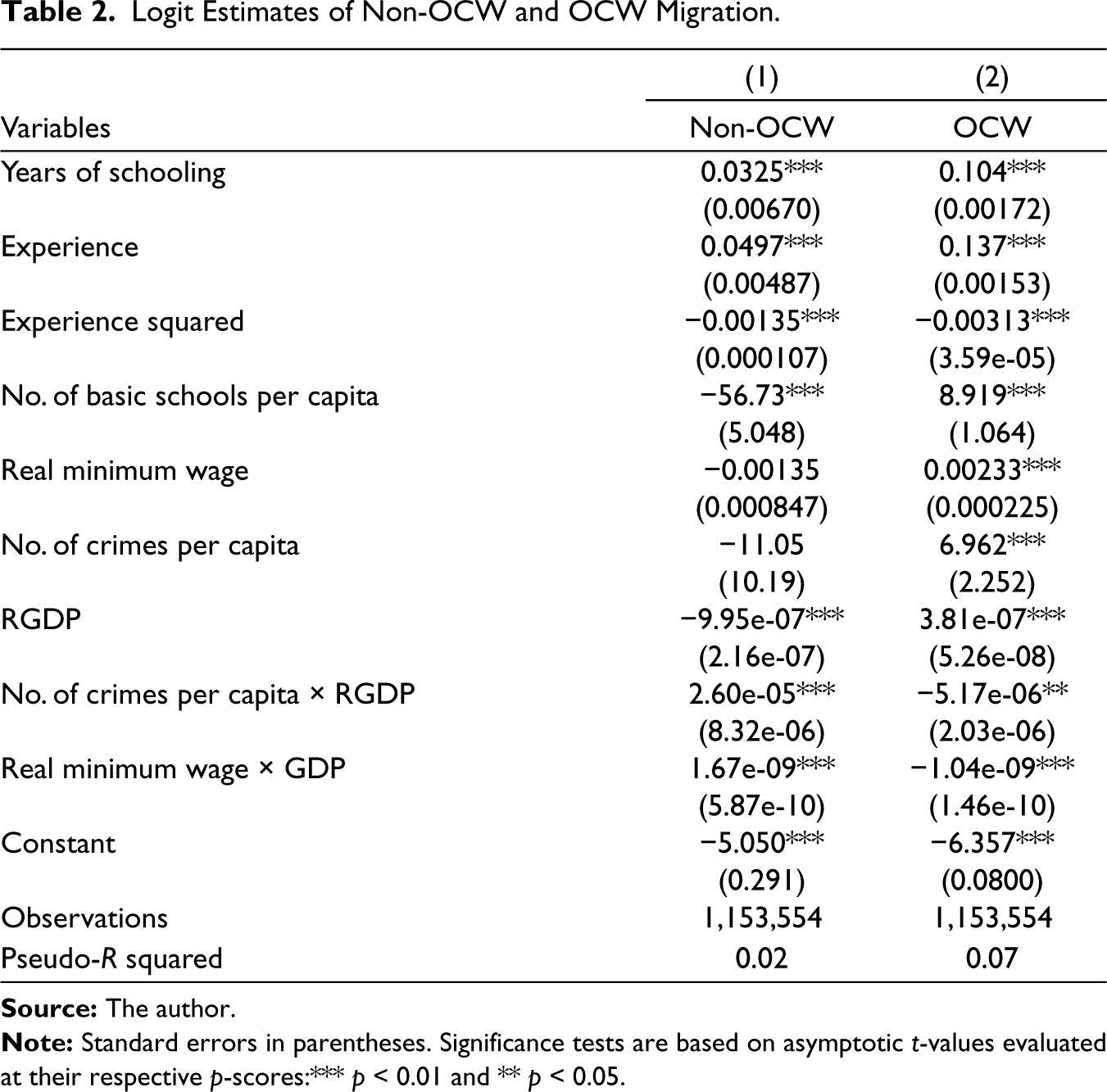
Coefficients for real minimum wage and per capita number of crimes are more difficult to interpret since they may likely be correlated to unobserved time-dependent covariates. To control for this bias, these variables were interacted with RGDP, which are also correlated time-varying factors. The interaction term for the number of crimes per capita is positive for non-OCW but negative for OCWs. This suggests that a crime-ridden growth rate is a disincentive for OCW migration, but a trigger for non-OCW migration because it may pose a threat to human security. Same results can be seen for the interaction of minimum wages and RGDP. Minimum wages, at periods with higher economic growth, cause less OCW migration but can result in more non-OCW migration. The latter may be workers who may have been laid-off because of higher minimum wages, suggesting the lack of social security programs.
Table 2 also indicates that non-OCW migration is mostly beyond the control of the worker and is mainly driven by regional factors. For schooling and experience, coefficients are lower for non-OCW but higher for OCW migration. While the non-OCW migration is to some extent dependent on individual qualities, these are not as significant as those for the more skilled OCW migrants. In contrast, regional variables are higher for non-OCW migrants compared to their counterparts. This means that non-OCW migrants are driven more by fragility caused by these regional factors (Martin-Shields, 2017). In this case, results show non-OCW migration can be interpreted as forced migration that cannot be attributed to a particular regional or worker characteristic, but by heterogeneous regional conditions, thus supporting the approach to measuring fragility.
Table 3 displays the means and standard deviations of dependent and independent variables that will be used in the employment and wage analyses. The table is meant to determine if the time-varying macro-economic affect these labour outcomes since pooled data are used. As observed from the data, both wages and employment are trending upward, suggesting improvements in the condition of workers. The same upward trend can be seen for education and experience, indicating that part of the increases in employment and wages are due to individual factors. The only regional variable, the fragility index, in general, seems to be stable. Nonetheless, contrary to expectations, during the period when it was increasing from 2010 to 2014, wages were also increasing.
Means and Standard Deviations of Labour Market Variables by Year
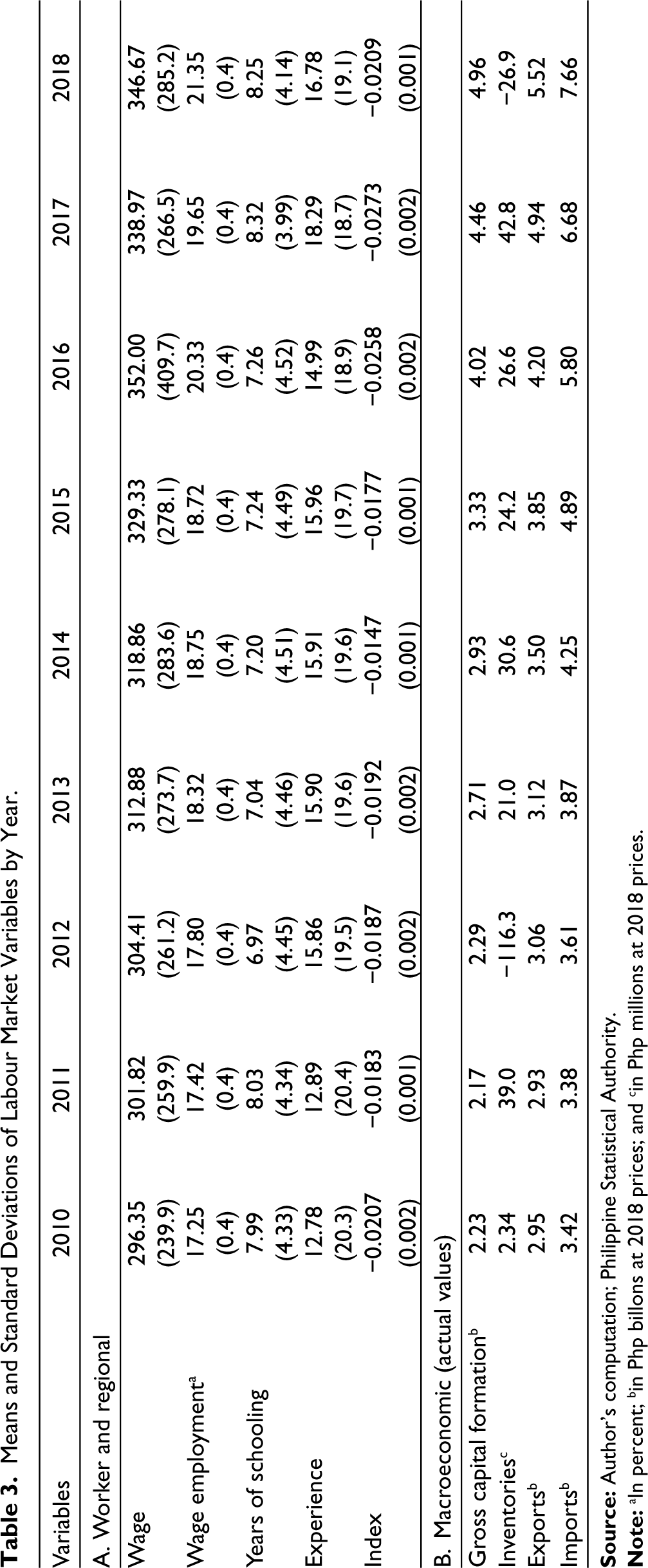
On the other hand, macro-economic variables seem to follow the same trend as labour market outcomes. When gross capital formation (GCF) and exports are increasing, these outcomes are also moving upwards. At the same time, increasing imports are also associated with increasing employment and wages. Finally, as expected, declining firm inventories are associated with significantly higher wages and participation.
To assess the weight of fragility, Table 4 presents estimates of the employment and wages using three specifications. The first includes the fragility index. The second incorporates regional effects to determine if the index is correlate with regional effects. To assess effects of not including fragility and region effects, a third specification is measured.
Heckman Maximum Likelihood Estimates of Labour Market Participation and Wages
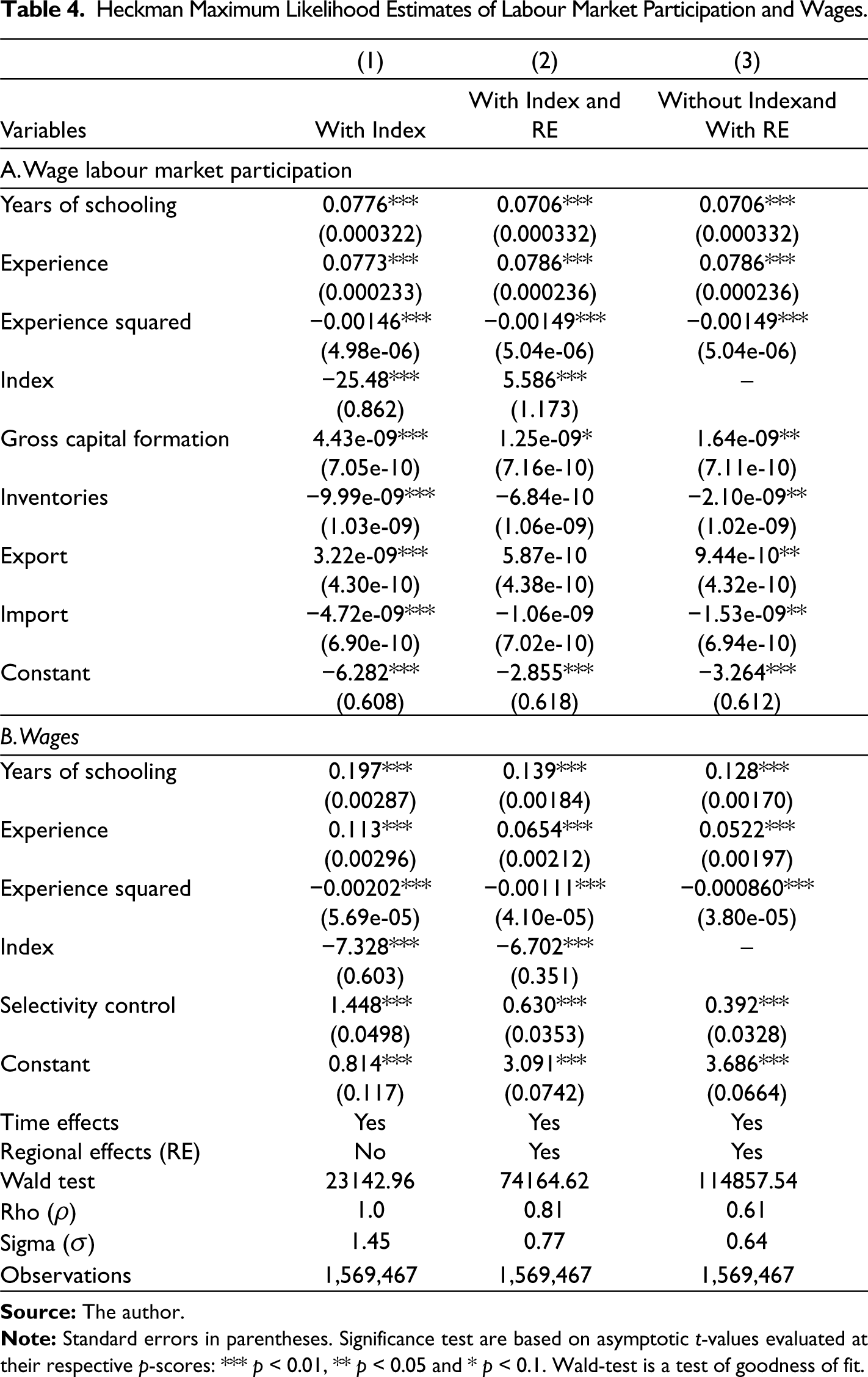
The following points are noteworthy. First, without regional fixed effects, fragility decreases employment and wages. However, when regional effects were included in the estimation, fragility increased employment but continued to reduce the wage. This result supports the expectation that the index is correlated with the regions. However, the continued significance of the index indicates that this is more than just capturing general regional effects. Furthermore, with the inclusion of regional effects, the argument that workers will try to cope with the situation caused by fragility by offering their services even at a lower alternative wage is supported (see Schoofs, 2015; Spier, 1992) .
Second, the inclusion of regional effects did not change the effect of schooling and experience on employment but is associated with a decrease in the returns of education and experience on wages. However, more importantly, the inclusion of the region effectively effects diminished the effect of macro-economic reforms on employment. This supports the theory that worker benefits of these reforms largely depend on regional institutions and associated fragility, suggesting the crucial role those local public goods have on the welfare of workers (e.g., Leonard et al., 2013)
Third, the omission of fragility in the wage estimates can cause several biases. These include (a) underestimation of wage returns of education and experience; and (b) the underestimation of wage effects of selectivity control. The first bias implies that fragility has a negative effect on human capital. The second bias suggests that the observed characteristics of wage workers, including those engaged in AWAs, result in higher productivity relative to those not earning wages or have outmigrated. 11 Furthermore, fragility is directly associated with a decline in wage returns of unobserved productivity-enhancing worker qualities (e.g., motivation and reliability). By controlling for fragility, the observed wage declines and associated reduction in decent workcan be partially traced to poor institutional conditions (see ILO, 2019).
Finally, the inclusion of fragility in the estimates seems to have reduced the significance of the central government policy outcomes on the employment estimates. With the fragility index, the signs of coefficients are all that expected, that is, positive with gross capital formation and exports and negative for imports and inventories. However, comparing coefficients of these variables in specifications (1) and (2), results show these programs to positively correlated with regional effects, and, from the results of specifications (2) and (3), with fragility as well. This supports the hypothesis that over time these macro-economic factors were simultaneously rising along with fragility and were having no effect on the institutional weaknesses (Chami et al., 2021b). Controlling for fragility leaves the employment effect of national government program outcomes insignificant, despite a improvements in gross capital formation.
Empirical results show that the estimated fragility index is directly positively associated with employment but negatively associated with wages. In non-fragile and low-income economies, lower wages are often accompanied by lower productivity and demand. This article suggests that given the weak delivery of services (including social protection) in a fragile situation, workers become risk-averse and increase their in lower-paying jobs in anticipation of possible security, environmental and income shocks. In the process, education and other productivity-enhancing worker characteristics are not adequately compensated. Furthermore, national government programs intended to increase trade and investments are insignificant in affecting employment in the face of fragility. In effect, governance rather than policies are important.
To derive these fragility index, non-work-related migration was used to identify fragility annually for each region. Empirical tests indicate that these indices were not just capturing regional effects but were reflecting weaknesses in the institutions that have involuntarily triggered migration.
The results also suggest that much of the instability in fragile areas stem from the regional inequalities. The main attributes of the regional institutions and their capacity to deliver basic services should be given priority in any development effort. Additionally, since fragility is ultimately based on individual transactions, blanket programs that fail to consider the heterogeneity the regions are bound to fail. Governments run by strong autocrats that fail to empower regional institutions are thus ineffective in meeting the challenges caused by fragility.
Lastly, laws or programs that attempt to regulate lower-paying AWAs are bound to fail unless the underlying fragilities that cause such arrangements are removed. Through its regulatory structure state intervention creates a formal economy, but by extension, an informal economy can exist outside the regulatory framework of the state given the institutional weakness. The need to carefully assess the role of institutions and governance has resonance in a fragile environment.
Footnotes
Acknowledgements
The referees and editors of this journal contributed greatly to the current version. Remaining errors are the author’s sole responsibility.
Declaration of Conflicting Interests
The author declared no potential conflicts of interest with respect to the research, authorship and/or publication of this article.
Funding
The author disclosed receipt of the following financial support for the research, authorship, and/or publication of this article: Funding for this research was provided by the Ateneo de Manila University Research Council.
Appendix A. Philippine Labour Market Outcomes
Table A1 presents the poverty and labour market outcomes as shown by the available data. The following points are noteworthy. First, while poverty declined, regional differences can be noted. This indicates that much of the improvement may be at the margins (those that are closer to the thresholds) since the regions with greater severity in poverty continued to have higher poverty incidence. Second, despite the poverty in certain regions, the labour force participation rates are almost similar than the national regions. However, for the most fragile region, the Autonomous Region of Muslim Mindanao (ARMM), labour participation is substantially lower than the national average. Third, unemployment is lower, but underemployment is higher than the national average. This indicates the phenomenon of the ‘working poor’ where employment rates seem high, but the compensation is not enough to meet the basic needs of the workers. This is representative of a fragile state where despite the improvements in poverty, the level of fragility remains high, thus placing the country in middle income trap (Chami et al., 2021a).
To determine the effects of fragility on employment and wages,  shows the distribution of surveyed individuals by their employment status and geography. The data allows jobs to be categorized into two.The first is the traditional work arrangement where workers are hired permanently and are regularly compensated. The second is the alternative work arrangements (AWAs) where workers are employed on a part-time basis and not regularly paid. A crucial element of these arrangements is the absence of any legal mandate to receive any benefits. According to the Philippine Labour Code (Republic Act 6175), employers are not mandated to provide worker benefits unless there is a promise of permanency and the worker has worked for a minimum of 6 months (probationary period). Since workers may accept this type of work, firms may then engage in AWAs simply to minimize costs. In all, unless the demerits are offset by certain subjective advantages, this type of work is inferior to other more regular employment, resulting in low returns to labour.
The following points can be notedin Figure A1. First, the most fragile area, ARMM, also had the highest percentage of people not going to work.This supports the notion that fragility results in lower labour force participation as skills and schooling are not readily accessible in fragile states (ILO, 2019).These workers may not be qualified forthe jobs being offered.
Second, ARMM has a relatively lower unemployment rate compared to the other regions.Luzon which is the most developed and least fragile of these areas has the highest level of unemployment.Workers in the more developed areas can afford to stay unemployed to search for better jobs.Workers in the more fragile region cannot remain unemployed and decide to accept any work offered, resulting in lesser unemployment (Kochar, 1999; Skoufias, 2003). In this case, being employed can result in lower wages as they internalize the externality caused by fragility.
Third, the workers in more fragile states are more likely to engage AWAs than the traditional arrangements. While AWAs are prevalent in other regions, the more fragile the region, the more of these contracts are formed (Ramey & Watson, 1997). These contracts whichseem to be more suitable to regions that are faced with lesser fragility create welfare losses to the workers (ILO, 2016; ).
To estimate thefragility index, the data on worker outmigration is considered. The LFS provides information on major types of international migration. One type is those workers who became overseas contract workers (OCWs) and those who migrated out of the country but are not OCWs. 12 Of the two categories, the latter is non-work related and hence more suggestive of forced migration given the region’s fragility. As discussed in the previous section, this will be used as the dependent variable in estimating the fragility index.
provides the percentage of workers out-migrating from their respective places of origin.Geographically, the Philippines is divided into three regions: Luzon, Visayas and Mindanao. The capital and the key industrial areas are found in Luzon, the richest of the three divisions. The Visayas also has strong urban and trading activities, especially Cebu City, and its proximity to Luzon makes it easier to generate markets. Mindanao is the poorest of the three as it remains agricultural.
Two points are noteworthy. First, Luzon has the highest number of OCWs because of the higher skills and resources found in this region. Nevertheless, despite the limited access to these resources, ARMM has the highest second percentage of these workers in the country because of its proximity to other countries, such as Sabah, Malaysia. Second, the number of non-OCW workers who left their place of origin is observed to be the highest in BARMM. This indicates that the conflicts and fragility in the region push people away to stay in the region.
Since the attributes and ability of the institutions to deliver servicesare unobservable, region dummies will be applied in Equation (2) to measure regional institutions. To test whether these variables represent the general characteristics of institutions in the region, regressions of the same migration variable will be performed on specific region characteristics such as the proportion of schools per capital, the proportion of crime cases per capital, and gross regional domestic product. An analysis of the results will indicate whether regional dummies are capturing the general effects of externalities in the region and not any feature of the individual worker. Furthermore, a comparison of the estimates on OCW migration will be done to see if the same results occur. If the results are significantly different, then non-OCW migration is distinct from OCW migration, thus supporting the proposition that the former is closer to forced migration.