



Abstract
Remittances have been one of the most critical components of the population migration debate. Since migration has been studied academically, the ‘remittance equals cash’ idea has dominated other types of remittances. This study focuses on in-kind remittances, which are transfers of goods and services sent by migrants (other than money) from their destination country. We examined the literature using content analysis. The research investigates how a nation takes shape through the injection of remittances in kind (RK) brought by ‘migrant populations’ of both origins and destinations, using empirical and theoretical evidence. RK are worth considering for a variety of reasons, the most important of which is that they play an essential part in international collectivist development. Second, they highlight the societal effects of migration. Third, they have a chance of gaining public support. With great transformative power, RK has the capacity to alter a nation’s economy, values and lifestyle. This article establishes for the first time, by re-conceptualizing conventional wisdom, that the major development paradigm shift that has occurred in Asia’s economies over the decades has been largely due to the contribution of RK brought and sent to by individuals such as Gandhi in India, Ho Chi Minh in Vietnam, Shinawatra in Thailand, Jose Rizal in the Philippines and Suu Kyi in Myanmar. We conducted qualitative research and relied heavily on secondary data sources. This article delves into a fresh idea about migration and remittances. This is a new addition to the migration and development scholarship.
Introduction
Mohandas Karamchand Gandhi aka Mahatma Gandhi did not bring with him money, but he brought something else to his country. On 7 June 1893, Gandhi was thrown out from a ‘white only’ passenger train in South Africa, causing him serious concern over the fact of ill treatment of Indians by the British. That led him to decide to leave for India from South Africa. This consciousness worked as a powerful remittance to rekindle the impetus among the Indians to drive the British out of the Indian subcontinent. Most ‘debates about migration and development privilege[d] the economic at the expense of the social. …But economics is not the whole story’ (Levitt & Lamba-Nieves, 2011, p. 2): migrants contribute to the development of their countries of origin through non-monetary transfers as well. The innovations of the returnees have reignited interest in non-citizens and policymakers to stand against the injustices (No & Walsh, 2010). Migration brings a slew of new ideas (social, political and cultural) that may influence the countries in many ways where they settle in and return to (Levitt, 2005).
Migrants move out for the traction of remittances, which are of various kinds including social and political (Levitt, 1996), and biological remittances (for details, see Ullah & Alkaff, 2018) in addition to cash remittances. The brain-gain metaphor is now challenging the long-held notion of brain drain. The concept of brain-drain gained prominence among policymakers and academics only lately. Knowledge, skills and courage acquired overseas and remittances in-kind provided or brought with them were never regarded as remittances. Monetary remittances, however, tend to resolve social injustice, and the remittances in-kind (social, political and cultural) do more significant issues.
In-kind remittance is whatever migrants transfer (other than money) from their country of destination to their home country or others (Ogbuagu, 2013). This means any materials or objects such as any gifts sent are considered remittance in-kind. In this study, we have deliberately precluded any material remittances. Remittances in-kind are worth consideration for various causes, primarily because it plays an imperative role in international collectivist development. Second, they bring the societal influences of migration to the front. Third, they are potential public support (Gakunzi, 2006). Levitt (1998) introduced a number of approaches for unravelling the intricate relationship between the societal structure of global influences, remittances and their political implications by the following: (a) directing advanced, interdisciplinary approaches that reveal the role of linkages in cultural flow; (b) bringing to light the legal and socioeconomic issues influencing who transmits what and (c) beginning to unravel all of this lays the groundwork for a more comprehensive understanding of global influences. They hope to achieve this by developing a more inclusive and integrated understanding of migratory schemes that recognize belongings, thoughts, ideas and behaviours.
Re-conceptualizing conventional wisdom, this article asserts that social, political and cultural remittances have significantly influenced major development paradigm shifts in major economies in Asia (Flores, 2007), brought and sent by leaders who were at one-point migrants elsewhere, such as Gandhi, Ho Chi Minh, Shinawatra and Jose Rizal. In our analysis, we demonstrate that both exporting and importing nations benefitted. The research presents how ‘migrant populations’ of origin and destination play a role in building a nation through such remittances. The ‘migration-remittance’ nexus has largely ignored remittance dynamics—this research on remittances in-kind attempts to fill in the existing gap in the scholarship of migration studies.
This article does not mean exploring the casual mechanism of remittance transfer. Rather, this has taken up the remittances in-kind (minus material items). Thus, developing a theoretical base and a clearly established methodology is instrumental in this study, contributing to clearly articulated analysis in answering our central research question. We are not arguing that the nation-building was possible or the entire country’s ideology has been changed due to remittances in kind (RK) brought about by influential personae throughout history. We argue that some small-scale or incremental changes happened due to the injection of the RK.
It is the first study to demonstrate that the major paradigm shift in Asia’s major economies over the last few decades has been primarily driven by the rise of RK brought and sent to by individuals such as Gandhi in India, Ho Chi Minh in Vietnam, Shinawatra in Thailand, Jose Rizal in the Philippines and Suu Kyi in Myanmar. The study explores how a nation takes shape through RK injection brought by ‘migrant populations’ from both origins and destinations.
The following is the organization of the article. This article began by contextualizing the various types of remittances (i.e., social, political, biological and monetary remittances, as well as in-kind remittances) that are worth discussing in light of their critical significance in international collectivist development. Following that, we describe the methodology utilized in this study and examine the analytical framework that links the theoretical investigation and the empirical analysis. The following section conceptualizes and illustrates the numerous implications of in-kind remittances. We then discuss how RK have been transferred to places of origin and how these RK have influenced these countries’ social, political and cultural environments. To accomplish this, we look to tenacious leaders such as Nelson Mandela, Gandhi and Ho Chi Minh.
Methodology
In this research, the historical context, pattern of social, political and cultural changes and relationship between origin and destinations in relation to the daily interactions are significant in determining the common traits that underpin our argument about social, political and cultural remittances the [im]migrant population contributes. We used a qualitative research approach and relied extensively on secondary data sources. In order to explore the mechanism of how remittances in-kind play a role in both origin and destination countries globally leads to the changes in the local politics and socio-cultural milieu, we used content analysis (both conceptual and relational) to examine the literature that we chose meticulously. Scholarly books, journal papers, some prior surveys and online sources are among the secondary sources. Our main concerns are social, political and cultural remittances. We strive to figure out how these elements influence the course of changes. We identify the remittances in-kind and separate them from remittances and in cash. We attempted to delve into the mechanism that the existing studies applied. We have deliberately chosen the political legendries to shed light on how their thoughts, ideas and philosophies were shaped by overseas experiences and applied in their own countries. This does not necessarily mean that the other categories of migrants do not bring remittances in-kind.
Analysis
The analytical framework links the theoretical inquiry and the empirical analysis in this study by describing our assumptions or theoretical knowledge about critical empirical phenomena. This framework’s components tell us what data we collected and what to look for in the analysis.
Remittances In-kind Conceptualized
Remittances in-kind are the ideas, practices, mindsets, worldviews, values and attitudes, behavioural norms and social capital (knowledge, experience and skill) that the migrant population mediates and transfers from host to home countries consciously or unconsciously (Safran, 1991). Informal channels include conversations via letter, telephone call, email, internet chat or video. They publish books and memoirs on their lives and adventures abroad. Future generations will read them and use them to make a difference in the world. These informal encounters enable migrants to convey societal values, attitudes and norms that have a transformative effect on those who remain behind preconceived notions about social relations, political involvement and practices, democracy and good governance and so forth. The indigenous population typically embraces returning migrants’ ideas and social ideals, owing to the migrants’ elevated social rank in society (Sander & Maimbo, 2003). This is because of the wealth, knowledge and networks they earned abroad, which endow them with enormous reputation and power.
The debates about remittance and its importance in developing countries have been intense for a long (De Haas, 2005; Ullah, 2017a, 2017b). The desire to remit a portion or all of one’s earnings could be explained from a variety of angles such as economic, social, political and psychological (Ullah, 2010; Krawatzek & Müller-Funk, 2019). International remittance is the portion of a migrant worker’s income remitted back to their home countries. Money sent back home by migrants serves as a source of capital for those who receive it. Apart from cash, ideas, practices, social capital, and identities many other social, political and cultural remittances circulate between sending and receiving communities (Levitt, 1998; Sekei et al., 2014). RK is the deliberate transfer of capital from one country to another (Gakunzi, 2006; Tuccio & Wahba, 2020).
Traditional explanations appeared to have neglected certain kinds of remittances, like remittances in-kind. The dominant factor for the remittances transfer is the altruistic consideration (Stark et al., 1986), suggesting that family members support one another to make up for lost income. Remittance intentions are often stimulated by mutually beneficial contractual relationships that exist between migrant and host. Poirine (1997) notes that remittances can be used to invest in the human capital of family members.
The ideas, behaviours, identities and social capital that transfers from receiving to sending countries are considered RK broadly. Levitt (1998, p. 201) distinguishes between normative structures, workout regimens, features and social capital. Normative arrangements include standards of behaviour (race, gender and class), attitudes on family accountability, principles of friendliness and public participation and social movement goals. Added to social capital is the sociological and political environment (Sabur Abdus & Mahmud, 2009) that allows for advancement and influences social arrangement. According to Isaakyan and Triandafyllidou (2017), there are three types of social remittances: civic, cultural and political. We, however, argue that ideas about politics and culture, social issues all reflect remittances. RK enables immigrants to make a positive social impact on their home states.
Migrants are often in touch with their friends and relatives back home through letters, videos, emails, phone calls and blogs. Most of their exchanges are rich in terms of texts and contexts. They compare the political situation between the two countries and how different these countries are in corruption, good governance, traffic, public service delivery, etc. These remittances are boosted and strengthened by other global cultural exchange channels in ways that are not limited by political, gender or religious boundaries (Barton et al., 2000; Levitt & Lamba-Nieves, 2010). RK may generate new commercial and employment opportunities while helping citizens at home and abroad (Isaakyan & Triandafyllidou, 2017; Levitt, 2001a).
While social remittances (or social transfers) are the ideas, practices, and know-how that circulate along migratory paths, social remittances are the ideas, practices, and know-how that circulate along migratory paths (Levitt, 1998, 2001b). So far, there has been very little research on how economic and social transnational transfers interact (Boccagni & Decimo, 2013; Lacroix et al., 2016). Peggy Levitt created the phrase ‘social remittances’ to describe how ideas, practices and know-hows circulate along migratory channels (Levitt, 1998, 2001; Levitt & Lamba-Nieves, 2011; Levitt & Rajaram, 2013). This idea was a watershed moment in the study of the migration-development nexus. As a result, literature asserts that social transfers have a significant impact in a range of circumstances (Kapur, 2010; 2014; Levitt & Rajaram, 2013; Piper, 2009).
According to Hossain (2020), [im]migrants who stay longer in destination countries acclimate to the culture. The migrants employ their acquired understanding and exercises in their new venture as they return home. These emigrants are the ‘instrumental connections’ in this passage. Social remittances, albeit in fragmented forms, have resulted in changes in how revisited immigrants engage in service and public relations and manage their dealings and knowledge while working with females in various workstations, allowing some males to acknowledge support for females’ participation in official employment. Cultural variety, educational attainment and the migratory era all play a role in meeting other issues (Carling, 2021; Ullah, 2013).
The term ‘political remittances’ has been used in academic debates regarding migration on a few occasions, although it has yet to be well conceptualized. It emphasizes that interactions between migrants and their home countries are more complex than just remittances, and it expands the scope of interdisciplinary research. Furthermore, some migration historians have emphasized the importance of the cross-temporal study, but social scientists have yet to respond systematically to their demand (Sasse, 2016). Pfutze (2012) investigates whether economic transfers have an impact on political outcomes, claiming that international migration improves the ‘democratic quality’ of the sending country.
Political transnationalism encompasses all forms of political engagement carried out by migrants and aspects of citizenship like being a public activist and being a good citizen (Martiniello & Lafleur, 2008, p. 655). As a result of their quest for empowerment, migrants frequently engage in political transnationalism. Many ‘diaspora’ theories pay special emphasis on migrants’ political involvement experiences (Triandafyllidou, 2009). In light of global changes and liberalization discourses, political engagement is now associated with a variety of activities that convey people’s ‘experienced understanding of and emotional meaning to the ideas and social spheres’ (Levine & Edelstein, 2009, p. 3; Binstock et al., 2011; Weissberg, 2005).
Cultural remittances are a type of remittance (literary, cultural or artistic remittances) that refers to activities with a social dimension that entails the movement of ideas and the creation of transcultural capital (Flores, 2007; Meinhof & Triandafyllidou, 2006). Indeed, such activities may begin as a scope in and of themselves; for example, one respondent, a 60-year-old college teacher who works as a domestic worker abroad and is planning to publish her book about the lives of domestic workers overseas. However, the book seems to take on a social dimension as it is promoted as a cultural interchange between the two countries. As a result of the book, the author is repositioned, returning from her downward social mobility (from a teacher to a domestic worker) to her intellectual position as a highly talented and developed individual. We attempted to demonstrate how RK remittances come into effect in the destination and origin countries.
Remittances In-kind and the Implications
There has been a remarkable resurgence in research on remittances in recent years (De Haas, 2007) partly due to the fact that remittances have penetrated global politics, economy, culture, security and trade. In the broader field of migration studies, remittances in-kind are relatively new dimension (Faist, 2010; Isaakyan & Triandafyllidou, 2017). It was not long when ‘social remittances’ were coined to capture the idea that the flow of beliefs, habits, virtues and social capital, among others, have tremendous value (Capstick, 2020). Monetary remittances stimulate migrant workforces, so the progressive influences of both the migrant-sending states and migration-receiving states are influenced (Hossain, 2020). Below, we show how remittances in-kind have been transferred to the countries of origin (Figure 1) and how these RK remittances contributed to the changes in the countries’ social, political and cultural milieu (Figure 2).
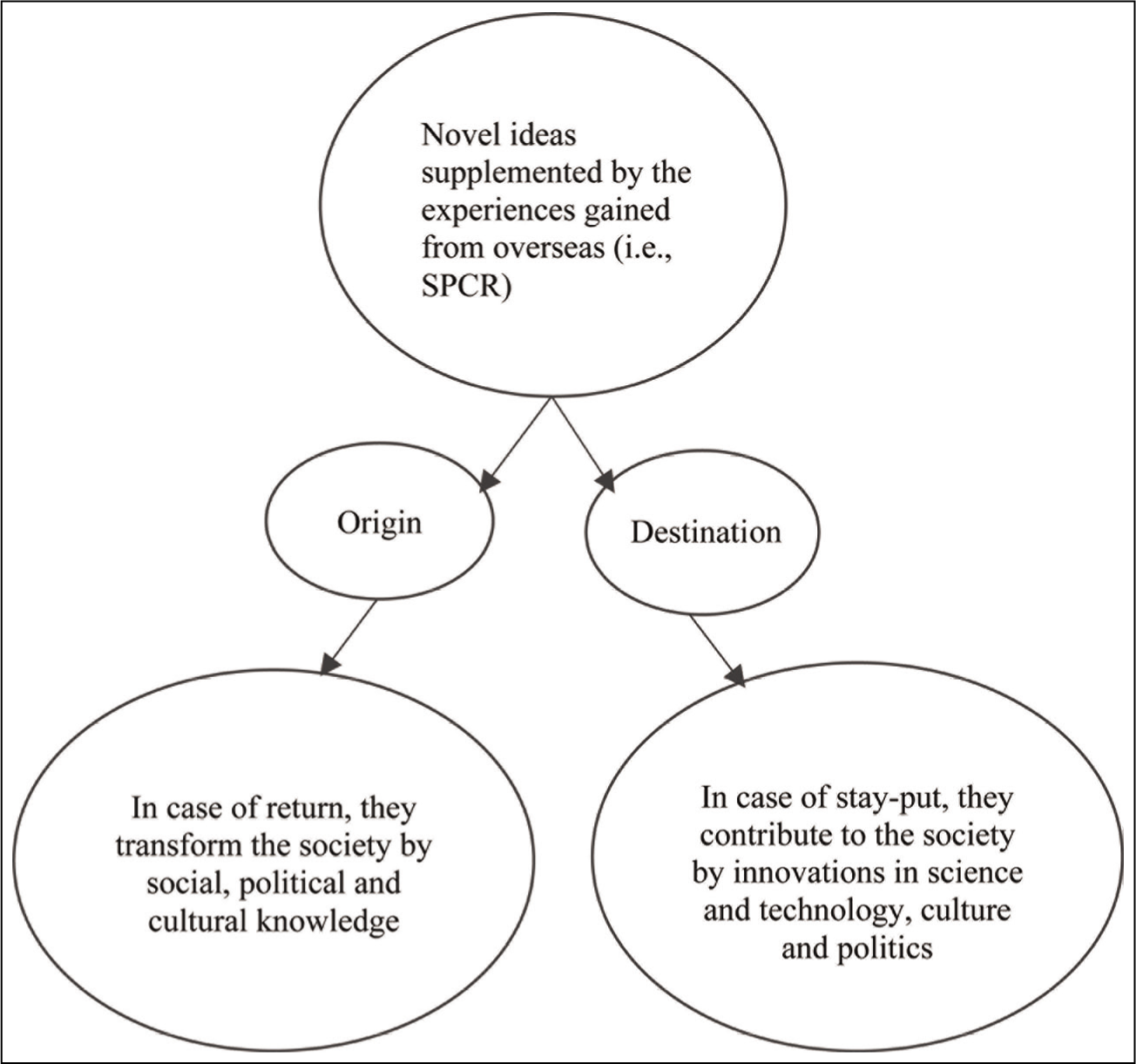
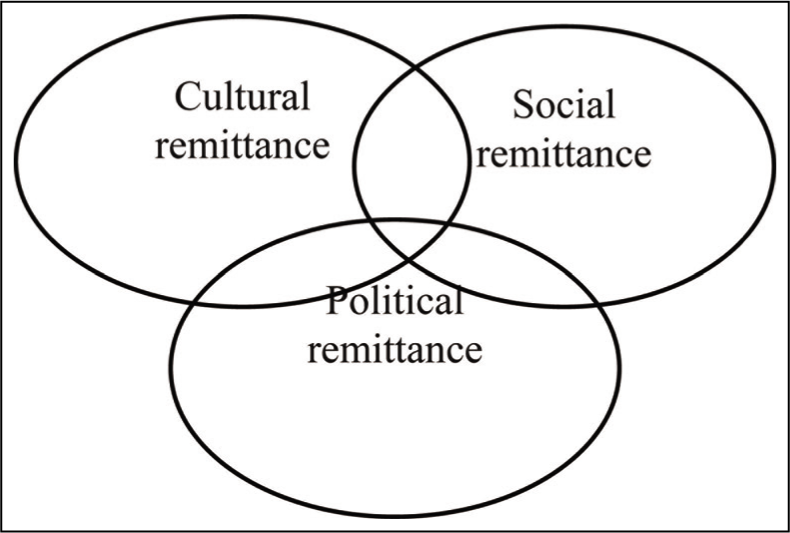
Looking only at the contribution to the changes in the origin is insufficient to comprehend RK as a whole. The context and the liminal regions between ‘origin’ and ‘destination’ should be considered.
In Origin on Return
Nelson Mandela’s visit to African countries and England to drum up support for the struggle afforded him confidence and moral support worldwide. He was trained in Morocco and Ethiopia before returning to South Africa in July 1962. His fight for freedom landed him in prison for 27 years. Nelson Mandela only stayed in office for one term that led to set an example for other African leaders who tended to remain in power indefinitely (Nelson Mandela Foundation, 2013). While he had doubts about many countries, he adhered to democratic principles and learned how to accept different beliefs, tribes, races and cultures in a single governmental body.
Mahatma Gandhi, a famous philosopher activist, caught the attention of the people through his battle for India’s independence by civil disobedience (Dalton, 2012). It is critical to understand Gandhi’s philosophical views on independence and their application in India’s freedom fighters and implications for social inclusion in the region. Through non-violence, Gandhi interpreted independence to include political freedom as well as social fairness. Gandhi believed that the journey to liberation was just as important as the goal. Gandhi’s belief in cooperative action led him to advocate for Hindu-Muslim unity and abolish untouchability in India. Still, the same communal message is equally applicable to other countries (Dalton, 2012). His experience and the treatment he received in South Africa from the British ignited his conscience and felt the drive to return to India. Gandhi left India in September 1888, at the age of 18, to study law in London and become a barrister (lawyer). His first days in London were spent luxuriously, but he quickly transitioned to a more modest and frugal way of living (Tamba, 2020). After completing his studies, he returned to India to practice law. Unfortunately, Gandhi discovered that he lacked both Indian legal expertise and self-confidence throughout his trial. So, he travelled to South Africa, where he was offered a year-long job, and stayed for the next 21 years.
As an Indian, he was subjected to bigotry and abuses that were typical among his fellow Indians. As a result, he decided that he could no longer tolerate the injustices and that he would not be able to reform the discriminatory treatment. In 1915, he returned to India. His goal was to assist India in achieving self-rule. However, before he did that, he used his clout to correct inequalities between Indians, who had been ripped apart by castes and even religious divides, the latter of which he was unable to resolve. He believed that India’s morale regeneration was linked to its political independence. He travelled around the country to promote morality in people’s daily lives while also attempting to reduce violence at the grassroots level. He organized enormous protests against British regulations, some of which were effective, but others devolved into violence against his will. Other great leaders, like Nelson Mandela and Martin Luther King Jr., were inspired by his ideas and life achievements. As a result, we observe that the concept of truth and non-violent resistance is a concept that comes to his mind when he is looking for a noble thought (Bligh & Robinson, 2010).
Aung San Suu Kyi studied in India, where her mother worked as a diplomat, before travelling to the UK to further her education. She was introduced to Mahatma Gandhi’s teachings while attending college in India. Her mother’s position as a diplomat also allowed her to meet and engage with a wide range of notable individuals, some of whom eventually became her mentors. From 1964 to 1967, she attended St Hugh’s College, Oxford. In 1997, she was awarded the Oxford Freedom. In 2012, she received an honorary degree from the University of Oxford. She fought for Burma’s freedom of democracy, risking her life and subjecting her family to sufferings like her husband’s detention and separation from his family. In 1991, she was awarded the Nobel Peace Prize. She became a global emblem of the Burmese democratic struggle.
Benazir Bhutto, the Prime Minister of Pakistan, attended Radcliffe College, Harvard University, from 1969 to 1973. She began very young and struggled to adapt to American life. She became a campus tour guide and Eliot House’s social secretary. She joined a Moratorium Day rally on Boston Common to oppose American involvement in the Vietnam War. She met second-wave feminism activists but was skeptical of some of their viewpoints. Bhutto earned a BA in comparative government from Harvard in 1973. Bhutto studied at Lady Margaret Hall in Oxford. Bhutto moved to the UK in autumn 1973 to study Philosophy, Politics, and Economics at Lady Margaret Hall, Oxford. She stayed at Oxford for a year to study international law and diplomacy at St Catherine’s College. She was the first Asian woman to be elected President of the Oxford Union Debating Society in 1977. Victoria Schofield took over when her 3-month term ended.
Benazir joined her father at the India–Pakistan Summit at Simla in 1972, replacing her sick mother. There she met Indira Gandhi, the Indian Prime Minister. It was the first time she was noticed by the local and national Indian press while in Simla. In 1974, she flew to Lahore to join her father at the OIC meeting. She became prime minister of Pakistan on December 1, 1988, heading a coalition government.
Philippine nationalist and physician Jose Rizal was an inspiration to Filipino nationalism. Rizal was born to a wealthy landowner and received his education in Manila and at the University of Madrid. Between 1882 and 1892, he spent most of his time in Europe, where he wrote the majority of his works (Ikehata, 1968). In 1892, Rizal returned to the Philippines and created the Liga Filipina, a peaceful reform movement in Manila, banished to Dapitan in northwest Mindanao. For the next 4 years, he was in exile. The Katipunan, a secret Filipino nationalist organization, rose against Spain in 1896.
He was a skilled medical student who quickly dedicated himself to reforming Spanish authority in his native Philippines, though he never called for independence. He rose to become the leader of the Propaganda Movement, publishing numerous pieces to its Barcelona-based journal, La Solidaridad. Integration of the Philippines as a province of Spain, representation in the Cortes (the Spanish parliament), the replacement of Spanish friars with Filipino priests, freedom of assembly and expression, and equality of Filipinos and Spaniards before the law were all parts of Rizal’s political programme (Ikehata, 1968). Rizal was arrested and prosecuted for sedition by the military, despite having no ties to that group and having played no role in the insurgency. After being found guilty, he was publicly killed in Manila by a firing squad. His martyrdom persuaded Filipinos that independence from Spain was the only option. While imprisoned in Fort Santiago on the eve of his execution, Rizal wrote ‘ltimo adiós’ (‘Last Farewell’), a classic of nineteenth century Spanish verse (Ikehata, 1968).
Jawaharlal Nehru was the first Prime Minister of independent India (1947–1964), who founded parliamentary governance and was recognized for his nonaligned foreign policy (Moraes, 2021). In the 1930s and 1940s, he was also a key figure in India’s independence movement. During his time overseas, he developed a keen interest in Indian politics. Nehru became a devotee of Gandhi and followed in his political footsteps to achieve freedom (Moraes, 2021).
He advocated for secularism, non-discrimination, democracy and economic planning. His education in science and technology in England influenced his secular ideas. Nehru thought that democracy, science and technology were the primary remedies to backward societies and the keys to development. As a result, he had a significant impact on India’s science and technology. This influence may still be observed in India today, as evidenced by the prominence of industry and the scientific and technology sectors.
Ho Chi Minh is widely regarded as the Father of Vietnam. He was a key figure in Vietnam’s national movement for independence from French colonial control, which had taken over after the Japanese had fled. Ho Chi Minh was a communist believer, which may have stemmed from the interaction between the French colonial power and capitalism, which resulted in the exploitation of the Vietnamese people. He stated that his nationalism came first, and many feel that his decision to become a communist was made for the greater good as a necessary means of achieving his nationalist objectives.
Ho Chi Minh obtained early education at Vietnam’s elite National Academy and subsequently furthered his education in France. In Paris, he became well known among the city’s communist circles. He was later summoned to Russia, where he received Comintern training in Moscow. Exposure to Confucius concepts like communal responsibility during his upbringing is thought to have affected his attraction to communism. His communist ideals and principles were suggested as reasons why he could not persuade the USA to back him in the liberation of Vietnam (Duiker, 1972), as his convictions linked him to more cruel communist leaders like Stalin and Mao Zedong. His communist sympathies helped him acquire popularity in Vietnam.
Lee Kuan Yew excelled as a student from an early age. His studies were halted following the Japanese invasion, and he relocated to the UK to complete his education, finally enrolling at Cambridge University to study law. He returned to Singapore after completing his education. He co-founded the People’s Action Party (PAP) with other English-educated middle-class men to seek complete independence and self-government and to abolish British control. The PAP elected him as Singapore’s first Prime Minister (Ullah et al., 2021). Lee Kuan Yew—the first Prime Minister of Singapore (1959–1990)—is regarded as Singapore’s founding father. Two significant events marked his three decades in power: first, the merger and subsequent separation of Singapore from Malaysia, and second, Singapore’s swift transformation from a developing to an Asian Tiger economy. Singapore, a newly independent country with limited natural resources and a small population, has grown into a true, real-life model of successful transition and growth around the world under his leadership. Some, however, have accused him of compromising political freedom in the name of economic progress. Nonetheless, the results he achieved were thought to be good enough to justify the means, and Lee and the PAP were able to maintain their support.
Thaksin Shinawatra, a Thai business magnate, was elected Prime Minister of Thailand in 2001 and was re-elected in 2005, but he was deposed in 2006 by a military coup (Hewison, 2007). Thaksin was born into a wealthy family that had made significant investments in a number of industries. He began his career as a police officer before moving to the USA to pursue his master’s and doctorate degrees in criminal justice. Despite his previous failures in various commercial enterprises, he later found enormous success in the computer and communications fields, eventually becoming Thailand’s largest mobile operator. In 1994, he was appointed to the role of Foreign Minister, and in 1995, he won a parliamentary seat. Later, he assisted in forming the Thai Rak Thai (TRT) party, which he used to run for and win the position of Prime Minister. He implemented populist programmes like expanding access to social services, which helped him and his party retain support, particularly among the poor and enabled them to win re-election.
In Destinations
We note here an interesting example of how the [im]migrants bring remittances in-kind to other countries. Nobel laureates are the most visible exemplars of such remitters. The Nobel Prize (named after Alfred Nobel and regarded as the world’s most prestigious award) was reinstated in 1901, and 962 people have received it through 2020, and 390 of them are from the USA (Anderson, 2020). There have been roughly 60 winners from Asia so far. A large number of Nobel Prize recipients are from countries other than the USA of America (Figure 3), reinforcing that immigrant plays a significant role in bringing destination countries credit and prominence in scientific domains.
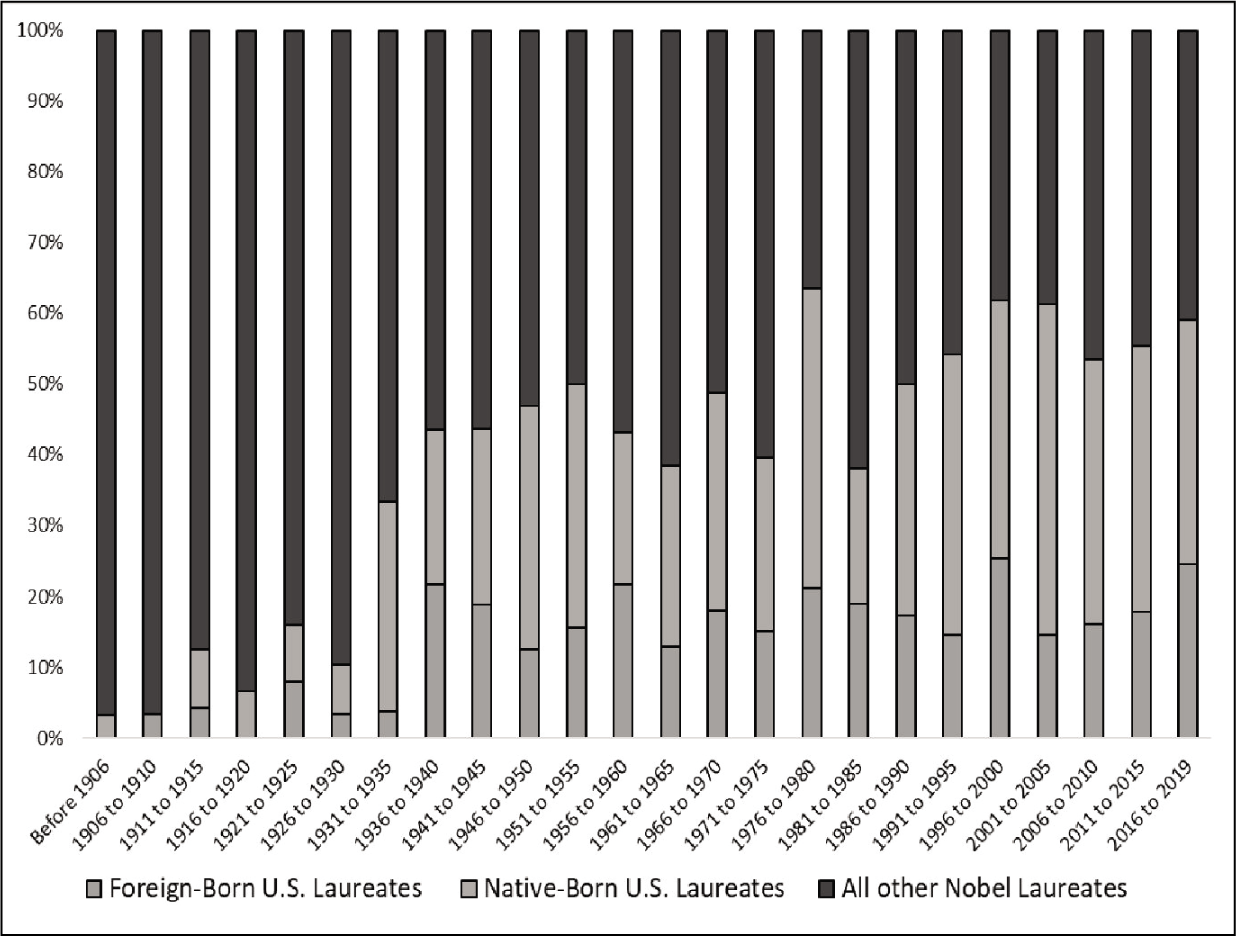
Since 1900, immigrants have accounted for one-third of Nobel Prize winners in chemistry, physics, medicine and economics in the USA. More than a quarter of the nearly 110,000 patents submitted in the USA each year are filed by immigrants. More than one million international students attend US universities, accounting for around 5% of total enrolment and contributing an estimated US$39 billion in yearly economic stimulation (Kerr, 2018; Ullah & Azizuddin, 2018). However, Trump’s (US President, 2016–2020) campaign has focused on immigration and the revocation of free trade agreements, claiming that globalization has left millions of US workers with nothing but poverty. Billionaires have backed stricter immigration regulations and ‘extreme vetting’ potential immigrants from certain countries (Bernal, 2016).
Both British immigrants, Oliver Hart of Harvard University and Bengt Holmström of the Massachusetts Institute of Technology (MIT), were awarded the Nobel Prize in Economics. Yoshinori Ohsumi, a Japanese scientist, was awarded the Nobel Prize in Medicine for his work on cell reproduction (Bernal, 2016). ‘I am exasperated by the degree of politics in this country and my former one,’ Sir J. Fraser Stoddart (the 2016 Nobel Laureate in Chemistry) commented of US politics. In an interview, Duncan Haldane, a Princeton University physics Nobel Laureate, described the immigration procedure as a ‘bureaucratic nightmare for many people.’ Regardless of administrative hurdles, experts believe that the American educational system will continue to attract researchers worldwide (Bernal, 2016).
Immigration has an effect on political outcomes, as seen by social protests and requests for greater transparency or reform during elections (Lacroix et al., 2016). Political leaders’ attitudes on immigration tend to be crucial in determining their electoral success or failure. For example, immigration took centre stage during the 2016 US presidential election and its aftermath, with then-US President Donald Trump adopting strong positions on immigration, the construction of a border wall, and Syrian refugees. The Brexit referendum in the UK, as well as subsequent legislative elections in Germany (2017) and Italy (2018), have highlighted immigration’s divisive political role and the electoral success of strong anti-immigration viewpoints (Mayda & Peri, 2018).
Remittances in-kind have recently become a focus in migration and transnationalism studies, with the exception of Peggy Levitt’s pioneering work (2001a, 2001b, 2008). The premise is that migrants bring many forms of non-economic capital [e.g., norms/ideas, practices/identities, culture and social networks] with them that affect their interactions with and integration into their host countries, and that they send back more than money (Carling, 2014; Levitt & Lamba-Nieves, 2011; Thai, 2014). However, this particular research does not look into the micro-impact of remittances in-kind on a micro-level.
The [im]migrant populations are the change makers. Their social, political and cultural understanding and comprehension got a lot of power to influence the society in both the countries of origin and destination. In this research, we have attempted to see how some particular leaders in Asia have influenced their own societies with the knowledge gained from overseas. Upon their return, migrants are no longer the ones when they first made their migration. They are enriched with new knowledge and skills, become multilingual, and educated, and have a more global perspective than many around them. Overseas experiences (school, job, etc.) can boost creativity, eliminate intergroup bias, broaden one’s worldview and help advance in career.
International experiences alter a person’s self-concept. If that person ascends to the position of leader, they gain the ability to shape the country’s progress. This article discusses a range of experiences. Migrants, for example, restore democratic political norms following extended periods of exile, resulting in increased voter engagement. Additionally, they anticipate higher levels of integrity from government leaders, which fosters political accountability.
Ho Chi Minh became an active socialist under the moniker Nguyen Ai Quoc (‘Nguyen the Patriot’) during his 6 years in France (1917–1923). He returned to China in 1938 and spent a few months at Yen-an with Mao Zedong. When Germany lost to France in 1940, Ho and his lieutenants, Vo Nguyen Giap and Pham Van Dong, devised a plan to exploit the situation. Ho fought the colonial system of the big powers for the most protracted and most expensive battle: the USA, the mightiest of capitalist countries. As a Marxist, Ho supports Yugoslav President Tito. President Ho Chi Minh led the tremendous resistance war of the Vietnamese people against American aggressors and the cause of socialist regeneration and construction in North Vietnam, with the help of the Party Central Committee.
President Ho Chi Minh adapted Marxism-Leninism to Vietnam’s unique circumstances, laying the groundwork for the Vietnamese revolution to achieve larger triumphs. He was the creator of the Vietnamese Marxist-Leninist Party, the Vietnamese National Unity Front, the Vietnamese People’s Army and the Democratic Republic of Vietnam, all of which made significant contributions to international unity (Vietnam Government, 2021). Gandhi’s philosophy ‘simple living and high thinking’ itself suggests that an individual’s thoughts have a great role in shaping their life. In challenging circumstances, remaining truthful, thoughtful, tolerant, nonviolent and respectful of others necessitates a high level of commitment. His philosophy was sparked by the mistreatment he received while overseas. They blended their international exposure into the social, political and cultural fabric of their own countries. More deep research must demonstrate how the ideas about politics, society and culture the leaders carried from overseas were translated into action in their own countries and how these ideas remain relevant in the fast-changing world. Of course, it is impossible to measure the contribution made to the world by the legendary leaders. There are of course many more charismatic leaders who contributed to the world even though they did not migrate out.
Compliance with Ethical Standards
Ethical Review Committee of Universiti Brunei Darussalam approved this research. The ref number: UBD/RSCH/1.2/FICBF(b)/2019/010.
Data Availability Statement
The authors confirm that the data supporting the findings of this study are available within the article.
Footnotes
Declaration of Conflicting Interests
The authors declared no potential conflicts of interest with respect to the research, authorship and/or publication of this article.
Funding
The authors received no financial support for the research, authorship and/or publication of this article.