



Abstract
The present study uses National Family Health Survey, 2015–2016 (NFHS-4) data to compute a multidimensional disempowerment index for women from India. A state-level analysis shows that disempowerment levels of women from the states of Haryana, Uttar Pradesh, Odisha, Madhya Pradesh, Karnataka and Bihar are found to be higher, with that of Bihar being the highest. Next, using a multilevel logistic model, the study explores the determinants of the level of women disempowerment. The probability of disempowerment is high among rural unemployed young Muslim women from joint families with low asset and education endowment and who witnessed parental violence as a child. Further, we found that the level of disempowerment of women from the state of Haryana is much higher as compared to its neighbouring state Punjab, where Haryana was an integral part of Punjab till 1966. A non-linear decomposition analysis reveals a significant contribution of Sikh religion on women’s autonomy in Punjab vis-à-vis Haryana.
Keywords
Introduction
Disempowerment of women is a process that deprives them of their rights, authority and power; it is one’s inability of making choices, inability to cope with one’s own life within domestic periphery or outside, and lack of confidence to grab the opportunities. Disempowerment of women signifies the long history of discrimination against women and is evident at every sphere of lives in different societies. It makes women ineffectual and excludes them from decision-making activities at home and outside. Given this background, the present study explores the factors responsible for disempowerment of women in India by using a comprehensive measure of disempowerment and captures the causes of difference in disempowerment of women of two neighbouring states of India.
There exist many studies on empowerment of women, 1 which is the fifth Sustainable Development Goal (SDG). The broad categories of empowerment can be classified into economic, sociocultural, interpersonal, legal, political and psychological (Malhotra et al., 2002). Empowerment is an amalgamation of three basic dimensions, namely agency, resources and achievement (Kabeer, 2005). 2
To become empowered, women need to exercise agency, must be able to access the resources and have positive accomplishments, as explained by Kabeer (2005), Hashemi and Schuler (1993). The lack of agency, lack of access to resources and failure to achieve any positive accomplishment signify the state of disempowerment of women. Within the above-mentioned three basic dimensions, there are other indicators of empowerment such as decision-making autonomy in money matters, freedom of mobility, child-related decisions, voice in house and in community (Ackerly, 1995; Hashemi et al., 1996, Jejeebhoy, 2000; World Bank, 2001), freedom from threat and nutritional empowerment (Narayanan et al., 2019). The failure to achieve in one or more of the above-mentioned dimensions indicates disempowerment of women. In the present study, the dimensions that we include to account for the disempowerment of women from India are as follows: absence of freedom of mobility, restriction on decision-making autonomy, lack of ownership of financial assets, attitude towards physical violence and husband domination faced by the women. Absence of freedom of mobility restricts women from achieving education, participating in labour force or other economic activities, thereby making them intellectually and economically dependent and disempowered. Restriction on decision-making autonomy leads to lack of agency and confidence within oneself; similarly, absence of control over economic resources restricts the skill enhancement, achievement and self-sufficiency. A woman’s attitude towards domestic physical violence signifies her self-esteem. When she is justifying abuse by husband, it actually shows her conformity towards traditional patriarchal norms of the society, which makes her disempowered. Similarly, when a husband is dominating a wife, if she succumbs, again she is becoming disempowered. The intense oppression, distress and subjugation faced by the women make them more vulnerable to being disempowered in a patriarchal society.
In this connection, we focus on two issues: the first research question of the present study is as follows: what are the factors that influence the disempowerment of women in India? This is achieved by using a comprehensive measure of disempowerment at the state level using nationally representative large-scale National Family Health Survey (NFHS)-4 data set. Second research question is as follows: why is there a huge difference in the magnitude of disempowerment of women of two neighbouring states of India, namely Punjab and Haryana, with approximately the same level of basic socio-economic infrastructure.
The rest of the article is arranged as follows: Section II provides a brief overview of the existing literature on disempowerment of women. Thereafter, Section III discusses the data and methodology, and Section IV gives the details of the variables chosen for our study. The empirics and results are discussed in Section V. Section VI concludes the major findings in the article.
Literature Review
Several studies have focused on the issue of disempowerment of women across the globe. According to Kawewe (2001), disempowerment of women may arise from major structural forces of a society in various ways: cultural, economic, political and resource distribution. Garba (1999) concluded that endogenous strategies, which involve external sources, enable disempowered women to empower themselves in the case of Nigerian women. The study by Ganle et al. (2015), on the rural women of Ghana, showed that some women became empowered from the access of micro-credit, and some were left disempowered due to a failure in proper management of the loan money. Mofolo (2011) identified disempowerment of women—caused by culture, lack of financial or family support, lack of information and limited government—as a major cause of poverty and other societal ills faced by many African countries. Islam et al. (2019) identified the existence of legal gender disparity and its impact on the disempowerment of women through the lower participation of women in the private sector labour market along with a lower likelihood to become top managers and owners of firms, using data from 104 economies. The evidence also indicates that access to finance and corruption lead to legal gender disparities that disempower women in the labour market.
There are some studies on measuring the disempowerment level. Alkire et al. (2013) constructed a unique empowerment index (5DE) based on five dimensions that comprised decisions about agricultural activities and showed the percentage of women who are empowered as well as the intensity of disempowerment. Another study by Ahmad and Khan (2016) focuses on assessing disempowerment of women in Pakistan.
Some of the studies have focused on disempowerment of women in India. Sarin (2001) revealed that due to the imposition of various forest management policies, the forest women of Uttarakhand, India, have become severely disempowered in decision-making for use of forest resources that are usually managed by them. Bhuyan (2006) focused on the deprivation of women in political decision-making in India. Mishra (2014) represents a multidimensional aspect of measuring disempowerment, by means of the NFHS-3 data, using only eight indicator variables. However, to the best of our knowledge, we did not come across any studies in the Indian context that consider issues of disempowerment of women using NFHS-4 data set. The present study fills this gap in the literature by computing a multidimensional disempowerment index comprising five major dimensions, namely mobility restriction, lack of ownership of financial resources, decision-making subjugation, domination by husband and attitude towards physical violence with 18 indicator variables. In addition, the above-mentioned studies that we have come across did not focus on the exploration of causes of differences in disempowerment of women across the two neighbouring states of India—Punjab and Haryana—which is another research gap that this present study would address.
The present study has the following contributions to the literature:
First, we compute a multidimensional disempowerment index, with 18 indicator variables from NFHS-4 data, using a methodology proposed by Chakravarty and Ambrosio (2006) and Jayaraj and Subramanian (2010) at the state level, and we have used the Alkire et al. (2013) methodology to measure the disempowerment level at the individual level. This indexing has helped us to understand the intensity of disempowerment at the individual level as well as at the state level. Then, after exploring the extent of disempowerment of women across states, we determine the socio-economic and demographic factors affecting disempowerment, using a multilevel logistic regression model to focus on interstate variation. This is one important contribution of our paper to the existing literature.
Second, the data exploration revealed that two neighbouring states of India—Punjab and Haryana—show diametrically opposite trends regarding the extent of women disempowerment. Our second contribution to the literature is that we have explored the causes of differences in disempowerment of women in these two states. Haryana is a landlocked region, which was carved out from East Punjab in 1966 as an independent state due to religious and language differentials of both the states. 3 Haryana shares its border with Punjab (approximately, 799.26 km), and both states share the common capital city of Chandigarh. When the Green Revolution in India took place, the two states became the biggest contributors to the increase of food grains, and it created a critical socio-economic impact in both the states (Shiva, 1991). 4 Now, the state of Punjab is home to the people of Sikh religion. 5 Studies observed that different religions have diverse effects on people’s economic attitudes, and some religious groups tend to be more provincial and less friendly to women’s right (Guiso et al., 2003; Klingorova & Havlicek, 2015). Sikhism has different ideologies towards women’s status, which segregates them from other states of the northern parts of India, inspired by their doctrine of Guru Grantha Saheb (scriptures) (Dyson & Moore, 1983; Kaur & Gill, 2018; Kaur, 2014). Men and women have equal rights in entering the gurdwara and can participate in various religious activities like participation in community kitchen (langar) (Kaur & Gill, 2018). Given this backdrop, we apply the Fairlie decomposition method to assess the contribution of Sikh religious identity to the difference in disempowerment of women in the two neighbouring states. This is another important contribution of this article.
Finally, our methodological contribution is to apply a multilevel and multivariate logistic regression or mixed-effect logistic regression for exploration of the factors affecting the disempowerment of women in India at the state level and to apply the Fairlie decomposition method to analyse the difference in disempowerment in two neighbouring states of Punjab and Haryana.
The results show that the likelihood of disempowerment is high among the rural unemployed young Muslim women from joint families with low asset and education endowment and who witnessed parental violence as a child. Further, the non-linear decomposition analysis reveals a significant contribution of Sikh religion on women’s autonomy in Punjab vis-à-vis Haryana.
Data and Methodology
Data
We use the nationally representative NFHS-4 (2015–2016) data for our analysis, 6 containing information of all the 36 regions (states and union territories) of India. We have merged 7 the household questionnaire and the ever-married women’s questionnaire for 17 major Indian states. After the removal of missing responses for variables relevant for our study, we included a total of 26,096 women who were married at the time of survey in our analysis. We have used this data set because this provides us with all relevant information on 17 major Indian states that we intend to study.
Methodology
Construction of Disempowerment Index at the State Level
Disempowerment index is a multidimensional latent variable, and it is measured using various dimensions and indicators. Following Chakravarty and Ambrosio (2006) and Jayaraj and Subramanian (2010), we construct the measure of multidimensional disempowerment faced by women in any region or country. If nj is the number of women who are disempowered in exactly j dimensions, j = 0, 1, … K, where n is the total population size, and Hj is the proportion of the population that is deprived in exactly j dimensions. Then:

Then, the disempowerment index is defined as follows:

In this case, as α increases from 1 to higher values, π α gives greater weight to the headcount of women who are disempowered in an increasing number of decisions. At very high α values, it measures the magnitude of extreme disempowerment (Mishra, 2014). We apply this index at the state level because this index satisfies symmetry, range monotonicity, range sensitivity, strong range sensitivity and decomposability property. Jayaraj and Subramanian (2010) showed that for α = 3, the above-mentioned index satisfies all the properties, so it is considered as the ideal index by the authors.
Construction of Disempowerment Score at Individual Level
At the individual household level, first, we have calculated disempowerment score for women respondents using the methodology proposed by Alkire et al. (2013). 8 Different statistical methods like principal component analysis (PCA), factor analysis and multiple correspondence analysis are all very convenient in constructing any multidimensional index; however, according to Alkire et al. (2015), these statistical methods have some limitations as well. The underlying assumptions of statistical measures like bivariate normality may not be an appropriate assumption when indicator variables are binary. So we have chosen the methodology proposed by Alkire et al. (2013). Here, we have, first, calculated the scores for each of the dimensions of disempowerment, then we have created the disempowerment score using weighted sum of the five dimensions from Table 1.
Dimensions and Indicator Variables Chosen for Disempowerment Measurement Using NFHS-4 Data Along with Their Percentage of Responses
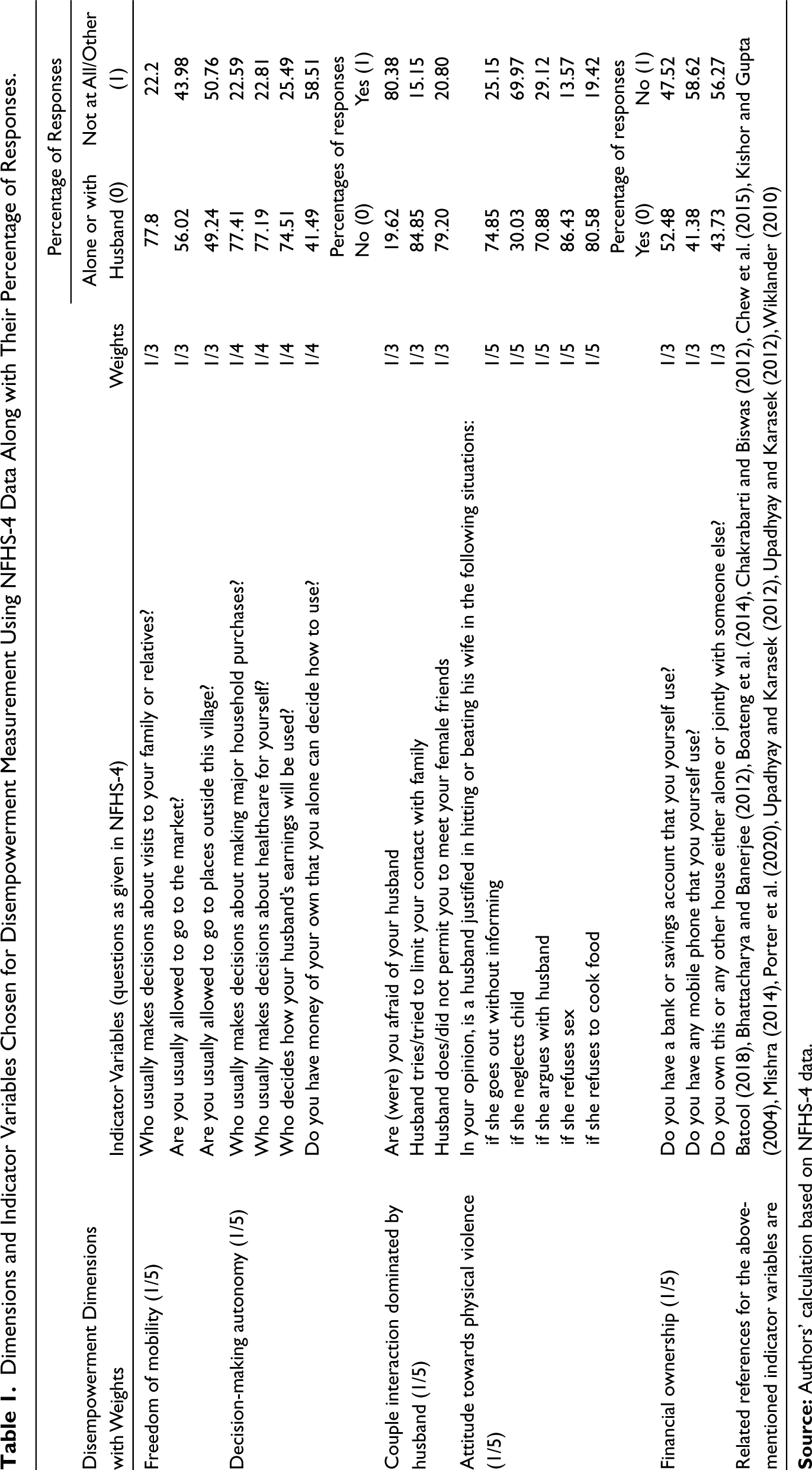
For example, let us take the dimension mobility of freedom, which is defined using three binary indicators. If the respondent answered negatively, the indicator variable assumes a value equal to unity. Hence, the disempowerment score for freedom of mobility = 1/3 × (visits to family or relatives? + allowed to go to the market? + allowed to go to places outside this village?).
Finally,
Overall disempowerment score = 1/5 × (freedom of mobility score + decision-making autonomy score + couple interaction score + attitude towards physical violence score + financial ownership score).
Econometric Analysis
Our empirical model is designed to search whether the incidences of disempowerment of women in India, which is caused from various types of dimensions and indicators, change either positively or negatively with the level of deprivation faced by that household, while taking into account the random effects caused from interstate variance.
Here, the unit of analysis is that the household is nested within a state. Since the incidence of disempowerment of women varies across the states and each household is clustered within the states, they share a common cluster-level random effects.
The model can be stated as follows:
Let Yij be a variable that takes the value of 1 if the woman in i-th household nested in jth state is disempowered, where j = 1, …, M clusters or states, with i consisting of i = 1, …, nj households.
Let pij be the conditional probability that Yij = 1.
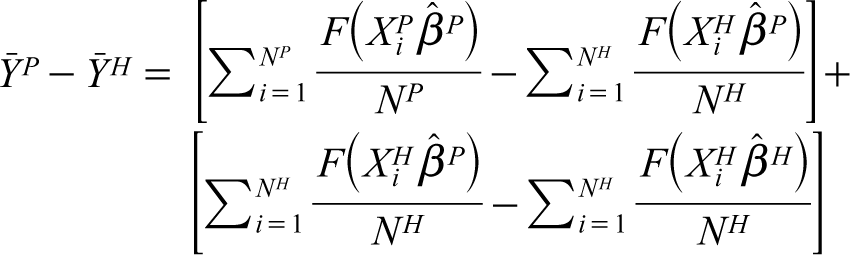
Under multilevel logistic regression, we have defined our model in this way:


Here,
where,
Dimensions and Indicator Variables for Disempowerment Index
We constructed the disempowerment index by using the following dimensions: freedom of mobility, decision-making autonomy, couple interaction, attitude towards physical violence and financial ownership. Each of these dimensions is measured using various indicators 10 expressed in Table 1.
From Table 1, we observed that although most of the women have freedom for visit to family or going to market, in the case of decision-making autonomy, 59% of the women do not have money that she alone can decide how to use. For decisions regarding large household purchase, own healthcare and spending of the husband’s earnings, most of the women have reported sufficient autonomy. Next, we observe that around 81% of the women said they are afraid of husband/partner most of the time or sometimes, whereas most of the women agree on the fact that their husbands do not limit their contact with family or do not impose any restriction on meeting female friends. Around 70% of the women justify beating wife if she neglects the child. In the case of the dimension of financial empowerment, around 59% of the women do not have a mobile phone, and 56% of the women do not own any house either alone or jointly, although more than 51% of the total women have their own savings account.
Observations from Disempowerment Index at the State Level
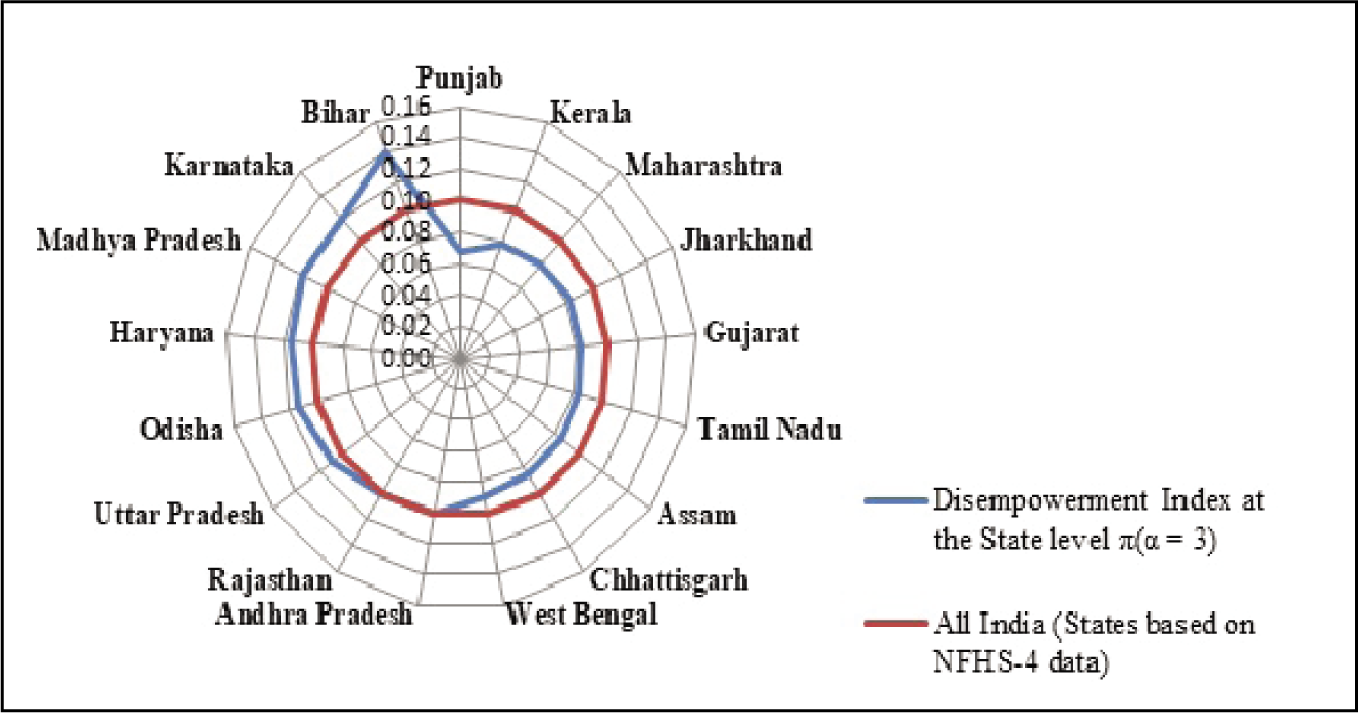
Using Equation (1), we have derived disempowerment indices for different levels of α. Figure 1 gives a comparative picture for 17 major states corresponding to a particular value of π at α = 3.
From Figure 1, we observe that disempowerment levels for the states of Haryana, Uttar Pradesh, Odisha, Madhya Pradesh, Karnataka and Bihar are found to be higher, with that of Bihar being the highest. Alternatively, we observe that the state of Punjab has the lowest level of women disempowerment. The surprising fact is that though Punjab and Haryana are two neighbouring states, they show a completely opposite picture related to women disempowerment levels. Both the states of Punjab and Haryana are characterized by low sex ratio at birth (number of girls per 1,000 boys) as compared to national average 11 due to a long history of practising of sex-selective abortion. The lack of women in society has led to bride trafficking in Haryana (Samal, 2016). Girls, including minors from poor families, are brought (mostly against money) from other states of India such as Assam, Odisha, West Bengal, Kerala and Andhra Pradesh to Haryana. These trafficked brides are known as Paro or Mulki. 12 These brides are extremely abused and exploited, 13 and their children even face intergenerational discrimination (Kukreja, 2018). Not only this, the state of Haryana is one of the states with high crime rates against women, and it is increasing over time (Rajeshwari & Singh, 2015).The National Crime Report Bureau (2018) and NFHS-4 fact sheet report as depicted in Table 2 clearly throws light towards the underprivileged condition of women in Haryana as compared to Punjab, which in turn leads to higher disempowerment of women in the state.
A Comparison of Punjab and Haryana over Reported Crime Against Women and Other Parameters
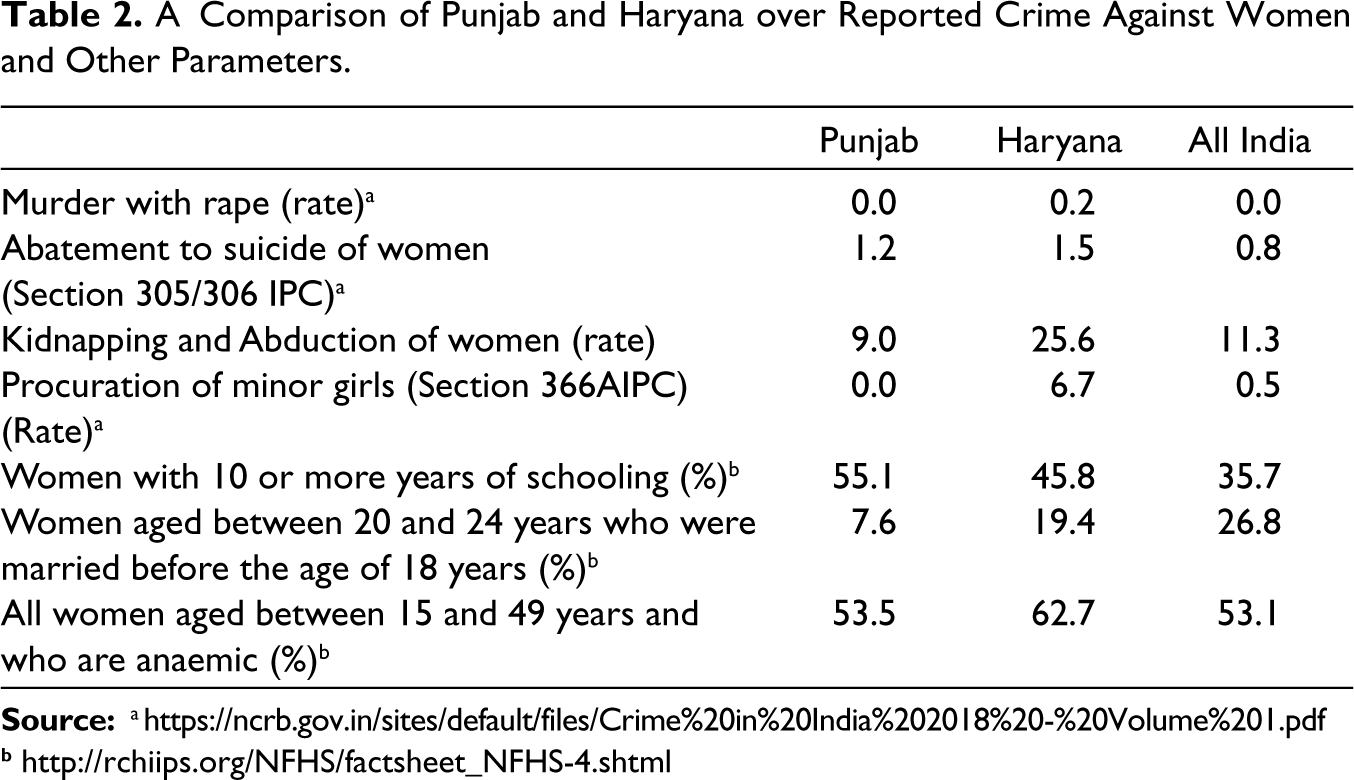
Source: a
b
Our objective is to find the influence of religious difference in two states, if any, on the divergence of disempowerment level between these two states. According to the 2011 census, in the state of Punjab, 57.69% of the population are from the Sikh religion, 14 whereas Haryana has 87.64% of the Hindu population and only 4.91% of the Sikh population. 15 Now, Sikhism believes in the equal treatment of men and women (Singh, 2014; Tatla, 2008). This religious philosophy, practice and teaching may have caused differential outcomes of gender between these two neighbouring states. In our later section, we will explore this interesting fact.
Variables Chosen for Empirical Analysis
Outcome Variable: Disempowerment Score at the Individual Level
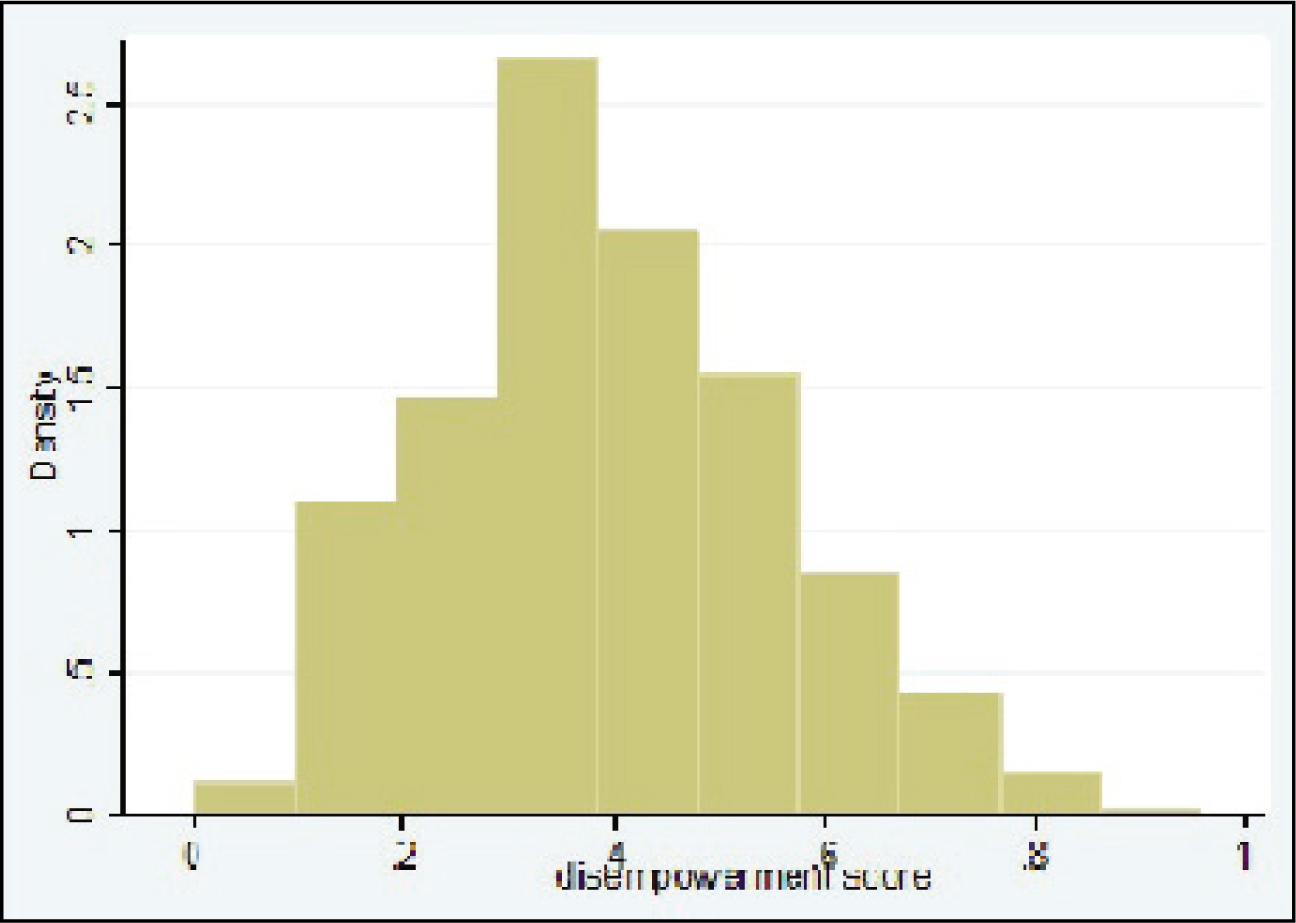
Next, we define disempowerment dummy in the following way: from the overall disempowerment score obtained by using methodology described at sub-section ‘Construction of Disempowerment Score at Individual Level’, median disempowerment score is obtained. The distribution of disempowerment score across the sample is shown in Figure 4. If for a woman respondent, disempowerment score is more than median score we consider her as disempowered and disempowerment dummy equal to unity for her, and otherwise it is zero. The details and descriptive statistics of all the variables are given in Table 4.
Control Variables
Details of the Dimensions and Variables Included for Deprivation Score
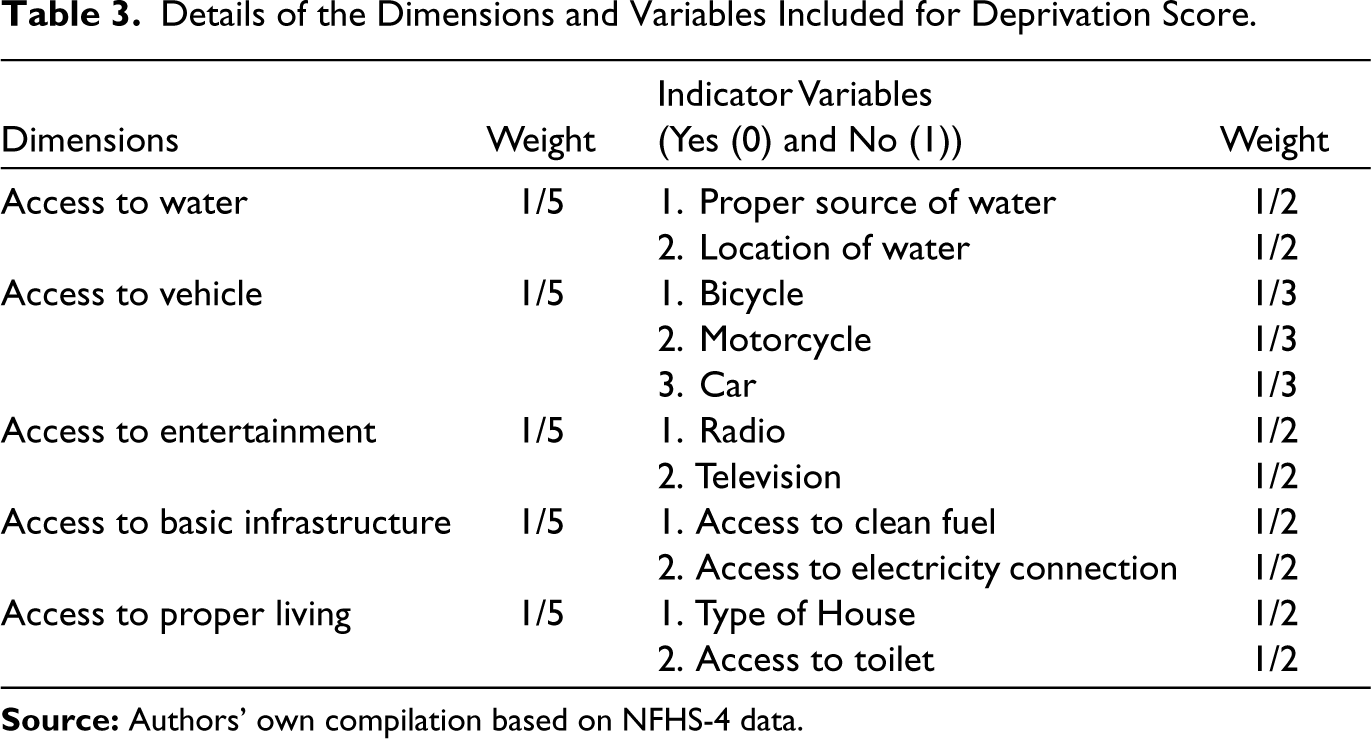
The following radar chart shows the percentage of population that is denied of their basic infrastructure across states. 21 Figure 3 is drawn in the following way: after calculating the individual-level deprivation score, we find the median level of score across all individuals. After that, we calculated the percentage of population with deprivation score above the median level for each state, which is presented in Figure 3.
From Figure 3, we observe that Bihar is showing the highest percentage of population that are deprived of their infrastructure and amenities with reference to the all-India average. Among the other states, Uttar Pradesh, Jharkhand, Assam, Chattisgarh, Odisha and Madhya Pradesh are also reflecting a higher percentage of deprivation than the all-India level.
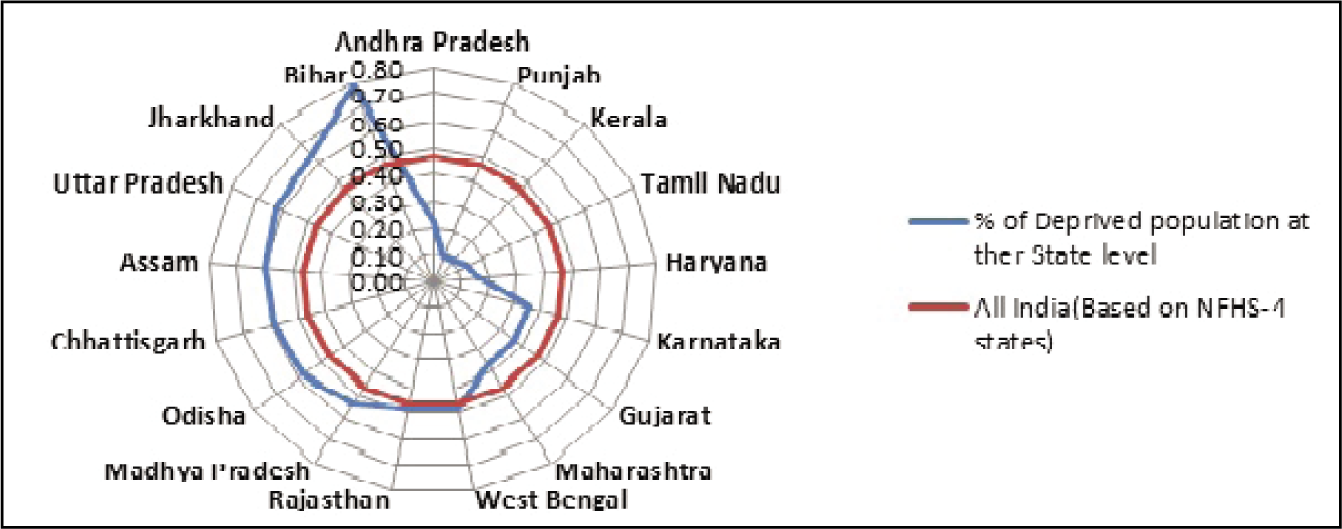
Description of the Variablesa for the Entire Sample
Variables Chosen for Fairlie Decomposition Analysis
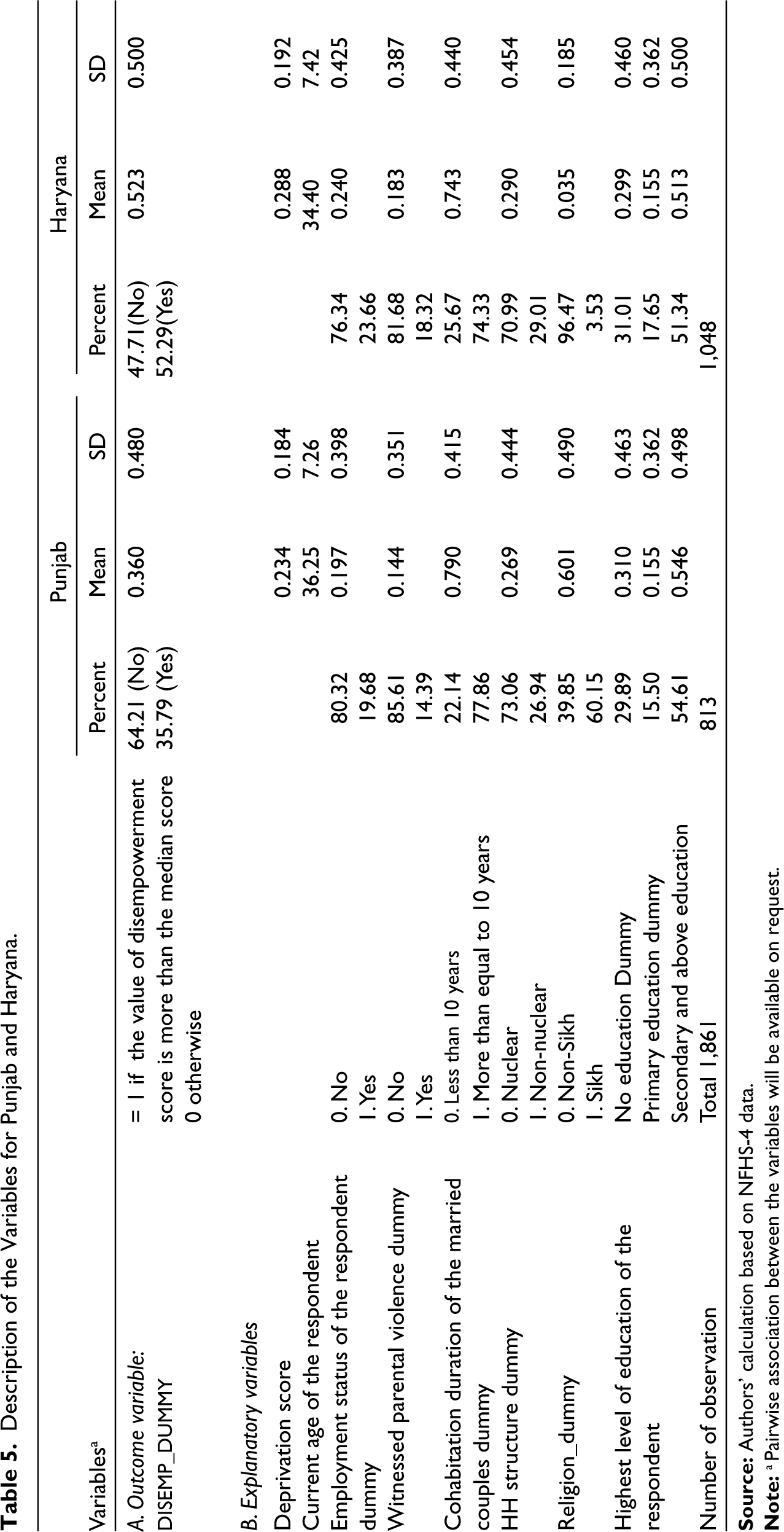
For the decomposition analysis, the control variables are similar, as chosen for our earlier model, except the following: we have introduced religion as a dummy variable, which is unity for Sikh religion, and 0 otherwise. Table 5 shows the descriptive statistics of the variables.
Description of the Variables for Punjab and Haryana
Multilevel Logistic Regression
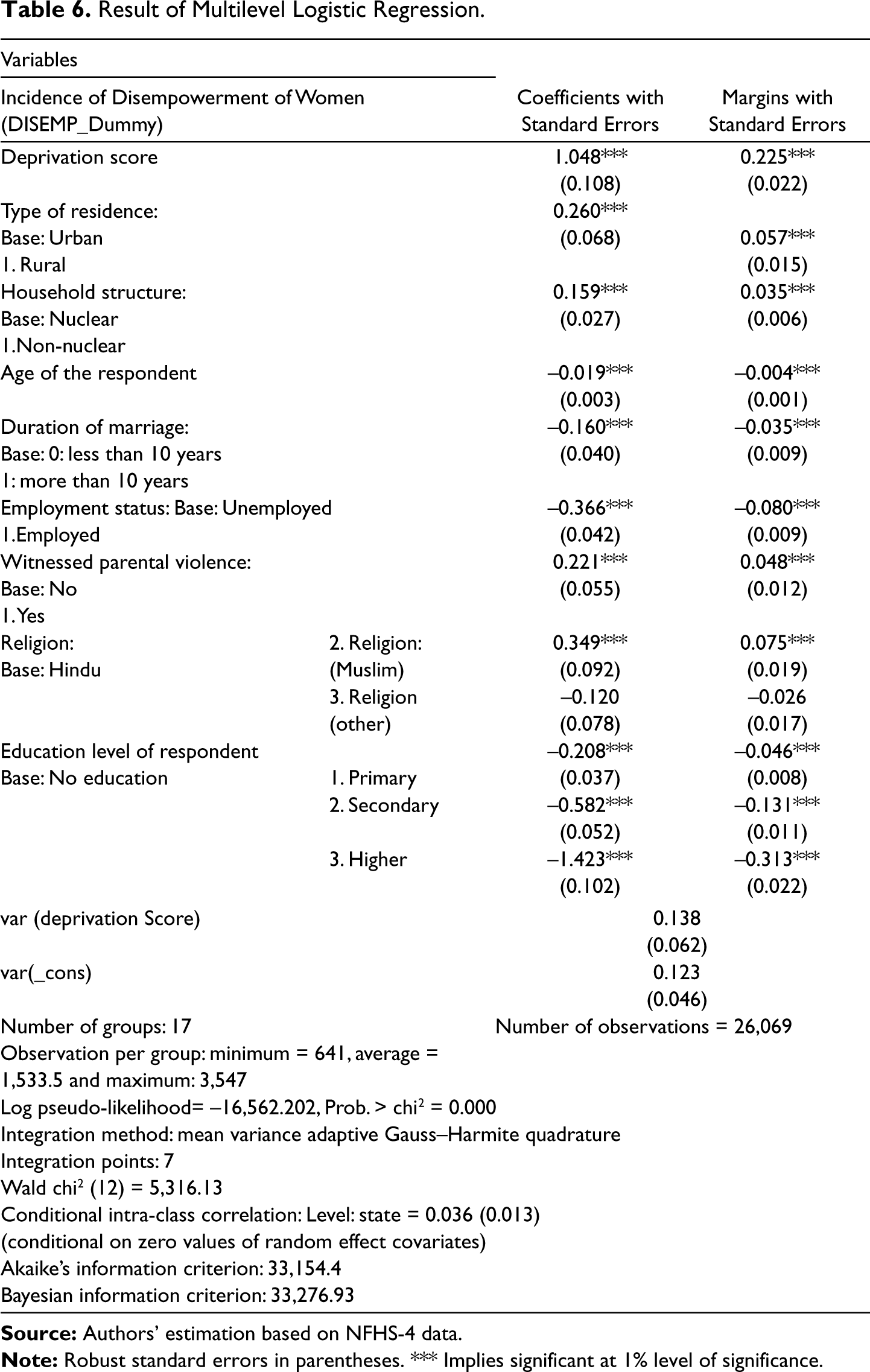
The result of the multilevel logistic regression is presented in Table 6. First, our study shows the existence of interstate variance in the incidence of disempowerment of women, as the variance of random intercept term is 0.123 > 0. Thus, the incidence of disempowerment of women varies across surveyed states of India.
Result of Multilevel Logistic Regression
Result of Multilevel Logistic Regression
Our analysis shows that the incidence of disempowerment of women increases with the rise in deprivation score with 22.5 percentage points if the woman belongs to the infrastructure-deprived household at state levels. The result is consistent to our earlier discussion. Further, we observed that the women with a higher level of deprivation score have lesser access to mass media such as newspapers, TV and radio. This leads to lower levels of awareness about their rights, opportunities and entitlements, thereby causing disempowerment among them. The finding is in line with the research carried out by Mohun et al. (2016) and Ting et al. (2014). Mohun et al. (2016) noted that improvement in housing or access to energy will free up time for economic activities for women and gradually make them empowered. Ting et al. (2014) observed that the provision of television positively affects women empowerment levels. Further, the estimated variance of random slope coefficient is positive, implying an interstate variation in the effect of infrastructure deprivation in households on the incidence of disempowerment of women.
Next, we observe that the incidence of disempowerment increases by 5.7 percentage points if the woman is a rural resident as against an urban resident. This is in line with the earlier findings by Saravanakumar and Varakumari (2019) and Tabassum et al. (2019).
The likelihood of disempowerment of women rises by 3.5 percentage points if a woman stays in a non-nuclear family or joint family, where she has to abide by the rules set by her elder parents-in-law. The finding is in line with the studies carried out by Biswas and Mukhopadhyay (2018), Kundu and Chakraborty (2012).
Interestingly, the age of women (by 0.4 percentage point) negatively affects the incidence of disempowerment as observed earlier by Gupta and Yesudian (2006), Biswas and Mukhopadhyay (2018), and Sanawar et al. (2019). In addition, if the duration of marriage is more than 10 years (by 3.5 percentage points), the incidence of disempowerment declines. This result supports the earlier discussion of the study carried out by Kundu and Chakraborty (2012), that longer duration of marriage enables women to exercise decision-making autonomy in the household, even if jointly with her spouse. Basically, an aged woman who is married for more than 10 years gradually attains maturity and seamlessly participates in the decision-making process within the households and becomes less disempowered.
Our analysis shows that the probability of disempowerment of women decreases by 8 percentage points when the women are employed as compared to being unemployed at the state level. The finding conforms to the observation of Bowlus and Seitz (2006), Banerjee and Ghosh (2012), and Kabeer (2012). Kabeer (1997) pointed out that if the woman is found to be able to take care of children and herself if her husband left, then this paid employment increases her autonomy in the family.
Next, we observe that the incidence of disempowerment of women increases by 4.8 percentage points if they observed that their father beat their mother at the state level. Observing parental violence and torture on mothers creates psychological trauma in a girl child (Carlson, 1991) and lowers her self-esteem (Shen, 2009), which in turn makes her less confident as an adult to fight for her autonomy.
Further, we observed that the probability of disempowerment of women increases by 7.5 percentage points if she belongs to a Muslim household as compared to a Hindu household at state level while controlling for various socio-economic and demographic variables. This observation is in contrast to the findings of Jejeebhoy and Sathar (2001) who observed no significant religious differences in decision-making autonomy of women in India and Pakistan. But according to Mainuddin et al. (2015), Muslim women are less empowered as compared to other religions in Bangladesh, and Kundu and Chakraborty (2012) observed that in the case of India also, Muslim women are less empowered due to strict conservatism and patriarchal norms. However, Das and Chattopadhyay (2012) found from their empirical study on West Bengal and Bangladesh that the population of ‘majority’ religion is more liberal to women’s autonomy than the clan of ‘minority’ religion. This may explain the disempowerment of Muslim minority women in India.
Next, we observe that the likelihood of disempowerment of women decreases by 4.6 percentage points if she has achieved primary education only; if she has secondary level of education, then it will decrease by 13.1 percentage points; and finally, for higher education, the margin indicates a decrease of 31.3 percentage points in the incidence of disempowerment. A higher level of education empowers women by increasing self-esteem and by strengthening their decision-making skills. The observation is in line with the findings of Gupta and Yesudian (2006), Duflo (2012), Mainuddin et al. (2015) and Shetty and Hans (2015).
Results from Fairlie Decomposition Analysis
The non-linear decomposition analysis explains the extent of difference in the disempowerment level of women for two neighbouring states: Punjab and Haryana. Table 7 presents the results.
Fairlie Decomposition for Two States: Punjab and Haryana
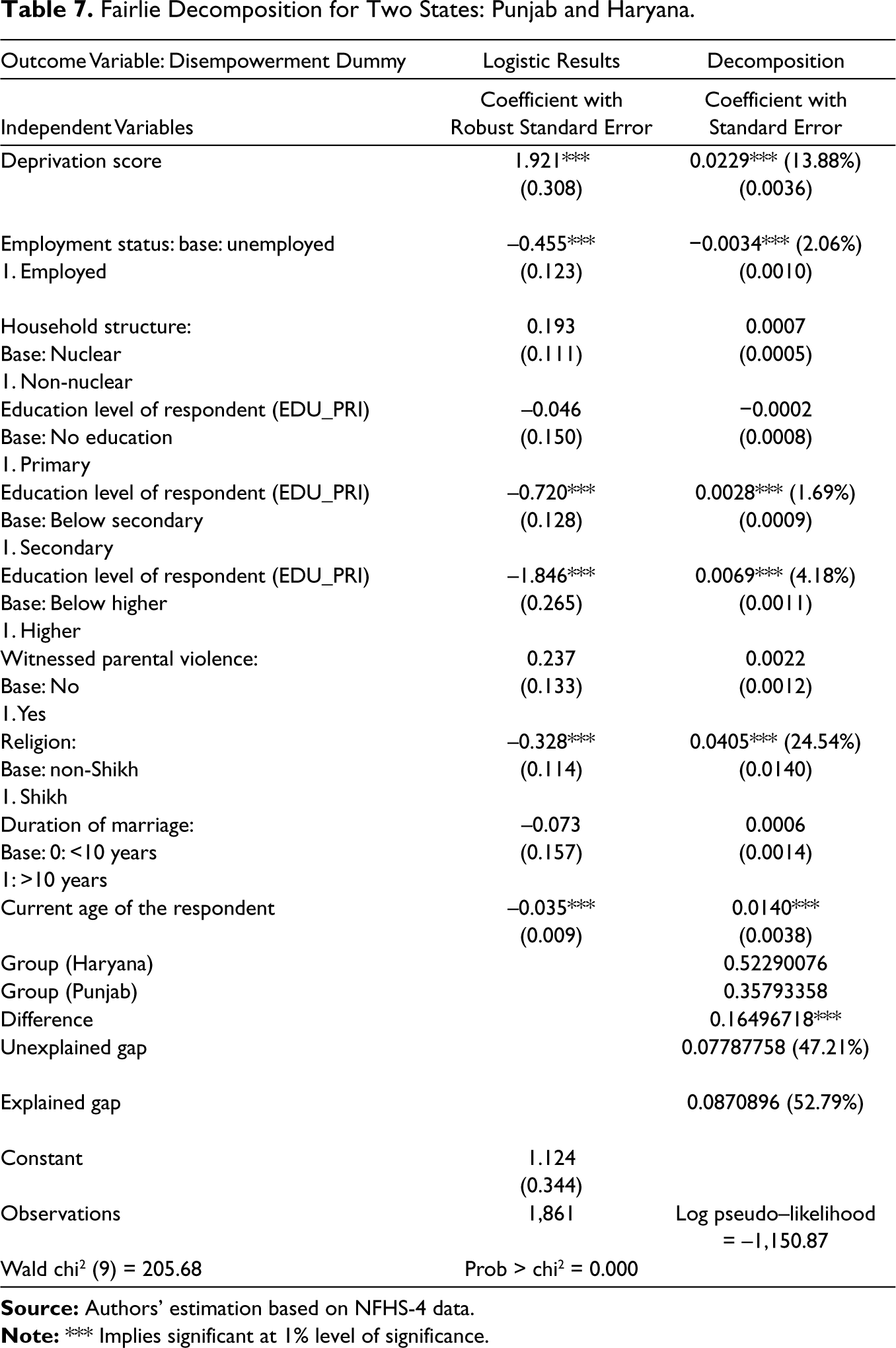
From Table 7, we observe that the result of the logistic regression is on the same lines as that of Table 6. Only the redefined religion dummy shows that the likelihood of disempowerment reduces if the woman belongs to the Sikh category. The decomposition result shows that the likelihood of being disempowered is much higher in Haryana relative to that of Punjab. The difference is approximately 0.16497 and significant. This indicates that the probability of a female from Haryana being disempowered is 16.497 percentage point higher as compared to a female from Punjab. Further, we observe that different socio-economic–demographic variables explain 52.79% of this difference. The most important finding is that the differences in religion account for 24.54% of the disempowered probability difference of women across the two states, While 13.88% of the difference is explained by the deprivation score. Thus, our hypothesis that the influence of the Sikh religion on the sample from Punjab is the reason behind the low disempowerment level among women vis-à-vis women from Haryana is justified. This decomposition analysis is one important contribution of this article, which has not been attempted earlier in the literature. As already mentioned, Dyson and Moore (1983) have considered the positive impact of the Sikh religion on various demographic parameters of the state of Punjab vis-à-vis other north Indian states. Shalender (2019) observed that according to the 2011 census, Haryana has a lower child sex ratio of 834 than that of Punjab, which is 846. Interestingly, according to this study, as per the 2011 census report, among the Sikh religious group, child sex ratios were 905 and 903 for Punjab and Haryana, respectively, and that of the Hindu religious group were 878 and 875, respectively, in the two states. Kumari and Goli (2021) using NFHS data also observed that child sex ratio for Haryana was 826 and that of Punjab was 840 in 2015–2016. Not only this, Singh (2015) observed that the male–female literacy gap in rural areas of Punjab was 11.45% in 2011, while it was 22.23% of Haryana. Thus, conforming to our result, these two studies clearly indicate the higher intensity of gender discrimination in Haryana in comparison to Punjab. The studies by Kapoor (2012) and Samal (2016) have pointed towards the social vices of bride trafficking in Haryana. Further, the analyses of Rajeshwari and Singh (2015), and Parihar et al. (2015) have explored that the state of Haryana is one of the states with high crime rates against women. The study by Nadda et al. (2018) recorded the existence of domestic violence among currently married women from Haryana. Further, the study by Mishra and Banerjee (2020) shows that the incidence of child marriage is higher in Haryana as compared to that of Punjab using DLHS-4 data. Thus, all these studies together strengthen our observation of the decomposition analysis that women are more disempowered in Haryana than in the Sikh-dominated state of Punjab.
The present study records the existence of disempowerment of women across the states of India. The exploratory analysis of NFHS-4 data brings out some serious concerns like the fact that around 81% of the women are afraid of husband/partner most of the time or sometimes and 70% of the women justify wife beating if she neglects the child. Both of the observations demonstrate serious a threat to the self-esteem of Indian women. The radar diagram exhibited that the disempowerment level of women for the state of Bihar is the highest, followed by Karnataka, Madhya Pradesh, Haryana, Odisha and Uttar Pradesh, whereas the state of Punjab has the lowest level of women disempowerment. From multilevel logistic regression analysis, we observe that rural unemployed young women with low asset endowment and education and belonging to Muslim community are disempowered. Further, the joint family structure and witnessing parental violence as a child positively influence disempowerment, whereas it decreases with higher levels of education, employment, longer duration of marriage and as women become more aged. Next, from the decomposition analysis, we observe that there is a significant difference in disempowerment of women in Punjab and Haryana as explained by the difference in religion. Hence, religious attitude plays a significant role towards shaping people’s perception towards women.
The results from the empirical findings suggest that better education and vocational training must be provided to girl children for their holistic development and better employment opportunities. Women’s autonomy may be ensured by organizing counselling programmes for the different clans of religion. Further, the government needs to pay special attention towards Muslim women for the improvement in their situation. Furthermore, the disempowerment is high in asset-poor families. Different recent studies show that asset inequality is increasing in India. 24 This is again a concern as this situation is more likely to deteriorate the condition of woman in asset-poor families. Thus, an overall development policy for recuperation of poorer households is required for lowering disempowerment among women.
Policy Implication
To eradicate the disempowerment of women, government policies should aim at improving the level of education and employment opportunities among women. A recent data show that labour force participation rate of women in India has gone down from 32.2% in 2005 to 23.45% in 2019. 25 With respect to our finding, this observation has a profound impact on the disempowerment of women in India. Therefore, government policies should focus on increasing the employability of women through skill enhancement training that would make them either job-market ready or self-employed.
In the case of India, with rapid growth and development in the past 50 years, different policies to promote equal rights for women are adopted, such as the Protection of Women from Domestic Violence Act, 2005, the 73rd and 74th amendments to the Constitution of India to provide reservations for women at the panchayat level and the Sexual Harassment of Women at Workplace (PREVENTION, PROHIBITION and REDRESSAL) Act (2013). The Government of India has already implemented the reservation of women into politics to improve their participation in political decision-making. 26 The Amendment to the Hindu Inheritance Act (2005) 27 has an accordant positive effect on all measures of women empowerment (Goel & Ravishankar, 2021). Different government policies like Rajiv Gandhi Scheme for Empowerment of Adolescent Girls (RGSEAG)-SABLA, 28 Indira Gandhi Matritva Sahyog Yojana (IGMSY), 29 Support to Training and Employment Programme (STEP) for Women, 30 Rashtriya Mahila Kosh (RMK), 31 SWADHAR: Scheme for Women in Difficult Circumstances, 32 Working Women Hostel Scheme and many others that work at helping disempowered women to gain their autonomy. Various women’s organizations also take care of the credit needs of the women by Self Employed Women’s Association (SEWA) in Ahmedabad, Gujarat; Working Women’s Forum (WWF) in Chennai, Tamil Nadu; and Annapurna Mahila Mandal in Mumbai, Maharashtra; Kanyashree Scheme in West Bengal and Bhamashah Yojana in Rajasthan. 33
However, the policies remain ineffective until it fails to accelerate the self-confidence and self-esteem among the women. Programmes like enterprise development programme would help young women to flourish their entrepreneurial skills by providing them with adequate financial help, technical support, guidance and training. Schemes like Mahila E-Haat, 34 Mahila Shakti Kendra (2017) 35 with effective implementation among rural and asset poor women would be beneficial. Along with that, periodical reward and appreciation would also help to raise their confidence in their decision-making powers. Thus, programmes like Nari Shakti Puraskar (1999) 36 must be framed to award the successful entrepreneurial service of a woman. Having friends also increases the autonomy of women as reported by Kandpal and Baylis (2019) by examining the participation of women in Mahila Samakhya, an education program group in Uttarakhand. Various schemes and government policies are framed and applied to combat the disempowerment of women in India. But the removal of women’s disempowerment from India needs women to be aware of their self-esteem, they should understand their own worth and they must always stand beside other women to remove any kind of gender inequality.
Limitations
The present study suffers from some limitations due to the NFHS-4 data set that does not contain the questions relating to political decision-making authority of the respondents. 37 The individual perception towards religion is also not covered in the data set. Further, whether the respondent is aware of various acts like section 498 A 38 of the Indian penal code that punishes husbands or in-laws subjecting women to cruelty or section 304 B 39 of the Indian penal code on dowry deaths also does not come under the purview of NFHS questionnaire, which can be used to formulate awareness of women regarding law and order of the country. A primary survey would be needed to shed light to these areas.
Footnotes
Declaration of Conflicting Interests
The authors declared no potential conflicts of interest with respect to the research, authorship and/or publication of this article.
Funding
The authors received no financial support for the research, authorship and/or publication of this article.