



Abstract
The three new farm laws promulgated by the Government of India in 2020 (now repealed) as agricultural marketing reforms, with the claim that they were aimed at expanding farmers’ marketing choices and increasing their incomes, have triggered massive protests by farmers. These protests have crystallized around two key demands: first, repeal the laws and second, make the minimum support price (MSP) for procuring farmers’ produce a legal right. Given that discussions between the government and farmers’ organizations continue to be at an impasse, it is critical to understand the arguments over the laws and the MSP, and the implications of these arguments for the agrarian future of India.
Keywords
Introduction
The new farm laws, which were enacted by the Government of India in 2020, have set policymakers and farmers at loggerheads. The government is promulgating these laws as a watershed moment in the agricultural history of the country. It is continuing to assert that the laws are necessary to transform India’s agriculture sector. The farmers’ organizations have denounced the laws as anti-farmer and anti-agriculture and are demanding their repeal. The government has rejected the demand for their repeal but is willing to consider amendments. The farmers also want the minimum support price (MSP) to become a legal right (Rautray, 2021). This article interrogates the competing arguments over these laws with a special focus on the MSP regime. The article is further divided into five main sections. The first section deliberates on the central government’s view of these farm laws, the second section highlights farmers’ apprehensions of the laws and the significance of the farmers protests driven by those apprehensions, the third section evaluates the critical importance of the MSP/PPS and APMC systems in India’s agrarian political economy, the fourth section examines the impact of the laws on the MSP system and finally the last section reflects on the way forward for India’s agrarian future.
Farm Laws: The Government’s View
The three farm laws: (a) The Farmers Produce Trade and Commerce (Promotion and Facilitation) Act, 2020; (b) The Farmers (Empowerment and Protection) Agreement on Price Assurance and Farm Service Act, 2020; and (c) The Essential Commodities (Amendment) Act, 2020 are being promulgated by Indian state media and by pro-government and pro-agrobusiness economists as the most critical and necessary reforms to restructure agricultural marketing (Pandey, 2020). One key government policy advisor views these laws as ‘forwarding the unfinished agenda of reforms started in 1991 and the fragmented, piecemeal and patchy reforms undertaken across states to their ultimate culmination’ (Chand, 2020, p. 3). The laws are also alleged to address agrarian distress, increase farmers’ income, generate remunerative employment for rural youth, enable Indian agriculture to become globally competitive and transform India’s rural economy.
The most contentious among these laws from the viewpoint of the issues examined in this article is The Farmers Produce Trade and Commerce (Promotion and Facilitation) Act, 2020. Government policymakers and pro-government and pro-agrobusiness economists have placed confidence in this law as a facilitator of farmers’ freedom to sell their produce either within or outside the Agricultural Produce and Market Committee (APMC) markets; thereby widening the market and eliminating middlemen from agriculture marketing. It is also claimed that the law provides the choice to farmers to sell directly from anywhere, including from their farms. It is further claimed that by removing the levies state governments collect from traders in the state regulated APMC markets, the law would make markets more competitive, and that this increased market competitiveness would create better returns for farmers’ produce. Most importantly from the viewpoint of the subject examined here, it is strongly upheld that this law will not dilute the MSP and that the public procurement system (PPS) via APMC mandis will remain intact (Iyer, 2020).
Farmers’ Apprehensions and Protests
Farmers in India have long been struggling with the growing economic unviability of farming as currently practiced (Singh & Bhogal, 2014). A widely reviewed work on Punjab economy in the context of India’s federal economy demonstrates that in this state—which was projected in global and Indian national discourses on development and agrarian prosperity as the pioneer of the 1960s Green Revolution strategy in Indian agriculture—returns from farming have been declining since the mid-1980s (Singh, 2008). Looking at the country as a whole, farming households have been embroiled in an ‘agrarian crisis’ which has caused farmer indebtedness, suicides and a trend towards depeasantization (Singh et al., 2014).
Contrary to government claims, farmers and many academics consider the 2020 farming laws to be a threat to the socioeconomic well-being of rural India in general, and to farmers in particular (Business Standard, 2020). They believe that the current BJP regime aims to use these laws to minimize government participation in agricultural marketing, in line with its adherence to the neo-liberal doctrine of promoting privatization and reducing the role of the public sector role in the functioning of the economy. It is feared that the vital institutional and government support system (encompassing the troika of MSP and PPS and APMC markets) that has been the cornerstone of agricultural development policies ever since the Green Revolution will be disabled (Mandal, 2020a). The likelihood of being exposed to profiteering by agrobusiness corporate interests that are increasingly moving towards digital capitalist strategies have sharpened the apprehensions of farmers about these laws and have triggered the most widespread farmers’ protests ever in India (Singh, 2021; Singh, et al., 2021a).
Farmers are also demanding that the MSP for their produce be made a legal right—the current MSP system is a government policy and hence not supported by law. It is contended that even if PPS continues after implementation of the new farm laws, the possibility of late arrival of public procurement agencies cannot be discounted. This would automatically pave the way for private players to step in with potentially exploitative trade practices, resulting in the farmers receiving prices less than the MSP (Singh & Bhogal, 2021a). The farmers fear that the central objective behind the three farm laws ‘is to encourage private investment by agrobusiness corporations from home and abroad into production, processing, storage, transportation and marketing of agricultural produce within the country and abroad’ (Singh, 2020a, p. 14) and that this would lead to a hugely unequal balance of power between powerful agrobusiness corporations and resource-scarce farmers.
The MSP/PPS and APMC System’s Critical Importance in India’s Agrarian Political Economy
The MSP system, along with PPS which is facilitated through the centrally controlled Food Corporation of India (FCI), has been the central plank of the Indian state’s articulation of Indian nationalism through achieving the national goal of food self-sufficiency (Singh, 2008, pp. 108–109). The Green Revolution strategy of the 1960s aimed to maximize food output and was the vehicle of achieving that goal. The government regulated mandis under the APMC Act has been an institutional mechanism of realizing that strategy. This incentivised farmers to shift from traditional farming—mostly subsistence farming of diverse crops– towards a focus on two main cereals—wheat and rice. The MSP, public procurement system (PPS) and a strict time bound purchase of output brought to the PPS (represented by Agricultural Produce Markets Committee, or APMC mandi yards) form a package deal. If you take out one aspect, the deal falls apart. For example, if you have the MSP but not compulsory PPS, the MSP becomes redundant. Similarly, if you have the MSP and even PPS/APMC mandi but not strict time-bound purchase of the produce brought to PPS, the deal will fail—especially if the product is a perishable commodity. Professor Gaurang Sahay of the Tata Institute of Social Sciences, Mumbai, has pointed out that on one occasion delays to the purchasing of vegetables in Madhya Pradesh led to farmers feeding cauliflower and aubergine to their animals. 1
A significant change has taken place over time regarding the purpose of the MSP, PPS/APMC and the timely purchase of agricultural products. At the 1960s launch of the ‘Green Revolution’, the MSP and PPS were designed to incentivize farmers to produce cereals—mainly wheat and rice—to assist India in achieving its national goal of food self-sufficiency, which was met by the early seventies. The purpose of the MSP and PPS/APMC is now twofold: first, to maintain food self-sufficiency because crop diseases and weather conditions such as droughts, especially due to global heating, can lead to food shortages in some years; and second, even more importantly, to ensure a reasonable assured income to the farmers. Regarding the importance of the first purpose, that is, food self-sufficiency, it is important to keep in mind that if by maintaining MSP, there is surplus food production in some years over and above the needs of self-sufficiency, that surplus stock can be relied upon to maintain self-sufficiency during the years of decline of food output caused by extreme weather. These imperatives demands that the incentive of secured price through the MSP structure must remain and if that incentive is taken away, the conditions of incentivizing food production and securing food security will be seriously weakened. Swaminathan and Bhavani (2013) have argued very forcefully and persuasively that the past experiences of the country underlines strongly that the MSP is a vital instrument to secure food production and subsequent food security.
Regarding the second purpose of MSP, that is, ensuring a reasonable assured income to the farmers, it is of key importance to note that this second purpose is critical for the 86% of India’s farming households who are either marginal (cultivating less than 1 hectare of land) or small (cultivating between 1 hectare and 2 hectares of land) and who sell their produce immediately upon harvest. Many pro-government and pro-agrobusiness economists who argue for scrapping the MSP now that food procurement targets have been met ignore either or both of the two new purposes of MSP/APMC. The recommendation to dismantle FCI public procurement, made by the Shanta Kumar Committee in its 2015 report, displayed a similar lack of recognition of the importance of these two new aims.
The government’s ‘assurance’ that the MSP/APMC system can co-exist with big agrobusiness-controlled private markets is not tenable, because a farmer who has reached a contract, say for three years, with a private trader will not legally be allowed to take the product to APMC if the APMC mandi offered him/her a better price than that contracted with the trader. The agrobusiness entity will take such a non-compliant farmer to litigation, where the dispute resolution mechanism is stacked against the farmer due to the structural inequities of legal resources and social-cultural capital (see Singh, 2020a, for an examination of the specific provisions of the farm laws on dispute resolution). The proposed dispute resolution mechanism increases the opportunities for the trader to trade and not for the farmer to sell (Singh, 2020a; Singh & Bhogal, 2021a). The complementary relationship between the MSP and PPS means that any weaknesses in either of the two should be critically examined (Gohain & Singh, 2018; Purohit, 2013).
The MSP: Its Vitality and Weaknesses
The MSP ensures the livelihoods of the farmers, the majority (86%) of whom are small farmers (Rahul & Nellithanam, 1997). The MSP is a provision that guarantees assured prices to protect farmers against market-price fluctuations, which can arise due to climate change, lack of market integration and imperfect information dissemination (Sharma, 2020a). It also protects farmers from the volatile global prices and trade of agricultural commodities. Besides, the MSP is critical for encouraging investment and promoting adoption of modern agricultural practices by farmers (NITI Aayog Development Monitoring and Evaluation Office, Government of India, 2016). However, failure of policymakers to recognize the importance of the MSP (due to complacency in official circles based on the perception that there is a food surplus) has led to several deficiencies in the MSP, such as the low level of payments, the underestimation of farming costs and the low rate of increase in the MSP. All these have combined to make it ineffective as a floor price.
Underestimation: Paid
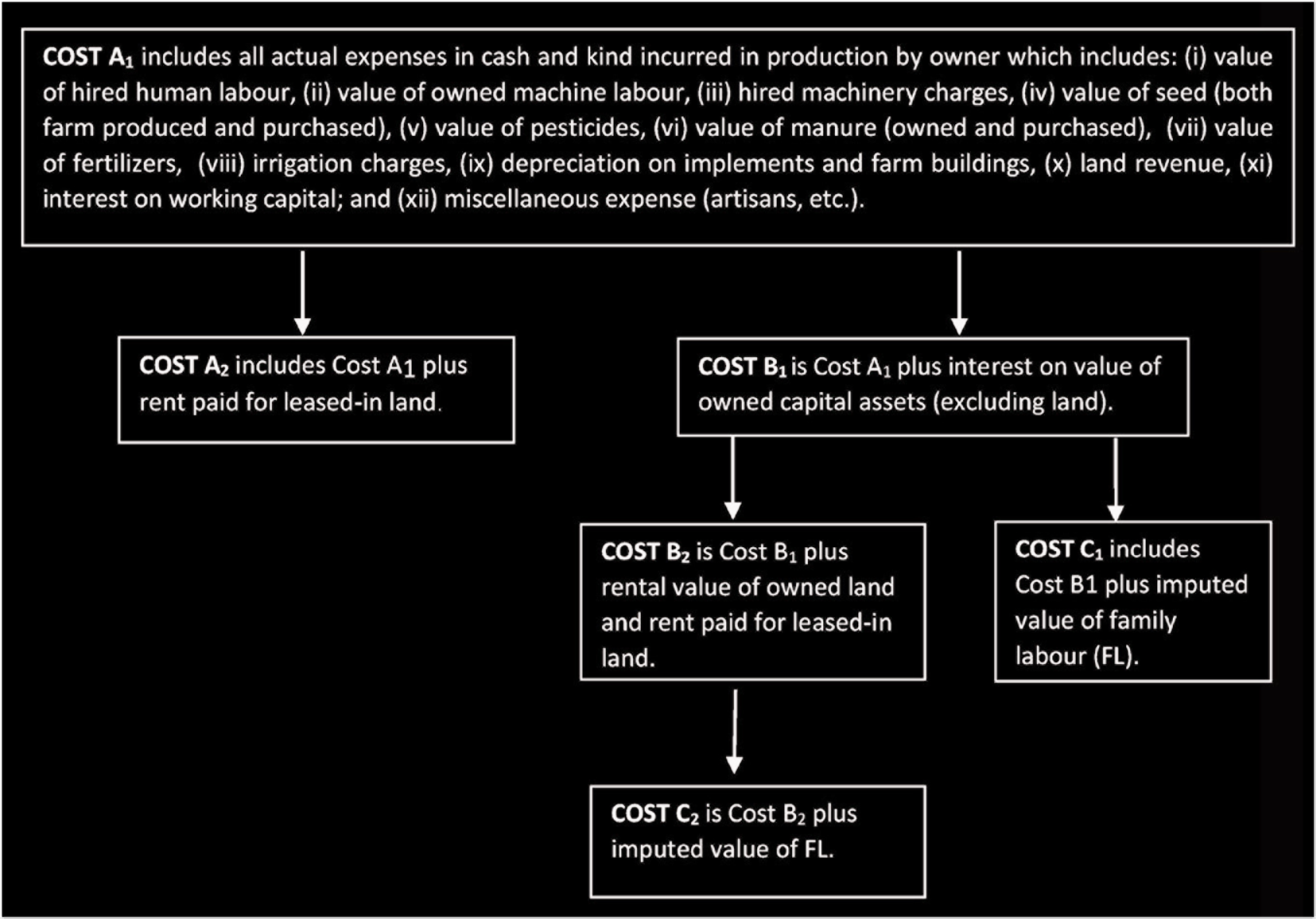
The idea behind the MSP was to ensure that all farmers would be paid a price that would cover all farm costs, thereby incentivizing farmers to contribute to the Indian state’s vision of agricultural growth (Rahul & Nellithanam, 1997). However, over time the MSP has largely ceased to be adequately remunerative. In fact, the economic unviability of farming can be linked directly to the inadequacy of the MSP (Sathyanarayana et al., 2017). This mainly stems from a mismatch between the rate of increase of cost of production and of the selling prices of produce (Vissa, 2017). Farmers were promised that the MSP would be implemented as per the recommendations of the National Commission on Farmers under the chairmanship of MS Swaminathan (Agarwal, 2018). According to these recommendations, the MSP should be 50% more than the complete cost of production (Ministry of Agriculture, Government of India, 2006). However, currently the MSP is being estimated using a formula which does not include all costs. The MSP is being calculated based on the cost formula A2 + FL + 50%, where A2 is the actual paid-out cost, FL is the estimated cost of family labour and 50% is the margin over the cost A2 + FL. A2 includes the costs of: (a) hired human labour, (b) owned machine labour, (c) hired machinery, (d) seed, both farm-produced and purchased, (e) pesticides, (f) manure, both owned and purchased, (g) fertilizers, (h) irrigation, (i) depreciation on implements and farm buildings, (j) land revenue, (k) interest on working capital, (l) miscellaneous expense (artisans, etc.) and lastly (m) rent paid for leased-in land. It is noteworthy that the cost A2 + FL does not include all farm costs. In other words, the MSP based on current cost formulation (A2 + FL) is insufficient since it falls short of the actual costs incurred by farmers.
The Swaminathan Committee report recommends that the MSP should be 50% more than cost C2, that is considered to be the complete cost of production. In addition to the base cost of A2 + FL, which is currently being used to estimate the MSP, C2 also includes costs such as (a) interest on value of owned capital assets (excluding land) and (b) rental value of owned land. These are not currently taken into account when estimating the MSP (Singh & Bhogal, 2021b). The various cost concepts are presented in Figure 1.
In 2015, a committee under the chairmanship of Ramesh Chand was set up to examine the methodological issues inherent in fixing the MSP. The committee’s report listed additional cost components to be included in cost C2 in order to make the MSP sufficient to farmers’ needs (Ministry of Agriculture and Farmers Welfare, Government of India, 2015). The recommended additions to cost C2 include: (a) wages for head of the farm households equivalent to that of a skilled worker (currently the wage for unskilled worker is included), (b) interest on working capital for a whole season (currently interest for half a season is included), (c) actual land rent without a ceiling rate and (d) the costs of cleaning, grading, drying, packaging, marketing and transporting produce. The committee also recommended another cost term known as C3 which was estimated by adding 10% to C2 (as per the above-mentioned formulation) for risks incurred by and managerial services provided by farmers. A study by Singh and Bhogal (2021b) highlighted that if the MSP is estimated based on the C2 cost as recommended by Ramesh Chand, then the MSP of wheat and paddy would increase by 45% and 67% respectively in comparison to the currently used MSPs of these two crops. This can be seen from Table 1. However, none of the recommendations—Swaminathan’s or Ramesh Chand’s—have been implemented.
Estimation of Proposed MSP in India (2020–2021) (₹/Qtl)

*Source: Singh and Bhogal (2021b).
Low Rate of Increase
Another weakness of the MSP system is that the annual increase in the MSP of many crops does not match the annual increase in farm costs. This makes it even less adequate to meet farmers’ needs. For example, analysis of data from the Commission for Agricultural Costs and Prices (CACP) on costs and prices of crops reveals that the increase in the MSP of paddy for the year 2019–2020 and 2020–2021 was 3%, while the increase in the C2 cost was about 7% (CACP reports by GOI, 2019, 2020, 2021a). During the same period, the MSP of cotton increased by merely 5%, while C2 increased by 31%. Furthermore, annual rates of increase in the MSP have been declining over the years; in the year 2019–2020, they were 2.6% for wheat and 2.9% for paddy, which were the lowest in the past decade (Sharma, 2020a). Studies show that increases in the MSP increase were usually higher in pre-election years than post-election (Singh & Bhogal, 2021b). Recently, the MSP of wheat and paddy was relatively high in the years preceding general elections—2004, 2009, 2014 and 2019. Over the years, the MSP seems to have become embroiled in politics, weakening the influence of technical and social considerations.
Ineffective as Minimum Price
Despite the MSP being considered the minimum price for crops, in the open market farmers often fail to receive prices that are even on a par with it (Damodaran, 2021). Often, when crop produce is not procured by the government, it is sold to private traders at low prices. For instance, the MSP for maize in the year 2019–2020 was ₹1,760/qtl, but the average market price received by farmers in Bihar, Haryana and Karnataka was ₹1,250/qtl, ₹1,000–1,200/qtl and ₹1,100/qtl, respectively (Singh & Bhogal, 2021a).
The MSP is fixed by government based on recommendations made by CACP, which are further based on factors such as demand and supply, cost of production, national and international price trends, inter-crop price parity, terms of trade between agriculture and other industries, and the likely implications of the MSP for overall inflation and other dimensions of the national economy (CACP, 2021b). A macro perspective on the national economy is always crucially linked with the economic philosophy and political interests of the party ruling at the Centre. This means that even if the MSP were made legally binding, the fact that its estimation and fixation is controlled by the central government means that it can be weaponised by the ruling party in power at the Centre. Therefore, quite aside from the struggle for the MSP to be made a legal requirement, it is equally important that the method of its estimation remain thoroughly professional and autonomous of government control. The government’s right to fix the MSP based on CACP recommendations cannot be taken away in a democratic system, but the scope for politico-economic misuse can be reduced if the estimation process is made professional, rigorous and transparent. The potential for government misuse of the MSP could be further minimised by creating an institutional arrangement where the members of CACP are selected not arbitrarily by the government but in consultation with the leaders of the opposition in the Lok Sabha and Rajya Sabha. This would check government power in selecting CACP members who are already known to hold pro-government positions on agricultural and general economic policies. Such a selection procedure would enhance professionalism and autonomous character of CACP.
It is perhaps time to explore whether CACP should be made a constitutional body on the pattern of Finance Commission (FC). No doubt, the FC recommendations also face critical appraisal and sometimes even charges of manipulation of it by the party in power at the Centre in selecting the members of the commission and setting the terms of reference of the Commission, but the constitutional status of the Commission empowers it in ways that the CACP lacks. Undoubtably, there is a scope for reforms of the FC commission too to get rid of the present defects that rob it of the dignity and power it should ideally command.
APMC, and Its Significance and Inadequacies
APMC ensures transparent, efficient and cost-effective trading of agricultural produce that enables farmers to achieve worthwhile prices for their produce. The role of APMC is of paramount importance in improving the marketing system, since it permits the establishment of regulated markets and the creation of infrastructure for grading, storage and so on (Kadrolkar, 2012). APMC markets (mandis) are the primary facilitators of PPS, and they are also venues for private purchase. Private traders approach the APMC mandis to purchase crops, for which they pay the MSP or more.
Here, we would like to report the regional variations we have noted between Punjab and Uttarakhand on the basis of our interaction and feedback from the farmers in these two regions. Our interactions with farmers in Punjab revealed that in Punjab all purchases in the APMC mandi by public or private players always happen at MSP or above. This is due to two reasons: one, the active presence of the government agencies ensures that no private player makes a purchase at a price lower than MSP, and two, the relative strength of farmers unions ensures that no individual farmer is exploited by a private player by paying the farmer at a price lower than the MSP. The institutional mechanism that has evolved to ensure the payment to the farmers at a price no less than MSP is the issuance of the sale slip by the trader/arhtiya known as J Form that states the price of the produce paid to the farmer.
However, interactions with farmers from Uttarakhand—where farm produce is mostly not procured by the government—present a different scenario. In these mandis, lack of public procurement, in addition to other factors like delay in payment from government procurement agencies, long delays in procurement sometimes as long as five days of waiting to sell to government agencies, need for immediate funds by farmers and the relative weakness of farmer unions do lead to farmers sometimes selling at a price lower than the MSP. The resourceful and wily traders do not formally acknowledge that they are paying a farmer a price lower than MSP; they skip this hurdle by pressurizing the distressed farmer to admit formally that the quality of the crop is lower than what is required to fetch the full MSP even when the quality, in fact, matches the level required to fetch the full MSP. For example, the government permitted moisture limit of the crop is 17% to fetch the full MSP. The powerful trader makes the farmer agree to specify in the formal sale slip 6R Form that the moisture level is higher than 17% even when the moisture level is in fact equal to or lower than 17%. This stratagem allows the trader to pay the farmer a price lower than the MSP. Another subterfuge indulged in by the traders that was reported was that the total amount of the produce bought was mentioned in the 6R Form as lower than the actual amount bought. This way the trader is able to underpay the farmer even by stating in the 6R Form that the produce was bought at MSP. The distressed farmer agrees to this subterfuge due to his/her dire necessity to sell the commodity.
The most crucial explanatory factor, apart from the factors mentioned above, behind this divergent regional pattern is, taking the example of wheat, that in Punjab, 70.9% of the wheat (in 2019) was procured through PPS in APMC mandi yards while in Uttarakhand in the same year, only 4.19% of the wheat was procured publicly through PPS in APMC mandis (Haritas, 2020). The strength of PPS through APMC mandis in Punjab in ensuring recommended price (MSP) paid to farmers and the weakness of PPS in Uttarakhand due to poor APMC structures opening the gates for private traders to exploit farmers speak volumes about the urgency and necessity of a robust PPS/APMC infrastructure.
Private players are also required to pay mandi taxes on the purchase. APMC markets contribute to value addition, provide extension services, ensure timely delivery of payments, encourage public-private partnerships and regulate market operations (Sharma et al., 2021). Farmers also prefer selling at APMC markets because they get an assured price, transparent marketing conditions, and are safeguarded against malpractices such as under-weighing. (Purohit, 2013). In addition, APMC markets play a critical role in generating revenue– via market fees, taxes and other levies—which allows states to undertake rural development and construction, and to maintain rural infrastructure. Some of the revenue is also allocated to welfare issues such as health and accident insurance for farmers and agricultural labourers (Agriculture Division Planning Commission, Government of India, 2011). For example, the Punjab State Agricultural Marketing Board, also known as the Punjab Mandi Board extended debt relief of ₹700 crores to farmers in 2019–2020 (Singh et al., 2020). Therefore, APMC plays a vital role in farmer welfare and rural development. Nonetheless, over time, APMC has become less beneficial.
PPS continues to weaken due to the varying coverage of APMC markets across the different regions and crops in the country, and to infrastructural deficiencies (Tripathi, 2013). Currently, there are fewer than 700 regulated markets in India. In order to bring universal accessibility to APMC markets—within a distance of 5 kilometres of each village—it is estimated that a total of 42,000 mandis would be required (Sharma, 2020b). Currently, only 6% of the all-India value of agricultural produce is being procured under PPS through APMC markets (NITI Aayog Development Monitoring and Evaluation Office, Government of India, 2015). Also, despite the MSP being announced annually for twenty-three crops, not all are effectively procured. The list of twenty-three crops for which MSP is annually announced includes: seven cereals (paddy, wheat, maize, sorghum [jowar], pearl millet, barley and ragi), five pulses (gram, tur, moong, urad, lentil), seven oilseeds (groundnut, rapeseed-mustard, soya bean, sesamum 2 , sunflower, safflower, niger seed) and four commercial crops (copra, sugarcane, cotton and raw jute), but public procurement is effective mainly for wheat and paddy. In addition, a few other crops such as raw jute, maize, cotton, sorghum [jowar], ragi and tur are also procured but the procurement of these is limited and that too in very few states (NITI Aayog Development Monitoring and Evaluation Office, Government of India, 2016).
Regarding the infrastructural deficiencies, the existing APMC markets are afflicted with various issues: inadequate storage, costly and ineffective transportation, outdated equipment and so on. (Nidhi et al., 2017). This requires policy interventions to improve the outreach and effectiveness of PPS. The response to some of the existing deficiencies in the APMC mandis cannot be privatization or dismantling of APMC market structures because the experience shows that such dismantling does not ensure better market infrastructure. Examples from Bihar show that repealing of APMC mandi system and proliferation of private mandis did not bring in investment in private or public market infrastructure or construction and maintenance of roads which were earlier funded by revenue collected from APMC mandis (Himanshu, 2020; Kumar, 2021).
The new farm laws, rather than building on the complementary strengths of the MSP system, are likely to render it obsolete, starting with the APMC markets. A primary slogan of the new farm laws is ‘one nation one market’. However, contrary to what is claimed, agricultural markets for wheat and paddy—the main crops under PPS—are already well integrated. Farmers also have the freedom to sell anywhere and to anyone though this is not without difficulties (Praveen & Inbasekar, 2015). It is worth emphasizing that the new laws, instead of promoting the government’s proclaimed objective of ‘one nation one market’ (which itself is problematic in many essential ways) are engendering a ‘one nation two market’ system by facilitating the creation of private mandis (Singh & Bhogal, 2021b) alongside the existing public (APMC) mandis. The private mandis will operate outside the jurisdiction of the APMC Act. Competition between the two would be on unequal grounds since, as per these laws, trade in private mandis will not be taxed. Even if APMC fees are reduced, APMC mandis would be placed at a disadvantage because the private mandis as proposed in these laws would not charge any fees. Consequently, business is expected to shift away from the APMC mandis, jeopardizing their operations and maintenance. Given the lack of a level playing-field, in time private mandis would eventually cannibalize public mandis. The dismantling of APMC mandis would deprive the states of crucial revenue the states earn for their infrastructure. The excellent contribution made by Punjab Mandi Board to Punjab’s infrastructure is well known. Punjab has one of the most expansive networks of regulated markets, village road network and marketing infrastructure in the country. Those excellent networks are maintained by the revenues collected from APMC mandis by the Punjab Mandi Board.
Additionally, the infrastructural facilitates funded through APMC-generated revenue smooth procurement of agricultural produce for national food stocks (Sangeet et al., 2014). Therefore, the levies in the APMC mandis play an important role that is multi-dimensional in character. Moreover, if a state cannot levy taxes on transactions within a state, then the state loses an important source of state revenue which is necessary for local development. Punjab’s finance minister Manpreet Badal has estimated that Punjab alone would lose ₹4,000 crore revenue per year because of this farming initiative of the Centre (Punjabi Tribune, 2020). This is a direct attack on the federal rights of the states’ in agriculture and, more generally, on the federal structure of the country (Singh, 2020b).
The government contends that public procurement will continue and APMC mandis will co-exist with private mandis (Guru, 2020). However, the long-term viability of this arrangement is doubtful. Such ramifications are already being noted in Madhya Pradesh. In the year 2020, out of the total 259 public mandis in the state 47 secured no business and 143 mandis recorded a drop in business of 50%–60%. Tax revenue generated from public mandis also fell by 50%–60% (Kakvi, 2020). These figures vividly illustrate the threat that the new farm laws pose to the existence of APMC mandis, and the resulting irrelevance of the MSP across the country.
The ‘free markets’ paradigm behind the farm laws, that aims at removing the government regulatory system from agricultural marketing, is deeply flawed as can be noticed from the fact that existing non-APMC markets across the country are failing to provide prices that meet farmers’ needs. This is due to an insufficient level of MSP and ineffective PPS, which has led to depressed market prices (CRISIL, 2017). Also, the rules of the free market, as they are applied to industrial goods, cannot be applied to agricultural produce for several reasons: among others, the difference in the nature of the commodities (for example, their perishability), exposure to vagaries of nature, the bulkiness of the produce, a fixed harvest cycle resulting in periodic glut, and the scarcity of marketing infrastructure.
Interestingly, the movement towards minimizing the role of government and promoting private agents in the agricultural market are not new (Chadha et al., 2008; Mandal, 2020b). A 2015 government committee report (Shanta Kumar committee report) called ‘The Report of the High-level Committee on Reorienting the Role and Restructuring of Food Corporation of India,’ hints at the dispensability of PPS and of the MSP. Balbir Singh Rajewal, the most prominent, articulate and well-informed leader of the current farmers’ protest, has in various publicly available lectures mentioned a NITI Aayog meeting in 2017 that he was invited to attend where the blueprint for the pro-agrobusiness reforms was proposed without mincing any words. He had opposed this blueprint. In his words, ‘In a NITI Aayog meeting in Delhi on 10 October 2017, the whole discussion was about agricultural reforms aimed at creating clusters of farms of the size of 5,000 and 7,000 acres which would be given on 50 years lease contracts to private corporate businesses. The initial idea of organizing farmers’ protests to oppose this proposal came to my mind in that meeting’ (Rajewal, 2021, translation from the original Punjabi by PS). Also, the APMC act is being gradually tweaked in various states to favour private purchase. For instance, APMC mandis were abolished in the state of Bihar in 2006. This action has had adverse ramifications, with the real income of farmers declining after the abolition (Singh et al., 2021b). Agricultural marketing policies which do not feature government as the key player are bound to have detrimental effects on farmers. Studies reveal that discounting the role of government ignores the vitality of inclusive, comprehensive and sustainable development (Vijaybaskar & Balagopala, 2019).
Reforms envisaged by the new farm laws do not address the critical issue of an insufficient MSP and ineffective PPS. Rather than strengthening the MSP system as recommended by experts, the laws promote a policy environment where it will eventually become unimportant, and the debate around its inadequacies will become irrelevant (Singh & Bhogal, 2021b).
The Way Ahead: Imagining the Agrarian Future
Immediate policy action is required to mitigate the longstanding problems of the agriculture sector that are pushing agriculture towards economic unsustainability (Yesurajan, 2018). To address the growing agrarian distress, the sincere, active and well-planned participation of the government is absolutely essential. A robust MSP system is integral to such a carefully conceived public agricultural policy. The MSP and PPS can be used with care to meet some of the growing ecological objectives such as increasing crop diversification and preservation of biodiversity. Crop diversity in Punjab was so seriously damaged by denial of MSP and PPS beyond wheat and rice that now nearly 90% of crop area in Punjab is under wheat-rice cultivation (Mann, 2017). Effective public procurement at the MSP of crops other than wheat and paddy will incentivize farmers to practice crop diversification. Such a move away from these water guzzling crops, especially rice, might bring the ecological benefit of water sustainability and improvement of soil health (Bhogal & Vatta, 2021). Crop diversification away from paddy has been identified for long to rectify ecological degradation (Sarkar & Das, 2014) but absence of effective public procurement and MSP of alternate crops (other than wheat and paddy) has been the main reason for the failure to diversify (Bhogal & Vatta, 2021; Sarkar, 2010).
In order for the MSP to be an effective, both economically and ecologically, it must meet farmers’ needs. To achieve this end, it should be estimated based on the ‘cost C2 + 50%’ formula recommended in the report by the Swaminathan Committee. However, in order to cover farm costs more comprehensively, ‘cost C2’ should also include the additional cost components recommended in the report by the Ramesh Chand Committee. In cases where a crop is purchased below the MSP under some exceptional circumstance, the concerned farmers should receive compensation from the government. The Price Stabilisation Fund, which compensates farmers in the scenario of price crashes, is already used for crops such as coffee, tea, rubber, tobacco, onions, potato, and pulses (Ministry of Agriculture, Government of India, 2015). Such support should be extended to all crops.
Considering that a major proportion of rural households in Punjab and Haryana are dependent on agriculture –90.5% and 75.6% respectively (PAU, 2018), and that a major proportion of wheat and paddy produced in these states is procured by government via APMC mandis, any threat to MSP and PPS would jeopardize farm incomes and rural livelihoods.
Though the focus of much commentary on farm laws has remained on Punjab, Haryana, Western UP, Uttarakhand and Rajasthan, the destructive impacts of the reforms enshrined in these laws relating to MSP-PPS on farmers’ livelihoods, especially of marginal and small farmers, goes beyond these regions (Baisakh, 2021).
In addition to this, the governments at the centre and in states should come up with macro cropping plans listing the crops to be procured from varied regions. Such plans should factor in competitive cost advantages and agroclimatic and hydrogeological factors. Such plans would improve the effectiveness of PPS and the MSP, ensure farmer well-being, encourage crop diversification and contribute to ecological sustainability. The MSP system is fundamental to Indian agriculture; it is an enabler of food security and of the sustainability of small farming. The growing importance of the subject of global climate change, which is bound to increase the importance of small-scale farming and of localised economic governance—working against current centralizing tendencies favouring large-scale farming—highlight the current significance of farmers’ struggle to secure a robust MSP.
Footnotes
Acknowledgements
We have benefitted from the reviews by two anonymous referees and suggestions from Professor Sukhpal Singh. We express our sincere thanks for their careful readings of the article. Responsibility for the views and errors, if any, remains ours.
Declaration of Conflicting Interests
The authors declared no potential conflicts of interest with respect to the research, authorship and/or publication of this article.
Funding
The authors received no financial support for the research, authorship and/or publication of this article.