




Abstract
This theoretically informed re-reading of existing empirical literature focuses on the understudied area of the conditions of possibility for democratic media in Europe. For the research, an adjusted version of the integrative literature review method was applied to empirical literature spanning 24 years. The review was guided by Carpentier and Wimmer’s framework (2025) that studies the democracy–media nexus through a discursive-material approach. Four main conditions of possibility for democratic media (in Europe) are elaborated in this study: communication technologies, economic resources and stability, democratic media culture, and the legitimacy of democratic regulation. As it is presented throughout the review, these conditions of possibility are the enabling frameworks for media to perform their democratic roles, permitting but also conditioning media’s performance. The ‘conditions of possibility’ lens of the study facilitated the attentiveness to the complex and contingent relationships of media and democracy, but also to democracy’s embeddedness in the social realm and its dependency on particular societal processes for its survival.
Introduction
The study of media’s democratic roles—including the challenges and threats media are facing when implementing these roles—takes a prominent place in the field of communication and media studies. These publications incorporate a wide variety of genres and types, ranging from theory-based and normative treatises to purely empirical surveys and reports. Also, the theoretical, conceptual and methodological tools for these explorations vary. A common thread in these publications and their tools is that they are often driven by implicit or explicit normative assumptions and expectations about the media’s roles in societies.
A recent literature review about the body of empirical research in Europe addressing the connections of media and democracy identified a multitude of preferences and absences in empirical research about democracy and media in Europe today, in terms of areas of study, themes, concepts and methodologies (Doudaki & Filimonov, 2024). It has, on the one hand, confirmed the abundance of research in the area, and on the other, identified specific gaps in theoretical and conceptual choices made in research on media and democracy. One of the identified gaps concerns the scarcity of empirical research that investigates the conditions of possibility for media’s democratic roles and more broadly for the democracy–media nexus. 1
Our work is guided by Carpentier and Wimmer’s (2025) usage of the—originally Kantian (Kant, 1996)—term ‘conditions of possibility’, as elaborated in their broad theoretical model that studies the connections of democracy and media through a discursive-material approach. For the authors, the conditions of possibility for democratic media are the enabling assemblages situated in the social realm that permit and condition the functioning of media’s democratic roles (Carpentier & Wimmer, 2025, p. 75).
Our study is a theoretically informed re-reading of existing empirical literature (from January 2000 to April 2024) aimed at investigating how this literature can contribute to a discussion about the conditions of possibility for democratic media in Europe. This focus makes this analysis different from more ‘regular’ overviews of the literature on the media–democracy nexus. For the research, an adjusted version of the integrative literature review method was applied (see Cronin & George, 2023; Fan et al., 2022; Torraco, 2016)—supported by the relevant components of Carpentier and Wimmer’s framework—to study the conditions of possibility for democratic media. The four main conditions of possibility elaborated in this study are communication technologies, economic resources and stability, democratic media culture, and the legitimacy of democratic regulation.
The exploration of media’s democratic roles through a conditions of possibility prism is important because it allows, we believe, to pay attention to both the rigidity and fluidity of social processes and the multitude of intersecting internal and external forces that impact these processes. In particular, this prism allows us to delve into the realm of democracy (and the media’s democratic roles), to gain a deeper understanding of democracy’s embeddedness in the social and its dependency on particular societal processes for its survival. Furthermore, this prism permits engagement in an encompassing approach to the complex and dynamic relationships of media and democracy, with particular attention to their openness and contingency.
Conditions of Possibility for Democratic Media: Theoretical Embedding
The term conditions of possibility, which is used in this article, finds its origins in the work of German philosopher Immanuel Kant, who, reflecting on the conditions of possibility of knowledge about natural phenomena, in his Critique of Pure Reason (initially published in 1781), argued that cognition and knowledge about these phenomena presuppose certain ‘a priori’ conditions (Kant, 1996). His treatise, which critiqued pure empiricism in science, is also relevant for the study of social phenomena, as it sets the ‘foundations for knowledge beyond mere experience’ by explicating forms of knowledge and cognition grounded in certain ‘a priori’ principles (Jovanović, 2010, p. 571).
In his reflection on Kant’s notion of the conditions of possibility, Deleuze introduced the concept of the ‘ground’, unpacking it through three interrelated terms: ‘conditioning, localisation, and limitation’ (2015, p. 31). For Deleuze, ‘[t]he condition is that which renders possible’ (2015, p. 31) or, put differently, ‘[t]he ground grounds by rendering possible’ (Deleuze, 2015, p. 33). Localisation and limitation relate to the capacity of the ground to pose ‘what it grounds in a given, in a milieu’ (Deleuze, 2015, p. 34) and to create ‘foundations beyond which it [the ground] cannot go’ (Deleuze, 2015, p. 36). Conditions of possibility, thus, according to Deleuze’s reading of Kant, situate processes and societal phenomena in a given ground, rendering them specific.
Foucault was also among the scholars who emphasised the contextual and, more precisely, the historical character of the term. For Foucault, the epistemological field is grounded on knowledge constructed in a ‘history’ of conditions of possibility. As he explained, elaborating on how forms of knowledge are constructed:
What I am attempting to bring to light is the epistemological field, the episteme in which knowledge, envisaged apart from all criteria having reference to its rational value or its objective forms, grounds its positivity and thereby manifests a history which is not that of its growing perfection, but rather that of its conditions of possibility. (2005, pp. xxiii–xxiv)
As these two examples illustrate, the term conditions of possibility has seen diverse usages and adaptations. What has been consistent in these different approaches, from the origins and Kantian meaning of the term to its later (re-)readings and adaptations, is the avoidance of models of direct causality for the apprehension of processes and (natural and social) phenomena. Instead, there is a focus on less obvious patterns of relations. For this reason, a conditions of possibility prism is considered suitable to explore the complex, dynamic and contingent relationships of media and democracy, and is preferred over similar terms such as preconditions, as those do not have the rich theoretical history of the conditions of possibility concept.
Recently, Carpentier and Wimmer (2025) have brought this concept into the field of communication and media studies, as part of a broad theoretical model to study the democracy–media nexus. They argue that the conditions of possibility of democracy are ‘not to be seen as “pure,” “original” or determining outsides, but as enabling assemblages, whose fluid existence remains nevertheless necessary for the democratic assemblage to exist’ (Carpentier & Wimmer, 2025, p. 21). Zooming in on the democracy–media nexus, the conditions of possibility for democratic media can be understood as the enabling (discursive and material) processes located outside media themselves, which are conducive towards the existence and functioning of media’s democratic roles.
Carpentier and Wimmer’s theoretical framework (2025), which informs this study, identifies three main sets of conditions of possibility for democratic media, one pertaining to resources, one to culture, and one to the legitimacy of state regulation. The first concerns the material affordances, such as communication technologies, infrastructures and financial resources; the second involves a series of values that constitute a democratic media culture, such as freedom, equality and pluralism; the third concerns the acceptance of the state as a democratic regulator for the media field, based on the rule of law.
Guided by this framework, we performed a re-reading of empirical literature on media and democracy in Europe. Its aim was not to exhaustively map the entire volume of research conducted in the areas under study, but to systematically and thoroughly reflect on empirical work using the lens of an existing theoretical framework. As a consequence of this re-reading, the original framework has been mildly adjusted, and the first category was split into two. This implies that in this article, we will address four conditions of possibility about the media’s democratic roles. These are communication technologies, economic resources and stability, democratic media culture, and the legitimacy of democratic regulation.
Research Methods and Procedure
Among the various literature review types and the different techniques that have been developed and which guide these reviews’ composition, we applied an adjusted version of the integrative review method (Cronin & George, 2023; Torraco, 2016), which best serves the purposes of our study. It is a method that is driven by systematicity and thoroughness, still allowing for a conceptual reflection of the reviewed material. As explained by Fan et al. (2022, p. 173), integrative reviews ‘seek to review, critique, and synthesise ‘‘representative’’ literature to generate new theoretical frameworks and perspectives’.
As already mentioned, we did not seek to develop a new theoretical framework. However, we used Carpentier and Wimmer’s model that studies the democracy–media nexus, in a conceptually guided reflection on the empirical research conducted within the broad area of democracy and media in/about Europe. Out of this broad framework that identifies core components, roles, struggles, threats and conditions of possibility for both democracy and media’s connections to democracy, we chose to focus on the specific area of the conditions of possibility for democratic media, given its under-researched status and its potential for studying the complex and contingent relationships of media and democracy.
The development of this integrative literature review followed a series of criteria and steps, aiming to protect the thoroughness and systematicity of the collection and evaluation of literature and empirical work, and synthesis of the literature review. The literature selection criteria can be summarised as follows:
The literature considered for the review had to be relevant to Europe. This criterion was implemented to keep the literature manageable, but it was also linked to the European nature of the project this study was part of.
2
Hence, the literature had to address Europe, the European Union, parts of Europe or specific countries in Europe to be included in the review. This focus on Europe allowed us to explore both commonalities and diversity, in topics, issues, research culture, academic traditions and epistemologies, in the field of media and democracy, as they appear in the European context. The literature considered for the review had to have an empirical focus. Hence, it focused on empirical analyses, surveys, reports, case studies and any other published work presenting (the analysis of) empirical data. Purely theoretical publications were thus not considered. In the few cases where theoretical literature is used, it is done to clarify a concept related to the empirical findings; still, theoretical literature was not systematically reviewed. The focus on empirical literature allowed us to methodically review the empirical work in the field of democracy and media in Europe, guided by the conceptual lenses of the selected theoretical framework, testing this framework through a confrontation with research practice. Three main types of material (referred to generally as literature) were considered for the literature review: (a) academic publications (books, book chapters, research articles, academic journal thematic issues); (b) surveys, indexes and their outputs (e.g., reports); (c) European research projects and their outputs (e.g., deliverables, reports and publications). In several cases, the types of material examined fell in more than one of these categories (e.g., a survey report being part of a European research project). The academic publications considered for the review were published or released during the period January 2000 to April 2024. Published work related to surveys and reports covered a shorter period (January 2018 to April 2024). Again, this criterion was implemented to keep the literature review manageable.
The literature review had five main stages. In a preparatory stage, we engaged in a series of open searches to gain an initial understanding of the available material. We labelled this stage 0 (see Figure 1). In the first main stage, two of this article’s authors performed a semi-automated search in Charles University and Uppsala University library repository search engines, combined with searches in Google Scholar, Scopus and Web of Science. The search started with the keywords ‘conditions of possibility’ + ‘media’, in different combinations with ‘democracy’ and ‘Europe’, always filtering the content with the extra filters of publication date, English language and empirical focus. However, given limited empirical literature explicitly using the term ‘conditions of possibility’ in research related to media and democracy (N = 1, even without using any additional filtering), the search was then expanded to include literature with keywords referencing different fields in which the theoretical framework (as outlined in Carpentier & Wimmer, 2025) situated these conditions of possibility. 3 This search resulted in the pre-selection of 4,288 publications.
Flowchart of the Analytical Process.
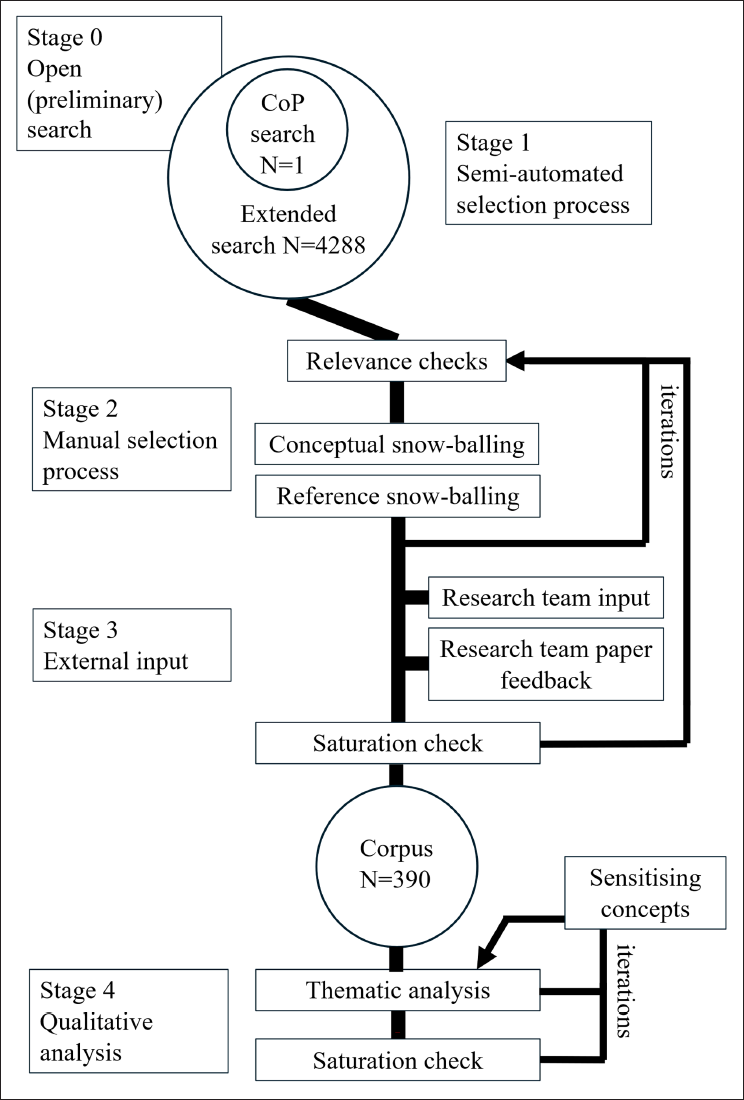
In the second stage, we switched to a more manual approach (instead of the semi-automated one in stage 1), considering the literature review’s specificities (guidance by a given theoretical framework, empirical focus and focus on Europe) and the need to ensure relevance of the selection. This model also allowed us to use two ‘snowball methods’, looking for relevant literature by using synonymous concepts and by following the trails of the reference lists. This was particularly important, given the shortage of empirical literature using the conditions of possibility term. Furthermore, it allowed us to be sensitive towards diversity by actively targeting research related to different parts of Europe, spanning a variety of methods and conceptualisations.
The third stage was an external input stage. First, an invitation was addressed to a team of researchers (members of the MeDeMAP research project this study is part of) to suggest further literature focusing on the conditions of possibility for democratic media (and on the other sections of the theoretical framework on democracy and media), applying the additional criteria of publication date, the European focus and the empirical focus. Then, after a first draft of the literature review was compiled, it was presented to the research project team, who once again suggested relevant literature. In both cases, suggestions were filtered by the literature review authors (based on the criteria mentioned above) and were accordingly integrated into the review. It is important to emphasise that at this stage, a saturation approach was used to finalise the corpus, to ensure that every different type of articulation had been included in the corpus. To reach saturation, the literature review authors went through a series of iterations (within stages 2 and 3, and between stages 2 and 3).
The resulting selection of 390 publications 4 was then, in stage four, brought into confrontation with Carpentier and Wimmer’s framework (2025) and its main categories. Through a method grounded in thematic analysis (Morey Hawkins, 2017), the book’s main categories were used as sensitising concepts (Blumer, 1969, p. 7) for the analysis of the selected publications. Through a series of iterative processes, the book’s main categories were critically investigated (and eventually modestly altered), while also generating the subcategories (on which this article reports). Also, here, saturation played a key role as a mechanism to decide on the completion of the analytical process.
Conditions of Possibility for Democratic Media in Europe: Literature Review
As already mentioned, our re-reading of empirical literature about media’s democratic roles and performance in Europe is structured around four main conditions of possibility, as discussed in Carpentier and Wimmer’s framework (2025) and adjusted for our study. These are communication technologies, economic resources and stability, a democratic media culture, and the legitimacy of democratic regulation. These conditions of possibility are anchored more in material (e.g., technological or financial) or discursive (e.g., cultural and regulatory) resources and affordances, still bearing to varying degrees both material and discursive components.
Communication Technologies
Availability of, and access to, resources is a main condition of possibility (both at the level of technology and finance), allowing or disallowing the media’s democratic roles. A significant part of these resources concerns technological means and infrastructures, and we will focus on this condition of possibility first.
The preoccupation with media’s technological aspects is not new, but rather as old as the first debates on what media are. There is a rich body of empirical research seeing media primarily as technologies and evaluating the impact of these technologies on social organisation, politics, human behaviour and so on, and the degrees to which the technological affordances facilitate or obstruct the media’s democratic roles. Empirical research, for instance, has been focusing on (digital or online) media-as-technologies promoting or impeding citizen participation, expression of opinion and democracy at large (Enikolopov et al., 2020; Margetts et al., 2016; Vaccari & Valeriani, 2021; Valeriani & Vaccari, 2016); media technologies enabling surveillance and restricting people’s freedoms (Broeders, 2007; Doudaki et al., 2023; Topak & Vives, 2020); or, authoritarian regimes imposing enhanced surveillance through media (Akbari & Gabdulhakov, 2019; Yesil & Sözeri, 2017).
This body of research has sometimes been driven by technocentric, media-centric or techno-deterministic approaches, overemphasising the potential of technological artefacts as drivers of societal change. During the 2000s, researchers would more readily argue for the affordances of the Internet to democratise participation in the public sphere, by providing easy and affordable access to communication spaces and offering opportunities for unmediated or non-curated expression of opinions and deliberation on issues of shared concern (see, e.g., Dahlgren, 2004; Rakhmetov, 2023). The early enthusiasm seeing the Internet and especially Web 2.0 as a democratic medium gradually diminished, due to the high levels of commercialisation of the online space, the intensification of concentration and consolidation tendencies in the media industries, and the increasing polarisation and toxicity online (Bonfadelli & Meier, 2021; Doyle, 2002; Van Bavel et al., 2021).
Avoiding both technology demonisation and techno-determinism, a conditions of possibility approach allows focusing on the democratising affordances of technology, embedded in the social. From a conditions of possibility perspective, (media) technologies can ‘be understood as intersecting sets of enablers that have significant impact on the possibilities of conception, production, bundling, distribution and reception of media’s signifying practices’, nested in ‘the societal context with, for instance, [their] (dis)appreciations, required skills, and knowledges and organisational assemblages in which [they are] articulated’ (Carpentier & Wimmer, 2025, p. 74). Hence, looking at technology as a condition of possibility for democratic media helps to pay attention to technology’s embeddedness in political, regulatory, cultural, economic and organisational contexts and infrastructures (see, e.g., the studies in Silverstone, 2017), acknowledging the complexity of how all these may activate or impede media’s democratic roles. It also helps to move away from technocentric or techno-deterministic positions and evaluations, avoiding narrow media-centric approaches of mediatisation 5 , and to explore instead the complexities of mediation. It further allows us to acknowledge that the identities of technologies are discursively-materially constructed, which means that their meanings are not fixed and unitary, and thus may change, no matter how dominant they are at a given time or place.
From a conditions of possibility standpoint, technologies have affordances (Norman, 1988; Grillo, 2021), qualities that allow for specific actions and not for others. These affordances, and the technologies they are associated with, are not outside the social; they are not neutral, but discursively and materially constructed within specific societal contexts. Their design, material construction and usage are always time- and context-specific, imbued with specific meanings that render these technologies socially relevant or irrelevant in given contexts. This applies not only in the case of tangible technologies and their outputs or products (e.g., in the case of a printing machine and a print newspaper) but also in the case of intangible or non-haptic (digital) technologies, such as software programmes and algorithms, which impact on material usages and outputs—conditioning what people do and how. For example, research on algorithmic design has shown how platform algorithms reflect and reinforce social hierarchies and perpetuate regimes and practices of discrimination (Kelly-Lyth, 2023; Leese, 2014; Lütz, 2022). Also, algorithmically supported recommendation systems and search engines have been shown to prioritise specific knowledge structures and discourses while systematically marginalising others (Favaretto et al., 2019; Stark et al., 2020).
At the same time, while the materiality-discursivity of media technologies allows for particular usages and disallows others, there is always space for diverse usages, sometimes substantially different from the intended ones. For instance, even though the commercial online platforms and their companies (e.g., Facebook/Meta, X/xAI and YouTube/Google LLC) appear to dominate the online space, there are still alternative efforts, as materialised, for instance, by applying the principles and practices of digital commons. The latter ‘can be defined as intangible resources shared among a community which are freely accessible to all; used and reused by “commoners” engaged in collective “commoning practices” for managing open data, source codes, and standardisation’ (Frion, 2022, p. 3). The digital commons practices, driven by the logics of free Internet and open sharing, are met in several fields and domains in Europe, such as in education, research, culture, business, economy and administration (Bloemen et al., 2019; de Groot & Bloemen, 2019; Engström, 2002). There are also efforts at the EU level to create a European framework for digital commons (see, e.g., Euractiv, 2022; Guadagnoli, 2022).
Another area that offers examples where the affordances of technology may serve as a condition of possibility for media to perform their democratic role is that of community media. These types of media have a long history as ‘democratic’ media, not only because of their focus on topics and issues often neglected by mainstream media, but also as spaces where the democratising potential of technology is materialised. This is performed in three interconnected ways, based on the principles and practices of easy access, easy use and a DIY approach to technology. The first way concerns the organisational logics of these types of media, which are managed and operated by the communities themselves, thus using communication technologies and infrastructures to enhance the participation of (interested) community members (Biringer et al., 2022). The second way in which community media democratise technology is related to their limited economic resources, leading to the acquisition of affordable and easy-to-use technological equipment, and a preference for open-source and non-profit technology and software, resisting the Big Tech oligopolies (Weish & Trattnig, 2021). The third way concerns the training of their members in not only operating but also in repairing, maintaining and producing technology and technological solutions, while actively participating in content production (Carpentier et al., 2015).
Economic Resources and Stability
In Europe, as in many other parts of the world, media operate within a capitalist economic setting, often being (profit-oriented) companies. Even in the case of ‘non-market’ media, these organisations also have to comply with this model and generate financial resources. Media are in general ‘embedded in economic logics, with their production and distribution costs, management and marketing efforts, and resource-generation requirements’ (Carpentier & Wimmer, 2025, p. 76). This also means that within the logic of capitalist domination, stable economies and well-functioning markets are important conditions of possibility for media to perform their democratic roles. This relates more broadly to ‘the absence of structural power imbalances between classes or societal groups, and the absence of fundamental imbalances in the distribution of capital’ (Carpentier & Wimmer, 2025, p. 22).
In practice, we see that this economic stability is sometimes disrupted, not only by economic crises but also by other processes leading to market dysfunction. For instance, digital technologies have been celebrated for their potential to limit imbalances in media production and consumption, rendering content creation and large-scale distribution easier and more affordable, thus creating, in principle, more opportunities for new companies to enter the media market. However, empirical research in most European countries shows increasing concentration in the ‘traditional’ media market combined with the enhanced presence and increasing power of a few digital intermediaries (Doyle, 2002; Peruško & Popović, 2008; Verza et al., 2024).
This is further documented in research on media market pluralism in Europe (Ciaglia, 2013; Iosifidis, 2014; Just, 2009; Klimkiewicz, 2005), which addresses the existence of different media providers and their distribution in the media market, the degrees of transparency of media ownership, the editorial and journalistic autonomy from business influences, and the media’s economic sustainability (Bleyer-Simon et al., 2023, p. 4). The findings of the Media Pluralism Monitor (MPM), which has been studying the degrees of, and risks to, media pluralism in Europe, are rather troublesome as they concern the risks to media pluralism related to market diversity. Based on its findings for 2023 (Bleyer-Simon et al., 2023), which consolidated the findings from the previous MPM waves (Bleyer-Simon et al., 2021, 2022), none of the 32 examined European countries was at low risk in terms of marked diversity. In contrast, a large majority of countries (21) were ranked as high-risk.
Hence, while a ‘healthy’ market environment would be characterised by diversity and pluralism, enhanced media concentration creates structural imbalances for media companies, leading to market dysfunction. In these persisting tendencies of media concentration, a shrinking number of large corporations dominate the markets, favouring fewer and fewer companies, in a spiral of inequality (of opportunities). These tendencies are seen as a significant threat to democracy because these mega-corporations are in the privileged position to not only set the market conditions to their benefit but also to ‘regulate access to the internet and structure the communication possibilities of users’ (Carpentier & Wimmer, 2025, p. 76). For these reasons, the involvement of the state or the EU in restraining the monopolistic tendencies in the media markets, through regulation and its application (Craufurd Smith et al., 2021; Trappel & Meier, 2022), is seen as enabling this condition of possibility for democratic media.
The availability of economic resources as a condition of possibility for democratic media is also related to both the media’s viability and independence. Economic independence, in the case of ‘market’ media, is connected to editorial independence and independence in content creation, which, in the case of news media, is of vital importance. As empirical research shows (Carson & Farhall, 2018; Karadimitriou et al., 2022), persisting economic pressures for legacy news media in Europe threaten their autonomy, which is a key pillar of professional journalism (Carpentier, 2005; Deuze, 2005). This is enhanced in conditions where, while media companies are dependent on advertising revenues, ‘legacy revenues continue to erode, and digital advertising revenues increasingly go to large technology companies like Google and Facebook who can offer advertisers unduplicated reach, targeted advertising, and low rates’ (Cornia et al., 2017, p. 1).
This financial predicament leads the media to gradually abandon costly forms of news reporting—for example, investigative journalism or news correspondence—which are, however, crucial in performing the media’s watchdog role (see, e.g., Carson & Farhall, 2018; Gerli et al., 2018; Karadimitriou et al., 2022; Stetka & Örnebring, 2013; Terzis, 2014). Moreover, the news media’s economic viability affects their ability to cover issues and topics not of interest to larger audiences, and to address minority societal groups, which is not profitable in a narrow market-driven logic, affecting, in turn, pluralism. Given that it is how minorities are addressed in public communication and policy that shows the quality of democracy in societies, failing to serve pluralism is a main concern for the media’s democratic roles. The media’s reliance on metrics also pushes them to invest fewer resources in stories deemed less ‘viral’ (Blanchett Neheli, 2018; Lamot & Paulussen, 2020; MacGregor, 2007). As Brennen et al. (2021) show in a study of British newsrooms, media reliant on subscription or donation revenues are significantly less concerned with ‘metrics pressure’ than their counterparts dependent on advertising, who are primarily driven by Internet traffic targets. Applying mainly or strictly market-driven criteria of infotainment in covering the news, which admittedly is not always connected to the media’s shrinking revenues, implies in practice that journalists and news media do not prioritise or that they even abandon their role of serving the public.
Moreover, the economic hardships of media production have resulted in increasingly precarious labour conditions for journalists, disruption of stable employment, and a growing dependency on freelance work (Gollmitzer, 2014; Norbäck, 2023; Örnebring, 2018; Spilsbury, 2018; Waisbord, 2019) in almost all European countries. These conditions of increasing precarity leave journalists more vulnerable to pressures related to critical reporting, again undermining the journalists’ and the media’s watchdog roles and their overall independence.
What is crucial, and still difficult to address, as is shown in the studied literature, is that while citizens generally agree on the importance of media to fulfil their leading democratic roles, the tensions between news-as-commercial-product and news-as-public-good, coupled with the public’s reluctance to pay for news (Fletcher & Nielsen, 2017), have not been resolved. Part of the problem stems from the abundance of free content online, discouraging the audience from paying for news (Hayes & Felle, 2016). Among Europeans who access news online, 70% use only free news content or news services online (Eurobarometer, 2022b). This makes it difficult for a big part of the news media to deploy viable organisational and business models. Still, some of the legacy media organisations in large markets seem to be maintaining their leading positions (see, e.g., Björkroth & Grönlund, 2018; Bruno & Nielsen, 2012; Edge, 2019; Nicholls et al., 2016). Also, a comparative study between Finland, France, Germany, Italy, Poland and the UK (Cornia et al., 2017) reported that most newspapers rely on paid subscriptions, offering a so-called freemium model, which means that parts of the material are free of charge, and others are exclusively available to paying subscribers. This is different for most broadcasters and a considerable part of digital-born news media, which remain free for viewers and readers (Cornia et al., 2017).
‘Non-market’ media are also confronted with economic challenges. The pressure for these media to be able to be self-sustained (e.g., through advertising and selling content) is increasing in times when the logic of the (neo)liberal market puts pressure to the welfare state model and raises questions about the need for state support of, for instance, public service media (PSM) (see, e.g., Lowe & Berg, 2013; Saurwein et al., 2019). These pressures, as research shows, are linked to state interference in PSM’s role of serving the public (see, e.g., Šimunjak, 2016). Hence, active involvement in protecting the media that operate outside the logics of the market in the strict sense, such as PSM and community media, also forms part of the ‘economic resources and stability’ condition of possibility for democratic media. This may take the form of subsidies, (in)direct financial support, and related protective legislation catering for their financial viability while preventing direct state interference (Kammer, 2016; Nielsen & Linnebank, 2011), recognising the ‘non-market’ media’s special role in serving democracy.
Within these challenging conditions, which seem to be disallowing an increasing part of the media to perform their democratic roles unobstructedly, there are still some examples of business and organisational models that show that editorial and economic independence, albeit difficult, is not impossible. For instance, some independent media which are run by journalists or certain investigative networks (Lindén et al., 2022; Newman, 2019) try to preserve their financial and editorial independence by employing subscription models, combined sometimes with ‘grants by organisations that support independent journalism and guarantee that funding will not be made conditional on the exercise of any control or influence over the editorial process’ (Maragoudaki, 2024, p. 21). These media manage to (re)create value that extends the narrow logics of economic value and profit, which is crucial in (re)building trust in the media’s and journalists’ work, in serving democracy. Still, gaining the public’s trust in conditions of oftentimes intense political and economic pressures where these media also ‘lack visibility and influence’ is an ongoing struggle (Maragoudaki, 2024, p. 37). The latter feeds into, and intersects with, the democratic media culture as a condition for possibility, which will be elaborated in the next section.
Democratic Media Culture
A third condition of possibility for media to perform their democratic roles is the presence of a democratic (media) culture, expressed through the validation of a series of values. Given that media do not function in a social vacuum but are products of their environment, which they co-construct, a strong or weak democratic socio-political culture feeds into how media are organised and operate, and allows or disallows media to contribute to the protection of the democratic values of freedom, equality, accountability, fairness, justice, dignity and pluralism.
For Carpentier and Wimmer (2025, p. 77), ‘[w]hen a particular society, or a considerable portion of this society, no longer accepts the core democratic value-discourses, also in relation to the media field, media cannot fulfil their democratic roles’. This condition of possibility is thus grounded on ‘broad societal support for the (key) value-discourses of freedom, equality, dignity and pluralism, … also to the functioning of the diversity of media active in the media landscape’ (Carpentier & Wimmer, 2025, p. 78). It is also grounded on the ‘propagation’ of these values, through public discourse and media content, helping to legitimate and validate them as societally relevant and beneficial.
In societies where these core democratic values are respected, media are facilitated to fulfil their leading democratic roles of informing the citizens, controlling power holders, enabling societal debate and democratic struggle, representing the pluriformity of the social and the political, and facilitating public participation (see, e.g., Carpentier & Wimmer, 2025; Doudaki & Boubouka, 2020; Esser & Umbricht, 2014; Hanitzsch et al., 2019; Márquez-Ramírez et al., 2019; Mellado, 2020; Pagiotti et al., 2024; Standaert, 2022). This, in turn, helps to shield societies against broader threats to democracy through the performance of these value-discourses. This democratic role is served through the media’s production of fair, respectful and inclusive representations of the diversity of opinions, groups, positions, approaches and interests in societies (Carpentier & Wimmer, 2025, p. 78). It is also served through the opportunities that media create for inclusive and pluralistic public discussions on issues of shared societal concern, and for enhanced citizen participation in and through the media (Atton, 2015; Carpentier, 2011, 2017; Coyer et al., 2007; Yüksek, 2020). Still, this is an area of struggle, given the power imbalances between the different societal groups, which lead to unequal opportunities in access to media and (self)representation.
Empirical research in this area shows that in European countries with stronger democratic cultures, there is higher media pluralism (Bleyer-Simon et al., 2023), and higher support for public service media (Saurwein et al., 2019; Thomass et al., 2022; Trappel & Tomaz, 2022) and community media (Gulyas, 2023). On the other hand, state-controlled public service media are associated with low levels of public trust (Psychogiopoulou et al., 2017; Šimunjak, 2016), and thus lower levels of societal legitimacy and support. Such examples can be found in Central and Southeastern Europe, where public service media are characterised by closer connections with the government or more broadly with the political system than in other parts of Europe (Bleyer-Simon et al., 2023), and with a weaker culture of independent, watchdog journalism, and where the struggle for PSM’s independence or control is ongoing. These cases are not limited only to countries that score relatively low (by average European standards) in democratic and media freedoms, such as Hungary (Freedom House, 2024a) or Serbia (Freedom House, 2024b). For instance, a relatively recent 2019 law in Greece put the national broadcaster ERT and the public news agency ANA-MPA under the prime minister’s direct supervision (Papada et al., 2023, p. 17), undermining the Greek PSM’s role of serving democracy.
Empirical research also shows connections between general media use, trust and democratic culture in Europe (Anderson et al., 2023; Gross, 2002; Placek, 2023). News media, in particular, are considered major mediators of trust relationships in European democracies (Otto & Köhler, 2018; Trenz, 2022). While research on trust is abundant, it is oftentimes ‘blackboxed’ or underconceptualised as it concerns the qualifiers, processes or dynamics of (dis)trust (especially in surveys and quantitative measurements). Generalising trust in media may be misleading, as different media sectors enjoy different levels of trust (see, e.g., EBU, 2021; Eurobarometer, 2021, 2022a, 2022b, 2023a, 2023b; Trenz, 2022). Also, trust in media and state institutions, and support for democracy should not be considered identical (Trenz, 2022). As research shows, a balance between trust and distrust in institutions can be a sign of well-functioning democracies (Christensen & Lægreid, 2005). Moreover, as it concerns news media:
[l]ow-trusting segments of the audience might have developed high critical capacities to interpret media performance and content […]. Such ‘critical public’ would be different from other segments of the population, who have developed generic attitudes of distrust towards the political system and democracy. (Trenz, 2022, p. 6)
Hence, the concept of ‘critical trust’, instead of a generalised sense or use of trust, may offer more possibilities in explorations of how democratic (media) cultures may serve as conditions of possibility in media’s democratic function.
Two related concepts in the study of democratic (media) cultures are ‘critical publics’ (Trenz, 2022) and ‘civic cultures’ (Dahlgren, 2015), which address nuanced dimensions of the public sphere and citizen engagement (Bartoletti & Faccioli, 2016). Civic cultures reflect the ‘dimensions of everyday life that have bearing on how democracy functions’ (Dahlgren, 2005, p. 319), embracing ‘the cultural and subjective dimensions of civic engagement’ (Dahlgren, 2015, para. 35). For Dahlgren, civic cultures provide ‘the preconditions for citizen identity and engagement in public spheres’ (2004, p. 1), and are the ‘necessary prerequisites for viable public spheres and thus for a functioning democracy’ (Dahlgren, 2015, para. 32). Research in this area addresses civic action, moving beyond top-down considerations of the public sphere, and examining the material, intangible and cultural affordances of communicative processes, media and people’s bottom-up or grassroots connection to the political, using the affordances of media and communicative spaces (Dahlgren, 2015; Sükösd & Jakubowicz, 2011).
A critical reflection on aspects of trust and citizen engagement and the role of media in co-creating a democratic culture in society serves as a reminder that the struggle to foster and protect democracy is ongoing. Moreover, forces of suppression create a stronger need and struggle for the establishment and protection of the core democratic values related to freedom and dignity. Hence, it shall not be assumed that media can automatically perform their democratic roles in countries and cultures with strong democratic traditions, or that they necessarily fail in countries faced with significant challenges to democracy. In this regard, the media’s potential to foster democratic practice in challenging conditions merits being addressed, seeing media as co-creating the conditions of possibility for well-functioning democracies. For instance, the role of democratic alternative media and community media in fostering polyphony, enhancing participation and educating their members in democratic practice is important and has been addressed by several researchers in countries of varying democratic robustness and vitality (Bellardi et al., 2018; Filimonov, 2021; Seethaler et al., 2016). Moreover, research has shown community media’s potential for conflict transformation (see, e.g., Carpentier, 2017; Carpentier & Doudaki, 2014), which feeds directly into the debates of how to enhance cultures of agonistic pluralism (Carpentier et al., 2003) and how to address difference and diversity (Lewis, 2008) under conditions of increasing polarisation and intolerance.
Legitimacy of Democratic Regulation
The fourth condition of possibility relates to the legitimacy of the state as a regulator. As Ananieva and Rozhkova (2021, p. 32) write, ‘[i]n the modern world, legitimacy has become a necessary, i.e. required, condition of a well-ordered state regarding its political institutions and their decisions’. The legitimacy of the state as regulator of the media field concerns the balance between, on the one hand, the need for (state) regulation of the media landscape, embedded in the rule of law, and on the other hand, the need for restraint by the state as it regards its intervention in the media landscape (Carpentier & Wimmer, 2025, p. 79).
Embeddedness in the rule of law, which is crucial for the legitimacy of democratic states and the EU as media regulators, is grounded in the capacity of the state, or the EU, to show restraint. The latter is exemplified not by intervening directly in media’s performance, but rather by regulating in ways that create the protective conditions for media’s independence (Harcourt, 2005), which in turn allows the media to perform their democratic roles (also promoting and protecting self-regulation) (Miconi et al., 2024).
Given that enhanced media concentration is seen as a threat to pluralism (Bonfadelli & Meier, 2021; Iosifidis, 2014; Papathanassopoulos et al., 2021; Trappel & Meier, 2022), as we argued above, legislation controlling concentration at the national and European level forms part of this condition of possibility. This is coupled with regulation promoting media ownership transparency and transparency in journalistic practice (Bleyer-Simon et al., 2021; Craufurd Smith et al., 2021; Fengler & Speck, 2019; Meier & Trappel, 2022). There are also arguments in favour of legislative and other provisions supporting print media, as pillars of democracy, at the state and European level (KEA, 2021; Miconi et al., 2024). Moreover, the self-regulation of journalists and news media (Fengler et al., 2015; Fidalgo et al., 2022) is seen as an enabling condition facilitating the media’s democratic roles. This may be served through updated and binding collective deontological agreements and instruments, adhering to the principles of a journalism attentive to a genuine democratic practice in contemporary digital environments.
A part of this discussion concerns the recognition of the special role of public service media (Thomass et al., 2022) and community media (Doliwa & Rankovic, 2014; European Parliament, 2007; Lewis, 2008), in performing the democratic roles of serving the public, and of pluralism and diversity, through protective legislation and the provision of (financial) support (Kammer, 2016). As it is argued by Thomass et al. (2022), well-functioning and strong public service media are relevant for democracy, also for their broader impact ‘on the general media ecology’, in the countries in which they operate (p. 187). Community media, as already mentioned, are seen as serving democracy by giving voice to marginalised groups and by training their members in democratic practice (Bellardi et al., 2018; Carpentier & Doudaki, 2014).
The recognition of the special role of PSM and community media is related to the need for both (financial) support and the absence of interference by the state, which will guarantee these media’s independence, enabling them to promote both internal and external pluralism. Public service broadcasters are expected, and are legally bound, to fulfil their public remit by (re)presenting the different social and political groups and their positions, in their programmes and overall content (Donders, 2021; Iosifidis, 2010; Karppinen, 2007). Still, they are often critiqued for their lack of independence from the state. For the Media Pluralism Monitor, ‘[i]nability to ensure the Independence of public service media […] is one of the key problems in achieving the PSM mission and relevance for the contemporary information environment’ (Bleyer-Simon et al., 2023, p. 7).
One related research area that shows the relevance of this condition of possibility focuses on ‘media capture’, either by the state or corporate interests, addressing the entanglement of vested interests with governments (Schiffrin, 2021, p. 5; Mungiu-Pippidi, 2008). State-driven media capture concerns ‘the use of legislative, regulatory and financial powers of the state by the dominant political force to capture media to advance its political interests’ (Maragoudaki, 2024, p. 4). Research has pointed to increasing tendencies of states capturing private and public media in several EU member states, for example, in Hungary, Poland, Romania and Greece (Dragomir, 2018, 2019; Maragoudaki, 2024; Nielsen et al., 2019). According to the International Press Institute (IPI), which has been documenting different forms of media capture in Europe, ‘[m]edia capture is most entrenched and systemic where […] the ruling party in cooperation with business interests’ (Maragoudaki, 2024, p. 4) ‘capture’ private media, public media, media funding and media regulation. Research has also been pointing to an increasingly stronger role of the corporate sector in taking the lead in media capture, in collaboration with governments (Dragomir, 2024; Schiffrin, 2021). Media capture in its enhanced forms constitutes a direct threat to democracy, as it showcases the failure of democratic institutions and the erosion of democratic values. The constitutional and legislative protection of the separation of the powers of the state, and the independence of its leading institutions, embedded in the rule of law, may function as a protective buffer against the materialisation of such forms of media capture.
The concerns about media’s independence from state and corporate control are echoed in the arguments for coordinated regulation at the EU level, catering for the democratic functioning of the media. In these cases, the EU is expected or called upon to play the role of the European regulator protecting media freedoms across Europe. An example of such an instrument is the European Media Freedom Act (2024) (European Media Freedom Act, 2024; Laaninen, 2024), which aims to promote media pluralism and independence across the EU, by increasing protection against political interference in editorial decisions and against surveillance of media and journalists (Borges et al., 2023; Centre for Media Pluralism and Media Freedom (CMPF), 2022; Reporters without Borders, 2024; Tambini, 2023). Related are also the provisions that are addressed by the anti-SLAPP Directive, which aims to create a binding European legal instrument protecting those targeted with strategic lawsuits against public participation (SLAPPs), such as civil society actors, journalists and news media (see, e.g., Bayer et al., 2021; European Commission, 2023; Fierens et al., 2023; Ravo et al., 2020).
Also, the European Commission’s annual Rule of Law reports assess media freedom and pluralism across member states and suggest recommendations for improvements. The 2024 report (European Commission, 2024) highlighted concerns in countries such as Romania, Malta, Hungary, Slovakia and Italy, citing issues such as political interference in media, lack of transparency in media ownership, and challenges faced by journalists. These reports serve as a basis for the EU to recommend reforms and, if necessary, initiate infringement procedures against member states that violate EU principles. For instance, in 2022, the EU referred Hungary to court for its national Media Council’s decision to refuse a renewal of an independent radio station’s licence (European Commission, 2022).
A set of challenges in regulating (state) media does not lie in the governments’ unwillingness to uphold democratic principles such as media freedom and freedom of expression but rather in the complexities introduced by the rise of global communication and media systems (Moore & Tambini, 2022). The latter creates regulatory challenges for national governments (Fukuyama & Grotto, 2020), driven by the internationalisation of the economy, the borderless character of the Internet and the global media conglomerates’ resistance to regulation. These conditions, which complicate or even challenge the legitimacy of the state as regulator, point to the need for the construction of new legitimacies for transnational, international and global regulation for (democratic) media. While state legitimacy is still upheld in democratic states, the EU is increasingly taking the role of the supra-regulator of the media sector at the European level, although it is still not fully addressing the global challenges (de Streel & Hocepied, 2021; Klimkiewicz, 2010).
One related example of EU regulation is the General Data Protection Regulation (GDPR) of 2016, applicable in 2018 in all EU member states. It ‘regulates at the EU level basic features and dimensions of privacy and processing of personal data by companies and third parties, aiming to enhance individuals’ control and rights over their data’ (Doudaki et al., 2023, p. 10). While GDPR has been welcomed as a pioneer regulation in the field, due to its broad scope and provisions, critics have addressed the structurally imbalanced power relations between companies and users (Helm & Seubert, 2020). As it is argued, ‘in conditions where users have limited agency in how to access, navigate and use the online platforms and environments, corporations find ways to harvest data from the platforms’ users’ (Doudaki et al., 2023, p. 10). Further limitations to GDPR’s efficiency relate to its inability to regulate data transparency (Schade, 2023) effectively and to address the implications of artificial intelligence (AI) (Paal, 2022).
Another example concerns the EU’s efforts to regulate digital platforms. In particular, the European Union has been preoccupied with the containment of the increasing(ly) (negative impact of) platformisation, aimed at protecting pluralism. In September 2023, the European Commission designated six digital gatekeepers—which comprised Alphabet, Amazon, Apple, ByteDance, Meta and Microsoft—under the Digital Markets Act (DMA) (European Commission, n.d.). The Act established a set of criteria to identify digital gatekeepers, as well as a framework for their regulation, to promote fair competition and user rights within digital platforms (Bostoen, 2023). These regulatory initiatives attempt to regulate several issues connected to the operation of the markets, yet fail to address the need to rebalance the power dynamics within digital ecosystems (see, e.g., Sharon & Gellert, 2023).
Lastly, responding to the rapid advancement of powerful algorithmic models by corporate actors, the EU approved the AI Act in 2024 (European Union, 2024). This became the first comprehensive legal framework for AI in Europe, aimed at AI systems’ safety, transparency and alignment with citizens’ democratic rights. The Act mandates risk assessments, human oversight, and clear labelling for AI-generated content, imposing extensive fines on non-compliant companies. Still, apart from the feasibility of harmonisation of national legislations and the applicability of oversight, scholars warn that among the most serious challenges faced by regulators will be the high pace of machine learning development (Helberger & Diakopoulos, 2023).
Discussion and Conclusion
This integrative literature review, supported by Carpentier and Wimmer’s (2025) theoretical framework on democracy and media, focused on the conditions of possibility for democratic media in/about Europe. Our review served as an opportunity for a theoretically guided reflection on the empirical research conducted in the understudied area of conditions of possibility for democratic media, which are seen as the enabling assemblages that are located outside media themselves, and which are still conducive towards the functioning of media’s democratic roles.
The review, which focused on empirical literature over 24 years (January 2000 to April 2024), was structured around four main conditions of possibility: communication technologies, economic resources and stability, democratic media culture, and the legitimacy of democratic regulation. As it is presented throughout the review, these four conditions of possibility are the enabling frameworks for media to perform their democratic roles, permitting but also conditioning media’s performance. Following Deleuze’s and Foucault’s interpretations of the concept—which we discussed in the theoretical part of our article—we need to acknowledge that these conditions of possibility are outside the democracy–media nexus, but still are necessary for this nexus to exist, and simultaneously interact with this nexus and thus co-shape it. To illustrate this with one of these conditions of possibility: communication technologies are, for instance, very much needed for media’s democratic roles and their affordances co-shape the democracy–media nexus, but communication technologies can also be used in non- or anti-democratic ways.
The focus on empirical literature (thus transcending a purely theoretical approach) allowed us to systematically re-read existing research output in the field of democracy and media in Europe, using the conceptual lenses of a specific theoretical framework. Apart from testing the framework’s usability in the field of empirical research, this exercise served as a reflection on research practice, reminding that the conceptual, theoretical and methodological choices made by researchers function as frameworks of intelligibility, guiding and conditioning the ways to create knowledge about processes and social phenomena.
As it became visible through this literature review, while empirical research on media and democracy is abundant, it often focuses on successes and failures of media’s democratic roles, measuring to what degree media/journalists perform well or fail in given times, based on normative frameworks and expectations. Also, research measuring the performance of democratic function through quantitative measurements based on normative standards is often inclined to identify deficiencies or lacks. The deployment of a normative ideal as a single starting point often results in measurements of the ‘distance’ between ideal and practice, failing to capture the nuances and the varying intensities in media’s (democratic) performance. At the same time, analyses that emphasise the element of struggle, studying intensities, inconsistencies and contingencies, through a conditions of possibility prism—and not rigidly focusing on successes or failures—might enable sketching more nuanced pictures.
Moreover, research on media’s democratic performance that takes the form of recommendations often neglects the tangible and intangible cultural, political, economic, technological and social environments for which the recommendations are intended. A framework considering conditions of possibility might help to shed light on existing or underexplored cultures, infrastructures and societal networks that can be activated further in the service of democracy (without limiting them to a list of ‘good examples’ or ‘best practices’ that are often found in recommendations). It also shows the intersection of democracy, media, technology, economy, culture, politics and law, which is vital for a better understanding of the functioning of democracy.
This also renders this article an invitation to transcend its European focus, and to theoretically and empirically scrutinise whether the concept of the condition of possibility, and its materialisations distinguished in this article, can contribute to a better understanding of the media’s (democratic) roles in other parts of the world. Overall, this prism might facilitate the comprehension of the global diversity, nuances and multiplicity of communicative practices performing democracy, and the embeddedness of these initiatives in broader societal networks and arenas of political struggle.
Footnotes
Acknowledgement
This text is part of the MeDeMAP project, which has received funding from the European Union’s Horizon Europe research and innovation action under Grant Agreement No. 101094984. The views and opinions expressed in this text are those of the authors only and do not necessarily reflect those of the European Union or the European Research Executive Agency. Neither the European Union nor the granting authority can be held responsible for them.
Data Availability Statement
This article concerns a literature review, which also includes non-open-access resources. All resources/literature mentioned in the article are listed in the references list. Links to these references are included when available.
Declaration of Conflicting Interests
The authors declared no potential conflicts of interest with respect to the research, authorship and/or publication of this article.
Funding
The authors disclosed receipt of the following financial support for the research, authorship and/or publication of this article: This text is part of the MeDeMAP project, which has received funding from the European Union’s Horizon Europe research and innovation action under Grant Agreement No. 101094984.
