




Abstract
This study examines the validity and reliability of the Kyrgyz version of the Online Gaming Motivations Scale, initially developed in English and comprising 12 items across 3 factors: achievement, social and immersion. The scale was translated into Kyrgyz, and subject matter experts verified language accuracy. Following content validation, the construct validity and reliability of the Kyrgyz version were assessed through factor analysis using data from 329 adolescents. Confirmatory factor analysis was conducted to evaluate construct validity, while reliability was assessed using Cronbach’s alpha internal consistency coefficients. The results of these analyses confirmed that the Kyrgyz version of the scale demonstrates both validity and reliability.
Introduction
In the last decade, online gaming has become one of the most significant activities in people’s daily lives worldwide (Hamari & Keronen, 2017). The most recent statistics from the Entertainment Software Association (ESA) show that 70% of parents play video games with their children, with 40% engaging in this activity at least once a week (Entertainment Software Association, 2024). This reflects a continued trend of family engagement in gaming, highlighting the social aspects of gameplay and the role of video games in fostering family connections.
In 2024, Kyrgyzstan’s Internet penetration rate reached 79.8%, equating to approximately 5.41 million Internet users out of a population of around 6.78 million (DataReportal, 2024). This significant increase in connectivity underscores the growing importance of the Internet in the region. However, barriers to Internet access in Kyrgyzstan persist, mainly due to affordability and a lack of content in the Kyrgyz language. While 54.5% of Internet users engage with social media platforms, only 43.5% of the total population are active social media users, highlighting accessibility challenges and the need for localised content to enhance engagement among Kyrgyz speakers (DataReportal, 2024).
To address these challenges, the government and telecom companies, including KyrgyzTelecom, Aknet, Megaline, Citynet, Homeline and Totel, are actively working to expand Internet access. Efforts focus on bridging connectivity gaps through fixed and wireless Internet services (DataReportal, 2024). Additionally, there is a pressing need to develop online content in the local language further to enhance engagement and inclusivity (Muhametjanova et al., 2020).
In Kyrgyzstan, mobile penetration has reached approximately 163.1%, with about 11.07 million mobile users reported in 2024—(DataReportal, 2024). Most young individuals in the country access the Internet primarily through their smartphones. Due to limited computer access, smartphones are the preferred device for Internet use. Kyrgyz youth use social media platforms (Muhametjanova & Ismailova, 2019) and play digital games online through their mobile phones (Muhametjanova et al., 2020).
A substantial body of research has investigated the effects of playing digital games. Most of these studies have focused on the impact of digital gaming on cognition and behaviour (Poels et al., 2012). For example, numerous studies have examined individuals’ levels of game addiction (Bulduklu, 2019). Additionally, prior research has explored individuals’ motivations for playing games by investigating their reasons for gaming (Vahlo et al., 2017).
Players’ motivations have been investigated in several countries, primarily in European countries and the United States (Bäcklund et al., 2022). However, no prior studies have analysed the motivations of Kyrgyz players to play games. Revealing players’ motivations through an appropriate scale is important for understanding this population. In this context, the current study was conducted to adapt a suitable scale for assessing the game motivations of Kyrgyz adolescents.
Literature Review
Various types of games have been developed to meet players’ interests and expectations. Hoon et al. (2002) categorised games into role-playing, simulation, multi-user dimension and shooting games. In another classification, Lakkaraju et al. (2018) considered the number of players. They identified additional types of games, including single-player, social, action, social role-playing and ‘massively multiplayer online role-playing games’ (MMORPGs).
Like the variety in game types, players have diverse motivations for engaging with online games (Khalafi, 2021). For instance, a general study on American players found that they prefer online games because they provide fun, enhance mental stimulation and offer stress relief (Entertainment Software Association, 2024). Additionally, players reported that games contribute to enjoyment, support relationships and improve well-being (Bäcklund et al., 2022).
Games are often regarded as a source of fun because they provide enjoyment and pleasure to players (Prensky, 2001). Existing research has analysed the structure of fun in games. For example, Lazzaro (2009) introduced a framework called the ‘Four Fun Keys’, which identifies different types of fun integrated into games. Specifically, Hard Fun involves the frustration and satisfaction of overcoming challenges, Easy Fun focuses on curiosity and the joy of exploring game elements, Serious Fun emphasises relaxation and meaningful experiences, and People Fun highlights interacting with other players.
In addition to the enjoyment factor, games’ usefulness is equally important in influencing players’ engagement (Al-Maroof et al., 2021; Hamari & Keronen, 2017). Research suggests that when games are used for educational purposes or other utilitarian outcomes, their primary motivator shifts from enjoyment to usefulness (Hamari & Keronen, 2017, p. 136).
O’Brien (2018) reviewed 20 studies and identified 3 significant categories of player motivations: achievement, social and immersion, each with corresponding subcategories. The achievement category focuses on pursuing success and accomplishment within games, the social category involves forming relationships and interacting with other players, and the immersion category encompasses discovery, role-playing, personalisation and escapism.
Cheah et al. (2022) reviewed existing research in a recent study. They identified six significant motivational aspects of game playing: immersion and flow, gratification and affect, escapism, social interaction, identification and goal orientation. The ‘immersion and flow’ motivation refers to a player’s deep involvement and loss of self-awareness during gameplay, where challenges and skills are balanced, leading to optimal engagement and intrinsic motivation. The ‘gratification and affect’ motivation involves seeking emotional rewards, such as pleasure, satisfaction or relief from boredom, resulting from achievements and experiences in the game. The ‘social interaction’ motivation reflects the desire for social engagement, connection and collaboration with other players, enhancing the gaming experience through shared activities and communication. The ‘identification’ motivation involves players relating to or embodying in-game characters or narratives, fostering emotional investment through role adoption and character alignment. The ‘goal orientation’ motivation reflects a player’s drive to pursue and achieve specific objectives, providing a sense of purpose and accomplishment within the game environment. In another recent study, Fritz and Stöckl (2023) identified 11 motivations for game playing: Social, Social Competition, Challenge, Escapism, Role-playing, Power Fantasy, Creation, Exploration, Completion, Griefing and Competitive Team Play.
The researchers also developed various scales to measure players’ motivations. For example, Kahn et al. (2015) introduced a scale designed to assess motivations in a specific type of game. After administering the scale to many participants, they identified six distinct player motivations: socialiser, completionist, competitor, escapist, story-driven and smarty-pants. Socialisers focus on the communication aspects of games, completionists enjoy exploring every possible stage of a game, competitors are driven by the desire to succeed, escapists play games to withdraw from real life, story-driven players are motivated by the narratives within games, and smarty-pants players are motivated by the challenge of enhancing their intelligence.
Demetrovics et al. (2011) developed the Motive for Online Gaming Questionnaire (MOGQ) to explore motivations for online gaming. The final version of the MOGQ includes 27 items organised into 7 categories: social, escape, competition, coping, skill development, fantasy and recreation. The social aspect focuses on the social aspects of online games; the escape aspect emphasises relief from daily problems and a desire to disconnect from real life; the competition aspect involves the joy of competing with others; the coping aspect addresses stress reduction and emotional endurance; the skill development aspect targets the enhancement of concentration, cooperation and related skills; the fantasy aspect is connected to the feeling of living another life; and the recreation aspect reflects the motivation to seek enjoyment from games.
Ryan et al. (2006) introduced the Player Experience of Need Satisfaction (PENS) model based on the Self-determination Theory. The PENS framework includes competence and autonomy, relatedness and intuitive controls. Competence and autonomy involve players’ perceptions of challenges within the game and their freedom to choose activities, relatedness focuses on the connections formed among players, and intuitive controls assess the user interface that governs player actions (Arpaci & Kusci, 2025).
Lafrenière et al. (2012) developed the Gaming Motivation Scale (GAMS), grounded in Self-determination Theory, to capture a broad range of gaming motivations. The GAMS consists of 18 items divided across 6 dimensions. These include intrinsic motivation, which reflects the inherent desire to engage in gaming for enjoyment, as well as several forms of extrinsic motivation, categorised into sub-factors: integrated regulation (aligning gaming with personal values), identified regulation (recognising gaming as beneficial), introjected regulation (gaming to avoid guilt or anxiety) and external regulation (gaming due to external pressures or rewards). Additionally, the motivation dimension indicates an absence of motivation to play. Together, these dimensions form a comprehensive framework for understanding the diverse motivational drivers behind gaming.
The Electronic Gaming Motives Questionnaire (EGMQ), developed by Myrseth et al. (2017), assesses various motivations behind gaming behaviours. The questionnaire consists of 14 items, organised into 4 key motivational dimensions: enhancement, coping, social and self-gratification. These dimensions address different aspects of gaming motivation, with enhancement relating to the pursuit of excitement or a positive mood, coping reflecting the use of gaming to manage stress or escape challenges, social focusing on interactions and connections with others, and self-gratification involving personal satisfaction and achievement.
Yee (2006) developed the Motivation to Play in Online Games Questionnaire (MPOGQ), which classifies the motivations for playing games using 10 subdimensions under 3 significant dimensions: achievement, social and immersion. More specifically, ‘these three main motivations are related to achievement (e.g., succeeding in quests, gaining power), immersion (e.g., discovering the game, uncovering its secrets, being fully immersed), and social interactions (e.g., making new friends, talking with other players)’ (Deleuze et al., 2019, p. 1025).
The MPOGQ also includes 10 sub-dimensions under the 3 main categories: achievement, social and immersion. The achievement category involves the subcategories of advancement, mechanics and competition. The advancement subcategory relates to players’ motivations to progress in the game and succeed within a strong player team. The mechanics subcategory focuses on understanding game rules to improve performance. The competition subcategory pertains to the challenges players face against others. The social category addresses communication and includes the subcategories of socialising, relationships and teamwork. The socialising motive involves helping and getting to know other players, while the relationship motive focuses on forming meaningful connections. The motive for teamwork pertains to the satisfaction gained from collaborating with others during gameplay. The immersion category includes discovery, role-playing, customisation and escapism. The discovery subcategory refers to players’ motivation to explore the elements of the game. The role-playing subcategory involves players’ enjoyment of creating characters within the game. The customisation subcategory focuses on players’ preferences for personalising their characters’ appearance and outfits. The escapism factor reflects players’ desire to disconnect from real-life problems.
The MPOGQ was proposed as a cross-culturally valid instrument to identify motivations for playing games (Yee et al., 2012). The MPOGQ has been adapted in several studies to examine player motivations. For example, Billieux et al. (2011) developed the French version of the MPOGQ to explore psychological indicators related to the problematic use of MMORPGs. Additionally, Yee et al. (2012) translated the MPOGQ into Chinese to confirm the reliability and validity of the scale. This was validated by investigating player motivations among participants from Hong Kong and Taiwan.
The study by Billieux et al. (2011) revealed that high urgency and immersion significantly influence players’ problematic use of MMORPGs. Carlisle et al. (2019) used the MPOGQ to investigate the relationships among personality, motivation and problematic gaming behaviour. Their study found that achievement-related motivation is a key factor contributing to the problematic use of games. Similarly, Wang and Cheng (2022) examined the links between gaming motivations and Internet gaming disorder. Their study showed that all aspects of the MPOGQ (achievement, immersion, social and escapism) were significantly associated with Internet gaming disorder. However, escapism and achievement motivations had stronger correlations than immersion and social motivations.
While previous research has been conducted in various countries, no study to date has specifically adapted a scale to explore the motivations of Kyrgyz players. Although various game motivation scales exist, the ‘Online Gaming Motivations Scale’ was considered in this study since it was a commonly used scale to reveal the motivations of game players (Bäcklund et al., 2022). In this regard, the study focused on a group actively engaged in gaming. Consequently, the sample consists of Kyrgyz adolescents. This research aims to answer the question: Can the Kyrgyz version of the ‘Online Gaming Motivations Scale’ be reliably used to measure online gaming motivations among adolescents in Kyrgyzstan? The research employed a quantitative approach, collecting data through participants’ responses to the ‘Online Gaming Motivations Scale’, adapted to Kyrgyz culture. The data analysis seeks to assess the reliability and validity of the adapted scale.
Methodology
Sample and Procedure
This study was conducted in Kyrgyzstan in the spring of 2021–2022. The study aimed to adapt a Kyrgyz version of the ‘Online Gaming Motivations Scale’ to measure the game motivations of Kyrgyz players. The purposive sampling method was used to determine the study sample. This method involves obtaining data from certain people or events that are deliberately selected (Taherdoost, 2016). Within the scope of the study, adolescents who play digital games for at least 2 h a week were considered. The participants voluntarily provided data. The study included adolescent participants from various regions, with data being gathered from both rural and urban areas of Kyrgyzstan.
Adolescents were selected for this study because they represent the age group that interacts most with online games. Adolescence, spanning the age range of 10–19 years, is a critical developmental period characterised by identity exploration, socialisation and a strong inclination towards leisure and social activities, including online gaming (Muhametjanova et al., 2023). Online games provide adolescents with a platform for achievement, social interaction and immersive experiences, aligning well with the motivational dimensions assessed by the scale: achievement, social and immersion.
Yamane (1967) provided a formula [n = N/(1 + N(e)2)] to calculate the sample size (n). In the formula, N is the ‘population size’, and e is the ‘level of precision’ (e = 0.05 at 95% confidence level). The population of the study is adolescents in Kyrgyzstan (N = 1,341,574). According to this formula, the minimum sample size to represent the population was calculated as 400. Although the calculated minimum sample size was 400, the final data set consisted of 329 valid responses. This is due to a non-response rate of approximately 17.75%, within acceptable ranges (Fincham, 2008).
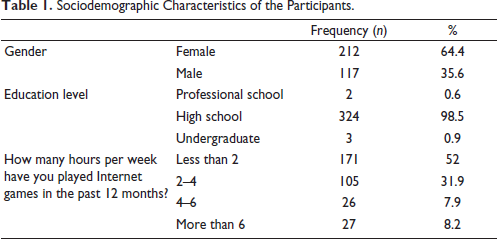
The sample consisted of 329 Kyrgyz adolescents (117 males and 212 females) with a mean age of 13.14 years (SD = 1.866, ranging from 10 to 18 years). Most participants were high school students who played games weekly. The sociodemographic characteristics of the sample are summarised in Table 1.
Sociodemographic Characteristics of the Participants.
Instrument
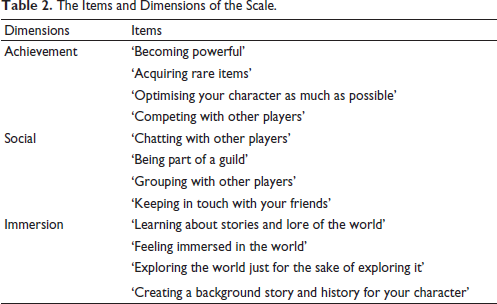
The ‘Online Gaming Motivations Scale’ was developed and validated by Yee et al. (2012) to measure players’ online gaming motivations. The original version of the scale is in English and consists of 12 items under 3 dimensions: achievement, social and immersion. The scale items for each dimension are provided in Table 2. The achievement dimension relates to players’ motivations to gain success in games, the social dimension pertains to their motivations to interact with other players, and the immersion dimension focuses on their motivations to engage in virtual worlds.
The Items and Dimensions of the Scale.
The scale items were rated on a five-point Likert scale ranging from 1 = ‘not important at all’ to 5 = ‘extremely important’. The overall scores range from 12 to 72, with higher scores indicating greater motivation. Cronbach’s alpha coefficients for the three dimensions ranged from .74 to .77 in the original scale, demonstrating adequate internal reliability.
Translation Procedure
Two translators proficient in English and Kyrgyz independently translated the English scale into Kyrgyz. Subsequently, two other translators, proficient in both languages, performed a back translation into English. The original and back-translated scales were compared, and the 4 translators agreed on a 12-item initial form. To address any ambiguities or inconsistencies in the Kyrgyz version of the scale, a pilot study was conducted with 20 users. The items were reviewed and revised to ensure clarity and comprehension. The final version of the scale is provided in Appendix A.
Data Collection and Analysis
After the translations were completed, necessary corrections were made, and the scale was converted into a digital format. It was distributed to adolescents through online forms, announcements and emails. Three hundred twenty-nine participants completed the scale and collected the data digitally. Appropriate statistical analysis methods were employed to interpret and analyse the data, following the recommendations provided by Carpenter (2018). The analyses were conducted using SPSS (ver. 21) and AMOS (ver. 24) software.
The ‘Kaiser–Meyer–Olkin’ (KMO) test and ‘Bartlett’s Test of Sphericity’ were conducted to assess the adequacy of the sample size and the suitability of the data structure for factor analysis (Arpaci et al., 2022). The normality of the data was evaluated using skewness and kurtosis values (Arpaci et al., 2024). The reliability of each factor was determined through Cronbach’s alpha coefficients (DeVellis, 2016). Lastly, confirmatory factor analysis (CFA) examined the scale’s validity.
Results
Factorability and Normality
The KMO statistic evaluates the sampling adequacy for factor analysis by measuring the proportion of variance among variables that might be common variance. A KMO value closer to 1 indicates that the data are suitable for factor analysis, while values below 0.5 suggest that the data may not be appropriate for factor extraction (Kaiser, 1970). Bartlett’s Test of Sphericity assesses whether the correlation matrix is an identity matrix, which would imply that variables are unrelated and unsuitable for factor analysis. A significant result (p < .05) indicates that the correlation matrix is not an identity matrix, confirming that factor analysis is appropriate because the variables are sufficiently correlated (Bartlett, 1954).
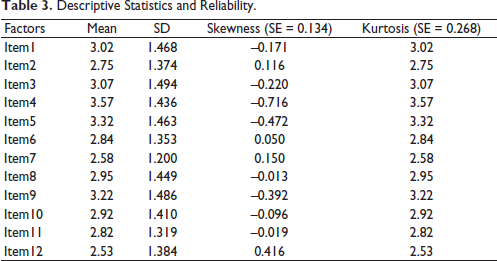
The ‘KMO measure of sampling adequacy’ was found to be 0.942, and ‘Bartlett’s Test of Sphericity’ was statistically significant, χ2 (DF = 66) = 2,402.887, p < .001. Threshold values for skewness fall between −3 and +3, and kurtosis is considered acceptable within the range of −10 to +10, according to the structural equation modelling (SEM) approach (Brown, 2006). Normality test results revealed that the kurtosis and skewness values ranged within threshold values, indicating that the study data were normally distributed (see Table 3).
Descriptive Statistics and Reliability.
Reliability and Validity
Cronbach’s alpha coefficients for social, immersion and achievement dimensions were .882, .847 and .828, respectively, indicating good internal reliability (Hair et al., 2014). ‘Average variance extracted’ (AVE) and ‘composite reliability’ (CR) were calculated to check the convergent validity. Fornell and Larcker (1981) suggested threshold values of 0.70 for CR and 0.50 for AVE, respectively. The results shown in Table 4 indicate that each dimension is significantly correlated with the others (p < .01).
Convergent and Discriminant Validity.
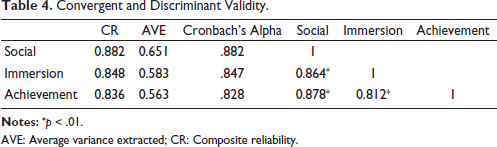
AVE: Average variance extracted; CR: Composite reliability.
Confirmatory Factor Analysis
CFA is a statistical technique used to evaluate the validity of a hypothesised factor structure and determine whether it aligns with the observed data (Brown, 2015). CFA was conducted using AMOS (ver. 24) to evaluate how well the three-factor structure fits the study data. The validity of the model’s structure was initially assessed by estimating the model fit, as illustrated in Table 5.
Model Fit Indices.
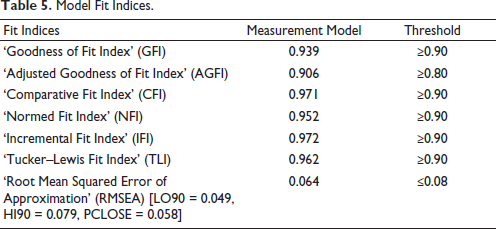
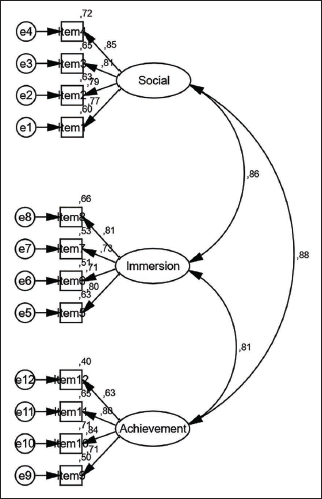
The Chi-square to degrees of freedom ratio (χ2/DF) is a commonly used fit index to evaluate the goodness of fit of a model (Kline, 2016). It assesses how well the hypothesised model reproduces the observed covariance matrix. The results indicated a good model fit: χ2(DF = 50) = 117.673, χ2/DF = 2.353, p < .001 since χ2/DF value is less than 3 (Byrne, 2016). ‘Goodness of Fit Index’ (GFI) is a measure used to assess how well the hypothesised model fits the observed data (Byrne, 2016). The ‘Comparative Fit Index’ (CFI) compares the fit of the hypothesised model to the fit of a baseline model (Bentler, 1990). The ‘Normed Fit Index’ (NFI) compares the fit of the hypothesised model to a baseline model, typically a null model where all observed variables are assumed to be uncorrelated (Bentler & Bonett, 1980). ‘Incremental Fit Index’ (IFI) is like the CFI in that it compares the fit of the hypothesised model to a baseline (null) model. However, it uses a different formula for model fit improvement (Bollen, 1989). ‘Tucker–Lewis Fit Index’ (TLI) compares the fit of the hypothesised model to the fit of a baseline model while adjusting for model complexity (Tucker & Lewis, 1973). ‘Root Mean Squared Error of Approximation’ (RMSEA) helps assess how well the model approximates the observed data while considering model complexity. RMSEA estimates the ‘badness of fit’, with a lower value indicating a better model fit (Hu & Bentler, 1999). Figure 1 illustrates the measurement model, where correlations among the constructs ranged between .81 and .88.
The Measurement Model.
Gender Differences
One-way analysis of variance (ANOVA) was performed to determine whether there is a statistically significant difference in motivations between males and females. Results showed that there was a statistically significant difference only in the ‘achievement’ factor between genders, where males (M = 12.3, SD = 4.61) scored higher than females (M = 11.05, SD = 4.46); F(1) = 5.795, p = .017; partial η2 = 0.017, power = 0.67.
Discussion
This study is significant as it is the first to examine the validity and reliability of the ‘Online Gaming Motivations Scale’ in a Kyrgyz sample. The Kyrgyz version of the ‘Online Gaming Motivations Scale’ has been shown to reliably measure online gaming motivations among adolescents in Kyrgyzstan (see Appendix A). Consistent with the original scale (Yee, 2006), the primary motivational dimensions of the Kyrgyz version were confirmed as achievement, social and immersion.
Achievement motivation in gameplay refers to the intrinsic drive to accomplish goals, attain mastery and demonstrate competence, often expressed through challenges, rewards and competitive contexts (Ryan & Deci, 2000). Within the achievement dimension, significant aspects include the pursuit of power, competition with other players, acquisition of in-game items and optimisation of character attributes. The achievement dimension, or closely related concepts, has also been identified as a key player motivation in existing studies, such as those by Cheah et al. (2022), Fritz and Stöckl (2023) and O’Brien (2018).
Social motivation in gameplay refers to the drive to connect with others, build relationships and engage in cooperative or competitive interactions, enhancing the gaming experience and fostering a sense of community among players (Pham et al., 2023). The social motivation dimension is reflected in scale items such as interacting with other players, participating in a guild, teaming up with others and maintaining connections with friends. Research on social motivation in gaming underscores social factors’ critical role in engaging players and shaping their gaming experiences. For example, Vorderer et al. (2004) explored how competitive and cooperative gameplay influences player enjoyment and motivation. Vorderer et al. (2004) found that social factors—such as shared achievements, rivalries and in-game partnerships—play a significant role in motivating players, often surpassing the influence of the gaming environment itself. Similarly, Klimmt and Hartmann (2008) highlighted the impact of social presence in gaming, revealing that connecting to other players within a game enhances immersion and motivation. Their study found that players are frequently driven by social dynamics and interactions within the game world, including those with ‘non-playable characters’ (NPCs).
The immersion motivation for gameplay refers to the player’s intense involvement and emotional engagement in the game world, characterised by a sense of presence and absorption that enhances the overall gaming experience (Bouvier et al., 2014). The following scale items were revealed within the immersion dimension: learning about stories and lore of the world, feeling immersed in the world, exploring the world just for the sake of exploring it, and creating a background story and history for the game character. Immersion in video games has become crucial to player engagement and enjoyment. Defined as the degree to which players feel absorbed in the game world, immersion can enhance emotional experiences and satisfaction during gameplay. Research by Liu & Wagner (2014) emphasises that immersion increases enjoyment and encourages players to explore game environments more thoroughly, leading to richer experiences.
Additionally, studies by Cowley et al. (2008) indicate that various design elements—such as narrative depth, interactivity and sound design—significantly contribute to a player’s sense of immersion, fostering a deeper connection to the game. Furthermore, a study by Hsu and Lu (2004) demonstrates that immersion is linked to players’ motivations, as it can satisfy psychological needs for autonomy, competence and relatedness, essential components of the gaming experience. Prior findings underscore the importance of immersion in shaping player experiences and preferences, suggesting that game developers should prioritise immersive elements to enhance player engagement and satisfaction.
Results showed a statistically significant difference in the ‘achievement’ factor between genders, with Kyrgyz males scoring higher than Kyrgyz females. Research explicitly examining gender differences in achievement motivation within Kyrgyzstan is limited. However, global studies indicate that males generally exhibit higher levels of engagement and motivation in competitive online gaming than females. For instance, Miezah et al. (2020) reported that males averaged 14.18 h of gaming per week, compared to 8.88 h for females. Studies by Lucas and Sherry (2004) and Hartmann and Klimmt (2006) further emphasise that males often seek competitive elements, leaderboards and skill-based challenges as central gameplay features.
In contrast, while valuing achievements, female players are more likely to pursue them within collaborative or narrative-rich environments (Yee, 2017). These findings highlight how gendered preferences and socialisation shape achievement motivation, suggesting that game design elements that cater to diverse motivations could enhance inclusivity and engagement. By understanding these differences, game developers can create experiences that appeal to varied player motivations, potentially reducing gender disparities in gaming spaces.
Online gaming motivations in Kyrgyzstan differ from those in Western and European contexts due to cultural, economic and technological factors. In Kyrgyzstan, traditional games like kok-boru hold significant cultural importance, and the country has recently implemented stricter gambling laws to regulate online betting (Sigma World, n.d.). In contrast, Western and European countries have well-established online gaming industries with diverse genres, advanced monetisation strategies and a strong presence in esports (Newzoo, 2023). These regions have also experienced a shift towards mobile gaming and the integration of virtual reality technologies (Newzoo, 2023). The differences in online gaming motivations between Kyrgyzstan and Western or European contexts can be attributed to varying technological infrastructure, economic development and cultural preferences.
Conclusions
This study aims to assess the reliability and validity of the Kyrgyz version of the Online Gaming Motivations Scale. Initially developed in English, the scale consists of 12 items grouped into 3 factors: achievement, social and immersion. The scale was first translated into Kyrgyz, and field experts verified language accuracy. The study evaluated the validity and reliability of this translated version using data from 329 participants for factor analysis. CFA was conducted to examine the construct validity of the Kyrgyz version, while reliability was confirmed through Cronbach’s alpha internal consistency coefficients. The analyses established that the Kyrgyz form of the scale is both valid and reliable.
This study is particularly important as it represents the first attempt to establish the validity and reliability of the Online Gaming Motivations Scale in a Kyrgyz sample. It confirmed the scale’s psychometric properties, making it a valuable tool for assessing online gaming motivations among Kyrgyz-speaking individuals. The successful adaptation of the scale ensures that researchers and practitioners can use it confidently to explore various motivational factors driving online gaming behaviours within this cultural context.
The Kyrgyz version of the scale focuses on three key motivational dimensions: achievement, social interaction and immersion. These dimensions provide insight into various aspects of gaming motivations, from competitive and goal-oriented play (achievement) to social engagement with other players (social) and the desire for escapism and in-depth engagement within virtual worlds (immersion). Thus, the adapted scale opens new avenues for research on online gaming motivations in Kyrgyzstan, enhancing our understanding of how cultural factors influence gaming behaviours.
Limitations and Suggestions for Further Studies
This study gathered data from a small sample of adolescents who engage in online gaming. Future research involving a more extensive and varied sample could facilitate a more comprehensive comparative analysis. Additionally, conducting face-to-face interviews with participants may provide more detailed insights.
Another limitation of this study is that it did not examine differences between participants who spent different amounts of time in games. Time spent on online gaming is a key factor in understanding gaming motivations, as it provides insight into the intensity and frequency of engagement, which can influence players’ underlying reasons for gaming. Research has shown that individuals who spend significant time gaming may do so for motivations such as achievement, social interaction or escapism, while those with limited gaming time may be motivated by casual enjoyment or stress relief (Przybylski et al., 2010; Vorderer et al., 2004). The amount of time spent on gaming can also help differentiate between various types of players, such as hardcore versus casual gamers, each with distinct motivations (Jansz & Tanis, 2007). Therefore, time spent on gaming can influence study results by highlighting diverse gaming behaviours and revealing potential correlations between gaming frequency and specific motivational factors (Sherry, 2004). Future research could explore how game duration affects players’ motivation.
This study focused solely on a sample from Kyrgyzstan. Future research could expand to include participants from various cultural backgrounds, allowing for an examination of gaming behaviours across different cultures. Such an approach would provide a deeper understanding of cultural differences in gaming motivations. Additionally, the current study did not compare online gaming motivations across different age groups, yet motivations are likely to vary by age. Future research could investigate these motivations across a broader range of age categories. Lastly, this study did not consider gaming motivations for different types of games. Further research could explore participants’ motivations concerning various game genres.
Footnotes
Authors’ Contributions
Gulshat Muhametjanova, Gulgun Afacan Adanir and Ibrahim Arpaci performed material preparation, data collection and analysis.
Gulgun Afacan Adanir and Ibrahim Arpaci wrote the first draft of the manuscript.
All authors contributed to the study’s conception and design.
All authors commented on previous versions of the manuscript.
All authors read and approved the final manuscript.
Declaration of Conflicting Interests
The authors declared no potential conflicts of interest with respect to the research, authorship and/or publication of this article.
Ethical Approval
All procedures performed in studies involving human participants were by the ethical standards of the institutional and/or national research committee and with the 1964 Helsinki Declaration and its later amendments or comparable ethical standards.
Funding
The authors received no financial support for the research, authorship and/or publication of this article.
