




Abstract
Based on a qualitative analysis of news posts on traditional media Facebook pages, this work seeks to explore the way(s) in which established news organisations in the United Kingdom use their social media accounts in times of extreme crisis. Specifically, we seek to assess what (other) types of news are publicised through social media beyond those related to the crisis itself. Findings show that well-respected international news organisations choose to post news items that aim to (a) distract from a bleak reality, (b) suggest ways to cope with new challenges and (c) create a community to alleviate the sense of loneliness. We argue that social media posts about the ‘rest of the news’ in times of crisis do much more than emphasise the ‘softer’ aspects of the crisis; they attempt to deliver another kind of message that there are ways to cope with adversity and that, eventually, things will work out.
Introduction
In the theatrical world, as in all live performing arts, accidents do sometimes happen, such as when an acrobat or a performer falls off the stage and is injured. An old trick to deal with such a complex and concerning situation is to ‘send in the clowns’ to make a few jokes and let the audience off the emotional hook, implying that things are so bad they are funny. In this way, clowns distract the audience from the accident or crisis.
In the news media world, until recently, such tricks seemed of little use since, traditionally, the informative role of traditional media has taken precedence over its entertaining one. However, in recent years, how traditional media use social media to increase their audience and news content consumption has led to an amalgamation of these two roles. This situation may become even more challenging in times of extreme crisis, when the informational needs of the public tend to increase significantly, placing additional strain on journalists who must navigate a multitude of intense stories amidst heightened pressure (Papadopoulou & Maniou, 2020; Papadopoulou et al., 2022).
The pandemic crisis of 2020 offers a typical example of such a case. Recent literature has focused chiefly on how the crisis was covered by traditional media and/or social media (Lewis, 2020; Overgaard, 2021; Wahl-Jorgensen & Quandt, 2022). Contrary to these studies, this work seeks to research and analyse the rest of the news that is reported on traditional media’s social accounts. Specifically, it examines the news content of credible media platforms’ social media posts in times of crisis, using the pandemic crisis after 2020 as a case study. Facebook accounts of traditional media are used here as a case study. Facebook is considered the dominant social platform, accounting for the largest share of social media traffic (28% in Europe and 30% in the United States) (Newman, 2023; Pew Research Center, 2023), delivering higher levels of audience engagement and considered more cost-effective at driving digital subscription sales (Cornia et al., 2018).
Theoretical Framework
The Use of Social Media by Traditional Media
Traditional media regulate the production and distribution of news content they deem worthy (Suran & Kilgo, 2017) as part of their gatekeeping function (Ali & Fahmy, 2013; Xu & Feng, 2014). Since the advent of social media, the gatekeeping role of traditional media has been diluted by citizen-driven information sharing through social media (Gerbaudo, 2012), initially leading scholars to hope for more democratic forms of societal dialogue (Biekart & Fowler, 2013; see also analysis in Ismail et al., 2019).
However, the increasing ‘infotainment’ character of social media platforms left narrow margins for such hope. While traditional media initially saw social media platforms as a potential ‘ally’ in their effort to face the ongoing crisis in news readership by attracting new audiences through these platforms, it soon became evident that social media were unsuitable for disseminating ‘hard news’ segments.
Initially, young adults and women were more likely to use social media for news consumption (Glynn et al., 2012). Gradually, social media platforms started gaining wider global audiences. However, most did not engage with traditional media’s typical ‘hard’ news content. Instead, they sought to fulfil a series of other core human motivations, such as the need for social interaction, the need to get things right and the need to feel good about oneself (Berger & Milkman, 2012). Sharing information with others gratifies these needs by reassuring people that their attitudes or beliefs are correct and allowing them to work out their positions about media content (Weeks & Holbert, 2013).
In this context, traditional media gradually started to employ specific strategies regarding their social media presence based mainly on specific selection criteria to decide which news segments were posted on their social media pages (Harcup & O’Neill, 2017). The primary criterion in this process usually relates to ‘clickbait’ strategies, a marketing technique designed to attract shares and click-throughs (Clickbait, 2019), defined in social media metrics as the raw total of those who have clicked on specific links. In times of extreme crisis, these strategies were mainly associated with the dissemination of ‘negative/bad’ news posts, as bad news tends to get more consideration, more clicks and more revenues, and negative information attracts more psychophysiological reactions than positive news (Shekhar, 2021).
News Typology in Crisis: From Traditional Media to Social Media
Tuchman (1972) presented a typology of different categories of news as soft news (exciting news regarding the daily events of life), hard news (important events potentially open to analysis/interpretation deemed newsworthy that require immediate coverage and publication), spot news (breaking stories and unexpected events), developing news (stories still emerging and news being gathered) and continuing news (stories on the same subject based on events occurring over some time). Tuchman’s fundamental study deals with news typology in traditional media and, along with more recent, updated taxonomies of news in conventional media (Limor & Mann, 1997; Patterson, 2000; Smith, 1985; Whetmore, 1987), focuses on the somewhat dichotomous distinction of news types as hard and soft news.
Lehman-Wilzig and Seletzky (2010), in an attempt to reassess this dichotomous categorisation, found an additional intermediate category of ‘general news’ and argued for the need to extend the traditional types of newspapers, accomplished by establishing a scale running from yellow journalism to elite journalism, adding mid-level categories. In short, they extended journalistic categories on two levels: Type of news item and type of newspaper. However, there is a lack of academic consensus when it comes to defining and describing the differences between hard and soft news (Baum, 2002, 2003; Boczkowski & Peer, 2008; Lehman-Wilzig & Seletzky, 2010; Patterson, 2000). For example, Shoemaker and Cohen (2006) argue that:
Hard news items are urgent occurrences that must be reported immediately because they become obsolete quickly. These items are genuinely ‘new’ (…). Soft news items (…) are usually based on nonscheduled events. The reporter or media organisation is under no pressure to publish the news at a specific date or time – soft news stories need not be ‘timely’.
Patterson (2000) offers a very different description:
Hard news refers to coverage of breaking events involving top leaders, major issues, or significant disruptions in the routines of daily life, such as an earthquake or airline disaster. Information about these events is presumably essential to citizens’ understanding and responding to the world of public affairs (…). Soft news (…) has been described (…) as news that typically is more personality-centred, less time-bound, more practical, and more incident-based than other news.
Reinemann et al. (2012) propose a distinction of thematic, focus and style features as basic dimensions that—in combination—make up harder and softer types of news. In addition, Sjøvaag (2015) proposes assessing the two types more as disruptions and affirmations than hard and soft news. Disruptions are primarily communicated as hard news, such as war reporting, political exposure or investigative journalism. Affirmations primarily include soft news, entertainment, features and human-interest stories, family life, consumer journalism and sports.
As ‘soft’ news appeared to attract users’ attention on social media more easily than ‘hard’ news, traditional media started re-shaping their social media presence based on what users like to consume and offer, with the technical help of algorithms, a customised experience of news consumption to their audience, based on demographic characteristics such as gender and age (Lischka & Garz, 2021). However, in times of extreme crisis, traditional media use social media in alternative ways, although their primary goal appears unaltered: Attracting users and clickbait. The overwhelmed news agenda, by monothematic coverage of the crisis at hand, appears to offer alternative ways of interpreting the crisis through social media. COVID-19 has not been the first global health crisis covered by the media, but it has been the first in which digital platforms and new media have played a significant role in public information (Papadopoulou & Maniou, 2021).
In this case, the transition from hard to soft news may occur by emphasising ‘softer’ aspects of the crisis and/or even ‘softer’ news items that are not necessarily directly connected to the crisis. For example, Rodin et al. (2019) found that during the 2014–2015 Ebola outbreak, news posted on Facebook by traditional media in Sweden tended to be more sensational and focused on human-interest stories.
Other studies have reported that when a crisis occurs, both journalists and the public opt to use social media to solicit emotional support, connecting virtually to share information and demand resolutions (Choi & Lin, 2009; Nguyen et al., 2020; Papa & Maniou, 2020; Veil et al., 2011); in other words, looking for ways to cope with the crisis through social media. It seems that the use of social media can reduce the tension of the situation since openness, communication, obligation and receptiveness are all vital to successful crisis management (Álvarez, 2012; Nardi et al., 2000). In the case of the 2020 pandemic, the newer social media platforms (such as TikTok) seem to owe their very existence to the crisis (Feldkamp, 2021), as many people spent more time on the internet looking for distraction (Johnson, 2020) from news related to the crisis, as recent studies suggest that consumption of crisis news leads to high psychological distress and fear that may impact intentions to engage in healthy behaviour (Jain, 2021). At the same time, however, social media, especially after the COVID-19 outbreak, have been charged with issues of misinformation and disinformation up to the point that researchers used the term ‘infodemic’ to describe the global health crisis (Cinelli et al., 2020), and several studies showed that the reliance on social media platforms for news consumption during the global pandemic crisis has amplified, with dire consequences for misinformation sharing (Ahmed & Rasul, 2022; Al-Zaman, 2021).
In addition, several studies in recent years examined how media organisations set the news agenda after the onset of the global pandemic crisis, focusing on the notion of intermedia agenda setting, the phenomenon of news migrating from one media outlet to another. Buturoiu et al. (2023) argue that after the pandemic crisis’s onset, traditional media’s power seems to have been transferred to online and digital media outlets. Wang and Shi (2022) highlighted the interaction between various social media news sources based on news content produced by traditional media, while Šķestere and Darģis (2022) showed that the agenda-setting process has been transformed by the dramatic growth of audiences that are simultaneously media consumers and producers. All these studies examined news content related to the main issues of the pandemic crisis, such as patients, vaccines, treatments and governmental policies.
Following this line of argument, the issue examined here is what (other) types of news are publicised through social media in times of extreme crisis beyond those related to the crisis itself, and why? Is the social media news agenda focused on ‘hard’ news related to the crisis, or does the crisis offer social media platforms the opportunity to move away from hard news and towards ‘lighter’ forms of information? In other words, when a crisis occurs, is it a good time to ‘send in the clowns’?
RQs, Methodology and Sample
This work seeks to answer the following RQs:
RQ1: In times of extreme crisis, what types of news do traditional media tend to promote through their Facebook accounts other than those related to the crisis itself? RQ2: How did the content posted by traditional media on Facebook change, if at all, before and after times of extreme crisis?
The early period of the pandemic crisis in 2020 is used as a case study. The initial sample of the study was 34,682 news segments/posts on Facebook covering the first 6 months of 2019 (17,403) and the first 6 months of 2020 (17,279). A qualitative analysis was conducted to compare the news types/categories in the early period of the global pandemic crisis with the period before the crisis to identify whether the existing typology of news alters during a crisis. Analytically, we retrieved all news posts of two media outlets on Facebook (BBC and Guardian) for the first semesters of 2019 and 2020 (1 January 2019 to 30 June 2019 and 1 January 2020 to 30 June 2020). The selected media outlets constitute typical examples of traditional European media with a solid social media presence.
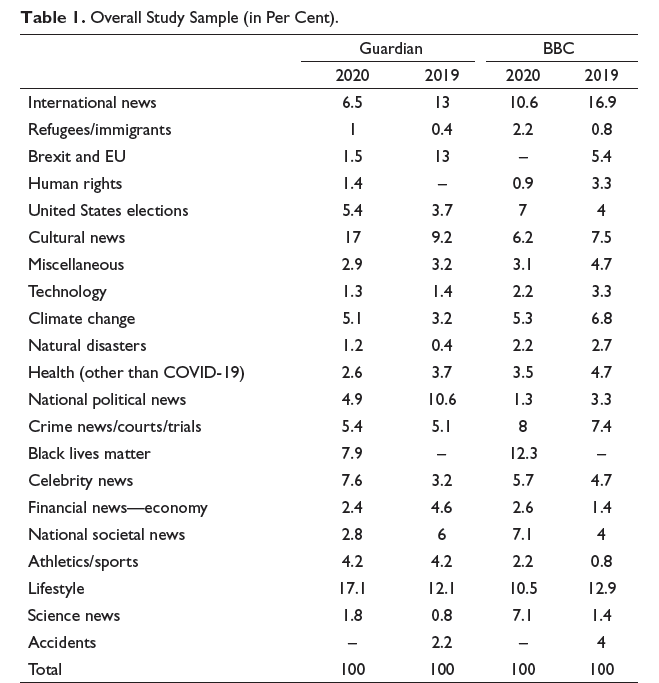
Overall Study Sample (in Per Cent).
To retrieve this sample, we used QUINTLY, an advanced, cloud-based social media analytics and competitor benchmarking solution that enables users to create custom metrics to track the social media performance of public accounts and social media pages (
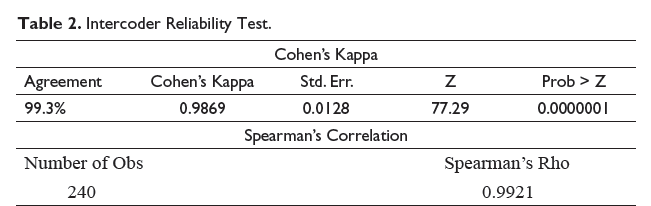
As regards the coding procedure, during the pilot stage, two researchers (Coder 1 and Coder 2) coded 120 random independent news posts each (10% of the overall sample), selected among both media examined on an absence/presence basis (0/1) using a standard typology of news stories based on the fundamental study of Tuchman (1972) and later revised taxonomies (Lehman-Wilzig & Seletzky, 2010; Limor & Mann, 1997; Patterson, 2000) of hard, soft and general news (international news, social news, financial news, internal politics/public affairs, crime/police stories, health news—other than COVID-19, cultural news, education, celebrity news, environmental news/natural disasters, technological news, sport news, lifestyle news). In addition, the analysis derived several ad hoc categories based on timely events/topics (e.g., United States elections, Brexit, accidents, #BlackLivesMatter). This initial coding procedure yielded an intercoder reliability test value of 0.99 (Spearman’s Rho), validated by a Cohen’s Kappa value of 0.98, as presented in Table 2. For all categories (variables) tested, Krippendorff’s alpha intercoder reliability coefficients were above 0.94. Based on these scores, the two coders proceeded to code the overall sample for the study.
Intercoder Reliability Test.
Conventional (qualitative) content analysis was employed to conduct thorough research into the final sample examined (1,200 posts). The codes (types/categories of news posts in this study) were enriched with added types/categories that flowed from the data used (in this case, the Facebook news posts), described as inductive category development. Its step model is a procedure to formulate a definition criterion derived from the theoretical background (Mayring, 2000). This method was deemed appropriate because it is suitable for making replicable and valid inferences from data to their context, generating knowledge, new insights, a representation of facts and a practical action guide (Krippendorf, 1980). Thus, in journalism research, qualitative analysis ‘goes into the field’ to gather data by observation and interpret them to build new theoretical concepts based on empirical findings (Iorio, 2003, p. 6). Initially, specific a priori deductive news types were used [as presented above, following (Lehman-Wilzig & Seletzky, 2010; Limor & Mann, 1997; Patterson, 2000; Tuchman, 1972)] to ‘get into the data’; after that, an inductive approach was used (Forman & Damschroder, 2007). During the conventional analysis, the inductive category development further generated additional types of news for the data set, which were used as study findings.
Findings
One of the first findings that stands out from analysing the news segments posted on Facebook is the prominence of specific news categories. During 2020, the most prominent news categories on the Guardian’s Facebook page were Lifestyle (17.2%) and Culture (17%). News about the Black Lives Matter movement (7.9%) that shook the world after the brutal killing of George Floyd on 26 May 2020 was the third most prominent category, followed quite closely by Celebrity news (7.6%).
In total, 41.8% of the news presented in the Guardian during 2020 consisted of soft news and, specifically, news concerning Culture, Lifestyle and Celebrities (17%, 17.2% and 7.6%, respectively). The same news categories amounted only to 24.5% of the total sample during 2019, a year not characterised by any severe crisis. As Table 3 shows, all categories present significant differences.
Comparison of Soft News Categories.
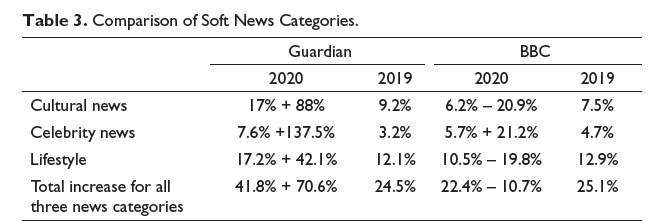
Turning to the BBC, although we found once again an abundance of news posts in the three categories of Culture, Lifestyle and Celebrities on the TV station’s Facebook page (Table 2), during 2020, news about Culture, Lifestyle and Celebrities amounted to 22.4%, slightly lower than 2019 when the sum of those three categories amounted to 25.1%. Focusing specifically on the Celebrity news category, we found an increase of 21.2% compared to 2019.
This abundance of soft news could be attributed to various reasons, one of the most prominent being the use of social media algorithms to align social media content with the preferences of news consumers to attract audiences. Indeed, according to various studies (Boczkowski & Peer, 2008; Lamot, 2022), audience metrics support and facilitate the softening of news content on the Facebook pages of mainstream media outlets.
However, delving deeper into the three most prominent news categories, we found that notwithstanding the specific category (i.e., Culture, Lifestyle and Celebrities) or the news organisation, most of the posts we assessed seemed to share some standard features. Specifically, they aimed to (a) Distract, (b) Provide ways to cope and (c) Create a community.
Regarding the first function (Distract), we found that one of the foremost characteristics shared by many news posts was a joint underlying effort to distract and entertain the audience by providing relaxing and funny news. One article, for example, presented a round of the latest funny videos shared by comics on Twitter and TikTok. 1 Another news post shared the story of an 87-year-old grandfather who was persuaded to dance on TikTok for the first time in January and got 1.5 million followers. 2
Under the same function (Distract), we identified numerous other posts that aimed at providing various ways to help people distract themselves and have a good time. The Guardian, for example, shared news about the 20 best episodes of Buffy the Vampire Slayer (The Guardian, 1/6/2020 3 ) and an article about the 100 greatest United Kingdom No 1 singles (The Guardian, 5/6/2020 4 ). Similarly, we found news and gossip about celebrities such as Meghan and Harry, 5 Prince William and Kate 6 and the Kardashians. 7 Distraction and entertainment may seem, ostensibly, unrelated to highly esteemed media organisations such as The Guardian and the BBC. However, the fact that these specific news categories were most prominent shows that this was a conscious effort to provide a break from the bleak reality and remind people that even in the darkest times, there is still room for a little laugh.
While this assertion holds, it is also imperative to consider that numerous news organisations publish captivating content on social media platforms to enhance their audience’s reach and interaction. A study conducted by Aldous and Jansen (2019) sheds light on this phenomenon through a focus group discussion involving content creators from the social media team of a prominent international news organisation. Their research documented journalists’ challenges in generating and disseminating engaging content across multiple social media platforms.
The second function we identified was news organisations’ effort to help people cope with adversity. We found numerous posts providing tips and advice on what kind of food products to stock in the cupboard for healthy and varied meals (The Guardian, 16/3/2020 8 ), techniques for online exercising (The Guardian, 15/3/2020 9 ) and even suggestions for clubs where people can hit the dancefloor while staying seated. One article, for instance, argued that although people’s routines have been turned upside down, this time could be seen as a once-in-a-lifetime opportunity for couples to reset and ignite desire. 10
News in this category aimed to constitute a roadmap for navigating the new reality. By offering practical tips for managing everyday issues, whether it be cooking, working remotely or exercising indoors, this news category aimed to reassure readers that life does go on and that although things are different right now, there are plenty of ways to keep living, working and getting by.
These findings could also be contextualised to the specific needs of individuals in a specific context. As argued by Aldous and Jansen (2019), social media content creators utilise analytical tools offered by each platform to discern audience interests and preferences. This approach enables news organisations to tailor their content to better resonate with their audience, enhancing engagement and reach on social media platforms.
Finally, this study identified a third function: The media’s effort to create a community. Many articles in this category underlined the importance of coming together and creating collective action when faced with a crisis. In another effort to provide comfort and create an imaginary community, many news articles featured videos depicting readers’ photos of beautiful sunrises and calls for readers to share the view from their windows and even hug trees to overcome isolation. 11 Sharing stories about people who managed to get in touch innovatively despite the strict measures was another way to offer comfort and a sense of community to the audience. For instance, the BBC shared the story of an elderly person isolated from his family at a care home who appealed to people to help celebrate his 100th birthday and received more than 700 cards, including one from the Queen of England. 12 We argue that this function is one of the most important identified since it not only aimed to acknowledge the expected feelings of anxiety, loss, grief and uncertainty that the pandemic crisis brought about but also to address them and offer much-needed solace to people who had lost their loved ones or were struggling with isolation by creating a sense of community.
This finding is consistent with previous research focused on the role of news and current affairs in the daily communications of individuals within social media communities. For instance, employing a focus group discussion methodology, Swart et al. (2019) found that the exchange of news in the daily communications of individuals within social media communities was primarily motivated by their desire to foster and maintain their sense of community, rather than solely aiming to overcome informational gaps.
There is no denying that the lockdown measures and the fear of contagion left many people isolated, scared and disconnected from their families and friends. News items in this category did not aim to fill this void—nothing could—but to offer a slight sense of community, faith and hope. By sharing pictures from their windows or watching videos of the beauty of nature, people were reminded that they are not alone and that good things can and—hopefully—will happen.
Discussion
The COVID-19 pandemic crisis constituted one of the most extreme crises to envelop the globe in recent years, and traditional media, as they should, rose to the occasion by offering systematic coverage and analysis. Notwithstanding the importance of the crisis, other non-crisis-related news segments managed to make it to their social media headlines.
This study initially sought to identify and record the types of news segments featured in traditional media’s social accounts. The first general finding from the research is the prominence of specific news categories. Specifically, we found a prevalence of lifestyle, celebrity and culture news. This finding seems to correspond with literature highlighting social media’s tendency to focus on lighter forms of information and ‘clickbait’ strategies. Moreover, several studies have demonstrated that various factors influence journalists’ decisions regarding news selection and dissemination. For instance, when traffic metrics indicate a story’s popularity, editors often respond by giving it a more prominent placement or instructing journalists to increase coverage on that subject and continue covering similar stories (Bright & Nicholls, 2014; Lamot & Paulussen, 2020).
Notwithstanding the importance of these findings, while diving deeper into the three most prominent news categories, we found that despite their ostensible ‘lightness’, they were performing unique and vital functions to (a) Distract, (b) Provide ways to cope and (c) Create a community.
Regarding the first function, Distract, we found numerous articles with relaxing and funny content, including funny videos, movie suggestions and celebrity gossip. Examined in the broader context of the pandemic crisis, this news category seems to exceed the profound aim of simply entertaining the audience, a function widely connected with social media. Various studies found that during the COVID-19 crisis, levels of depression, anxiety, stress, sleep problems and psychological distress were higher in the general population (Lakhan et al., 2020). At the same time, psychological distress seems to be increasing in parallel with social media use (Bazan et al., 2020, 2021). Against this background, news posted on traditional media’s Facebook pages points to taking people’s minds off the pressure and lifting spirits with a good laugh or a memorable movie. In line with recent studies regarding celebrity news and the pandemic crisis (Hatfield, 2021) and overall positive news and the pandemic crisis (Shekar, 2021), this study suggests that ‘good news’ regarding celebrities offered an outlet that ultimately reinforced the role of celebrity culture as a distraction mechanism and served an important need for audiences during the early months of 2020; the need to ‘escape’ from an unpleasant and highly stressful reality.
The second identified function was that of providing ways to cope with adversity. It is no secret that the pandemic crisis brought about new and unexpected challenges: Sanitising, working from home, stopping seeing friends, wearing masks, etc. Learning to navigate these challenges was the only way to adapt to the crisis’s new reality. In this category, we mainly found practical tips and suggestions to help people overcome everyday obstacles and go on with their lives. These practical everyday tips, addressing various challenges from cooking with limited ingredients to working from home while children attend classes online, constituted a much-needed roadmap for people who saw their everyday lives turned upside down.
The third function we identified was that of creating a community. The social distancing measures that were implemented to contain the virus took a heavy toll on people’s mental health as they separated them from colleagues, friends and relatives. In many cases, even after the lockdowns, people continued their social isolation to protect themselves and their loved ones. A strand of reports pointed out that those measures could intensify pre-existing loneliness and even elicit detrimental levels of loneliness in individuals not particularly affected by this problem before implementing the measures (Hoffart et al., 2020; Holmes et al., 2020). Against this background, traditional media devoted a significant part of their social media postings to news that aimed to alleviate those feelings and create an imagined community. Asking their readers to actively contribute to their content or view content created by others entailed a sense of coming together and sharing. Notwithstanding the geographic distance, every reader, no matter how alone they felt or how long had passed before they last shared a hug or a laugh with someone else, was faced with the chance to join an unexpected community.
Social media during the pandemic crisis of 2020 were held accountable for spreading fake news (The Lancet Infectious Diseases, 2020) and conspiracy theories (Goreis & Kothgassner, 2020); however, at the same time, they seem to have served their users in alternative ways by offering distraction, solace and providing ways to cope with the crisis through the dissemination of specific type of news. For some people, this is all it takes to alleviate the feelings of loneliness, anxiety and stress.
Conclusion
Overall, the findings from this study show that contrary to what might have been expected, in times of crisis, well-respected news organisations, such as The Guardian and BBC, choose to post on their social media accounts news that aims to (a) distract the audience from a bleak reality, (b) suggest ways to cope with new challenges and (c) create a community to alleviate the sense of loneliness.
Previous research has documented that when journalists begin prioritising stories that are likely to attract widespread interest, there is a potential for the overall landscape of news to transition towards a more populist, ‘soft news’ style of reporting, where entertainment takes precedence over providing informative content (Bright & Nicholls, 2014). While this argument holds true, especially for social media content, we argue that during the health pandemic, social media posts did something more than emphasise ‘softer’ aspects of the crisis. They tried alleviating negative feelings and offering ways out of this overwhelming situation. News about a funny song that went viral, Meghan and Harry’s baby, or a new 5-minute delicious recipe of comfort food that took over TikTok may seem totally out of context during life-changing events. Nevertheless, the findings of this study show a high rise in these specific news categories during the first year of a global pandemic that severely impacted all spheres of life and left millions of people struggling with anxiety and uncertainty.
Although there is no doubt that traditional media’s newsmaking is rightly focused on providing essential information regarding the crisis, as shown in this study, they also used their social media accounts to reach a wider audience and deliver another message that there are ways to cope with adversity. That, eventually, things will work out.
Although the three most prominent news categories that this study identified (Culture, Lifestyle and Celebrities) may fall under the category of soft news, a term traditionally associated with notions such as ‘tabloidisation’ and ‘infotainment’ (Reinemann et al., 2012), we should not underestimate the vital role that these kinds of news can play during the worst of times when feelings of uncertainty and fear for the future prevail.
Limitations of this study derive from the fact that we examined only two traditional media and that this research was focused on one country, the United Kingdom, and as such, we cannot generalise findings; however, since the two media examined here constitute some of the oldest, high profile and historical news organisations in Europe, we argue that these findings point towards some important theoretical dimensions of traditional media’s use of social media in times of extreme crisis. Nevertheless, widening the sample with other media in different countries could be one way forward for future research.
To enhance understanding of this argument, future studies could also focus on investigating more in-depth strategy approaches to using social media by traditional media. In addition, while this study focused on examining the content of social media accounts of these media and, as such, theoretical and empirical implications are limited in scope, by no means can we imply that these media had a particular social media strategy related to this content rather than an overall approach to offering a mix of content across all their platforms (e.g., print, online, social media). Further research on a comparative platform basis will be needed to reach robust conclusions.
Ultimately, this work demonstrated that in challenging times, prominent traditional media sometimes choose to ‘send in the clowns’ and fulfil another, perhaps equally important, mission of informing people: That of letting their audience know that even in the darkest of times, there can also be hope and sometimes, to find a way out, we may need to make room for some distraction and even a little laugh.
Footnotes
Declaration of Conflicting Interests
The authors declared no potential conflicts of interest with respect to the research, authorship and/or publication of this article.
Funding
The author(s) disclosed receipt of the following financial support for the research, authorship, and/or publication of this article: The authors received funding from the University of Cyprus (Article 311/2023).
