



Abstract
Introduction/Background: The title is a unique element in academic writing that summarises the research questions, answers, achievements, and conclusions found in research papers, dissertations, and conference papers. The lack of a systematic approach in title drafting prompted the authors to introduce a new checklist/criterion named TRIPS. The outcome of our article carries significant implications for young researchers and early-career academic writers. Aims/Objective: In this narrative view, we introduced the TRIPS framework which stands for Topic, Results, Intervention, Population, and Study Design. Emphasising the significance of adhering to TRIPS while drafting a research title is the subject of this narrative review. Patients and Methods: 25 randomly selected study titles of clinical trials, randomised control trials (RCTs), original publications, observational studies, systematic reviews, and meta-analyses from PubMed were analysed using the TRIPS framework, and results were summarised. These were evaluated by two readers—one musculoskeletal radiologist and one orthopaedic surgeon. Results: When the TRIPS framework was applied to 25 research study titles, we found that just 32% of the studies met this condition. T (topic) was stated in the titles of all the research, whereas R (results) and S (study design) were cited in 56% of the studies, and P (population) and I (intervention and comparators) in 92% of the studies. There was an excellent correlation between readers (intra and inter-reader) with a kappa of 0.9. Conclusion: We suggest that by following the TRIPS strategic approach, authors can make their research titles clear, concise, comprehensible, and in line with all the necessary components.
Introduction
The title is a unique element in academic writing, conveying the essence of queries, proceedings, accomplishments, and conclusions related to research papers, dissertations, and conference papers. The title serves as the initial point of contact for editors, reviewers, and readers, presenting the first glimpse into the research focus and purpose. The title is an ‘index’ of an article.
In today’s busy and automated world, it is unlikely that a busy researcher will read the whole content of the most recently published articles beyond their titles. Thus, it is crucial to write a precise, understandable, and comprehensive title that enables readers to understand the content. Hsin et al. observed that readers often search papers through keyword-generated online search results, rather than pursuing the tables of contents of preferred journals.[1] Thus, the title emerges as a central element influencing research visibility. Belcher has aptly remarked, ‘Your title is the highway billboard of your article’.[2]
An improper title fails to arouse the interest of the readers and causes the immediate rejection of the paper at the editorial discussion stage itself.[3]
One must follow the instructions laid down by the ‘target journal’ regarding the style and word limit specified for the title.[4–8]
In the past, writers typically opted for straightforward titles, but in recent times, there has been a shift in the trend, with many authors now preferring to use more attention-grabbing titles. The authors were inspired to write this review article by the abundance of catchy titles they encounter daily. While many of them are deceptive, some are engaging and concise despite them being unconventional.
Many times, readers are drawn into an article by the title, but the content fails to honour it and falls short of their expectations, leading to disappointment.
The literature review done by us indicates the lack of a systematic approach to guide beginners and young writers in the field. The realisation that a methodical approach is required in title drafting led to the development of a new strategy. In this context, the authors proposed a checklist/criterion named TRIPS. TRIPS stands for TRIPS = Topic, Results/Outcomes Assessed, Intervention and comparators, Population studies, and Study Design (Retrospective/Prospective or a randomised control trial [RCTs]).
In this narrative review, we examined the unique features of the titles of 25 studies using the TRIPS framework, described the findings, and emphasised the significance of adhering to TRIPS while drafting a research title. The outcome of our article carries significant implications for young researchers and early-career academic writers.
Framework
Materials and Methods SEARCH Strategy:
Study design: Narrative Review using PICOS search strategy of Population, Intervention, Control or context, Outcomes of interest, and Study Design Search strategy: A comprehensive search strategy was conducted using PubMed to identify the literature published till March 2022. Major research objectives were identified. The keywords used for the search included ‘Industry 5.0’ and ‘Orthopaedics’ to identify the literature for assessment and prepare this narrative review. Published Clinical trials, RCTs, Original articles, Observational studies, systematic reviews, and meta-analyses on the subject were reviewed. Only articles printed or online in English literature were included. Two readers: one musculoskeletal radiologist with over 300 peer-reviewed publications and one orthopaedic surgeon with over 200 peer-reviewed publications independently analysed the titles of articles. They scored if each component of the TRIPS framework was included in the title.
Data were documented on MS Excel, and intraclass correlation was used to assess interobserver reliability. Descriptive statistics were performed on the data collected.
Results
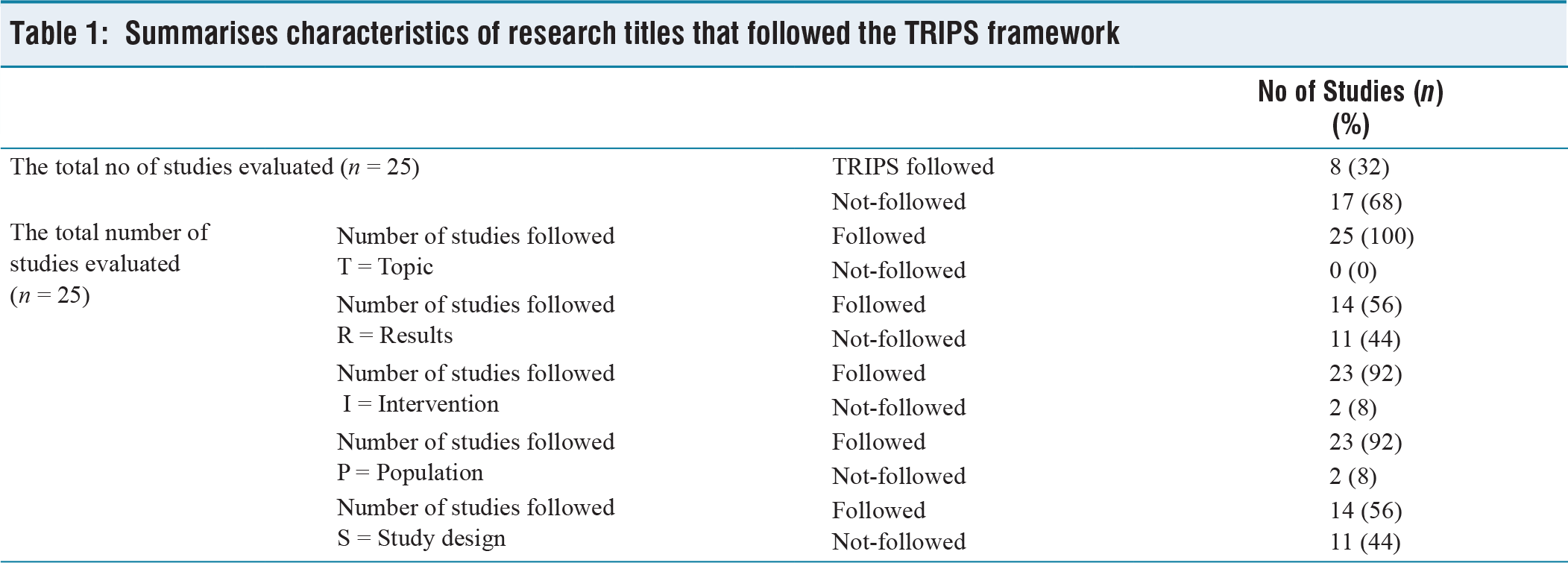
Twenty-five research study titles were evaluated using the TRIPS framework, revealing that only 32% of the studies adhered to this criterion. All the studies mentioned T (topic) in their title, while 56% of the studies mentioned R (results/outcomes) and S (study design). Furthermore, 92% of the studies incorporated I (intervention and comparators), as well as P (population), in their titles as illustrated in Table 1 [Illustrations 1–4]. There was good inter- and intrareader reliability with a kappa of 0.9.
Summarises characteristics of research titles that followed the TRIPS framework
Discussion
Why Are Research Titles Important?
Research titles are integral to the overall success of a paper, serving as a bridge between the writer, reviewers, editors, and readers, irrespective of whether they are straightforward or catchy. Drafting catchy research titles is an artistic endeavour that involves combining creativity and relevance in language. But many times, the goal is also defeated, particularly when the author fails to provide the readers with a pertinent and understandable message in favour of a catchy title.
Scholars today are more likely to use Google Scholar, depend on email alerts from important journals, or use tools like PubCrawler3, which uses keywords to automatically search online publication databases like PubMed and then sends out weekly emails highlighting papers that may be of interest.[9]
A good title should be simple, straightforward, descriptive, accurate, and should not be deceitful.[10] A concise and understandable title provides an understanding of the research topic, enhances searchability, draws readers in, clarifies the research topic, and adds to the professional reputation of a writer. It should seem fascinating to those who work on the same or related topics.
Characteristics of Straightforward Titles
Such titles are direct, informative, unambiguous and do not rely on creativity or wordplay. They aim to convey the main subject matter of the research clearly and understandably. The language used in them is usually simple, avoiding unnecessary complexity. Additionally, they involve all vital elements of the research, like the topic under investigation studies focus of the study, and the variables being examined. Examples are Descriptive and declarative titles.
Characteristics of Catchy Titles
Catchy titles are used by the writers to spark interest in the study. They are usually short, contain captivating terms that appeal to the intended audience, vibrant verbs, or interesting adjectives, and end up with some questions that create curiosity among readers. Some catchy titles pose questions as a central element of the research to create interest in the audience and leave room for interpretation and multiple potential answers. Some authors prefer to use titles that provide clues to the research question without explicitly stating the main findings. Examples are Interrogative and Suggestive titles.
How Can an Effective Title Be Framed?
While drafting a research title, authors should consider some key questions to ensure the clarity of the title, like what the study is about, the type of study, the target audience, key variables, any specific keywords that need to be used, and adherence to the journal guidelines. This narrative review aims to introduce a strategic approach to drafting an effective research title by considering key questions, as outlined in TRIPS.
How can TRIPS be followed in a title? We wish to illustrate through a few examples mentioned below, which include some studies available online and others selected for this review.
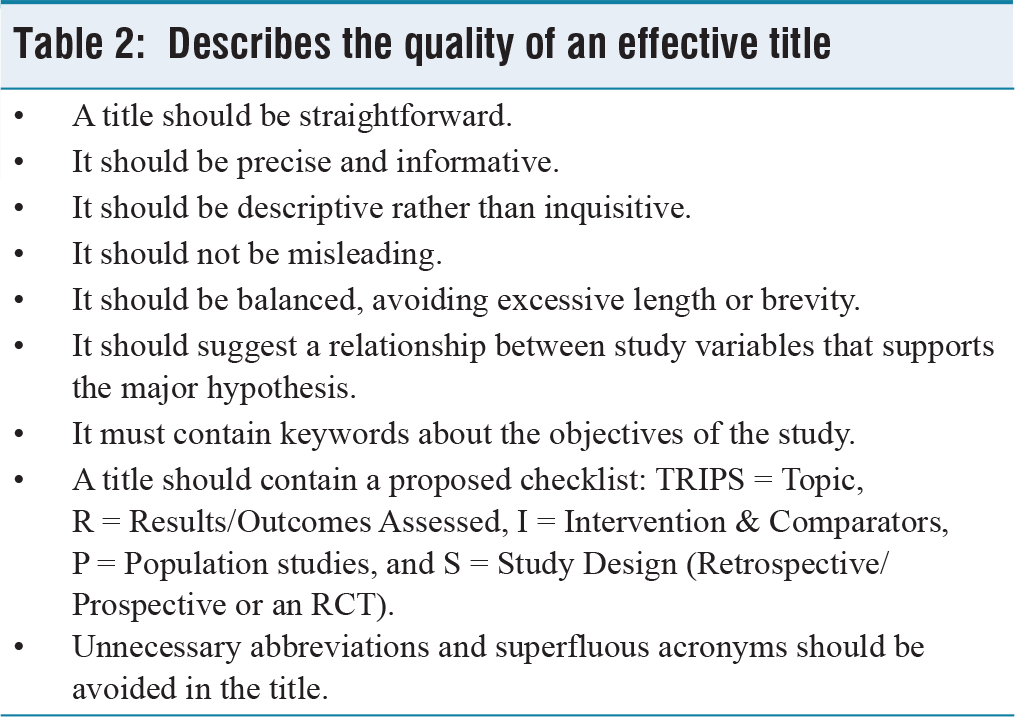
Incorporating the keywords in the title is very important for proper indexing purposes, citations, and retrieval from search engines and scientific databases.[10] According to Hairston and Keene, a good title should accomplish four goals as listed: predict the content of the research paper, be interesting to the reader, reflect the tone of the writing, and contain important keywords that will make it easier to find during a keyword search.[11] Similarly, we propose several characteristics that a title should encompass, as indicated in Table 2.
Describes the quality of an effective title
Advantages of TRIPS
TRIPS offers a structured approach to creating research titles, ensuring that each element (topic, result, intervention, population, study design) is precisely defined. TRIPS helps researchers, reviewers, and editors make decisions regarding study design by explicitly specifying key components. When performing meta-analyses or systematic reviews, the TRIPS framework helps to find studies that are comparable in terms of PICOS (population, intervention, comparison, outcome, and research design).
Limitations of TRIPS
Although not abundant, there are a few limitations to TRIPS. Certain study designs may deem it less suitable, potentially concealing a few elements of the research title that could be conveyed effectively otherwise.
Future Considerations
It is important to anticipate trends and changing dynamics in the field of research and academics. Incorporating new terms and essential keywords from the emerging fields may be considered. With advances in artificial intelligence, structured research titles may be framed by analysing vast data sets of academic literature using algorithms that enhance efficiency, improve research visibility, and predict audience preferences.
Conclusion
We conclude that by following the strategic approach of TRIPS, authors can ensure that their research titles are precise, effective, understandable, and aligned with all essential elements required to communicate the objective and message of the study effectively to the readers.
Footnotes
Declaration of Conflicting Interests
The authors declared the following potential conflicts of interest with respect to the research, authorship, and/or publication of this article: Authors M Jeyaraman, Rajesh Botchu and K. P. Iyengar are members of the Editorial Board of Apollo Medicine. Author Raju Vaishya is Editor-in-Chief at Apollo Medicine. The authors did not take part in the peer review or decision-making process for this submission and have no further conflicts to declare.
Funding
The authors received no financial support for the research, authorship and/or publication of this article.
Institutional Ethical Committee Approval Number
Ethical approval was not required for this study.
Credit Author Statement
HK, KPI and RB were involved in conceptualisation, literature search, manuscript writing and editing.
HK and KPI Literature search, manuscript writing, references and editing.
RB supervised the overall submission and approved the final draft.
All authors read and agreed on the final draft submitted.
Data Availability
The data that support the findings of this study are available from the corresponding author, [RB], upon reasonable request.
Patient Consent
Not applicable. No patient involvement.
Use of Artificial Intelligence
None used.