



Abstract
Background:
Obstructive sleep apnoea (OSA) is a common disorder associated with excessive daytime sleepiness, reduced work performance, and long-term cardiovascular complications. Continuous positive airway pressure (CPAP) is the standard therapy, but many patients are unable to tolerate it due to discomfort or intolerance. Transoral Robotic Surgery for Sleep Apnoea (TORSA) has emerged as an alternative option, offering enhanced precision, ergonomics, and three-dimensional visualization. However, TORSA presents unique anaesthetic challenges that require meticulous preparation.
Aim:
To outline key anaesthetic considerations and perioperative strategies essential for the safe conduct of TORSA.
Methods:
This descriptive review is based on institutional experience and existing literature on TORSA. Key elements analysed include operating room setup, anaesthesia workstation positioning, airway management techniques, hemodynamic control during instrumentation, robotic undocking preparedness, and postoperative airway care.
Results:
Optimal OT layout is crucial, with the anaesthesia workstation placed at the foot end to allow robotic docking at the head end. A nasal RAE tube ensures unobstructed access to the surgical field. Adequate muscle relaxation, eye protection, and careful patient positioning are essential. Sympathetic surges during mouth gag placement and robotic arm insertion can be managed by adjusting anaesthetic depth or administering intravenous boluses. Emergency undocking protocols must be well rehearsed due to restricted access once docking is complete. Postoperative concerns include airway oedema, bleeding, and safe extubation after confirming adequate airway patency.
Conclusion:
TORSA is a promising option for CPAP-intolerant OSA patients. Successful anaesthetic management requires comprehensive planning, coordinated teamwork, and familiarity with robotic workflow to ensure safety throughout the perioperative period.
Keywords
Introduction
Obstructive sleep apnoea (OSA) is a common condition that affects a significant portion of the global population. It is characterised by repeated episodes of airway obstruction during sleep, resulting in fragmented sleep and daytime somnolence. If left untreated, it can lead to long-term complications such as pulmonary hypertension, cor pulmonale and heart failure.[1] Beyond its physiological impact, OSA is recognised as an important public health issue due to its effects on productivity and overall well-being.[2]
Management strategies for OSA include medical, surgical or combined approaches. Continuous positive airway pressure (CPAP) remains the gold standard of treatment,[3] provided the patient maintains adequate compliance, typically at least five nights per week for the majority of each night. However, compliance is frequently poor due to factors such as high-pressure settings, discomfort, air leakage, device noise and claustrophobia. For patients unable to tolerate CPAP,[4] surgical options become necessary.
Surgical interventions are selected based on the site of obstruction, which may involve the nasal passages, oropharynx or tongue base. Historically, surgery has focused on the soft palate and uvula through procedures such as uvulopalatopharyngoplasty[5] laser-assisted uvuloplasty or radiofrequency ablation. More recently, tongue base surgeries have gained importance because, when combined with palatal procedures, they can produce improved airway patency and surgical outcomes. Nevertheless, tongue base surgeries[5] are technically demanding due to restricted access, limited lighting and lack of depth perception with conventional endoscopic methods, often necessitating external incisions or even tracheostomy.
Transoral robotic surgery for sleep apnoea[6] (TORSA) has emerged as a minimally invasive solution to these challenges. This robotic approach enhances dexterity, precision and three-dimensional visualisation while minimising surgical limitations. TORSA aims to enlarge the airway passage from the oropharynx to the trachea through resection of obstructive tissues, which may include the tonsils, adenoids, uvula or tongue base. Importantly, this technique allows tissue removal without external incisions, thereby reducing morbidity and improving recovery.
Preoperative Workup
Preoperative surgical workup usually includes a polysomnogram, completion of the Epworth Sleep Scale and a detailed examination followed by a drug-induced sedated endoscopy. A thorough preoperative anaesthesia evaluation is then done, required blood investigations are sent for and cardiac risk evaluation is done.
Anaesthesia Considerations for TORSA
OT Preparation
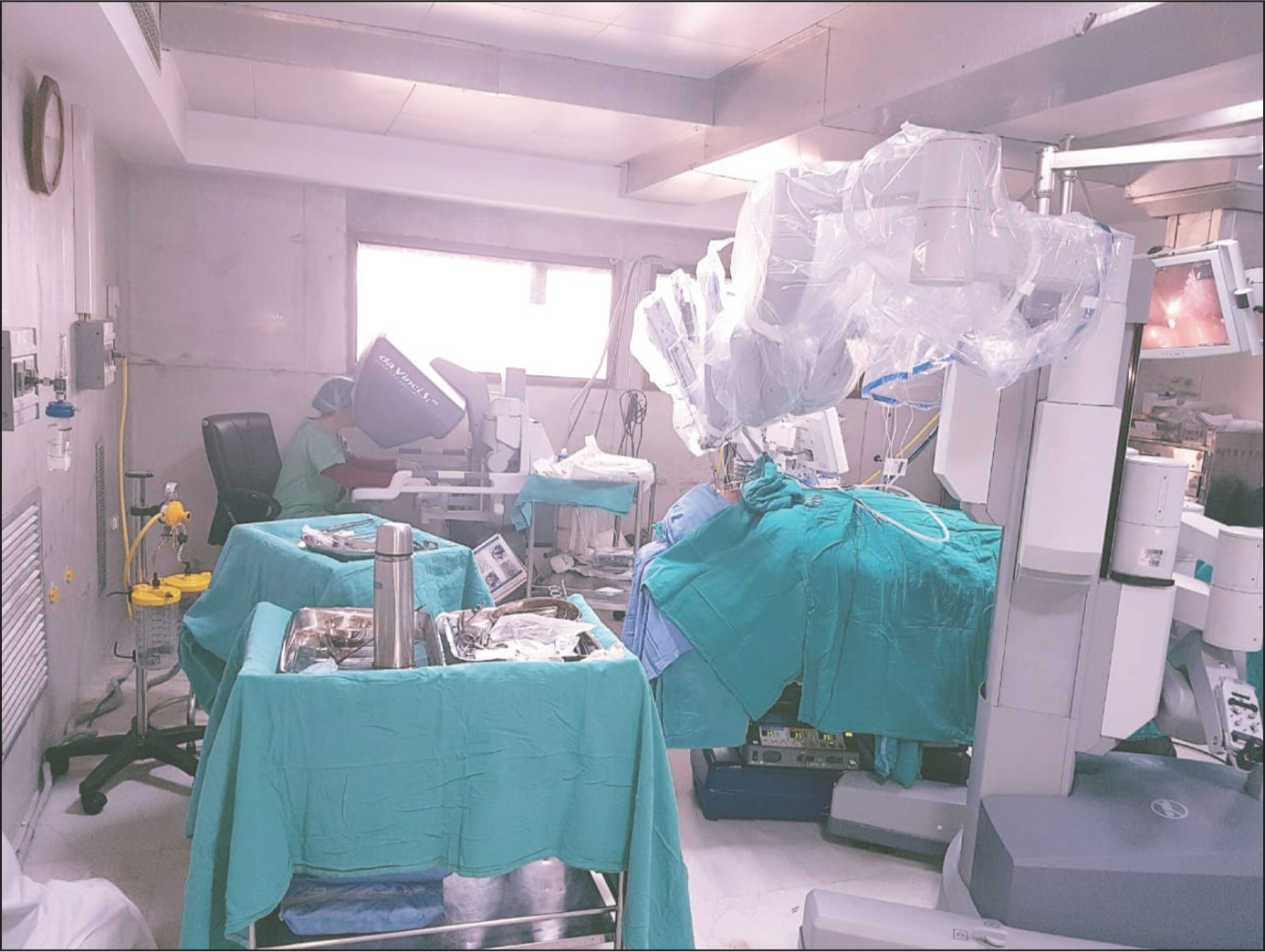
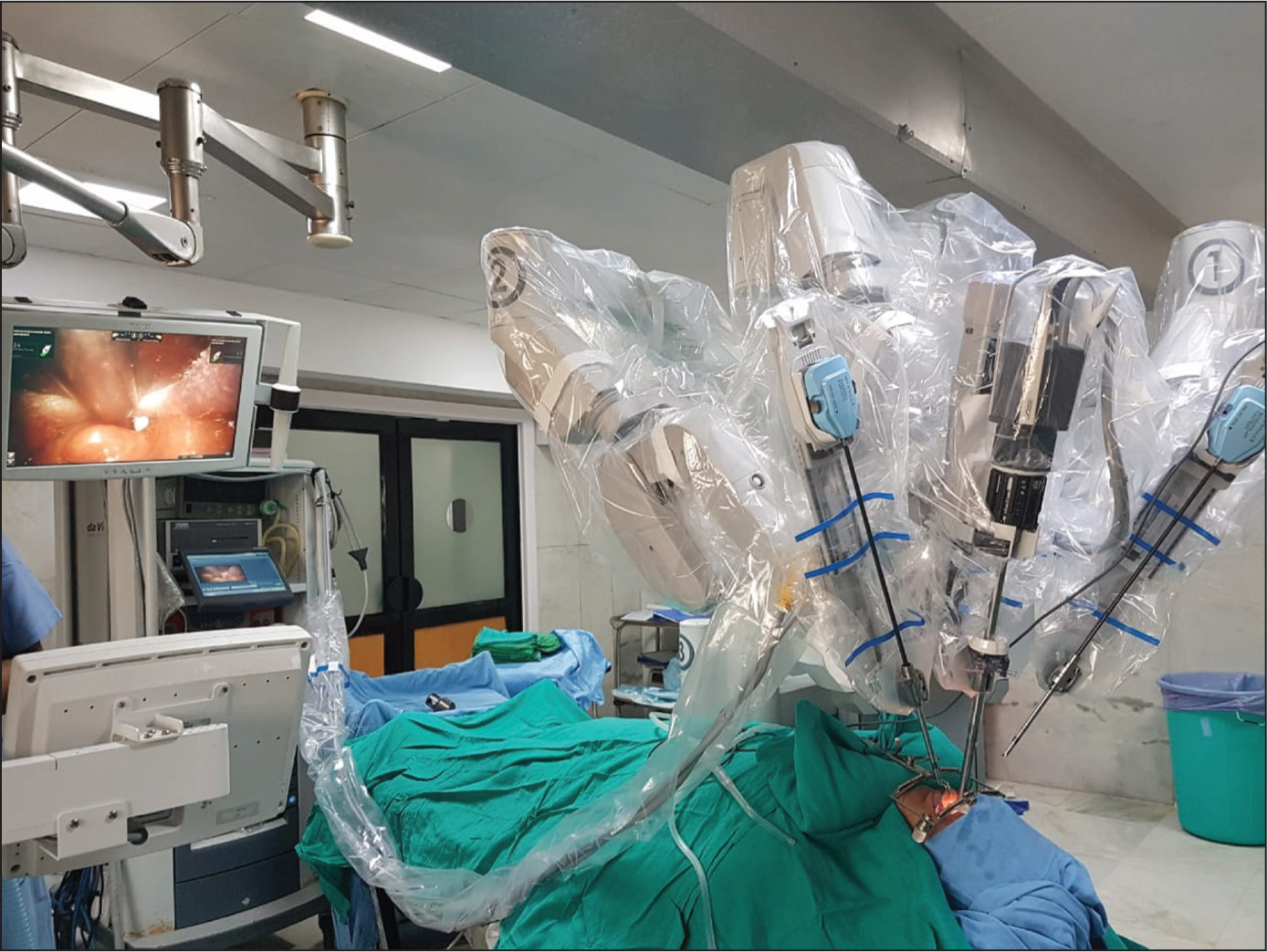
Arrangement of the operating theatre, the anaesthesia machine and the robotic system is an integral and important part of TORSA. Transoral robotic surgeries are challenging because the anaesthetist and the surgeon both share the same area of interest, namely the oral cavity. As the robotic system is docked at the head end of the patient, the anaesthesia machine is usually kept at the foot end [Figure 1]. The induction is usually done in the normal position and then the Operation Theatre(OT) table is moved so that the anaesthesia machine comes at the foot end. This requires long ventilator tubing and the connections should be checked properly before it goes under the drapes. Extension tubing should be attached to the intravenous lines, with an easily accessible drug injection port. The eyes should be well protected with padding or eye goggles to avoid any inadvertent contact from the robotic arms. A moulded dental guard can also be placed for dental protection. Neck extension is usually required, should be gentle and it must be rechecked after positioning to ensure that the head is properly placed and not hanging. Access to the patient becomes very restricted once the robotic arms get docked and in any intraoperative emergency, a rapid undocking is essential [Figure 2]. The whole robotic staff should be well-trained in the emergency undocking drill and this is a very important part of any robotic surgery. The robotic console for the main surgeon is usually placed in a corner of the operating theatre.
Operating room setup for Transoral Robotic Surgery, showing the da Vinci robotic system docked at the head end
Docked robotic arms and intraoperative endoscopic view during Transoral Robotic Surgery
Airway Management
Airway management in these patients usually comprises a nasal north-facing Ring-Adair-Elwyn tube (RAE) endotracheal tube, which provides optimal access to the surgical field. The patient is prepared in the preoperative room with nasal vasoconstrictors in the form of a nasal spray or drops. The patients for TORSA usually present as difficult laryngoscopy in view of their large tongues and the difficult airway cart should be kept ready. If the patient also requires a nasal procedure, such as septoplasty, in the same sitting, then at the end of the robotic procedure, the nasal tube is changed to an oral endotracheal tube. Our experience shows that in these cases, the laryngoscopy becomes easier after the robotic procedure and base of tongue reduction.
Induction and Maintenance of Anaesthesia
As per our institutional protocol, these patients are induced with fentanyl and propofol, along with muscle relaxation with atracurium. A nasal RAE tube is inserted and anaesthesia is maintained through an inhalation agent along with oxygen and nitrous oxide/air. As the surgical expertise and training have increased and the duration of surgery has reduced, at our centre, we have discontinued the use of atracurium infusion and nowadays just use boluses at fixed intervals. Nonetheless, as in all robotic surgeries, adequate muscle relaxation should be provided for optimal surgical relaxation and to prevent even the slightest movement while the robotic arms are at work. Airway handling while putting in the mouth gag and insertion of robotic arms usually gives rise to a sympathetic response, resulting in increased blood pressure and tachycardia. This hemodynamic response can be blunted by increasing the inhalation agent or giving small boluses of propofol. As per our protocol, a steroid (dexamethasone) shot is given intraoperatively to take care of the airway oedema. Analgesia is maintained with intravenous paracetamol and diclofenac and our experience has shown that this is usually sufficient to provide adequate pain relief in the immediate postoperative period.
Extubation Concerns
At the end of surgery, the oral cavity is checked for any bleeding and airway oedema. Reversal of neuromuscular blockade is done by neostigmine and glycopyrrolate and the trachea is extubated when the patient is awake. In some cases, the patient is also planned for septoplasty in the same sitting and in these patients, the nasal endotracheal tube is changed to an oral endotracheal tube at the end of the robotic procedure. Our personal experience during the change from nasal to oral tube shows that the laryngoscopy grade becomes better after the robotic base of tongue reduction.
Complications
Postoperative complications can be classified as major and minor, depending on the need for surgical exploration and readmission. The major complications include bleeding, oropharyngeal stenosis and poorly controlled pain. The minor complications include transient dysphagia, transient dysgeusia, pharyngeal oedema and tongue numbness and these usually subside with time.
Conclusion
TORSA for the treatment of OSA appears to be a promising and safe procedure for patients seeking an alternative to traditional therapy. Appropriate patient selection remains an important consideration for the successful implementation of this surgical approach. This recent approach provides a new set of challenges for the anaesthesiologists. The major anaesthetic concerns are positioning of the anaesthesia workstation and OT setup, emergency undocking protocol, control of sympathetic response following application of mouth gag and robotic arms, protection of eyes and careful positioning and meticulous airway management.
Footnotes
Declaration of conflicting interests
The authors declared no potential conflicts of interest with respect to the research, authorship and/or publication of this article.
Funding
The authors received no financial support for the research, authorship and/or publication of this article.
Institutional ethical committee approval number
NA.
Informed consent
NA.
Patient consent
N/A.
Credit author statement
Atish Pal: 1. Conception and design of the research, 2. Drafting the manuscript and making intellectual contributions to the text, 3. Final approval of the manuscript and 4. Agreeing to be held accountable for the work.
Chitra Chatterji: 1. Conception and design of the research, 2. Drafting the manuscript and making intellectual contributions to the text, 3. Final approval of the manuscript and 4. Agreeing to be held accountable for the work.
Data Availability
NA.
Use of artificial intelligence
Not used.