




Abstract
Background and Aims:
Mpox (formerly Monkeypox) is a zoonotic infectious disease with symptoms of rash, fever, and swollen lymph nodes. The most recent outbreak was reported in May 2022 with the first US case identified in the middle of the same month. Google Trends is a unique tool that quantifies frequencies of a specified search term in real-time, in a given time range, and by geographical location. The present study evaluates the utilisation of Google Trends data in understanding Mpox patterns in the US.
Materials and Methods:
On 29 September 2023, a Google Trends search was executed to analyse the popularity of the term Mpox for time range of 10 May 2022 to 28 September 2023. Data was exported into MS Excel and matched with the CDC’s Mpox case incidence data.
Results:
Mpox search was most popular in the District of Columbia (100) followed by Delaware (71), Maryland (70) and Georgia (68), respectively. The popularity scale of 24 was observed 2 days before the first US case was identified which could be attributed to the global rise in cases earlier in May 2022. Although a steep increase in Mpox searches was observed between July and August 2022, the trend aligned with the number of Mpox cases reported to the CDC during the same time frame.
Conclusions:
Google Trends data, if used in conjunction with other surveillance tools, can help in a better understanding of disease dynamics and may help validate trends obtained through other sources. Since Google Trends monitors and analyses searches in real-time, it can be valuable in establishing a robust action plan.
Introduction
Mpox formerly known as Monkeypox is an infectious disease caused by Monkeypox virus, a member of the Othopoxvirus genus.[1] The disease is characterised by a skin rash that appears on the hands, feet, chest, face, mouth, and genitals. Patients may also experience mucosal lesions, fever, headache, swollen lymph nodes, muscular pain, backache, and upper respiratory symptoms.[1,2] Mpox is primarily transmitted through direct close contact with an infected individual. Once a person is exposed, it can take anywhere from 3 to 17 days for symptoms to develop, which usually last for a duration of 2–4 weeks.[1,2] Treatment is mainly focused on supportive care and antivirals may also be utilised among patients with severe disease or who are immunocompromised.[3]
Mpox Case Incidence & Trends
On 17 May 2022, the first case of Mpox was identified in Massachusetts among a patient with recent history of international travel.[4] Subsequently, multiple suspected or confirmed cases of Mpox were reported across multiple States in the US.[4,5] The cases peaked in August with the highest numbers (647) reported on 1 August 2022, before counts started observing a gradual decline.[5] By 28 September 2023, there were 30,861 cases that had been identified in the US alone and 54 Mpox-related deaths were also reported.[5] During the same period, California reported the highest number of Mpox cases, reaching 5854, followed by New York with 4326 cases, and Texas with 3072 cases, respectively.[5] Figure 1 illustrates the Mpox case counts in the US from 2022 to 2023.
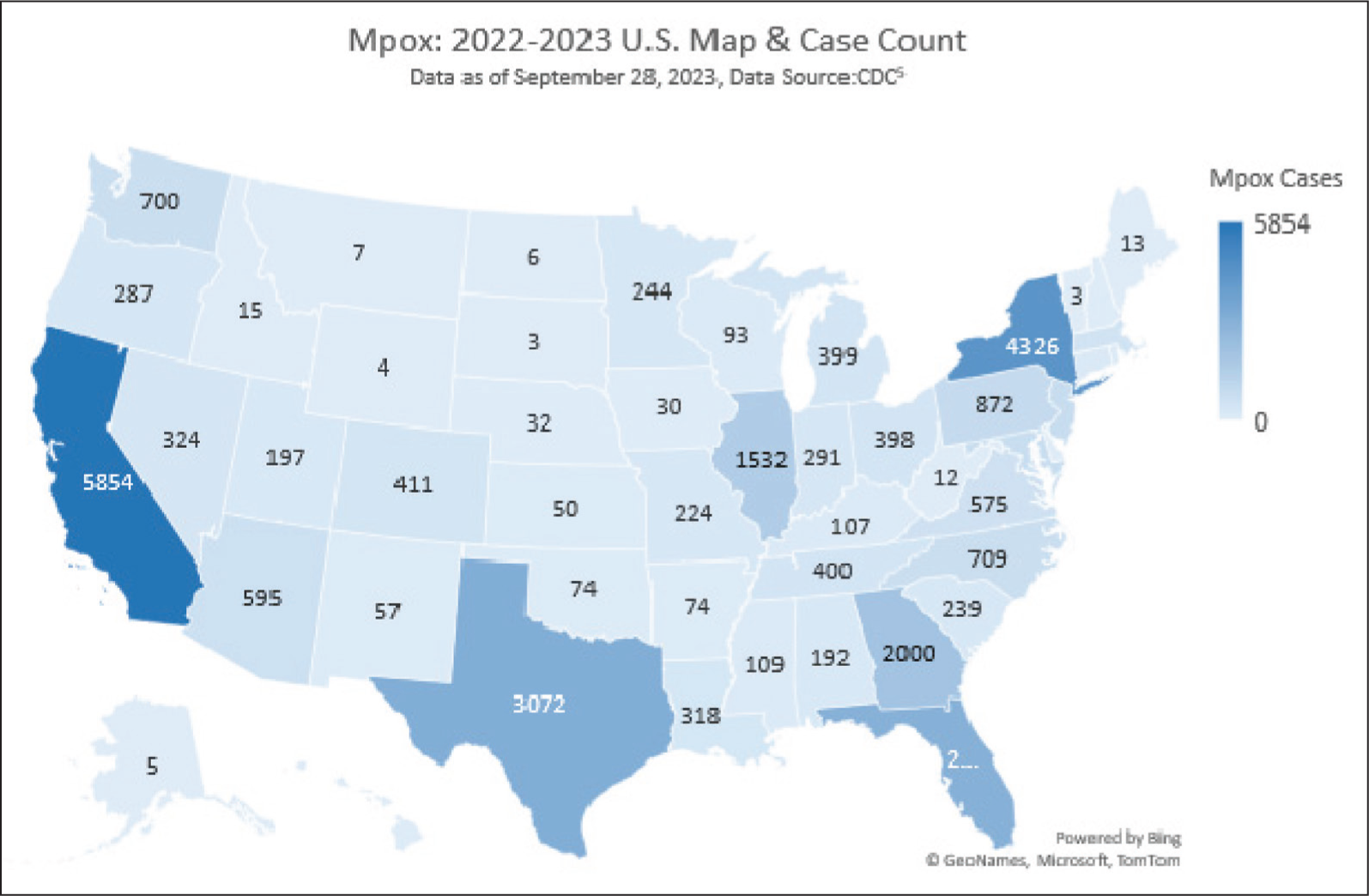
Among 30,861 cases of Mpox reported by 18th September 2023, 32.4% were non-Hispanic Black or African American, 31% were Hispanic or Latino (Hispanic), and 29.5% were non-Hispanic White.[6] By gender highest number of cases were men (~95%). Furthermore, by age, highest number of cases were in the age range between 21 and 50 years (~87%).[6]
Google Trends Data
Google Trends is a useful tool that helps people understand topic-specific web search trends over time. Furthermore, it can help in determination of timeline during when there is an uptick of searches on a topic of interest. The tool provides options to choose geographical regions, time ranges, and display this information in form of a graph. Google Trends data allows users to download relevant ‘interest over time’ data in comm-separated values (CSV) format which can then be used for further analyses. The data is presented as a scale ranging from 0 to 100 instead of absolute search numbers and depicts relative popularity based on time and region.[7] Evidence suggests that internet search queries correlate with disease activity of infectious diseases such as influenza and West Nile virus hence can help in real-time monitoring and early detection of outbreaks.[8-10]
The objectives of the present study are to evaluate whether Google Trends data can be utilised to understand disease patterns, early detection of cases, and dynamics of Mpox and other infectious diseases.
Materials and Methods
On 29 September 2023, a Google Trends search (
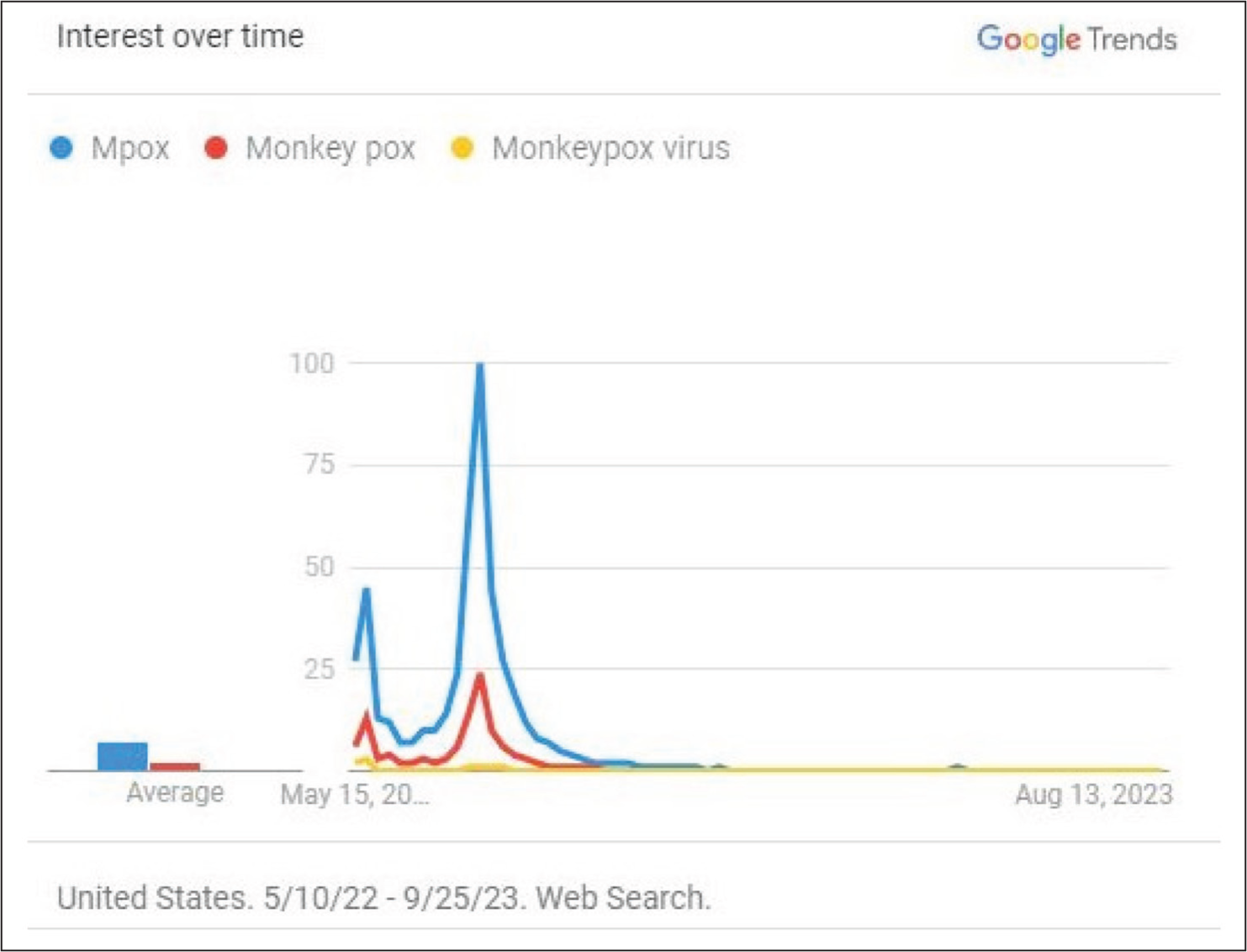
For further examination of the data, the term ‘Mpox’ was solely used as it exhibited a higher popularity compared to the other two terms and displayed a similar trend pattern [Figure 2]. The search term data for ‘Mpox’ was then downloaded in CSV format. Additionally, the publicly available outbreak case trends data for the years 2022–2023 was utilised from the CDC’s weblink.[5] The weekly search data from Google Trends was then matched with the 7-day average Mpox caseload. The 7-day average represents the average number of cases identified and reported per day in the previous 7 days.[5] To visually present the search scale and case count data on maps, the Insert Map Chart option in Microsoft Excel version 2302 was utilised.
Google Trends search for Terms Mpox, Monkeypox, and Monkeypox Virus, United States, 22 May–September 23
Results and Discussion
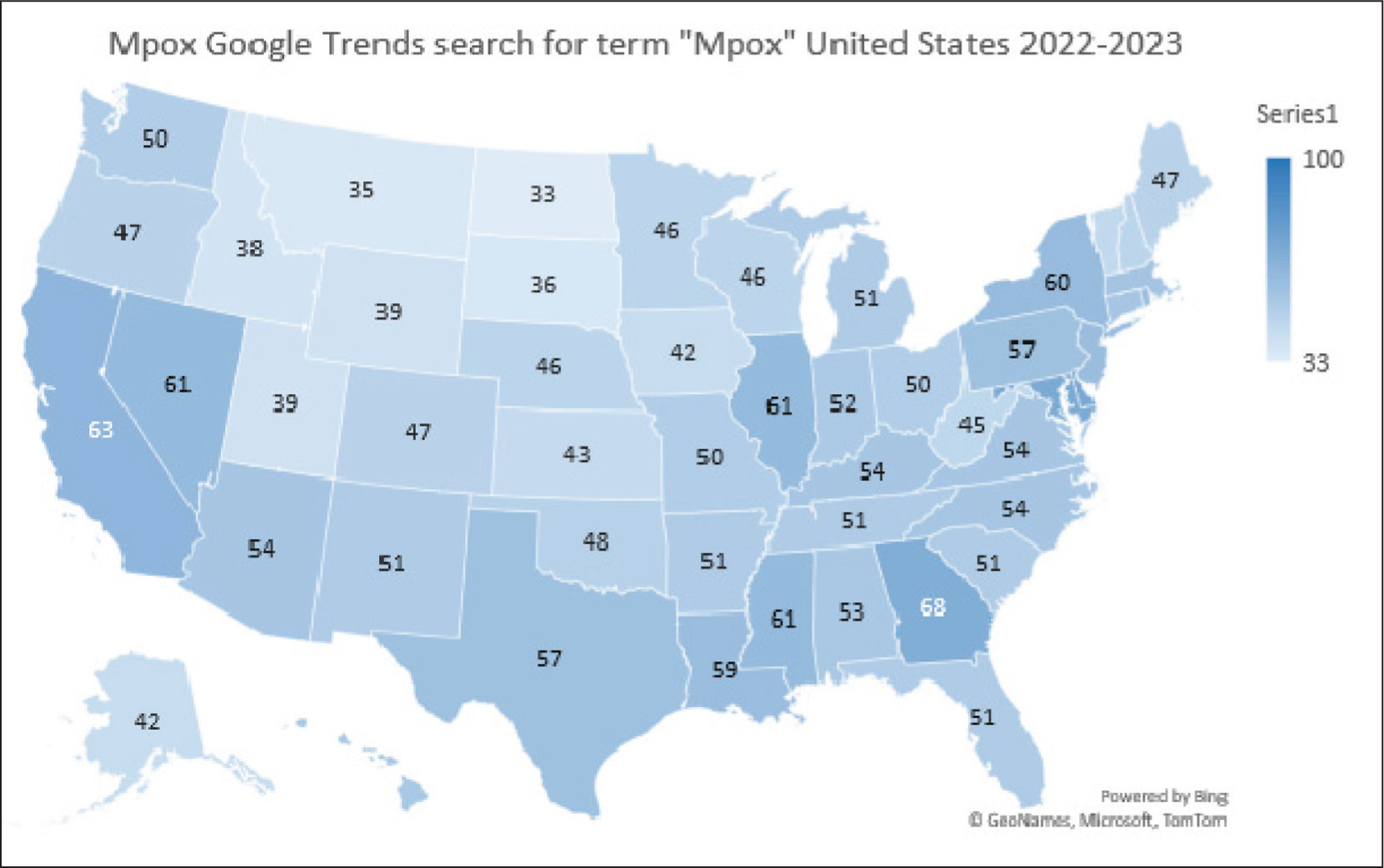
Figure 2 shows the heat map for the United States. Mpox search was most popular in the District of Columbia (100) followed by Delaware (71), Maryland (70) and Georgia (68), respectively (Data may not be visible due to the small geographical area on the map). The states with the highest number of reported cases also had a scale greater than 50 for the search term ‘Mpox’, that is, California (63), New York (60), Texas (57), Florida (51), Georgia (68) and Illinois (61) [Figure 3].
Google Trends search for the term ‘Mpox’ by States, 2022–2023
Although the first confirmed case of Mpox in the United States was identified on 17 May 2022, data from Google search trends indicated a popularity scale of 24 for the term ‘Mpox’ on 15 May 2022. This can be attributed to the fact that in early May 2022, countries where the disease was not endemic began reporting Mpox cases.[11] The search scale values increased during May and started decreasing in June. A steep increase was observed between July and August 2022, which aligns with the number of Mpox cases reported to the CDC during the same time frame [Figure 4]. However, the CDC’s incidence data reveals a less abrupt pattern in the epi-curve. As the case counts (7-day average) decreased, we also observed a decline in popularity of term ‘Mpox’, particularly after October 2022 [Figure 4].
Mpox search trends comparison with Mpox incidence data from CDC, 22 May–23 September, United States
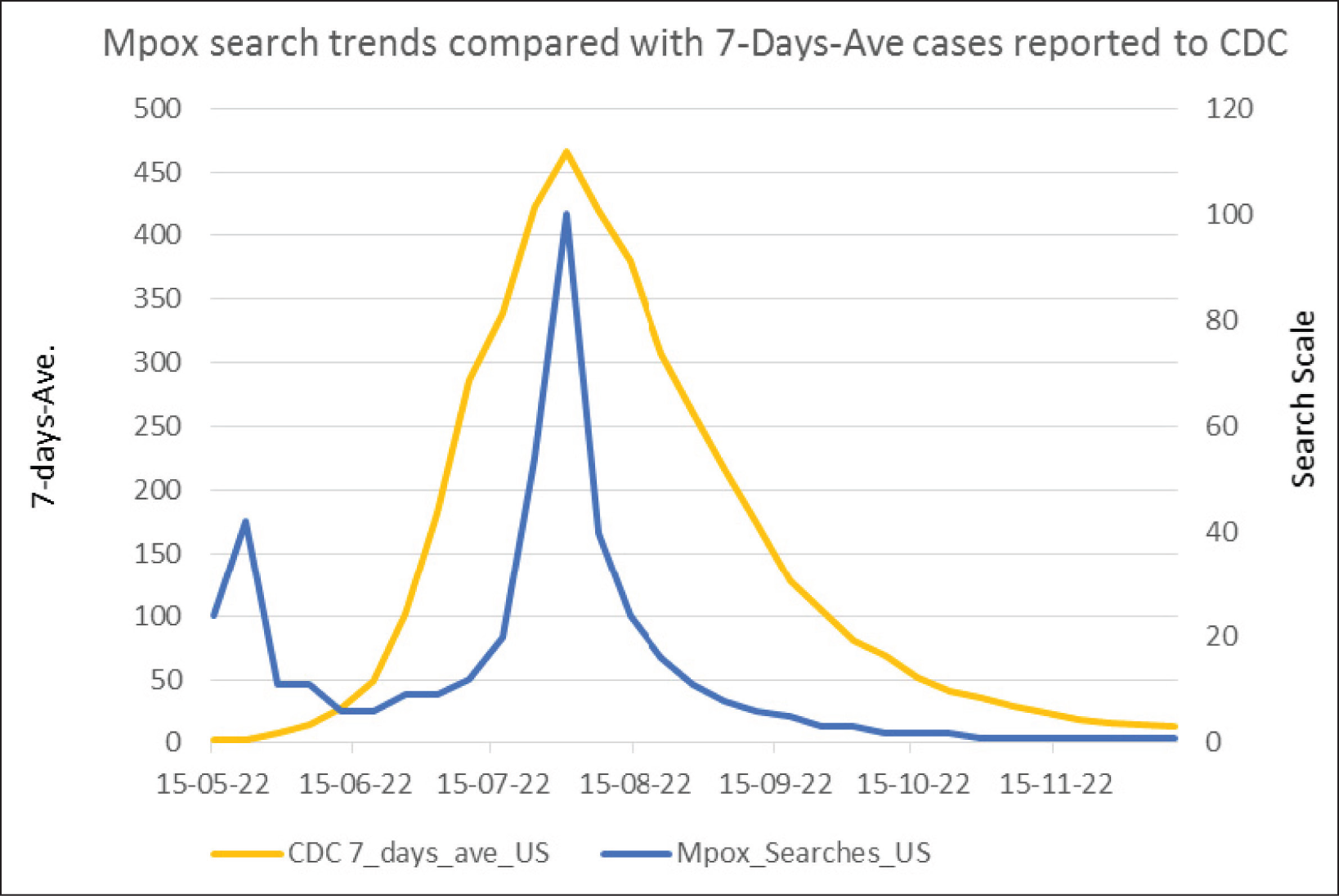
The present study uncovers an interesting finding: in May 2022, 2 days prior to the first case of Mpox being identified in the US, the popularity of Mpox reached 24 on the scale. This notable increase indicated a heightened interest in the disease, likely due to the growing number of cases worldwide, which might have caught the public’s attention. Moving forward to July and August 2022, a remarkable surge in Mpox searches was observed. This surge coincided with the rise in Mpox cases reported to the CDC during the same time frame. The correlation between the search trend and the reported cases suggests that public concern and awareness regarding Mpox were directly influenced by the actual spread of the disease. Similar trends have been observed in other studies, especially during influenza outbreaks.[8-10]
Google Trends data may have limitations in predicting outbreaks and may influenced by the media coverage of an issue hence under or overestimating a situation.[12] The data, however, can be useful in conjunction with other enhanced surveillance or mixed-method tools to gain a deeper understanding of disease dynamics.[13-15] One strength of Google Trends is allowing users to monitor and analyse searches in real time, which can be crucial in establishing a robust action plan. Moreover, enabling users to compare various search terms and geographical locations can aid experts in identifying areas that may require additional resources, education, and interventions. Furthermore, this data may serve as a valuable tool in validating information gathered through alternative surveillance methods.
Footnotes
Declaration of conflicting interests
The author declared no potential conflicts of interest with respect to the research, authorship and/or publication of this article.
Funding
The author received no financial support for the research, authorship and/or publication of this article.
Patient/informed consent
Not applicable.
Credit author statement
HA performed literature review, used and analyzed data from the publicly available locations, and developed the manuscript.
Data availability
Available on request (publicly available data).
Use of artificial intelligence
Not applicable.