




Abstract
Background and Aims:
The aim of this study was to conduct a survey on usefulness of medical education-based software applications in learning physiology as an aid to regular academics among first-year medical and dental students in India.
Methodology:
This is a survey-based cross-sectional study which included 282 students from medical and dental health sciences.
Results:
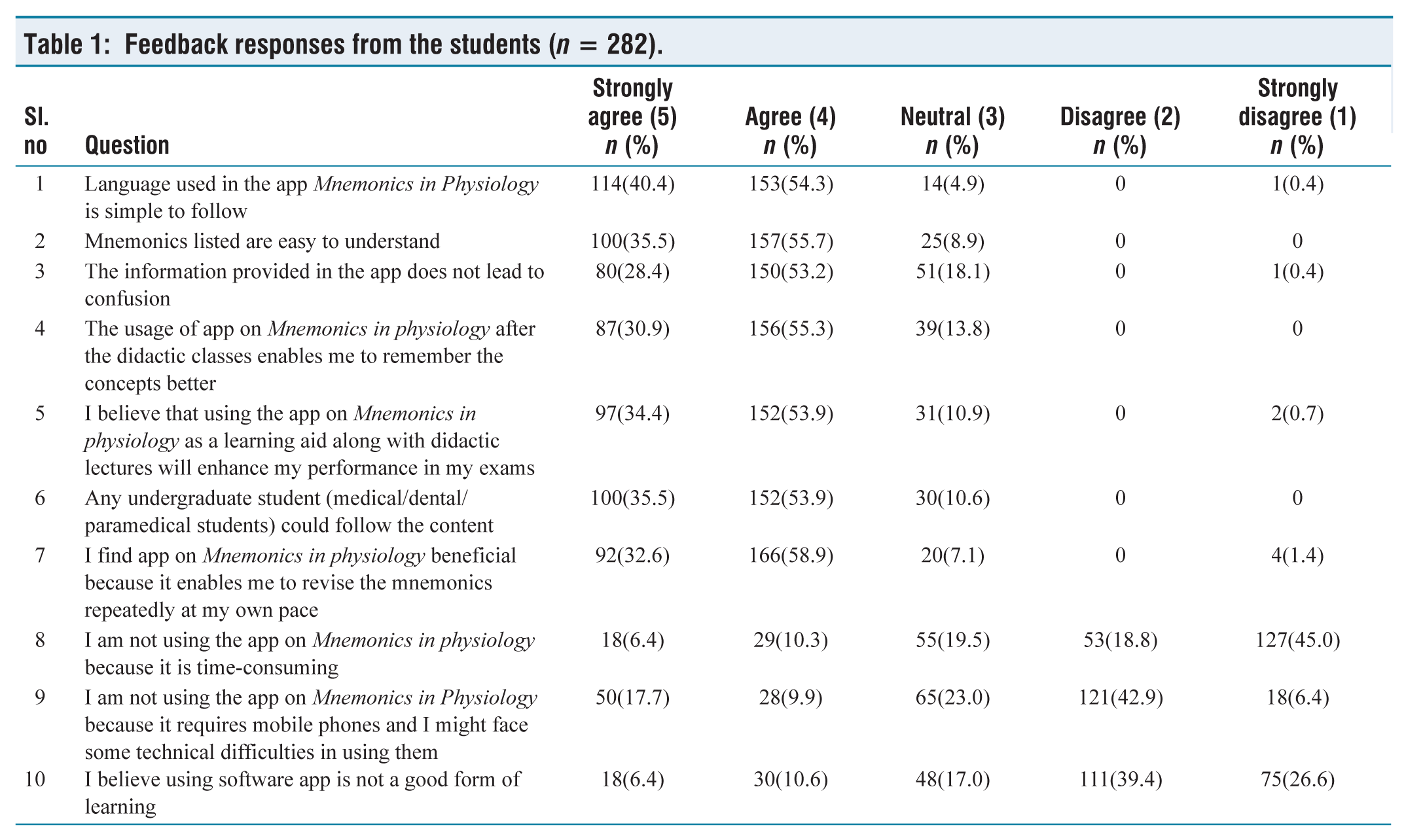
Out of 282 medical students, 267 (95%) students found the app simple to follow, 257 (91%) students said that app was easy to understand and 243 (86%) found it as a learning aid to didactic learning.
Conclusion:
Our study reports that students widely use medical education-based apps for academic benefits and as an aid to didactic learning.
Introduction
In medical education, physiology forms the foundation of clinical sciences. Physiology forming the basics of medical education involves a lot of concepts which are difficult to understand and memorise.[1] Educational tools are innovative, advantageous and fun-filled approach in teaching-learning which can be used to enhance understanding, strengthen memorisation and promote reasoning skills.[2,3 Medical education enthusiasts are always looking forward to novel teaching-learning strategies for engaging medical students in the course content and review the content which would enhance the student success. With reference to the Oxford dictionary, a mnemonic is defined as ‘A pattern of letters and words used as an aid to memory’. The term mnemonic is taken from Greek word ‘mñem´on’ which means mindful. Constructing mnemonics can be considered as a beneficial learning strategy which can help them memorise difficult concepts. Hence, it is an approach which boosts memorising capacity and accelerates recall of information.[4] Mnemonics boost memorising capacity by linking known facts with unknown facts.[5] Learning with mnemonics stimulates higher-order learning along with a student-friendly approach.[6]
Android phones and medical education-based applications are trendy and are extensively utilised by medicos as they are beneficial in facilitating peer relation in combination of ‘Learn anytime and Anywhere’ mode.[7] Smartphones permit usage of digital applications (Apps).[8] Owing to its resourcefulness, medical education enthusiasts are incorporating the usage of smartphone for curriculum delivery with highlighting its benefits and trying to curb the demerits.[9] There is an enhanced usage of gadgets specifically smartphones with respect to medical education according to recent surveys.[10] The current generation of medical learners acknowledges, acclimatises and uses standardised electronic information to a greater extent.[11] The recent surveys observed that medical students reported enhanced academic performance owing to smartphone usage.[12,13 Smartphone-based medical learning apps have gained popularity amongst medical learners and have been reported to be beneficial to students in terms of self-learning.[14-16 Chase et al. observed that mobile learning has an enhanced impact on the knowledge acquisition of a medico, especially in clinical setting.[17] However, there is a dearth of mobile-based apps for preclinical subjects.
With the newer generation of digitally connected learners, medical schools should incorporate novel technologies to disseminate knowledge. Only a part of medical academics can be delivered through didactic lectures. Medical education in India uses traditional didactic lecture model and adapting to technology still needs to be worked upon. However, there should be no delay in blending medical education with technology as the newer generation is more techno-friendly and use of this would result in enhanced student engagement and improvised faculty satisfaction. Even though plenty of web-based information is accessible in form of websites, many of them do not have all the required academic information in an organised manner. Hence, the authors decided to design ‘I remember’ a simple and innovative software application which contains various mnemonics for all the systems of physiology. We encouraged our students to use this software application as an aid to learn difficult and confusing topics along with traditional teaching-learning methods. The advantages of the software application are that it can be easily downloaded to a smartphone or laptop. Students have the option to revisit the material multiple times. Currently, there are few studies in India with emphasis on merits and demerits of software-based medical educational applications. The aim of this study was to analyse the efficacy of software applications. Another purpose was to assess the students’ perception of software applications with regard to their usefulness as a supplementary learning aid.
Objective
The aim of this study was to conduct a survey on usefulness of medical education-based software applications in learning physiology in first-year medical and dental students in India.
Materials and Methods
Methodology
The following are the methodologies for this study:
Study type: Cross-sectional observational study. Study setting: Online survey among medical and dental sciences college students in south India. Study participants: Student volunteers studying at the medical and dental sciences colleges across south India. Study Period: One year (February 2022–February 2023).
Physiology Curriculum
The medical colleges currently in India follow the newly designed competency-based curriculum in which physiology is taught in the first-year MBBS. The first year is more of theoretical classroom-based teaching of physiology in combination with quick preclinical exposure. The all-inclusive syllabus of physiology consists of general physiology, haematology, cardiovascular, respiratory, and endocrine in combination with reproductive physiology and neurophysiology.
Features of Development and Designing for the Software Application
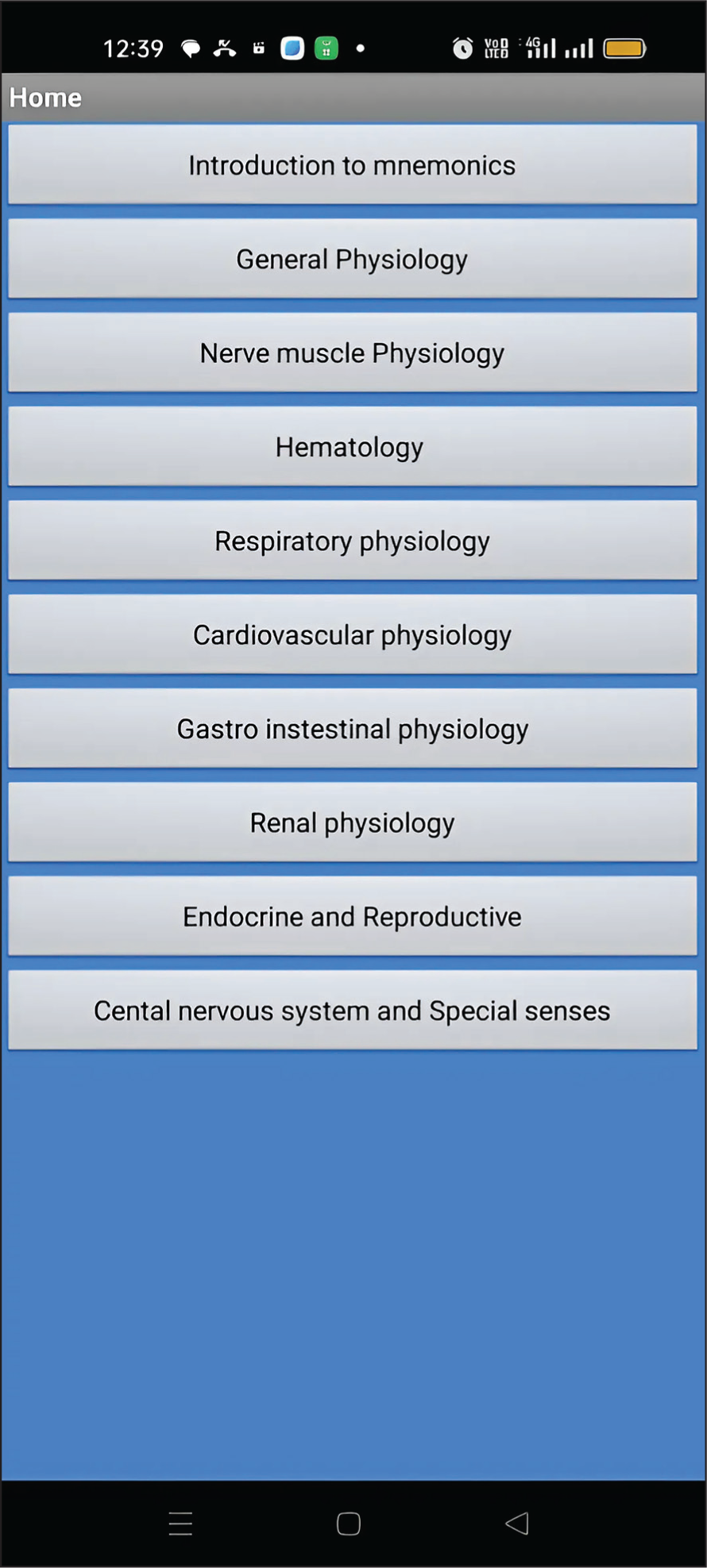
Script associated and mnemonics were prepared by three faculties of the Department of Physiology Mahatma Gandhi Medical College, Pondicherry, and Sree Gokulam Medical College Trivandrum. The software application was developed by Insprarobotics and copyrighted (Copyright no - 28570/2021-CO/SW). The software application can be downloaded through Google Play Store. The mnemonics have been developed for every unit of physiology as mentioned earlier. The application has good image resolution, enhanced speed and simple-to-use features. User feedback features are also available in Google Play Store. The mnemonics are presented system-wise [Figure 1]. For the benefit of the students, the app is free and easily downloadable.
Screenshot of Mnemonic App and Front Page
Feedback from Students
After obtaining ethical clearance (BGSGIMS/IEC/app/oct/2022/01), the study was conducted among first-year MBBS students in the academic year 2021-22 and 2022–23 in the Department of Physiology in Medical and Dental Health Sciences Colleges in south India. We collected feedback from 282 students belonging to five medical colleges and one dental college that are enrolled based on ranking system of the National Eligibility Entrance Test. The student participants who volunteered and gave consent were recruited for the study. The feedback questionnaire was validated in a pilot study. The feedback questionnaire was made available online for a limited time. The student participants were informed in advance about the aims and implications of this medical education study. Participation was voluntary and consent was obtained along with the feedback questionnaire. The questionnaire consists of 12 items: Ten closed-ended questions which required a response on a five-point Likert scale of strongly agree to strongly disagree and two open-ended questions. The questionnaire was developed by the authors and reviewed by experts from medical education departments.
Inclusion Criteria
First-year MBBS students who volunteered to participate in the survey after using the app were included in this study.
Results
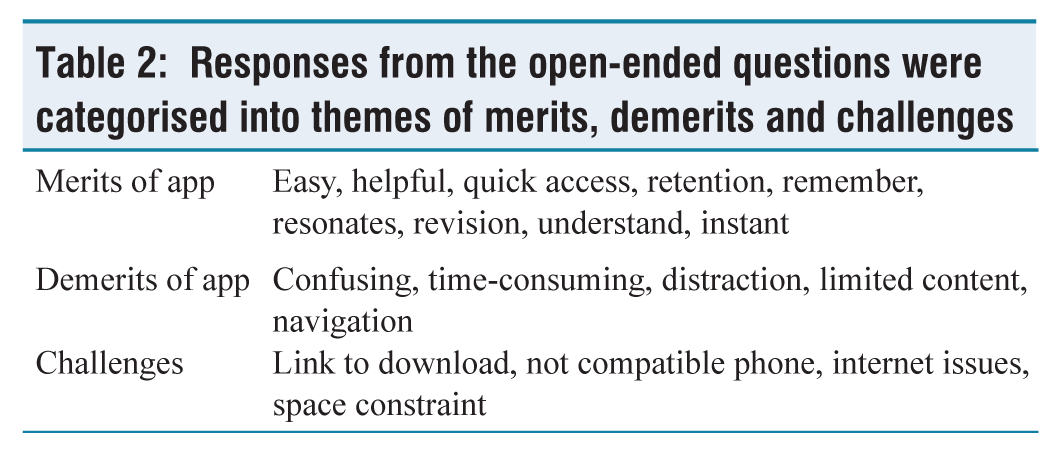
Data was entered into an Excel sheet and analysed. Out of 282 medical students, 267 (95%) students found the app simple to follow, 257 (91.1%) students said that app was easy to understand and 243 (86.1%) found it as a learning aid to didactic learning [Tables 1 and 2].
Feedback responses from the students (n = 282).
Responses from the open-ended questions were categorised into themes of merits, demerits and challenges
Discussion
The feedback from the students via online survey has focused on merits of using smartphone applications for medical education. At the beginning, the authors would like to mention that reflections from other medical colleges also need to be explored but the pilot data is also valuable. Majority of students agreed that the app is an aid to traditional lecture-based learning and would help them in enhancing their performance (Table 1). Mobile-based educational apps promote discussion and enhanced student engagement. The generation Zee prefers more student-centric, self-directed modules for studying. The mobile-based educational app can be an effective way to move teaching beyond traditional classroom teaching. Mobile educational app can be blended with medical education to analyse its efficiency along with ease to deliver learning resources. A faculty-directed approach in deciding and designing interactive, low cost and knowledge-resourceful applications is a must in future. The feedback from the medical and dental health science students was collected with intent to understand their opinion about usage of mobile-based apps in medical education. Previous literature study performed on medical students report that mobile-based apps enhance learning.[18] Previous literature is suggestive of mobile-based education as an adjunct to classroom teaching but with limited evidence regarding the same.[19] Post-pandemic mobile learning has emerged as a novel form of learning. Even though many studies have been conducted on mobile-based educational apps, none of them have focused on the effectiveness of the intervention.[20] The technical difficulties in usage of the app were not much highlighted. Majority of students said learning from the app was not time-consuming [Table 1]. A few commonly reported disadvantages of learning via mobile apps are limited phone storage and small screen[21,22 [Table 1]. The major limitation of our study is that we have not assessed the change in knowledge amongst students after the usage of the software app. Similar views were expressed in a study stressing on the assessment of learning outcome following mobile-based learning than looking at student perception.[23] About 58.9% of the students in our survey said that ability to access the content anytime at their own leisure is the biggest advantage of this app-based learning. This study focuses on usage of on single mobile app; thus, the results are not generalisable.
Outcome
One of the interesting observations made post-exposure to this mnemonics app is few students contacted the faculty to share the mnemonics prepared by them emphasising an important transformational change in learning among students from a benefiter to content developer.
Conclusion
Mobile applications are efficient tools in medical education. Online/offline applications will be used in future. The pandemic situation has led to discovery of new modalities in e-learning blended with traditional teaching. In the current scenario, mobile applications are said to act as an aid to traditional teaching bearing in mind cost-effectiveness, enhanced versatility and flexible access time.
Supplemental material
Supplementary material for this article is available online.
Footnotes
Acknowledgements
Students and staff of associated medical and dental colleges.
Declaration of conflicting interests
The authors declared no potential conflicts of interest with respect to the research, authorship and/or publication of this article.
Funding
The authors received no financial support for the research, authorship, and/or publication of this article.
Institutional Ethical Committee Approval Number
The ethical approval was obtained from the Institutional Ethics Committee (Approval Number: BGSGIMS/IEC/App/Oct/2022/01).
Patient consent
Not applicable.
Data Availability
Data are included in the manuscript.
Use of Artificial Intelligence
Artificial intelligence was not used.
References
Supplementary Material
Please find the following supplemental material available below.
For Open Access articles published under a Creative Commons License, all supplemental material carries the same license as the article it is associated with.
For non-Open Access articles published, all supplemental material carries a non-exclusive license, and permission requests for re-use of supplemental material or any part of supplemental material shall be sent directly to the copyright owner as specified in the copyright notice associated with the article.

