




Abstract
Background and Aims:
Traumatic bilateral brachial plexus injuries in adults are rare and present unique challenges in management. We report a case of a 21-year-old veterinary student who sustained bilateral brachial plexus injuries following a fall from a moving two-wheeler.
Case Presentation:
The patient suffered a C5,6 brachial plexus injury on the right side and a C5–7 injury on the left side. Remarkably, the right-sided injury showed signs of recovery after four months, while the left-sided injury took seven months to resolve completely. Despite the severity of the injuries, the patient underwent a conservative approach and did not undergo any surgical intervention.
Results:
Following months of dedicated rehabilitation, the patient achieved significant recovery and was able to return to her veterinary studies. This case highlights the potential for recovery in traumatic bilateral brachial plexus injuries with conservative management, emphasising the importance of patient-specific treatment strategies and rehabilitation protocols.
Conclusion:
Conservative management can lead to significant recovery in traumatic bilateral brachial plexus injuries. Patient-specific treatment strategies and dedicated rehabilitation are crucial components of successful outcomes in such cases.
Introduction
Bilateral traumatic brachial plexus injuries in adults are infrequent and insufficiently documented, with occurrences linked to various factors such as crutch palsies, surgical positioning and motor vehicle accidents.[1-4] Mechanisms include nerve compression, traction and direct nerve toxicity.[1,2] Despite the rarity, a few cases involved successful outcomes through interventions such as nerve transfer and neurolysis. Our reported case involves a 21-year-old veterinary student with complete recovery using conservative management, adding to the limited pool of documented cases in this context.
Case Report
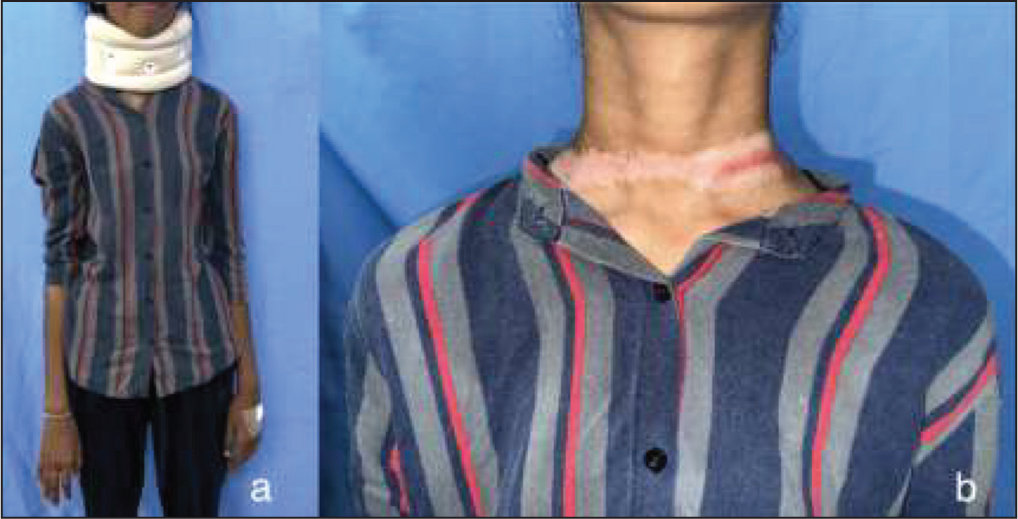
A 21-year-old Indian woman presented to the emergency department with bilateral upper limb weakness persisting for two weeks after a fall from a moving two-wheeler, resulting in her shawl entangling around her neck. A transverse scar resembling a choker/necklace was observed during examination (Figure 1). Both right and left upper limbs had British Medical Research Council (MRC) muscle strength grades of 0/5 for the shoulder (abduction/external rotation) and elbow (flexion/ extension) and 4/5 for the wrist (flexors/extensors) and hand (intrinsic/thenar muscles). CT scan revealed bilateral C6,7 transverse process fractures, for which a neck soft collar was applied for six weeks. MRI of the cervical spine was done and did not show any cord injury. Electrodiagnostic studies indicated motor axonal neuropathy (fibrillations/positive sharp waves) in the bilateral suprascapular nerve, musculocutaneous nerve and axillary nerve. A diagnosis of bilateral brachial plexus palsy was made based on clinical, electrodiagnostic and radiological findings. The patient was unable to afford the cost of an MRI for brachial plexus. Given the electrodiagnostic studies suggesting bilateral brachial plexus injuries, we did not insist on an MRI.
(a) The attitude of bilateral brachial plexus injury in a 21-year-old girl who had a soft cervical collar for her cervical spine transverse process fractures. (b) The neck choker sign which was caused by her cloth that strangled the lower neck when she fell from a two-wheeler and sustained bilateral brachial plexus injuries
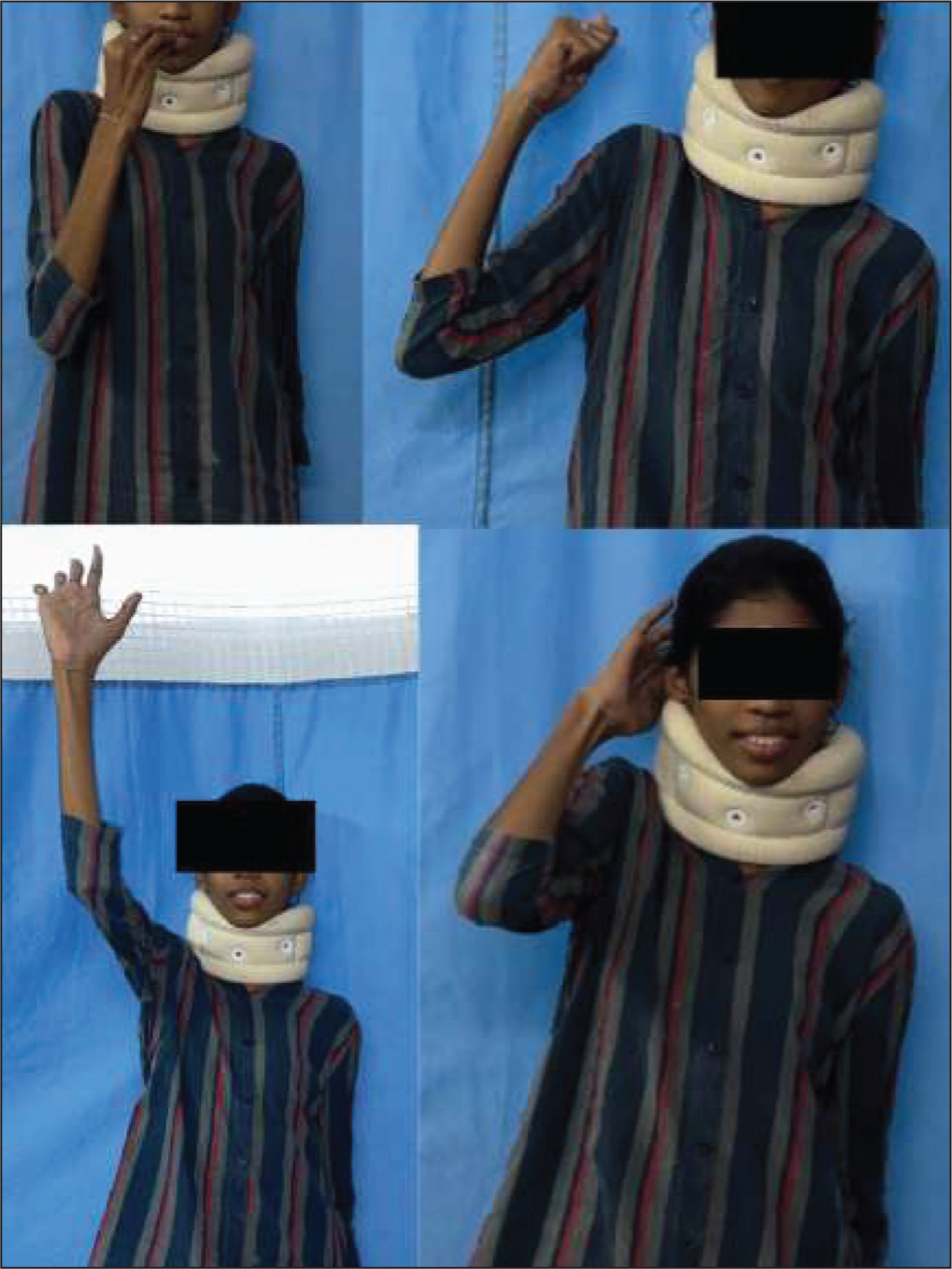
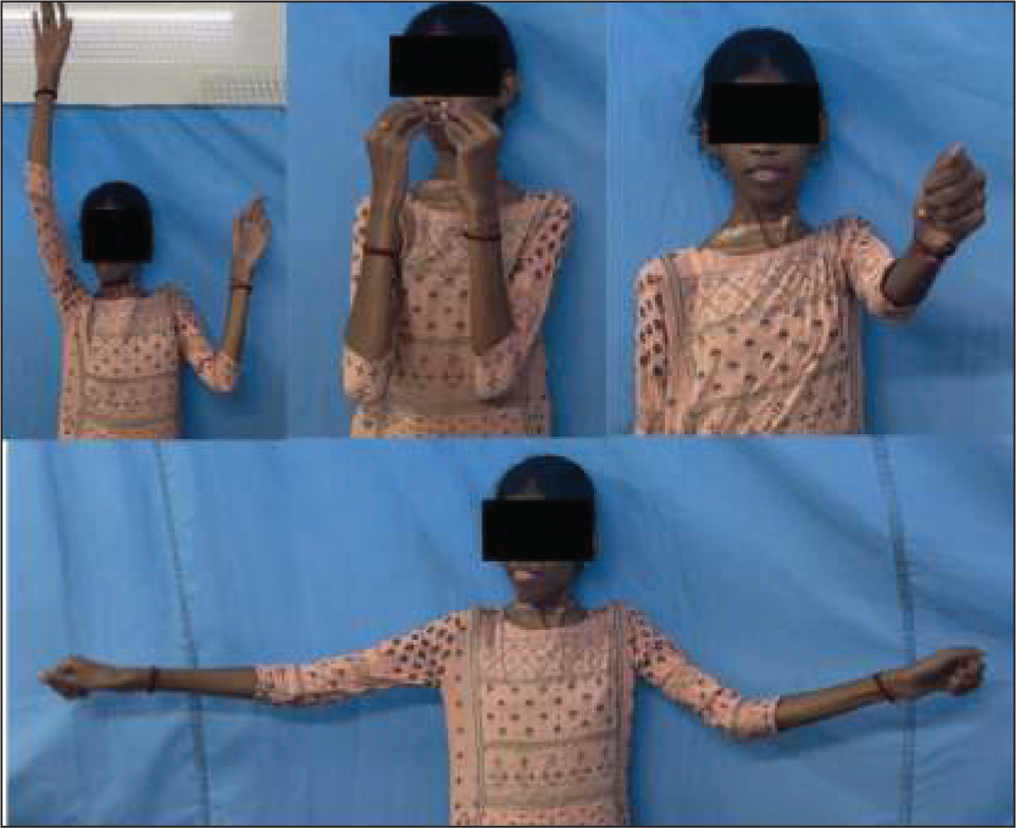
The patient and the parents were not keen for surgery and chose electrical nerve stimulation for both upper limbs at six weeks, supported by daily active and passive therapy. Subsequently, the right upper limb fully recovered to a 5/5 grade at four months, while the left upper limb exhibited significant improvement, reaching a grade 4 in shoulder (abduction/rotations), elbow (flexion/extension), wrist (flexors/extensors) and hand (intrinsic, thenar muscles) at seven months (Figures 2 and 3). The electrodiagnostic studies at the follow-up showed polyphasic motor unit potentials (MUP) representing reinnervation and motor recovery. The patient successfully resumed her studies at the veterinary college.
Good recovery of the shoulder and elbow functions in the right upper limb at four months of follow-up
Full recovery in the right upper limb with MRC grade 5 and grade 4 recovery in the left upper limb at seven months of follow-up
Discussion
This report discusses a unique case where a patient’s clothing became a neck traction unit during a fall from a moving two-wheeler. The patient was dragged along the road for a few metres before coming to a stop. This type of injury is different from others reported in the literature, which include direct pressure over the brachial plexus while extricating the victim and recoiling of the ipsilateral brachial plexus leading to contralateral traction injury.[1-3]
The average motorcycle speed leading to brachial plexus injuries, resulting from collisions with stationary objects, typically ranges from 47 km/h to 88 km/h.[4] In this scenario, the traction force exerted is likely within this speed range, as it is directly influenced by the velocity of the motorbike at the time of impact. A distinct clinical presentation often observed in Indian women, reminiscent of a neck choker, can be attributed to clothing that inadvertently constrict the neck region. When such individuals experience a fall while riding a moving bike, the combination of the clothing item’s constriction and the force of the fall results in a uniform traction force being applied to the neck. This uniform traction force predisposes individuals to bilateral brachial plexus injuries, highlighting the importance of recognising and addressing such unique risk factors in clinical practice.
Traumatic adult bilateral brachial plexus injuries pose challenges due to associated injuries, difficulty in understanding the nerve injury pattern and timing of surgical intervention. Existing case reports highlight neuropraxia on one side recovering spontaneously and root avulsion injuries necessitating distal nerve transfer. Discrepancies in injury levels are noted among studies, with different treatments and outcomes reported. Ramdass et al[1] and Pai et al[2] documented C5–7 brachial plexus injuries in both sides, while Kokkalis et al[3] reported C6–8 brachial plexus injuries based on clinical and MRI findings. Kokkalis et al[3] advised early fixation of associated limb fractures and a separate distal nerve transfer surgery. Their case achieved an MRC grade 5 in both upper limbs at the final follow-up. Pai et al recommended brachial plexus exploration after four months of no motor recovery. They performed neurolysis on the right side and reported grade 5 recovery. Simultaneously, they performed distal nerve transfers for shoulder external rotation and elbow flexion on the left side and reported grade 3/5 outcome at 12 months of follow-up.
In contrast, Ramdass et al[1] documented a case of bilateral brachial plexus injury during extrication from a car crash, treated conservatively, resulting in poor motor recovery in the shoulder and elbow.
Our case had C5,6 brachial plexus injury on the right side and C5–7 on the left side. The case was managed conservatively despite severe motor axonopathy and demonstrated spontaneous recovery in both shoulder and elbow functions. Electrodiagnostic studies conducted during follow-up revealed polyphasic motor unit potentials (MUP), indicative of re-innervation and motor recovery. The patient’s improvement was better than in Ramdas et al.’s study, which documented poor shoulder and elbow function in their conservatively treated case, highlighting the variability in outcomes in traumatic brachial plexus injuries.
Furthermore, the sensitivity and specificity of MRI of the brachial plexus for detecting root avulsions vary may not provide additional information in certain cases. While MRI can be useful in some scenarios, its limitations in diagnosing post-ganglionic injuries and determining the extent of damage should be considered.[5]
Conclusion
In conclusion, the case of a 21-year-old Indian woman with bilateral upper limb weakness following a traumatic incident highlights the complexities of managing brachial plexus injuries. Despite financial constraints preventing the completion of an MRI, the diagnosis of bilateral brachial plexus palsy was established through clinical, electrodiagnostic and radiological assessments. The patient opted for conservative management with electrical nerve stimulation and therapy, leading to significant improvements in both upper limbs. Notably, the right upper limb fully recovered within four months, while the left upper limb demonstrated substantial progress over seven months. Electrodiagnostic studies confirmed motor recovery, allowing the patient to resume her studies successfully. This case highlights the potential efficacy of conservative approaches in treating brachial plexus injuries, emphasising the importance of tailored treatment plans and diligent rehabilitation efforts.
Footnotes
Declaration of Conflicting Interests
The authors declared no potential conflicts of interest with respect to the research, authorship and/or publication of this article.
Funding
The authors received no financial support for the research, authorship and/or publication of this article.
Institutional Ethical Committee Approval Number
Ethical approval was obtained from the Ethical Committed Board of OHRC. No 04/2024.
Informed Consent
Informed consent was obtained from the patients, informing them about the publication in the journal.
CRedit Author Statement
J. Terrence Jose Jerome: writing—original draft, data curation, conceptualisation, writing—drawing, review & editing.
Data Availability
Yes.
Use of Artificial Intelligence
No.