



Abstract
After many years of apartheid rule, South Africa held its first democratic elections in 1994. As evident in the Constitution of the Republic of South Africa 1996, a commitment to establish developmental and human rights became an imperative doctrine. Three government spheres were established here: national, provincial and local. The latter is the sphere closest to the public and is constitutionally mandated to render and deliver sustainable essential services. Since 1994, significant strides have been made by the local sphere of government with both successes and failures. South Africa’s legal and policy framework transformation took place between 1993 and 2000 through changes in legislation, proclamations, white papers and by-laws. However, the elements of bad governance since 1994 have created a loss of confidence and service delivery hindrances in South African local government. Much of the population, especially the previously marginalised, face inadequate health services, unclean water and poorly maintained infrastructure and housing because some state institutions have become paralysed due to corruption and maladministration. This article aims to delve into the constitutional and legislative framework of local government in South Africa. The premise from which this article moves is that the quality of governance at the local government level directly impacts service delivery and is, therefore, critical to understanding some of the constitutional and legislative underpinnings driving local government. Municipalities should ensure that all actions and conducts comply with the statutes (acts of parliament, legislations and laws) and regulatory documents (white papers, official rules and regulations and by-laws) to local government.
Introduction
After the successful 1994 elections, South Africa, a state post its pariah status, sought to re-integrate itself into the African and global economy. Consultations to end apartheid and the commencement of democratic elections were focused on establishing the national and constitutional framework for the much-anticipated transition. An arrangement was reached between the negotiating parties that a three-phase procedure of local government transition should be introduced further to simplify a move away from apartheid local government structures and to provide ample time for the final form of local government to be discussed and sanctioned. The Local Government Transition Act of 1993 (LGTA), which introduced the post-apartheid local government framework, was never envisioned as the blueprint for the final form of local government. However, the LGTA was a temporary measure to enable the democratisation and racialisation of local government (Pycroft 2000).
The re-integration of South Africa followed the ending of years of segregation (because of the apartheid regime’s destabilisation policies) and the lifting of some sanctions executed by the international community against the National Party (NP) government. After winning the first-ever democratic elections in South Africa, the African National Congress (ANC) saw this as a perfect opportunity to steer economic growth, prosperity, redistribution and poverty. South Africa’s ability to position itself within the African and global economy was thus important (Southall 1994). The signing of the new Constitution of South Africa in 1996 shaped local government as the epicentre of the government delivery system and at the core of poverty eradication initiatives. Indeed, post the 1994 era, the South African government has devoted much of its responsiveness and resources to the local sphere of government to ensure its proficiency in line with the constitutional necessities. In essence, post-1994, the presence of local government has been driven and depended on the basis that it is an essential aspect of democratisation and the magnification of mass participation in the decision-making process.
Thus, from a global perspective, no form of political philosophy is considered comprehensive and democratic if it does not possess a local government system. This stems from the fact that the local sphere serves a twofold perspective. First, it drives the administrative perseverance of supplying goods and services, and second, it represents and involves citizens in defining local public needs and how such requirements can be met. Hence, a process extends and connects representations and administration at the local levels within local government structures. Out of all spheres of government, local government debatably has the instant developmental motive(s) to steer the ideal physical environment for the communities it aids. The 1998 White Paper on local government reverberating the developmental directive ingrained in the Constitution initiates municipalities to, among other things:
Utilise their powers to maximise economic growth and social development. Harmonise development activities of state and non-state agents in its jurisdictions and Extend democratic development over community participation, drive social capital and upsurge sustainability (Christmas and de Visser 2009).
South Africa is a constitutional democracy with a three-tier system of government and an independent judiciary. The national, provincial and local levels of government have legislation and executive authority in their spheres and are defined in the Constitution as distinctive, interdependent and interrelated. According to Tshishonga (2021), from 1994, the South African local government structure has made significant overhauls driven by apartheid’s highly unequal, racially classified local administrative tool to one that is hypothetically integrated, developmental, impartial and sustainable to all.
This transformation saw the reshaping of the local sphere and the introduction of legislative frameworks such as the Constitution (1996), the White Paper on Local Government (1998), the Municipal Structures Act (1998), the Municipal Demarcation Board Act (1998), the Municipal Systems Act (2000) and the Municipal Financial Management Act (2003). These frameworks focus on transforming local government. This predominance rendered to municipal service delivery indicates the national government’s planned role of assuring a critical role concerning superseding more pragmatically in addressing poverty and inequalities in most parts of the country, particularly in rural areas.
Koma (2010) and Mlambo (2019), argued that, over the past 29 years, local government has also been experiencing massive challenges coupled with service delivery protests. These necessities us to re-visit some of these to draw a nuanced appraisal of some of the failures of local government. The performance of some municipalities demonstrated dire deficiencies concerning the contentment of their constitutional and legislative obligations. The South African government is structured as a constitutional democracy with a three-tier system of government: (a) national, (b) provincial and (c) local government. South Africa’s government operates within a framework of its Constitution, which provides for the separation of powers, a Bill of Rights and a Multi-Party system. Thus, drawing from the above, this article draws questions like (a) what has been driving local government’s constitutional and legislative frameworks in South Africa post-1994? (b) Does the quality of governance at the local government level impact service delivery? Furthermore, (c) what should municipalities do better for effective service delivery to the people? Against this backdrop, this article ponders the constitutional and legislative frameworks for the local government sphere in post-apartheid South Africa.
Functions and Powers of Municipalities
Apartheid left many scars on millions of South African residents and the country’s municipal institutions. The first point of interaction between a person and the government is through local government; hence, in most cases, it is often called the government structure closest to the people. Apartheid was not the beginning of social, physical and institutional separation in the local sphere, as exclusion was already a policy when apartheid came to the fore in 1948. Nevertheless, the Groups Areas Act of 1966 established sterner residential seclusion and enforced the exclusion of the black population in certain areas. Via spatial separation, influx control and a policy of own management for own areas, apartheid aimed to limit the extent to which affluent white municipalities would bear the financial burden of serving disadvantaged black areas (Mabin 1992). The act further delimited the permanent presence of Africans in urban areas through the pass system. It earmarked a viable municipal revenue base for the white population by splitting townships and industrial and commercial development.
With the end of apartheid and a transition to a democratic-led government, the challenge for the first democratically elected ANC administration was to alter deep-rooted socio-political aspirations, especially those of the poor and marginalised, into tangible material improvements in living and working conditions. Apart from other apartheid-driven challenges, local government was a major force leading to the national reform process that began in the 1990s and debates at the local government-negotiating forum alongside the national negotiating process. According to Cogta (2016), the LGTA 209 of 1993 provided different alternatives for creating a local government. Thus, the amalgamation of former white municipalities with the surrounding black townships further brought with it the challenges of creating a unified administration.
According to de Visser (2009), before the end of apartheid, no single uniform of local government occurred in South Africa. Each province at that time had its configuration of local government institutions. In this instance, local government as an institution of governance was subservient, racist and illegitimate. Such is because local government was driven by the obvious in that local authorities 1 occurred in terms of provincial laws, and their powers and occupations were reliant on and condensed by these laws. According to EyeWitness (2021), the separation of local government authorities to suit different groups created a loophole for mass exploitation driven based on race. This is even though the NP was made to repeal more than 100 discriminatory laws between 1981 and 1987. A further 59 laws were revoked in 1993 when South Africa’s fourth Constitution was disseminated (the Interim Constitution of South Africa 1993, Act 200 of 1993).
The preamble of this act was to create a new South Africa where individuals would be treated equally and services rendered effectively, efficiently and equitably. This was also supported by measures to bring about peace and prosperity. However, as noted by Walshe (1991), before this, in 1990, a year when the procedure of democratisation commenced with the unbanning of liberation movements, the local government was subordinate creatures of statute, encompassing a municipality of disjointed institutions racially separated, which as a consequence delivered inadequate services to diverse communities. Hence, the much-needed change of local government was focused on eradicating the racial foundation of government, making it a vehicle for integrating society and restructuring municipal services from the upper class to low-income people. This procedure was envisioned to take place in different phases encompassing:
The first pre-interim phase. This began with the coming into action of the LGTA 209 of 1993 and instituting the negotiating forums in local authorities awaiting the first local government elections. Phase two. The first local government elections took place in 1995/6, instituting integrated municipalities; however, these were not yet entirely democratically elected. Phase three. This occurred with the local government elections on 5 December 2000, creating current municipalities. These were underpinned by the Interim Constitution of 1993 and the final Constitution of 1996 (Salga 2016).
Before the Constitution in 1996 and earlier the transition to democratic local government, local authorities, as they were called, were seen as meagre creatures of statutes created by provincial governments. However, because of their shortage of constitutional status, they influenced limited rights and powers specifically approved by the legislative. It condensed all their actions subject to judicial review, including passing by-laws and administrative measures. The 1996 Constitution of South Africa separated the country into three spheres of government (national, provincial and local). All three of these spheres operate via a bifurcated government structure and establish direct relations and responsibilities between the national government and provinces on the other hand and between the national government and local government on the other.
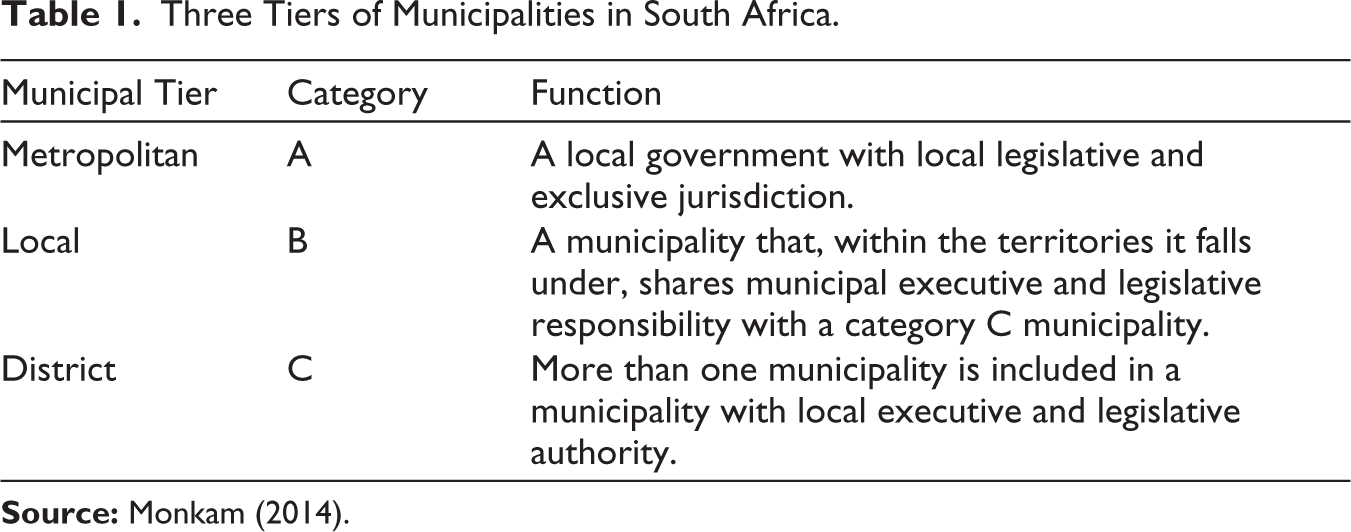
Hence, producing two spate spheres of sub-national governments in South Africa. Nevertheless, as stated in the Constitution, these spheres of government are distinctive, interdependent and interrelated. In a similar vein, after the adoption of the Constitution in 1996 and the Local Municipal Government Structures Act 1998, local government structures (see Table 1) in South Africa were divided into three tiers.
Three Tiers of Municipalities in South Africa.
While the categorisation of municipalities was driven to make government and service delivery more responsive to the people, this does not entail that the ANC inherited a sufficient state. When the ANC assumed power in 1994, it inherited a country in dire challenges. Mosala and Venter (2017) conceded that the first administration inherited uneven local authorities across the country. This is because some were formed to serve a particular race class (some for whites and others for blacks) and others for mixed origin and individuals of national descent. The so-called homelands and Bantustan government had previously administered some. Transform such structures that the ANC inherited required extensive and robust political choices, administrative restructuring and reconsidering the role of the local sphere of government in the new political dispensation.
To adequately address the needs of various communities, the government was overwhelmingly overburdened with legislation evaluations, which caused numerous difficulties during the early years of democratic political leadership. Numerous service-related activities, including but not limited to policy formulation, addressing everyone’s fundamental requirements, clearing the backlog in physical infrastructure, establishing social security and enacting policy relief measures, needed to be updated or launched. According to Thornhill (2008), local government was given a wide range of responsibilities and authority to reshape the post-apartheid period. Some of these difficulties were to be addressed by the local government. Through the duties and authority entrusted to them by the Constitution (articles 156 and 229). which were:
The authority to manage the local affairs that the Constitution entrusts to it (Schedules 4(B) and 5(B)). The power to create and implement by-laws for the efficient management of the affairs entrusted to it, as well as the ability to set rates, taxes and surcharges for services rendered by or on behalf of the municipality. May create and adopt strategies, plans and policies to encourage the implementation of service delivery projects and To carry out any other task within its legislative and executive purview.
Hence, one may deduce that a municipality remains responsible for core services such as water provision, electricity distribution, refuse removal and sanitation. Accordingly, we may classify local government as a territorial, non-sovereign community possessing the legal right and the necessary organisation to regulate its affairs. In this instance, the main objectives of local government are to:
Give local communities access to democratic and accountable government. To guarantee the sustainable delivery of services to communities. To encourage social and economic growth. To stimulate the creation of a secure and healthy environment and To promote community engagement in local government issues.
Although society aspires to significant environmental changes for the general populace to live a better life and be subjected to needed services, municipalities (particularly post-1994) have increasingly become under severe pressure to respond to the ever-increasing demands at the local government level. Cameron (2022) adds that in post-1994, the South African government introduced significant reforms to drive and champion the issue of better service delivery in all corners of the country, thus trying to shackle the shackles of apartheid. The state’s acceptance also drove such that access to better service delivery was not a thing to benefit a few individuals in a post-apartheid state, and individuals who were previously exploited and marginalised had the right to essential service delivery. A transitional period of transformation in South Africa began with the first local government elections and continued for five years (1995–2000).
The creation of transitional municipalities during this era was a defining feature; these municipalities started to match their financial and service delivery borders with constitutional boundaries (Binza 2005). Through various development-driven policies over the last 29 years from national to the provincial government, South Africa has continued to be seen as a developmental state to some observers, generally driven by the notion that it is a state that continues to enhance its public administration doctrine and promotes social development (Maserumule 2007; Palmer et al. 2017; Tshishonga and De Vries 2011). It can (a) serve as a training ground for every political education (advance political leadership) and (b) drive government accountability. Is it this instance that the role of local government from the first administration has been projected and determined on the basis that local government is a fundamental aspect of democratisation and the acceleration of mass participation in the decision-making process. It further argues that no political system is viewed as complete and democratic if it does not possess a local government system, and some of the following viewpoints have driven this.
Furthermore, the role of local government continues to constitute a significant part of public administration, meaning it ought to excel in providing public services. A robust state capacity is a distinguishing feature of a developmental state and is achieved through creating an inexpensive, efficient and effective public service. The socio-economic demands of the entire population, particularly the poor, the marginalised and the historically disadvantaged must be met if a state is to integrate the dual economy successfully (Koma 2010). In any country globally, local government is a pivotal part of the reconstruction and development-driven initiatives. The aim of any state in democratising its society and growing it can only be achieved via a responsive, accountable and effective local government system that forms part of a developmental state. Post 1994, establishing a South African development state is manifested in the vision of the state and society working hand in hand at all levels to achieve social justice, economic growth and development. Thus, developmental local government is critical in building a developmental state (Palmer et al. 2017). However, to achieve these objectives, an ideal municipality should follow and possess some of the following elements:
Give local communities access to democratic and accountable government. Should be in charge of meeting community needs. Ensure that services are sustainably delivered to communities. Encourage social and economic growth. Promote a secure and wholesome environment. Encourage participation in local government issues from communities and community organisations. Encourage the personnel to adopt a culture of accountability and public service and Clearly define who oversees and coordinates these organisational structures.
Drawing from the above viewpoints, a local government must be developmental, taking into consideration that the much-anticipated transformation into a fully pledged and non-racial institutions of governance propelled by a legacy of an urban economic logic that favoured urban areas at the cost of black urban and peri-urban areas. However, this also made it possible for local government, the branch of government closest to the people, to promote democracy and local community socio-economic development vigorously. Since the first administration, local governments in South Africa have been propelled by a constitutional mandate and development commitment to building integrated, economically and socially resilient communities.
This is because, as stated by Mashamaite and Lethoko (2018), from a global perspective, changes in government policy and the abdication of responsibility have given local governments a developmental mandate driven by critical factors like rising inequality, poverty, unemployment rates, the provision of essential services, globalisation and technological advancements, which have allowed municipalities also to change their planning. This is why, from a South African perspective, local government is viewed as a distinctive and autonomous spectrum of government and was also rendered specific powers and functions that were unique and appropriate to the lowest sphere of government to the state. However, this is notwithstanding that local government is also constitutionally protected, and their functions and powers are not absolute and subject to constitutional and national legislative requirements.
It is crucial to consider a few minor underlying concepts before delving into the numerous substantive and procedural requirements relating to the roles and responsibilities of crucial local government actors, such as the municipal council. In essence, since 2000, all local government entities have been required to execute their authority in a way that meets necessary goals and fulfils their developmental responsibilities. Essentially, these served as the primary justification for establishing the local government. Despite having some rights and responsibilities, local governments ultimately exercise them under the control of the national and provincial governments; the Constitution also establishes the framework for their practices (Bekink 2006).
There are various reasons over the last two decades, and significant observations have been taken to robustly examine the roles of local government and the way such functions are carried out. These are made up of the following:
Changes in social and political structures. Financial planning and resource limitations. A failure to respond to public requests. Ineffective policy programmes (caused by a lack of service delivery). The requirement to compete in the international economy and Propensities for bureaucracy.
According to Monkom (2014) and Masegare and Ngoepe (2018), enhancing South Africans’ socio-economic circumstances, often referred to as a developmental mandate, was the driving force behind the establishment of local governments after 1994. This is because local government is in charge of delivering much-needed services and enhancing economic growth and development. To create and identify a new decentralised democratic, progressive local government model that would be responsive to the needs of all South Africans (unlike the ones used during apartheid), local government was transformed. The local government of South Africa consists of diverse municipalities (in terms of structure) ranging from metropolitan, district and local, ranging from severely underpopulated rural to well-resourced urban municipalities in terms of population and resources. Similarly, and drawing from this, South Africa remains one of the world’s most unequal societies regarding wealth disparity.
Although the local level of service delivery has been largely accomplished, the developmental mandate of local government, as outlined in the White Paper, goes considerably further than the provision of fundamental services. As a result, during the past two and a half decades, local government has been driven by three crucial and mutually reliant constituencies. They include (a) defining goals, (b) accurately and precisely allocating tasks, responsibilities and resources to particular units or municipal categories and (c) creating performance indicators and output metrics that can be used to assess the success of achieving development goals.
Poor Governance at the Local Government Level: Symptoms and Effects
Breakfast et al. (2019) noted that apartheid brought many governance challenges. Until today, questions still arise about how South Africa transformed itself from a dictatorial apartheid system to a democratic state driven by a respected constitution. From a state that had severe apartheid-driven challenges during the reign of the NP until 1994, the ushering of the late Mandela administration in 1994, the restructuring of South Africa’s political governance domain was welcomed by many observers. While significant strides have been gained in South Africa’s 29-year-old democratic history, particularly from a local government point of view, significant hindrances have also faced local government over the years.
According to Landsberg (2004), the transition from apartheid to democracy on the African continent is still considered a significant historical event; however, since the democratic era, considerable problems have accelerated. At the local government level, South Africa’s transition from a racist and unequal state to a constitutional democracy built on freedom, dignity and equality is nevertheless fraught with difficulty. The stark disparities in wealth, physical infrastructure, and the delivery of essential services are constantly present and frequently most apparent. As a result of the severe obstacles that apartheid’s lasting legacy presents to local administration, some of the divisions under apartheid have persisted under democratic governance. Since the advent of the new democratic local government system of governance in 2000, local government has, in many cases, made a substantial contribution to realising several social and economic advancements post-apartheid. Currently, Local Economic Development provides services and economic possibilities to most communities (Rogerson 2010).
Despite these advancements, local government still faces numerous difficulties while developing service delivery procedures. These difficulties include but are not limited to, the need for policy recognition, a lack of technical and financial resources, economic collapse, a lack of high-quality services and poverty. Many South African communities continue to face development obstacles. Due to this, most South Africans, particularly those who live in rural regions, remain dissatisfied with the standard and lack of vital service delivery accomplishments. Due to this, throughout the past 10 years, there have been problems with the provision of public services, authoritarian government, political decisions and ineffective governance (Netswera 2014; Wasserman et al. 2018). These have primarily been influenced by the precarious situation in South Africa, which is directly related to the current administration’s failure to deliver basic amenities like water, electricity, housing, good roads and sanitation. These occasionally occur, although not always due to the delayed service delivery pace; instead, they can result from the subpar quality of the necessary services. Therefore, ongoing complaints about corruption, nepotism, dishonesty, inaction on the part of the administration, poverty and rising inequality have only exacerbated this. Again, some of these concerns include, among others:
Most South African municipalities face increased responsibilities due to the rapid population growth and the fact that most problems are assigned or delegated to them. Some of the municipal functions are vaguely defined, particularly where services are vertically integrated or shared and In some instances, municipalities are often ignored when the higher spheres of government make decisions.
Because of this, some local government scholars (Allan and Heese 2011; Mamokhere 2019; Twala 2014) have noted that social protests in developing economies are fundamentally common because of the government’s ongoing inaction and the lack of responsibility displayed by those holding important positions in local government. Thus, it can be concluded that most community protests in South Africa are motivated by unfulfilled promises.
According to some academics, people’s experiences of inequality and reductive deprivation rather than poverty fuel service delivery demonstrations in South Africa. When compared to the opportunities and quality of life in wealthier regions, millions of South Africans continue to be unsatisfied with their lot in life. Service delivery protests cost South Africa’s economy money, just like elsewhere (Botes 2018). For instance, Mashamaite and Lethoko (2018) attest that a lack of resources can also cause this lack of capacity, as well as rapid globalisation, urbanisation, technological advancement and the environment, becoming more and more competitive globally.
A lack of poor service delivery frequently results from some municipalities’ failure to uphold their obligations as outlined in the Constitution and other local government legislations. The ineffective execution of these laws causes the lingering effects of local governments run by autocrats and bureaucrats under apartheid, a lack of administrative ability, and a lack of coordination. Others include the issue of cadre deployment and limited administrative capability paired with undertrained civil officials (Tshishonga 2021). Excellent leadership is necessary for any organisation to run efficiently since it translates to excellent governance both strategically (concerning an entity’s aims and objectives) and ethically (exemplifying moral solid principles) and taking proactive measures to address mismanagement issues.
Reviewing the Legal and Constitutional Frameworks for Local Government
Constitution of the Republic of South Africa
The South African Constitution is still highly recognised internationally as one of the most progressive. The constitutional court adopted the Constitution on 4 December 1996, and it came into force on 7 February 1997. No other legislation or government action can replace the Constitution’s provisions anywhere in the world, making it the ultimate law of the land. According to Section 152 of the Constitution, local governments must sustainably provide communities with fundamental services and a democratic and accountable form of local government. Additionally, it stimulates the participation of communities and community organisations in local government development activities and supports social and economic development. The notion of developmental local government was initiated through the Constitution (Jitsing et al. 2019). If an act conflicts with the Constitution, it must be considered decisive.
A Constitution outlines the organisational principles used by the various branches of government. It establishes the scope of the powers granted to each branch of government and the procedures for reviewing those powers (Hungwe 2017). As a result, the Constitution specifies the developmental obligations of all South African municipalities, including organising and administering its administration, budgeting and planning procedures to give the community’s fundamental requirements priority while fostering the community’s social and economic development. Moreover, to take part in regional and national development programmes. However, this cannot be accomplished without the continuing assistance and collaboration of the national and provincial governments (Koma 2012). The elevation of local government to a separate government sector, firmly establishing local government authority, was one of the significant developments in the constitutions adopted in 1996.
This meant a municipality was given the authority to control its initiatives and the neighbourhood’s local government activities. This also meant that while the national and provincial governments might oversee local government’s daily operations, they should not do so at the expense of the municipality’s institutional integrity. The division of municipalities into three clusters metropolitan, district and local, as already mentioned in this article, is motivated by the fact that other services are provided on a bigger scale due to economies of scale. The South African Constitution sets forth the authorities and duties these municipalities must exercise and carry out to carry out their missions. It establishes local government structures that will oversee each municipality’s functioning and the entire sphere of government (Magagula et al. 2019). Chapter seven of the Constitution stipulates the following regarding the status of municipalities:
Municipalities are the unit of local governance, and they must be developed across the nation. A municipality’s municipal council is in charge of both the executive and legislative branches. By the provisions of the Constitution, a municipality has the power to control the local government issues of its community on its initiative. The ability or right of a municipality to exercise its rights or fulfil its duties may not be compromised or interfered with by the national or provincial government.
Municipal Finance Management Act 2003 (Act 56 of 2003)
Post the apartheid era, the financial management for most government entities has become a fundamental and pivotal doctrine to make government entities account for how they utilise their finance to the public and other government stakeholders. The act aims to ensure sound and sustainable financial management in municipalities and further deepen the budgeting process in municipalities. It is crucial to the act to ensure that municipalities adhere to and follow proper guidelines and procedures when handling their finances and repository thereof to various government structures.
One cornerstone of these reforms was implementing the Municipal Finance Management Act (MFMA) 56 of 2003, which became effective in July 2004. The act aims to modernise budget, accounting and financial management practices by placing local government finances on a sustainable footing to maximise other municipalities’ capacity to deliver services to communities. The power of any municipality is critical to ensure that the institution is functional and able to deliver its mandate of delivering services to any community. This (capacity), a tangible workforce (human, financial, material or technological) and the acquaintance to implement policies that benefit the public is essential.
Hence, the need and importance of the MFMA are to avoid waste and ensure efficient and transparent governance. Thus, it is one piece of legislation that enforces public consultation regarding budgeting in the local sphere of government. Nevertheless, in some municipalities in South Africa, implementing the act is challenging, driven mainly by corruption and poor managerial oversight. Magwasha (2018) asserts that the act replaces previous legislation in the local government sphere that never considered communities’ views regarding municipal budgeting and consultation processes. Section 34 of the MFMA calls for cooperation in all spheres of government and indicates that, upon reaching an agreement, provincial and national governments must assist in building the capacity of municipalities to ensure that financial management in municipalities is effective, efficient and transparent. Poor financial systems also drove such; poor repository mechanisms, lack of proper budgeting protocols, poor revenue collection systems and mismanagement of funds have rocked post-1994 most municipalities in South Africa.
These exacerbate mandates for inefficient service delivery. The MFMA provides for regulating and overseeing municipalities’ financial operations to lessen some of these difficulties. With the advent of the MFMA, national and provincial treasuries are now required to play an active role in regulating and monitoring the financial affairs of municipalities (Kakaza 2006). Previously, the provincial department of local government was responsible for overseeing the general affairs of municipalities.
Promotion of Access to Information Act 2000 (Act 20 of 2000)
The need for the government to firmly strengthen protocols to thwart and combat corruption, to provide for the offence of corruption and offences linked to corruption activities, is what motivated the creation of this act (which went into force in 2004). Additionally, it is to provide for extraterritorial jurisdiction over corruption offences, investigative measures relating to corruption and matters related in addition to those.
Act 12 of 2004s Prevention of Combating Corruption makes it illegal to engage in corrupt practices. It creates a register to impose restrictions on people and businesses guilty of corrupt behaviour. These could be connected to bids and contracts, and they mandate that certain people in positions of responsibility report corrupt behaviour (Munzhedzi 2016). The act is the primary legislation guiding South Africa’s efforts to prevent and combat corruption and bribery. Organisations with headquarters in South Africa are covered, as are those headquartered elsewhere that conduct business there. All organisations’ governing bodies manage risks, prevent corruption and adhere to national and international laws, regulations and standards.
The general offence of corruption under the act is giving or offering to give someone in a position of power gratification to act in a particular manner. This gratification can be money, a donation, a vote, a service or a favour, employment etc. Access to information is a human right and essential for exercising various other fundamental rights. It is vital for civil and political rights and any democratic participation in society. Hence, the right to access information helps achieve what is generally referred to as good governance and promotes third-generation rights such as the socio-economic right established by the Constitution (Roling 2014).
Municipal Structures Act 1998 (Act No. 117 of 1998)
According to Baatjies (2008), the overriding of the act mandates that municipalities make provisions for establishing municipalities under statutory requirements relating to the types and categories of a municipality. A municipality has the duties and authority outlined in Sections 156 and 239 of the Constitution, according to Section 83 of the act. The broad legislative and executive powers of a municipality concerning local government subjects stated in Schedules 5 and 6 part B are covered by Section 156 of the Constitution. The ability of a municipality to manage matters included in part B of those schedules delegated to it by the federal and provincial governments is also mentioned in this section. Section 229 concerns a municipality’s power to impose rates, fees, taxes and other duties. The act was based on the constitutional recognition of local government as a distinctive sphere of government that is interdependent and interrelated with national and provincial government spheres. The act offers an alternative system of government that is far more geared towards cooperation between political parties and service delivery.
Municipal Systems Act (Act 32 of 2000)
The preamble to the local government, Municipal Systems Act 2000 (Act 32 of 2000), refers to the involvement of communities in local government affairs because it is a crucial component that drives interactions between the government and people. This relates to performance management, service delivery and planning (Mabaso 2019). The legislation outlines the concepts, procedures and mechanisms to support local communities’ social and economic growth to provide developmental local government. It also establishes a framework for planning, performance management, resource mobilisation and organisational change while guaranteeing everyone access to affordable services. Hence, Section 21 of the act outlines the importance of developing values for community participation mechanisms and procedures concerning community participation, public notice of council meetings and communication between the council and the local community. All these are principles of developmental local government in a democratic and developmental state.
The Way Forward: What Needed Amendments
Most residents’ interactions with the government occur at the local level, which serves as the primary delivery point. Despite this, the South African government unveiled the National Development Plan (NDP) in 2011 as a framework for development with a 2030 expiration date to address the socio-economic issues many South African communities face. The text also admits that, among other things, the local government’s function as one of the government sectors should be a priority for South Africa to address some of its issues.
These include increasing public service and local government as desirable vocations, stabilising the political-administrative interface and strengthening ties between the three realms of government. For instance, the NDP identifies community involvement in providing a safe environment as a critical component. Municipalities should encourage socio-economic growth as well. This suggests that towns and cities, as societal entities, ought to support a framework that enables all residents to advance both socially and economically. Municipal development initiatives often accomplish this to ensure resident empowerment (Madumo 2017).
One cannot deny that since 1994, much has been accomplished in strengthening South Africa’s local governance. To allow communities to engage with the government, a decentralised local government system has been established and is further affirmed in the Constitution as a unique, autonomous and interconnected realm of government. The government’s top goal over the past 29 years has been providing for the basic requirements of people, especially those who are poor, to meet the development needs of millions of South Africans since 1994, especially the formerly marginalised population. This has been critical to the government’s efforts to redistribute wealth and end poverty.
Although the government made efforts to ensure that all households had access to the minimum standard of every basic service (water, sanitation, refuse removal, housing, sport and recreation, education, health services, transport and good road infrastructure) by the year 2014, this has not been the case in the majority of marginalised communities over the past 29 years. Thus, while much has been gained in South Africa’s young democratic history and with the growing population, inequality and unemployment, much must be done to realise the government’s developmental blueprints (Cogta 2009). Most South African municipalities continue to be riddled with challenges and institutional capacity, further undermining the local government’s sustainability and leading to a breakdown of services.
Thus, continued service delivery protests reflect many South Africans’ frustrations and generate a negative narrative and perception of municipalities. To divert some of these challenges, municipalities should:
Put the needs of communities first and ensure adequate public participation platforms to render trust and confidence. Deliver municipal services of the required standard. Stimulate the element of good governance and administration. Ensure sound financial management and accounting and Build and maintain sound institutional and administration capabilities.
Creating an efficient public service should primarily be understood regarding how well it can deliver to the public. Nevertheless, since the delivery of services can be complicated by many other factors that are out of government control, much of the need and focus should dwell on getting government structures to function first. This is because most of the local government’s problems are well documented, but some are difficult to address quickly. Some may only be addressed in the end and require proper planning and large budgets. However, putting sound management policies in place is also of utmost importance. This entails enforcing compliance with legislation by implementing it daily, holding people accountable for their performance and actions, and encouraging and supporting proactive audit committees and internal audit units.
Beyond the local elections, political candidates must carry out their duties of responsible leadership and efficient service provision. These should be the main initiatives that propel and energise local government ahead and are backed by various creative approaches (PSA 2015). Implementing and maintaining a solid politico-administrative diving wall and categorically avoiding any conflicts of interest is essential to addressing the problems caused by politicisation. A national implementation framework for professionalising the public service, which offers valuable guidelines to help develop competent civil servants with the necessary skills to sharpen administration and governance, was recently published to address this issue (Mbanyele 2021).
Conclusion
This article aimed to ponder the constitutional and legislative framework for the local sphere of government in South Africa through an analytical and interpretive perspective. It intended to ponder if (a) the quality of governance at the local level impacts service delivery and (b) what should local government should do better for effective service delivery to the people. Since 1994, significant strides have been made by the local sphere of government with both successes and failures since South Africa’s legal and policy framework from 1993 to 2000 through changes in legislation, proclamations, white papers and by-laws.
However, the elements of bad governance since 1994 have created a loss of confidence and service delivery hindrances in South African local government. Much of the population, especially the previously marginalised, face inadequate health services, unclean water and poorly maintained infrastructure and housing because some state institutions have become paralysed due to corruption and maladministration. The foundation from which this article moved was that the quality of governance at the local government level directly impacts service delivery and is, therefore, critical to understanding some of the constitutional and legislative underpinnings driving local government. Municipalities should ensure that all actions and conducts comply with the statutes (acts of parliament, legislations and laws) and regulatory documents (white papers, official rules and regulations and by-laws) to local government.
The above is drawn from the fact that, after the transition from apartheid to democracy, the South African government and local government, in particular, faced (and still do) significant hurdles to altering past challenges (apartheid) and creating a sense of belonging.
Hence, adopting the Constitution further provided robust protocols to push South Africa to be a developmental state through various constitutional and legislative frameworks. While these became imperative for the new government, over the past two and a half decades, local government has also been subject to numerous challenges, which have both in the short and long run affected the much-needed development at the local government level as stipulated in various policy document and importantly the NDP. The article proposes that political bearers consider local government-driven constitutional mandates for efficient development at the grassroots level and align to other legislative frameworks for an effective, sound, transparent and trusted government sphere closest to the people.
Footnotes
Acknowledgements
The National Institute for the Humanities and Social Sciences (NIHSS) is gratefully acknowledged by the authors for its financial assistance.
Declaration of Conflicting Interests
The authors declared no potential conflicts of interest with respect to the research, authorship and/or publication of this article.
Funding
The authors received financial support from The National Institute for the Humanities and Social Sciences (NIHSS).