




Abstract
The article examines Africa’s struggle with corruption in a post-colonial era with specific reference to South Africa. The article conceptualises the Afrocentric appraisal approach to reflect on the corruption challenges in post-colonial Africa. The article demonstrates that even though most African countries have adopted democratic systems of governance, nothing has changed, as the post-colonial leader has used the same tactics used by colonialism to maintain control, force, tyranny and oppression. Even though liberation movements in Africa were seen as heroes in the struggle for freedom, they, in turn, have become a burden to Africa’s development through increased corruption, breakdown in governance, political instability and the failure to consolidate a shared vision for Africa’s development. This observation has also been observed in South Africa. Narrowing this to South Africa, corruption has been a widespread phenomenon, predominantly post the democratic era. Over the years and until recently, the African National Congress-led government has been severely hindered by immense allegations of corruption among those top of the hierarchy. In the eyes of most academics, researchers and analysts, this has further hindered the need for inclusive development in a country faced with high numbers of escalating unemployment, inequality, poverty and crime. Driven by institutional theory, this article critically delves into corruption from an Afrocentric viewpoint, albeit focusing on South Africa’s post-democratic era.
Introduction
Within the African political discourse and predominantly post-colonial era (besides other socio-economic challenges), one of the most discussed issues has undeniably been rampant corruption or, as some scholars put it, public sector looting. This is even though corruption is witnessed globally in the public and private sectors. Private sector corruption is generally under-represented in corruption literature (particularly in post-colonial Africa) as opposed to public sector corruption. Corruption in the private sector takes different forms. Still, it occurs in varying levels of corporate activity in spheres of influence within the company, supply chain, comprehensive business operation and societal surroundings. Private sector corruption erodes economic development and investment, including unfair competition, inflated costs and impact on societal surroundings (UNODC n.d.). Nonetheless, the consensus among many observers is that it has been wrong and has continued to create considerable damage to Africa’s quest for development and regional integration (Mlambo 2018). In this vein, corruption in Africa is often observed as causative to Africa’s internal problems of political instability, economic stagnation, poverty, social unrest and institutional failure, which have been witnessed in many countries post the colonial era (Apata 2019).
Musila (2019) draws attention to the fact that the consequences of corruption concerning the quality of life continue to be the focus of intensive research activity from various disciplines inter alia development studies and other cognate studies disciplines such as political science, international relations, public administration and public policy. Estimates from the African Union (AU) show that about a quarter of the Gross Domestic Product of African states (approximately US$500 billion in 2017) was lost through corruption. This capital would have been spent on essential and much-needed services such as education, healthcare and housing, which continue to evade many African individuals.
From the above, corruption in Africa has been a formidable hindrance to Africa’s lack of trust in public services for years. Thus, it has eroded the public service recognised principles such as equality, merit, neutrality, representativeness and accountability. As most African states are presently suffering from low levels of economic growth, the cost(s) of corruption can be very devastating, which leads to the inefficient allocation of scarce resources. By narrowing this down to South Africa, post the democratic era, corruption has continued to be a widespread phenomenon where some of the top brass of the African National Congress (ANC) led the government to have been embroiled in corruption-related offences at the expense of the general populace (Ayee 2002; Luiz and Stewart 2014). One may deduce that the elements of neo-patrimonialism are at play in modern corruption drivers in most African post-colonial states from a top-down approach in most organisations and institutions. This political regime is based on the personal use of one or a party of public resources and civil servants’ preferential (instead of meritocratic) appointments. This could be interpreted as manifest corrupt practices and unlawful behaviour. This further undermines the core value of any organisation or institution in that some individuals who have political connections or those that possess power abuse their positions and resources. This has made some people supplant the role of inherited colonial institutions to benefit a few individuals. This has been a common practice in most African states, albeit to different degrees.
This article aims to develop an understanding of the contextual significance of corruption for Africa’s economic growth, albeit with a focus on South Africa. Musila (2019) rightfully posits that to draw a nuanced evaluation, understanding the determinants of corruption is fundamental to developing a successful anti-corruption framework. The remainder of the article after this introduction is structured as follows: the second section examines the state of corruption in Africa, and the third section presents (concisely) the transition from apartheid to democracy and the detergents of corruption in South Africa post-1994. The fourth section outlines a brief review of what measures can be put in place to tackle corruption, and the article’s conclusion is presented in the fifth section.
The Post-colonial Corruption Pandemic: A Concise Afrocentric Appraisal
From an Afrocentric viewpoint and mainly post the colonial era. The emergence of debates, engagements and discussions about corruption necessitates us to critically examine the potential effects of this on Africa’s renewal. Indeed and in Africa, corruption within the state or institutional corruption has long been recognised as a challenge for developing and transitioning countries (see Godinho and Hermanus 2018). Any state plagued with corruption cannot build its citizens to the fullest potential. Consequently, corruption, like good governance and transparency, thus affects all facets of a country’s economy, society and polity, leading to underdevelopment (Momoh 2016). In his 1957 inaugural address to the newly independent state of Ghana, Kwame Nkrumah noted corruption as something that would harm the continent from freedom and justice. Three years later, when Tanganyika (now Tanzania) was edging closer to attaining political independence, Julias Nyerere shared the same sentiments and articulated that Tanzania, which was already suffering from poverty and other socio-economic ills, risked adding another enemy, corruption.
Mlambo (2019a, 2019b) is of the view that in Africa, corruption is neither new nor a peculiar phenomenon; however, as evidence has shown, post the colonial era, it has continued to undermine development, and it is worth noting that its consequences are more deleterious on most fragile and depressed economies of many African countries to date. Since independence from their erstwhile European colonisers, most African heads of state have been exploiting public departments and government-run institutions (because of public resources at their disposal) to make themselves and their allies rich through exercising their political power(s), which is often driven by the logic of self-preservation. Owoye and Bissessap (2012) noted that most African states performed relatively well from the early post-independence years but failed in the 1980s. This has been credited to promptly expanding external debts, ethnic violence, civil unrest, coups, immense bureaucratic corruption and administrative inefficiency.
As Ayee (2002) submits, the causes of corruption in Africa are numerous and complex. As a result, diverse reasons have often emerged as contributing to the flourishing of corruption in the continent. Some have pointed out that low wages drive corruption, some African heads of state are corrupt, and public servants tend to do the same. African leaders post the colonial era were mainly black elites, some of whom had acquired their education in Europe or the United States of America. When they assumed power, elections were held in some countries; however, in others, European colonisers handed power to those whom they perceived would (moving forward) serve their interests (Mughwai 2010).
In this regard, Yeh (2011) argues that corruption in Africa has its roots in colonial practices and has been intensely ingrained as a self-reinforcing and self-perpetuating institution, which has essentially captured government institutions post the colonial era. Colonial masters dismantled traditional checks and balances to centralise power for their benefit(s). The colonial education system shaped several colonial chiefs, colonial appointees and other elites. In this regard, these colonial chiefs became familiarised with the exercise of absolute rule with no judicial restriction as long as they had the full backing of the colonial master(s). Such colonial practices institutionalised favouritism, dictatorial regime and self-aggrandised, fundamentally training African elites in favouritism, personal enrichment and unrestrained power. During the colonial period, vital institutions that should have acted as corruption watchdogs, such as the police, judiciary, the rule of law, and security services, selectively served the interests of the elite classes (Gumede 2012).
Hence, after independence, the power transfer to African leaders brought disastrous results. Fundamentally, it brought the sense that they could utilise their combined economic and political power to shift economic activity, reward political allies, enrich themselves, crush opposition individuals and punish political rivals. In this vein, the centralisation of economic and political power turns the state into a port of gold where various groups compete for the loot. Indeed, after the demise of colonialism, African heads of state stepped into the shoes of their former colonisers, inheriting the institutions of alienation and often behaving in ways not too different from these European colonisers. It has often been articulated that the change in leadership was merely a change in guard because the new African leaders rapidly began to misuse public assets (Timamy 2005).
Harkness (2018) argues that Africa has witnessed enormous politically driven challenges in the last five decades ranging from civil war, dictatorship rule, 1 apartheid in South Africa, ethnic cleansing, military rule and a range of abuse of power by some African elites. As economics and politics are intimate, political instability 2 in many African states, such as the Democratic Republic of Congo (DRC), Mali, Nigeria, Somalia, South Sudan, Lesotho and Zimbabwe, has had vital socio-economic implications on their already fragile economies (Ejiogu 2011). Nevertheless, not all African leaders are corrupt or possess ill intentions. Undeniably, to some, the quality of leadership offered by former leaders such as Ghana’s Kwame Nkrumah, Julius Nyerere of Tanzania, and South Africa’s Nelson Mandela speaks for itself to anyone who follows African politics since the post-colonial era. These leaders led the fight for their respective countries and robustly worked to rebuild Africa as a whole and preserve Africa’s renewed image.
Conversely, some African leaders like the late Mobuto Sese Soko of Zaire (now DRC) are believed to have looted millions of US dollars from his tenure as head of state and ran his country like his property. Again, former Zambian president Frederick Chiluba was tried for stealing millions of dollars from Zambian taxpayers. However, these charges were later dropped under mysterious conditions. Others have included and are not limited to Equatorial New Guinea’s Teodoro Obiang Nguema Mbasogo, former Sudan president Al-Bashir, South Africa’s former president Jacob Zuma and Chad’s Idriss Deby. To such leaders, since relinquishing power may mean imprisonment and confiscation of property and wealth, some have refused to vacate office or share political power. Again, those refused power or another presidential term resort to violence despite the country’s Constitution; such tendencies tend to disrupt democracy and accountability in any state (Yeh 2011). Because of this, over the last few years, there has been a growing trend in the attention paid to corruption, as often measured by various international and continental organisations such as Transparency International, the World Bank, the AU and the Mo Ibrahim Foundation. To Ayee (2002), the dire negative side of corruption is that it brings with it some of the following social ills:
Alters social and economic development Erodes public trust and confidence in the public service leading to its loss of legitimacy Endangers wrong decision making Stimulates bribery Hinders administrative development and performance It affects political stability and Threatens the elements of good governance
For African states to act on corruption, pressure has been twofold. First, internally, through the emergence of pro-democracy forces, which since the 1990s have continuously debated how to steer more openness, transparency and accountability on the part of the government. Second, over the years, international institutions and foreign donors have made significant (albeit not consistently successful) strides in combating corruption in the continent. Fighting corruption in many African countries is a daunting task because of poor oversight mechanisms coupled with institutions of governance lacking checks and balances. In the same vein, Fagbadebo (2019) emphasises that African leaders lack the required political will to fight corruption despite the availability of many protocols, such as the Southern African Development Community Protocol Against Corruption (2001) and the African Union Convention on Preventing and Combating Corruption (AUCPCC 2003). However, these have failed to spearhead the culture of accountability and transparency that leads to good governance. Another impediment to combating corruption in Africa is discretionary anti-corruption laws; most anti-corruption laws in African states like Nigeria, Kenya and South Africa grant immunities to some political leaders by making the procedure of prosecuting them dubious when found guilty of corruption charges difficult.
Again, the limited autonomy given to anti-corruption agencies in some African states such as Nigeria, Kenya, Malawi, Zimbabwe, Liberia and Guinea, among others, to effectively combat corruption has, over the years, posed a severe threat to the smooth functioning of these institutions 3 (Momoh 2016). For instance, February (2019) believes that the creation of some anti-corruption bodies has resulted in corrupt bureaucratic bodies possessing limited accountability and broad discretionary powers that are often abused; these are embroiled in political intrigues and have been beholden to political interests.
Liberation Movements in Post-colonial Africa: Development or Ruse?
During the height of the decolonisation period (1945–1960), African liberation movements became a source of hope for many who were discriminated against, segregated and exposed to violence by the colonial regime. Arguably, when Africa broke free from colonialism, there was hope that the post-African colonial state would be built on values of Pan-Africanism, Ubuntu and African Solidarity, where Africans would play a constructive role in the continent’s socio-economic and political development. Despite this newfound freedom, while the role of liberation movements in the struggle for freedom cannot be downplayed, however, to a great extent, they have not lived up to the expectations of consolidating socio-economic development (Vaudran 2017). Reinforcing this assertion, Wa Muiu (2010) asserted that nothing has changed since colonialism. Instead, the post-colonial state was ‘post’ in name only. It retained all colonial institutions. Except for those who benefited directly from the new state, the post-colonial state inherited the mistrust, fear and hate that most of the people felt towards the colonial state as a foreign entity that was imposed on them. Thus, this assertion questions the role of liberation movements in Africa’s post-colonial development. In Southern Africa, liberation movements span across the region from the ANC (South Africa), Southwest African People’s Organisation (Namibia), the People’s Movement for the Liberation of Angola, the Zimbabwe African National Union-Patriotic Front (ZANU-PF) and the Botswana Democratic Party (BDP) have all since Africa’s struggle for freedom consolidated their power (Vandone 2019).
Arguments have been that liberation movements have failed to evolve and keep up-to-date with the ever-changing socio-economic environment and still use colonial-era methods to maintain control. Nevertheless, even though the liberation movement’s core was to free Africa from colonial chains, today, these movements have adopted the need to empower institutions, actively promote a culture of accountability and transparency within their party ranks and pursue economic reforms (Vandone 2019). The post-colonial leader who emerged from colonialism has become brutal as those they had deposed (Gathara 2019). Former Democratic Alliance (DA) leader Mmusi Maimane articulated that first there was unjust and exploitative colonialism, then came elected democratic governments, and then after followed years, even decades, of oppression by the very same people who were meant to deliver freedom. Building on these insights, after independence, most black African countries entered a new era called Black imperialism (Ayittey 2006). Black imperialism is African exploitation by Africans, usually by top government officials, businessmen and women. Three decades after independence, the freedom and justice many people sacrificed their lives for have been replaced by tyranny, oppression and corruption. Today, many Africans view liberation movements as an extension of the colonial oppressors.
South Africa’s socio-economic decline since the post-2008 financial crisis has cast doubt on the ANC’s ability to lead South Africans into socio-economic prosperity. Increasing rates of corruption, the breakdown in service delivery, and cadre deployment have characterised a post-apartheid South Africa (Breakfast, Bradshaw and Nomarwayi 2019). For Gottschalk (2022), the problem with the ANC as a liberation movement is that it has failed in the fight against corruption by tolerating corrupt practices, failing to hold the corrupt to account, and going as far as to shield them. In his book titled ‘The Enemy Within’, Mpumelelo Mkhabela, as cited by Gottschalk (2022), argued that South Africa had a
toxic mix of old money, businessmen eager to win favours from politicians, and political leaders ready to tackle anyone who dared make corruption claims against the party. (Gottschalk, 2022)
African liberation movements’ organisational culture is so highly institutionalised that they replicate themselves in the governments they run, institutionalising the governments with the party’s organisational culture (Gumede 2022). Since 1994, South Africa has been run like a party-state, where the party was seen by its leaders and members as synonymous with the state, with the party deploying its cadres to every level of the government, state-owned entities, democratic institutions and as beneficiaries of government tenders (Gumede 2022). The ANC is weakening, driven by the notion that the ANC’s insistence on being a liberation movement is incompatible with a constitutional democracy (Zondi 2017). This article notes that despite the importance of liberation movements in Africa, for inclusive development to prevail, they ought to do away with ancient traditions such as leadership collective, consensus choice of leadership, revolution, comradeship, cadre deployment and patriarchal leadership patterns; this we argue is the case with South Africa and the ANC. Liberation movements arose in Southern Africa in the second half of the twentieth century to fight colonialism, apartheid and white minority rule, all sharing an African nationalism of socialist ideology. Most (including the ANC) remain in power, albeit slowly losing support in local and national elections due to the struggles of ending economic inequality and corruption (Crespo 2019).
Founded in 1912, the ANC is the oldest liberation movement in Africa that fought apartheid until the first-ever democratic elections in 1994 and has continued to be a dominant party in South African politics since then. Chindonga believes that political leaders have adopted the use of nativism to retain their histories, values and identity, as the African public discourse was determined by colonial masters during colonialism. Thus, post the colonial and apartheid eras, African states utilised nativism as a political mobilising tool to gain support and popularity further. Nativism has also been used as a populist strategy articulated to conceal the AANC’s shortcomings and enable them to connect with the broader rural-based section of the population. Indeed, in South Africa’s 29-year democratic rule, the ANCs majority support base has been and continues to be in rural areas and townships across South Africa (Mlambo 2019a, 2019b).
The Much-admired Transition Period from Apartheid to Democracy: South Africa and the Dawn of Post-democratic Corruption
Pretoria’s conversion from apartheid rule to a truly multi-racial democracy is, from a global perspective, one of the most pivotal political occurrences post the cold war era. Beall, Gelb and Hassim (2005) contend that the transition in South Africa forecasted to build a mutual future brought high hopes for advanced growth in South Africa and Africa at large. Sichel (2012) notes that, in South Africa, pre-1994, apartheid was a system formed by the National Party (NP) predominantly post the 1948 era and comprised of segregation and racial discrimination; concisely, it favoured white supremacy over all other races. Because of such policies, between 1960 and 1990, most political parties, including the ANC and other liberal movements opposed to apartheid, were banned from South Africa by the apartheid government.
In general, the democratic transition gained impetus when Nelson Mandela was released from prison in 1990 and when the ANC was unbanned by the apartheid government in the same year, which gave way to open dialogue between the ANC, NP, Inkatha Freedom Party and other third parties. In 1994, such negotiations bore fruit when Mr Nelson Mandela became the first black president of South Africa and (to ensure a smooth transition process) was deputised by Frederik W. de Klerk and Mr Thabo Mbeki (Habib 1995). According to February (2019), during its transition to democracy, safeguarding the state and society from corruption was a widely recognised objective of the system of governance that was being negotiated. With this transition underpinned by constitutional commitments to core values such as openness, transparency and responsiveness, the ANC-led government has grasped the moral high ground by publicly tackling corruption.
Post-1994, corruption in South Africa has been so widespread that many citizens view it as a normal aspect of life. It has become part of society and has been a burden to uproot. The problem is that some post-apartheid leaders (and their allies) have not led by example and have often talked about tackling corruption without seeing any significant results. When the ANC-led government assumed power in the historic 1994 general elections, a considerable hindrance that confronted it was amending the destabilisation policies of the apartheid regime driven by the NP as the new administration was democratic and legitimate (Mlambo 2017).
When the ANC came into power, its leaders inherited the trappings of state power left by the erstwhile apartheid regime, the bodyguards, state cars, free housing, luxury travels, free healthcare, and so on. Such further spearheaded dishonesty and non-accountability that destabilised all values underpinning the liberation struggle. Such a lifestyle change became a new notion of achievement and a sign that one has made it in life. Over the years, corruption has undermined the delivery of essential public services such as water, housing, healthcare, education, electricity, and so on. It has consistently diverted resources for millions of South Africans that could have been utilised for poverty alleviation and job opportunities (Gumede 2011; Hellsten 2019). Bruce (2014) expounds that in South Africa, a large percentage of the white population continues to enjoy a good standard of living, characterised by employment opportunities and owning property in suburban areas; however, on the other side, a large percentage of the black population continues to face a plethora of socio-economic ills. In this vein, corruption further erodes such conditions, diverting much-needed resources to those already in hardship.
Such undermines people’s trust in government, the credibility of the democratic system, and the rule of law. This has led to several (see Table 1) service delivery protests, which have, in one way or another, reflected the government’s failure across the local, provincial and national spheres to deliver essential and needed services efficiently and effectively to the people.
Recorded Service Delivery Protests in South Africa 2009–2019.
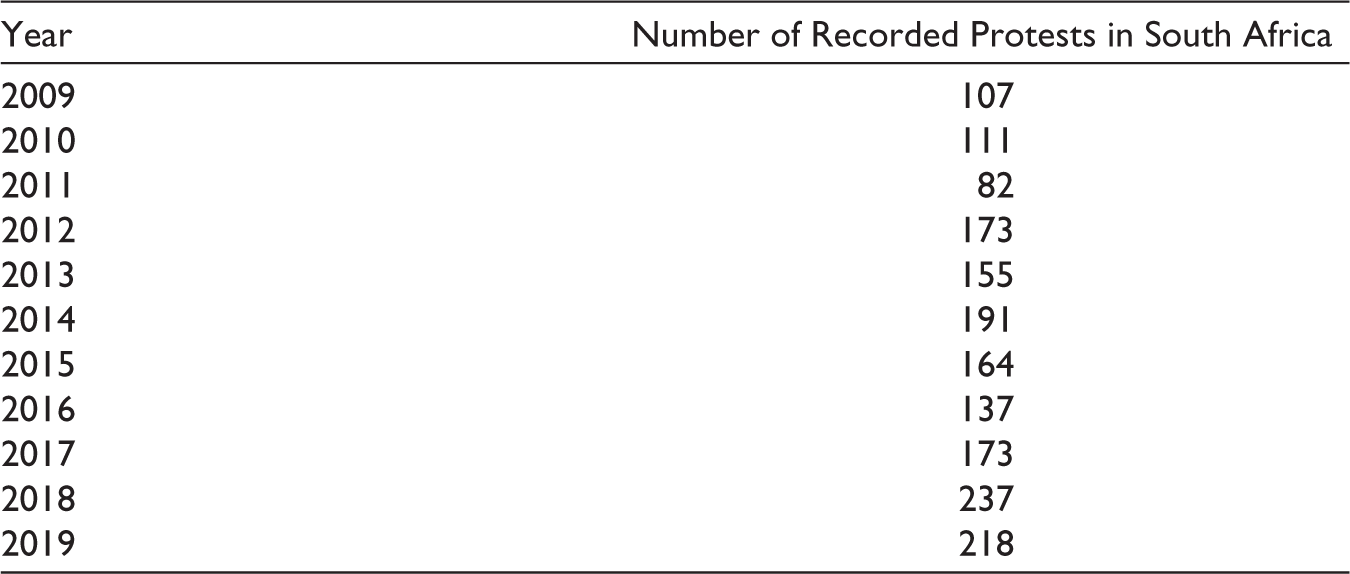
Judging from Table 1, in ten years (2009–2019), there seems to be an increasing trend in these protests, the most notable being those recorded in 2018. Viewing these statistics from a provincial standpoint, one may deduce that the three significant provinces (see Table 2), KwaZulu-Natal (KZN), Gauteng and the Western Cape, account for the most affected concerning service delivery protests. 5
Provincial Service Delivery Protests in 2019.
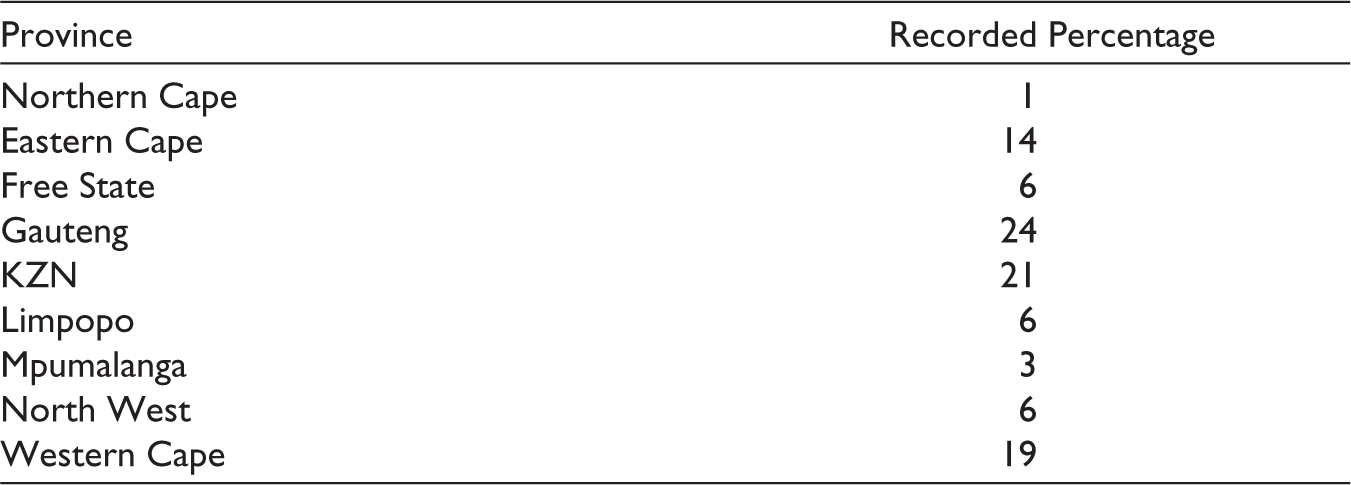
In light of Table 1 and particularly the high level of protests recorded in the three provinces, one may deduce that push factors are also at play. These three provinces, mainly Gauteng, are the economic hubs of South Africa. Most individuals (both locally and in Africa) move to these provinces for better economic opportunities for themselves and their families. This is even though the level of poverty and unemployment in these provinces is high, coupled with the mixture of all races from different cultures, including foreign nationals. There must be an opportunity to channel community engagement through democratic processes (like ward committees, petition processes and community meetings) to avert delivery protests. While these are available in some parts of the country, they have not been sufficient to address problems at the local level due to poor governance, monitoring mechanisms and corrupt practices.
Over the years, the ANC has received robust criticism for its cadre deployment policy in various government departments and municipalities, hence, creating employment positions to reward comrades. This discourages talented and qualified individuals and further undermines institutional performance in a country where the current unemployment 6 rates are shocking and are on a continuous rise. This is even though the post-1994 administration had promised to embark on public sector alteration by redressing the imbalances of the apartheid regime (Maramura et al. 2019). However, this has been vastly hindered by maladministration, financial management, weak governance, greed and ineffectiveness, making corruption strive at all levels of government. Corruption has become part and parcel of South African politics in two ways. First, it contributes to the ineffective functioning of the state, and second, it impacts the effectiveness and legitimacy of the country.
This is despite South Africa possessing several legislations such as the Prevention and Combating of Corrupt Activities Act 12 of 2004, the Protected Disclosures Act 26 of 2000, the Public Finance Management Act 1 of 1999 and the Municipal Finance Management Act 56 of 2003. To further attest to the mounting corruption in South Africa, this is evident from many media reports on corruption among politicians, tender rigging, abuse of state resources, and relationships between wealthy business people and politicians. Concerning the latter, such is evident in the widely known and questionable relationship between former South African president Mr Jacob Zuma and the wealthy Indian family, the Guptas (made up of brothers Ajay, Atul and Rajesh Gupta).
The latter family has been widely known (particularly under Zuma’s tenure as president) for having an immense influence on South African state resources, such as government departments and state-owned enterprises (SOEs) to gain business tenders amounting to millions of dollars (Mlambo 2019a, 2019b). During his time as president, Zuma had often received a vast amount of backlash from ordinary South Africans and other opposition parties, namely the DA and the Economic Freedom Fighters, concerning corruption and his relationship with the Gupta’s and their role in the changing of ministers in key government departments and SOEs. Manyaka and Nkuna (2014) note that in his first term in office, Zuma reshuffled his cabinet more than three times amid rumours of corrupt activities, often implicating some government members.
Booysen (2018) notes that a decade after the end of apartheid, the ANC had already started to decline gradually in its hegemonic posture. It was merely driven by the ANC’s political and organisational leadership that, since 1994, failed in many aspects. We argue that the immense domestic challenges further drive this. This has also been driven by vast factions within the ruling party; this, particularly under Zuma’s tenure, was evident as he had his factions who supported him and, at the other end, current president Mr Cyril Ramaphosa had his comrades. Such as Booysen (2018) argues creates personalised mechanisms of leadership and further selects ideological positioning as both factions have quests to become the dominant force within the ruling party and society, hence, forgetting to lead as a collective group and political party for the benefit of the people.
Nevertheless, one way the ANC has often countered such allegations from the public and other opposition parties is to outline that these allegations are driven by racism and political and social change resentment. Such corruption-related incidents have been blown out of proportion (Hyslop 2005). In South Africa, when top politicians are sought after for corruption-related matters, they tend to attack or hinder the investigation, which undeniably undermines genuine investigation procedures. Kgosana (2018) avers that the ongoing maladministration in SOEs 7 such as South African Airways, ESKOM, the South African Broadcasting Corporation (SABC), TRANSNET, Passenger Rail Agency of South Africa (PRASA) and supplier of defence DENEL is directly related to weak leadership, financial management and corruption.
It is worth noting that over the last two decades, South Africa has lost about ZAR 700 billion due to corruption (Mathekga 2017). For instance, in its 2014 election manifesto, the ANC clearly articulated that one of its intentions was to ‘intensify the fight against corruption’ and further stated, ‘the ANC is committed to a corruption-free society, ethical behaviour across the society and a government that is accountable to the people’. However, statements such as these from the ruling party are highly incongruous (Bruce 2014). In this regard, Manyaka and Nkuna (2014) state that in South Africa, much time is wasted on investigations and resolution of corruption-related cases rather than prevention and detection coupled with sound prosecution mechanisms for any individual found guilty. Ntoyanto (2019) argues that while there have been many corruption investigative clusters established through the recommendation of the Public Protector and Parliament that have, over the years, uncovered corrupt activities in the public sector, most have failed to attain the desired results of prosecution. Indeed, a robust challenge encountered in South Africa has been the lack of consequences for those accused of being corrupt and conclusiveness in corruption cases. These cases run for years with no prosecution, and many public officials have over the years gotten away without being prosecuted. One may then ask the question as to why corruption continues to strive in South Africa despite the country possessing one of the best anti-corruption agencies in Africa made up of but not limited to:
The Office of the Public Protector The Directorate for the Priority Crime Investigation The Assets Forfeiture Unit The Auditor-General The Independent Police Investigative Directorate The Financial Intelligence Centre The South African Police Services The National Prosecuting Authority and The South African Revenue Services
While these have, in one way or another, assisted in the conviction of some individuals, we argue that their record when it comes to others, especially top government officials leaves much to be desired. Again, the appointed leadership in the country’s vital anti-corruption agencies is either controlled by the Minister of Police or the President; hence, senior politicians of the ruling party enjoy a high level of impunity. While this article has aimed to paint a picture of corruption in Africa and, precisely, South Africa, it would not serve any justice if one does not put to the floor any recommendations that might assist in curbing the high levels of corruption both on the continent and in South Africa. Having examined the causes of corruption in Africa and South Africa, we must turn to some strategies that may be utilised to combat it.
Theoretical Framework
Institutional Theory
According to Tolbert and Zucker (1983), the institutional theory has been utilised to explain individual and organisational actions, including administrative and management practices. This aims to reflect the dynamic relationship between the organisational environment, the behaviour of individuals, outcomes and organisational architecture. From a corruption point of view, two frameworks have dominated the literature. First, the economic perspective has to do with the influence of rational self-interest, efficiency and formal regulative structures in explaining the development of corruption. Second, corruption is driven by organisational culture, structures and cognition (Misangyi, Weaver and Elmas 2008).
The institutional theory (also known as institutionalism) utilises country and government institutional characteristics such as the pre-existing rule of law, well-defined anti-corruption norms and independent anti-corruption institutions with enforcement powers to explain corruption in the public sector. The theory examines the processes and mechanisms structures, schemes, rules and routines that become established as authoritative guidelines for social behaviour. Apart from understanding corruption, the theory also provides the social context and taxonomy for understanding how corruption becomes entrenched in organisations, institutions and society despite anti-corruption laws. Such organisational behaviour reflects a culture that evolves over time and becomes legitimised within organisations, institutions and society. To Luo (2005), malfeasance is opposed to ethical behaviours and violates the rules, and corruption manifests through various malfeasant norms. These include:
System malfeasance: This exists when corrupt and illegal acts take place across the organisation; Procedural malfeasance takes place when organisations formalised ethics procedures are not strictly adhered to by employees at some levels; Categorical malfeasance takes place when many corrupt practices occur in one or two teams, departments, sub-units or functions and Structural malfeasance occurs when most hierarchies are involved in corruption that is typically small in quantity and gravity.
This theoretical framework links with the study in so far in integrating the different forms, sizes and ways that individuals or organisations might drive corruption. Thus, corruption can be complex and far-reaching to departments, organisations and society.
Tackling Afrocentric Corruption: What Notable Remedy (If Any)?
According to Owoye and Bissessap (2012), from an Afrocentric perspective, one may deduce that to scrutinise the extent of corruption post-independence robustly, we can assume that some heads of state hold discretionary power in their design and execution of public policies and further possess the ability to extract economic rents. Furthermore, some control all branches of their economy, like the central bank, security forces, electoral commission, judiciary and media. It is paramount to stress that if African states are to address corruption and revamp their fragile economies robustly, development-oriented leadership is a prerequisite. Such, we argue, pertains to each state implementing robust adopted national policies driven by anti-corruption strategies that aim to limit corruption (Mlambo et al. 2019). Indeed, these should be driven by the promotion of national integrity systems that are citizen-friendly and politically inclusive; this is because fighting corruption requires a clear ethical commitment by the political elite. Musila (2019) gives us some of the following factors that may also be implemented to fight corruption:
Robust and effective democratic institutions Whistle-blower protection laws A solid political obligation by the leadership to combat corruption A vibrant civil society and free media Severe punishment for corruption offenses and Adequate resources for both the prosecution services and anti-corruption agencies.
Such factors comprise that, irrespective of a state’s level of development, the political will to fight corruption can be generated by strengthening any form of governance, both democratic and dictatorship. By narrowing this down to South Africa, to fight corruption, clear mechanisms must first be put in place to draw a nuanced appraisal as to what drives corruption in the first place; looking at how other countries tackle corruption could be a point of departure. A recent (2019) study conducted by Afro Barometer 8 showed that corruption in South Africa occurs from all corners, such as the police, judges and magistrates, local government officials, members of parliament, and government officials. Drawing from this, to curb corruption, irrespective of one’s position or rank, you should, if found guilty, face the full might of the law; when a state aims to fight corruption, there must be a robust action of zero tolerance (Manyaka and Nkuna 2014).
Gumede (2011) contends that it will be paramount to announce corruption as a national emergency, as to him, this could assist in bringing to a halt the dangerous defensiveness and in some cases, denialism within some political circles and governments about the issue of corruption. This is even though, and as stated earlier, South Africa has the necessary anti-corruption enforcement agencies and anti-corruption laws; however, depending on who you are, these have been insufficient. Besides, as the ruling party, it is the role of the ANC itself to punish any of its members who are found guilty in corruption-related scandals; this may restore some dignity of ordinary citizens towards the ruling party.
While the ANC has launched immense economic blueprints plans like the latest 2012 National Development Plan (NDP) Vision 2030 (a product of the National Planning Commission), which is a strategy aimed at addressing inequality, and poverty, enhancing faster and more inclusive economic growth, public and private sector investments and improved education, nonetheless, with vast current hindrances, the realisation of such frameworks stipulated in the NDP faces the uncertainty of not being realised. With the high rates of poverty, inequality, population growth, unemployment and recurring xenophobic attacks against foreign nationals, the ANC will continue to feel the immense pressure of governing a state post-1994. Undeniably, the massive and ever-growing corruption scandals post this era will continue to be daunting. Poor policy choices, corruption and deteriorating governance have weakened South Africa’s economy and criminal justice system for years. While means to revamp these institutions are underway, the speed at which this has been done is slow, coupled with inadequate resources.
The recent (2019) spate of xenophobic attacks on foreign nationals in Johannesburg, Tshwane and Ekurhuleni is something the government cannot keep a blind eye to. Such attacks are further fuelled by the fact that most South Africans (particularly in townships and rural areas) are frustrated and facing hardships encompassing diverse factors, including inequality and unemployment (Tafira 2019; Newham 2019). While there are those in the ANC who are opposed to corruption, nevertheless, they might be attached to the organisation based on its role in South Africa’s liberation from apartheid and the charisma of former stalwarts and comrades such as Nelson Mandela, Oliver Tambo, Walter Sisulu, Albert Luthuli, Winnie Madikizela-Mandela, Steve Biko and Chris Hani. However, this does not justify that a country should be led by robust policies of inclusiveness and public participation and driven by leaders who are accountable to the people for their decisions. We argue that perhaps establishing a single, robust and well-monitored bureaucratic organisation to fight corruption is needed. This stems from the fact (and as discussed earlier) that South Africa has multiple institutions fighting corruption, leading to a scarcity of resources, delays and duplication of tasks.
Conclusion
This article sought to delve into Africa’s corruption, albeit from a South African perspective. Noticeably, corruption in Africa post the colonial era has severely eroded the economic growth of many African countries. This stems from the fact that it is undeniable that post the colonial era, corruption has indeed weakened the new democratic governments in Africa, and the continent has continued to lag in its quest for development and economic growth blueprints. This is even though several efforts have been implemented and rectified over the years in most countries, including South Africa; nevertheless, through poor oversight, most of these have not produced the desired results and are effective. To limit corruption, what is needed is accountability and greater transparency, punishment, the rule of law, more oversight that is effective, and implementation of a political culture intolerant of corruption.
Footnotes
Declaration of Conflicting Interests
The authors declared no potential conflicts of interest with respect to the research, authorship and/or publication of this article.
Funding
The author, Daniel N. Mlambo, who is a post-Doctoral Research Fellow in the Office of the Executive Dean (Faculty of Humanities) would like to thank the National Institute for the Humanities and Social Sciences (NIHSS) for their financial support.