




Abstract
This study explores public sentiment in relation to the African Continental Free Trade Agreement (ACFTA) by analysing 18,481 tweets mentioning ACFTA over a three-month period. The findings highlight the dominance of actors outside the African continent in the public discourse on ACFTA thus indicating the importance of the African diaspora and foreign interests in framing the debate and influencing public opinion on the continent. They also highlight the salient issues in the public debate on ACFTA to include its potential effects on national economies and jobs as well as the potential for its exploitation by foreign interests. The study also points at a disconnect between governments and politicians promoting ACFTA on the one hand and the average citizen in Africa on the other as it shows a general negative sentiment in all regions and age groups, and more particularly in West Africa and amongst males towards ACFTA.
Introduction
On 7 July 2019, Benin and Nigeria both signed the African Continental Free Trade Agreement (ACFTA). This brought the number of signatories to 54. All member states of the African Union with the exception of Eritrea had now signed the agreement. The prime objective of ACFTA was the creation of a single continental market for goods and services with free movement of people and capital to be known as the African Continental Free Trade Area (AfCFTA). It was hoped that this would pave the way and accelerate progress towards the establishment of a Customs Union (Odijie 2018). Indeed, the AfCFTA marked a significant step towards achieving the African Union’s Agenda 2063 goals of accelerating Africa’s integration, economic growth and development as well as promoting a common African identity (African Union Commission 2015).
ACFTA came into force on 30 May 2019 when the 22nd state deposited its instrument of ratification and the AfCFTA implementation was due to commence on 1 July 2020 (Mahamat 2020) but this has been put off until early in 2021 as a result of the COVID-19 pandemic (Mbewa 2020). While progress has been made, the AfCFTA ratification has been slow with only 28 countries having ratified the agreement to date. These represent only about half of the continent’s GDP. This would suggest a need to pay attention to the dynamics of ratification of the agreement. This is not a trivial point as the politics of ratifying such international treaties and agreements can be as important as the negotiations leading up to the agreement (Caldwell 2016). We argue that the politics of ratification of the agreement will be greatly influenced by public opinion. Indeed, the political science literature clearly establishes that public opinion impacts on public policy (Burstein 2003) and on the ratification of international treaties and agreements (Dür and Mateo 2014). For instance, public opinion is shown to be the major influencer of the French government’s decision to hold a referendum on the ratification of the European Union (EU) Constitutional Treaty (Marthaler 2005).
The importance of public opinion in the ratification process raises questions about how public opinion can be measured and understood in relation to ACFTA. These questions are pertinent given that in most African countries, literacy rates are low and public opinion polls are still in their infancy. We argue that social media, and Twitter more particularly, could provide us a tool with which to develop an understanding of public sentiment in relation to ACFTA as Twitter and social media more generally have been shown to be the platforms of choice for airing of individual opinions on public policy in several African countries. (Hodes 2017; Owen and Usman 2015; Reyntjens 2015). Consequently, this article seeks to develop an understanding of public sentiment towards the ACFTA using Twitter posts as a measure of this.
Our study contributes to the understanding of public opinion in relation to ACFTA in a number of ways. First, it highlights the dominance of actors outside the African continent in the Twitter discourse on ACFTA and thus points at the key role the African diaspora and foreign interests play in the formation of public opinion on the African continent. Second, it draws attention to the salient issues in the public discourse which are shaping public opinion towards ACFTA as including its potential effect on national economies and jobs as well as the potential for exploitation by foreign interests who are seen as driving forces behind the agreement. A disconnect between governments and policymakers on the one hand and the average citizen on the other is hinted at as we show a negative sentiment towards ACFTA in all regions and amongst all age groups but more especially in West Africa and amongst males. Finally, we show that public opinion in relation to ACFTA is fluid as it moved in a more positive direction over a three-month period.
The rest of the article is structured into four main parts. First, the literature in relation to AfCFTA and public opinion is explored. Next, we present our research design and methods and then move on to highlighting and discussing our findings. Finally, we present concluding thoughts which include policy implications and possible directions for future research.
African Economic Integration and AfCFTA
Hail! United States of Africa
Hail! United States of Africa-free!
Hail! Motherland most bright, divinely fair!
State in perfect sisterhood united,
Born of truth; mighty thou shalt ever be.
(Marcus Garvey 1924)
The idea of a politically and economically integrated Africa first found expression in Marcus Garvey’s poem (1924), ‘Hail, United States of Africa’. This idea of an integrated Africa was given impetus by the Pan-Africanism movement and ultimately found expression in the formation of the Organisation of African Unity. However, while African nations agreed that integration was necessary for Africa’s growth and development, there was no consensus on how this integration was to be achieved (Muchie, Habib, and Padayachee 2006). In the years prior to the formation of the African Economic Community (AEC), two approaches to integration split countries on the continent. While some countries like Algeria, Egypt, Ghana, Libya, Mali and Morocco advocated for the creation of a political and economic federation, others like Ethopia, Liberia, Nigeria and the former French colonies wanted a more measured approach which would build on regional economic integration as a starting point (Juma and Mangeni 2018). The signing of the AEC Treaty in June 1991 marked a new beginning for the idea of African Integration (Kouassi 2007; Odijie 2018) with countries coalescing around the approach of a gradual approach to integration starting with regional economic integration (Mistry 2000). The AEC Treaty which entered into force in 1994 set out a six-step agenda for the establishment of the AEC:
(to be completed in 1999) Creation of regional economic communities where none existed and strengthening of those already in existence (5 years) Strengthening of integration within regional economic communities and harmonisation between regional economic communities (8 years) Establishment of a free trade area and customs union within each regional economic community (10 years) Establishment of an African Customs Union (this implies the establishment of an African Free Trade Area) (2 years) Establishment of an African Common Market (ACM) (4 years) Establishment of an African economic and monetary union and Parliament (5 years)
The creation of AfCFTA then is just a step towards the achievement of the AEC. However, it is an important step as it is the first of the steps which impacts on the continent as a whole as opposed to having regional impact. Thus, its uptake and support across the continent will impact on the feasibility of achieving full economic integration across the continent as envisaged by the AEC Treaty.
Like most multi-state treaties, ACFTA requires individual states to sign and ratify the treaty in accordance with their constitutional arrangements. For most African states, this would mean ratification by the legislature. However, as economic integration progresses (especially at step 6), ratification might involve popular votes, that is, referenda. In either case, public opinion will play a significant role in the decision to ratify or reject these treaties. We explore the role public opinion plays in shaping public policy choices in the next section.
Public Opinion and Public Policy
While it is unlikely that anyone believes that public opinion always determines public policy, few would believe it never does (Burstein 2003). Indeed, those who study public opinion and public policy in democratic societies would concede that public opinion is likely to impact on public policy (Dür and Mateo 2014) with issues which are more salient to the public having greater impact (Burstein 2010). Thus, the more salient an issue is, the stronger the link between public opinion and the legitimacy of public policy on that issue. This is highlighted strongly in relation to international treaties and agreements by the impact public opinion has had on the ratification of EU constitutional treaty (Hainsworth 2005; Marthaler 2005; Vetters, Jentges, and Trenz 2009) as well as on the EUs non ratification of the Anti-Counterfeiting Trade Agreement (Dür and Mateo 2014). Indeed, the legitimation of international agreements and treaties is intrinsically linked to the debates which occur in the public sphere and the resultant public opinion which is formed. This however, leads to questions as to how public opinion is formed and measured.
The public opinion formation process usually proceeds through three key stages: (a) a group of people (even a small minority) is confronted with an issue which they consider important; (b) they engage in a discussion over the issue which results in its increased salience; and (c) opinion is mobilised to affect a collective decision (Cai et al. 2017; Katz 1966). Public opinion research shows that the average citizen’s initial approach to issues is usually emotionally laden and so unstable and changeable (Cai et al. 2017). This is because an average citizen’s knowledge in relation to political issues is low (Converse 2006, 2000) and so they are unlikely to understand the issues at stake thoroughly. As the cost of becoming a well-informed citizen is high, an average citizen relies on cues from a range of sources including political and social elite, political parties, labour unions etc. to guide their policy attitudes (Gelpi 2010; Jones and Brewer 2020; Leeper and Slothuus 2014). Traditionally, the discussion of issues and mobilisation of opinion relied heavily on the mass media (McCombs 2014; Zaller 1992). However, more recently, the internet and social media have come to play a significant role in this (Neubaum and Krämer 2017; Savigny 2002). The role of social media such as Facebook, Twitter, MySpace etc. is even more pronounced in Africa as it has become a significant means of communication; discourse amongst friends, acquaintances and social and political groups; as well as a means of connecting with leaders, policymakers and distant others who would ordinarily be inaccessible (Gazzar 2013; Kalyango Jr and Adu-Kumi 2015). As such, in Africa, social media has become not just an ideal means of communication but a critical component of civic engagement (Udanor, Aneke, and Ogbuokiri 2016).
While public opinion has traditionally been measured using opinion polls and surveys (Berinsky 2017; Cai et al. 2017), the rise of social media as a significant tool for the formation and expression of public opinion has led to increased interest in the use of social media to infer public opinion (Anstead and O’Loughlin 2014; Dubois, Gruzd, and Jacobson 2018; Klašnja et al. 2017). A significant body of research in this area has focused on the measurement of the sentiment of Twitter users (Bastos and Mercea 2018; Georgiadou, Angelopoulos, and Drake 2020; Nordheim et al. 2018) as it is recognised that Twitter’s popularity, openness, user friendly interface, along with its horizontal and broadly networked structure make it a strong force in public discourse (Park and Kaye 2017; Parmelee and Bichard 2011). We adopt this approach to measuring public opinion in relation to AfCFTA.
Research Strategy and Methods
We commenced our data collection in August 2019 using the hashtag #AfCFTA and continuous data collection spanned August–September 2019, translating into 20,299 tweets. In order to enable demographic and geo-inferencing, we dropped all observations without description which resulted in a reduction to of the sample to 18,481 tweets.
Our initial analysis was aimed at understanding the demographic and geolocation characteristics of the data and what those could mean in terms of the formation and expression of public opinion on AfCFTA. For our analysis of location, we utilise Pigeo (a Python Geolocation Library) to infer geolocation of users in our data, based on pre-trained models (Rahimi, Cohn, and Baldwin 2016). Our choice of Pigeo is justified because it is a text-based classification and network-based regression pre-trained models. The algorithm supports informal text. It also provides possibility of training a new text-based classification model. Using Pigeo, we are able to predict location which contains city, state, country and coordinates of the predicted location (model has 930 classes/regions). It also provides the top 50 most important features of the predicted class. For our demographic inferencing, we utilise M3Inference (Wang et al. 2019). M3Inference is a deep learning system for demographic inference (gender, age, and individual/person). The Model was trained using massive Twitter dataset using profile images, screen names, names, and biographies. Based on the distributions of collected tweets, we grouped them into regions: Eastern-Africa, Middle-Africa, Northern-Africa, Southern-Africa, Western-Africa, Western-Europe, USA, UK, Canada, Malaysia, Singapore, Australia, Brazil and Others. We are of the view that analysing at the regional level increases our accuracy better than working on the national level where a handler influence could cut across two countries (Rwanda and Kenya, Nigeria and Ghana for instance). We also retain the tweets from outside Africa as there is a keen recognition of the role which African diaspora plays in politics on the continent (Adi 2002; Akyeampong 2000).
Our analysis then moved on to developing an understanding of the issues which formed the core of the debate about AfCFTA on Twitter. To do this, we adopted a qualitative content analysis to thematise the positive and sentiments which the AfCFTA elicits. We then moved on to a quantitative analysis of the data which involved merging sentiment scores with geo-inferenced and demographic-inference data to undertake regression analysis. Our Dependent variable is binary = 1, when individual’s sentiment is positive, otherwise zero. Our explanatory variables are: Gender (Male or Female); Individuals, grouped into age bin (18 and below, 19−29, 30−39, 40 and above); Entity (individual or corporate handle); and Regions. We controlled for time fixed effect by including a variable for August or September.
Our regression model:

where
Xit: K x 1 vector of individual characteristics Xi consists of Age, Gender, Location, Entity β is the conformable vector of coefficients φt: a set of time fixed effects (month dummy). Iit: 1 if individual tweet i is classified as positive under sentiment analysis εit is the error term at individual level.
Our findings are presented and discussed in the subsequent sections.
Who is Influencing and Expressing Opinion on AfCFTA on Twitter?
Our initial analysis focused on characterising the key actors in the formation and expression of opinion in relation to AfCFTA on Twitter. To do this, we examined both the demographic and geolocation characteristics of the Twitter discussants. The demographics characteristics of the Twitter debate on AfCFTA are shown in Table 1. Our results show that the Twitter discussion of AfCFTA was dominated by the over 40s who accounted for over 63 per cent of the discussants. Males also were more involved in the discussion as they accounted for over 70 per cent of each age group with the exception of the 20–30-year olds where they accounted for 63 per cent. Thus, the average discussant would be male above the age of 40. This is important as we have seen in Britain with the Brexit decision that the older segment of the population tends to be more nationalistic and conservative in outlook when presented with prospects of regional integration (Eichengreen, Mari, and Thwaites 2018; Nouvellet 2017).
Summary by Age and Gender

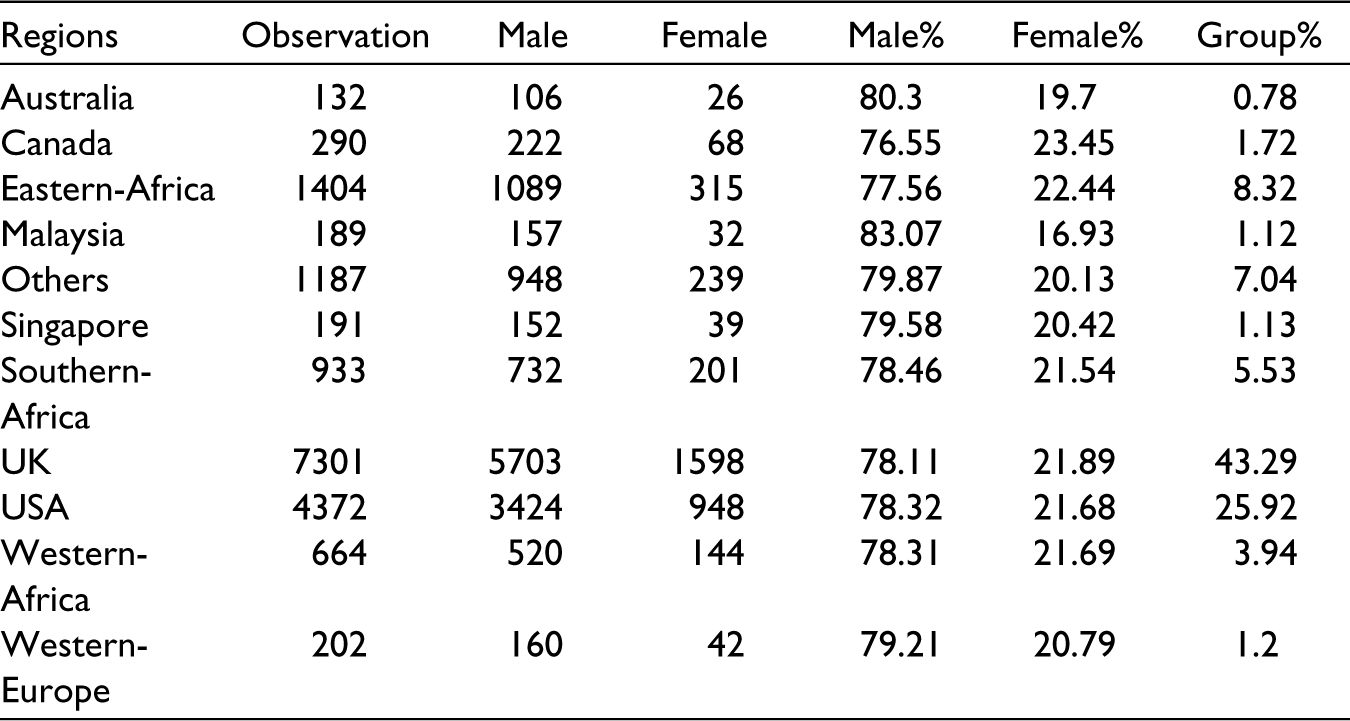
The results from the geo-inferencing analysis are shown in Table 2. Two key observations are made from these. First, the importance of the African diaspora and foreign in the formation of public opinion on issues affecting the continent is highlighted. The results show 43 per cent of people participating in the discussion having their networks centred in the UK and about 26 per cent with networks centred in the United States. Second, it shows the limited interest in AfCFTA on the continent itself with people discussing AfCFTA on the African continent accounting for about 18 per cent of the discussion (East Africa 8%, West Africa 4%, Southern Africa 6%). This means that the discussions were dominated by interests outside of the continent and to a large extent might reflect concerns of these interests.
Summary by Region and Gender
Salient Issues in Relation to AfCFTA Twitter Discussions
The next stage of our analysis focused on identifying the issues which formed the core of the Twitter discussion on AfCFTA and therefore were gaining in salience. To do this, we carried out a qualitative content analysis of these tweets which showed that the social media debate coalesced around a number of themes which are discussed below:
Concerns Over Exploitation
A significant part of the discussion centred on concerns that non-African countries and groups which have are seen as drivers of AfCFTA would exploit institutional weaknesses in African states to enable their goods and services qualify as goods produced or originating in Africa and what countries needed to do to prevent this. One discussant noted:
[G]overnment must develop internal mechanisms to protect local markets from smuggling and dumping.
Of particular concern are goods originating in China, as discussants note:
Chinese products will invade the African market. A united Africa may give China its moment to shine.
The concern over exploitation focused attention on the rules of origin which should define what goods and services qualify as being produced in Africa with some discussants proposing solutions such as:
Yet we must ensure that d rules of origin must be above 60 local content to make it admissable into AfCFT.
Effect on National Economies
Another significant theme of the discussion was the effect AfCFTA would have on national economies. There was great optimism on the potential for AfCFTA to transform economies in some tweets:
The AfCFTA can transform Nigeria from a target economy to the gateway economy.
At the same time there was also grave concern for potential effects like loss of revenue, as well as its potential negative several sectors of the economy. A lot of this concern seemed to centre on Nigeria. A word cloud analysis of the tweets (Figure 1) highlights this dominance of Nigeria in the discussions:
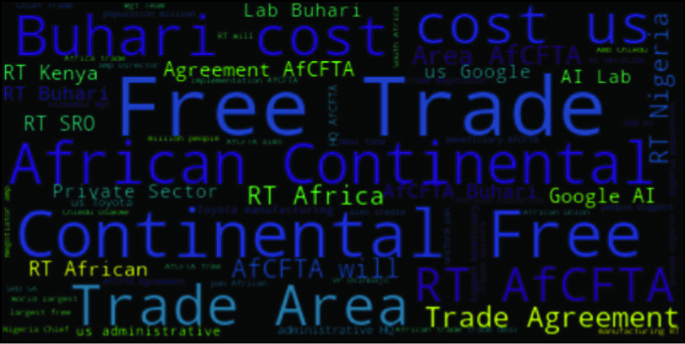
Concerns expressed about Nigeria focused on its economic and institutional ability to participate and benefit from the agreement:
10bn agro export loss threatens Nigeria AfCFTA Nigeria needs flag carriers for role in AfCFTA AfCFTA TUC Urges FG to Fix Infrastructure Nigeria AfCFTA Investors Manufacturers May Quit Nigeria.
The discussions focusing on Nigeria could be linked to a recognition of its importance to the success of AfCFTA (Odijie 2018) coupled with its initial negative posture towards AfCFTA which led to a delay in its signing the agreement.
Effect on Jobs
There was also a focus on the effects the agreement was likely to have on jobs. While there was a keen recognition of the potential for the creation of new jobs:
AfCFTA is a great initiative that will help countries create jobs advance sustainable economic development The implementation of AfCFTA will result in welfare gains creating more than 2 million new jobs,
This sense of optimism was not just in relation to the creation of new jobs but also in the type of jobs which are to be created:
AfCFTA 4 us must represent AFRICA’S INDUSTRIAL REVOLUTION It is only jobs that com. I like the way Byanyima looks at success of the AfCFTA at quality of jobs quality of small and medium firms. Africa regional integration should focus on creating decent jobs for youth says government.
Thus, the prognosis is for good quality jobs in industry especially within the small and medium firms. Youths are also shown to be potential beneficiaries. This is significant given the high levels of youth unemployment in several countries.
The potential for AfCFTA to change the nature of work especially in relation to increased mobility within countries is highlighted:
The future of jobs will be transnational There is need for young people to pressure their countries to sign and ratify.
Again, the youths are portrayed as beneficiaries of the agreement and galvanised to pressure governments for its ratification.
However, there was also a concern that countries with low wage rates could benefit disproportionately and that this would have an impact on jobs in several countries where workers’sa rights are not prioritised:
With no private sector minimum wage low wages are seen as Ethiopia’s comparative advantage AfcFTA leaves workers behind
Foreign Influences
The tweets show some scepticism around foreign interests in AfCFTA. For instance, it is seen as a tool of neo-colonialism and neoliberalism:
This same Wallace person is here pushing AFCFTA yet we are agreeing with him when it is a shortcut to colonize us financially The AfCFTA as a neo liberal project While capital is less and less restricted there is no intention in the AfCFTA.
There is also the recognition that powerful foreign interests would prefer to deal with Africa as one block as opposed to dealing with sub-regional blocks or individual countries. For instance, a Tweet notes:
EU Ambassadors reiterates the interest for a Continent to Continent Trade Agreement with Africa
This focus on foreign interests being the driving force behind AfCFTA hints at issues of legitimacy and trust of the African leaders who are seen as the face of AfCFTA.
Sentiment Analysis
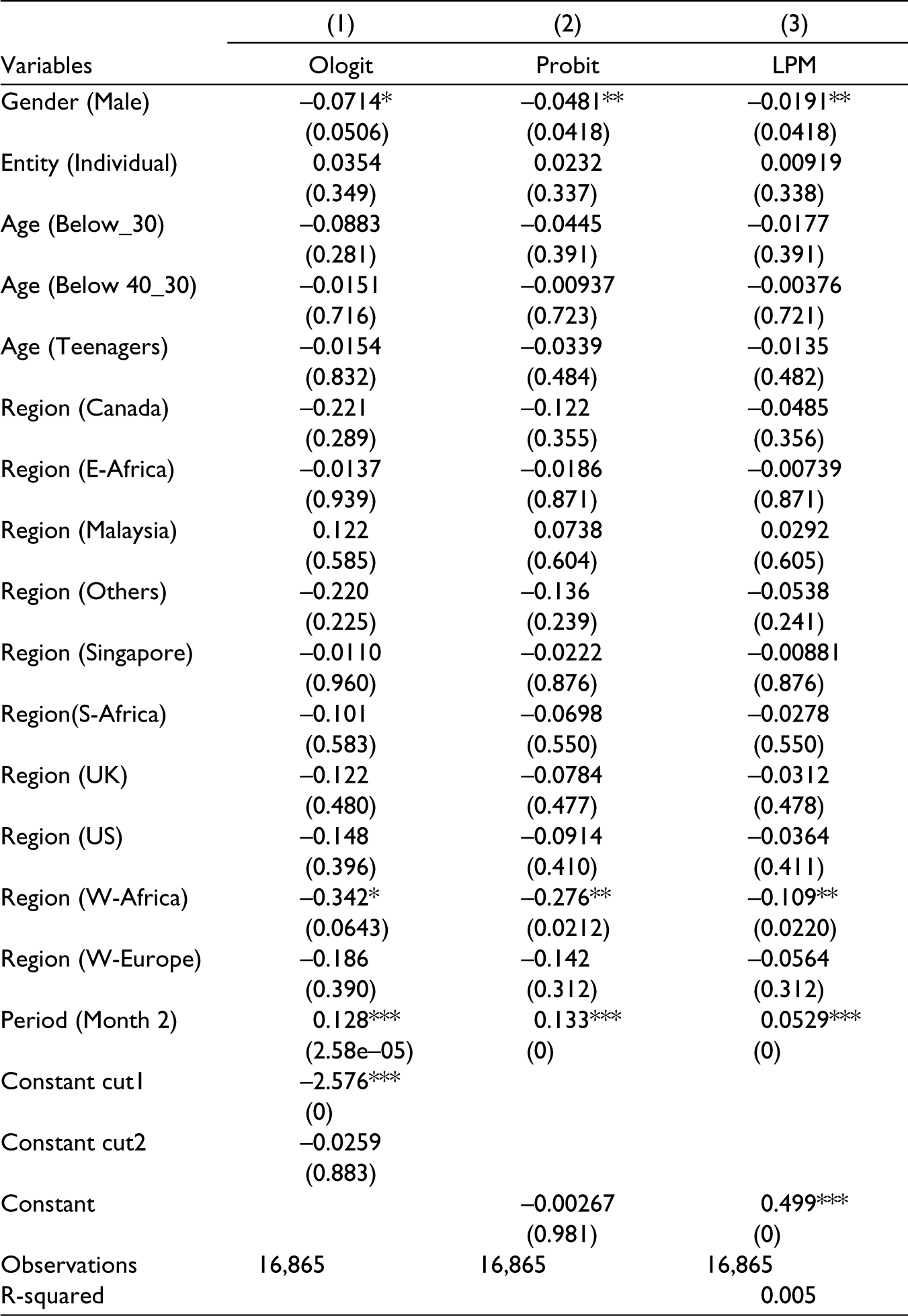
We then tried to understand the distribution of sentiment in relation to AfCFTA and how this is impacted on by demographic and geolocation characteristics. To do this, we ran a Linear Probability Model; the results of which are shown in Table 3.
Regression Analysis Results
*** p < .01, ** p < .05, * p < .1.
The results indicate that all regions (except those in Malaysia) have negative effect on the sentiments of AfCFTA. However, only West Africa has an effect which is statistically significant. The West African individuals are shown to be about 11 percentile negatively inclined towards the policy relative to the reference group. This significant negative sentiment in West Africa could be attributed primarily to Nigeria given its dominance in the discussions. While the results are only statistically significant for West Africa, they do show a predominant negative inclination towards AfCFTA which could have significant implications for governments as they try to mobilise public support for the ratification and implementation of the agreement as it indicates a potential disconnect between the governments and interests promoting AfCFTA on the one hand and the public on the other.
Our results also indicate that gender could play a role in the formation and expression of opinion in relation to AfCFTA as males are shown to be about 2 percentiles more negatively inclined towards AfCFTA than females. This result is statistically significant at 5 per cent. The more negative inclination of males is important in the AfCFTA debate as the demographic analysis in the previous section highlighted that the males dominate the Twitter discussion on AfCFTA.
In addition to these, we find that sentiment is about 5.29 percentile more positive in the later month than the previous month and it is significant at 1 per cent. This gives an indication of the fluidity of public opinion in relation to AfCFTA and its ability to be influenced over time.
Conclusions, Implications and Next Steps for Research
We set out to develop an understanding of public sentiment towards the AfCFTA using Twitter posts as a measure of this. To do this, we adopted a multi-stage approach to the analysis of the 18,481 tweets mentioning AfCFTA over a three-month period. First, we explored the demographic and geolocation characteristics of the tweets to understand which groups were driving the formation and expression of public opinion on AfCFTA. We then carried out a qualitative content analysis of the tweets to develop an understanding of the salient issues which were shaping opinion on AfCFTA. Finally, we carried out a quantitative sentiment analysis of the tweets to explore the distribution of sentiment and how demographic and geolocation characteristics were impacting on sentiment in relation to AfCFTA.
The key messages from the study are fourfold. First, we show that majority of the discussion in relation to AfCFTA is occurring in regions outside of Africa. This points at the importance of the African diaspora and foreign interests in framing and shaping the issues which are discussed as well as in influencing public opinion in Africa. However, it also points at an apathy by an average person on the African continent towards engagement with the public discourse on AfCFTA. Second, we highlight the salient issues in the AfCFTA discourse to include its potential effect on national economies and jobs as well as the potential for exploitation by foreign interests who are seen as driving forces behind the agreement. Third, we highlight a general negative sentiment towards AfCFTA which is more pronounced in West Africa and amongst males. This hints at a potential disconnect between the governments and politicians who are promoting AfCFTA and the average citizen. Finally, we show that the sentiment became marginally more positive over the three-month period of our analysis.
These have implications for governments and policymakers as they attempt to influence public opinion and push through the ratification and implementation of AfCFTA. First, is the need to prioritise engagement with the African diaspora as this could unlock the key to influencing public opinion on the continent. Second, is the imperative to develop more effective communication about AfCFTA within individual countries and more particularly in West Africa. This should involve engagement on the salient issues of job creation, effects on the nation as well as building trust and legitimacy to show that AfCFTA is indeed an African agenda and not some neo-colonial tool or foreign imposition.
While we have produced significant results from our study, our findings also open up avenues for future research. For instance, our finding which shows that sentiment changes over time could be the point of departure for future research which could present a more nuanced view of the formation of public opinion in relation of AfCFTA via social media by undertaking a network analysis which will identify key individuals that may be able to swing opinion within the region and how these key influencers effect a change in opinion over time. Indeed, we hope that our article is just a start into research on AfCFTA as well as on public opinion formation and measurement via social media in Africa.
Footnotes
Declaration of Conflicting Interests
The authors declared no potential conflicts of interest with respect to the research, authorship and/or publication of this article.
Funding
The authors received no financial support for the research, authorship and/or publication of this article.