




Abstract
There is very limited theory and policy guidance that specifically relates to multijurisdictional and multimodal (M&;M) infrastructure corridors: those that traverse national boundaries and encompass multiple modes of co-located infrastructure modes. This paper develops a framework for understanding the social welfare costs and benefits—and the barriers to implementing—these corridors. The framework posits the need for both a dedicated assembler and a national (or supranational) sponsor. An assembler provides the platform to match up initial property rights holders, infrastructure mode providers and end users. The sponsor financially and politically backstops an assembler. We decompose the economic necessity for, and advantages of, an assembler and also those that result from some degree of multimodality. We also consider the economic and political barriers to M&;M corridor implementation. To illustrate these, we review the evidence from the very small number of proposed or realised M&;M corridors and closely related projects. Although reliable evidence is scarce, it is consistent with the framework’s implications regarding the need for both an assembler and a sponsor.
Introduction
There is considerable policy interest in multijurisdictional and multimodal (M&;M) (that is, with co-located infrastructure modes) infrastructure corridors (Berg et al. 2017; Brunner 2013; Kumar and Isran 2019; Roberts et al. 2020; Sulzenko and Fellows 2016; Xu et al. 2021). Despite this interest, few M&;M corridors have been implemented. The reasons for this scarcity have not been extensively analysed until quite recently, beyond general observations that these projects are complex, are very capital-intensive and require cross-constitutional coordination.
The extant research on complex corridors mostly adopts one of three perspectives: (i) a multiple stakeholder perspective (e.g., Abdou et al. 2019; Hanaoka et al. 2019; Öberg, Nilsson and Johansson 2016); (ii) a trade flow perspective (e.g., Abdou et al. 2019; Baniya, Rocha and Ruta 2020; de Soyres, Mulabdic and Ruta 2020; Ghoneim 2003); or (iii) a hegemonic state perspective (e.g., Ogunnubi 2017; Schneider 2021). None of these three perspectives (nor the few other extant studies that use other perspectives) focuses directly on economic rationales for these corridors. More importantly, they do not analyse specifically how to structure and manage these multijurisdictional projects (Arnold 2006; Berg et al. 2017; Lim et al. 2017; Xu et al. 2021). Indeed, the World Bank has criticised the ‘lack of guidance on how to design, determine the components to include, and analyse the likely impact of corridor projects’ (Kunaka and Carruthers 2014, xiii and 1). Given this reality, Xu et al. (2021, 189) recently noted that ‘the research of economic corridors can be regarded as an attractive and emerging field for the coming years’. The lack of analysis and guidance is particularly surprising, given that the review literature shows that corridors can significantly reduce transportation costs of goods and services (Berg et al. 2017; Roberts et al. 2020). Regarding transport infrastructure in developing countries specifically, a comprehensive recent review of the evidence finds a very broad range of benefits. Foster et al. (2023) conclude that the
benefits from transport investments in developing countries…are key to promoting economic growth and spreading growth geographically by lowering trade costs, accelerating firm growth, enhancing competition, expanding agricultural productivity as well as farm and non-farm production, expanding trade, increasing welfare and reducing poverty; in addition to enabling commuting by workers. (p. 23, cites in quote not reproduced)
An M&;M corridor is one that has at least two co-located infrastructure modes and that connects (usually) different countries (Kumar and Isran 2019). By multimodal corridors we mean those where different modes (e.g., a railway and a gas pipeline) are built and operate simultaneously. 1 We deliberately focus on multijurisdictional corridors, not just transnational corridors. We include corridors that cross boundaries of subnational regions (e.g., provinces or states) with some constitutional authority, where, in effect, there is ‘dual constitutionalism’ (Boardman et al. 2022; Burgess and Tarr 2021). Globally, many subnational jurisdictions, such as states, provinces and länder, have some constitutional authority (Burgess and Tarr 2021; Tarr 1996; Watts 1998): for example, Quebec within Canada. In these constitutional domains, the subnational government often has either veto power or constitutional authority that can only be superseded by a super-majority of the other subnational authorities (Boardman et al. 2022; Sharma 2022; Vining and Moore 2017). Even in the absence of a sector-specific veto or super-majority requirement, any degree of constitutional authority provides logrolling power (Elster 1995). In some important historical cases, constitutional authority derives from the fact that the jurisdiction constitutionally preceded a subsequent national government. This applies to, for example, the 13 original colonies, Texas and California in the USA, and also includes countries and subnational jurisdictions in Africa, South Asia and South and North America. We focus on corridors that provide at least one transport mode, but multimodal corridors may also include water distribution, electricity transmission, pipelines and telecommunication modes (Berg et al. 2017; Kunaka and Carruthers 2014).
The cost of M&;M infrastructure corridors can be enormous, even in comparison to other infrastructure projects. Yet, as noted earlier, there is very limited theory or policy guidance regarding the conditions needed for probable successful implementation. We develop a framework that suggests some broad predictions about the need for specific design and governance structures. We adopt the normative assumption that participating nations and other governments aspire to improve economic efficiency (a measure of social welfare or social value) when proposing and designing these corridors (Berg et al. 2017). Given this, we argue that an M&;M corridor requires both a (dedicated) assembler and a national (or supranational) sponsor. We lay out the key roles of both an assembler and a sponsor, or sponsors. An assembler provides a platform to assemble initial property rights holders (PRHs), infrastructure mode providers and end users. A sponsor (or sponsors), financially and politically, supports and legitimises the assembler. We analyse the economic efficiency advantages of a single assembler in performing this matchmaking role and in achieving multimodality. We also explore the economic and political reasons for the difficulty in implementing M&;M corridors. To illustrate these barriers as best we can, we review the empirical evidence from the limited number of proposed or realised M&;M corridors or closely related projects. Although reliable data are scarce or hard to obtain, the results of the review are consistent with the framework and our analysis regarding the nature of implementation barriers.
There are five features of the framework we present. They are: (i) a supra-jurisdictional social efficiency or welfare perspective to ground normative evaluation; (ii) the need for a platform assembler, which can also be elaborated using matchmaker, clearinghouse, intermediary or a variety of similar descriptors (Cramton et al. 2020; Evans and Schmalensee, 2010; McKinney, Niederle and Roth 2005); (iii) elaboration of how an assembly platform reduces negotiation and other transaction costs; (iv) the need for national or supranational sponsors to politically and financially champion the assembler; and (v) an explanation of why M&;M corridors are especially difficult to implement. We consider each of the key stages from initial formulation to implementation and identify the key actors at each stage and discuss their incentives.
The paper is organised as follows. Section 2 summarises the conceptual rationale for M&;M corridors based on the potential for a supra-jurisdictional social welfare improvement. Section 3 demonstrates the necessity for an entity (an assembler) that provides an organisational platform to intermediate between—or to match—the initial PRHs of corridor land and the eventual infrastructure providers (IPs). It also explains why an assembler is either, directly or indirectly, the creation of one or more sponsoring governments. Section 4 presents a framework that integrates these actors (we prefer this value-neutral term because of the social welfare ambiguity of ‘stakeholder’ language) and their roles. Section 5 discusses the most significant barriers to implementation. Section 6 reviews the limited available evidence from existing corridors and draws on political economic theory to explain the barriers. To empirically ground the framework to the extent possible, in Section 6 we review the performance of realised M&;M corridors and, because there are so few, other complex corridors (or mega corridors) which may not quite qualify as M&;M corridors (Romein, Trip and de Vries 2003). Although relevant data are hard to obtain, the review supports the implications of the framework regarding implementation barriers. Section 7 provides a summary.
Social Welfare in a Multijurisdictional Context
Governments may have many reasons for participating in an M&;M corridor. From a public policy perspective, however, the primary issue is the potential economic efficiency or social welfare effect of these corridors. A major rationale for corridors is that they can lower transportation costs between nations by reducing travel time, vehicle operating costs and other border costs (Berg et al. 2017; Lebrand 2021; RGL Forensics 2012; Shires and De Jong 2009). Corridors also have the potential to increase trade and economic activity by expanding markets and encouraging agglomeration benefits (Bonfatti and Poelhekke 2017; Goldmann and Wessel 2020; Nawaz and Mangla 2021; Nordås, Pinali and Geloso Grosso 2006; Tripathi and Gautam 2010; Wolf 2016). Both of these potential benefits can be especially significant for M&;M corridors that traverse developing and landlocked countries’ borders (Arvis 2011). Social welfare also improves through reduced congestion on contiguous routes and increases the value of other transport networks that connect to the corridor (Rothengatter 2017). All these changes can also provide environmental and external benefits.
For multijurisdictional corridors, the appropriate normative rationale is the potential increase in the aggregate social welfare of the residents of the involved nations or subnational entities with constitutional authority (Boardman et al. 2018; Klytchnikova and Lokshin 2009; Rimmer and Dick 2010). Computing a quantitative measure of aggregate social welfare across jurisdictions, however, is not straightforward for many reasons. The standard spatial scope in cost–benefit analysis and social welfare analysis generally is the nation-state (Boardman et al. 2022; Gayer and Viscusi 2016). However, adopting a multiple nation or jurisdictions’ social welfare criterion clarifies the appropriate welfare scope test that the various participants should strive to meet and identifies some of the (‘will it improve welfare?’) barriers to implementing an M&;M corridor.
We initially assume only two nations and adopt the principle of methodological individualism; that is, all persons count equally, regardless of which of the two jurisdictions they reside in (Boardman et al. 2022). Doing so, a corridor should be implemented if it increases the aggregate social welfare of residents, regardless of the distribution of the costs and benefits across or within the nations or regions. More restrictively, if residents of both nations expect to see net benefits from a corridor, then it is both efficiency enhancing and unlikely to face significant political opposition. However, if the benefits are not widely distributed within even one of the two nations—a quite likely situation—then obtaining political support in favour of corridor implementation is further reduced, even if that nation’s residents expect net benefits in aggregate. Thus, even when efficiency enhancing, projects with these distributional characteristics would most likely fail a democratic referendum, and so a direct vote implementation, test. Of course, this is a base-case oversimplification even in a reasonably well-functioning democracy.
Corridor implementation is also unlikely when the residents of only one nation or region expect to experience increases in welfare for the same reason. In this case, implementation would normally require a nation or region that expects direct benefits to compensate the one that does not (de Soyres, Mulabdic and Ruta 2020). As the number of number of nations or regions beyond two that a corridor traverses increases, it becomes even less likely that all affected regions would anticipate direct net benefits from the corridor, unless they receive some form of compensation. Where compensation would be required, holding all else constant, corridor implementation becomes less likely because of the increasing transaction costs of reaching an agreement among the regions (cf., the negotiating costs faced by supranational standard setting organisations: Layne-Farrar, Llobet and Padilla 2014).
A Corridor Sponsor and an Assembler
The potential increase in aggregate social welfare provides the best normative rationale for an M&;M corridor, but even a corridor linking only two constitutionally empowered countries or regions requires the cooperation of a large number of actors. Most importantly, these corridors require both a governmental sponsor and an assembler.
A Corridor Sponsor
A necessary initial condition to implement an M&;M corridor is a government or supranational sponsor. This sponsor can be a single national government, several national governments or a supranational governmental entity (i.e., an organisation formed by more than one national government), such as a multilateral development bank (MDB). The most prominent example of a supranational sponsor is the European Commission (EC), the executive arm of the European Union (EU) that allocates EU funds and can establish subsidiary entities.
All MDBs are ultimately funded by a collection of donor nations and so are essentially supranational in nature (Congressional Research Service 2020). An MDB consists of a collection of donor and recipient national representatives and so possesses the resources and legitimacy that derive from those. However, any analysis of MDB projects from a social welfare perspective is complicated by the ambiguity as to whose social welfare should have standing in a specific analysis (Boardman et al. 2022; Buiter and Fries 2002; Pereira Dos Santos and Kearney 2018). MDBs do appear more willing than many national governments to undertake regional infrastructure investments both because of their multinational mandate and their superior risk-spreading abilities (Gurara, Presbitero and Sarmiento 2020). Additionally, most MDBs have a mandate to subsidise emerging and developing economies. MDBs also have informational advantages with respect to infrastructure projects because their broad range of activities allows them to spread the upfront costs of investing in country-specific information across many projects. Finally, an MDB has the capacity to use pre-existing financing and funding share agreements to reduce the collective action problem and so increase the probability of raising sufficient funds (Barrett 2007). This suggests that MDBs should have a comparative advantage as sponsors in poorer global regions.
A single nation can seek to induce corridor cooperation from other nations if it expects large enough benefits, such that it is willing to bear the costs of being the sponsor and is also willing to provide financing and perhaps the ultimate funding. A hegemonic government sponsor can do so through side payments or non-monetary incentives to the other affected nation(s).
In practice, an M&;M corridor sponsor is required to establish, or at least enable, a separate and distinct entity with the ability and incentive to intermediate at relatively low cost between the PRHs along a proposed corridor and the potential IPs and, ultimately, the end users and other actors. We argue, however, that governmental sponsors are unlikely to be able to directly perform the assembling role well and, even when they could, they would usually prefer to stay at arm’s length.
Assembler Theory Background
A dedicated assembler that is distinct from a sponsoring government is almost always necessary because M&;M corridors involve multiple stages that require distinct mandates, management structures and managerial technical expertise. Negotiating with PRHs, for example, requires contract negotiation and international law competence, while working with IPs particularly requires engineering competence. Corridor stages are always tightly coupled and largely sequential, as an earlier stage must be in place before the next stage can commence (de Bruijn and Leijten 2008). In sum, these corridors are particularly complex, multi-actor and multitask projects (Hærem, Pentland and Miller 2015).
The need for an assembler to deliver complex projects is well documented in the public policy literature (Bardach 1977; Sabatier and Mazmanian 1979). The terms used to describe this crucial role, however, are confusingly varied. They include intermediary, platform provider, clearinghouse, matchmaker, fixer, critical mass or more metaphorically a ‘chicken and egg’ implementation problem-solver (Demil and Lecocq 2006; Evans and Schmalensee 2010; Ivarsson and Svahn 2020; Roth 2015; Trischler and Meier 2021). Almost all potential intermediation ecosystems face a similar coordination, ‘critical mass’ or ‘chicken and egg’ problem in putting together potentially complementary actors and assets (Evans and Schmalensee 2010; Murthy and Madhok 2021; Rochet and Tirole 2003).
However, an M&;M intermediary is different from almost all other platform providers in a number of important ways. First, an assembler in the M&;M context is highly unlikely to be motivated by profit or revenue maximisation (cf., the United Network for Organ Sharing in the United States, Roth and Sönmez 2005). Second, there are well-defined limits to the number of required PRHs and IPs. Third, because of the supra-jurisdictional nature of these corridors, politics is as important as economics in both conception and implementation. Fourth, the scale of investment and sunk costs required to implement these corridors is massive, even by normal platform and infrastructure cost standards.
A Corridor Assembler
A dedicated corridor assembler needs to perform multiple functions: (i) determine an optimal corridor route; (ii) obtain rights-of-way (or options on them) from existing PRHs through either purchase, gifting or expropriation; (iii) assign or delegate the use of these rights to IPs through either sale, gifting or some other contractual arrangement; and (iv) coordinate with the multiple IPs on end-user payment regimes that must ultimately fund the assembler and the IPs. In platform terminology, the assembler intermediates between the supply-side PRHs and demand-side IPs and the ultimate users (Rochet and Tirole 2003).
Where an assembler seeks to enhance social welfare rather than profit, the creation of that entity is only the first of multiple stages required to get to service provision and use (Hærem, Pentland and Miller 2015; Kunaka and Carruthers 2014; Panagakos and Psaraftis 2017). Current PRHs and potential IPs are both sensibly unwilling to commit resources to even negotiating regarding such corridors without a commitment from a credible assembler backed by a ‘deep pocket’ sponsor. This reflects the reality that even engaging in negotiations on initiating these kinds of infrastructure investments requires significant sunk costs by all participants. The creation of an assembler by itself reduces some of the uncertainty facing PRHs and potential IPs and so facilitates negotiation.
Some commentators have suggested that private consortia of IPs or private investors could assemble the required property rights, as is the case in less complex infrastructure contexts. However, private consortia are unlikely to be able to deliver in an M&;M context. First, the costs of negotiating consortium governance, corridor route(s), financing contributions and the division of funding received would be prohibitively expensive, particularly in a supranational context with high uncertainty. Second, private consortia do not possess the power of (potential) expropriation (especially across nations). Third, they lack the existing communication and regulatory frameworks available to governments. Fourth, private investors have a higher cost of capital than governments (Moore, Boardman and Vining 2017a, 2017b).
M&;M Corridor Framework
An M&;M corridor assembler must intermediate between two primary sets of actors, PRHs and IPs, assuming there is a sponsor in place to initiate a corridor process. Figure 1 summarises the major M&;M corridor actors and linkages between them. Besides showing the primary linkages among the sponsor, the assembler, the PRHs, the IPs and the end users, it identifies subsidiary actors that are required in most corridor contexts: financiers of the infrastructure modes and regulators. Most importantly, Figure 1 summarises the resource flows between the major actors, including sources of financing and of ultimate funding. We distinguish between financing and funding, terms that are frequently conflated. Financing is the process of organising financial resources (public or private debt or equity) to create an assembler, obtain rights-of-way, and build and operate the infrastructure modes. Funding refers to the payments to the financiers. Funders ultimately pay for the assembly of the corridor, rights-of-way acquisition and for the infrastructure modes that will be built upon it, whether they are end users or some direct or indirect governmental sponsor.
An Intermediation on Model of a Multimodal Corridor.
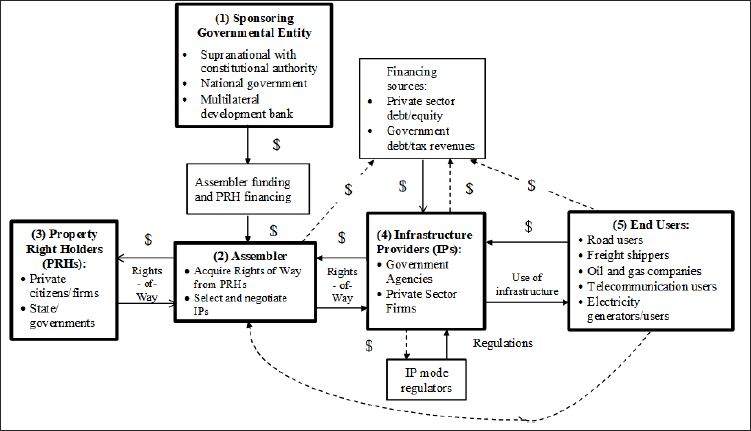
An Intermediation on Model of a Multimodal Corridor.
An assembler must first acquire route rights-of ways. Depending on route potential and property rights ownership, the number of PRHs could range from a single PRH—in contexts where a given national government retains land ownership rights or retains specified rights-of-way—through to a very large number of PRHs. The number of feasible routes is an important determinant of the number of PRHs. In some geological circumstances, there may only be one potential route. If so, PRHs on that route may have a degree of monopoly bargaining power.
Another central task of the corridor assembler is to negotiate with potential IPs, both mode builders and operators. The number of potential IPs, however, is limited because each mode provider can expect to operate as a natural monopoly. Each infrastructure mode, whether a road, railway, telecommunications network, electricity transmission grid, etc., requires very large, upfront, indivisible and ‘sunk’ cost investments. Thus, a single mode provider would incur lower costs of provision than would multiple providers, where each would produce a fraction of the total output of services demanded. Once built, the marginal or incremental cost of providing one more unit of service is small or even zero. Therefore, there will be very large economies of scale.
An assembler would confront a limited number of potential IPs; most potential corridors would expect to include no more than seven modes. We now consider the cost advantages of an assembler versus the absence of one on a multimodal corridor and then the cost advantages of multimodality.
There are two major cost advantages to having a dedicated assembler (Boardman, Moore and Vining 2020; Priemus and Zonneveld 2003; Sulzenko and Fellows 2016). First, a dedicated assembler reduces the fixed costs (F) of conducting the required property surveys, route designs and environmental reviews, as these will only have to be conducted once for the corridor (albeit depending on the specific mode characteristics). In the absence of an assembler, each IP would need to make a similar investment on its own. Indeed, the IPs would also have to negotiate and agree on a single route in order to capture the benefits of multimodality, incurring additional costs that the existence of an assembler would obviate.
Second, the presence of an assembler drastically reduces the number of required negotiations and so their costs. Without an assembler, each IP would need to negotiate with each PRH on the route to secure a corridor right-of-way. If there are M IPs and N separate PRHs, there would be N × M negotiations (where N and M are integers). The total transaction costs of these negotiations of the M IPs (TIP) would be

The transaction cost function T(x) increases in the number of negotiations (i.e., T’(x) > 0 for all x > 0).
2
An assembler would only need to negotiate once with the N PRHs and once each with the M IPs, resulting in only N + M negotiations. The total transaction costs of assembler negotiations (TA) are

Thus, an assembler will have a transaction cost advantage as long as N × M > N + M, provided that the assembler and the IPs have the same transaction cost functions. This advantage will be even greater if the assembler’s transaction costs in any given negotiation are lower than for any single IP. This would likely be the case if the assembler has accumulated experience organising previous corridors or related projects such that TA(x) < TIP(x) for all x > 0. 3
With multimodality (M > 1) there will be a relative cost advantage for an assembler if N >1 but a disadvantage if N =1. As a single corridor, PRH is very unlikely (unless the relevant state owns all the land, in which case no assembly is needed!), then an assembler will have a transaction cost advantage. This relative advantage increases both as the number of PRHs and as the number of IPs increases. However, even given an assembler, increasing the number of PRHs and IPs increases the transaction costs of assembly and so reduces the likelihood of any M&;M corridor implementation.
We now consider the specific cost advantages of multimodality, as distinct from those arising from the presence of an assembler. First, the upfront costs (Fj) of conducting necessary property surveys, route designs and environmental reviews will only have to be conducted once for the multimodal corridor j. In contrast, with M unimodal corridors these upfront costs would be:
Second, having each mode located on a separate route, each with Ni distinct PRHs, i = 1, 2,…, M, would result in
Third, in addition to the negotiation cost reductions, the costs to an assembler of acquiring the rights-of-way from the PRHs on the multimodal route j (CAj) should be much lower than the costs of acquiring such rights from the PRHs on M unimodal corridors, which would be:
Fourth, there are likely cost savings to multimodality in building co-located infrastructure. For example, having built the road or railway, these modes can then be used to transport materials and personnel needed to build additional modes in the same way that telegraph lines were strung along railway routes in the 19th century across North America (Schwantes 2019). Finally, the environmental costs of a multimodal corridor will almost certainly be lower than those of a number of unimodal corridors.
Thus, the total costs of assembling a multimodal corridor (TCM), before any IP infrastructure is built, would be

where j is the multimodal corridor route, whereas the total costs of assembling M unimodal corridors (TCU) would be

One would certainly expect that TCM would be much less than TCU. Since there are cost advantages both from the existence of an assembler and from multimodality, a multimodal corridor would have significantly lower costs than multiple unimodal corridors and no assembler. The total cost advantage (TCA) would be

That is, the cost to M IPs of having to survey, plan, gain regulatory approvals, negotiate with PRHs and acquire rights-of-way on M separate unimodal routes will greatly exceed the costs of a dedicated assembler for a single multimodal route.
In sum, there are a number of cost advantages to an M&;M configuration. Of course, this does not mean that all corridor proposals would meet an appropriate social welfare improvement test (NB>0), especially given the tendency to optimism bias in large public projects (Flyvbjerg, Bruzelius and Rothengatter 2003). Addressing that question requires performing the corridor-specific cost–benefit analysis. However, as far as we are aware, few ex ante cost–benefit analyses have actually been performed. We now consider why, in spite of the cost advantages and large potential benefits of multimodal corridors, especially in developing country contexts, they are still scarce.
Given the potential benefits of M&;M corridors, why are they so difficult to implement? They do face, of course, the same financing and funding barriers as do all large infrastructure projects with significant sunk costs. But they also face unique barriers that relate to more fundamental political economy factors that are only manifested in multijurisdictional contexts.
M&;M corridors involve upfront design, planning, right-of-way acquisition and physical infrastructure investments that are largely sunk after construction but before use. Ex ante, these investments require a combination of short-term financing commitments and long-term funding commitments. The financing components need to be finalised before corridor implementation can proceed, which in turn require agreed-upon funding commitments. There are limited possible sources of both financing and funding for M&;M corridors, for both economic and political reasons. In addition, there are significant political economy barriers to implementation, some of which apply to all large infrastructure projects, but others that are specific to multijurisdictional corridors.
Barriers to Multijurisdictional Assembler Formation
An authoritative supra-jurisdictional decision-making entity clearly facilitates the establishment of an assembler for multijurisdictional corridors (Nordhaus 2015; Olson and Zeckhauser 1966). The reason is that, in the international or other constitutional context, corridor implementation requires the consent of all participating nations. As Nordhaus (2015, 1340) notes:
The 1648 Treaty of Westphalia established the central principles of modern international law. First, nations are sovereign and have the fundamental right of political self-determination; second, states are legally equal; and third, states are free to manage their internal affairs without the intervention of other states. The current Westphalian system requires that countries consent to joining international agreements, and all agreements are therefore essentially voluntary. (Treaty of Vienna 1969, article 34)
Effectively, this means that each jurisdiction must expect an increase in its own social welfare, either directly or through compensation from one or more of the benefiting nations: a higher threshold than NB>0. As discussed earlier, the transaction costs of arriving at an agreement on compensation will increase rapidly with the number of jurisdictions involved, making implementation less and less likely. In sum, in federated nations, many subnational negotiations over corridors—whether province-to-province, canton-to-canton, state-to-state or länder-to-länder—are now more like classic international (Westphalian) negotiations among sovereign states (Watts 1998).
Barriers to Multijurisdictional Assembler Financing
As summarised in Figure 1, a sponsor is needed to finance the creation of an assembler, which then must finance the acquisition of rights-of-way along the corridor. In practice, the sponsor may also have to fund the assembler’s subsequent steps. If multiple nations are needed to agree to create an assembling entity, they will face significant transaction costs in negotiating financing shares and amounts. Each nation has an incentive to try to free ride on other nations, increasing the probability of coordination failure. This risk increases exponentially with the number of nations involved. The pre-existence of a supranational sponsor, where donor shares have already been negotiated cost shares, considerably reduces this implementation barrier.
Assuming that an assembler does obtain initial financing from a sponsor, it must then determine (i) how to provide IPs with access to the corridor; (ii) how to obtain longer-run funding to repay the initial financiers; (iii) how to sustain its ongoing operation; and (iv) how to regulate the IPs. Assemblers can be ultimately funded in a number of ways, whether (i) charging access fees to IPs for the right to provide infrastructure on the corridor; (ii) charging the end users; or (iii) funding the corridor with tax revenues. The feasibility and desirability of these options will depend on the regulatory framework of the infrastructure-service provision (Boardman, Moore and Vining 2020).
Barriers to Multijurisdictional Assembler Funding
Boardman, Moore and Vining (2020) consider alternative means of funding an assembler. The most likely are either the end users (Bird and Slack 2017) or taxes, notably those arising from increased land values at intermediate or end points along a corridor. As land is a fixed factor, it is feasible to tax the increment in value—value capture—taxation that is virtually impossible to escape (Batt 2001; Connolly and Wall 2016). There will likely be an unequal distribution of tax revenue increases across jurisdictions. As argued above, the more uneven the distribution of the costs and benefits across jurisdictions, the less likely M&;M corridor implementation becomes.
IPs’ Financing and Funding
Once an assembler is in place, IPs that expect ex ante to operate a profitable mode, such as an oil pipeline, freight railway or telecommunication line, can often raise their own financing either internally or by borrowing. Some IPs may also seek to access financing through public–private partnerships (PPPs) (Saini and Giri 2022). Typically, PPP consortia raise equity finance from their members; that is, the firms that are directly engaged in infrastructure design/build, operation or maintenance. However, PPPs have rarely been a source of financing for this kind of infrastructure with the exception of the Channel Tunnel (Chunnel), which eventually collapsed in bankruptcy. Private equity is another potential source of infrastructure financing. Gemson, Gautami and Rajan (2012) argue, however, that private-equity investors prefer to invest in operational infrastructure projects with less revenue risk, making this an unlikely source of finance for greenfield M&;M corridors. Public pension plans may provide financing because infrastructure with end-user charges can provide steady, long-term cash flow with which to pay retirees and other beneficiaries. However, pension plans are reluctant to bear construction risk, making them also unlikely sources of M&;M corridor finance.
Given the barriers to private finance, the more likely sources of M&;M corridor financing are governmental, or supranational entities such as MDBs, and the most likely funding sources are end users or governments. As with the establishment of an assembler, this requires either one nation that is prepared to finance and possibly fund an M&;M corridor that serves its own national interest, or a supranational entity that has pre-existing financing share agreements, such as the EC or a willing MDB. With multiple nations involved, however, negotiating the division of financing also presents a significant implementation barrier.
Political Economy Barriers to M&;M Corridors
Political economy theory (also known as public choice theory or rational choice theory) focuses on governments’ and firms’ actual motivations and behaviour. Buchanan (1996, 12) summarises that ‘the analysis attempts to relate the behaviour of individual actors in their various capacities as voters, as candidates for office, as elected representatives, as leaders’ or members of political parties, as bureaucrats … to the composite of outcomes that we observe or might observe’. It posits that governments essentially seek to maximise votes (Downs 1957) or equivalent political benefits. There are political economy costs that discourage politicians from investing in all forms of capital-intensive infrastructure investment (Dwyer 2020; Helm 2010). The temporal patterns of infrastructure expenditures, revenues, costs and benefits are often unappealing from an electoral perspective. Infrastructure features budgetary expenditures and social costs that governments bear at the initiation of projects. However, benefits and revenues flowing are not realised for a number of years and are then often directly received by firms or individuals (usually in the form of consumption benefits, such as time savings or operating cost reductions), rather than as government revenue (Coelho, Ratnoo and Dellepiane 2014). Furthermore, corridors are particularly prone to generating NIMBY opposition (Euston and Nursultan 2020).
From a political economy perspective, organising a corridor that crosses national borders, or even one that crosses subnational constitutional boundaries, is intrinsically more costly than one that does not. These corridors present a collective action problem, because in many potential M&;M corridor contexts, there is no authoritative supranational decision-making authority (Poteete, Janssen and Ostrom 2010). Adding to the political cost is the fact that, to the extent that an external entity to the transited nations partially funds a corridor, the citizens of the nations that bear those costs will not be the same as those that potentially benefit from it.
Corridors: Case Evidence and Some Implications for Future Implementation
What is the evidence derived from the small number of extant M&;M corridors and a slightly larger number of other complex corridors that illustrate aspects of our framework? A caveat is that most information relating to these projects is found in ‘grey literature’ and much of it is overtly promotional (Quium 2019). Kumar and Isran (2019) provide the most comprehensive summary of planned and realised economic corridors in Asia, Africa and Europe, as well as the infrastructure modes within each (see their Tables 1–4). Many or most of these projects, however, are not truly multimodal in our use of the term.
It is not clear that any existing corridor can claim to be actually both multijurisdictional and multimodal, apart from those operating within the EU. The closest non-EU project to a true proposed M&;M corridor is the Lamu Port–Southern Sudan–Ethiopia Transport Corridor (LAPSSET). Other corridor clusters that have the potential to achieve M&;M status are the Greater Mekong Subregion Program (GMS), the South Asia Subregional Economic Cooperation Program (SASEC), and the Central Asia Regional Economic Cooperation Program (CAREC), although each of these is more intermodal than multimodal. The two economic corridor clusters to receive the most attention are the Trans-European Networks (TENs) and the Chinese Belt and Road Initiative (BRI) (Xu et al. 2021).
LAPSSET: Lamu Port–Southern Sudan–Ethiopia Transport Corridor
This proposed multimodal corridor would encompass Kenya, South Sudan and Ethiopia (LAPSSET Corridor Development Authority (LCDA) 2015). While these nations initiated the project in 2012, to date they have not established an organising entity, although in 2020 they did sign a joint communiqué that established a steering committee to develop an ‘umbrella body’ to coordinate implementation (i.e., an assembler). Committee members include representatives of the three governments: the UN Economic Commission for Africa, the African Union (AU) Development Agency and the African Development Bank (AfDB), an MDB. The LAPSSET project has been ‘adopted’ by the AU Program for Infrastructure Development in Africa (LCDA 2020).
The proposed corridor is to be between 500 metres and 10 kilometres wide. The LCDA claims that it does not require the acquisition of individual rights-of-way, as they are held communally without individual land titles. The LCDA and the National Land Commission of Kenya are to acquire the necessary land in Kenya and pay compensation to affected communities (LCDA 2020; Rift Valley Institute (RVI) 2013). The corridor would consist of a port at Lamu, railways to Juba and Addis Ababa, roads and crude oil pipelines to South Sudan and Ethiopia, an oil refinery, an electricity transmission line, a fibre optic cable network, four international airports and two resort cities. Most of the potential IPs appear to be Kenyan state-owned enterprises (LCDA 2020). The Kenyan government is providing some 25% of the financing, but there is also MDB finance from the AfDB, and from the World Bank, the EU and China (Chome et al. 2020, Table 1; RVI, 2013). The Kenyan government seeks private sector participation through equity and infrastructure bonds, but there is little evidence that much has occurred. The Kenyan government is financing the first three berths of the Lamu port, although the ultimate source of finance for these may be Chinese loans (Chome et al. 2020). The remaining 29 berths are to be financed by private-sector investors, as are the airports, the oil pipelines and all the development of the resort cities except for the basic infrastructure (LCDA 2015). However, as of 2022, it appears that (at most) only three of the government-financed berths have been constructed by the Chinese Communications Construction Company (Chome et al. 2020). The project seems to be delayed due to a combination of governmental financial constraints, a paucity of private financing and a lack of political goodwill among the participant nations (LDCA 2020; RVI 2013).
GMS: Greater Mekong Subregion Program; SASEC: South Asia Subregional Economic Cooperation; CAREC: Central Asia Regional Economic Cooperation
Each of these regional initiatives consists of multiple corridors. All of them are multijurisdictional by design but, to the extent that one can determine, all are intermodal. The ADB has promoted and mostly financed these corridors and has sponsored the programmes; GMS, SASEC and CAREC are the assembling entities. All three consist of transport and energy projects, with CAREC also including trade facilitating projects and SASEC adding trade and telecommunications (Kertzman 2018).
The GMS programme is designed to foster trade and development among China, Vietnam, Laos, Cambodia, Myanmar and Thailand (Brunner 2013; Fung, Garcia-Herrero and Ng 2012). The transportation infrastructure consists mostly of road projects, with some port development. There has been some private financing, but this has been limited by large sunk costs, long payback periods, political risks and the transaction costs of multijurisdictional negotiations (Kertzman 2018). From 2009 to 2011, the ADB and national governments provided over 70% of financing while PPPs accounted for only about 3% of US$26.5-billion financing (Fung, Garcia-Herrero and Ng 2012, 430, Table 11.A7). 4
SASEC would consist of six corridors connecting India, Bangladesh, Nepal and Bhutan. The aspiration is to re-establish South Asia’s transport network that was disrupted by political partition (Brunner 2013). Up to 2017, ADB supplied US$6 billion in financing (Kertzman 2018). It is currently unclear, however, how much implementation has actually taken place (Abdou et al. 2019).
CAREC is designed to facilitate trade among China, Mongolia, Pakistan, Afghanistan, Georgia and several other Asian countries. As of 2017, the ADB had contributed US$11 billion 2017 (Brunner 2013; Kertzman 2018). Currently, the CAREC programme supports two corridors: the Almaty–Bishkek Economic Corridor and the Shymkut–Tashkent–Khajand Economic Corridor, although it is unclear whether either is multimodal, and they still appear to be mostly in the planning stage (Abdullaev and Akhmedov 2021).
TEN-T: Trans-European Transport Network
The EC originally planned three TENs: transport (TEN-T), energy and communications. The EC’s stated intention is to strengthen the internal market by interconnecting various national infrastructures and ensuring better access to networks (Turner 1995). The TEN-T consists of a cluster of transport corridors with a planned implementation date of 2030. None of these corridors is yet an M&;M corridor in the sense that we use the term as the linkages are intermodal rather than multimodal. Much of the infrastructure was already in place, and the incremental projects were designed to improve intermodal linkages (European Commission (EC) 2014). In this context, there is a limited need to acquire new rights-of-way. As our analysis would suggest, private financing of the TENs, especially TEN-T, did not emerge because of the amounts required, construction risks and limited immediate revenues (Turner 1995). While the TEN-T has received some EC financing and funding, to date member nations have provided most of the finance and funds (Otsuka et al. 2017). The key implementation barrier that has delayed the TEN-T is that, as our model suggests, member nations have tried to free ride by attempting to obtain EC monies to improve their own national infrastructures. Indeed, Aparicio (2017) argues that the TEN-T financing and funding have mostly been captured by a coalition of the EC and self-interested national transport providers. We suspect that this is why there has been a financing deficit (Otsuka et al. 2017; van der Geest and Núñez-Ferrer 2012a).
To address financing and funding barriers, several governance changes were made in 2006. A new executive agency was created to manage assembly: the Innovation and Networks Executive Agency (Aparicio 2017). Project coordinators (mostly unpaid politicians) were appointed as fixers to improve governance, to identify additional financing sources and to generally facilitate the implementation of each major TEN-T project. Member nations agreed on Corridor Forum members to assist the coordinators in implementation (EC 2014). The Connecting Europe Facility (CEF) provides a single financing mechanism for all the TENs (Otsuka et al. 2017). The European Investment Bank and the European Bank for Reconstruction and Development Infrastructure (regional MDBs) have provided most of the financing in the form of loans, with additional financing from the Structural and Cohesion Funds (EC 2014; Marshall 2014). PPPs have provided some limited finance but with loan guarantees from the CEF. User fees also represent a small source of funding, but the main sources appear to be member nations’ government budgets (van der Geest and Núñez-Ferrer 2012a).
The TEN-T demonstrates the difficulties of creating multijurisdictional corridors, even when these would mostly connect existing national infrastructures. As expected, financing and funding barriers have been the main sources of delay. The progress that has been made has been possible because of ‘…the existence of solid intergovernmental institutions…a supranational administrator (the EC), and clear treaties defining the terms of collaboration’ (van der Geest and Núñez-Ferrer 2012b, 337). This illustrates the value of a supranational sponsor that can at least provide the institutional framework to create an assembler. Even without the need to obtain new rights-of-way or to negotiate with multiple new potential IPs, the EC has faced many barriers to the implementation of these corridors.
CPEC: China–Pakistan Economic Corridor
The CPEC is the BRI’s flagship project and is the largest recipient of BRI investment (Ghiasy 2021). The core consists of an intermodal corridor that will link Xinjiang province to Pakistan’s Gwadar port at the mouth of the Persian Gulf by road and rail (Alam, Li and Baig 2019). It may also include oil and gas pipelines. CPEC is a stated priority for China because it provides China with a direct connection to the Strait of Hormuz and the Arabian Sea.
Similar to many other corridors, it is hard to find data pertaining to CPEC. In 2017, Dawn, a newspaper, obtained a copy of CPEC’s master plan that revealed that it ‘envisages a deep and broad-based penetration of most sectors of Pakistan’s economy’ (Husain 2017). By 2018, CPEC had received US$60 billion (Hillman 2018). While the details of the terms have not been revealed, the US Department of State has argued that the plan benefits China but is unsustainable for Pakistan. Both the Chinese and Pakistani governments aggressively stamp out criticism (Afzal 2020). Some scholars argue it may yield a significant influence over Pakistan’s economic, social and human development, energising core economic sectors and contributing positively to the balance of payments (Wolf 2020).
CPEC is being built in phases, with the first 2015–2018 phase now being complete. Despite political differences between China and Pakistan, CPEC plans have been modified successfully over time and more attention is paid to local communities (Ghiasy 2021). However, there are many potential problems to complete implementation. In addition to construction problems due to the climate and terrain, there is long-running internal political turmoil at the national and inter-provincial levels, the Uighur issue, domestic terrorism, militancy, national border disputes and international jihadism (Garlick 2018; Wolf 2016, 2020).
BRI: Belt and Road Initiative
The government of China is the sponsor and de facto assembler of the BRI, previously known as the One Belt One Road project. As mentioned above, CPEC is the largest part of the BRI, but there are many other related projects. The heart of the BRI consists of several land-based corridors to connect Asia and Europe (the Belt) via high-speed railways, highways, energy and distribution networks as well as fibre optics, and the ‘21st Century Maritime Silk Road’ (the Road), a sea-based route linking Chinese ports with South Asia, Southeast Asia and Africa (HSBC Global Asset Management 2019; OECD 2018; Wolf 2016). Most of the corridors appear to be intermodal, although some have the capacity to become multimodal.
Yang, Jiang and Ng (2018, 192) point out that ‘…owing to the only recent release of B&;R documentation and to poor data availability, empirical data is scanty, and the number of quantitative research papers is limited’. Referring specifically to the CPEC, one of the flagship projects of the initiative, Syed and Ying (2020, 3) argue:
Scholars have also pointed towards issues of transparency and accountability in CPEC’s execution. For a programme of this scale and importance, the status reporting available for implementation is very limited. The CPEC website of the Government of Pakistan provides limited basic information. Detailed information is not available on performance targets, percentage completion or disbursements.
China obviously has complex strategic and geopolitical motives for the BRI (Dwyer 2020; Garlick 2018). Dwyer (2020, 1) summarises this as follows: ‘…the BRI is more an effort to marshal a variety of existing infrastructure initiatives under a single grand narrative associated with the leadership of Xi Jinping than it is a de novo plan’. Indeed, some already completed projects, such as the Northern Economic Corridor, a two-lane highway linking Yunnan province with Chang Rai, Thailand through Laos, have been added to the BRI ex post (Dwyer 2020). The OECD (2018) claims that the Chinese National Development and Reform Commission oversees and coordinates all BRI projects (i.e., is the assembler), but others have suggested that there are multiple assemblers (HSBC Global Asset Management 2019). What is somewhat clear is that most projects involve Chinese state-owned enterprises, in one way or another. Chinese state-owned banks as well as the China Development Bank have overwhelmingly supplied the financing (Murtaza and Ali 2021). The Asian Infrastructure Investment Bank and the Silk Road Fund have contributed a small percentage. Financing typically consists of loans, some concessionary and some at market rates (HSBC Global Asset Management 2019; OECD 2018).
Some Policy Implications and Conclusions
This paper develops a novel framework that integrates the important components of an M&;M corridor. We employ a supranational social welfare (or social value) perspective that encompasses all traversed nations or constitutional jurisdictions. We argue that these corridors should only proceed if the aggregate social benefits exceed the aggregate social costs from a supranational perspective. This may only be achievable via cross-national or subnational side payments. We further argue that an M&;M corridor is highly unlikely to proceed without a national or supranational sponsor and a dedicated supranational assembler, which intermediates between the PRHs, IPs and ultimate users. The primary ex ante intermediation benefit from the presence of an assembler is to reduce transaction costs between PRHs and IPs, but an assembler also reduces ongoing transaction costs ex post, once a corridor is in place. We also consider the roles of the financiers of the various infrastructure modes, end users of the infrastructure modes and regulators, and possible sources of financing and ultimate funding. We examine the evidence from the few proposed or realised M&;M corridors to test whether it is at least consistent with the framework.
The framework shows the cost advantages of a dedicated M&;M assembler, especially when there are a large number of PRHs and multiple infrastructure modes and providers along a corridor route. These cost advantages increase in the number of PRHs and IPs. Given the existence of an assembler, there are cost advantages to multimodality which also increase with the number of infrastructure modes. Indeed, given the political economy costs of M&;M corridors, and that there may be only one opportunity to implement a corridor, a sponsor and assembler may be better off going multimodal. However, even with an assembler the transaction costs of assembly increase in the number of PRHs and IPs, thus reducing the likelihood of corridor implementation.
We identify many significant barriers to implementing an M&;M corridor. Implementation requires a sponsor and there are only a few entities that actually have the necessary authority and resources to exercise that role. In practice, sponsors are either a regional supranational entity with constitutional or quasi-constitutional authority, or a dominant hegemonic country. China, for example, sponsors the BRI, but Brazil, India, Nigeria, South Africa or Kenya also have the potential to be hegemonic government sponsors, possibly without many of the geopolitical ambiguities that surround China’s motivations (Callahan 2016; Kindleberger 1981; Li et al. 2022; Ogunnubi 2017; Pedersen 2002).
There are at least three reasons for the lack of implementation of multijurisdictional corridors, in addition to their inherent complexity relative to unijurisdictional corridors. First, corridors are less likely to be implemented when the economic benefits are unevenly distributed, both across jurisdictions and across stakeholder groups within each jurisdiction; both tend to reduce political support for these corridors. An uneven distribution of benefits is more likely, the greater the number of jurisdictions that must be traversed. Second, the more jurisdictions involved, the greater the transaction costs of negotiating the sharing of the financing and funding of a credible assembler. Uneven distribution of benefits and costs increases the need for cross-subsidisation. Third, the greater the number of jurisdictions involved, the less feasible it is to use value capture to fund the assembler and, potentially, some of the infrastructure provision.
The largest potential net benefits of an M&;M corridor are most likely in continental regions where there are multiple, less wealthy and landlocked countries that have the potential to substantially reduce their trading costs. The African continent, Latin America and South Asia are prime candidates (Moore, Boardman and Vining 2020; Sequeira, Hartmann and Kunaka 2014). However, without a sponsor and a dedicated assembler, an M&;M infrastructure corridor that traverses developing countries will not get built. Unfortunately, conventional supranational organisations similar to the EC are relatively weak in these regions, so either a regional hegemon or an MDB would have to play the role of a sponsor and assembler. In addition, property rights in these regions are either fragile or contestable which makes their assemblage more costly (Mkutu, Müller-Koné and Owino 2021; Unruh et al. 2019).
Footnotes
Declaration of Conflicting Interests
The authors declared no potential conflicts of interest with respect to the research, authorship and/or publication of this article.
Funding
The authors received no financial support for the research, authorship or publication of this article. In places we draw upon a paper prepared for the Canadian Northern Corridor Research Program and we acknowledge their financial support for it.
