




Abstract
This essay revisits the history of Ranjit Movietone, India’s longest-running studio to date. Based on new research, it argues that Ranjit Movietone’s 40-year record was made possible by a form of transversal integration that is not accounted for in current film historiography. The result of a symbiotic relationship between film production and cotton trading in colonial India, Ranjit Movietone’s mode of operation hinged on time delay, overproduction and slow turnover. This argument is supported by the analysis of visual material contemporary to and often produced by Ranjit Movietone. As most of Ranjit Movietone’s films were destroyed in a fire, the essay seeks to demonstrate that valuable historiographic insights can be gained from paying close attention to para-filmic sources. This material also shows that the star value of studio co-founder Gohar Kayoum Mamajiwala was an important, though not the sole, component of Ranjit’s mode of operation. Better known in her days as the ‘Queen of Emotions’, Miss Gohar has been written into film history simply as an actor and wife of studio owner and director Chandulal Shah. A more nuanced understanding of industrial integration in cinema, as it functions differently in specific historical formations, would enable us to make visible the valuable contribution to the cinema of Gohar and other women like her.
Introduction: The Times of Ranjit
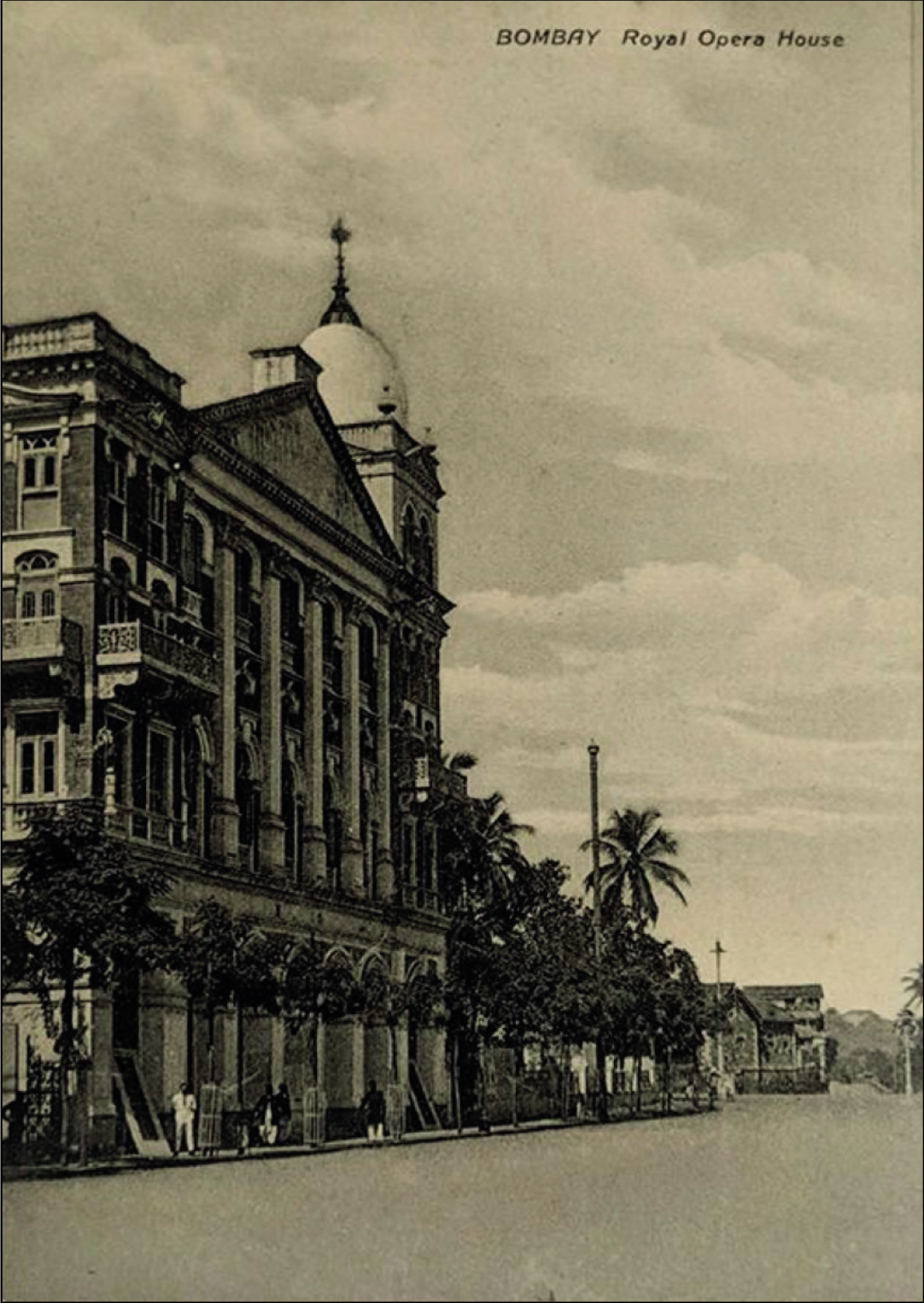
Ranjit Movietone remains India’s longest-running and most productive studio to date. Its lifespan covered three of the most formative and historically significant decades of Indian cinema: from the late 1920s to the 1950s. The period between the late 1920s and the second half of the 1930s is marked by three key industrial developments. From the early 1930s, the exhibition sector opened up and expanded, especially in Bombay. With new, purpose-built or smartly refurbished cinema halls showing Indian talkies, exhibitors started catering not only to a select middle class with imported films or to workers of the newly opened textile mills with locally produced stunt movies, as they had done in the late silent cinema period, but also to a broader middle-class base (Bhaumik, 2001, p. 114ff). The Royal Opera House (Figure 1) was one such venue: opened in 1916, it was converted into an elegant cinema in the 1930s.
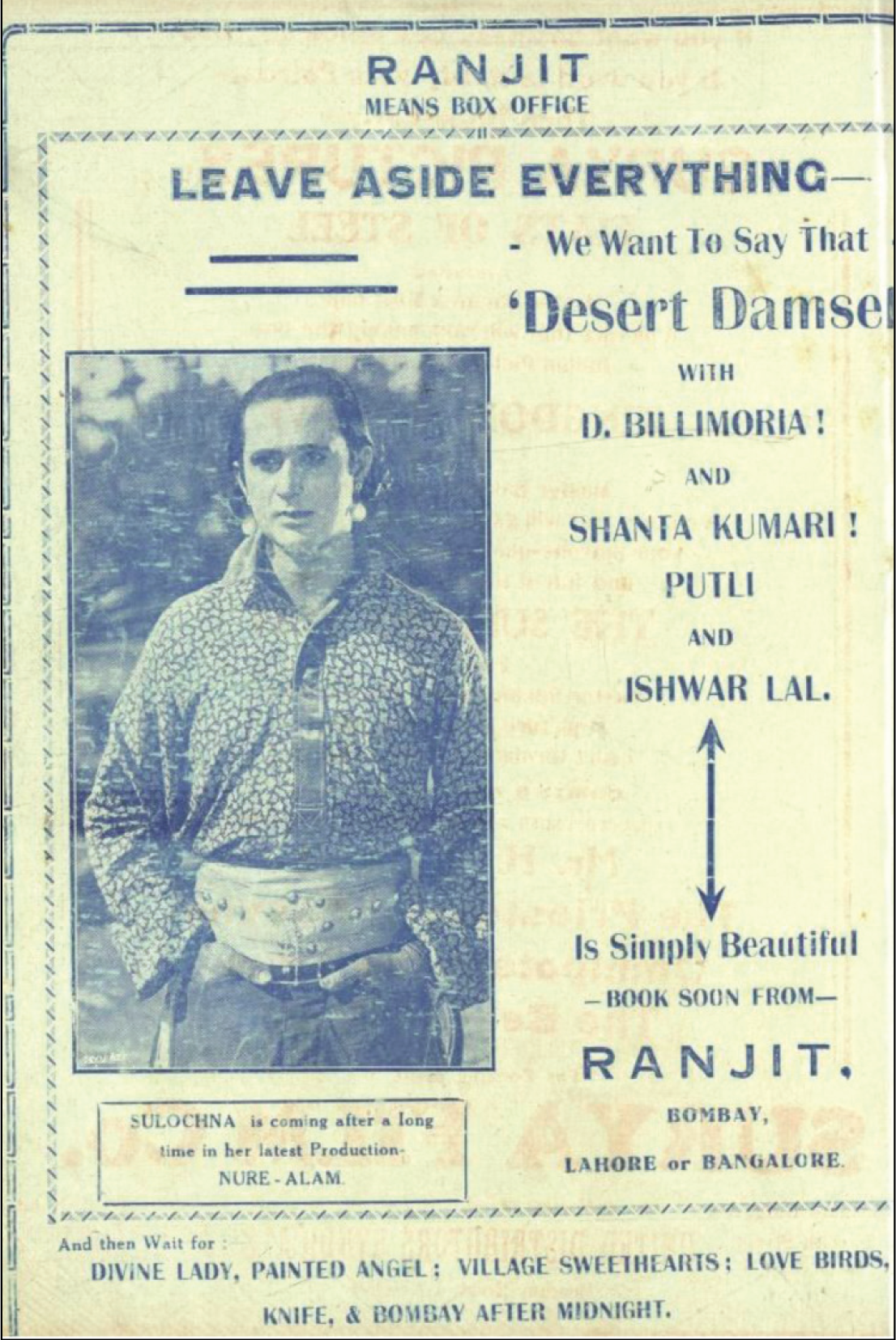
Large distribution concerns began forming at this time, quickly extending their reach to parts of colonial India other than Bombay, Maharashtra and Gujarat (Moving Picture Monthly, 1935, p. 27). With distributors also came the first Indian film magazines. 1 Early film magazines and advertisements were distribution tools that addressed primarily, if not exclusively, exhibitors. Cinema was one such publication. Its May 1931 issue (Figure 2) proposes the silent film Mojili Mashu/Desert Damsel (Nanubhai Vakil, 1931) to exhibitors by pointing to Ranjit films as a guarantee of quality and profit: ‘Ranjit means box office’.
The 1930s also saw the creation of the Indian Motion Pictures Producers Association (IMPPA, 1936). The IMPPA was ‘at the head of a number of organised film interests that included distributors, exhibitors, technicians, journalists and performers’ (Bhaumik, 2001, p. 119). Dominated by the more prominent figures of the industry (including Ranjit Movietone’s co-founder Chandulal Shah), the IMPPA managed inter-company disputes, maintained relations with local politicians and, in 1939, organised the first All India Motion Picture Congress.
Ranjit was set up 10 years earlier, in 1929, as Shree Ranjit Film Company, by Gohar Kayoum Mamajiwala, then a major film star at Kohinoor Film Company, and film director Chandulal Shah, also at Kohinoor, though trained as a stockbroker. Ranjit was originally financed by bullion businessman Vithaldas Thakordas. When he died in 1930, Ranjit found help with the investments it needed for sound production from Kapurchand Nemchand Mehta and his brothers, who were then setting themselves up as distributors–exhibitors. When the Mehta brothers withdrew from the film financing business, Ranjit ‘started its own financing concern, alongside a new distribution company called Supreme Distributors’ (Mukherjee, 2020, pp. 74–75, 337n37).
Throughout the 1930s, the now-renamed Ranjit Movietone maintained an average of 350 employees. In the 1940s, the numbers reached 650 (Mukherjee, 2020, pp. 74–77), including several major film stars. During its silent cinema years, Ranjit made an average of six to eight films per year; with the conversion to sound, it made between four and six (Karnad, 1980, p. 77). Ranjit talkies were released in multiple languages. Indeed, Ranjit was the first Bombay producer to record its first talkie, the mythological hit Devi Devayani (Chandulal Shah, 1931), on the double sound system Audio-Camex (Moving Picture Monthly, 1935, p. 17). By 1938, when Gohar and Shah inaugurated their new soundproof studio (Figure 3), Ranjit had four sound stages, the largest number in the country and an assembly-line approach to production (Mukherjee, 2020, p. 77). By the late 1950s, the studio had made over 160 films, the largest number under any single banner in Indian cinema (Rajadhyaksha & Willemen, 1998, pp. 192, 212).

Ranjit was the only producer to survive the transition to synchronised sound in India. By the second half of the 1930s, it had become India’s largest film producer. Operating successfully until the late 1960s in an industry where historically producers have been the most vulnerable sector, the studio’s record begs the question: what enabled Ranjit to last so long? It is a question of consequence beyond the immediate field of Indian cinema. By the 1930s, Hollywood studios had grown into corporate companies whose main line of business was film production. ‘The Big Five Majors’ (Paramount Pictures, Warner Bros., RKO Pictures, Metro-Goldwyn-Mayer and 20th Century Fox) and ‘The Little Three’ (Universal Pictures, United Artists and Columbia Pictures) formed the core of a cinema that, well into the 1970s, operated as a ‘vertically integrated’ industry, in the sense that these studios controlled distribution directly and, indirectly, also exhibition (cinema halls) (Cook, 2002; Monaco, 2003). 2 Because of the dominance of Hollywood cinema, both as an industry and a subject of study, vertical integration has tended to be tacitly though erroneously assumed as the default mode of large national cinemas the world over. The corollary of this has been historians’ near-exclusive focus on film production (and thus on studios and directors) until relatively recently, at the cost of distribution and exhibition. This has also been the case for the study of cinema in India (Vitali, 2006, 2008). 3 Co-run by Shah and Gohar as a ‘film factory’ (Gohar, quoted in Karnad, 1980) in a vertically non-integrated industry, Ranjit represents a model that is radically different from the one at work in the United States during the same period. Different, that is, from the model that is still assumed as default in film historiography.
Ranjit Movietone’s Formula
In 1930s India, Ranjit was not a typical producer. In 1935, the Moving Picture Monthly listed 86 production concerns in Bombay alone, with another 10 in Pune and Kolhapur. Of these, only 27 had their own studio.
Out of this number about thirteen have sound proof studios and possess lighting equipment. The rest are open air studios. […] Thirty produced only one or two pictures and are not showing any signs of activity. About twenty nine more are busy shooting their first picture or have completed the picture and are waiting for its release. (Moving Picture Monthly, 1935, p. 19)
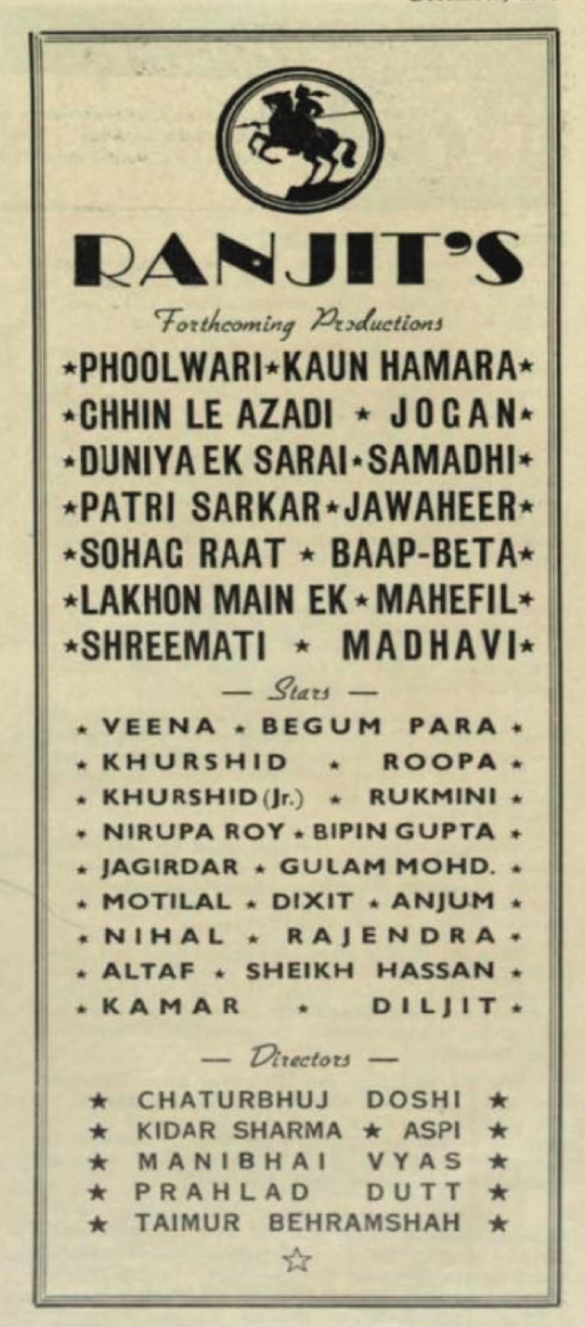
As contemporary critics and later historians have documented, the 1930s boom in Indian cinema coincided with ‘a glut in the market’ (Fazalbhoy, quoted in Prasad, 1998, p. 38) – a period of fly-by-night, one-off operations more akin to gambling than anything resembling film production, and of a high mortality rate among ‘producing concerns’. Regular film production came from a dozen studios, of which Ranjit was, for a comparatively long time, the largest and most productive (Figure 4).
Seven of the fourteen films advertised as ‘forthcoming’ in the advertisement given in Figure 4 are listed in the authoritative Encyclopaedia of Indian Cinema. The remaining seven may have never been released or were released with a different title. Even so, historians agree that Ranjit was, for many years, one of the biggest and most prolific studios in Indian cinema. It was not, however, a vertically integrated company. What, then, enabled Ranjit to weather the volatile conditions of Indian cinema during the formative decade of the 1930s, thrive in them and emerge in the 1940s as a leading player?
Five key features distinguish Ranjit Movietone from other comparatively stable studios at the time. First, as we have seen, ownership of a production site, with physical studios and in-house production equipment. Second, Ranjit used advertising extensively, through which it created a distinctive brand name. In its early days, Ranjit’s main advertising tool was the in-house studio magazine, written in Gujarati and English. This was, to my knowledge, the only instance of an Indian production studio setting up and running its own magazine. Unlike earlier magazines, the fortnightly Ranjit Bulletin was aimed, crucially, at audiences. It included news of forthcoming Ranjit productions, profiles of Ranjit stars, a fans’ letters section (Figure 5) and advertisements of consumer products (Figure 6).


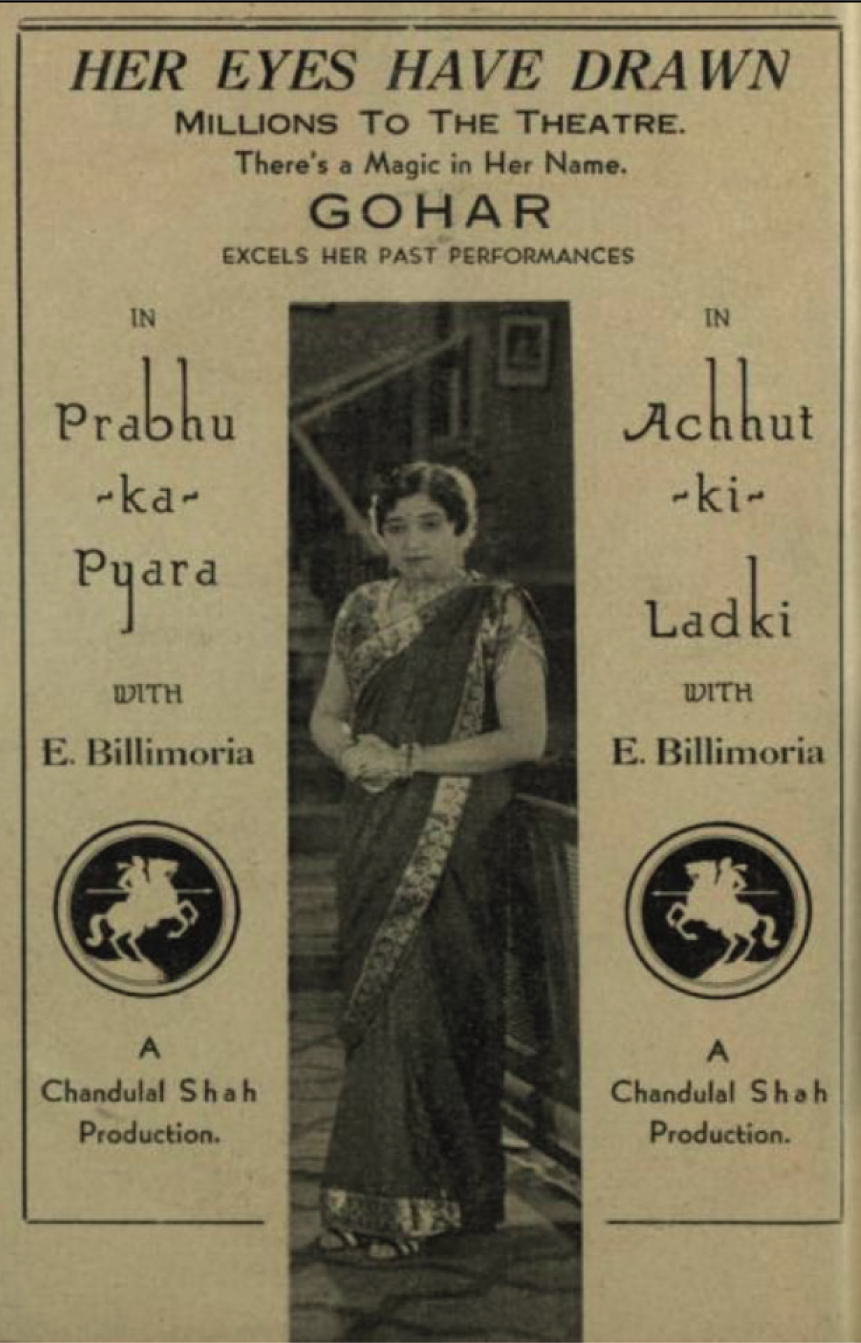
The studio cultivated its brand as a quality talkies producer very carefully. It used modernist graphics that often featured modern communication technology (Figure 7) and built its brand image largely on Shah’s directorial mark and Gohar’s star persona as ‘the Queen of Emotions’ (Figures 8 & 9).

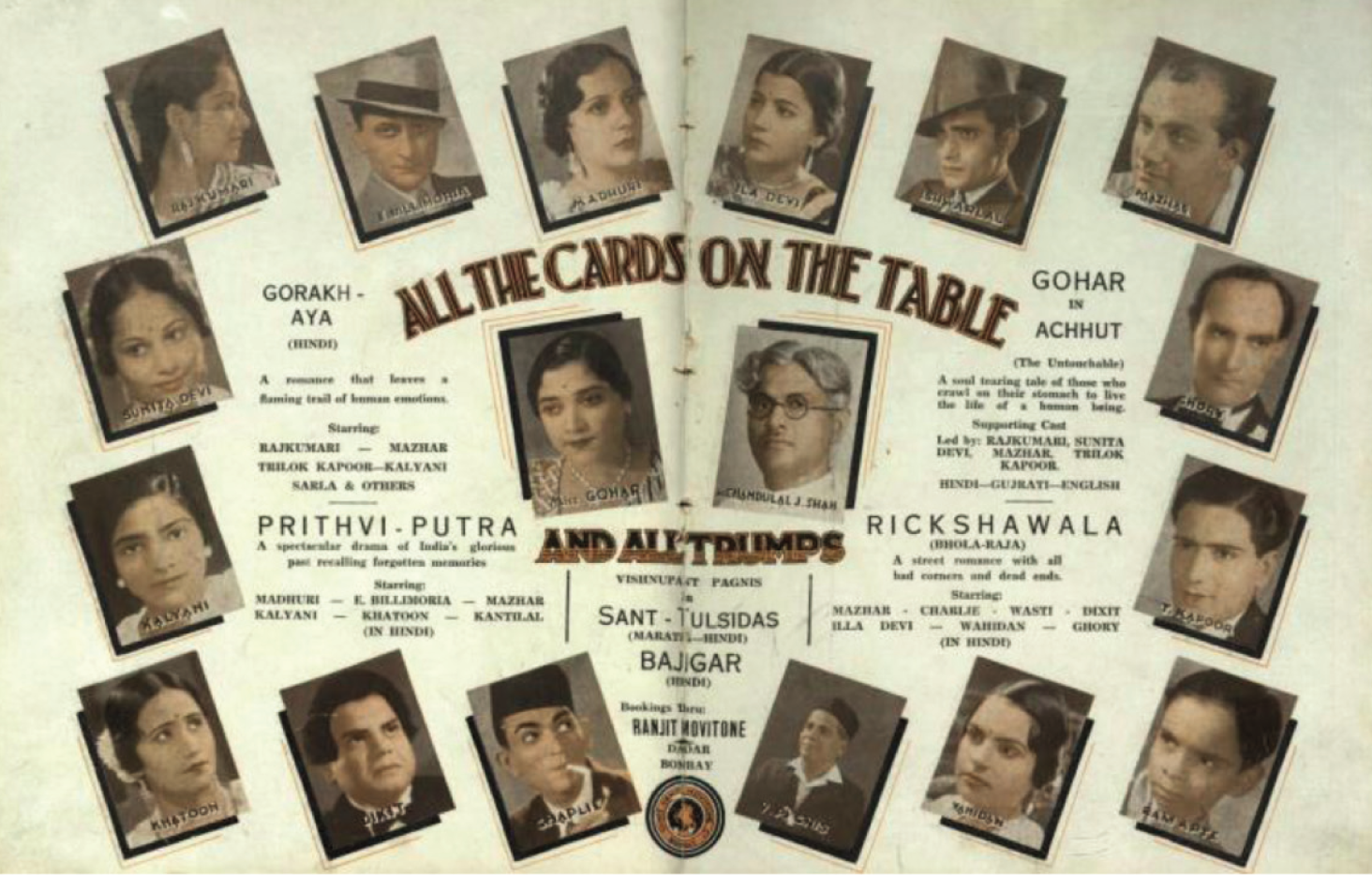
When Ranjit Bulletin stopped publishing, it became the turn of Filmindia, Baburao Patel’s influential magazine, to feature appreciative reviews of Ranjit films and photographs of the stars on set. Filmindia published a large number of double-spread advertisements for Ranjit films, as well as regular Ranjit films’ colour advertisements on its back cover (Figure 10). Several other studios, from Prabhat Film Company and New Theatres to Minerva Movietone, advertised their films on the pages of Filmindia. From late 1938 to June 1944, however, Ranjit was the sole studio whose films featured very regularly in that prime, back cover, advertising space.
Ranjit productions were always announced well in advance, with colour advertisements displaying the studio’s distinctive logo, the lancer (Figures 10, 11 & 12).
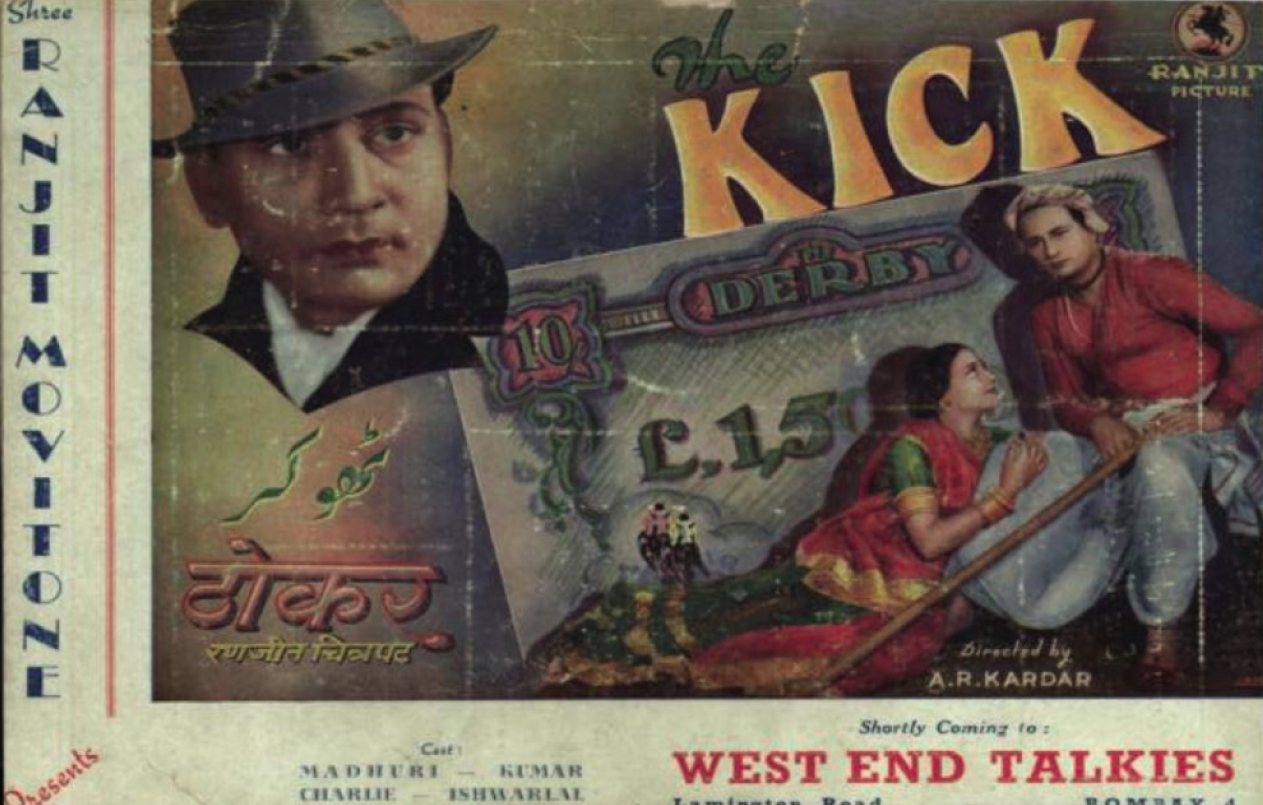
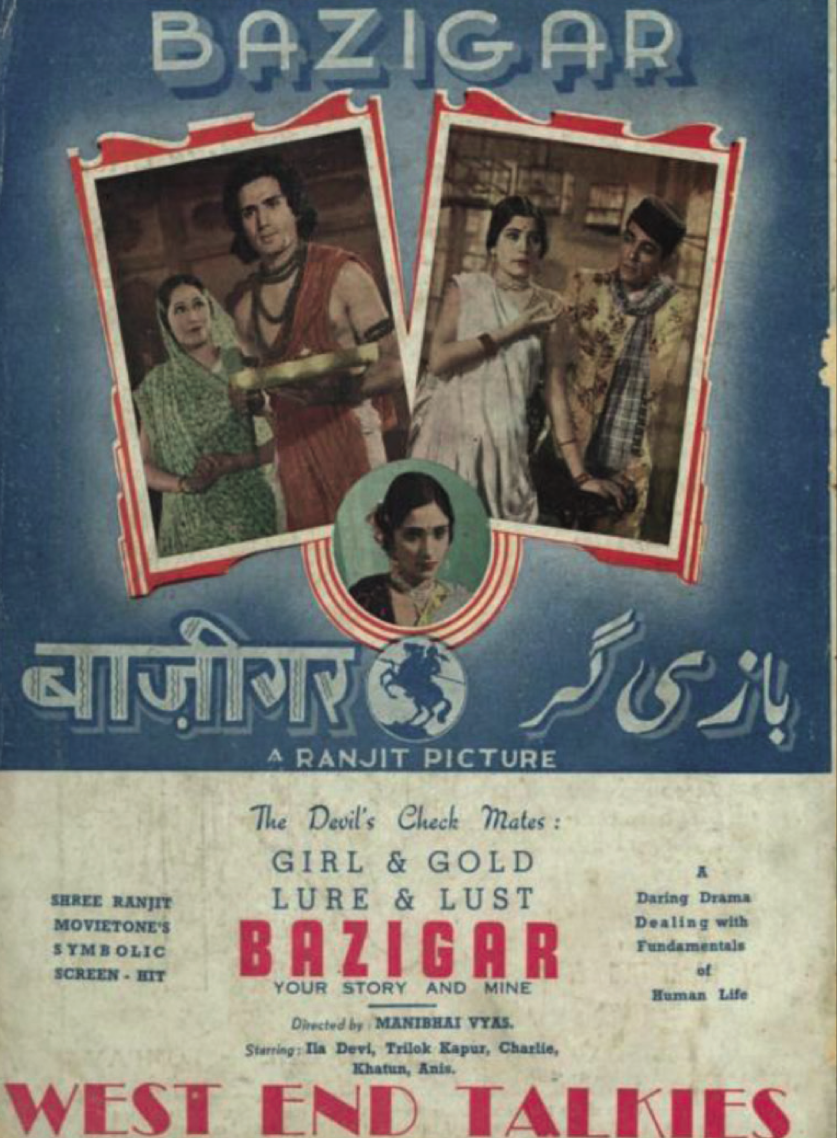
A third key factor in Ranjit’s operation was its direct control of first-class cinema halls in Bombay. According to Gohar, Ranjit did not rely on distributors, neither for Bombay nor in other areas, where Ranjit had its own ‘arrangements with […] people who were essentially exhibitors’ (Gohar quoted in Karnad, 1980, p. 78). The Moving Picture Monthly (1935, p. 25), on the other hand, reported that in 1934 Ranjit did sell distribution rights for North India for several of its films at ₹50,000 per film, with a ‘minimum guarantee’ of ₹60,000 and, after that, 50% of the box office (for Ranjit). These are most likely to have been sold by Dayaram Shah, Chandulal’s elder brother, who handled distribution for the studio (Rajadhyaksha & Willemen, 1998, p. 212). What is certain is that in Bombay, where distributors handled only 50% of the market (Moving Picture Monthly, 1935, p. 27), Ranjit leased both the new West End (Figures 10 & 12), one of the city’s best cinemas, which in 1933 it renovated and converted for sound projection, and the Royal Opera House (Figure 1), which reopened in 1936 after sound conversion and refurbishment. This was not an original approach: many producers had (that is, leased) their own cinema in Bombay during the late silent cinema period (Bhaumik, 2001, p. 36). In the saturated market of the mid-1930s, however, overpopulated as it was by small ‘producing concerns’, this was possible only for a minority of producers, of which Ranjit was one. Leasing the cinemas afforded Ranjit advantages: the West End and the Royal Opera House provided guaranteed releases of Ranjit films at the top end of India’s largest market for cinema and allowed Chandulal Shah complete programming freedom. Above all, leasing two top-end Bombay venues and, perhaps, direct agreements with exhibitors elsewhere gave Chandulal Shah relative autonomy from distributors.
This was important for a producer. In the early 1930s, the exhibition sector began to expand but not fast enough to keep pace with the increasing rate of production. Money was being piped into poor-quality films made by short-lived ‘producing concerns’ – films that stayed on the bill for as long or as short as the exhibitor saw fit. The exhibition sector’s slow pace of expansion made it so that complete films could wait months before being released. Once on the bill, a film could be pulled off after only a short time if the exhibitor deemed returns were not as expected. With exhibitors demanding an increasing rate of return on the box office and not pumping any of their returns back into production, by the end of the 1930s, distributors had emerged as powerful middlemen and the main source of finance for film production (Prasad, 1998, p. 40).
In his seminal study of Hindi cinema, Prasad further notes that
The ‘minimum guarantee system’, which is supposed to assure the producer a minimum return on each film, is also not as favourable to producers as it appears. The amount that is fixed as the minimum guarantee in this transaction is usually the amount loaned by the distributor to the producer during the making of the film. As a result the producer often gets no revenue from a film after production because the minimum return has already been given in the form of loans. It was also in the distributor’s interest ‘to see that returns from the pictures are not so excessive as to enable the producer to pay them off’ (Fazalbhoy, n.d., p. 48). (Prasad, 1998, p. 41)
In this context, Ranjit’s partial autonomy from distributors is most likely to have been a crucial factor in the studio’s long life. But autonomy from distributors came at a price. As Mukherjee (2020) has documented in her remarkable study of cinema in colonial Bombay, Ranjit financed film production partly with Chandulal Shah’s stock market gains, most notably his investments in cotton futures. This parallel source of funding sheltered Ranjit from the vagaries of a volatile environment and a minimum guarantee system geared against producers.
Proof of Ranjit’s dependence on Chandulal Shah’s cotton futures gains came in 1944 when Shah incurred a major loss on the stock market. Perhaps due to the massive drop in India’s cotton production that year, along with a drop in cotton prices worldwide (Brandis, 1951, pp. 271, 273), Shah’s stock market loss negatively impacted Ranjit’s operation. Significantly, the expensive colour advertisements of forthcoming or current Ranjit films that had begun to appear on the back cover of the influential Filmindia in September 1938, at the peak of the studio’s rise, came to an abrupt end in July 1944. Pagli Duniya (Aspi, 1944), distributed by Chandulal Shah’s Supreme, is the last Ranjit film to feature in the regular back cover advertisement of Filmindia (Figure 13). It is also the last Ranjit film for a while to feature as showing at the Opera House. This suggests that that year Ranjit may have also lost direct control of this premier cinema.
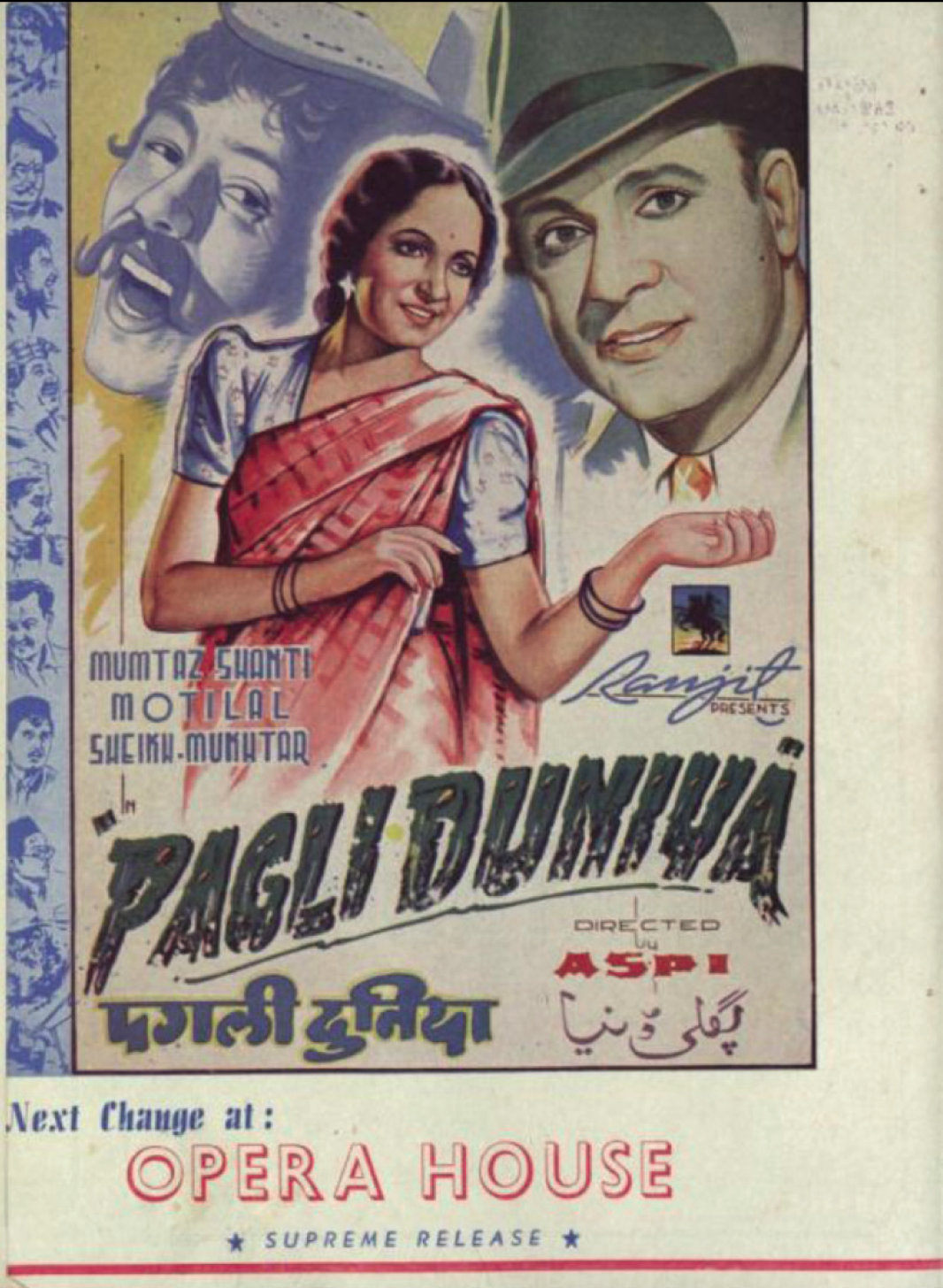
Gohar herself is said to have sold personal assets at this time to keep Ranjit going. And keep going it did, until 1963, though, from this point onwards, probably with mortgaged premises. 4
While Shah’s investment in cotton futures gave Ranjit a more secure base than other studios might have had, the studio could not have been entirely dependent on Shah’s stock market gambles, for Ranjit did survive the shock of Chandulal Shah’s unfortunate investment. By 1944, 4 years after Gohar’s withdrawal from the stage, the film industry had settled, and Ranjit’s name, as well as its solid production base, saw it in good stead. What is less clear from existing research is what film production afforded to Chandulal Shah’s stock market ventures, for the relation between film production and cotton futures trading must have been a mutually advantageous, symbiotic relation and not a one-way affair. Mukherjee does hint as much, though she does not follow it through. I suggest that in this cross-feeding between film and cotton, time was the fundamental factor. Mukherjee rightly speaks of ‘speculative capital’, and her examination of its functioning in cinema in colonial Bombay is illuminating. But what is capital if not money invested in the acquisition and exploitation of labour power, understood as the ‘capacity to realize, in commodity form, a certain quantity of socially necessary labour time’ (Harvey, 1999, p. 23, emphasis added)?
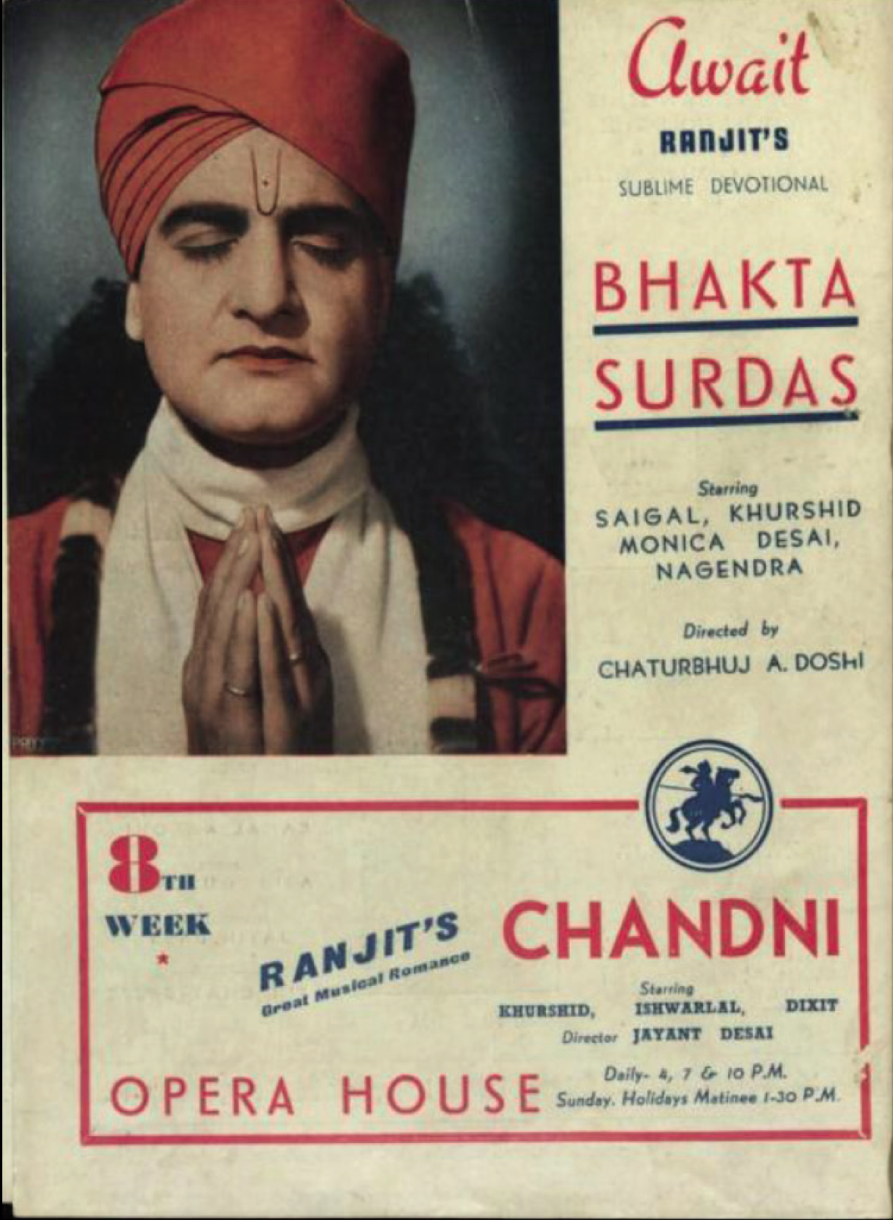
‘Await’ entreats the advertisement of Ranjit’s Bhakta Surdas (Figure 14). I argue that time was central to Ranjit’s modus operandi. A close inspection of Ranjit’s advertisements in Filmindia, their timing and that of the films’ reviews shows that a fourth feature key to Ranjit’s operation was the studio’s slow turnover. In economic terms, turnover time relates to the full cycle of commodity production, that is to say, the time it takes for the initial investment (capital) to be recouped with added value (profit) after the commodity has been produced and sold. In Ranjit’s case, turnover appears to have been very slow. For instance, Achhut was released 18 months after it was first advertised (Figure 15), while Bhakta Surdas (Chaturbhuj Doshi, 1942) was announced in June 1939 but was not released until three and a half years later, in December 1942.
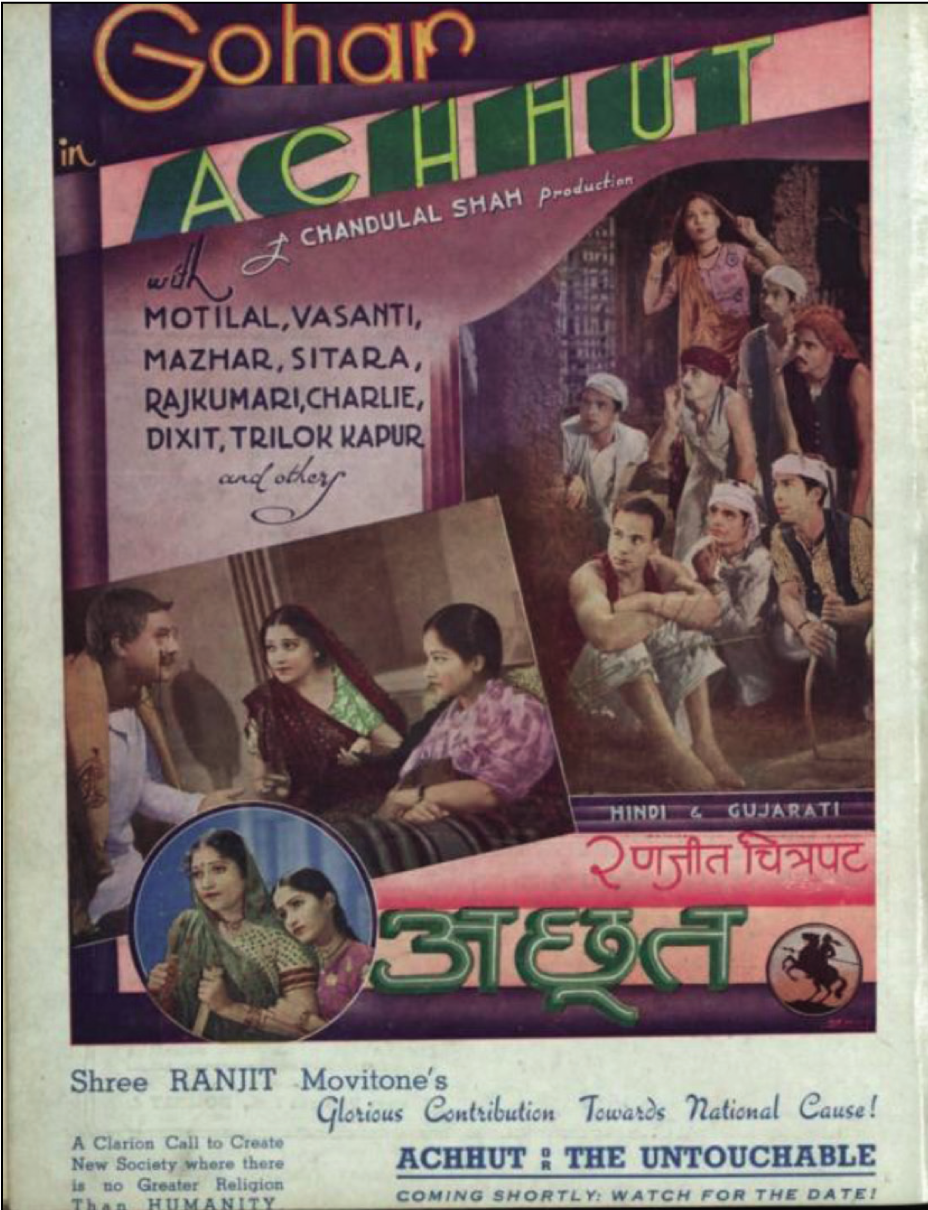
Achhut had already been announced 18 months earlier, in Filmindia’s issue of 4 April 1938.
Scrutiny of Filmindia’s ‘Studio Close-Up’ rubric reveals not only that Ranjit Movietone made films in greater numbers than most other studios but also that its productions were piling up beyond Ranjit’s exhibition capacity. That in these years a complete film would have to wait a long time before getting a release was far from unique. Many Indian studios had to wait for their films to be released. What is odd is that months would pass between Ranjit announcing a film as ‘forthcoming’ and its actual release despite the fact that, unlike most other studios, Ranjit was protected from the factors that usually held films back from release or extended production time unduly. These factors could be the overbooking of the film star, who, being independent, could and often did work on several productions simultaneously; glut in exhibitions, with too many films seeking access to too few cinemas; lack of finance; or lack of access to production facilities. None of these applied to Ranjit, which had its star in-house, controlled its own cinemas in Bombay, had its state-of-the-art production studio and even its own finance.
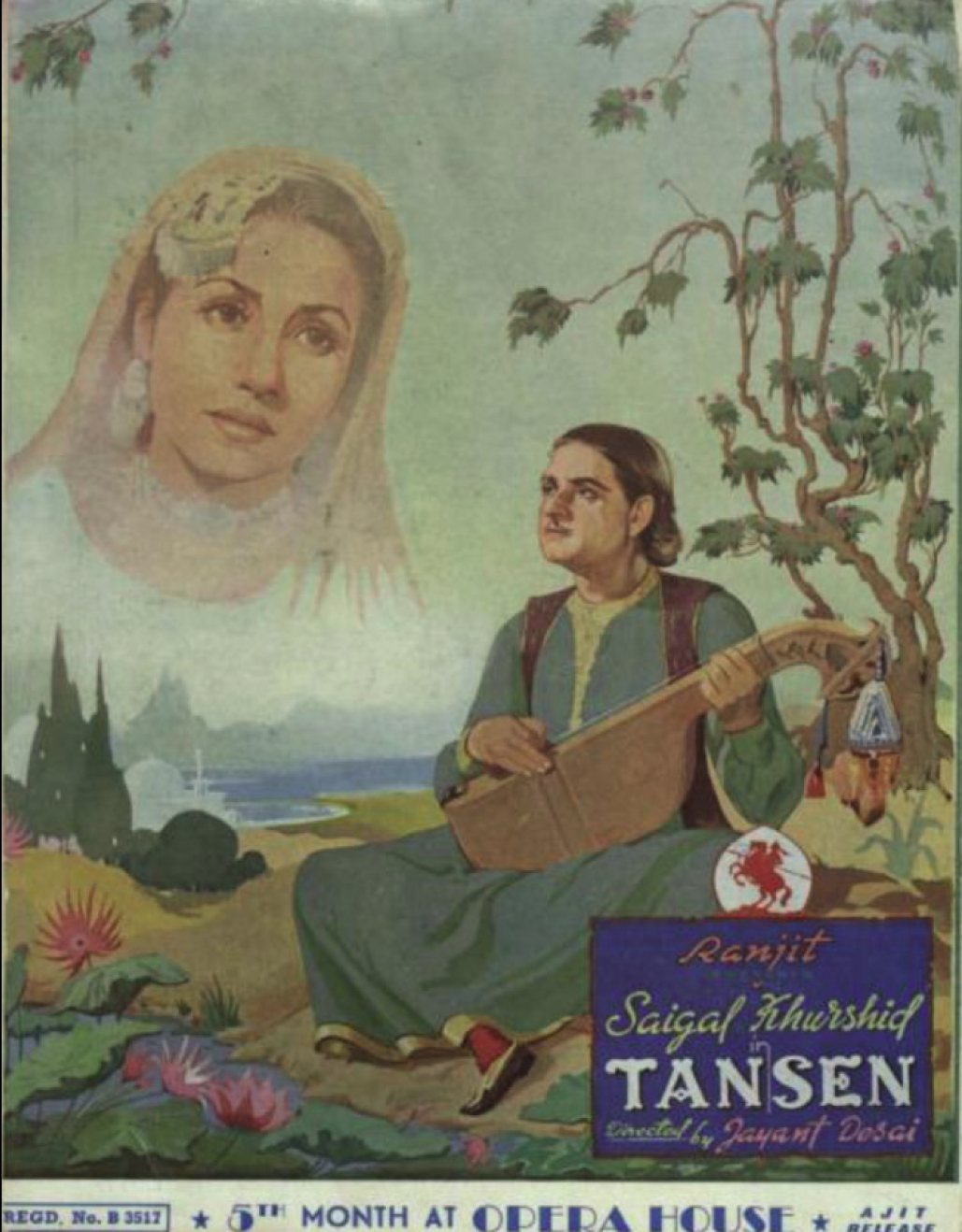
More puzzling still, though fairly common among large studios at the time, is the fact that in spite of its slow turnover, Ranjit adopted the ‘double-unit’ system (Mukherjee, 2020, p. 136), 5 thus further speeding up its rate of production. Why increase (the rate of) production when the studio had a backlog of films waiting to be released, and the capital invested in them was yet to be recovered? On the surface it would seem as if Ranjit still produced at the silent cinema rate when a large number of shorter films stayed on the bill for an average of 2 weeks, yet did so in the 1930s and 1940s, when fewer but more expensive films would normally stay on the bill for weeks on end – as Ranjit’s Tansen (Jayant Desai, 1943) did (Figure 16).
Through Ranjit, the extent to which two temporalities were at work in Indian cinema at this time becomes apparent. One, represented by exhibitors, was based on a pre-capitalist form of landlordism, deriving income from the extraction of ground rent, rather than growth and expansion. 6 The other, represented by sizeable studios, was based on industrial division and exploitation of labour, technological innovation and geared towards rising productivity. Ranjit, like other studios, straddled the two, its longevity being a measure of a distinct balancing act. I argue that while slow turnover was indeed the norm rather than the exception among studios in these years, what enabled Ranjit to survive better than others is what Chandulal Shah did with it: plunging the studio into a state of overproduction, as it were, purposely, Shah used Ranjit’s slow turnover as an advantage elsewhere, as an investment tool for a cross-sectors operation. To and from cotton and film, two businesses with a time gap built in: in cotton dictated by the harvest cycle 7 and built in as futures; in cinema imposed by the scarcity of cinema halls and built in as release delay.
Again, time was crucial in this operation. A future is a legally binding contract to deliver, or take delivery of, a commodity of a given quality and quantity, at an agreed price, on a specified date in the future. 8 In cotton trading, it is used to protect sellers and buyers from cotton price fluctuations. In case of price decline, with futures, a producer–seller can mitigate (hedge) the risk of loss. In Ranjit’s case, investment in cotton futures enabled Chandulal Shah to use cotton trading gains to bridge the turnover delay: he could finance film production with cotton trading gains without having to wait for box office revenues or depend wholly on distributors’ loans. Similarly, he could invest film box office returns into cotton futures. This might even have allowed him partly to evade costly entertainment tax, by hiding box office revenue in cotton futures. More importantly, in this cross-over exchange, film production could, and did, become a repository of gains from cotton futures. Shah ‘parked’, as it were, stock market gains in Ranjit productions. This might have allowed him to shelter trading gains from colonial tax, pumping them into film production and returning them ‘clean’ as box office. 9 Or simply to remove them from circulation, hedging (protecting) stock market investments against price fluctuations in an unregulated cotton market. In other words, ‘forthcoming films’ as congealed capital, the principle of futures applied to film.
It is not possible today to demonstrate that this is actually what Shah did. Shah and Gohar have long died, and archives do not store documents that may help substantiate speculative arguments such as this, about Ranjit or any Indian film studio’s financial operations. However, existing research does allow us to argue that Ranjit’s mode of operation rested on transversal, not vertical, integration, as was instead the case of Hollywood’s major studios from the 1930s. Transversal here points to a functional relation across seemingly separate sectors. 10 Of course, no sector is entirely closed off, and the merit of new research such as Mukherjee’s is precisely to point to the porousness of cinema. Ranjit’s history shows that Indian cinema emerged into the talkies as an industry that integrated transversally. The studio was formed by and grew in a colonial economy within which symbiosis between distinct sectors enabled commodities and finance to move below the British Raj’s radar. In his discussion of a more recent phenomenon – the businessman, diamond merchant and film financier–distributor Bharat Shah – Rajadhyaksha (2006, 2014) shows that transversal integration remains a closer description of Hindi cinema’s base today than the more customarily invoked, vertically integrated industrial model. Rajadhyaksha also shows that cross-feeding between seemingly distinct sectors has a long history in Bombay cinema. Ranjit Movietone was part of that formation, one that remains, in India, well-established.
Gohar Kayoum Mamajiwala
Ranjit may have not been a unique case. My research focused on Ranjit in order to understand what enabled it to survive the transition to synchronised sound, which other studios did not, and thrive thereafter. But my interest in Ranjit is also grounded in the implications that this history can have for our understanding of cinema generally – a cultural practice that, as Fredric Jameson (1998, p. 70) noted, ‘falls under base and superstructure alike’. The history of Ranjit challenges the primacy of vertical integration as the default model of film historiography. Capitalism always works with and adapts to conditions on the ground. In India, in the 1930s and 1940s, these did not favour film producers. Transversal integration enabled Chandulal Shah to contain distributors’ and exhibitors’ pressure on Ranjit as a producer. To do so, along with cotton trading, cinema halls and production facilities, Shah needed Gohar.
In recent years, much has been done to rewrite women in the history of cinema. Yet even endeavours as remarkable in their scope as the Women’s Film Pioneers Project 11 remain informed by a film industrial model based on North American cinema. There, production was the industry’s driving sector, at least until the late 1960s. In this configuration, film stars were studio employees. This was not generally the case in India, where production has historically been a fragmented sector of mostly small-scale units relying on localised sources of finance (distributors). As we have seen, Chandulal Shah’s cotton trading sheltered Ranjit from the distributors’ financial stranglehold. Even so, Ranjit could hardly ignore distributors and exhibitors’ priorities – first and foremost, calculations on the role of the star in a film’s box-office return. Combined with the scarcity of cinema halls across the country, distributors’ and exhibitors’ influence within Indian cinema has historically lent a lot of leverage to film stars. As Gohar also noted in an interview (Karnad, 1980, p. 78), unlike Hollywood film stars in the same decades, Indian film stars could and did work on multiple productions at once, imposing their own schedule and, at times, even their choice of director. Indian cinema is rife with film stars who, due to the continued primacy of the distributor–exhibitor nexus in that industry, have held far greater decisional power and creative input than most directors. Like them, Gohar was not a director. As a result, she remains under-researched, her contribution to Indian cinema made invisible by film historiographic parameters still tacitly imprinted by a production-led Hollywood model that is long gone.
What scholarship there is on Gohar has focused on her public image as a woman, an image of modernity. 12 There are elements in existing scholarship that also suggest that Gohar’s role within Ranjit Movietone extended beyond that of the star and wife of Chandulal Shah. However, partly due to the lack of surviving evidence, we know near to nothing about Gohar’s function within the studio, as co-founder, co-owner and star. The argument that follows is thus speculative but hinges on the methodological significance of integrating two perspectives: Gohar as image or icon, and Gohar as means of production or labour power.
Gohar Kayoum Mamajiwala (1910–1985) was born into a Muslim family from Lahore. The daughter of an actress, she started on the stage as a child and became a major star at Kohinoor Film Company (Figure 17). Her first success was Lanka Ni Laadi (Homi Master, 1925), one of India’s biggest silent hits. Gohar acted in several of Homi Master’s films, which were especially scripted for her by Mohanlal Dave. In 1927, she left Kohinoor with film director Chandulal Shah to form Jagdish Film, then Ranjit. Shah used her screen persona for his satires on Gujarat’s urban business communities, as in Gohar’s best-known silent films Typist Girl/Why I Became a Christian (1926) and Gunsundari/Why Husbands Go Astray (1927). She later acted alongside action star Raja Sandow and, in Ranjit’s popular film-novelettes, performed roles of upper-class socialites opposite the suave Bilimoria brothers (Rajadhyaksha & Willemen, 1998, p. 102). Often billed as ‘the Queen of Emotions’, Glorious Gohar, as she was also known, starred in Ranjit Movietone’s most important productions until 1940. She retired from the stage after that but continued to play an important role in the life of the studio.
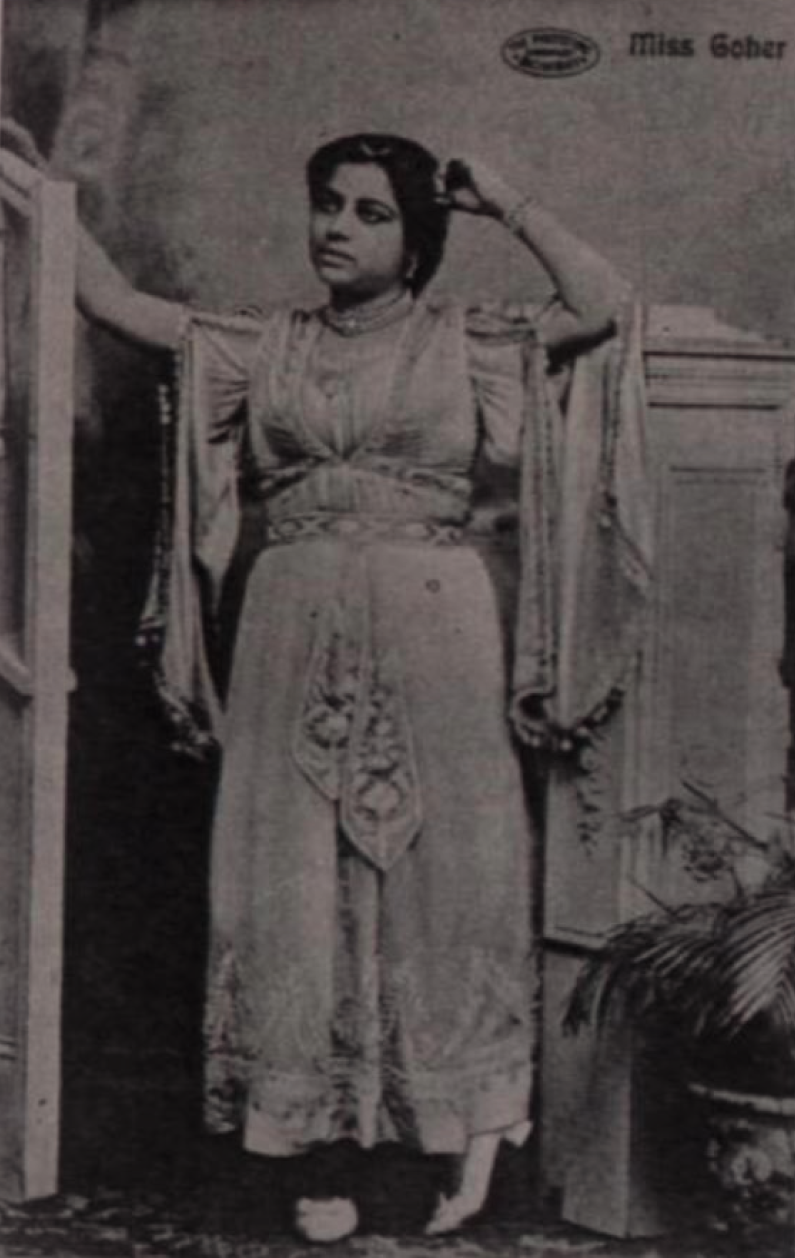
As a star, Gohar was central to Ranjit’s operation and longevity. Unlike other Indian studios, with Gohar, Ranjit had a film star quite literally in-house, one who was Shah’s partner in her private and professional life. In the unstable and competitive environment of 1930s Indian cinema, where, as Gohar herself recognised, ‘the worst […] was when the studios tried to steal each other’s stars by offering higher pay’ (Karnad, 1980, p. 78), only Bombay Talkies could count on the same advantage, with studio co-founder and star Devika Rani in a stormy marriage with director and Bombay Talkies co-founder Himanshu Rai. While Devika Rani’s temporary elopement with co-star Najm-ul-Hassam nearly bankrupted Bombay Talkies, the competition to win over freelancing stars whose salaries kept rising as a result, did put an end to Sagar Film Company (Mukherjee, 2020), one of India’s largest studios in the 1930s. 13 Not only did Gohar remain loyal to both Shah and Ranjit, but she could speak good Hindi and, importantly, sing. With the transition to synchronised sound, not every studio or star could count on these skills.
Gohar’s star value – a value that would fall, in Jameson and, more generally, Marxist terms, within notions of ‘superstructure’ – was the fifth factor in Ranjit’s operation. There is evidence that Gohar was more active in shaping her value than many actors of her day, in India and elsewhere. In the 1930s and 1940s, ‘Hollywood worked actively to make and market its stars. Stars became a vital asset in maintaining the hegemony of the major studios’ (McDonald, 2000, p. 40). Under the Hollywood studio system, actors and stars were thus under contracts that stipulated studio control over most aspects of an actor’s on and off-screen life. As Jane Gaines (1991, p. 148) has shown, ‘whereas the star wanted some control over self-definition, the studio wanted image insurance’:
[C]ontinuity within the film from shot to shot as well as on-screen and off-screen consistency of character type would be backed up by written contract. The studio used the contract to secure on-screen continuity through provision for illness and vacations, wardrobe fittings, tardiness on the set, absences, photographic sittings and retakes. But while studios tried to guarantee continuity, stars with demands represented the threat of discontinuity in the eyes of their employers. Stars retaliated with riders modifying wardrobe requirements, stipulating screen billing order and typeface size on the credits, and mandating the number of close-ups per picture. It was also common practice for the stars to write requests for particular designers, hairdressers, and cinematographers into their own studio contracts. Again, such demands were attempts on their part to control the manufacture of their own images within the constraints of the studio system. […] [S]tudios [also] took a firm stand against the star’s use of [outside press agents]. (Gaines, 1991, p. 149)
In the 1930s and 1940s Hollywood, the production sector’s control over distribution and exhibition within a vertically integrated industry made it so that actors and stars were effectively part of a studio’s labour force, subject to even tighter contractual constraints than other skilled labour was. Neither constraints nor a contract delimited Gohar’s working within Ranjit Movietone. As de facto co-owner of Ranjit, not only did Gohar own the capital that paid for her labour, but she also defined her own labour value. She controlled her image, which she shaped through her close collaboration with her husband and director Chandulal Shah. Gohar may have been able to do that perhaps because she injected capital or assets of her own into the studio. More likely, Gohar had a degree of control never enjoyed by her North American counterparts because, during the four decades of Ranjit’s life span, it was the distribution–exhibition nexus, not production, that topped the Indian film industry’s value chain. Gohar was an early instance of that Indian film star phenomenon, which, years later, would manifest itself over and over again in powerful figures like Nargis, Amitabh Bachchan, Madhuri Dixit or Shah Rukh Khan.
This is made clear, for instance, in an article entitled ‘As the Clock Turns on’, which purports to present to film fans a day in the life of the studio. Gohar, we are told, was not just any Ranjit employee:
In stentorian voice Mr. Jayant Desai ordered ‘Everybody to be ready for shooting at 9:30am’. The Studio Manager blundered forth ‘Whom do you mean?’ ‘I mean everybody, everyone of the player’s staff – except Gohar’. (Ranjit Bulletin, 15 June 1935, p. 5)
Within Ranjit, Gohar and her image fell within what Jane Gaines (1991, p. 157) has called ‘two zones of utilization’: simultaneously the product and its exploitation. Issue after issue, Ranjit Bulletin presented Gohar and Shah as evenly synonymous with the studio, especially equating her image and his name with Ranjit as a brand. Accordingly, in an interview with Gajanand Sharma, Shah is reported as saying that
[H]e will direct pictures only so long as Gohar is a star of Indian film world. It is she only for whom it is so easy to understand and interpret the complex roles he creates for her… She fully and minutely understood the psychological imports of parts she had been called upon to play and therefore her representation of characters is so vivid and life-like. (Mr. Chandulal Shah Talks, Ranjit Bulletin, 26 October 1935, p. 24, errors in the quoted text).
Whether Gohar was a good actor or that Shah went on to direct after Gohar left the stage is not the issue here. My point, rather, is that Ranjit’s publicity presented Gohar as a central and active figure of Ranjit as her director husband. This is corroborated by actor Narayan Prasad Betab:
I wish to clarify just three items about [Miss Gohar’s] private life, so that readers may better understand her. (1) I have been an employee of the company [Ranjit] since its earliest days, and Miss Gohar is a partner in the company. […] (2) I never saw her use her position or power to remove any employee from the company. (3) In June 1936 the new film Prabhu ka pyara was in rehearsal. In it Gohar played a respectable daughter whom adversity makes a beggar and who then makes a life for herself as an actress in the theatre. She had to play the role of a courtesan who serves wine to spectators and entertains them with songs. I wrote a song: pi lo, pi lo surang lal pani, ‘drink, drink the bright red water’. When Gohar was to film this song, she blushed so much that she could not even sing. […] She tried again and again to satisfy the requirements of art, but she had no breath to sing in opposition to her feelings. I was compelled to change the song to: pi lo, pi lo ye ras bhar-bhar pyala, ‘drink, drink the cup full of juice’. Today this is the very song that is sung in the film. (Quoted in Hansen, 2011, pp. 99–100)
Narayan Prasad Betab’s recollections are important because they reveal the extent to which Gohar had control not only within the studio’s operation but also creatively over her own image.
Narayan Prasad Betab’s testimony also evidences a shift in mood and outlook that took place in Indian cinema from the mid-1930s. To begin with, Gohar projected the persona of ‘the Indian Modern Girl’. As Ramamurthy (2008, p. 157) observed, the ‘bobbed hair, large eyes, and mascara-laden eyelashes’ of her studio portraits ‘referenced Clara Bow, the famous American movie star widely acknowledged as the “It” girl, but the sari, bindi, and pearls were from a visually Indian cultural palette’. Like other Muslim actors, Gohar also ‘transgressed the religious borders between Western and Indian, Hindu and Muslim’ (Ramamurthy, 2008, p. 162) in her attire and body fashioning. However, Ramamurthy showed that by the late 1930s, the Indian Modern Girl faded from popular cinema culture:
Increasingly, film story lines were more didactic and ‘Indianized’, with Indianness signified by woman as a good wife, now in the modern role of companion within the confines of heterosexual, middle-class marriage. Typically, a heroine’s desire for modernity was restricted to serving her modern husband better, rather than through assertion of individual choice or autonomy. (Ramamurthy, 2008, p. 163)
As the sexualised, publicly visible and active ‘Modern Girl’ faded, in came the Bharat nari, the ‘new Indian woman’ preferred by Indian nationalism. In contrast to Sulochana, India’s highest-paid star in the 1930s, known for her daringly modern, sexy heroines, Gohar’s repertoire gradually saw her playing less flamboyant roles. ‘Sulochana continued to play the glamorous working girl in her silent film hits that were remade as talkies in the mid- to late 1930s and were very popular, but Gohar was increasingly cast more narrowly as a docile wife’ (Ramamurthy, 2008, p. 167). She was not, unlike Sulochana and other Indian film stars at the time, Eurasian, and, as such, not unlike Durga Khote, Gohar tamed her persona down. Referred to as ‘Goharbai Mamjiwala’ in articles of this time, she was described as ‘doing her bit for making her profession a respected one’ with behaviour that ruled out smoking and drinking, preferring to spend time reading ‘biographies, fiction and religious literature’ (Ramamurthy, 2008, p. 168). Gohar’s late 1930s repertoire thus sees her playing ‘respectable’ women, devoted wives and mothers or modern upper-class socialites, even as, within these limits, she built her on- and off-screen persona cleverly, in ways that demonstrate an unusual degree of agency for a star and a woman at this time.
Docile wife on stage, unlike Hollywood stars, off-stage and through Ranjit Bulletin Gohar acted as her own press agent, perhaps even Chandulal Shah’s. It is impossible to say whether this continued to be the case when the studio’s bulletin stopped publishing and publicity was carried out primarily in Filmindia. But Ranjit Bulletin did shape the image of both the studio and Gohar in her early years as an independent star – that is, independent both from studios she did not own, such as Kohinoor Film Company, and as a professional woman. In its various rubrics, with Gohar, Ranjit Bulletin conveys the figure of a female star who is in control. As evident in an article entitled ‘The Call of the Afflicted’, in which, responding to a fan’s letter, Gohar asks:
Why should one million of spectators pain for the sake of one individual? … While I was cogitating on this interesting question, a thought occurred to my mind. Some people’s sorrow are individualistic – some imagine they have sorrows … Then, for whom should I cry? A thought flashed across my brain. There are millions of people in India who are suffering grief meekly – having no source where withal to be happy. If I cry for these people and make thousands of spectators cry in sympathy with these people, then my crying will be worthwhile. […] [signed] Gohar (Ranjit Bulletin, 29 June 1935, p. 7, errors in quoted text)
The emphatic nationalistic ethos that Gohar offers as a motivation for her work says more about the times than Gohar herself. The important fact is that here, as elsewhere in the bulletin, Gohar presents herself as the individual responsible for the decisions that shape the roles she plays and why and how she plays them. In the bulletin, Ranjit’s other big female star, Madhuri, is most often profiled by a third party. By contrast, Gohar often writes in the first person. In the reflective article quoted above, this results in a powerful double address: Gohar the actor speaking and making decisions about her characters.
Conclusion
Gohar Kayoum Mamajiwala has been written into film history as little more than an ‘actress’, film star and wife of studio owner and director Chandulal Shah. Yet it is hard to imagine Ranjit becoming the longest-running and most prolific studio in the history of Indian cinema had it not been for Gohar’s star value in Ranjit’s formative and peak years. When Gohar and Shah were still at Kohinoor Film Company, it was Gohar’s pull as a star that enabled them to set up their own ‘production concern’. It was also Gohar who contributed to rescuing Ranjit in the aftermath of Shah’s cotton trading misadventure. Above all, how successful would have been Shah’s cross-feeding operation between cotton and film, his exploitation of the time gap between film production and release, and of the capital congealed in ‘forthcoming’ films, without Gohar’s star value at Ranjit? A forthcoming film without a star is, after all, just one of too many films struggling to find exhibition space.
Whether real or not, many of the fan letters printed in Ranjit Bulletin praise not Gohar’s looks – the face and the ‘histrionics’, as for the beautiful Madhuri, but Gohar’s voice, words and emotions. Often – as fan letters and publicity were keen to emphasise – emotions expressed through Gohar’s eyes (Figures 18 & 19).
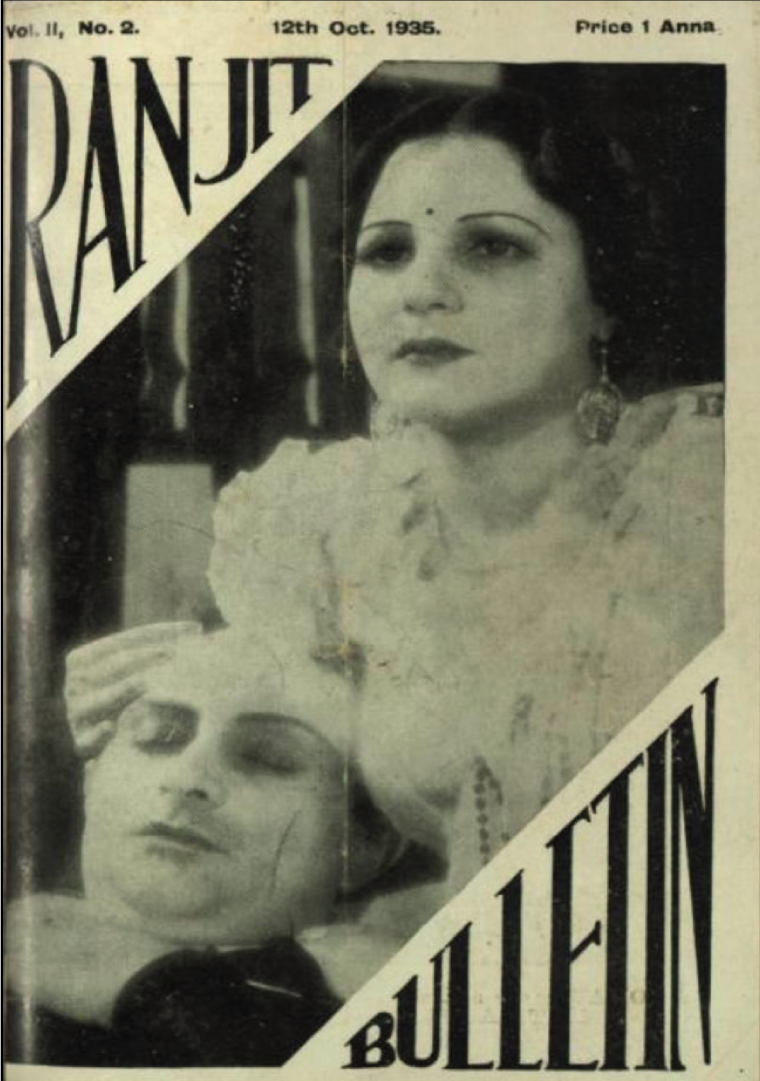
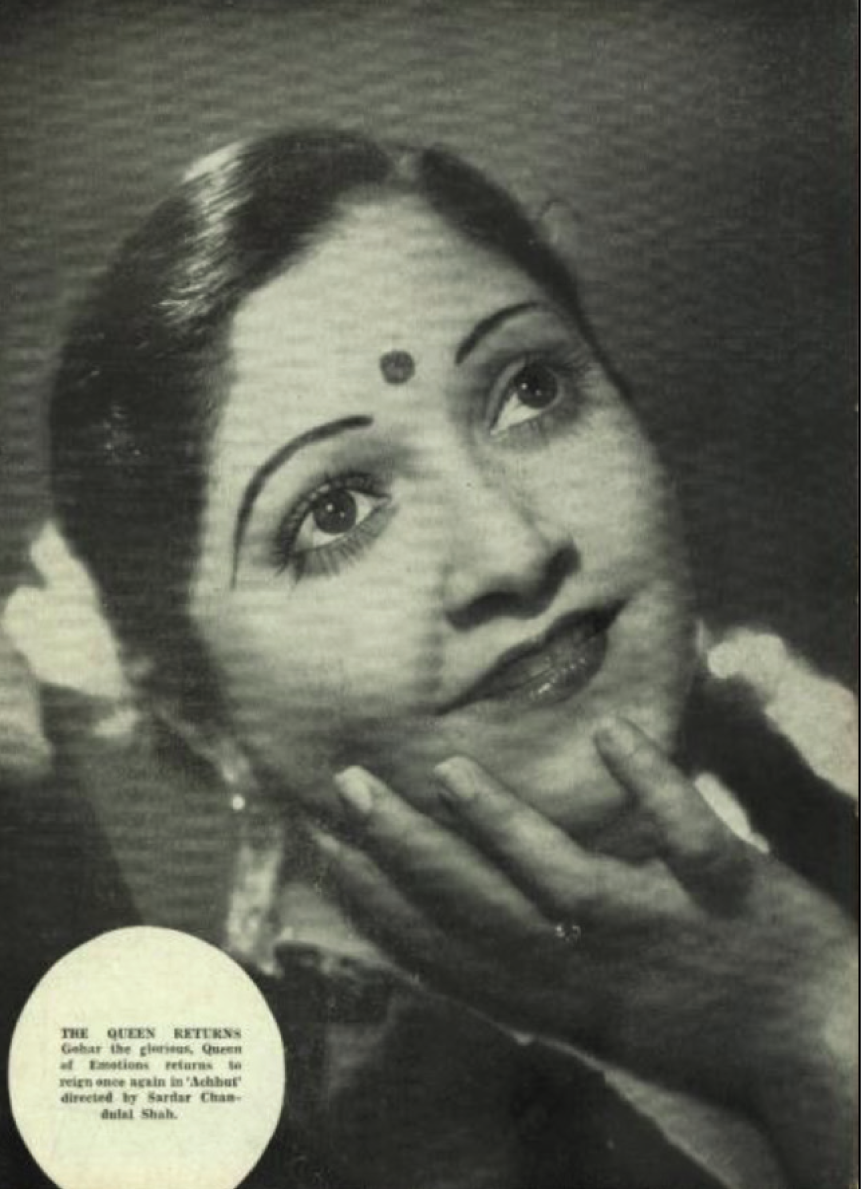
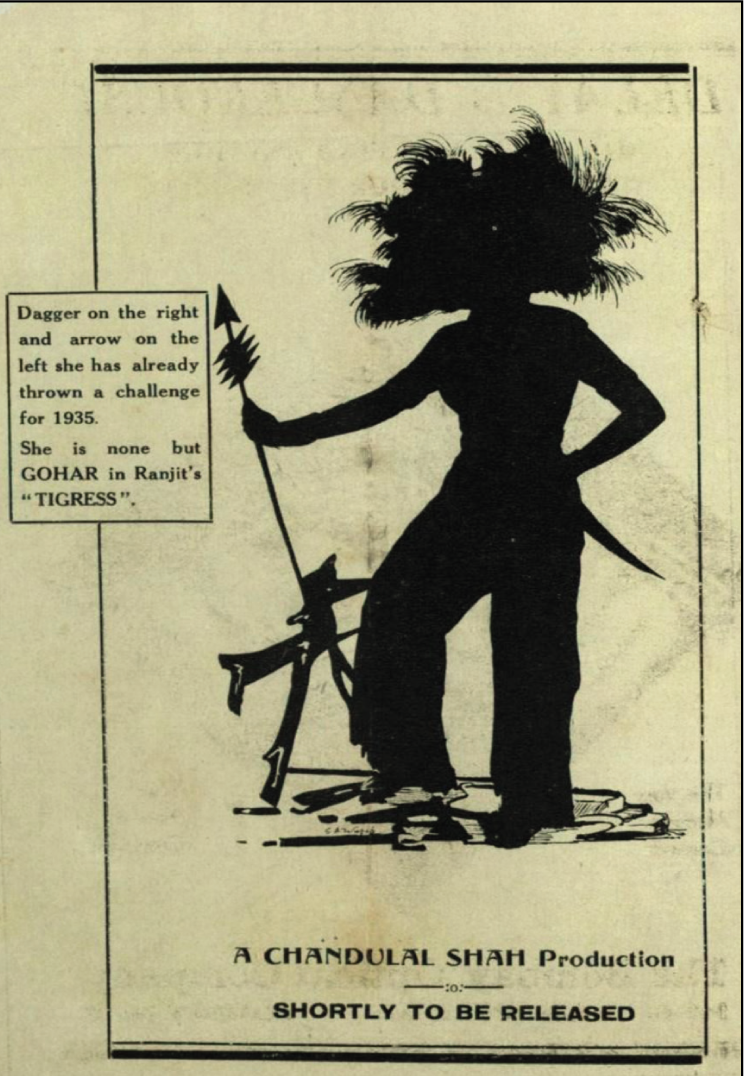
In the psychologically overcharged landscape of today’s cinema and media, it is easy to underestimate the importance of these close-ups on Gohar’s face and the epithet that went with them, ‘Queen of Emotions’. Before the 1930s and, to a lesser extent, throughout that decade, Indian films came in a limited range of genres: stunts, historicals and mythological dominated. It is only with the introduction of synchronised sound and, with it, the power of dialogues, music and lyrics that the psychology of characters gradually surfaced as an important dimension of scripts and performances. The three advertisements of Ranjit’s Tigress in Figures 20, 21 and 22 were published in quick succession in Ranjit Bulletin. They present a gradual disclosure of facial expressions that were symptomatic of this shift in genre and address.
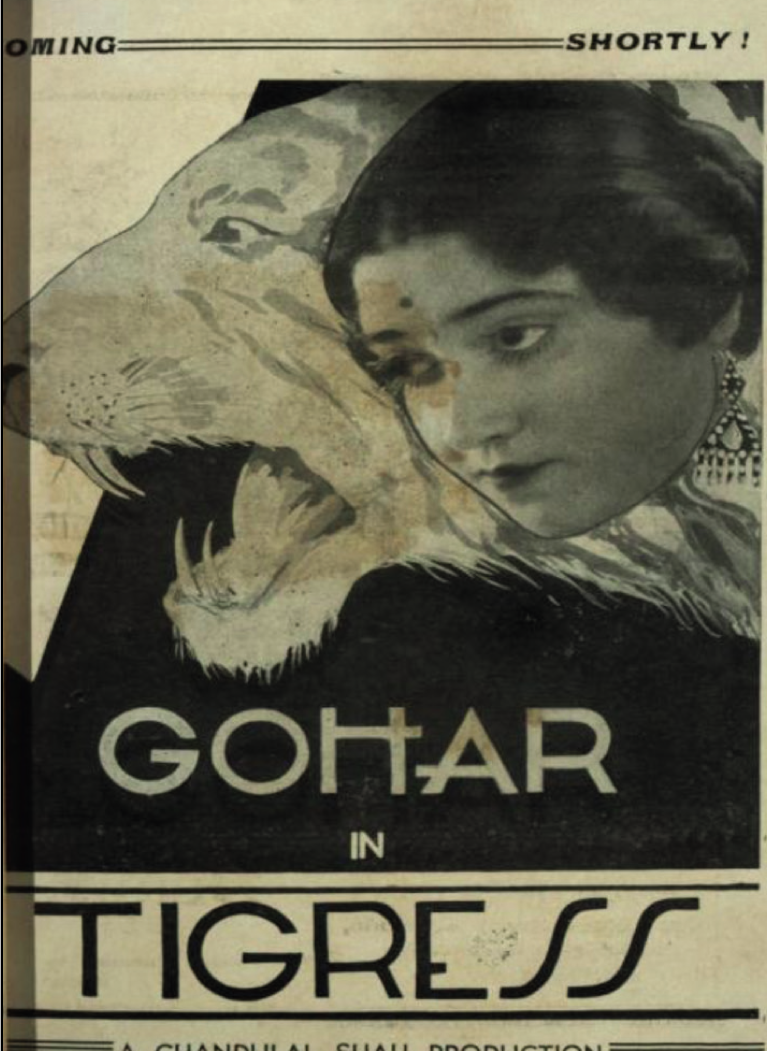
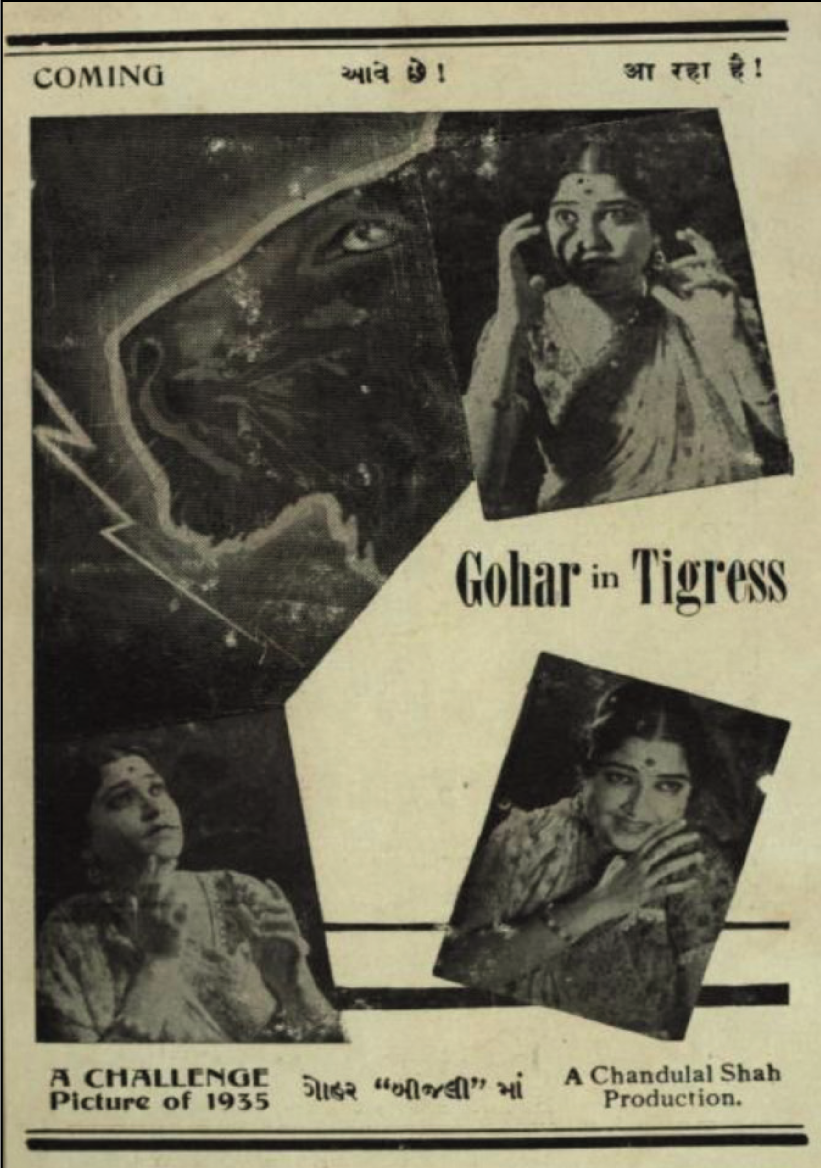
In this context, a form of Indian realism gradually began to take shape. Gohar’s performance of emotions (Figure 22) was fundamental to the genres that Ranjit Movietone became best known for: social novelettes that marked, in Indian cinema, the transition from silent actioners to sound cinema’s social melodramas. With Ranjit’s entire film production destroyed in a fire, it is impossible to know whether Gohar’s emoting roles went hand in hand with a filmic mode of address that foregrounded individuation, as the best of film realism and melodrama have proved capable of doing. What we can say is that Ranjit’s capacity to survive the transition to synchronised sound and thrive through the 1950s was the result of a balancing act between two temporalities, each at work in Indian cinema. Ranjit and Gohar’s social novelettes and the studio’s distinctive mode of operation were the two sides of the same compromise formation: modernity – where the nature of the compromise and its material, being Indian, should not be made to fit historiographic models developed through the study of North American cinema. Straddling across modernisation and what stood against it, Ranjit appears to have leaned more heavily on the former, using cotton futures as a way to contain the exhibition sector’s pre-capitalist, rent-based, anti-expansionist pull. Its social melodramas, centred on Gohar’s ‘respectable’ and emoting socialite persona, also mediated the contradictions and tensions of that transversal balancing act.
Footnotes
Declaration of Conflicting Interests
The author declared no potential conflicts of interest with respect to the research, authorship and/or publication of this article.
Funding
The author received no financial support for the research, authorship and/or publication of this article.