




Abstract
Immediately after India’s independence, the Indian revolutionary martyr Bhagat Singh became the focus of several competing biopic projects. A censorship controversy erupted around the making of the now-lost film Shaheed-e-Azam Bhagat Singh (1954), the first biopic on the martyr. It became a contentious site where the interests of the filmmakers, former revolutionary colleagues of Bhagat Singh and his family members, and various other stakeholders like public representatives, intersected with an almost disinterested state. Following Debashree Mukherjee’s (2019) methodological approach of considering film censorship ‘as a productive material site for the study of lost films’, this article enters into a microhistory of this controversy by utilising bureaucratic paperwork and filmic and nonfilmic paratextual material to compensate for the absent film element. By tracing the very first attempts which were made to mount a biopic on Bhagat Singh, I try to investigate personal and political motivations behind the race to make the first biopic on the revolutionary martyr. For this purpose, I employ Chris Moffat’s (2019) mobilisation of the metaphors of corpse, corpus and corps, which he productively uses to understand the politics behind the multifarious afterlives of Bhagat Singh and wrangle over his revolutionary inheritance in the post-colonial period, and make a case for the importance of the study of Bhagat Singh’s hitherto neglected biopics by arguing that the time of their making, their production contexts and attendant controversies afford us unique insights into what Moffat terms the politics of ‘India’s revolutionary inheritance’.
Introduction
In the year 2002, Dr Jagmohan Singh, a nephew of Bhagat Singh and the director of the Bhagat Singh Research Committee, wrote to the Information and Broadcasting Ministry, Government of India and the Central Board of Film Certification (CBFC), complaining about ‘grave distortions of history’ being committed by the filmmakers working on biopics of Bhagat Singh at that time (Singh, 2002). On the 70th anniversary of the execution of Bhagat Singh and his other two revolutionary colleagues, there were as many as five competing Bhagat Singh biopics under production in the Bombay film industry, compensating for his long-standing neglect in the official national historiography (Dwyer, 2013; Maclean, 2015; Pinney, 2004). 1 This sudden rush to make films on Bhagat Singh alarmed his relatives to such an extent that a son and a daughter of one of Bhagat Singh’s real brothers, Rajinder Singh, even petitioned the court to issue ‘a writ in the nature of mandamus directing respondents [the filmmakers] not to allow the screening of films containing distorted versions of the real-life history of Shaheed-e-Azam Sardar Bhagat Singh’ (Paramjit Kaur and Ors. vs UoI, 2003). While I deal with the outcome of this petition towards the end of this article, it is curious to see that half a century back we find Bhagat Singh’s other brothers, Kulbir Singh and Kultar Singh, petitioning the government and protesting similarly against two competing biopics on Bhagat Singh which were in production in 1953. While one of the biopics was stalled during its production, a controversy was stirred up around the second. This latter film, Shaheed-e-Azam Bhagat Singh (1954) [henceforth SABS], which has the distinction of being the first biographical motion picture on the Indian anti-colonial revolutionary martyr, became a contentious site where the interests of the filmmakers, former revolutionary colleagues of Bhagat Singh and his family members, and various other stakeholders like public representatives, intersected with an almost disinterested state. Following Debashree Mukherjee’s (2019, p. 32) methodological approach of considering film censorship ‘as a productive material site for the study of lost films’, which Kartik Nair (2022, p. 172) has aptly termed ‘a new site of [Indian] film history’, this article enters into a microhistory of the controversy around the first biopic of Bhagat Singh by utilising bureaucratic paperwork and filmic and non-filmic paratextual material to attempt restitching the lost film.
Chris Moffat (2016, 2019) in his work on the politics of Bhagat Singh’s revolutionary inheritance and the fortunes of his multifarious afterlives in the post-colonial period makes use of an insightful formulation to argue that it is the absence of Bhagat Singh’s corpse (which was cremated clandestinely after hanging and was not handed over to his family), and always-in-the-making nature of his corpus (his material remains in the form of writings) that defies the attempts of the corps (a heteromorphous body of people invested in retrieving the corpus and wielding it to claim to be the true inheritors of the legacy of the martyr) to ‘contest appropriation and “incorrect” invocation [of Bhagat Singh]’ (2016, p. 644), and ensures the revenant possibilities, the spectral appearances, of the revolutionary martyr. In this article, I propose that in the case of the SABS controversy, the corps was formed by the martyr’s fellow revolutionaries and casemates, especially with communist affiliations, as well as his family members who were marshalling their own bodies (as opposed to Bhagat Singh’s lost corpse) and their first-hand experiences and memories of the martyr to recover and resurrect his corpus in the form of a biopic to claim and contest rights over their own representation as well as that of the revolutionary martyr on celluloid. By dwelling on this mobilisation by situating it in the immediate post-independence period and investigating the politics behind it, I make a case for the importance of the study of Bhagat Singh’s biopics, which unfortunately the scholarly community has neglected till now, and argue that their production contexts and attendant controversies afford us unique insights into what Moffat terms the politics of ‘India’s revolutionary inheritance’ and the multifarious afterlives of our national heroes. Additionally, such contestations over revolutionary legacies and resulting censorship also afford us a peek into the various procedures of film censorship, the inbuilt ambiguity, flexibility, and arbitrariness of censorship rules thanks to what Matthew Hull (2012) has termed the ‘Government of Paper’ which independent India inherited from the British colonial dispensation. In the sections that follow, I begin by tracing the very first efforts that were made to mount a biopic on the life of Bhagat Singh in the immediate post-independence period, followed by a section that deals with the entire controversy around SABS, and dwell upon the reception of the film in the penultimate section.
Bhagat Singh and His Heroic Stardom
Bhagat Singh was an Indian revolutionary who was hanged by the colonial British government, along with his two comrades Sukhdev and Rajguru, on 23 March 1931 at the age of 23 years after the conclusion of the Lahore Conspiracy Case. He and his colleague Batukeshwar Dutt had courted arrest after throwing two low-intensity smoke bombs in the Legislative Assembly in Delhi. According to them, the bombs were not intended to harm anybody but were only meant ‘to make the deaf hear’. Unlike the Congress party, which was being led by M. K. Gandhi, and its official credo of non-violence to achieve political independence from the British,
2
Bhagat Singh was a member of the Hindustan Socialist Republican Army (HSRA), a revolutionary outfit which believed in the dictatorship of the proletariat and was not averse to using violence to achieve it. Recently, various scholars of the Indian anti-colonial revolutionary movement (Elam, 2013; Maclean, 2015; Maclean & Elam, 2013; Moffat, 2019; Sawhney, 2013) have contested the appropriation of these revolutionaries, especially Bhagat Singh, by the official Indian left and highlighted the problem inherent in naming them committed ‘Marxists’ or ‘Communists’. According to Maclean and Elam, ‘Bhagat Singh and the HSRA promiscuously combined many varied strains of political thought that a comprehensive list might read like a Borges short story’ (2013, p. 114). Bhagat Singh was a ‘nationalist, internationalist, radical democrat, socialist, anarchist’ all at the same time (Elam, 2013). He believed in confrontation with the Crown, a confrontation that, according to him, was being avoided by the Congress which only represented the feudal, comprador bourgeoisie and whose only object was the transfer of power and not the liberation of the oppressed masses (Lal, 2013). During the protracted trial, Bhagat Singh came into the limelight and his fame soared in the national imagination. According to Maclean, this was not at all unintended and was the result of a ‘sophisticated media campaign’ run by the HSRA as part of their political tactics (2015, p. 51). As attested to by the then Director of Intelligence Bureau, Sir Horace Williamson: ‘The prisoners’ dock became a political forum and the countryside rang with his heroics. His photograph was on sale in every city and township and for a time rivalled in popularity even that of Mr Gandhi himself’ (Williamson, 1976, p. 275, as quoted in Noorani, 1996, p. 256; also see Pinney, 2004, p. 124). Even Jawaharlal Nehru acknowledged this unprecedented popularity of Bhagat Singh. According to Nehru, Bhagat Singh rose to national fame not because of
an act of violence, an act of terrorism … but because he seemed to vindicate, for the moment, the honour of Lala Lajpat Rai, and through him of the nation. He became a symbol; the act was forgotten, the symbol remained, and within a few months each town and village of the Punjab, and to a lesser extent in the rest of northern India, resounded with his name. Innumerable songs grew up about him, and the popularity that the man achieved was something amazing. (Jawaharlal Nehru, 2004, pp. 184–185)
3
Ishwar Dyal Gaur (2008) has written about this folk-popular stardom of Bhagat Singh, and Chaman Lal (2013) has collated a comprehensive list of banned texts which were written about Bhagat Singh immediately after his hanging which attest to the incontestable celebrity of the martyr. Interestingly, even Gandhi admitted that ‘[t]here is a romance around the life of Bhagat Singh’ (Times of India, 5 June 1934; quoted. in Maclean, 2015, p. 5). It was this ‘romance’ which would lead to a veritable contest for making the first biopic on the revolutionary right after independence.
Bhagat Singh Biopics: The Early Efforts
Even though the revolutionary movement Bhagat Singh was part of gradually declined after his hanging (Maclean, 2015), it was this intense period of wide popularity that made Indian filmmakers of the immediate post-Independence period, almost all of whom had been witnesses to those interesting times of revolutionary fervour, explore the possibilities of biopics on Singh. In fact, I would argue that his already established celebrity, the ‘romance’ around him which Gandhi talked about, and the very absence of repressive colonial censorship demanded a biopic and also promised huge financial returns. Also, as the Congress government began forging an official mythology of the freedom struggle in its own ‘non-violent’ image with almost no acknowledgement of the ‘violent’ revolutionaries (Maclean & Elam, 2013, p. 119), it was in the realm of the popular (in this case for celluloid) that his legacy was reclaimed.
According to Rachel Dwyer, Bhagat Singh is
one figure who is well suited to the [Indian] biopic form.… He is also the only nationalist leader who fulfils the requirements of a real-life popular hero as well as those of a Hindi film hero: he is a romantic figure martyred at a young age and he can sing and dance. (2013, p. 225)
His short but eventful and heroic life presented myriad opportunities for dramatisation on screen. While desecration anxiety and the trauma of his assassination kept filmmakers from making any attempts to impersonate the newly consecrated ‘Father of the Nation’ Mahatma Gandhi on screen, no such anxiety governed Bhagat Singh’s filmic representation (Singh, 2010, 2016). Moreover, such was the euphoria of freedom from the British that films memorialising the freedom movement were already in vogue and churning profits at the box office. Films like Mandir (Patil & Vinayak, 1948), Ahinsa (Rajaram, 1947), Sabyasachi (Agradoot, 1948), Azadi ki Rah Par (Mehta, 1948), Anjangarh (Roy, 1948) and Hua Savera (Agarwal, 1948) were produced in the first flush of independence. Ramesh Saigal’s Shaheed (1948) is perhaps the first Hindi film where the possibilities of filming Bhagat Singh’s life (as also of Subhash Chandra Bose) are explored via a fictional, melodramatic narrative set during the height of the freedom movement. Employing the life narrative of the protagonist Ram (played by Dilip Kumar) – who is depicted as an ‘Inquilab Zindabad’ – shouting revolutionary youth inspired by the ideology of Bhagat Singh, and like him is a member of an HSRA-like underground revolutionary party – the film stages a dramatic conflict between the ideologies professing violence versus non-violence as preferable means of achieving independence. Bhagat Singh’s name itself finds a mention in the introductory text that rolls on the screen a few minutes into the film. In the filmic narration that follows, Ram is shown carrying out a Kakori-like armed train robbery with his revolutionary comrades. 4 In one shot, he is shown carrying an overcoat which has now come to be associated with Bhagat Singh through later biopics. 5 Later in the film, Ram has a heated debate with a Gandhian over the necessity of violent means for the achievement of freedom. In one song sequence – watan ki rah mein watan ke naujawan shaheed ho [Trans.: On the road to freedom, o young men, sacrifice yourself!] – we see Ram dressed as a rebel soldier leading an armed contingent marching up a hill. In this sequence, we see the director Ramesh Sehgal referencing Subhash Chandra Bose via the protagonist where historical personalities of Bhagat Singh and Bose get superimposed on the filmic persona of Ram. 6 The extended trial sequence in court as also the last sequence in jail, after Ram is sentenced to death, anticipate and figure in all the future biopics on Bhagat Singh. Ram is shown walking up to the gallows without fear, and a smile appears on his face as the hangman hands him the noose. As the camera trains its focus on Ram’s love interest, then his grief-stricken parents standing outside the jail with a milling crowd, and then the entrance of the jail to avoid the hanging of the revolutionary, off-camera we hear Ram shouting ‘Inquilab Zindabad’ as the noose tightens and snuffs the life out of him.
In August 1948, possibly both emboldened and inspired by Shaheed, K. Asif announced the production of a biopic on Bhagat Singh under the banner of National Theatres with a hand-sketched, black-and-white poster promising ‘SENSATIONS!’ (Figure 1). The advertisement was published in Sound, a progressive film magazine launched in the wake of the Quit India Movement in August 1942 with Zahid Kureishi aka ‘Zabak’ as its editor. Simply titled ‘Bhagat Singh’, the ad featured the full-length figure of Bhagat Singh in his iconic trilby hat, looming large over the Indian parliament, perhaps a suggestion that a specter haunted the Nehru government, the spectre of Bhagat Singh’s revolutionary ideology, as it did the colonial regime. This reading becomes credible because Sound had on its Editorial Board famous progressives like Khwaja Ahmad Abbas and V. P. Sathe, with Mulk Raj Anand as its Arts Director. From another poster of the biopic, published in filmindia’s March 1949 issue, now with more illustrated detail, we find out that by then Asif had made up his mind to also direct the biopic and roped in Khwaja Ahmad Abbas as the scriptwriter. Abbas was a known writer, who had also made his directorial debut recently with Dharti Ke Lal (1946), a film co-produced by IPTA (Indian People’ Theatre Association). It is quite probable that it was actually Abbas who originally conceived the project and brought in K. Asif. This new advertisement had a blood-red background, symbolic of communist ideology, and featured ‘the most enduring [iconic] image of Bhagat Singh’ donning a trilby hat signifying a ‘defiant nationalism’ (Maclean, 2011) 7 on the lower half. The upper half bore four sketches drawn in black ink, almost like silhouettes, mostly of key events in Bhagat Singh’s life. One of these was the miniature version of the earlier poster published in Sound. On the top left was a sketch of J. P. Saunders’s assassination, and below it was a group of revolutionaries rushing towards the parliament with flags in their hands. On the bottom right stood three condemned revolutionaries in prison uniform facing the reader with nooses hanging over their heads. This film advertisement unmistakably drew its aesthetics from the popular poster imagery associated with Bhagat Singh which was circulated (and mostly proscribed) in the colonial period (see Maclean, 2015; Pinney, 2004).
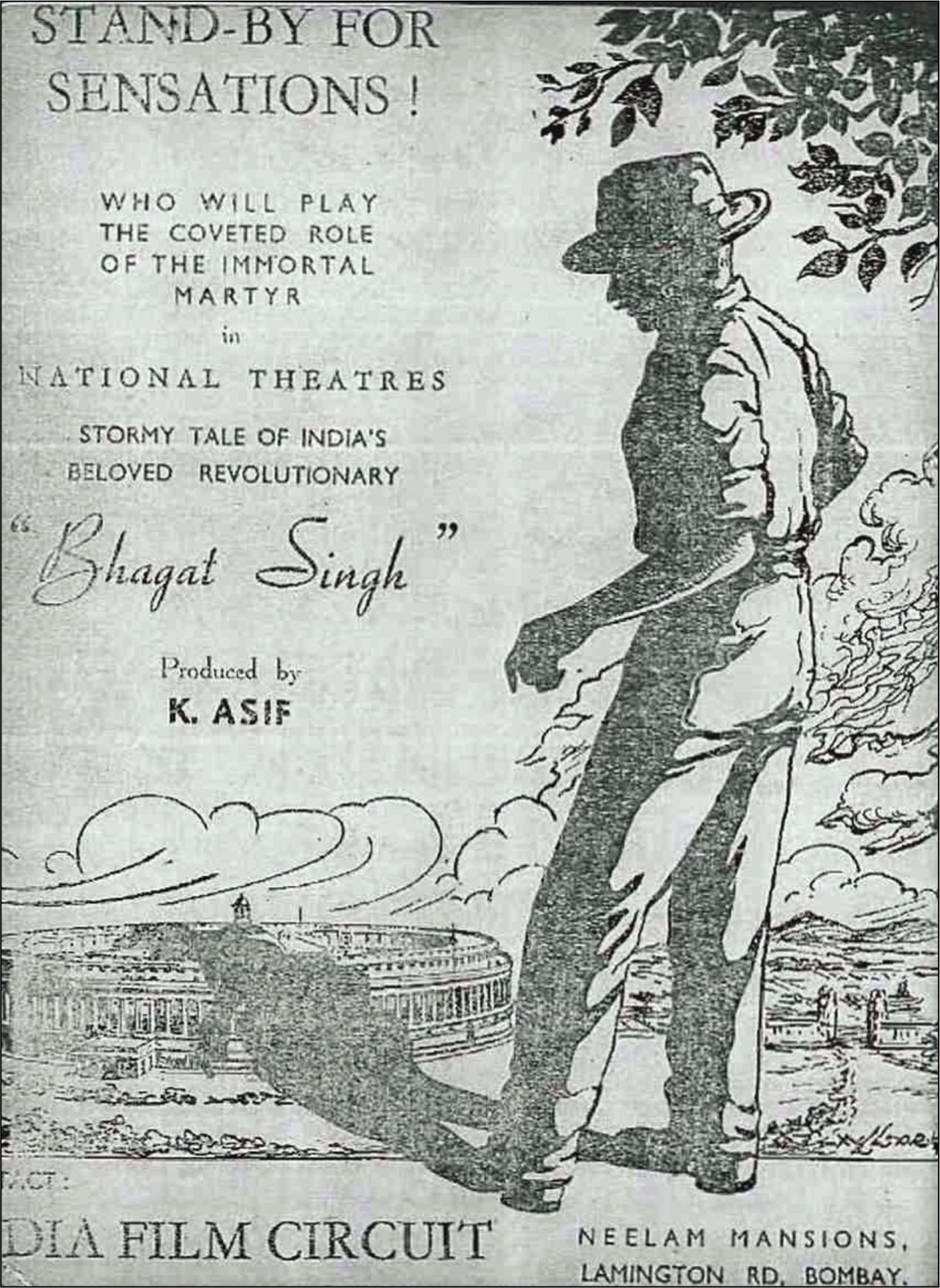
Interestingly, nothing was heard of this venture thereafter. In the absence of factual details, one can only speculate on the reasons behind the shelving of this project. Perhaps, it was stalled by the hostility whipped up by Baburao Patel, the editor of filmindia magazine, who had a formidable reputation as a self-appointed conscience-keeper of the Bombay film industry, in his editorials against biographical films especially those on ‘national heroes’ (Patel, April 1948, pp. 3–5). Around this time, the communists had also come under fire from the postcolonial state because of their stance on Indian freedom which they had declared to be ‘fake’ (Chandra et al., 2008, p. 258). 8 The aesthetics of K. Asif – K. A. Abbas’s film advertisements make ample sense in this light. The Communist Party of India had even given calls for ‘immediate armed uprising’ and ‘indulged in several terrorist acts’ because of which it was banned in several states in 1949 (259). The Nehru government came down heavily upon the communists and imprisoned many of them, with the actor Balraj Sahni being one of them. According to Sahni (1974, p. 132), Abbas was one among the many members who left the Communist Party of India without any explanation because of the fear of the Nehru government’s repression. 9 It is around this time that Abbas was expelled from the Progressive Writers’ Association (PWA) and the IPTA ‘after being one of the three editors of the PWA journal, Naya Adab, and being the founder and General Secretary of the IPTA for several years’ (Abbas, 1977, p. 330). Two court cases were also filed against him, one by the bureaucrats against his story Sardarji and another by his own ‘communist friends for writing the preface to Ramanand Sagar’s humanist novel Aur Insan Mar Gaya (Sagar, 1977, ‘And Man Died!’) about partition riots and the inhumanity they engendered’ (Abbas, 1977, p. 330). 10 After his expulsion from PWA and IPTA, and after Sardar Jafri and Balraj Sahni were arrested, Abbas was obviously under a lot of pressure from both sides. Morarji Desai even threatened to put him and Mulk Raj Anand behind bars when they visited him to plead Jafri’s case. As he admits in his Autobiography, he had to convince even Nehru that he was not a communist (Abbas, 1977, p. 335). Writing a film on Bhagat Singh at such a time would have jeopardised Abbas’s efforts to distance himself from the communists who were in any case hostile to him. However, going by Abbas’s narration in his autobiography, it is clear that Abbas (1977, p. 42) held Bhagat Singh close to his heart. After Bhagat Singh’s arrest following the Assembly bomb incident, Abbas had ‘followed every detail of the Bhagat Singh case for I took personal and “proprietorial” interest in the phenomenally intrepid young man. He was one of us, he belonged to our generation, felt as we felt, but in daring and self-sacrifice, he had surpassed us’ (61). That K. Asif’s biopic project of the martyr was a passion project for Abbas cannot be denied and there must have been compelling reasons behind the biopic not getting made.
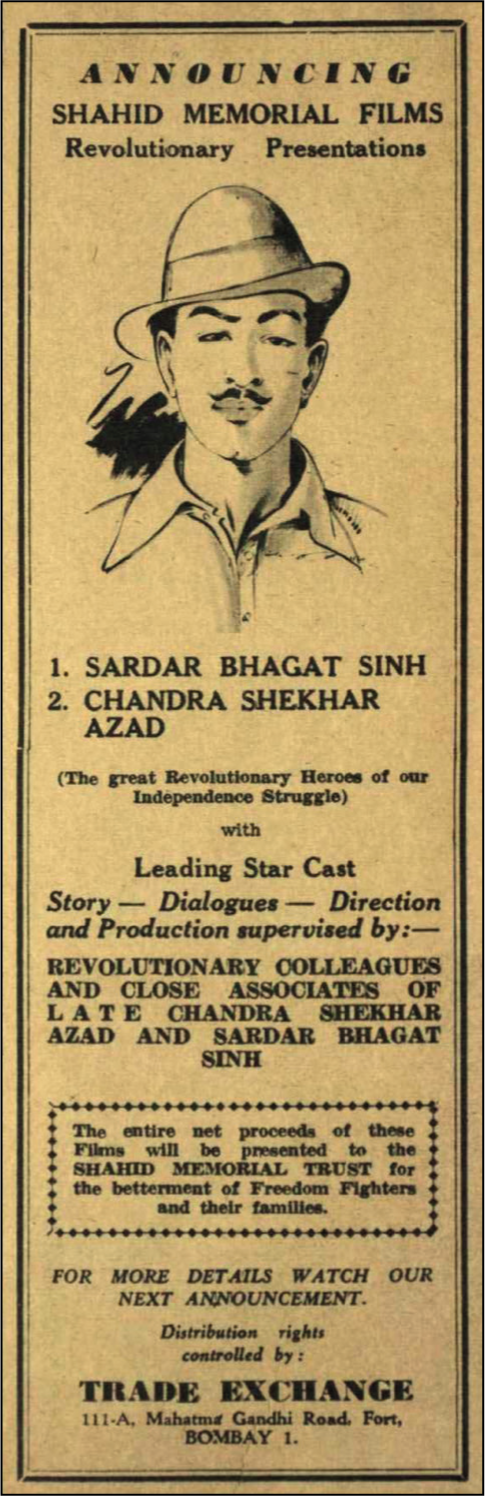
Interestingly, three years after K. Asif first announced his project, the Shahid Memorial Trust declared the making of two biopics, one titled Sardar Bhagat Sinh and another Chandra Shekhar Azad, under the banner of Shahid Memorial Films. Both organisations were instituted by Bejoy Kumar Sinha, chief editor of the Bhagat Singh Commemoration Volume (BSCV), and a revolutionary colleague and casemate of Bhagat Singh who had spent considerable time with Singh both during anti-colonial work (Sanyal, 1931) and inside jail during the Lahore Conspiracy Case trial. Sinha had escaped execution but was imprisoned till 1938 when he was released on medical grounds, and later joined the Communist Party like many of his other HSRA colleagues (Moffat, 2019, p. 154). The setting up of BSCV Editorial Board was the originary moment of the formation of Bhagat Singh’s corps. It is quite possible that the popularity of Ramesh Sehgal’s Shaheed, which portrayed the martyr as a violent revolutionary without fleshing out his ideological leanings, and the announcement of K. Asif’s biopic, instigated card-carrying communists like Bejoy Kumar Sinha to form this corps. It is obvious that this corps was assured of box-office success because the declared object of the Shahid Memorial Trust was to take care of ‘the freedom fighters and their families’ (Trade Exchange, 1952, p. 34). The announcement, which appeared in Filmfare, was again adorned by Bhagat Singh’s iconic, passport-size image in a trilby hat (Figure 2). It was declared that the films would have a ‘leading star cast’, and the story, dialogues and direction would be by the martyrs’ colleagues (Trade Exchange, 28 November 1952, p. 34). The Shahid Memorial Trust eventually signed a contract with S. Amarjit of Lovely Films for the film ‘Sardar Bhagat Singh’ in November 1952 (Movie Times, 1952, p. 2). An advertisement for this film appeared in the 19 December 1952 issue of the Movie Times, and again featured Bhagat Singh’s iconic photograph in trilby accompanied by sketches referring to the bombing of the assembly building. 11 The similarity between this poster and K. Asif’s filmindia March 1949 poster discussed before is unmistakable. This new film was to be directed by Niranjan based on the story written jointly by Kulbir Singh, the younger brother of Bhagat Singh, and Sinha who had the responsibility of fleshing out Bhagat Singh’s political life. Balraj Sahni was to write the dialogues and also play the lead role, possibly of Bhagat Singh, alongside Geeta Bali, a leading actress of the times, who possibly was essaying the role of Durga Bhabhi. 12 Except for the similarity in posters, it does not look like this new venture had anything to do with the one started by K. Asif. While K. A. Abbas had gone out of favour with the communists after having admitted publicly to not being one, 13 Balraj Sahni had proved his communist credentials and endeared himself to erstwhile revolutionaries by opting to go to jail even while working in the film. This likely explains his choice by the filmmakers both as the hero and the dialogue writer for a film on Bhagat Singh.
Shaheed-e-Azam Bhagat Singh (1954), the First Biopic on the Revolutionary Martyr and the Controversy
Before this ambitious venture of the corps could take off, two other competing film projects on the life of Bhagat Singh were hastily announced in December 1949 and January 1951.
14
One biopic titled Shaheed Bhagat Singh was being directed by Vishram Bedekar, a Marathi film director and litterateur, under the banner of his newly constituted Neeldhara Films.
15
Written by Inder Raj Anand, it was being shot by veteran cinematographer Pandurang Naik at Famous Studios (Bombay) owned by Baburao Pai (Bedekar, 1984, p. 277).
16
The other, titled Shaheed-e-Azam Bhagat Singh (SABS henceforth), which is the focus of the remaining part of this article, was spearheaded by director Jagdish Gautam who had also written it. Both these films went into production in early 1953, with the latter at the Bombay Talkies’ studio at Malad and then at the Jagriti Studios, Chembur. Shot at Bombay’s best-equipped film studios, the announcement of these films appears to have stopped Shahid Memorial Films in their tracks. Bejoy Kumar Sinha shot an urgent letter of protest titled ‘Biographical Films on National Heroes’ to the then Information and Broadcasting Minister, B. V. Keskar, on 29 January 1953. Along with it was appended a resolution that the BSCV Editorial Board had adopted at an urgent meeting held on 23 January 1953 in Kanpur. This resolution started off a chain of exchanges between different interested parties and set the terms of discourse which would keep the I&B ministry and the Censor Board’s offices abuzz for almost two years. The resolution read:
The … Editorial Board … draws the Information Minister’s attention to the manifestation of several producers’ increasing tendency to exploit for purely commercial ends the sacred names of National heroes [emphasis added] for their so-called films of martyr’s lives. The committee particularly cites the cases of the unauthorised [emphasis added] declarations to produce in such manner screen versions of the life story of Sardar Bhagat Singh. This committee, therefore appeals to the Information Minister to check such irresponsible action, by issuing a directive, pending suitable amendment to Cinematograph Act, that for undertaking any Biographical film of recognised National heroes [emphasis added], producer will have to take prior sanction of the Government which would grant permit only when it would satisfy that the film concern proposing the venture was inspired by national purpose also [emphasis added], had based film story on authentic historical material after due research, and further was a responsible producer fit to do justice to such great national themes. (SABS File, NAI, 1953)
This resolution is revealing and alarming, both at the same time. According to them their biopic project on Bhagat Singh was a ‘sacred’ calling, whereas for others, it was driven towards ‘purely commercial ends’. What was alarming was the request to the state, a Congress-governed state at the time, to become a guarantor of ‘nationalistic’ credentials and encode rules about this in the law itself. The offer to the state was to become a part of the Bhagat Singh corps itself and become an arbiter of his corpus. Surprising as it may seem, there was a very practical angle to this resolution: if the state recognised erstwhile revolutionaries as legitimate freedom fighters, they became eligible for pension, however meagre. However, that was not to be.
That the BSCV Editorial Committee members were well-connected politically can be gauged from the fact that a few days later, the Executive Committee of the Jullundhur [now Jalandhar] District Congress Committee expressed resentment over the same issue (The Hindustan Times, 13 February 1953; The Tribune, 13 February 1953) which was reflected in a resolution passed on 12 February by the Executive Committee of the Punjab Pradesh Congress Committee. The next month, the Punjab Congress Legislative Party passed a resolution and voiced its ‘grave’ concern over the proposed ‘antinational’ venture of certain film companies. In their letter to the I&B minister – signed by 30 MLAs in all – they expressed ‘no objection to the filming of the life of the great martyr provided proper regard [was] paid to the authentic and historical facts of his life’. To them, ‘the producers who [had] undertaken [the] venture [judging] by their standard as seen in other films … won’t be able to do justice to the sacred theme’ [emphasis added]. They demanded that in such cases ‘the censors may have to ban the picture as a whole and not merely apply the scissors to odd scenes here and there’ (SABS File, NAI, 1953). That Bhagat Singh was being reclaimed as the son of the soil (his name was prefixed with ‘Sardar’ in all the resolutions) becomes amply clear from this overwhelming solidarity and outrage expressed by the Punjabi political community against predatory filmmakers. Bhagat Singh’s overwhelming and enduring folk-popular stardom ensured that if the Congress could not officially endorse the martyr, it could not ignore him either.
These objections by political representatives were given added support by an appeal published in the national daily National Herald on 18 February 1953 by the brothers of Bhagat Singh, now a part of the corps. In it, they narrated how they had started making efforts to mount a biopic on the martyr right after independence and had recently located a producer, only for their venture to be hijacked by two competing productions. ‘They are going ahead with their shooting to complete the picture somehow and release it earlier’, they wrote. Like the BSCV Editorial Board resolution quoted before, Bhagat Singh’s brothers similarly requested the government to take ownership of revolutionary histories and exhorted the censors that they should ‘totally ban pictures that failed to do full justice to the life-story of our freedom struggle’ (SABS File, NAI, 1953). The brothers also tried to discredit the competing filmmakers, terming their earlier films ‘worthless’ and ‘senseless’, and publishing a defamatory pamphlet on 6 February:
In one of these, the Director and story writer is one Mr. Jagdish Gautam who gained notoriety of late in the film world for releasing a worthless picture under [the] title Maharani Jhansi Ki while Mr. Sohrab Modi’s Jhansi Ki Rani was under production. In the second concern, Messrs Bedekar and Inder Raj are Director and Story writer, and the picture-goers have enough idea of them after having seen their latest joint film story ‘Rangeeli’ in which Miss Rehana, the heroine, is shown throughout the picture pickpocketing – as senseless film that we understand was cut and recut by the Bombay Censors before it could be considered fit for exhibition. (SABS File, NAI, 1953)
Obviously, for the government, which was already tightening its censorship regime and going two steps ahead of the colonial rulers, the proposition to include Bhagat Singh in the official pantheon of freedom fighters was unthinkable at that moment. It could not include somebody who was tainted by ‘violence’, however popular he may have been. The Nehruvian government was not at all concerned about biopics on Bhagat Singh as this popular memorialisation of the martyr, which had begun in the colonial period after his hanging, was not a threat to the Congress regime. The dominant popular had never celebrated Bhagat Singh as a Marxist, anti-bourgeois icon accompanied by communist regalia, especially hammer and sickle, but had assimilated him into the ever-widening pantheon of national leaders, as Christopher Pinney (2004) and Kama Maclean (2015) have shown, which could accommodate him along with Gandhi in one frame, all serving at the altar of Bharat Mata. Nevertheless, taking note of the objections piling up one after another, the Ministry of Information and Broadcasting wrote to the Chairman of the Central Board of Film Censors (henceforth CBFC), C. M. Agarwala, ‘suggesting’ that he bring to the notice of the film producers the resolutions and the feelings prevalent among the public on the subject. He was asked to ‘advise’ the producers ‘informally to ensure that the treatment of subject does not offend the sensibilities of the people those who hold Sardar Bhagat Singh in high regard’.
17
Similarly, the ministry also dispatched a letter to Bejoy Kumar Sinha and Vaid Ram Dial, General Secretary, Punjab Pradesh Congress Committee, on 10 March 1953 stating that:
[T]he powers of the Central Government do not extend to the production sector of the film industry. The Central Board of Film Censors can refuse to certify a film if it comes under any of the objectionable items enumerated in the Board’s Directives to its Examining Committees. But it will not be possible to reject a film merely because it is historically inaccurate [emphasis added]. (SABS File, NAI, 1953)
This official response of the government stated unequivocally that they were not interested. This governmental stance has a precedent in pre-Independence India. In 1945, after having found a film – already certified by the Censor Board – ‘historically untrue’, some members of the Censor Board had asked the government for action in this regard. The colonial government, to their dismay, replied that ‘refusal of a certificate on these grounds was beyond the powers conferred by the Cinematograph Act of 1918’ (Vasudev, 1978, p. 81).
Not content with the Government’s response, the Singh brothers wrote a letter to the Information Minister Dr Keskar (dated 3 April 1953), telling him ‘to check immediately the said producers by devising effective measures, if necessary, even outside the bounds of technical rules’. This was indeed surprising given the fact that such an incitement to the state to become even more repressive was coming from those who were staking a claim to Bhagat Singh’s anarchist legacy. They suggested the minister ‘either constitute a new body for censoring [the] film, or association with full powers, with [the] Censor Board of three eminent public leaders of Punjab, one brother and one associate of the martyr’ (SABS File, NAI, 1953). They also requested him to issue official letters to the producers in this regard. Attached to their letter was a memorandum signed by no less than 60 Punjab politicians. The government though stood firm on its previous disinterested stand. But, by and by, as the public pressure mounted, the government relented a bit. Keskar, in a meeting with the Film Federation of India in June 1953, referred to the representations related to Bhagat Singh biopics and advised the producers ‘to properly portray the lives of national heroes venerated by millions’ (SABS File, NAI, 1953).
18
In June, in a letter to the Chairman of the Central Board of Film Censors marked ‘SECRET’, the ministry of I&B maintained:
In view of the apprehensions expressed by various public bodies in the matter it is considered that it would be desirable that before a certificate is issued to such films a reference be made to the Ministry. This may be done informally [emphasis added] immediately after the Examining Committee has seen the film.… It is hoped that the departure from the normal procedure in this particular case will not be misunderstood [emphasis added] by [the] Board. (Letter, 17 June 1953 in SABS File, NAI, 1953)
It is pertinent to mark here the absence of politicians of any other party in such representations to the government. Meanwhile, it appears that the Shahid Memorial Trust stalled their filmmaking plans – we come across no publicity of their film project in popular media after December 1952 – and were focusing solely on trying to stop rival productions through governmental intervention.
Vishram Bedekar’s Shaheed Bhagat Singh disappears out of view after August 1953 when an advertisement last appears in filmindia (p. 89). But Jagdish Gautam’s Poonum Productions was still in the race to make the first biopic on Bhagat Singh. By December, he had completed post-production and submitted an application with the Censor Board for the examination of his film entitled Shaheed-e-Azam Bhagat Singh. The Examining Committee of the CBFC saw the film but waited to examine the script before making any recommendations. On the other hand, the Chairman, CBFC, wrote to the ministry: ‘I understand nothing objectionable has been found in the picturisation’ (SABS File, NAI, 1953).
19
Soon after, as the pressure from the public representatives reached another level, the I&B ministry directed the Board to get the film examined by a Special Revising Committee on 18 January 1954. Writing to the members of the Committee the Chairman said:
From a perusal of the enclosed directive you will find that historical inaccuracy is not a matter on which we can insist [emphasis added]. The Revising Committee, therefore, will have to decide whether the film is suitable for public exhibition or whether there is any ground covered by the directives which will justify not certifying it for public exhibition. (SABS File, NAI, 1953)
20
We can clearly make out that now the slant was more towards finding reasons to ‘not certify [the film] for public exhibition’. A reluctant Censor had certainly capitulated to pressure from higher-ups in the ministry. The Special Revising Committee Members
21
watched the biopic at the Films Division Auditorium in Delhi and unanimously declared ‘the picture in its present form … unsuitable for public exhibition in India’. It found the following sequences objectionable:
1) The reference to Smt. C. R. Das, 2) The whipping of Chandrasekar Azad, 3) The scenes in the High Court, 4) The lathi charge by the police in the Magistrate’s court, 5) The scenes of torturing by police, 6) The scene of the actual hanging of the three principal characters. (SABS File, NAI, 1953)
22
Many of the sequences which were found objectionable have become acceptable constituents of biopics on Bhagat Singh over time. But despite its objections, the committee was fair enough to give another chance to the producer provided he excised sequences objected to. The producer, being a shrewd businessman that he was, not only made the required excisions promptly but also held a public preview of the biopic in Bombay on 21 February 1954, for which he invited none other than Morarji Desai, the Chief Minister of the Bombay state, and managed to elicit a kind of no-objection certificate from him, which he appended with the application when submitting the new version of the film for re-certification. 23 In his certificate, Morarji Desai, true to the Congress’s official credo of non-violence, was unequivocally critical of ‘the terrorist methods employed by [Bhagat Singh and his revolutionary associates] for the attainment of their purpose [which] were neither appropriate nor desirable, however great may have been the provocation occasioned by the repressive measures of the then Government’, but lauded the revolutionaries for their ‘patriotism and courage’ (SABS File, NAI, 1953). 24 A summary of Desai’s careful endorsement was also relayed in Filmfare where he was stated to have said that ‘the trouble taken in producing this film would prove worthwhile, if those who see it are inspired by its sense of patriotism rather than by the less desirable acts of the patriots’ (Filmfare, 30 April 1954, p. 8). Desai’s public endorsement of the biopic dragged the controversy to the Indian parliament where on 23 February 1954, S. N. Majumdar, Member of the Council of States, pointedly asked the Minister of I&B, Keskar, if there was any chance that the permission to SABS could be withheld. Keskar took a disinterested stance stating that ‘as we are bound down by certain constitutional restrictions it is not possible for Government to take steps regarding the films which might be improperly produced which we would like to reform, but we are not able to do it’ (National Informatics Centre, 1954b). Here, I would argue that despite being at loggerheads with the communists at the time, who had officially declared independence ‘jhoothi’ [false], and had openly called for a violent insurrection against the Nehru government, Bhagat Singh’s folk-popular stardom was formidable enough to deter the government from banning the film. It can also be argued that these were the very first proto-efforts, however passive, by the post-colonial Indian government to accommodate Bhagat Singh as an icon by staying away from censoring any popular memorialisation of the martyr, in this case on celluloid. Ultimately, Morarji Desai’s public endorsement of the biopic, and expression of the inability to stall the film’s production because of constitutional constraints, worked and the film was finally regranted a censor certificate on 25 March 1954. 25
The controversy, however, snowballed. In a meeting of about 35 MPs, it was resolved that the picture should be previewed before its release. Another group of 40 MPs made a representation to the I&B Minister for banning such a film.
26
Sensing further trouble, Jagdish Gautam announced the date of release for the film – 9 July 1954.
27
As the date drew near, the drama around the biopic heightened.
28
The CBFC first informed Bhagat Singh’s brother – who had been assured of an opportunity to represent his case before the third Reviewing Committee – about the date of the review being 4 July, four days before the release of the film, but right after that, for unknown reasons open for speculation, in an express telegram, the date was changed to 11 July 1954 – two days after the release date. Sensing sabotage by the film producers, a desperate Kulbir Singh rushed an urgent telegram to the CBFC on 1 July and sent a letter on the same date to Keskar informing him about the unfair change in preview dates. It is perhaps because of this that the film was previewed urgently by a three-member board on 6 July itself.
29
It found the objections of Kulbir Singh ‘not valid’
30
but suggested that the
Government of India may write to the applicant [the producer] to voluntarily delete only two scenes: ‘1) the scene showing Chandrasekhar Azad robbing a postman and 2) the gruesome scene showing in silhouette three corpses hanging by the ropes, after Bhagat Singh and his two companions were hanged’.
31
In a letter meant ‘for self and colleagues’, the Chairman (CBFC) rubbished all the objections (put forward by Bhagat Singh’s brother scene-by-scene)
32
by maintaining that:
The film glorifies Bhagat Singh and his sacrifice in the cause of India’s freedom and the Reviewing Committee finds nothing to which the relations of Bhagat Singh can reasonably object. It may be that the film … is not accurate or authentic in certain details relating to Bhagat Singh’s life or in regard to his views on women and religion, but the Board cannot insist upon authenticity or accuracy of detail.… [emphasis added] There is, however, nothing in the film which is derogatory to Bhagat Singh or which ridicules his parents or family. On the other hand, the general impression created by the film is that Bhagat Singh was a hero [emphasis added] who sincerely believed in the creed of violence for achieving India’s freedom, and died as a martyr to the cause.
33
The film was finally released in Bombay on 9 July 1954. All efforts to stall the film’s release by the Shahid Memorial Fund had come to a naught. The same day, a dejected Kulbir Singh wrote one more letter to the CBFC Chairman stating resignedly:
It is wonder (sic) that how Government of India which came to exist as a result of the sacrifices of Sardar Bhagat Singh and other national martyrs failed to check [the] mutilated and distorted version of his life. [The] Nation had done a cruel injustice to its hero in return of their sacrifices. (SABS File, NAI, 1953)
Appended to the letter was a detailed scene-wise list of objections. Thanks to the censor file which contains this list we now have some idea of what the first biopic of Bhagat Singh, now presumably lost, contained. I discuss these scenes in the next section.
Meanwhile, Batukeshwar Dutt, Bhagat Singh’s casemate in the Delhi Assembly Bomb case, raised a storm in Patna after seeing the film in a local cinema. ‘I wish to express my deep resentment against the screening of the film’, so began his detailed statement against the film which was published in The Searchlight (1 September 1954), a leading semi-weekly of the region. The statement reverberated in the form of angry editorials and opinion pieces in many other journals and dailies (Pradeep, 1 September 1954; Rashtravaani, 4 September 1954; The Searchlight, 1 and 6 September 1954). The angry voices of protest against the first Bhagat Singh biopic, which were hitherto emanating mainly from Punjab, had reached Patna. Such was the uproar that no less than 41 legislators of the Bihar legislative assembly released a statement asking the government to ban the film (The Searchlight, 6 September 1954). The issue now reached the Indian parliament where P. Sundarayya showered the I&B minister with a barrage of pointed questions on 10 September (National Informatics Centre, 1954b). The result was that the government was forced to issue a strongly worded order to the producers the very same evening stating that if the specified scenes were not excised from the film prints within 30 days, it would be declared ‘an uncertified film in the whole of India’, or, in other words, the film would be banned. 34
The producer was in a legitimate dilemma – the prints of the Bhagat Singh biopic were circulating all over India, and the film was indeed doing good business. So he requested an extension of the deadline by two months. 35 With the government still considering the extension, on 4 November, the producer sent another letter to the government detailing the number of prints, and their location, and also appended a letter from a north-India distributor expressing difficulty in carrying out the order promptly. 36 The extension was finally granted on 13 November. Ultimately, after the producer managed to deposit the excised portions from all the film prints with the CBFC, except one which was in Burma, Mr. Kothari, the third Chairman of the Censor Board since the controversy had erupted, finally endorsed the original certificate of the film on 31 January 1955 and put an end to the controversy that raged strong for more than two years and played out in the public sphere as well as government files marked ‘SECRET’. 37 Thus, from the ‘NO OBJECTION’ certificate of the first Reviewing Committee to the ‘UNSUITABLE FOR EXHIBITION’ of the second (with a list of six objections) and ‘objections NOT VALID’ of the third (with two disinterested objections), the first biopic on revolutionary Bhagat Singh charted a curious graph.
The Revolutionary Martyr’s Biopic and Its Popular Reception
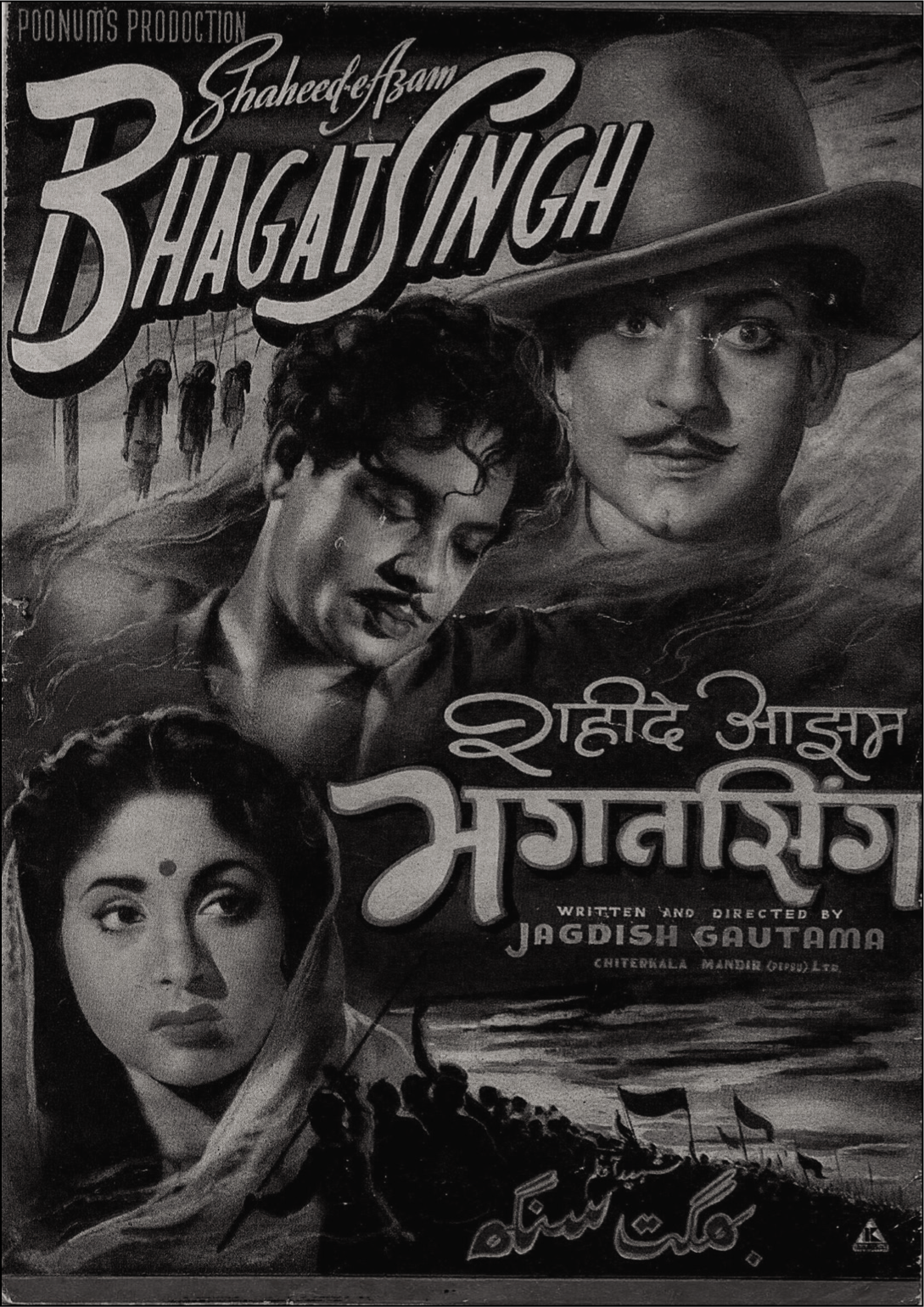
The film finally had a multi-theatre premiere in Bombay on 9 July 1954 (Figure 3). It was simultaneously released at Swastik, Palace and City Light cinemas. It ran for more than 21 weeks in prominent theatres of Bombay, ‘draw[ing] full houses’ (Times of India, ‘Bhagat Singh Draws Full Houses’, 1954b). 38 It is pertinent to point out here that if we go by a news item that appeared in The Bombay Chronicle on 26 June 1954, the film had already been released in other distribution territories in India and had ‘done outstanding business’ there (The Bombay Chronicle, ‘Bhagat Singh saga awaits release’, 1954). This is also corroborated by the film publicity where in one advertisement that appeared seven days before the film’s release in Bombay, it was declared that SABS had ‘[a]lready Proved the Greatest Box-office Smasher of this or Any Year’ (Poonum’s Production, 2 July 1954, p. 10). This is in keeping with the film distribution logic prevalent at that time wherein films were often first released in northern territories, especially Punjab, and if they proved to be successful, they fetched higher valuations with distributors elsewhere.
Despite the film’s box-office success, it was unanimously criticised by the press. The criticism that appeared in the English language national dailies and film magazines like filmindia and Filmfare was particularly scathing. The film critic with the Times of India rubbished the film saying: ‘[U]nimaginative treatment, poor direction and naïve presentation have combined to defeat the purpose of the picture…’ (Times of India, ‘Poonum’s “Bhagat Singh”’, 1954a). filmindia declared the film ‘A National Insult’. True to its reputation, filmindia went a step further and called for the film to be banned (1954). Filmfare too came heavily upon SABS in its review, declaring it ‘a depressing travesty of the thrilling truth which does little credit to the patriots it portrays’ (Filmfare, ‘Poonum’s “Shaheed e Azam Bhagat Singh”’, 1954). Despite being outrightly dismissive, one historiographical benefit that these film reviews, like the censorship file, afford us in the absence of the film text is that they provide ample details which help us to imagine what scenes and sequences constituted the film. When cobbled together with the information gleaned from the censorship documents and other filmic paratextual material like the film booklet, publicity stills and film posters, we manage to get a fairly elaborate sketch of the film. Additionally, these reviews also give us an idea of what expectations contemporary critics harboured about cinema especially when it was a biopic on the revolutionary martyr Bhagat Singh.
One of the key flaws that many critics found jarring was the film’s overreliance on dialogues. It was ‘so grossly overloaded with dialogue that it degenerates into a talking match with Bhagat Singh and Chandrashekhar ranting right through it from beginning to end’ (Times of India, ‘Poonum’s “Bhagat Singh”’, 1954a). Other critics echoed this observation: ‘The script which should have been all action is over-blown with verbiage, all dialogue and shabby speeches’ (Filmfare, ‘Poonum’s “Shaheed e Azam Bhagat Singh”’, 1954) which ‘suggest[ed] neither the politics nor the history of those days’ (filmindia, 1954). From these reviews, it appears that the critics expected a biopic on Bhagat Singh to be a thriller full of ‘dramatic intensity and thrilling sense of adventure’ (Times of India, ‘Poonum’s “Bhagat Singh”’, 1954a). They were not entirely wrong. As Aparna Vaidik argues,
[t]he popular and historiographical characterisation of the revolutionaries is premised on the spectacular moments at which they came into full public view when they shot someone or dropped a bomb or undertook a heist or stood trial (Figure 4) or when the newspapers reported their arrest and hanging. (6)
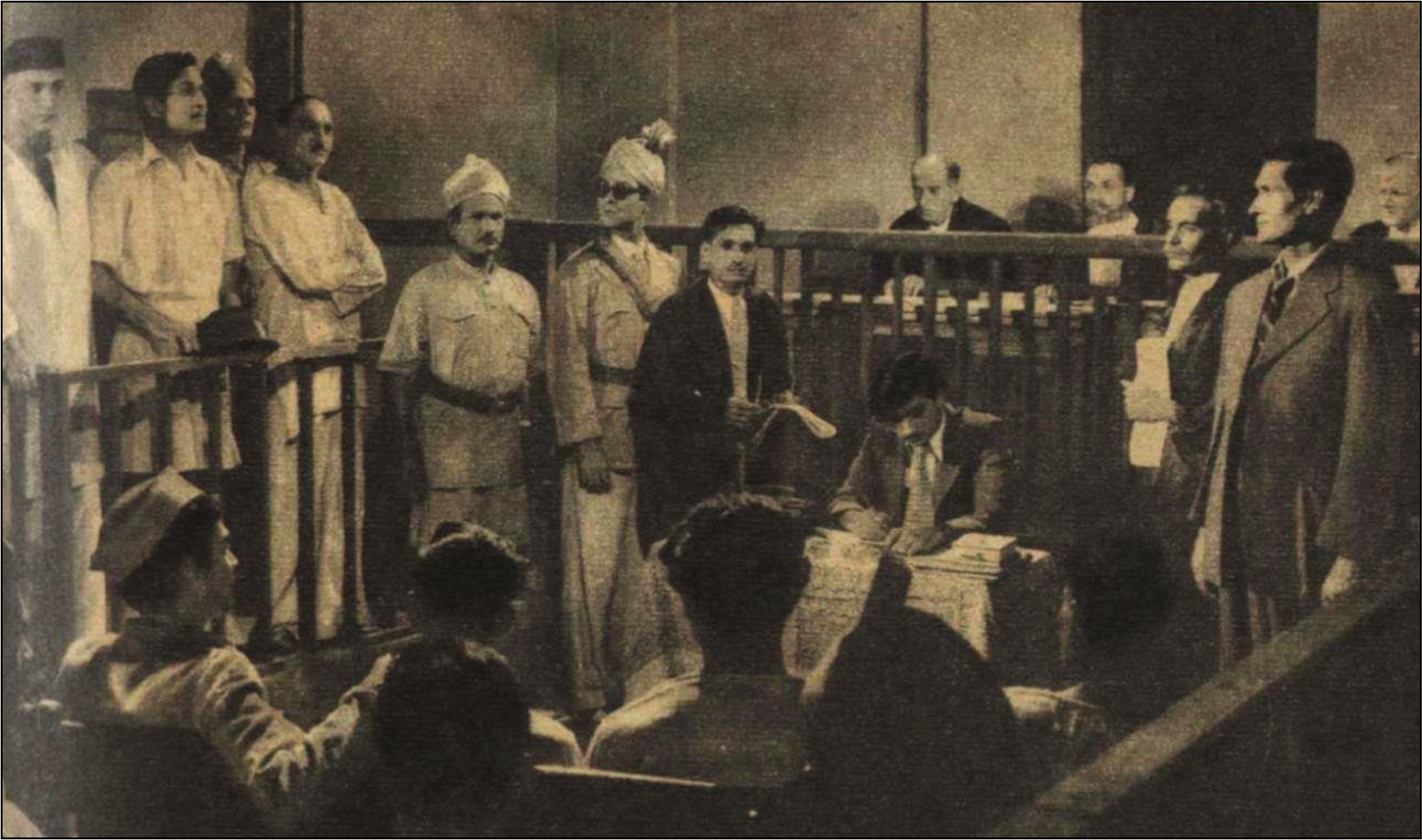
From the public’s perspective, their lives indeed ran from one thrilling event to another and signified what Avinash Kumar has termed ‘thriller nationalism’ (cited in Maclean, 2012, p. 1568). However, according to Vaidik, ‘the essence of being a revolutionary [actually lay] in the everyday conversations, banter and anecdotes, and in the stray fragments of life in the underground’ (2). By the time this biopic was made, these revolutionaries had hardly published any memoirs and whatever was published had been proscribed by the colonial government. Additionally, being out of favour with Bhagat Singh’s relatives and colleagues, the veritable corps, Jagdish Gautam had only his imagination and events popularly memorialised to rely upon. His haste had also made the filmmaker compromise with the production values of the film for which he was unanimously criticised. 39 However, the major beef these film critics had with the filmmaker was his disregard for facts, which as we know in hindsight, must not have been available in abundance at that time.
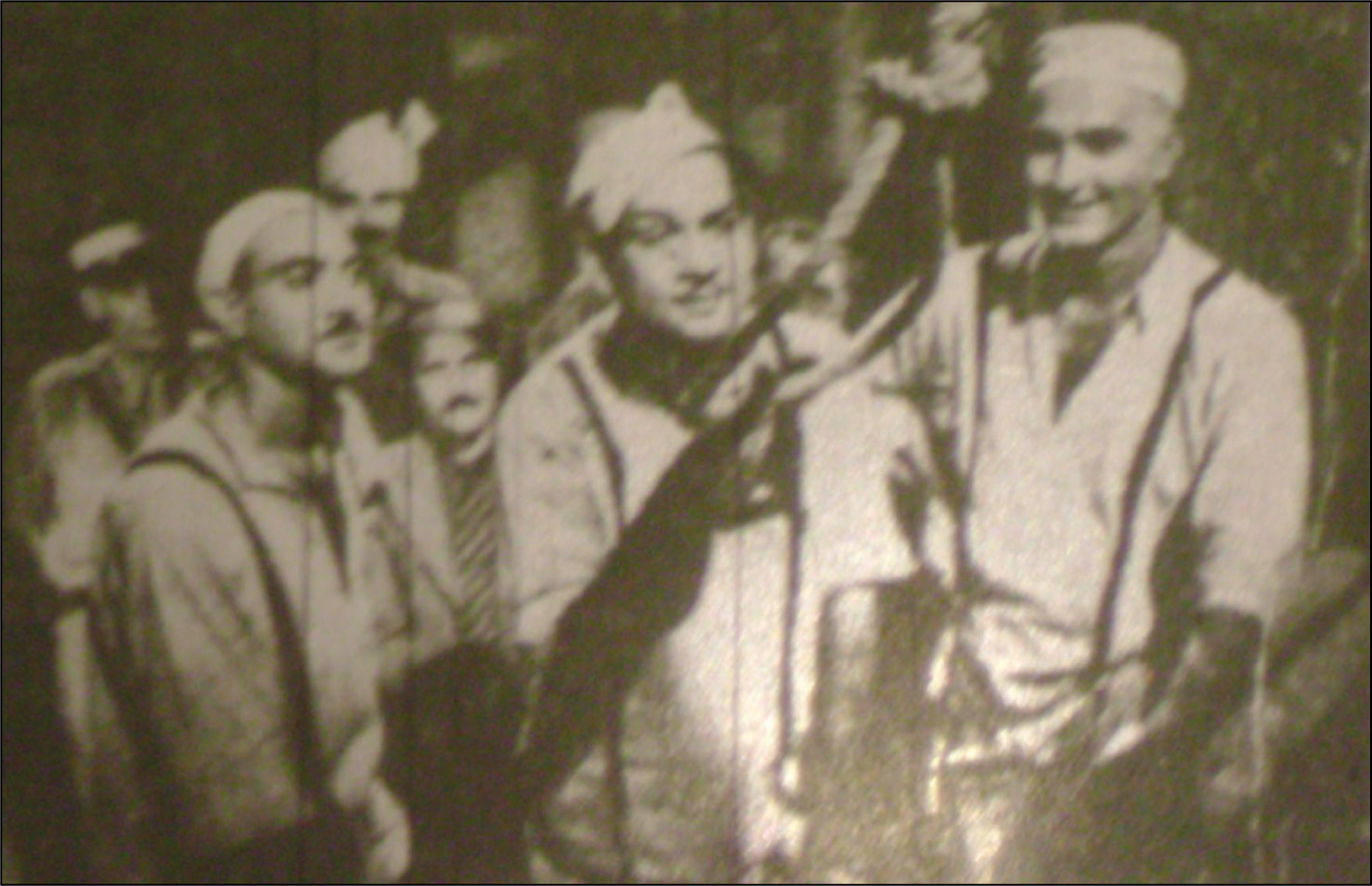
Being a predatory film made specifically for financial profit, and perhaps for historical fame for being ‘the first’, the film had five songs, including its theme song, the famous ‘Sarfroshi ki tamanna ab humare dil main hai’ written by Bismil Azimabadi and popularised by Ramprasad Bismil, which was likely sung by the character of Bhagat Singh in the film (played by Prem Adib) with his colleagues in chorus, and which would become a staple of all the future biopics on Bhagat Singh. In another sequence, Bhagat Singh is shown breaking into song right when he enters the prison. The film’s climax scene also contained a song sequence in which the trio of Bhagat Singh, Sukhdev and Rajguru is shown singing while on their way to the gallows which by virtue of ‘sheer exaggeration degenerates into maudlin melodrama’ (Times of India, ‘Poonum’s “Bhagat Singh”’, 1954a) (Figure 5). The critics were livid, alleging that this was a historically false representation of the martyr who ‘never sang [a song] in his life’ (Times of India, ‘Poonum’s “Bhagat Singh”’, 1954a).
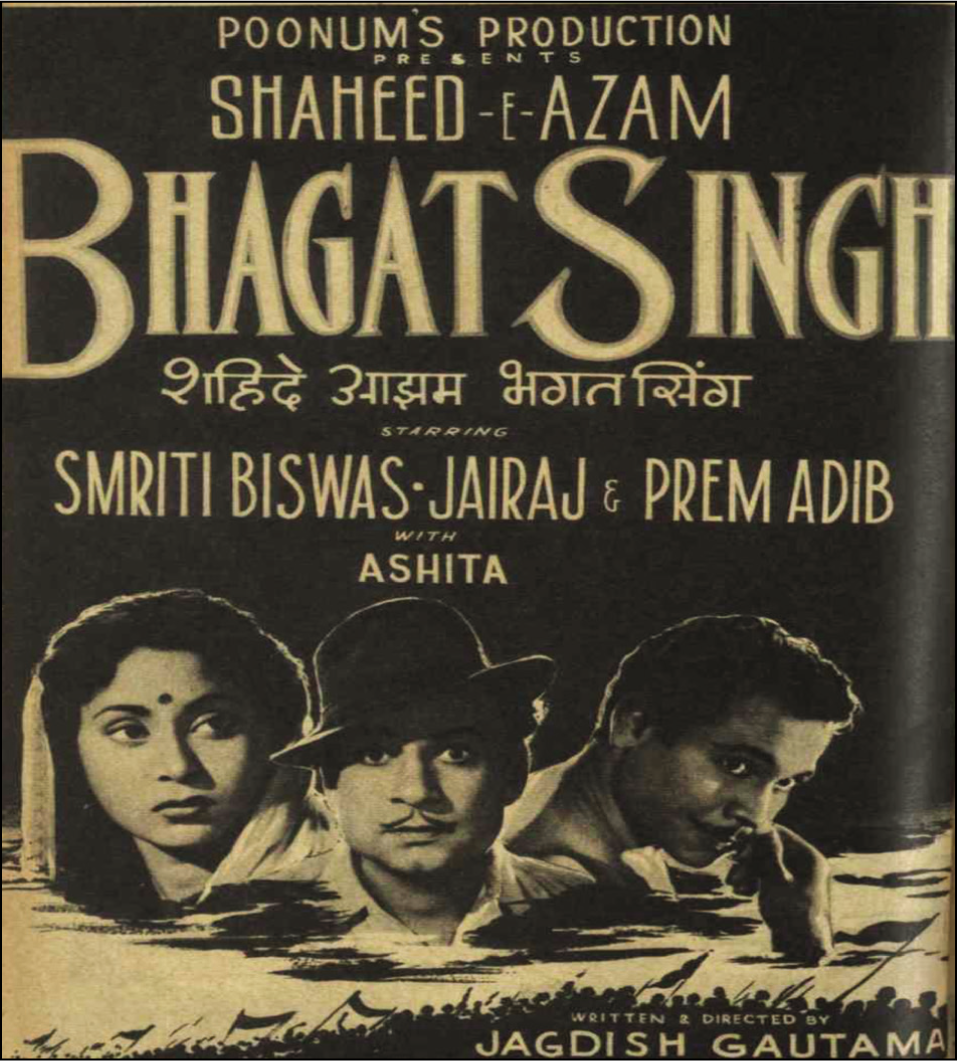
Jagdish Gautam had also included an elaborate dance sequence by ‘hip-swinger and bust-jerker’ Cuckoo (filmindia, 1954). Her dance was staged at a rich landlord’s house where Azad (played by Jairaj) goes to seek monetary help for the HSRA’s revolutionary activities. ‘Azad and his comrades have to wait and watch while Cuckoo projects her curves into the revolutionaries’ eyes. This picture disgraces the memory of some of India’s best sons’, the critic wrote (filmindia, 1954). 40 To add to critics’ misery, there was a drunken act played by the popular comedian Johnny Walker which they found praiseworthy but quite ‘ill-conceived’ (Times of India, ‘Poonum’s “Bhagat Singh”’, 1954a). It seems Gautam had left no stone unturned to make the film a popular fare which eventually paid him rich dividends at the box office. It is pertinent to point out here that Gautam did not give any space to these additions in the film’s publicity, rightly sensing public sentiments. Instead, he had made it a point to insert in almost all SABS publicity posters the images, in silhouette, of three corpses hanging on the gallows, symbolically summoning audiences’ patriotism and duty towards the martyrs. According to Chris Moffat (2016, p. 147), ‘[i]t is this dazzling “last scene” [of Bhagat Singh’s sacrifice] that transforms the revolutionary into amar shaheed, a transformation not owned by any party and appealing far beyond the bounds of the Indian left…’ thus opening his legacy to be claimed even by filmmakers like Jagdish Gautam. The filmmaker was also faulted for showing Azad ‘wearing all those disguises’ which, according to the critics, Azad never did. Now, though, we know better. 41 As became the norm in later Bhagat Singh biopics, SABS gave considerable weightage to the life narrative of Azad, or perhaps more, because of which, according to critics, it is he who emerged as the hero of the film. Indeed, the film had scenes showing Azad changing guises or ‘careering about in a beard on a motor-cycle rescuing satyagrahi damsels…’ (Filmfare, ‘Poonum’s “Shaheed e Azam Bhagat Singh”’, 1954). Given the fact that Azad was also given equal space on most of the film publicity posters alongside Bhagat Singh, it can be said that the filmmaker found it impossible to imagine the life-narrative of Bhagat Singh without Azad, and rightly so, given the ubiquity of such imagery in the popular as Pinney has attested (2004, p. 126) (Figure 6).
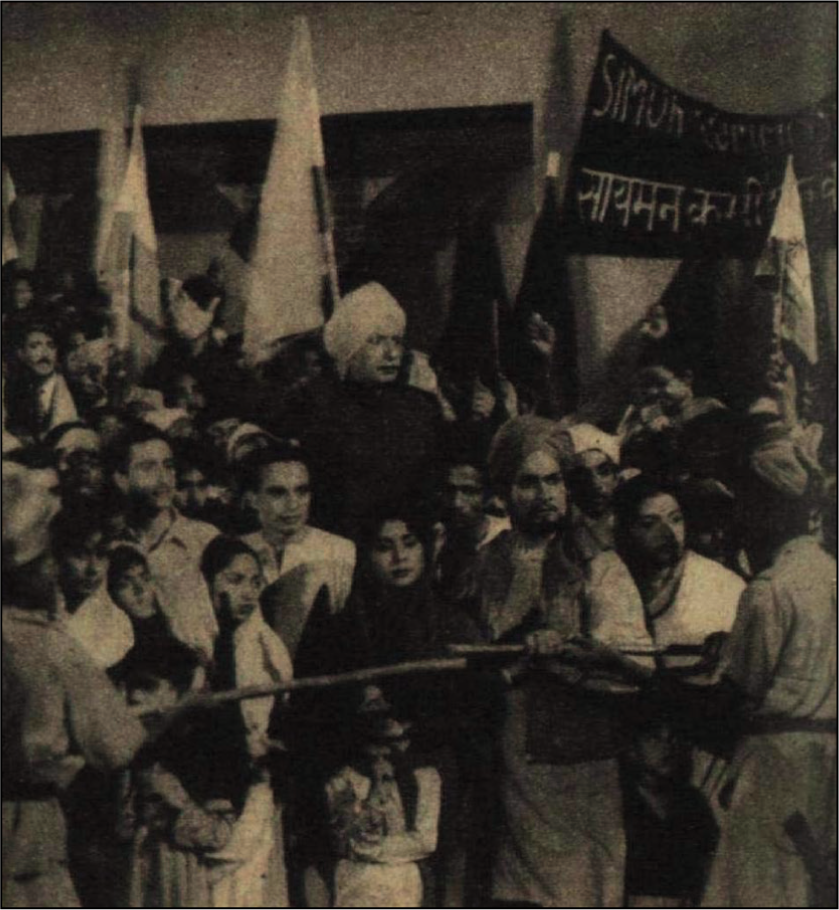
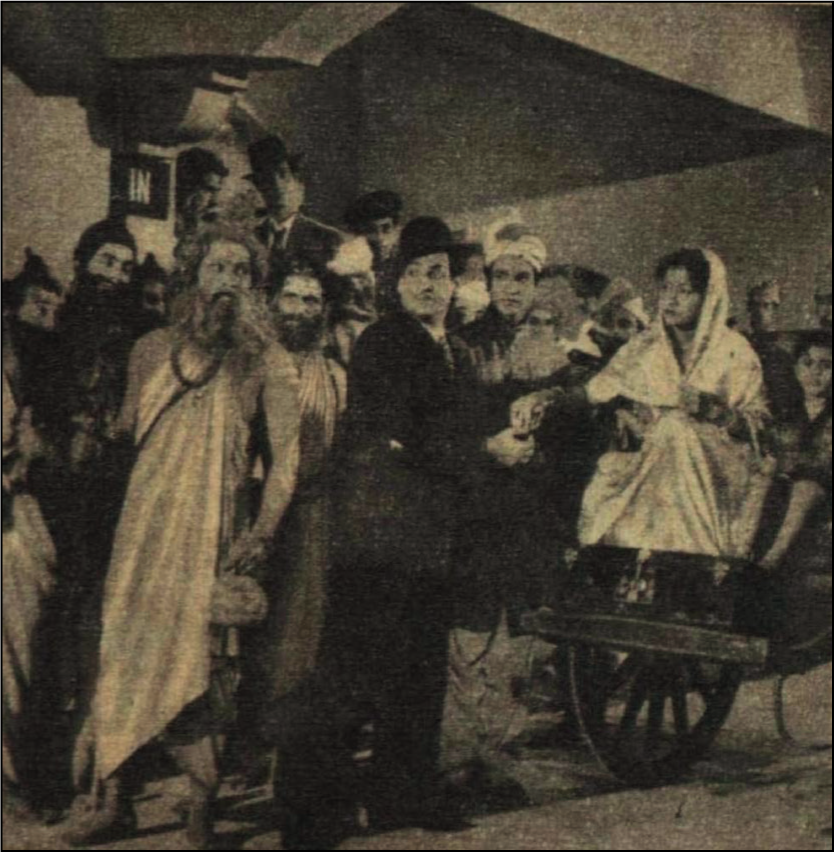
Apart from the scenes of iconic events, like the protest against the Simon Commission (Figure 7) or killing of the police officer John Saunders in retaliation of Lajpat Rai’s death, or escape from Lahore by Bhagat Singh and Azad in disguise (Figure 8) or for that matter elaborate trial sequences in the court, and the throwing of the bomb in the assembly, which found their way also into the film publicity posters, the film also contained scenes which showed revolutionaries planning their activities while in hiding. In one such scene staged in their underground den, where Bhagat Singh and his colleagues were manufacturing bombs, the character called ‘Didi’ accidentally drops a bomb while trying to place it on a shelf. What the critics found hard to digest was that everybody escaped unhurt, without any serious injuries (Times of India, ‘Poonum’s “Bhagat Singh”’, 1954a; Filmfare, ‘Poonum’s “Shaheed e Azam Bhagat Singh”’, 1954). The film also contained a chase sequence where Azad, who was being pursued by the police, is shown firing ‘his revolver backhanded at them without so much as glancing around’ (Times of India, ‘Poonum’s “Bhagat Singh”’, 1954a). Such overly critical nit-picking makes one wonder if the critics were biased owing to the general perception in the film industry about the SABS filmmaker as being a predator of film projects, and were motivated by malice to criticise the film because of the negative discourse that had been whipped up in the public sphere by the Bhagat Singh corps; or, is it that such questions regarding historical veracity were invited by the film’s genre itself – a film which was based on the life of a contemporary historical personality needed to be factually correct? According to George Custen, the use of a real name in a biopic ‘suggests an openness to historical scrutiny and an attempt to present the film as the official story of a life’, something which the corps was contesting (1992, p. 8). In terms of acting, critics panned Prem Adib, playing Bhagat Singh, for his failure to evoke any emotion because of his ‘dead pan expression’ but lauded Jairaj for putting ‘much fire and quiet zeal into a character which was a composite of both’ (Times of India, ‘Poonum’s “Bhagat Singh”’, 1954a). It will not be an overinterpretation if I were to claim that Prem Adib was too much under the spell of Bhagat Singh’s iconic photograph especially what Kama Maclean calls ‘his engaging, clear and steady stare’ (2015, p. 48). 42
Jagdish Gautam’s first film as a director, Maharani Jhansi (1952) was cited as the reason why he had no right to launch another ‘assault on history’ by making SABS (Times of India, ‘Poonum’s “Bhagat Singh”’, 1954a). When we look at the production context of Maharani Jhansi, we find that it was also a predatory project very much like SABS. Right after Sohrab Modi announced his ambitious, technicolour project Jhansi Ki Rani (1953), Jagdish Gautam, seeing an opportunity to benefit from the buzzing publicity around Modi’s film, also announced his parallel project Maharani Jhansi (1952) and managed to complete and release it before Jhansi Ki Rani which, being an ambitious project, took its own time. 43 But, despite all the controversy raked in by the corps and caustic criticisms that were hurled at the predatory film director, the first biopic on Bhagat Singh was a popular hit of its time, which is possibly also the reason for it being lost. The enthusiasm with which it was lapped up by the public is a testimony to the popularity that Bhagat Singh’s martyrdom claimed in a newly liberated (and partitioned) nation.
Shaheed Bhagat Singh, the second film that, despite entering into production in competition with SABS, had suddenly vanished was finally released almost a decade later in 1963, but without credit to Vishram Bedekar as the director. After a series of financial setbacks and production delays, both Bedekar and Kedar Nath Bansal, the key partner of Bansal Pictures, were in debt and embroiled in a legal dispute with each other. In the end, Bedekar severed his ties with the Bhagat Singh biopic project and shut his film company.
44
Kedar Nath Bansal completed the small, remaining portion of Shaheed Bhagat Singh around a decade later by using body doubles of the martyrs for the gallows scene interspersed with a ragbag of photos of historical personalities and various heritage monuments. He released the film in 1963, and, armed with the benefit of hindsight added a precautionary disclaimer in Hindi at the beginning:
All effort has been made in this film to present the personality and nature of Sardar Bhagat Singh in their true light but in order to make the story dramatic some changes have been made to some events in the life of this great revolutionary. Despite that a great (sic) care has been taken to ensure that the life of that great man is depicted truthfully as far as possible [translation added].
With both predatory films now released, it was clear that there was still space for another biopic on the revolutionary martyr which could undo the drawbacks that plagued these films. At last, S. Ram Sharma took pains to compile the story of Bhagat Singh’s life with the help of the martyr’s family members and Batukeshwar Dutt and made Shaheed (1965) whose popular success and governmental acceptance – it won three President of India medals in 1965 – signified Bhagat Singh’s inclusion into the official nationalist mythology of the freedom struggle, and successfully obliterated SABS from popular memory. It is not clear how much, if at all, Kulbir Singh and Kultar Singh, the protagonists of the SABS controversy, were part of this new biopic though this is what their petitions had demanded all along – embrace of Bhagat Singh’s legacy by the government. But the absence of Bejoy Kumar Sinha, the primary initiator of the original Bhagat Singh corps, in the credit sequence was loud and clear – the filmmakers did not want the communists to influence or take over the project. Batukeshwar Dutt, for them, was a safer option as unlike many of his surviving HSRA colleagues he had not joined the communist party and retired from political life after his long incarceration in the colonial prison.
Most of the criticisms that were levelled against SABS at that time can also be similarly applied to all other biopics on Bhagat Singh, the latest being the ones which were released in 2002. This brings us back to the beginning of the paper where I had mentioned how Bhagat Singh’s niece and nephew had petitioned the court against these biopics on the revolutionary martyr in the same way as their uncles, Kulbir Singh and Kultar Singh, had done way back in 1953–1954. However, there is a curious link between the two petitions: Kultar Singh. He was very wisely roped in by Rajkumar Santoshi, the director of The Legend of Bhagat Singh (2002), as one of the consultants for the film. It was his letter to Santoshi, ‘congratulating him on the film as the same had done full justice to the personality, ideas and views of Shaheed Bhagat Singh’, that was produced by the respondents in court against the petitioners. The petition was quashed, leaving the filmmakers free to release their biopics on Bhagat Singh (Paramjit Kaur and Ors. vs UoI, 2003). It had taken about half a century for Kultar Singh to finally see a biopic on his brother which, according to him, had done full justice to his memory. 45
Conclusion
It is amply clear that Bhagat Singh’s popular afterlives chart a curious graph, especially in the medium of celluloid, and his revolutionary inheritance was a contested terrain right from the time India gained independence. A corps which came into being at that moment, constituted by the martyr’s revolutionary colleagues who had joined the communist party and his family members, staked a claim to being the true inheritors of Bhagat Singh’s revolutionary legacy and contested the making of other biopics by those not vetted by them. As the example of Shaheed-e-Azam Bhagat Singh shows, production and censorship debates over political biopics even though they may ‘recycl[e] sentimental tropes of self-sacrifice and national devotion’ (Moffat, 2016, p. 157), may yet afford us unique insights into the problematic of revolutionary inheritance and spectral afterlives.
Footnotes
Acknowledgements
I am grateful to Ira Bhaskar, Ranjani Mazumdar, Richard Allen and Madhava Prasad for their valuable comments on different versions, and the BioScope reviewer and editors for their constructive comments and suggestions. All errors, however, are mine.
Declaration of Conflicting Interests
The author declared no potential conflicts of interest with respect to the research, authorship, and/or publication of this article.
Funding
The author received no financial support for the research, authorship and/or publication of this article.