




Abstract
Contemporary Tamil films are largely dependent on viewers having prior knowledge of film canon, celebrities, industry happenings and social issues in the Indian state of Tamil Nadu. Taking the form of complicated chains of intertextuality, self-reflexive moments are fundamental to the ways in which Tamil film narratives, particularly the narratives of mass hero films, are constructed. The 2019 blockbuster film Bigil (Whistle), a sports film about a male coach leading an all-women soccer team, highlights the extent to which Tamil mass hero films rely on self-reflexive techniques to uphold the portrayal of specific gendered identities. This article examines the ways in which Bigil constructs contemporary Tamil masculinity through both the narrative representation of the central character Michael and the use of cinematic techniques, which privilege and celebrate the star’s (Vijay) relationship with his fans. This article conducts a close textual analysis of key sequences in the film, including song sequences, and interactions between Michael and the women soccer players. In doing so, it unpacks the ways in which the hypermasculinity of the male protagonist fundamentally diminishes the film’s supposedly empowering storyline and the ways in which contemporary Tamil films seek to capitalise on the marketability of such narratives.
Introduction
Contemporary Tamil Cinema has grown substantially since its inception in the 1930s to feature a wide variety of genres, styles and unique self-reflexive characteristics. This self-reflexivity, and indeed self-reflexivity across India’s many industries, has been a point of interest for scholars for many years (Dickey, 2008; Gopalan, 2002; Nakassis, 2016, 2017, 2019). Contemporary Tamil films are largely contingent on viewers having prior knowledge of past films, celebrities, industry happenings and social issues in Tamil Nadu. Taking the form of complicated chains of intertextuality, self-reflexive moments open the fourth wall of the film into the theatre space, creating an ‘in-between space’ (Laine, 2007), in which meaning can be made. The 2019 blockbuster film Bigil (Whistle) highlights the constraints of contemporary Tamil hero films and the extent to which they rely on self-reflexive characteristics. Bigil’s success at the box office, divergence in genre from general masala to sports movie and attempt to push for a message that empowers women, make it an ideal candidate for investigation. This article examines the ways in which Bigil, in many ways, fails in its representation of empowered characters who are women. Instead, it invests in constructing and maintaining hegemonic Tamil masculinity, both through the narrative representation of the central character Michael, and the use of cinematic techniques which privilege and celebrate the star, Vijay. I build upon the arguments of scholars, such as M. Madhava Prasad (1999), Lalitha Gopalan (2002) and S. V. Srinivas (2009), that the specific convergence of male stars, fandom and self-reflexivity in mass hero films requires a manifold approach, which takes into account the self-reflexive techniques utilised by these films to engage audiences in an intertextual dialogue with the onscreen star. First, I discuss representations of masculinity and femininity within Tamil cinema, as well as the use of self-reflexive cinematic techniques. Following this, I briefly consider contemporary representations of masculinity alongside the self-reflexivity of Tamil cinema. I then argue that these characteristics are instrumental in reinforcing the central character of Bigil’s hypermasculinity; defined here as a highly exaggerated representation of masculinity facilitated by both physical traits and specific cinematic tropes. This emphasis on masculinity has a sizable impact on the representations of femininity in the film, significantly undercutting the agency of the female characters. It is precisely this conditional agency of the many women in this film, that substantiates the hypermasculinity of the film’s protagonist. To unpack this, I discuss Michael’s introductory sequence as well as two songs from the film, Verithanam Verithanam and Singappenney. All three of these examples shed light on the ways in which the film privileges Michael’s subjectivity over the subjectivities of the women on the soccer team. Finally, I discuss the ways in which Michael interacts with the women on the soccer team and the many ways in which Bigil situates him as the patriarchal head of the soccer team by positioning the women as part of his kin group. Here, I discuss the ways in which the positioning of Michael and the soccer players, notably Anitha and Gayathri, as part of the same kin group, diminish the lived experiences of these women. Torn between the normative production of hypermasculine heroes and the desire to branch out of the conventional masala genre into more ‘progressive’ film genres, Bigil loses much of its empowering message when it places the popular male star Vijay at the helm.
Gendered Representation in Tamil Cinema
Tamil Cinema is one of India’s larger industries, producing close to 200 films in 2019 (Naig & Poorvaja, 2019). Tamil films share many similarities with neighbouring industries (such as Telugu and Malayalam cinema), particularly in the format of popular films. These films are commonly labelled as masala films, due to the inclusion of multiple genres in a single film, much like a spice mix. According to Vasugi Kailasam (2017), common traits of a Tamil masala film include ‘a heterosexual love plot, song and dance sequences, stunt episodes, liberal doses of melodrama and a hypermasculine hero who restores justice in an amoral world’ (p. 24). The contemporary mass hero is a saviour for the masses, campaigning against corrupt government officials, gangsters, foreign investors and religiously motivated terrorists. While the narratives of these films celebrate the mass hero as a protector, his authority is also exaggerated through various self-reflexive conventions, which are particular to the masala format. Self-reflexivity within Tamil cinema, and indeed Indian Cinema more broadly, can be traced as far back as early mythological cinema, which utilised various cinematic techniques to facilitate audience worship of onscreen deities (Ram, 2008). The specific self-reflexivity within Tamil cinema can also be somewhat attributed to the use of film as a propaganda tool by various Dravidian parties within the 20th century, most notably the Dravida Munnetra Kazhagam (DMK). In these early films, repeated references to contemporary social issues, party members and political happenings aided significantly in the popularity of Dravidian parties across the state. Self-reflexivity has evolved significantly over the last few decades in keeping with Tamil cinema’s shift into the 21st century. Frequent references to prior films, celebrities, politicians or industry events, and dialogue which draw viewer attention to the fictional status of the text are commonplace in contemporary Tamil films. In the case of mass hero films, these self-reflexive techniques often combine to foreground the superhuman characteristics of many stars. As will be seen in the example of Bigil, the use of techniques such as slow motion, frontal or low camera angles, and reverse POV shots, alongside self-reflexive dialogue or narrative structures all aid in reifying the protagonist as a hypermasculine leader.
Gendered Representation in Tamil Cinema
The specific representations of gender, as represented in Bigil, fit alongside a long history of gendered roles within Tamil cinema. Popular heroes of the 1940s to 1960s such as Sivaji Ganesan and M. G. Ramachandran (MGR), played disenfranchised labourers, whose devotion to the Tamil language and culture was analogous to their masculinity. Discussing the appeal of MGR, Sara Dickey argues that his popularity was heavily influenced by his use of both physical actions, in the form of stunts, and spoken language, in the form of impassioned monologues mobilising his audiences. Dickey contends that
…he very likely understood the power and draw of physical bravado for viewers who were not only less learned in the arts of rhetoric but also oppressed, often through the power of words, by those who were so educated. (Dickey, 1993, p. 344)
As such, MGR’s physicality was the paramount element which bolstered the construction of the actor’s on-screen masculinity, something that aided him considerably in his career as both actor and politician. MGR’s masculinity, along with his apparent love and deep respect for the Tamil people and culture, which we see in his on-screen and off-screen activities, was the trait which aided him in being the ‘saviour of the masses’, further strengthening the link between masculinity and Tamil identity. Such archetypes are the blueprint for contemporary stars such as Vijay, the male lead of Bigil. The representation of women, however, was substantially different to that of their male counterparts. According to C. S. Lakshmi (2008), for women this often manifested in a binary of mothers and whores, two archetypes deliberately presented to curtail an appropriate mode of Tamil femininity. In this restrictive mode of representation, the good women were ‘chaste, intelligent, motherly and divine’, quintessential characteristics of the ideal Tamil women (Lakshmi, 2008, p. 16). Despite their opposition, these two modes of feminine representation ultimately reified the male hero’s Tamilness and masculinity. In recent years there have been some changes to the model of feminine representation on screen, helped in part by the increased popularity of female stars such as Nayanthara. Nayanthara is a key example of how the cinematic conventions, which reify mass heroes, can be applied to non-masculine figures to similar effects. In such cases, female stars may perform physical feats or reject traditionally feminine traits in order to boost their onscreen capital. However, as this article focuses primarily on Bigil and the way in which it foregrounds the star Vijay, I will focus mainly on the normative construction of masculinity in the film as inherently powerful and paternalistic.
Contemporary Tamil Masculinity
The masculinity of contemporary Tamil heroes such as Vijay, Rajinikanth, Dhanush, Ajith and Sivakarthikeyan, is similarly contingent on their Tamil identity. Many of these heroes are portrayed as hypermasculine on screen, an exaggerated form of masculinity, defined (in a Western context) by Vokey et al. (2013) as, consisting of, ‘four inter-related beliefs, namely toughness as emotional self-control, violence as manly, danger as exciting and calloused attitudes towards women and sex’ (p. 562). The traits associated with hypermasculinity that Vokey, Tefft and Tysiaczny outline are consistent with modes of hypermasculinity performed by male stars in Tamil cinema. Hypermasculinity in Indian cinema has more broadly been theorised by various authors, such as Aysha Iqbal Viswamohan and Sanchari Basu Chaudhurl (2020), Praseeda Gopinath and Pavitra Sundar (2020), Swapna Gopinath (2021), and Premalatha Karupiah (2021). These authors contend that the exaggerated masculine traits in hypermasculinity are contingent on misogyny, and the fundamental notion of male superiority. Karupiah notes that alongside the exaggeration of characteristics deemed as masculine, a key component of hypermasculinity is a ‘rejection of subjective feminine experiences’ (2021, p. 123). More specifically, hypermasculinity manifests through the repeated emphasis on the protagonist’s nativity through both characterisation and physical appearance. Disdain for or inability to speak English (or Hindi), strict values surrounding family structures and gender roles, and overtly ‘Tamil’ clothing are common traits across modern mass heroes. As Selvaraj Velayutham notes, on-screen ideals surrounding masculinity are ‘epitomised by the wearing of a moustache, physical prowess, authority, sexual virility and the capacity to control women’ (2008, p. 8). Similarly, C. S. Lakshmi adds that a legitimate Tamil man must also be ‘courageous, a devoted son and a virile lover’ (Lakshmi, 1990, p. 81). This emphasis on facial hair, dark skin and the rejection of English are clear reactions against Northern Indian hegemony as well as the Western influences through both India’s colonial past and contemporary globalisation. The Tamil hero’s physicality is an emblem of his continued commitment to nativity and Tamil-ness, and contributes heavily to his hypermasculinity. While some changes have been made to this archetype over the years, the connection between hypermasculinity and Tamil identity remains relatively unchallenged. Vasugi Kailasam argues that
[i]n contexts such as Tamil Nadu where masculinity is rooted in discussions of Tamil ethnic identity, it is not achieved independently. Rather, it is measured in relation to the masculinity of others, to shifting ideas of femininity and patriarchy while at the same time existing within different modalities of class and caste. (Kailasam, 2021, p. 90)
As will be discussed in relation to the case study of Bigil, the mass hero’s masculinity is reinforced by the various models of femininity surrounding him, and often takes precedence over other aspects of the film. Logical inconsistencies, plot holes and gratuitous violence are some of the inclusions which assist in reinforcing the protagonist as a saviour, particularly where female characters are concerned. Mass hero films like Bigil also dedicate vast amounts of screen time to the construction and emphasis of the hero through self-aware references, and the use of the aesthetics of frontality, which invite audiences to partake in dialogue with the film.
Self-reflexive Characteristics in Contemporary Tamil Cinema
The self-reflexive characteristics most commonly present themselves in Tamil cinema in the following ways: (1) intertextual references to other films or literature; (2) extratextual references to celebrities, politicians or real-world events; (3) metafictional references within the film, which alert viewers to the fictional status of the text; (4) possibly the most well-known, and certainly most theorised, characteristic of Indian cinema, semi-diegetic song sequences which operate outside the conventional world of the film (Dickey, 2009; Nakassis & Dean, 2007; Nakassis & Weidman, 2018); and finally, (5) sequences which engage with spatiality, frontality and temporality, stopping, slowing or redirecting film time to allow for audiences in the viewing space to respond to the film in various ways. Nakassis notes that
[t]extual features of mass-hero films [include] punch dialogues, stylish fashion, ‘signature’ dance steps, and other tropes of ‘heroism’; these films’ intertextual references and compulsive reflexivity; their formulaic narrative arcs and character types–these are all defined by the fact of their repeatability, their citability, their potential to be detached and reanimated elsewhere. (Nakassis, 2016, p. 218)
The inclusion of these self-reflexive moments not only rewards loyal Tamil cinema fans with references which engage their knowledge of past films and popular culture but also allow for direct audience engagement with the film’s content during the film’s runtime. Bigil features many intertextual references, both to the canon of Vijay’s past films, but also to other popular hypermasculine heroes. Throughout the film the central character Michael is depicted singing a popular MGR song, referencing the reality television show Bigg Boss hosted by Kamal Hassan, and replicating Rajinikanth’s iconic move of throwing chewing gum into his mouth. The film also features seven songs, two of which are discussed in my analysis. In addition to these references, the film engages heavily with the aesthetics of frontality, notably a comedic frontal address, which often breaks the fourth wall. These self-reflexive moments give audiences familiar with Tamil films an active role in meaning-making, allowing them to draw not only from the information given to them by the film text but also from the trails of intertextuality that run deep throughout Tamil masala films. These trails of intertextuality are key to the establishment of Michael’s hypermasculinity throughout the film. In alignment with this view, my approach to Bigil situates this ‘cocreational indeterminate space’ (Singh, 2014, p. 27) as fundamental to theorising Tamil films and audiences.
Bigil (2019)
Bigil (Whistle, 2019) is a masala film directed by Atlee, starring popular actors Vijay and Nayanthara. The film follows Michael (Vijay), known amongst friends and fans as Bigil, a football player turned gangster who returns to his sporting roots to train the Tamil Nadu women’s football team. Bigil is incredibly playful with the fourth wall, deliberately utilising self-reflexive techniques to bring its leading actor, Vijay, into the theatre setting. The film’s title in itself nods towards the fan practice of whistling to celebrate the presence and power (or ‘mass’) of the hero. I split my analysis of Bigil and the ways in which it constructs the hypermasculinity of its leading man, Michael, into three components. First, I explore the way in which the introduction of Michael plays with the aesthetics of frontality to invite audiences to participate in the ‘worship’ of the hypermasculine hero. Michael’s introduction deliberately extends diegetic time, leaving space between dialogue and action for audiences to cheer, whistle and throw confetti, without missing narrative beats. The inclusion of these ‘pauses’ in diegetic time encourages the construction of mass heroes, as inherently hypermasculine. These self-reflexive invitations extend into the song sequences which occur throughout the film, the second component of my discussion of Bigil. Two song sequences in particular, Michael’s introductory song ‘Verithanam’ (Fierceness) and the supposedly empowering song ‘Singappenney (Oh Lion Woman!) directly reinforce Michael’s masculinity through both lyrics and imagery. ‘Verithanam’ directly engages with common components of theatre culture amongst Tamil audiences, further encouraging fan activity within the theatre space. ‘Singappenney’s’ signification works more on a narrative level, imbuing the female-centric narrative with a sense of legitimacy through positioning the privileged Michael as a bestower of respect. The common theme across all of Bigil’s engagement with self-reflexivity is the reinforcement of Michael’s masculinity and the subsequent cementing of both normative masculinity and femininity. The final component of my reading of Bigil continues from ‘Singappenney’ and considers the characterisation of the women’s soccer team Michael is appointed to coach. Michael’s position as the only man, and the head of this team reveals much about the ideals surrounding contemporary Tamil femininity. Bigil struggles to reconcile its identity as both a masala and a sports film, favouring Michael’s superhuman abilities at the expense of the character depth, motivation and stakes required for an effective sports film. The lack of depth provided to supporting characters in Bigil, ultimately exposes the extent to which mass heroes are trapped by the need for playing hypermasculine leads. Discussing this, Nakassis suggests that the consensus amongst industry members was that the mass hero format was failing both stars and their fans. He notes
that hero-stars like Vijay were sticking to the formula but without any real content, without a good story that made sense and was emotionally gripping. Such actors were ‘trapped’ by their own image, unable to break out of the set recipe that was suffocating them and the industry as a whole. (Nakassis, 2016, p. 222)
Bigil is a prime example of the ways in which the mass hero film’s format does not allow for depth beyond the central character. As such, in my reading of Bigil, I discuss the various ways in which Michael’s hypermasculinity takes precedence over the character developments concerning the 11 players on the team and significantly undermines the film’s overall message and end credit dedication ‘to all women’ (Atlee, 2019). The way in which the film foregrounds the male star and privileges the star’s relation to fans, points towards a necessity for larger mass heroes to maintain fan loyalty through the specific performance of their onscreen selves. Here, S. V. Srinivas’s (2009) notion of ‘conditional loyalty’ is useful to consider. Srinivas notes that ‘the relationship [between star and fans] often spoken of in feudal or devotional terms […] is contingent upon the fulfilment of certain conditions’ (2009, p. 24). These conditions, an expectation for the star’s onscreen characters to perform in specific ways which may represent the political aspirations of their fans (Dickey, 1993), further explain the crisis of identity present in Bigil’s representation of Michael and the women he coaches. The exaggerated representations of Michael’s masculinity in the film’s hero introduction sequence and songs, as well as the way in which the film often references the actor’s relationship with fans, emphasise the extent to which Vijay’s onscreen identity is mediated by the conditions of fan loyalty.
Michael’s Entry: Frontality and Inter/Extratextuality as an Articulation of Masculinity
Bigil opens with a group of students protesting against their college being shut down. The politician who is responsible orders the police to beat up the students and disperse them. When the police refuse to attack peaceful protesters, he orders his own hired goons to dress up as police officers and carry out the job. The students run to a nearby slum, under the care of Michael. Michael’s hero entry is typical for the brand Vijay has built up for himself over the years. The rowdies rush in after the students, but a metal bar is lowered preventing their entry. The head gangster is held back by one of his gang members, who shakes his head forbiddingly. However, he ignores this warning and climbs over the barrier, ordering his men to follow suit. The rowdies come across a young boy who taunts them about having made the wrong choice to enter the slum:
Boy: I’ll try talking to them! If they don’t listen, then you can do a ‘mass’ entry! What’s happening lads? A fancy-dress competition? You’re all wearing PUBG outfits, they don’t suit you at all!
1
Gangster: Hey! Boy: Hey! Lower your volume, you know whose area you’re in, right? Gangster: Whose area? Boy: The CM’s area! Gangster: [sarcastically] Look at this! We would know the CM’s area. Boy: […] This is Captain Michael’s area! Gangster: Who the hell is Michael? Call him! (Atlee, 2019).
The Gangster goes to hit the young boy, but before he is able to, he is hit in the face with a firecracker. The camera cuts to the source, and we see Michael facing away from us, from the perspective of the gangster. He slowly comes into focus; his bright modern soccer jersey, paired with a faded traditional saram, is an indication that he has not lost his roots despite playing a non-traditional sport (Figure 1). This slow reveal of Michael works not only as a means of building cinematic tension but also fits within the broader tradition of hero introductions. A slow or partial reveal of the hero is highly reminiscent of traditional Hindu worship practices, in which the deity is partially or fully covered for periods of time. However, as Madhava Prasad states, ‘we must avoid assuming that the elements that go into making the performance of bhakti are in themselves embodiments of a fixed idea of religious worship’ (2013, p. 174). While there are similarities between Hindu worship practices and fan practices, this can easily be perceived as fans borrowing aspects of Hindu worship as part of their enthusiastic display of affection for the star. Instead of viewing this sequence as analogous to religious adoration, one might consider the particular way in which the film text draws on pre-existing visual and auditory motifs, such as falling flower petals, garlands, imagery of deities and the sound of the Ekkaalam horn traditionally used to welcome deities and kings, to introduce the star to viewers. In this configuration, fans anticipate the arrival of the hero, attempting to catch a proper glimpse of him in his new incarnation.
Before the gangster can recover from the first attack, Michael spins another firecracker between his fingers before lighting it with a match in his mouth and throwing it towards the gang. The camera follows from behind the cracker, as it travels in slow motion through the air, finally hitting the gangster in the face. Michael spins around, smirking and delivers his first line in the film: ‘Happy Deepavali Nanba! [friend]’ (Atlee, 2019). It is unclear whether or not this statement is for the gangster or the audience, or indeed both, but Michael’s delivery, facing the camera, is consistent with the aesthetics of frontality. Valentina Vitali (2006) notes that sequences in cinemas such as Hollywood, the purpose of cinematography and editing is to create the impression of 360-degree space. In such cases, where audiences see the space from the viewpoint of multiple characters, ‘the spectator is imagined as absent’ (Vitali, 2006, p. 163). Conversely, Bigil and many other mass hero films employ a frontal mode of address, which includes the spectator in the scene. This technique
…can be used to fix the viewer within a strictly ordered spatial hierarchy, treating the film frame as a flat surface and allocating spaces to the characters and other diegetic elements […] [thereby allocating] the spectator in the text as an active element, a presence to whom the gesture is addressed, often emphatically. (Vitali, 2006, pp. 162–163)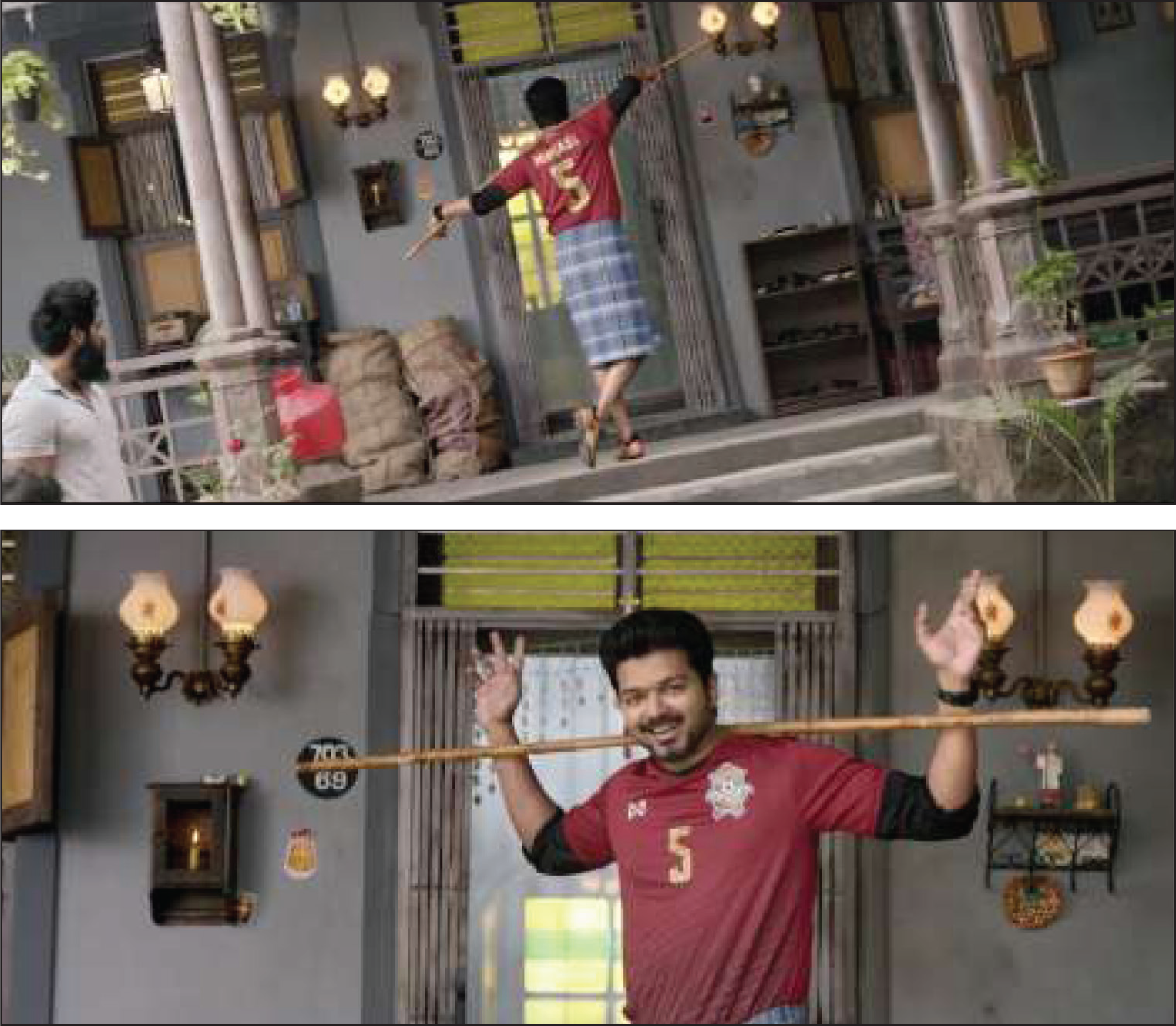
Hence, the audience is part of Michael’s address, alongside the gangsters, students and slum occupants. Michael’s holiday greeting extends beyond the film world and overflows into the theatre space creating what Nakassis (2017, p. 218) refers to as an ‘affective intimacy’ between the actor and his fans as they gaze upon the star. The inclusion of this reference to the time of year is of course a direct reference to the fact Bigil was released on Deepavali, a festival commemorating the defeat of evil by Rama, an avatar of Lord Vishnu, which is a common strategy for big hero films. This greeting also works alongside Michael’s use of the firecracker, a Deepavali tradition, as a weapon. But more than that, the reference to Deepavali highlights the transient nature of Tamil masala films. Frequent inter- and extra-textual references to popular culture, industry happenings and social issues, rely heavily on viewer awareness. While Deepavali, an annual celebration, is not likely to leave the audience’s collective memory, many of the comedic or ‘mass’ plot points, particularly those which refer to specific social or popular culture events, lose their potency over time. Similarly, the figure of Vijay is himself constructed through a series of intertextual references, which reach back into the canon of his career. Viewers may note that Vijay’s characters, for the most part, share similar characteristics, charisma and speech patterns. In this sense, these films act in an episodic manner, building the star canon of Vijay across decades, replicating popular narratives and dialogues for devoted fans. Indeed, this hero introduction, particularly the dialogue, ‘Who the hell is Michael? Call him!’ is identical to the prompting query before Vijay’s hero entry in Sivakasi (Perarasu, 2005a) and Pokkiri (2007). In Pokkiri, a gang member asks Vijay’s character the same question and he responds, ‘you are the first man in Tamil Nadu who has looked at me and asked this question’ (Prabhu Deva, 2007). This exchange is also remarkably similar to a more recent hero entry, in Jilla (Nesan, 2014) where a gangster mocks Vijay’s onscreen name before being flung across the room in a single hit. Michael takes his time dancing towards the gangsters, allowing audiences to take in his grandeur, as well as cheer and whistle. When he comes to a stop, his sidekick places a pair of sunglasses on him, stating ‘wear these, it will be gethu [cool]’ completing Vijay’s ‘mass’ image. As the first scene which introduces Michael to viewers, the scene utilises established conventions from Vijay’s previous films to emphasise Michael’s masculinity and sovereignty as the hero of the film.
Musical Masculinity in
Verithanam and Singappenney
The two song sequences chosen from Bigil, ‘Verithanam’ and ‘Singappenney’, respectively, take on masculinity and femininity as their point of focus. ‘Verithanam’ exists within the long tradition of hypermasculine hero introduction songs, which often feature lyrics that reinforce the good nature, virility and physical strength of the hero, and feature visuals of the hero surrounded by an adoring crowd, emblematic of the public he protects. The lyrics in ‘Verithanam’ vary slightly from other songs in the hero introduction tradition, in that rather than characters singing about Michael’s power and good nature, he sings about his poor community:
ஆமா அழுக்காஇருப்போம் / கருப்பா களையாஇருப்போம் / ஒண்ணா உசுராஇருப்போம் / புள்ளிங்கோ இருக்காங்கோ வேற என்ன வேணும் Yeah, we are dirty / we will be black [have dark skin] and handsome / we survive together as one / we have our kids what else could you want? (Vivek, 2019b)
These lyrics further align Michael alongside the archetypal representation of Tamil heroes as a saviour for the masses. The focus on the community in Michael’s slum assists in allying Vijay/Michael with lower-socioeconomic fans and pushing for affection between the actor and fans. Michael positions himself as the kin of the slum dwellers, certainly in lines such as ‘we survive together as one’ Michael establishes himself as a patriarch/protector of his community. This kin-like connection between the actor and his fans is often emphasised in Vijay’s hero introductions. For example, in his introductory song in Thirupaachi (Perarasu, 2005b), Vijay breaks the fourth wall by looking into the camera and sings, ‘Even though someone has given birth to me and someone else has given birth to you, you and I are (elder and younger) brothers’, explicitly establishing himself as an elder brother to his fans (Perarasu, 2004). This sequence is consistent with many other hero introduction songs. As noted by Kailasam (2021), heroes are
[o]ften pictured in the midst of large groups of people to whom the male star’s dialogues are addressed, the filmic model of the mass film proposes the mass hero as the leader who can effectively speak for the political desires and aspirations of the common people. (Kailasam, 2021, p. 86)
This notion of Michael as a leader who champions the interests of his community is symbolised on a visual level through Verithanam’s night setting and low-key lighting. These techniques make Michael the focus, he dances brightly lit by a spotlight while the masses of back-up dancers’ faces are shrouded in shadow (see Figure 2a).
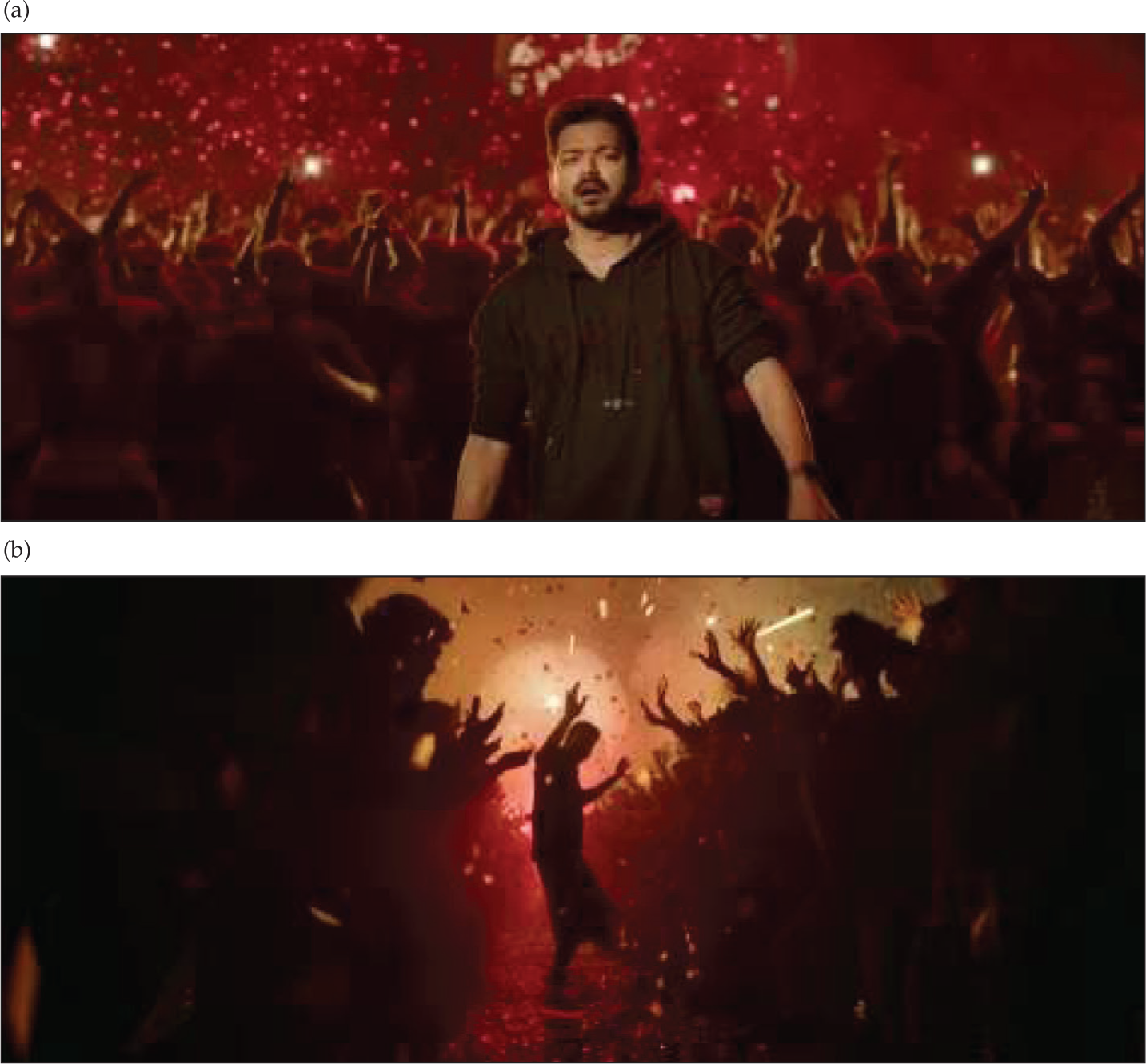
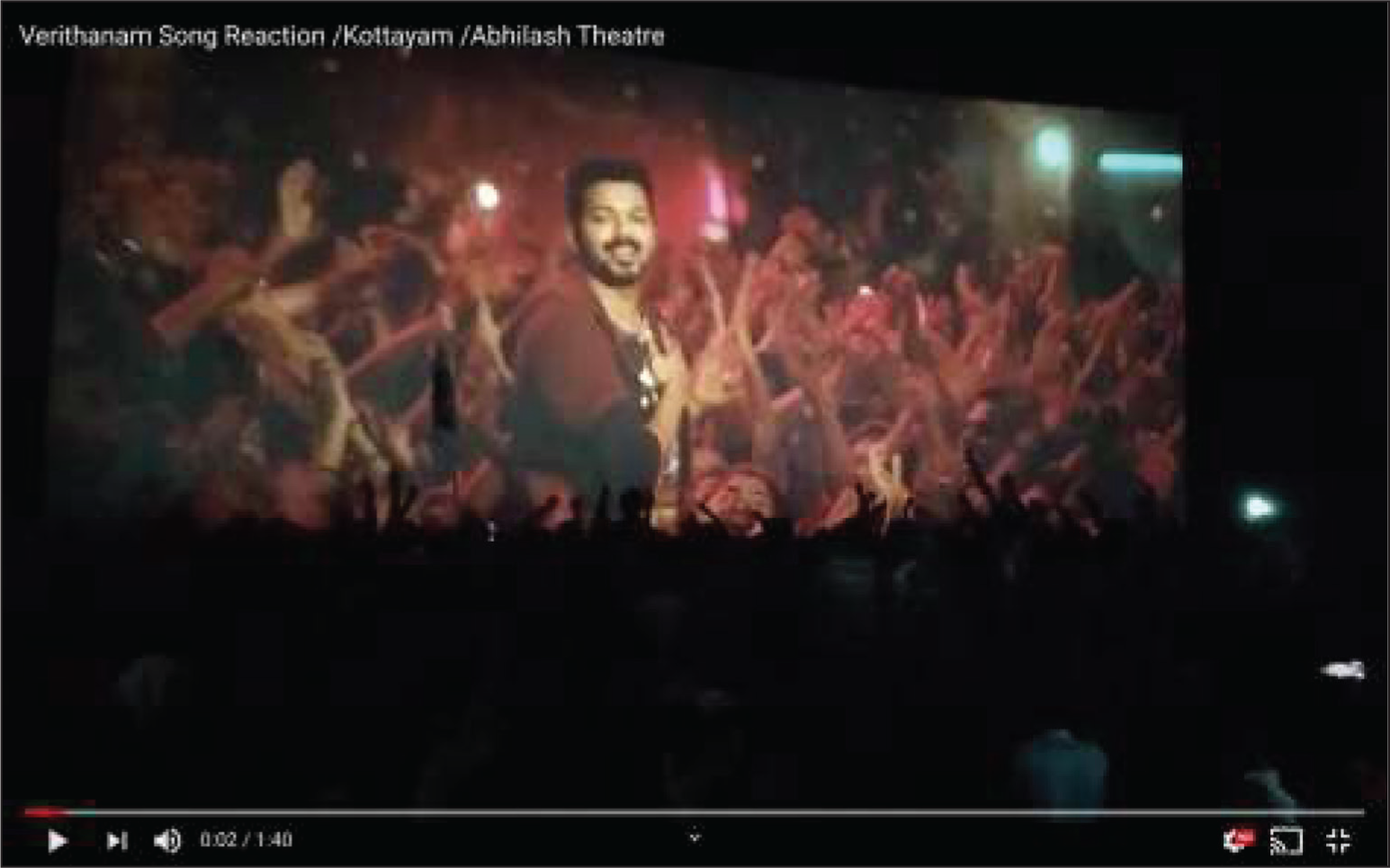
However, the sequence does more than simply highlight Michael as the protagonist; the use of backlighting emphasises the ambiguity between the space Michael occupies and the theatre space. As noted by Priya Jha (2003), the presence of a song sequence, ‘opens up moments that cannot be uttered at the diegetic level’ (p. 48). Shots in which Michael is surrounded by the silhouettes of adoring members of the slum, allow for a collapse between the diegetic space and the theatre setting. The audience in the theatre, backlit by the screen in the theatre merges seamlessly with the silhouetted crowd on screen (Figure 3). Similarly, various shots place Michael on a red carpet, walking and dancing up the aisle between cheering fans. With confetti raining down upon him, the mise-en-scène of these shots are vividly evocative of the theatre space (see Figure 2b). These evocations may initially seem to simply pay homage to the theatre space, but as evidenced in Figure 3, the deliberate use of this imagery to dissolve the fourth wall is clear. As such, one interpretation of a sequence such as this is that the film text itself is structured in a way to allow for a specific encounter between the star and spectators in the theatre space. Verithanam’s deliberate engagement with images similar to that of audiences in the theatre space is further accentuated by the changes made to the audio track in the theatrical version of the song. The release of a film’s song album several weeks prior to the film release is common practice in the Tamil film industry. The release of singles and full albums, and lyric videos work alongside the more conventional first-look posters, teasers, trailers and sometimes star interviews, as part of a film’s promotional material. Bigil’s soundtrack was released on 27 September 2019, close to a month prior to the film’s release. Accordingly, it is not unreasonable to expect that audiences may be familiar with the song lyrics prior to the film’s release and sing along in the theatre. The chorus of the original Verithanam features a single male backing vocal throughout, while in the theatrical version of Bigil this backing vocal is replaced with a chorus of voices, to emulate the crowd both around Michael and the audience in the theatre space. The visual references to the theatre space, as evidenced in Figure 3, momentarily breaks the film’s fourth wall. As such, the way in which the crowd gathers around Michael can be interpreted as a parallel to the way in which the star’s fans may gather around the star in the real world. Michael’s connection with his onscreen community and the collapse of the fourth wall as he looks into the camera thus playfully hints towards a potential non-diegetic community which also forms around the star Vijay.
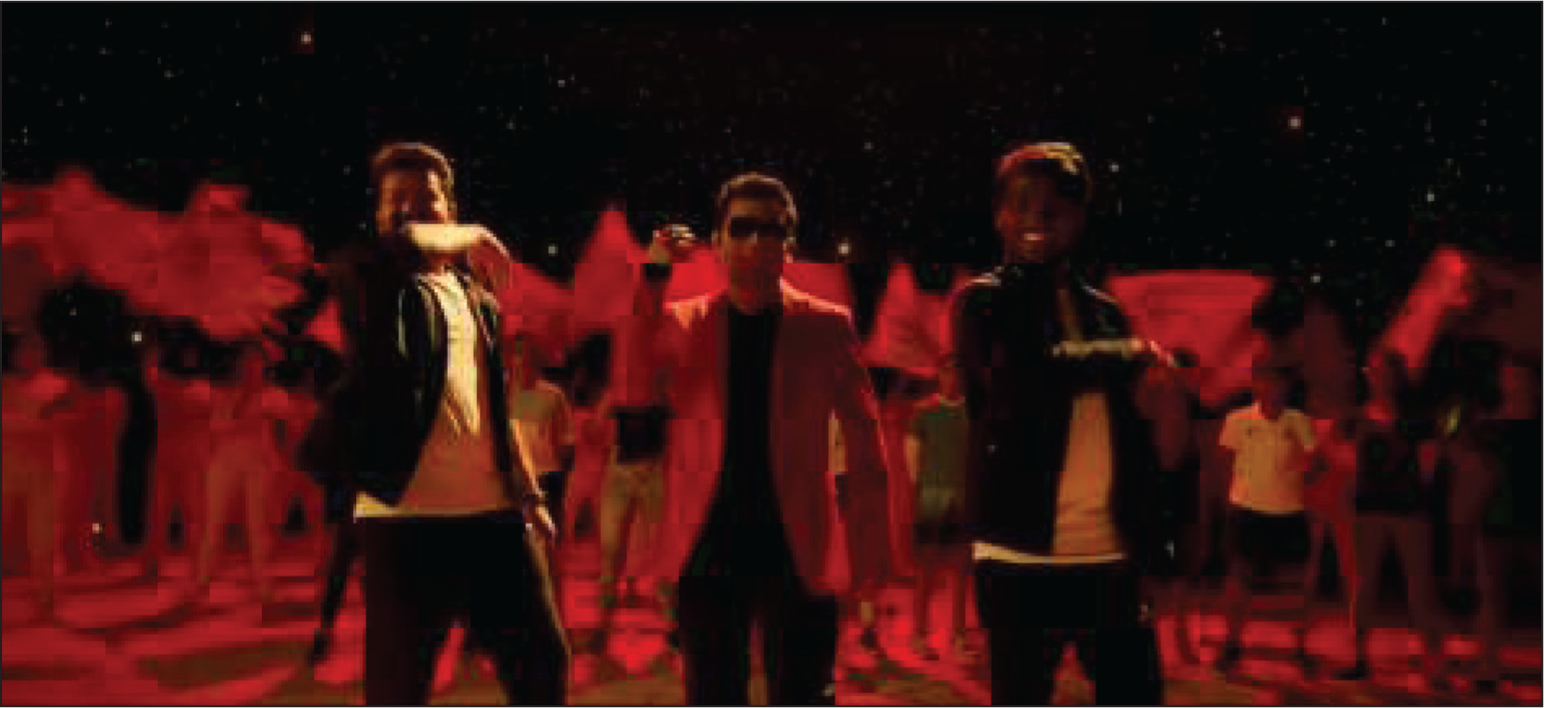
In contrast to ‘Verithanam’ (Fierceness), ‘Singapenney’ (Oh Lion Woman!) is a song intended to empower women, specifically the players of the soccer team. The song, diegetically sung by Michael (but voiced by composer A. R. Rahman) includes lines such as ‘உன்னால்முடியாதென்று / ஊரேசொல்லும்நம்பாதே’ (Don’t trust the words of the society that tells you that you cannot achieve) to encourage women to remain strong against societal oppression (Vivek, 2019a). Visually, the sequence shows Michael in a clean-cut suit standing in a red-tinged expanse, singing towards the camera, intercut with shots of the women on the team in the same setting, running, lifting weights/tires and breathing laboriously from their exercise (Figure 4). This juxtaposition is seemingly an attempt to be inspirational by pairing images of the women struggling alongside Michael’s encouragement. However, this battle against society’s oppression of women is still filtered through the respect and opinions of men, as evidenced by the song’s chorus:
சிங்கப்பெண்ணே / ஆணினமேஉன்னைவணங்குமே / நன்றிக்கடன்தீர்ப்பதற்கே / கருவிலேஉன்னைஏந்துமே Oh! Lion Woman Oh! Lion Woman / Male kind pays its respect to you / To repay our debts we would carry you in the womb. (Vivek, 2019a)
Here, the song not only emphasises the respect given to women by men but also reinforces a normative notion of ideal Tamil femininity by foregrounding womanhood within the context of motherhood. Michael expresses his gratitude to women, offering to return the key sacrifice he sees as representative of female identity. This is further emphasised in the line: ‘பிரசவத்தின்வலியைதாண்டபிறந்தஅக்னிசிறகே’ (you have the fiery wings to withstand the pain of childbirth!) (Vivek, 2019a). As such, the respect bestowed upon women by Michael is conditional, only given to, in C. S. Lakshmi’s words, ‘good women’ who conform to the role of mothers and wives (Lakshmi, 2008, p. 16). The legitimisation of ideal women, coming from Michael, further reifies men as patriarchal authorities. The song’s privileging of male subjectivity is further exhibited by the inclusion of cameos from both the music director A. R. Rahman and the film’s director Atlee as part of the sequence (Figure 5). Similar to the imagery in Verithannam, the men stand side by side in the foreground, brightly lit again, while a crowd of women darkened by shadow wave red flags in the background. These sequences, though not fully connected to the diegesis of the film, still impact heavily on the film’s plot and overall message, as well as heighten Michael’s masculinity.
Constructing Femininity in Relation to Michael’s Masculinity
As the song Singapenney demonstrates, the merit of the women in Bigil is fundamentally determined by the worth assigned to them by the central character, Michael. The construction of Michael as the hypermasculine saviour of the film circumvents any other narrative motivation. For a film with a dedication ‘to all women’, Bigil is seemingly unable to depart from the various tropes of the mass hero genre which position the leading man as all-powerful. This, in combination with its use of conventions from the sports genre, does little to assist in supporting the attempted empowerment of the female soccer players. Viridiana Lieberman (2014) argues that when it comes to female focussed sports films in Hollywood, there is little liberation to be seen. Rather, these films further propagate notions of sports culture as inherently dominated by males (p. 3). She notes that ‘[s]torylines that feature female athletes practising and working in traditionally male sports are focused on the perpetuation of hegemonic masculinity as the standard’ (Lieberman, 2014, p. 4). Bigil undeniably falls within this contradictory paradigm, as clearly portrayed in the scene in which the newly appointed Michael challenges the players on the team to a game against him. Being the hero of the film, Michael effortlessly weaves his way through the players and wins against them, despite the women supposedly being the best team in Tamil Nadu. In addition to this scene, the film devotes large stretches of screen time to Michael’s past as a player, his relationship with his father (also played by Vijay), and the romantic subplot between him and the team physiotherapist Angel, played by Nayanthara. While these plot points are fundamental to the structure of a masala film, which builds tension around the hero and his motivation, the inclusion of these tropes takes valuable screen time away from the women of the soccer team.
Bigil’s is not the first Tamil film to participate in the sports film genre. Nor is it the first film to focus on female sporting events and male trainers, with films such as Irudhi Suttru (Kongara, 2016) and Kanaa (Kamaraj, 2018) attaining somewhat significant popularity. It is however, one of the few mass hero films to include both sports and a large female ensemble cast alongside a hugely popular male star. As a point of contrast, the widely popular Hindi language film Chak De India (Amin, 2007), featuring popular actor Shahrukh Khan as Kabir Khan, an ex-player turned hockey coach, spends time establishing the internal dynamics between the central characters. Kabir Khan’s humiliation at a past hockey world cup motivates him as a character but does not overshadow the conflicts of the players he coaches, who also have their own painful pasts and prejudices towards one another. The ambivalence the female players have towards their newly appointed coach, as well as personal conflicts with each other coincide within the narrative to build tension and high stakes. For instance, the hostile relationship between players Komal and Preeti prevents the team from winning multiple games throughout the film; thus, when the pair finally reconcile and work together, there is an overwhelming sense of satisfaction for viewers watching the team’s final victory against Australia. While Bigil attempts to set up traumatic backstories for certain players, such as Gayathri (played by Varsha Bollamma) and Anitha (played by Reba Monica John), there is little correlation between these backstories and the players’ sports ability. As the film does not invest screen time in establishing the relationships players have with one another, it may become difficult for some spectators to invest in these women. The film puts forward little information as to precisely why this team is unable to win their games throughout the film, aside from the conflict between Michael and the head of the Soccer board, another man. The team’s victory at the end of the film, therefore, seems unearned, as no stakes have been established prior to this win. Bigil’s preoccupation with the representation of Michael as all-powerful, significantly undercuts the overall plot of the film.
Further to this point, even in instances where the film attempts to engage with the traumatic issues faced by the players, these problems are solved through Michael’s intervention. The agency of female players is routinely undercut by the coach throughout the movie. At one point in the film Michael mocks a player, Pandiamma played by Indraja Shankar, for her weight. In response, Pandiamma channels her aggression towards him onto the opposing team and later thanks Michael for helping her play more skilfully. In the final game, he prohibits another player from playing after learning that she is pregnant. Here, Michael establishes himself as the woman’s elder brother, much like he does with fans, stating, ‘I am not telling you this as a coach, I am saying this as your elder brother’ (Atlee, 2019). This scene in particular, points towards the continuation of familial roles established in cinema by Dravidian politics, in which the patriarch of the family, in this case Michael, the elder ‘brother’ of all the women in the team, maintains the respect of other (lesser) family members. This kinship dynamic as noted by Constantine Nakassis is common in contemporary Tamil society. Nakassis notes that particularly in relation to the perception of women, the use of terms like
‘our girls’ doesn’t only encompass actual kin, but potentially shifts and expands, maximally including ‘our’ Tamil women, scaling precisely with the ethnopolity carved out by […] Dravidian politics. (Nakassis, 2015, p. 15)
The women on the soccer team, though not his real kin, are his sisters by nature of a shared ethnic identity. Similarly, the casual violence faced by the players, and indeed according to Michael by women everywhere, is portrayed specifically through Michael’s subjectivity. Earlier in the film, we witness another instance of Michael taking on this role as ‘elder brother’. Michael, without warning, takes a player, Anitha, who was the victim of an acid attack to meet her attacker. Unprepared for this encounter, a visibly frightened, Anitha attempts to get back in the car, but Michael stops her from leaving and urges her to confront the man and states that in order to play for the team she must, ‘let go of all of this [trauma]’ (Atlee, 2019). Again, Michael positions himself as a brother to Anitha, rather than her coach. The particular violence against Anitha is used as a ploy to further cement Michael in the position of the patriarchal head. Here, the violence suffered by a woman at the hands of an incensed male stalker is somehow positioned as an act of injustice primarily through Michael’s eyes. Violence against women, particularly representations of gratuitous and sexual violence, is common in Tamil Cinema. Chinniah states that as far back as ‘the 1980s graphic violence was incorporated in the rape scenes, to assist in ‘making the female the pleasurable object’ (Chinniah, 2008, p. 35). While there is little indication that Bigil attempts to position any of the soccer players as desirable objects, it does linger pointedly on Anitha’s face as it melts under the acid. The casual violence faced by Anitha, and the pain faced by the character is fundamentally at odds with the gratuitous nature of these shots. Michael’s reaction to hearing of the attack on Anitha renders the attack, not simply as an act of violence against a woman, but as an act of violence against Michael’s kin, his sisters who follow his lead in the team. Here again, the positioning of Michael as a victim by virtue of his relation to Anitha dismisses the subjective experience of Anitha, the actual victim of the attack, in favour of the male protagonist’s own hurt feelings. A similar occurrence can be seen played out in Theri (Atlee, 2016), the first of three Vijay/Atlee collaborations. In Theri, Vijay’s character, Vijaykumar a police officer, is briefed on the brutal rape and murder of a young woman. While nothing is visually represented, the film goes into extreme detail in explaining the assault. As the description takes place the camera spins around Vijaykumar’s horrified face as tears roll down his cheeks. Here again, violence against a woman is framed entirely through the feelings of its central male character. As such Bigil’s attempt to examine a wide variety of ‘women’s issues’, from controlling husbands to acid attacks and pregnancy, is repeatedly portrayed through the perspective of Michael in order to reinforce his status as the film’s sole hero.
Conclusion
The 2019 film Bigil highlights the importance of self-reflexivity in contemporary Tamil cinema’s depictions of gender. This self-reflexivity, when utilised within the mass hero genre, acts as a means of reinforcing a specific mode of masculinity in the main character, Michael. This hypermasculinity is reinforced through specific cinematic techniques, such as frontality and slow motion, which contribute to the exaggerated portrayal of the star’s on-screen gravitas. Despite its closing dedication ‘to all women’, the film’s preoccupation with Michael’s masculinity significantly deviates from showing a complex portrayal of the struggles faced by the supporting female characters on the soccer team coached by Michael. Throughout this article, I have unpacked various instances of self-reflexivity within the film Bigil, starting with the use of the aesthetics of frontality and the opening of the fourth wall in Michael’s hero introduction, and in the song Verithanam. Verithanam utilises its unique mise-en-scène to mirror the theatre space. Such sequences playfully reference the specific engagement between fans and the star through mirroring the way in which fans might mobilise around the star figure.
In contrast to Verithanam, the song Singappenney focuses primarily on the plight of the female characters in the film. Despite this focus, the song still filters its representation of normative Tamil femininity through the subjectivity of Michael, the male coach. Various lyrics, the sequence’s mise-en-scène, which highlights Michael, and the cameo appearance of the director and music director, further relegate the feminine figures onscreen to the visual sidelines of the song. These self-reflexive moments work alongside the film’s narrative content to further establish normative gender roles. I conclude my analysis of Bigil with a closer reading of Michael’s relationship with the female soccer players on the team and the ways in which Michael routinely undercuts their agency. The casual violence faced by these women, or the restrictions placed on them are mediated primarily through Michael’s own opinions and feelings, thereby dismissing the subjective experiences of the women. By positioning himself as an elder brother, Michael not only positions himself as a victim by virtue of his relation to the women on the team, but he also aligns himself as a patriarch of a kin group widely defined by a shared Tamil identity, in much the same way he does with his fans.
The presence of self-reflexivity in popular/mass hero Tamil films has a significant impact on a film’s narrative and plays a key role in establishing the masculinity of the hero. As Bigil demonstrates, the inclusion of fan culture as part of the viewing experience shows the extent to which, despite their plotlines, Tamil mass hero films, with their overt self-reflexivity, emphasise the hypermasculinity of the film’s protagonist. In such cases, the very structure of mass films, which are inherently built around the male protagonist detracts from narratives that attempt to focus on minority characters and groups. While whether Bigil is genuinely an attempt to foreground the experiences of women remains somewhat opaque, it is evident that the film ultimately falls prey to its format, centring the experiences of its male character and dismissing the subjectivities of the many women in the film.
Footnotes
Declaration of Conflicting Interests
The author declared no potential conflicts of interest with respect to the research, authorship and/or publication of this article.
Funding
The author received no financial support for the research, authorship and/or publication of this article.