



Abstract

The term ‘bazaar’ exists in uneasy translation, as do the physical and conceptual spaces it denotes. In Hindi, Urdu and Bangla (from Persian) it means a marketplace, or the market in general; in English it connotes an exotic ‘oriental’ market or informal sale, usually for charity. Its salience to South Asian media and cultural forms bears these colonial connotations of cultural difference and informality (Jain, 2007, 2012). Here its earliest association was with ‘bazaar art’: paintings and prints for a vernacular public, notably those produced around Calcutta’s Kalighat Kali Temple from the 1820s (Guha-Thakurta, 1992). Kalighat paintings are particularly beloved to artists and scholars; featuring anti-elite or anti-Brahmin satire and themes from everyday life as well as religious icons, they had a critical edge lacking in later prints. But ‘bazaar’ also carries a much wider valence as the colonial descriptor for a vernacular realm of ‘native’ commerce, distinct from the official colonial economy. This usage has shaped the bazaar’s character as the key economic, social-political and aesthetic infrastructure for a range of vernacular forms, extending beyond paintings and prints to theatre, cinema, festivals, temples, museums, monuments, theme parks and now social media.
The distinctive character of the bazaar was enshrined in the 1882 Indian Companies Act, which placed British governance of domestic bazaar firms under Hindu and Muslim personal law rather than corporate law (Birla, 2009). The bazaar was thus designated as a realm of pre-colonial religion and ‘custom,’ even as domestic trading communities played an essential comprador role as intermediaries in the colonial economy. Perpetuating ‘customary’ forms of power, sociality and commerce in the service of colonial exploitation, the bazaar became the colonial economy’s ‘constitutive outside’ (Derrida, 1988). This paradoxical position of the bazaar, as simultaneously different from and integral to the colonial economy, explains several features of the vernacular cultural forms whose financing, production and circulation emerged from – and continue to perpetuate – the bazaar’s mercantile ethos. This is not the hegemonically bourgeois, Protestant milieu within which mass culture, mass media and their theorisations developed in Europe and North America. However, it cannot be separated from the latter either, for these are co-constituted fields with ongoing, albeit uneven, interactions. So the bazaar is not urban, secular and modern rather than rural, religious and customary. It is better understood as a site of circulation between life-worlds, spaces, epistemes and historical processes that do not disappear but are constantly remade in multilayered encounters with new forms.
The bazaar’s circulation and semi-formality are encapsulated in its promissory notes known as hundi or hawala that enabled South Asian traders since medieval times to operate over vast distances from the Silk Route and Indian Ocean to Southeast Asia. While colonial law did not recognise them as legal instruments, they came to carry official state seals and tax stamps. They thus inhabit a ‘grey’ economic zone, as do the bulk of South Asia’s industries, not least the culture industries. The obvious instance is Indian cinema, which despite producing the world’s largest number of films was only granted official industry status in 1998. Until its gradual – and still partial – integration with global media networks, Indian cinema notoriously relied on informal, if not illegal, sources of finance, from bazaar-style family businesses to transnational crime syndicates. This echoes other forms from the mid-nineteenth century onwards, like the printed icons known as ‘calendar art’ or the vernacular ‘Parsi’ theatre considered a forerunner of cinema (Hansen, 2001; Kapur, 1993). Production across these industries has primarily relied on unorganised casual labour and multiple small-scale ancillary services. Circulation and distribution have worked through similarly semi-formal networks, like the mobile seasonal agents distributing calendars (Jain, 2007; on film distribution, see Ganti, 2012). The piracy characterising post-liberalisation ‘media urbanism’ (Sundaram, 2009) therefore stems from this longer genealogy in the bazaar.
The bazaar still bears traces of pre-colonial systems of circulation of goods, credit and resources that relied on networks of trust rather than legal regulation and institutions like banks. The centrality of trust renders inoperative distinctions between commerce, kinship, religion and social and political power. The bazaar’s vernacular capitalist communities (like North India’s Marwaris and other Banias) typically keep capital within families, maintaining close caste and community ties, including through marriage. In this ethos, social standing and reputation are key to both moral and economic creditworthiness, as are the social connections that consolidate power through the brokerage of resources. Here religious patronage and charity work to shore up status, gain social mobility and maintain or grow social-commercial networks.
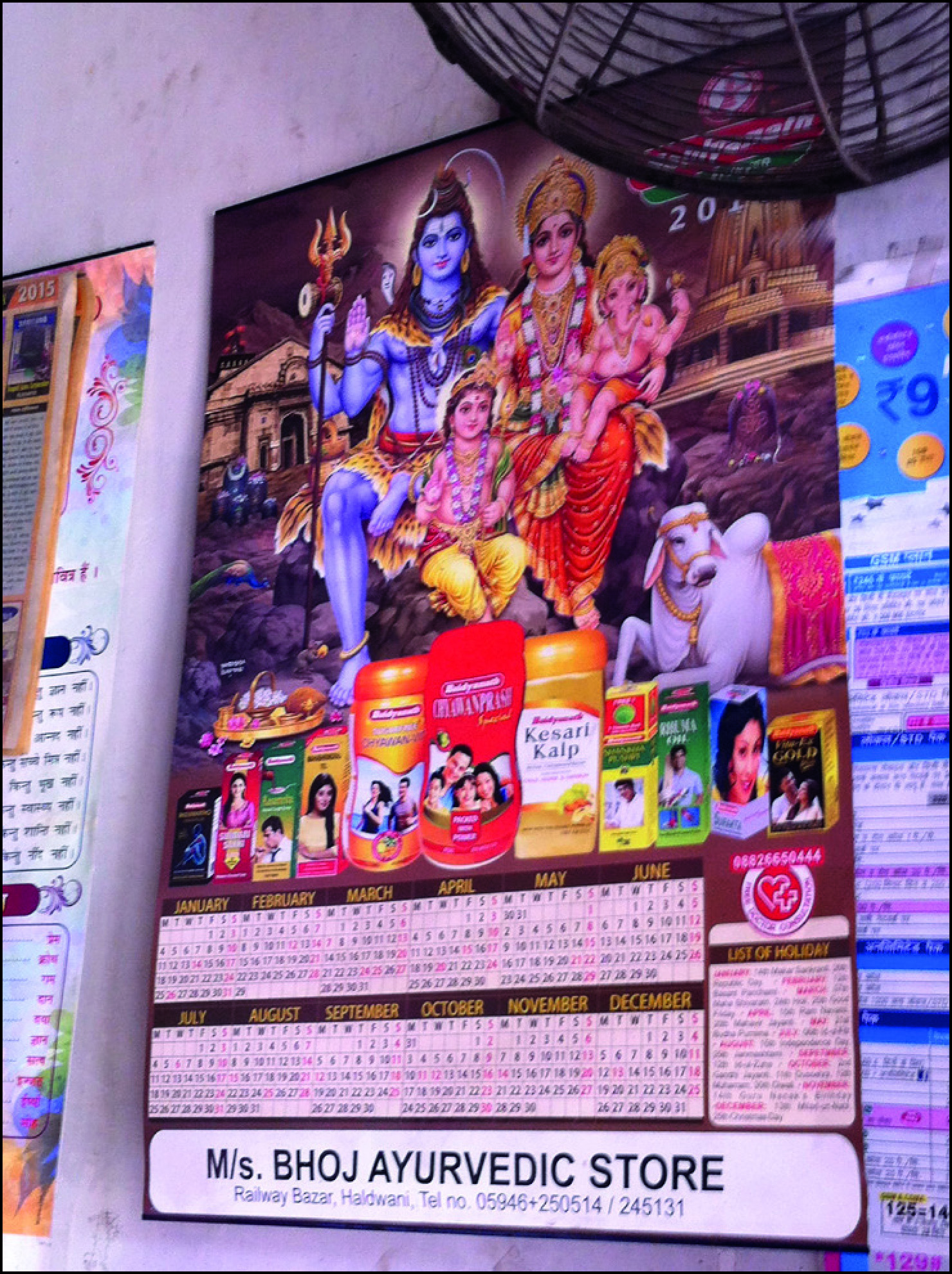
The latter has implications for the often religious or socially conservative content and political affiliations of the culture industries (bazaar traders have been a core Hindu nationalist constituency); for their circulation networks; and, since canonical iconography is central, their rampant replication and imitation. Thus business owners still distribute calendars featuring icons or pilgrimage sites to customers and associates, annually reinforcing their moral status and renewing face-to-face networks (Figure 1). Prime exemplars of religious patronage in the bazaar are the leading Indian business family the Birlas. Innovative temple and museum builders since 1939, they have also pioneered post-liberalisation forms like monumental public icons. Their much-replicated 60-ft Shiva statue in Delhi is among the precursors of a spate of giant statues, including India’s Statue of Unity (Jain, 2021). Indeed, religion has quickly and enthusiastically embraced most new media introduced into the subcontinent, from oil painting and woodblocks to vinyl banners, 3D printing and digital media. Religious invocations often preceded secular films, embedding producers in this ethos: Awaara (1951), features actor Prithviraj Kapoor seated before a lingam to the sound of a mantra (Figure 2).

The Kapoors, well into their fourth generation in cinema, are also a paradigmatic instance of kinship in the film industry (as satirised in Om Shanti Om, 2007), consistent with the bazaar in general. Arguably even the uptake of
Footnotes
Declaration of Conflicting Interests
The author declared no potential conflicts of interest with respect to the research, authorship and/or publication of this article.
Funding
The author received no financial support for the research, authorship and/or publication of this article.